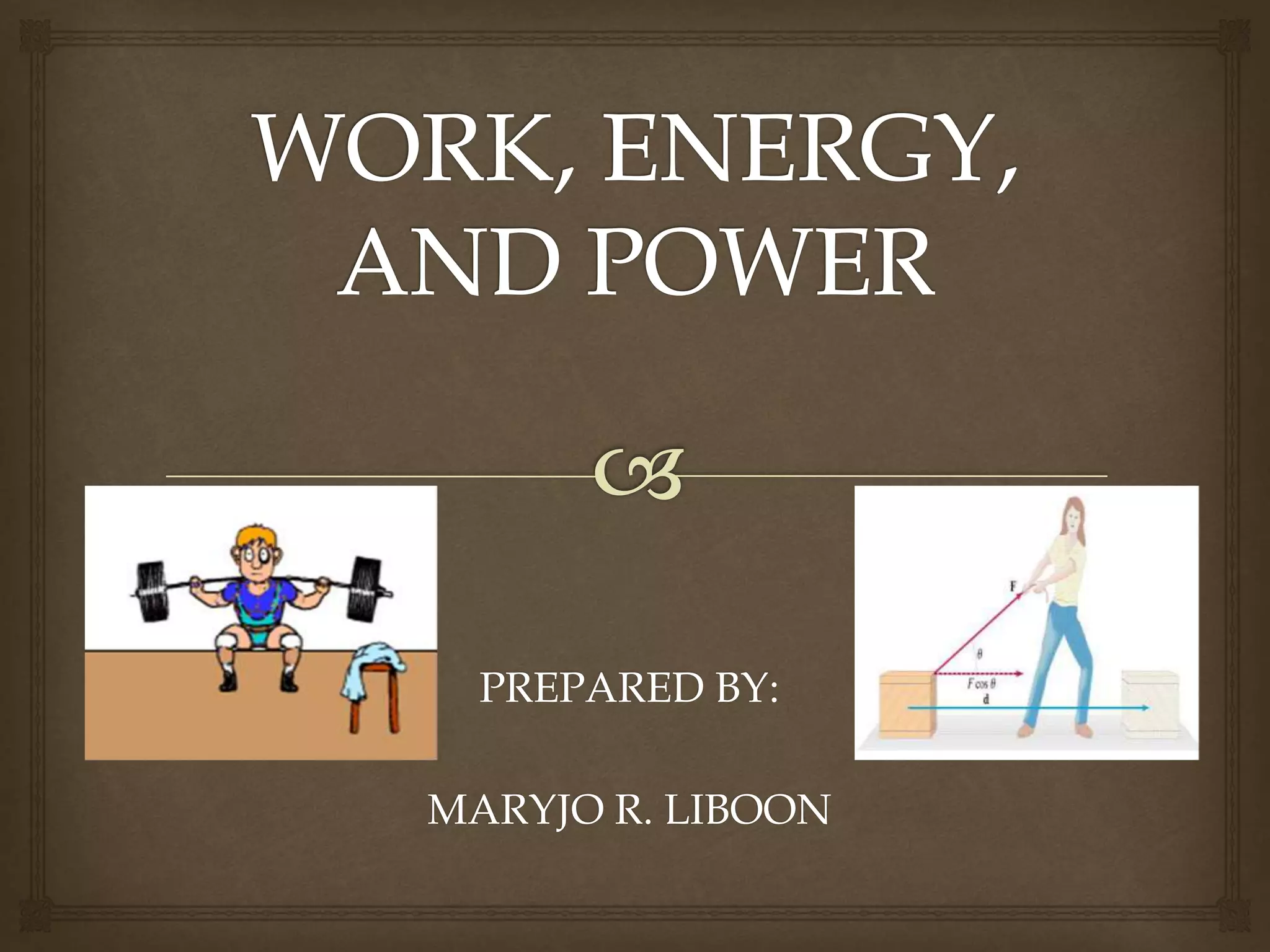
PREPARED BY:
MARYJO R. LIBOON
Identify situations in which work is
done and in which no work is done
Describe how work is related to
power and energy
Differentiate potential and kinetic
energy
Relate speed and position of object
to the amount of energy possessed
by a body
OBJECTIVES

 The product of force and displacement of an
object in the direction of force. How much
work is done depends on the distance the
object is moved.
 Work = force * distance.
 W = F x d
WORK
 The unit we use for work is joules (J),
named for James Prescott Joule.
 force and distance. Quite simply, a joule is
a Newton-meter (N*m), and one joule of
work is done when a force of 1 N is
exerted over a distance of 1 m.
 1 joule = N. m = (kg . m2/s2)
UNITS FOR WORK

 First, the object must move over some
distance in order for work to be done.
 Second, the force and the distance of
movement must be in the same direction.
 And finally, the force must be constant.
There are three important
components of work.
 How much work is our mighty weight lifter
if he steadily holds 1000 N barbell 2 meter
above his feet?
 The weight lifter holding the barbell in a
stationary position does no work, since
distance is equals zero. The force exerted
is irrelevant since the distance moved is
equals zero.
WORK OR NO WORK?
When calculating work,
only the force that is applied thus the work is often
To the direction of motion is given as W= f d cos Ꝋ
Considered.
If a force acts at an angle,
only the component of that force in a
direction of motion should be used
to calculate the work done.
Consider the direction

Calculating Work Done
A box is dragged across a floor by a
100N force directed 60o above the
horizontal. How much work does the
force do in pulling the object 8m?
F = 100N
θ = 60o
d = 8m
W = (F Cos θ) d
=(100N Cos 60o) 8m
= 100N x .5 x 8m = 400 J

Kinetic energy is energy possessed by a body by virtue
of its movement. Potential energy is the energy
possessed by a body by virtue of its position or state.
While kinetic energy of an object is relative to the state
of other objects in its environment, potential energy is
completely independent of its environment. Hence the
acceleration of an object is not evident in the movement
of one object, where other objects in the same
environment are also in motion. For example, a bullet
whizzing past a person who is standing possesses
kinetic energy, but the bullet has no kinetic energy with
respect to a train moving alongside.




 Solution:
 PE = mgh
 PE = (5kg) (9.8m/s) (0.8m)
 PE = 39.2 J

Kinetic Energy Potential Energy
Definition The energy of a body or a system with
respect to the motion of the body or of the
particles in the system.
Potential Energy is the stored energy in an
object or system because of its position or
configuration.
Relation to environment Kinetic energy of an object is relative to other
moving and stationary objects in its
immediate environment.
Potential energy is not relative to the
environment of an object.
Transferability Kinetic energy can be transferred from one
moving object to another, say, in collisions.
Potential energy cannot be transferred.
Examples Flowing water, such as when falling from a
waterfall.
Water at the top of a waterfall, before the
precipice.
SI Unit Joule (J) Joule (J)
Determining factors Speed/velocity and mass Height or distance and mass

THANK YOU FOR LISTENING !!!!!

Work, Energy, and Power

  • 1.
  • 2.
    Identify situations inwhich work is done and in which no work is done Describe how work is related to power and energy Differentiate potential and kinetic energy Relate speed and position of object to the amount of energy possessed by a body OBJECTIVES
  • 3.
      The productof force and displacement of an object in the direction of force. How much work is done depends on the distance the object is moved.  Work = force * distance.  W = F x d WORK
  • 4.
     The unitwe use for work is joules (J), named for James Prescott Joule.  force and distance. Quite simply, a joule is a Newton-meter (N*m), and one joule of work is done when a force of 1 N is exerted over a distance of 1 m.  1 joule = N. m = (kg . m2/s2) UNITS FOR WORK
  • 5.
      First, theobject must move over some distance in order for work to be done.  Second, the force and the distance of movement must be in the same direction.  And finally, the force must be constant. There are three important components of work.
  • 6.
     How muchwork is our mighty weight lifter if he steadily holds 1000 N barbell 2 meter above his feet?  The weight lifter holding the barbell in a stationary position does no work, since distance is equals zero. The force exerted is irrelevant since the distance moved is equals zero. WORK OR NO WORK?
  • 7.
    When calculating work, onlythe force that is applied thus the work is often To the direction of motion is given as W= f d cos Ꝋ Considered. If a force acts at an angle, only the component of that force in a direction of motion should be used to calculate the work done. Consider the direction
  • 8.
     Calculating Work Done Abox is dragged across a floor by a 100N force directed 60o above the horizontal. How much work does the force do in pulling the object 8m? F = 100N θ = 60o d = 8m W = (F Cos θ) d =(100N Cos 60o) 8m = 100N x .5 x 8m = 400 J
  • 9.
     Kinetic energy isenergy possessed by a body by virtue of its movement. Potential energy is the energy possessed by a body by virtue of its position or state. While kinetic energy of an object is relative to the state of other objects in its environment, potential energy is completely independent of its environment. Hence the acceleration of an object is not evident in the movement of one object, where other objects in the same environment are also in motion. For example, a bullet whizzing past a person who is standing possesses kinetic energy, but the bullet has no kinetic energy with respect to a train moving alongside.
  • 10.
  • 11.
  • 12.
  • 13.
      Solution:  PE= mgh  PE = (5kg) (9.8m/s) (0.8m)  PE = 39.2 J
  • 14.
     Kinetic Energy PotentialEnergy Definition The energy of a body or a system with respect to the motion of the body or of the particles in the system. Potential Energy is the stored energy in an object or system because of its position or configuration. Relation to environment Kinetic energy of an object is relative to other moving and stationary objects in its immediate environment. Potential energy is not relative to the environment of an object. Transferability Kinetic energy can be transferred from one moving object to another, say, in collisions. Potential energy cannot be transferred. Examples Flowing water, such as when falling from a waterfall. Water at the top of a waterfall, before the precipice. SI Unit Joule (J) Joule (J) Determining factors Speed/velocity and mass Height or distance and mass
  • 15.
     THANK YOU FORLISTENING !!!!!