Work
Work is an abstract idea related
to energy. When work is done it is
accompanied by change in energy.
When work is done by an object it
loses energy and when work is
done on an object it gains energy.
Work
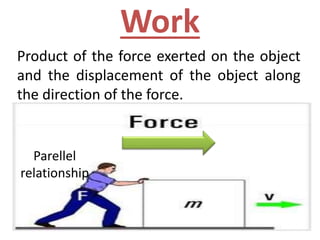
Product of the force exerted on the object
and the displacement of the object along
the direction of the force.
Parellel
relationship
For us to say that work is done,3
conditions must be met
• There must be a presence of force.
FORCE- push or a pull of an object to another.
• The object has a move a certain distance called
displacement.
DISPLACEMENT – change in object’s position.
• There must be movement in the direction of force.
Force and displacement shows a parallel
relationship with one another.
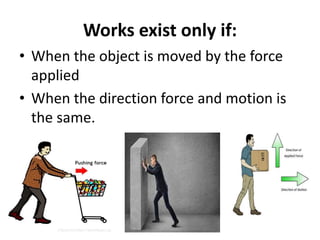
Works exist only if:
• When the object is moved by the force
applied
• When the direction force and motion is
the same.
Considered as work done
An object moves a distance in the direction of the force
• You push a heavy shopping trolley for 10m
• You lift your school bags upwards by 1m
• You push against a wall
• Jumping continuously on the spot
• Holding a chair and walking around the
classroom.
Not considered as work done
Force exerted does not make the object move
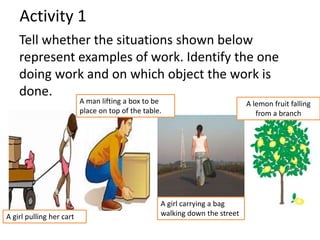
Activity 1
Tell whether the situations shown below
represent examples of work. Identify the one
doing work and on which object the work is
done.
A girl pulling her cart
A man lifting a box to be
place on top of the table.
A girl carrying a bag
walking down the street
A lemon fruit falling
from a branch
Work
W = F x d
Where:
W Work N.m or J (Joules)
F Force N (Newton)
d displacement m(meter)
Problem 1
•A person pulls a block 2m
along the horizontal surface
by a constant force 20N.
Determine the work done by
force acting on the block.
Problem 2
•A force 10N acting on a
box 1m long a horizontal
surface. The force acts at
a 30 degree angle.
Determine work done by
the force.
Problem 3
•A 3 kg object falls freely
from rest, from a height
of 2m.Determine the
work done by the force
of gravity.
Try This!
• A person pulls a crate using a force of 56N which makes
an angle of 25∘ with the horizontal. The floor is
frictionless. How much work does he do in pulling the
crate over a horizontal distance of 200m?
• You lift a book of mass 2kg at constant speed straight
upward a distance of 2m. How much work is done
during this lifting by you?
• A worker pushes a cart with a force of 45N directed at
an angle of 32∘ below the horizontal. The cart moves at
a constant speed. Find the work done by the worker as
the cart moves a straight distance of 50m
Power
• The rate of doing work
• The amount of work applied to an object
per unit of time
• Power is a scalar. The SI unit of power is
the Joule/second. The Joule/second =
Watt (abbreviated as W), named so to
pay homage to James Watt. The British
imperial unit for power is foot-pound per
second.
Power
• This unit is too small for practical
purposes, so the greater unit
horsepower (abbreviated as hp) is used.
One horsepower = 550 foot-pound per
second = 764 Watt = ¾ kilowatt.
• The amount of work can also be
expressed in power x time units, for
instance, kilowatt-hour or kWh. One
kWh refers to the work done at a
constant rate of 1 kiloWatt for one hour.
Power
Power=Work (J)
(Watt) time (s)
Power
• Based on this equation, it can be
concluded that the greater the
work rate, the greater the power.
On the other hand, the smaller the
work rate, the smaller the power.
Work rate refers to the rate at
which work is done.
Example:
• Two students are asked to transfer the teacher’s
table to a corner at a distance of 5 meters. If
their combined force is 100N and they finished
the job in 10s. What is the power output in
watts?
• A 50-kg person runs up the stairs 10 meters
high in 2 minutes. Acceleration due to gravity
(g) is 9.8 m/s2. Determine the power.
Solve Me!
• Calculate the power required of a 60-kg person
who climbs a tree 5 meters high in 10 seconds.
Acceleration due to gravity is 9.8 m/s2.
• A rotary comedy with a power of 300 watts and
period of 5 minutes rotates 5 rounds. The
energy it uses is?
• Known :
• Power (P) = 300 Watt = 300 Joule/second
• Period (T) = 5 minutes = 5 (60 seconds) = 300
seconds
• Number of rotation = 5
• Wanted: Energy used by the rotary comedy
• Solution :
Energy
• In physics, energy is the quantitative
property that must be transferred to an
object in order to perform work.
• It is the capacity/ability to do work.
• It is transferred by a force moving an object
through the distance
• Work is a method of transferring energy.
Kinetic energy
• Kinetic comes from the Greek word kinetikos
which means moving.
• A form of mechanical energy that is present in
moving objects.
• The energy on object has because of its motion.
Factors affecting kinetic energy
• The mass of an object.
• The speed of an object.
Example: Car and motorcycle
K.E = ½ mv2
K.E = mv2
2
Solve me!
• A car with a mass of 700 kg is moving with a speed of
20m/s. Calculate the kinetic energy of the car.
• A cyclist and bike have a total mass of 100 kg and a
speed of 15 m/s. Calculate the kinetic energy.
• A tennis ball is traveling at 50 m/s and has a kinetic
energy of 75 J. Calculate the mass of the tennis ball.
• How much work is done when a force of 500 N is
used to slide a heavy cabinet 1 m across the floor?
• How much work is done in lifting a 2 kg book onto a
shelf 1.5 m high?
Potential energy
• A form of mechanical energy that is
possessed by an object at rest.
• It is stored energy by an object’s due to
an object’s position and above the
ground.
• The energy gained or lost by the object is
called gravitational potential energy or
simply potential energy (PE).
Factors affecting potential energy
• The mass of an object.
• The height of an object from the ground.
P.E = mgh
m = mass
g = acceleration due to earth’s gravity
h = height of an object from the ground
Law of conservation of energy
• States that energy can neither be created nor
destroyed; rather, it can only be transformed or
transferred from one form to another.
• That system always has the same amount of
energy.
• Energy is converted into several forms.
• But the overall energy done is remain the same.

Work.pptx

  • 1.
    Work Work is anabstract idea related to energy. When work is done it is accompanied by change in energy. When work is done by an object it loses energy and when work is done on an object it gains energy.
  • 2.
    Work Product of theforce exerted on the object and the displacement of the object along the direction of the force. Parellel relationship
  • 3.
    For us tosay that work is done,3 conditions must be met • There must be a presence of force. FORCE- push or a pull of an object to another. • The object has a move a certain distance called displacement. DISPLACEMENT – change in object’s position. • There must be movement in the direction of force. Force and displacement shows a parallel relationship with one another.
  • 4.
    Works exist onlyif: • When the object is moved by the force applied • When the direction force and motion is the same.
  • 5.
    Considered as workdone An object moves a distance in the direction of the force • You push a heavy shopping trolley for 10m • You lift your school bags upwards by 1m • You push against a wall • Jumping continuously on the spot • Holding a chair and walking around the classroom. Not considered as work done Force exerted does not make the object move
  • 6.
    Activity 1 Tell whetherthe situations shown below represent examples of work. Identify the one doing work and on which object the work is done. A girl pulling her cart A man lifting a box to be place on top of the table. A girl carrying a bag walking down the street A lemon fruit falling from a branch
  • 7.
    Work W = Fx d Where: W Work N.m or J (Joules) F Force N (Newton) d displacement m(meter)
  • 8.
    Problem 1 •A personpulls a block 2m along the horizontal surface by a constant force 20N. Determine the work done by force acting on the block.
  • 9.
    Problem 2 •A force10N acting on a box 1m long a horizontal surface. The force acts at a 30 degree angle. Determine work done by the force.
  • 10.
    Problem 3 •A 3kg object falls freely from rest, from a height of 2m.Determine the work done by the force of gravity.
  • 11.
    Try This! • Aperson pulls a crate using a force of 56N which makes an angle of 25∘ with the horizontal. The floor is frictionless. How much work does he do in pulling the crate over a horizontal distance of 200m? • You lift a book of mass 2kg at constant speed straight upward a distance of 2m. How much work is done during this lifting by you? • A worker pushes a cart with a force of 45N directed at an angle of 32∘ below the horizontal. The cart moves at a constant speed. Find the work done by the worker as the cart moves a straight distance of 50m
  • 12.
    Power • The rateof doing work • The amount of work applied to an object per unit of time • Power is a scalar. The SI unit of power is the Joule/second. The Joule/second = Watt (abbreviated as W), named so to pay homage to James Watt. The British imperial unit for power is foot-pound per second.
  • 13.
    Power • This unitis too small for practical purposes, so the greater unit horsepower (abbreviated as hp) is used. One horsepower = 550 foot-pound per second = 764 Watt = ¾ kilowatt. • The amount of work can also be expressed in power x time units, for instance, kilowatt-hour or kWh. One kWh refers to the work done at a constant rate of 1 kiloWatt for one hour.
  • 14.
  • 15.
    Power • Based onthis equation, it can be concluded that the greater the work rate, the greater the power. On the other hand, the smaller the work rate, the smaller the power. Work rate refers to the rate at which work is done.
  • 16.
    Example: • Two studentsare asked to transfer the teacher’s table to a corner at a distance of 5 meters. If their combined force is 100N and they finished the job in 10s. What is the power output in watts? • A 50-kg person runs up the stairs 10 meters high in 2 minutes. Acceleration due to gravity (g) is 9.8 m/s2. Determine the power.
  • 17.
    Solve Me! • Calculatethe power required of a 60-kg person who climbs a tree 5 meters high in 10 seconds. Acceleration due to gravity is 9.8 m/s2. • A rotary comedy with a power of 300 watts and period of 5 minutes rotates 5 rounds. The energy it uses is?
  • 18.
    • Known : •Power (P) = 300 Watt = 300 Joule/second • Period (T) = 5 minutes = 5 (60 seconds) = 300 seconds • Number of rotation = 5 • Wanted: Energy used by the rotary comedy • Solution :
  • 20.
    Energy • In physics,energy is the quantitative property that must be transferred to an object in order to perform work. • It is the capacity/ability to do work. • It is transferred by a force moving an object through the distance • Work is a method of transferring energy.
  • 22.
    Kinetic energy • Kineticcomes from the Greek word kinetikos which means moving. • A form of mechanical energy that is present in moving objects. • The energy on object has because of its motion.
  • 23.
    Factors affecting kineticenergy • The mass of an object. • The speed of an object. Example: Car and motorcycle K.E = ½ mv2 K.E = mv2 2
  • 24.
    Solve me! • Acar with a mass of 700 kg is moving with a speed of 20m/s. Calculate the kinetic energy of the car. • A cyclist and bike have a total mass of 100 kg and a speed of 15 m/s. Calculate the kinetic energy. • A tennis ball is traveling at 50 m/s and has a kinetic energy of 75 J. Calculate the mass of the tennis ball. • How much work is done when a force of 500 N is used to slide a heavy cabinet 1 m across the floor? • How much work is done in lifting a 2 kg book onto a shelf 1.5 m high?
  • 25.
    Potential energy • Aform of mechanical energy that is possessed by an object at rest. • It is stored energy by an object’s due to an object’s position and above the ground. • The energy gained or lost by the object is called gravitational potential energy or simply potential energy (PE).
  • 26.
    Factors affecting potentialenergy • The mass of an object. • The height of an object from the ground. P.E = mgh m = mass g = acceleration due to earth’s gravity h = height of an object from the ground
  • 27.
    Law of conservationof energy • States that energy can neither be created nor destroyed; rather, it can only be transformed or transferred from one form to another. • That system always has the same amount of energy. • Energy is converted into several forms. • But the overall energy done is remain the same.

Editor's Notes

  • #20 What kind of energy does the boy possess?