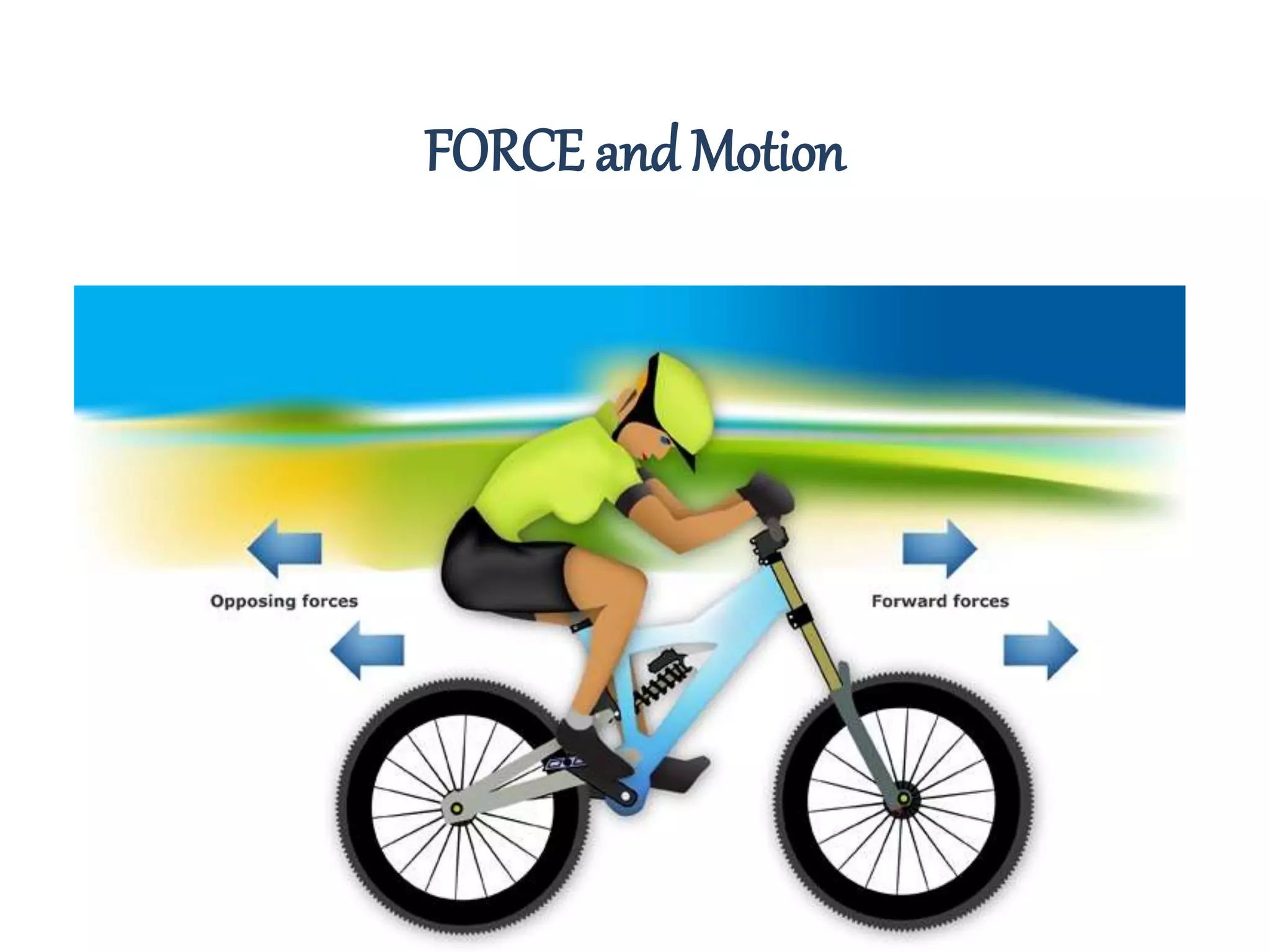
FORCE and Motion
A force is the effect that may produce a change in 
the motion state, the size, or the shape of a body. 
• A force is just a push or pull. Examples: 
– an object’s weight 
– tension in a rope 
– friction 
– attraction between an electron and proton 
– Force is a vector! 
• Bodies don’t have to be in contact to exert forces 
on each other these are called Field Forces, e.g., 
gravity.
Objects at Rest 
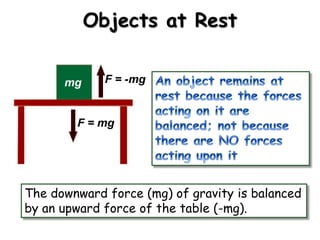
The downward force (mg) of gravity is balanced 
by an upward force of the table (-mg).
A 
c 
c 
e 
l 
e 
r 
a 
t 
i 
o 
n 
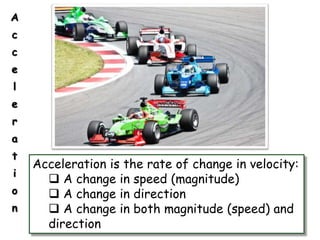
Acceleration is the rate of change in velocity: 
 A change in speed (magnitude) 
 A change in direction 
 A change in both magnitude (speed) and 
direction
Newton’s First Law (Inertia law) 
• The velocity of an object remains 
unchanged unless acted upon by a net 
force. 
or…. 
• An object will experience acceleration 
if acted upon by a net force.
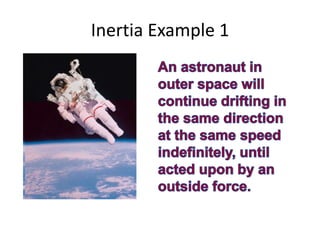
Inertia Example 1
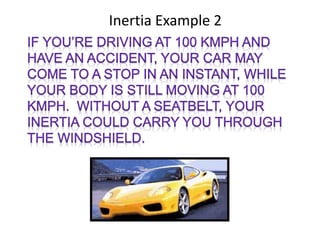
Inertia Example 2
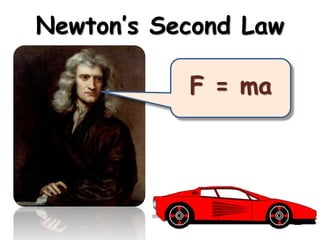
Newton’s Second Law 
F = ma
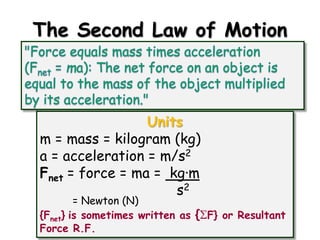
The Second Law of Motion 
Units 
m = mass = kilogram (kg) 
a = acceleration = m/s2 
Fnet = force = ma = kg∙m 
s2 
= Newton (N) 
{Fnet} is sometimes written as {SF} or Resultant 
Force R.F.
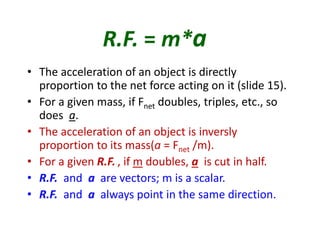
R.F. = m*a 
• The acceleration of an object is directly 
proportion to the net force acting on it (slide 15). 
• For a given mass, if Fnet doubles, triples, etc., so 
does a. 
• The acceleration of an object is inversly 
proportion to its mass(a = Fnet /m). 
• For a given R.F. , if m doubles, a is cut in half. 
• R.F. and a are vectors; m is a scalar. 
• R.F. and a always point in the same direction.
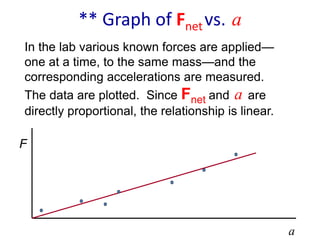
** Graph of Fnetvs. a 
In the lab various known forces are applied— 
one at a time, to the same mass—and the 
corresponding accelerations are measured. 
The data are plotted. Since Fnet and a are 
directly proportional, the relationship is linear. 
F 
a
** Mass = Slope 
Since slope (rise /run) = F/ a, the slope is 
equal to the mass. 
F 
a 
so [m = F / a] 
F 
a
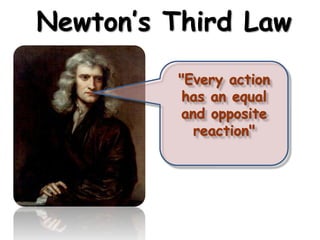
Newton’s Third Law 
"Every action 
has an equal 
and opposite 
reaction"
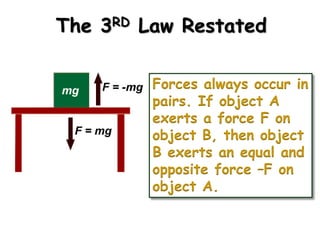
The 3RD Law Restated 
Forces always occur in 
pairs. If object A 
exerts a force F on 
object B, then object 
B exerts an equal and 
opposite force –F on 
object A.
Action – Reaction examples: 
• If you hit a tennis ball with a racquet, the 
force on the ball due to the racquet is the 
same as the force on the racquet due to the 
ball, except in the opposite direction. 
• If you fire a rifle, the bullet pushes the rifle 
backwards just as hard as the rifle pushes 
the bullet forwards. 
• If you drop an apple, the Earth pulls on the 
apple just as hard as the apple pulls on the 
Earth.
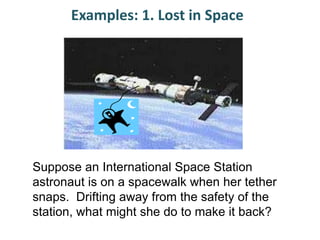
Examples: 1. Lost in Space 
Suppose an International Space Station 
astronaut is on a spacewalk when her tether 
snaps. Drifting away from the safety of the 
station, what might she do to make it back?
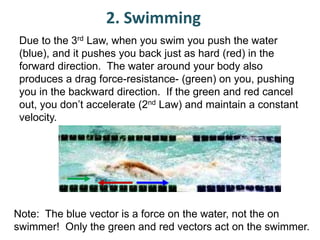
2. Swimming 
Due to the 3rd Law, when you swim you push the water 
(blue), and it pushes you back just as hard (red) in the 
forward direction. The water around your body also 
produces a drag force-resistance- (green) on you, pushing 
you in the backward direction. If the green and red cancel 
out, you don’t accelerate (2nd Law) and maintain a constant 
velocity. 
Note: The blue vector is a force on the water, not the on 
swimmer! Only the green and red vectors act on the swimmer.
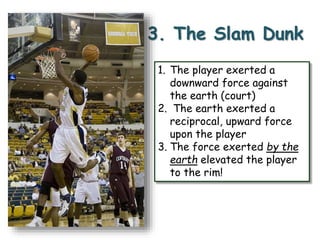
3. The Slam Dunk 
1. The player exerted a 
downward force against 
the earth (court) 
2. The earth exerted a 
reciprocal, upward force 
upon the player 
3. The force exerted by the 
earth elevated the player 
to the rim!
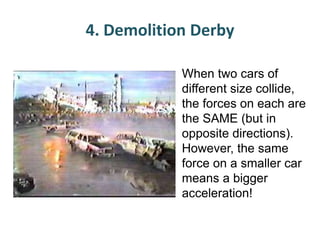
4. Demolition Derby 
When two cars of 
different size collide, 
the forces on each are 
the SAME (but in 
opposite directions). 
However, the same 
force on a smaller car 
means a bigger 
acceleration!
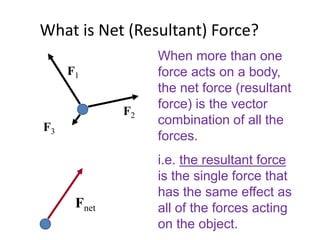
What is Net (Resultant) Force? 
When more than one 
force acts on a body, 
the net force (resultant 
force) is the vector 
combination of all the 
forces. 
i.e. the resultant force 
is the single force that 
has the same effect as 
all of the forces acting 
on the object. 
F1 
F2 
F3 
Fnet
Resultant Force (cont.) 
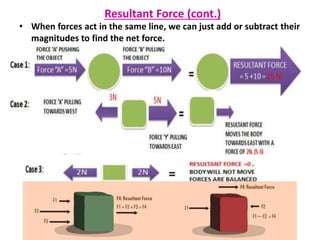
• When forces act in the same line, we can just add or subtract their 
magnitudes to find the net force.
Resultant Force (cont.) 
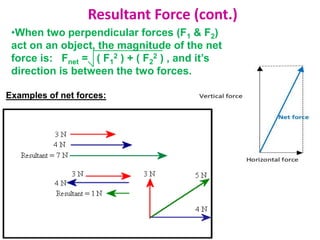
•When two perpendicular forces (F& F) 
1 2act on an object, the magnitude of the net 
force is: F= ( F2 ) + ( F2 ) , and it’s 
net 1 
2 
direction is between the two forces. 
Examples of net forces:
Net Force & the 2nd Law 
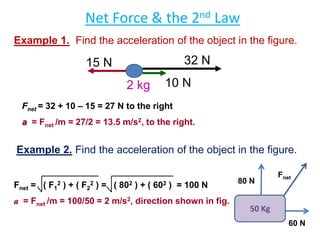
Example 1. Find the acceleration of the object in the figure. 
15 N 32 N 
2 kg 
10 N 
Fnet = 32 + 10 – 15 = 27 N to the right 
a = Fnet /m = 27/2 = 13.5 m/s2, to the right. 
Example 2. Find the acceleration of the object in the figure. 
80 N 
50 Kg 
60 N 
Fnet = ( F1 
2 ) + ( F2 
2 ) = ( 802 ) + ( 602 ) = 100 N 
a = Fnet /m = 100/50 = 2 m/s2, direction shown in fig. 
Fnet
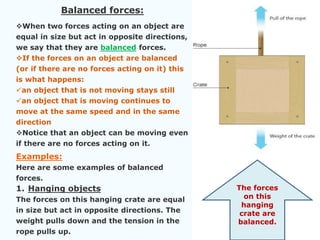
The forces 
on this 
hanging 
crate are 
balanced. 
Balanced forces: 
When two forces acting on an object are 
equal in size but act in opposite directions, 
we say that they are balanced forces. 
If the forces on an object are balanced 
(or if there are no forces acting on it) this 
is what happens: 
an object that is not moving stays still 
an object that is moving continues to 
move at the same speed and in the same 
direction 
Notice that an object can be moving even 
if there are no forces acting on it. 
Examples: 
Here are some examples of balanced 
forces. 
1. Hanging objects 
The forces on this hanging crate are equal 
in size but act in opposite directions. The 
weight pulls down and the tension in the 
rope pulls up.
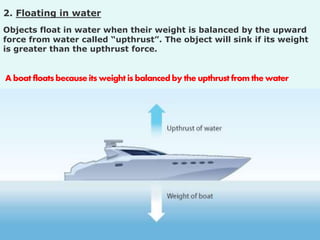
2. Floating in water 
Objects float in water when their weight is balanced by the upward 
force from water called “upthrust”. The object will sink if its weight 
is greater than the upthrust force. 
A boat floats because its weight is balanced by the upthrust from the water
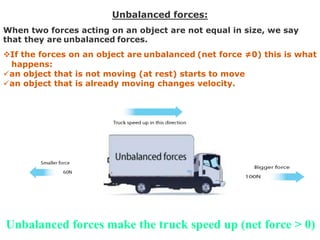
Unbalanced forces: 
When two forces acting on an object are not equal in size, we say 
that they are unbalanced forces. 
If the forces on an object are unbalanced (net force ≠0) this is what 
happens: 
an object that is not moving (at rest) starts to move 
an object that is already moving changes velocity. 
Unbalanced forces make the truck speed up (net force > 0)
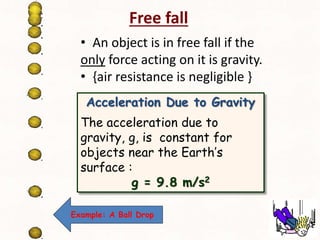
Free fall 
• An object is in free fall if the 
only force acting on it is gravity. 
• {air resistance is negligible } 
Acceleration Due to Gravity 
The acceleration due to 
gravity, g, is constant for 
objects near the Earth’s 
surface : 
g = 9.8 m/s2 
Example: A Ball Drop
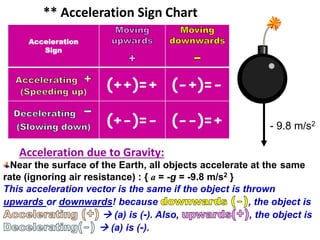
** Acceleration Sign Chart 
Acceleration 
Sign 
(++)=+ (-+)=- 
(+-)=- (--)=+ 
Acceleration due to Gravity: 
- 9.8 m/s2 
Near the surface of the Earth, all objects accelerate at the same 
rate (ignoring air resistance) : { a = -g = -9.8 m/s2 } 
This acceleration vector is the same if the object is thrown 
upwards or downwards! because , the object is 
 (a) is (-). Also, , the object is 
 (a) is (-).
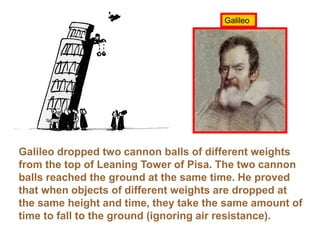
Galileo 
Galileo dropped two cannon balls of different weights 
from the top of Leaning Tower of Pisa. The two cannon 
balls reached the ground at the same time. He proved 
that when objects of different weights are dropped at 
the same height and time, they take the same amount of 
time to fall to the ground (ignoring air resistance).
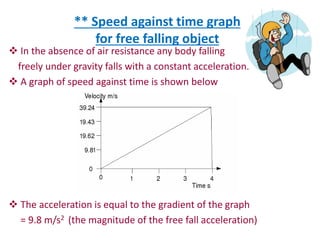
** Speed against time graph 
for free falling object 
 In the absence of air resistance any body falling 
freely under gravity falls with a constant acceleration. 
 A graph of speed against time is shown below 
 The acceleration is equal to the gradient of the graph 
= 9.8 m/s2 (the magnitude of the free fall acceleration)
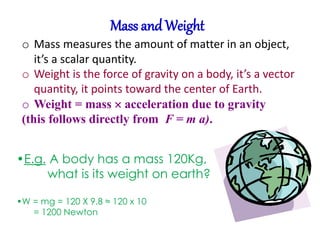
Mass and Weight 
o Mass measures the amount of matter in an object, 
it’s a scalar quantity. 
o Weight is the force of gravity on a body, it’s a vector 
quantity, it points toward the center of Earth. 
o Weight = mass  acceleration due to gravity 
(this follows directly from F = m a). 
•E.g. A body has a mass 120Kg, 
what is its weight on earth? 
•W = mg = 120 X 9.8 ≈ 120 x 10 
= 1200 Newton
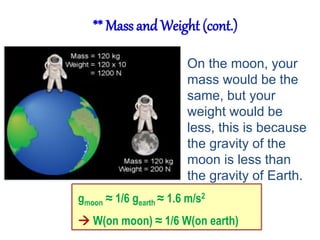
** Mass and Weight (cont.) 
On the moon, your 
mass would be the 
same, but your 
weight would be 
less, this is because 
the gravity of the 
moon is less than 
the gravity of Earth. 
gmoon ≈ 1/6 gearth ≈ 1.6 m/s2 
 W(on moon) ≈ 1/6 W(on earth)
Hippo & Ping Pong Ball 
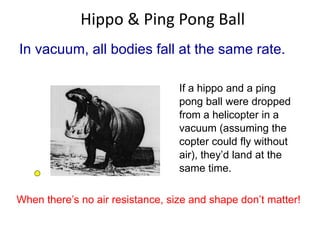
In vacuum, all bodies fall at the same rate. 
If a hippo and a ping 
pong ball were dropped 
from a helicopter in a 
vacuum (assuming the 
copter could fly without 
air), they’d land at the 
same time. 
When there’s no air resistance, size and shape don’t matter!
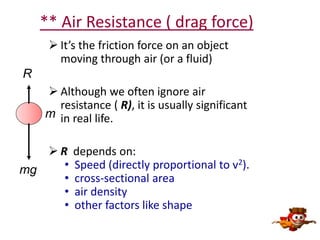
** Air Resistance ( drag force) 
 It’s the friction force on an object 
moving through air (or a fluid) 
 Although we often ignore air 
resistance ( R), it is usually significant 
in real life. 
 R depends on: 
• Speed (directly proportional to v2). 
• cross-sectional area 
• air density 
• other factors like shape 
mg 
m 
R
Terminal Velocity 
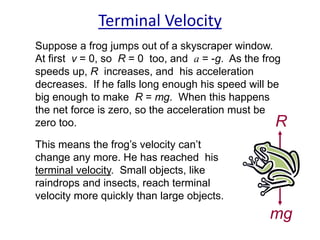
Suppose a frog jumps out of a skyscraper window. 
At first v = 0, so R = 0 too, and a = -g. As the frog 
speeds up, R increases, and his acceleration 
decreases. If he falls long enough his speed will be 
big enough to make R = mg. When this happens 
the net force is zero, so the acceleration must be 
zero too. 
R 
mg 
This means the frog’s velocity can’t 
change any more. He has reached his 
terminal velocity. Small objects, like 
raindrops and insects, reach terminal 
velocity more quickly than large objects.
The speed against time graph 
for a falling parachutist 
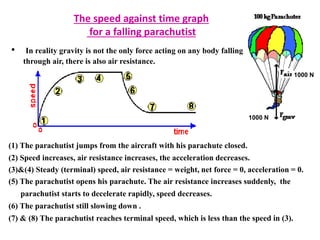
• In reality gravity is not the only force acting on any body falling 
through air, there is also air resistance. 
1000 N 
(1) The parachutist jumps from the aircraft with his parachute closed. 
(2) Speed increases, air resistance increases, the acceleration decreases. 
(3)&(4) Steady (terminal) speed, air resistance = weight, net force = 0, acceleration = 0. 
(5) The parachutist opens his parachute. The air resistance increases suddenly, the 
parachutist starts to decelerate rapidly, speed decreases. 
(6) The parachutist still slowing down . 
(7) & (8) The parachutist reaches terminal speed, which is less than the speed in (3). 
1000 N
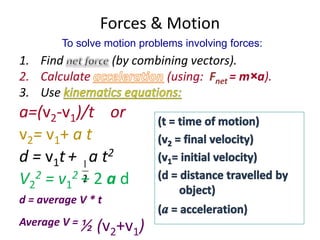
Forces & Motion 
To solve motion problems involving forces: 
1. Find (by combining vectors). 
2. Calculate (using: Fnet = m×a). 
3. Use 
a=(v2-v1)/t or 
v2= v1+ a t 
d = v1t + a t2 
1 
V2 
2 = v1 
2 + 2 
2 a d 
d = average V * t 
Average V = ½ (v2+v1)
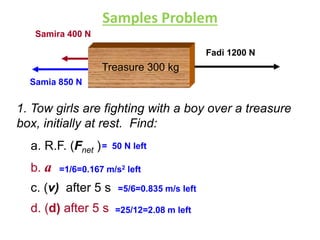
Samples Problem 
Samira 400 N 
1. Tow girls are fighting with a boy over a treasure 
box, initially at rest. Find: 
a. R.F. (Fnet ) 
b. a 
c. (v) after 5 s 
d. (d) after 5 s 
Fadi 1200 N 
Samia 850 N 
Treasure 300 kg 
= 50 N left 
=1/6=0.167 m/s2 left 
=5/6=0.835 m/s left 
=25/12=2.08 m left
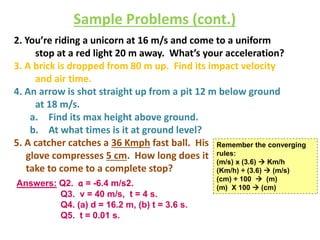
Sample Problems (cont.) 
2. You’re riding a unicorn at 16 m/s and come to a uniform 
stop at a red light 20 m away. What’s your acceleration? 
3. A brick is dropped from 80 m up. Find its impact velocity 
and air time. 
4. An arrow is shot straight up from a pit 12 m below ground 
at 18 m/s. 
a. Find its max height above ground. 
b. At what times is it at ground level? 
5. A catcher catches a 36 Kmph fast ball. His 
glove compresses 5 cm. How long does it 
take to come to a complete stop? 
Answers: Q2. a = -6.4 m/s2. 
Q3. v = 40 m/s, t = 4 s. 
Q4. (a) d = 16.2 m, (b) t = 3.6 s. 
Q5. t = 0.01 s. 
Remember the converging 
rules: 
(m/s) x (3.6)  Km/h 
(Km/h) ÷ (3.6)  (m/s) 
(cm) ÷ 100  (m) 
(m) X 100  (cm)
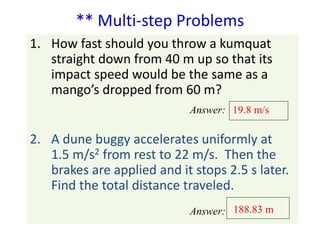
** Multi-step Problems 
1. How fast should you throw a kumquat 
straight down from 40 m up so that its 
impact speed would be the same as a 
mango’s dropped from 60 m? 
19.8 m/s 
2. A dune buggy accelerates uniformly at 
1.5 m/s2 from rest to 22 m/s. Then the 
brakes are applied and it stops 2.5 s later. 
Find the total distance traveled. 
188.83 m 
Answer: 
Answer:
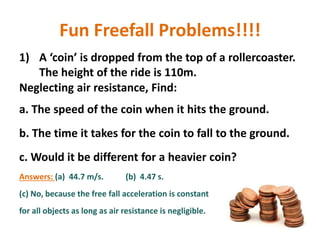
Fun Freefall Problems!!!! 
1) A ‘coin’ is dropped from the top of a rollercoaster. 
The height of the ride is 110m. 
Neglecting air resistance, Find: 
a. The speed of the coin when it hits the ground. 
b. The time it takes for the coin to fall to the ground. 
c. Would it be different for a heavier coin? 
Answers: (a) 44.7 m/s. (b) 4.47 s. 
(c) No, because the free fall acceleration is constant 
for all objects as long as air resistance is negligible.
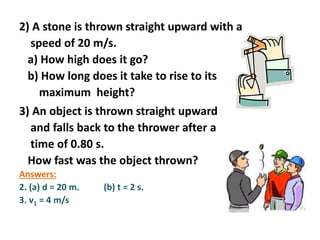
2) A stone is thrown straight upward with a 
speed of 20 m/s. 
a) How high does it go? 
b) How long does it take to rise to its 
maximum height? 
3) An object is thrown straight upward 
and falls back to the thrower after a 
time of 0.80 s. 
How fast was the object thrown? 
Answers: 
2. (a) d = 20 m. (b) t = 2 s. 
3. v1 = 4 m/s
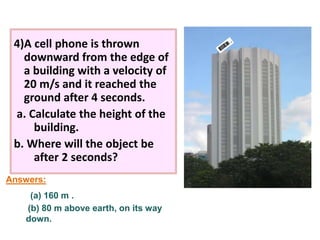
4)A cell phone is thrown 
downward from the edge of 
a building with a velocity of 
20 m/s and it reached the 
ground after 4 seconds. 
a. Calculate the height of the 
building. 
b. Where will the object be 
after 2 seconds? 
Answers: 
(a) 160 m . 
(b) 80 m above earth, on its way 
down.
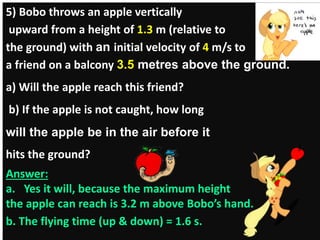
5) Bobo throws an apple vertically 
upward from a height of 1.3 m (relative to 
the ground) with an initial velocity of 4 m/s to 
a friend on a balcony 3.5 metres above the ground. 
a) Will the apple reach this friend? 
b) If the apple is not caught, how long 
will the apple be in the air before it 
hits the ground? 
Answer: 
a. Yes it will, because the maximum height 
the apple can reach is 3.2 m above Bobo’s hand. 
b. The flying time (up & down) = 1.6 s.
Misconceptions 
• If an object is moving, there must be a net force making it move. 
• Wrong! It could be moving without accelerating. 
• Heavy objects must fall faster than light ones. 
• Wrong! The rate is the same in vacuum, or when air resistance is 
negligible (i.e. veryyyyyy small compared to object’s weight). 
• When a big object collides with a little one, the big one hits the little 
one harder than the little one hits the big one. 
• Wrong! The 3rd Law says they hit it each other with the same force, 
but the little object will gain a greater acceleration. 
• If an object accelerates, its “speed” must change. 
• Wrong! It could be turning at constant speed (i.e. direction changes 
but not magnitude, so “velocity” is changing) .
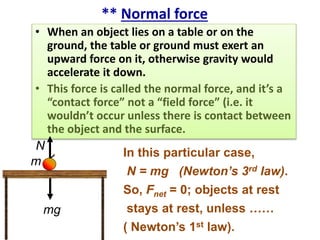
** Normal force 
• When an object lies on a table or on the 
ground, the table or ground must exert an 
upward force on it, otherwise gravity would 
accelerate it down. 
• This force is called the normal force, and it’s a 
“contact force” not a “field force” (i.e. it 
wouldn’t occur unless there is contact between 
the object and the surface. 
In this particular case, 
N = mg (Newton’s 3rd law). 
So, Fnet = 0; objects at rest 
stays at rest, unless …… 
( Newton’s 1st law). 
N 
m 
mg
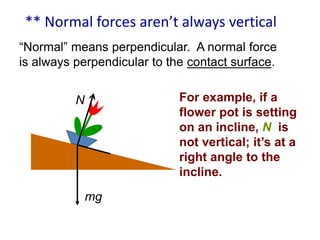
** Normal forces aren’t always vertical 
“Normal” means perpendicular. A normal force 
is always perpendicular to the contact surface. 
For example, if a 
flower pot is setting 
on an incline, N is 
not vertical; it’s at a 
right angle to the 
incline. 
N 
mg
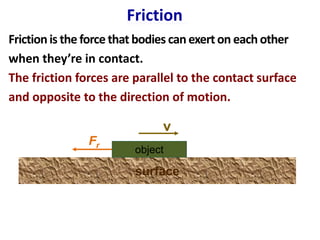
Friction 
Friction is the force that bodies can exert on each other 
when they’re in contact. 
The friction forces are parallel to the contact surface 
and opposite to the direction of motion. 
v 
Fr object 
surface
Friction Facts 
• Friction is due to electrostatic attraction 
between the atoms of the objects in contact. 
• It allows you to walk, turn a corner on your 
bike, and warm your hands in the winter. 
• Friction often causes energy waste . 
• It makes you push harder and longer to attain 
a given acceleration.
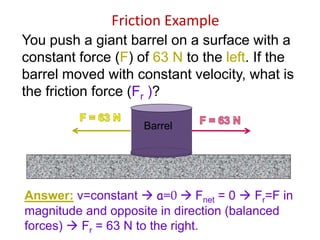
Friction Example 
You push a giant barrel on a surface with a 
constant force (F) of 63 N to the left. If the 
barrel moved with constant velocity, what is 
the friction force (Fr )? 
Barrel 
Answer: v=constant  a=0  Fnet = 0  Fr=F in 
magnitude and opposite in direction (balanced 
forces)  Fr = 63 N to the right.
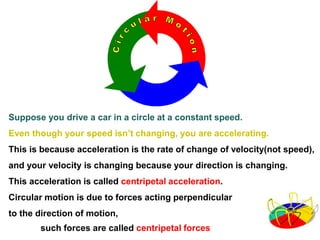
Suppose you drive a car in a circle at a constant speed. 
Even though your speed isn’t changing, you are accelerating. 
This is because acceleration is the rate of change of velocity(not speed), 
and your velocity is changing because your direction is changing. 
This acceleration is called centripetal acceleration. 
Circular motion is due to forces acting perpendicular 
to the direction of motion, 
such forces are called centripetal forces
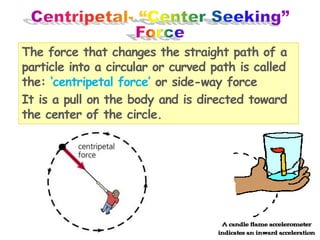
The force that changes the straight path of a 
particle into a circular or curved path is called 
the: ‘centripetal force’ or side-way force 
It is a pull on the body and is directed toward 
the center of the circle.
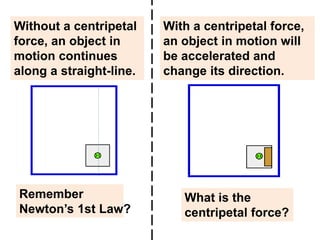
Without a centripetal 
force, an object in 
motion continues 
along a straight-line. 
With a centripetal force, 
an object in motion will 
be accelerated and 
change its direction. 
What is the 
centripetal force? 
Remember 
Newton’s 1st Law?
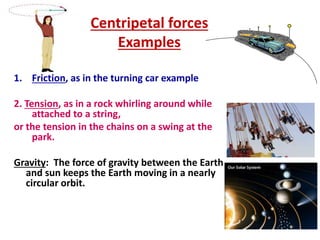
Centripetal forces 
Examples 
1. Friction, as in the turning car example 
2. Tension, as in a rock whirling around while 
attached to a string, 
or the tension in the chains on a swing at the 
park. 
Gravity: The force of gravity between the Earth 
and sun keeps the Earth moving in a nearly 
circular orbit.
Amal Sweis

Force and motion

  • 1.
  • 2.
    A force isthe effect that may produce a change in the motion state, the size, or the shape of a body. • A force is just a push or pull. Examples: – an object’s weight – tension in a rope – friction – attraction between an electron and proton – Force is a vector! • Bodies don’t have to be in contact to exert forces on each other these are called Field Forces, e.g., gravity.
  • 3.
    Objects at Rest The downward force (mg) of gravity is balanced by an upward force of the table (-mg).
  • 4.
    A c c e l e r a t i o n Acceleration is the rate of change in velocity:  A change in speed (magnitude)  A change in direction  A change in both magnitude (speed) and direction
  • 5.
    Newton’s First Law(Inertia law) • The velocity of an object remains unchanged unless acted upon by a net force. or…. • An object will experience acceleration if acted upon by a net force.
  • 6.
  • 7.
  • 8.
  • 9.
    The Second Lawof Motion Units m = mass = kilogram (kg) a = acceleration = m/s2 Fnet = force = ma = kg∙m s2 = Newton (N) {Fnet} is sometimes written as {SF} or Resultant Force R.F.
  • 10.
    R.F. = m*a • The acceleration of an object is directly proportion to the net force acting on it (slide 15). • For a given mass, if Fnet doubles, triples, etc., so does a. • The acceleration of an object is inversly proportion to its mass(a = Fnet /m). • For a given R.F. , if m doubles, a is cut in half. • R.F. and a are vectors; m is a scalar. • R.F. and a always point in the same direction.
  • 11.
    ** Graph ofFnetvs. a In the lab various known forces are applied— one at a time, to the same mass—and the corresponding accelerations are measured. The data are plotted. Since Fnet and a are directly proportional, the relationship is linear. F a
  • 12.
    ** Mass =Slope Since slope (rise /run) = F/ a, the slope is equal to the mass. F a so [m = F / a] F a
  • 13.
    Newton’s Third Law "Every action has an equal and opposite reaction"
  • 14.
    The 3RD LawRestated Forces always occur in pairs. If object A exerts a force F on object B, then object B exerts an equal and opposite force –F on object A.
  • 15.
    Action – Reactionexamples: • If you hit a tennis ball with a racquet, the force on the ball due to the racquet is the same as the force on the racquet due to the ball, except in the opposite direction. • If you fire a rifle, the bullet pushes the rifle backwards just as hard as the rifle pushes the bullet forwards. • If you drop an apple, the Earth pulls on the apple just as hard as the apple pulls on the Earth.
  • 16.
    Examples: 1. Lostin Space Suppose an International Space Station astronaut is on a spacewalk when her tether snaps. Drifting away from the safety of the station, what might she do to make it back?
  • 17.
    2. Swimming Dueto the 3rd Law, when you swim you push the water (blue), and it pushes you back just as hard (red) in the forward direction. The water around your body also produces a drag force-resistance- (green) on you, pushing you in the backward direction. If the green and red cancel out, you don’t accelerate (2nd Law) and maintain a constant velocity. Note: The blue vector is a force on the water, not the on swimmer! Only the green and red vectors act on the swimmer.
  • 18.
    3. The SlamDunk 1. The player exerted a downward force against the earth (court) 2. The earth exerted a reciprocal, upward force upon the player 3. The force exerted by the earth elevated the player to the rim!
  • 19.
    4. Demolition Derby When two cars of different size collide, the forces on each are the SAME (but in opposite directions). However, the same force on a smaller car means a bigger acceleration!
  • 20.
    What is Net(Resultant) Force? When more than one force acts on a body, the net force (resultant force) is the vector combination of all the forces. i.e. the resultant force is the single force that has the same effect as all of the forces acting on the object. F1 F2 F3 Fnet
  • 21.
    Resultant Force (cont.) • When forces act in the same line, we can just add or subtract their magnitudes to find the net force.
  • 22.
    Resultant Force (cont.) •When two perpendicular forces (F& F) 1 2act on an object, the magnitude of the net force is: F= ( F2 ) + ( F2 ) , and it’s net 1 2 direction is between the two forces. Examples of net forces:
  • 23.
    Net Force &the 2nd Law Example 1. Find the acceleration of the object in the figure. 15 N 32 N 2 kg 10 N Fnet = 32 + 10 – 15 = 27 N to the right a = Fnet /m = 27/2 = 13.5 m/s2, to the right. Example 2. Find the acceleration of the object in the figure. 80 N 50 Kg 60 N Fnet = ( F1 2 ) + ( F2 2 ) = ( 802 ) + ( 602 ) = 100 N a = Fnet /m = 100/50 = 2 m/s2, direction shown in fig. Fnet
  • 24.
    The forces onthis hanging crate are balanced. Balanced forces: When two forces acting on an object are equal in size but act in opposite directions, we say that they are balanced forces. If the forces on an object are balanced (or if there are no forces acting on it) this is what happens: an object that is not moving stays still an object that is moving continues to move at the same speed and in the same direction Notice that an object can be moving even if there are no forces acting on it. Examples: Here are some examples of balanced forces. 1. Hanging objects The forces on this hanging crate are equal in size but act in opposite directions. The weight pulls down and the tension in the rope pulls up.
  • 25.
    2. Floating inwater Objects float in water when their weight is balanced by the upward force from water called “upthrust”. The object will sink if its weight is greater than the upthrust force. A boat floats because its weight is balanced by the upthrust from the water
  • 26.
    Unbalanced forces: Whentwo forces acting on an object are not equal in size, we say that they are unbalanced forces. If the forces on an object are unbalanced (net force ≠0) this is what happens: an object that is not moving (at rest) starts to move an object that is already moving changes velocity. Unbalanced forces make the truck speed up (net force > 0)
  • 27.
    Free fall •An object is in free fall if the only force acting on it is gravity. • {air resistance is negligible } Acceleration Due to Gravity The acceleration due to gravity, g, is constant for objects near the Earth’s surface : g = 9.8 m/s2 Example: A Ball Drop
  • 28.
    ** Acceleration SignChart Acceleration Sign (++)=+ (-+)=- (+-)=- (--)=+ Acceleration due to Gravity: - 9.8 m/s2 Near the surface of the Earth, all objects accelerate at the same rate (ignoring air resistance) : { a = -g = -9.8 m/s2 } This acceleration vector is the same if the object is thrown upwards or downwards! because , the object is  (a) is (-). Also, , the object is  (a) is (-).
  • 29.
    Galileo Galileo droppedtwo cannon balls of different weights from the top of Leaning Tower of Pisa. The two cannon balls reached the ground at the same time. He proved that when objects of different weights are dropped at the same height and time, they take the same amount of time to fall to the ground (ignoring air resistance).
  • 30.
    ** Speed againsttime graph for free falling object  In the absence of air resistance any body falling freely under gravity falls with a constant acceleration.  A graph of speed against time is shown below  The acceleration is equal to the gradient of the graph = 9.8 m/s2 (the magnitude of the free fall acceleration)
  • 31.
    Mass and Weight o Mass measures the amount of matter in an object, it’s a scalar quantity. o Weight is the force of gravity on a body, it’s a vector quantity, it points toward the center of Earth. o Weight = mass  acceleration due to gravity (this follows directly from F = m a). •E.g. A body has a mass 120Kg, what is its weight on earth? •W = mg = 120 X 9.8 ≈ 120 x 10 = 1200 Newton
  • 32.
    ** Mass andWeight (cont.) On the moon, your mass would be the same, but your weight would be less, this is because the gravity of the moon is less than the gravity of Earth. gmoon ≈ 1/6 gearth ≈ 1.6 m/s2  W(on moon) ≈ 1/6 W(on earth)
  • 33.
    Hippo & PingPong Ball In vacuum, all bodies fall at the same rate. If a hippo and a ping pong ball were dropped from a helicopter in a vacuum (assuming the copter could fly without air), they’d land at the same time. When there’s no air resistance, size and shape don’t matter!
  • 34.
    ** Air Resistance( drag force)  It’s the friction force on an object moving through air (or a fluid)  Although we often ignore air resistance ( R), it is usually significant in real life.  R depends on: • Speed (directly proportional to v2). • cross-sectional area • air density • other factors like shape mg m R
  • 35.
    Terminal Velocity Supposea frog jumps out of a skyscraper window. At first v = 0, so R = 0 too, and a = -g. As the frog speeds up, R increases, and his acceleration decreases. If he falls long enough his speed will be big enough to make R = mg. When this happens the net force is zero, so the acceleration must be zero too. R mg This means the frog’s velocity can’t change any more. He has reached his terminal velocity. Small objects, like raindrops and insects, reach terminal velocity more quickly than large objects.
  • 36.
    The speed againsttime graph for a falling parachutist • In reality gravity is not the only force acting on any body falling through air, there is also air resistance. 1000 N (1) The parachutist jumps from the aircraft with his parachute closed. (2) Speed increases, air resistance increases, the acceleration decreases. (3)&(4) Steady (terminal) speed, air resistance = weight, net force = 0, acceleration = 0. (5) The parachutist opens his parachute. The air resistance increases suddenly, the parachutist starts to decelerate rapidly, speed decreases. (6) The parachutist still slowing down . (7) & (8) The parachutist reaches terminal speed, which is less than the speed in (3). 1000 N
  • 37.
    Forces & Motion To solve motion problems involving forces: 1. Find (by combining vectors). 2. Calculate (using: Fnet = m×a). 3. Use a=(v2-v1)/t or v2= v1+ a t d = v1t + a t2 1 V2 2 = v1 2 + 2 2 a d d = average V * t Average V = ½ (v2+v1)
  • 38.
    Samples Problem Samira400 N 1. Tow girls are fighting with a boy over a treasure box, initially at rest. Find: a. R.F. (Fnet ) b. a c. (v) after 5 s d. (d) after 5 s Fadi 1200 N Samia 850 N Treasure 300 kg = 50 N left =1/6=0.167 m/s2 left =5/6=0.835 m/s left =25/12=2.08 m left
  • 39.
    Sample Problems (cont.) 2. You’re riding a unicorn at 16 m/s and come to a uniform stop at a red light 20 m away. What’s your acceleration? 3. A brick is dropped from 80 m up. Find its impact velocity and air time. 4. An arrow is shot straight up from a pit 12 m below ground at 18 m/s. a. Find its max height above ground. b. At what times is it at ground level? 5. A catcher catches a 36 Kmph fast ball. His glove compresses 5 cm. How long does it take to come to a complete stop? Answers: Q2. a = -6.4 m/s2. Q3. v = 40 m/s, t = 4 s. Q4. (a) d = 16.2 m, (b) t = 3.6 s. Q5. t = 0.01 s. Remember the converging rules: (m/s) x (3.6)  Km/h (Km/h) ÷ (3.6)  (m/s) (cm) ÷ 100  (m) (m) X 100  (cm)
  • 40.
    ** Multi-step Problems 1. How fast should you throw a kumquat straight down from 40 m up so that its impact speed would be the same as a mango’s dropped from 60 m? 19.8 m/s 2. A dune buggy accelerates uniformly at 1.5 m/s2 from rest to 22 m/s. Then the brakes are applied and it stops 2.5 s later. Find the total distance traveled. 188.83 m Answer: Answer:
  • 41.
    Fun Freefall Problems!!!! 1) A ‘coin’ is dropped from the top of a rollercoaster. The height of the ride is 110m. Neglecting air resistance, Find: a. The speed of the coin when it hits the ground. b. The time it takes for the coin to fall to the ground. c. Would it be different for a heavier coin? Answers: (a) 44.7 m/s. (b) 4.47 s. (c) No, because the free fall acceleration is constant for all objects as long as air resistance is negligible.
  • 42.
    2) A stoneis thrown straight upward with a speed of 20 m/s. a) How high does it go? b) How long does it take to rise to its maximum height? 3) An object is thrown straight upward and falls back to the thrower after a time of 0.80 s. How fast was the object thrown? Answers: 2. (a) d = 20 m. (b) t = 2 s. 3. v1 = 4 m/s
  • 43.
    4)A cell phoneis thrown downward from the edge of a building with a velocity of 20 m/s and it reached the ground after 4 seconds. a. Calculate the height of the building. b. Where will the object be after 2 seconds? Answers: (a) 160 m . (b) 80 m above earth, on its way down.
  • 44.
    5) Bobo throwsan apple vertically upward from a height of 1.3 m (relative to the ground) with an initial velocity of 4 m/s to a friend on a balcony 3.5 metres above the ground. a) Will the apple reach this friend? b) If the apple is not caught, how long will the apple be in the air before it hits the ground? Answer: a. Yes it will, because the maximum height the apple can reach is 3.2 m above Bobo’s hand. b. The flying time (up & down) = 1.6 s.
  • 45.
    Misconceptions • Ifan object is moving, there must be a net force making it move. • Wrong! It could be moving without accelerating. • Heavy objects must fall faster than light ones. • Wrong! The rate is the same in vacuum, or when air resistance is negligible (i.e. veryyyyyy small compared to object’s weight). • When a big object collides with a little one, the big one hits the little one harder than the little one hits the big one. • Wrong! The 3rd Law says they hit it each other with the same force, but the little object will gain a greater acceleration. • If an object accelerates, its “speed” must change. • Wrong! It could be turning at constant speed (i.e. direction changes but not magnitude, so “velocity” is changing) .
  • 46.
    ** Normal force • When an object lies on a table or on the ground, the table or ground must exert an upward force on it, otherwise gravity would accelerate it down. • This force is called the normal force, and it’s a “contact force” not a “field force” (i.e. it wouldn’t occur unless there is contact between the object and the surface. In this particular case, N = mg (Newton’s 3rd law). So, Fnet = 0; objects at rest stays at rest, unless …… ( Newton’s 1st law). N m mg
  • 47.
    ** Normal forcesaren’t always vertical “Normal” means perpendicular. A normal force is always perpendicular to the contact surface. For example, if a flower pot is setting on an incline, N is not vertical; it’s at a right angle to the incline. N mg
  • 48.
    Friction Friction isthe force that bodies can exert on each other when they’re in contact. The friction forces are parallel to the contact surface and opposite to the direction of motion. v Fr object surface
  • 49.
    Friction Facts •Friction is due to electrostatic attraction between the atoms of the objects in contact. • It allows you to walk, turn a corner on your bike, and warm your hands in the winter. • Friction often causes energy waste . • It makes you push harder and longer to attain a given acceleration.
  • 50.
    Friction Example Youpush a giant barrel on a surface with a constant force (F) of 63 N to the left. If the barrel moved with constant velocity, what is the friction force (Fr )? Barrel Answer: v=constant  a=0  Fnet = 0  Fr=F in magnitude and opposite in direction (balanced forces)  Fr = 63 N to the right.
  • 51.
    Suppose you drivea car in a circle at a constant speed. Even though your speed isn’t changing, you are accelerating. This is because acceleration is the rate of change of velocity(not speed), and your velocity is changing because your direction is changing. This acceleration is called centripetal acceleration. Circular motion is due to forces acting perpendicular to the direction of motion, such forces are called centripetal forces
  • 52.
    The force thatchanges the straight path of a particle into a circular or curved path is called the: ‘centripetal force’ or side-way force It is a pull on the body and is directed toward the center of the circle.
  • 53.
    Without a centripetal force, an object in motion continues along a straight-line. With a centripetal force, an object in motion will be accelerated and change its direction. What is the centripetal force? Remember Newton’s 1st Law?
  • 54.
    Centripetal forces Examples 1. Friction, as in the turning car example 2. Tension, as in a rock whirling around while attached to a string, or the tension in the chains on a swing at the park. Gravity: The force of gravity between the Earth and sun keeps the Earth moving in a nearly circular orbit.
  • 55.