Quick Study Notes Work and Energy 1
Work
 Work is said to be done, if an applying a force on
an object, it is displaced from its position in the
direction of force.
 Its Sl unit is newton-metre which is also called
joule.
Scientific Conception of Work
 From the point of view of science, following two
conditions need to be satisfied for work to be
done.
i. A force should act on an object.
ii. The object must be displaced.
 If any one of the above conditions does not exist,
work is not done. e.g., A girl pulls a trolley and the
trolley moves through a distance. In this way, she
has exerted a force on the trolley and it is
displaced. Hence, work is done.
Work Done by a Constant Force
Work done by a force on an object is equal to the
magnitude of the force multiplied by the distance
moved in the direction of force.
Work done = Force × Displacement in the direction of
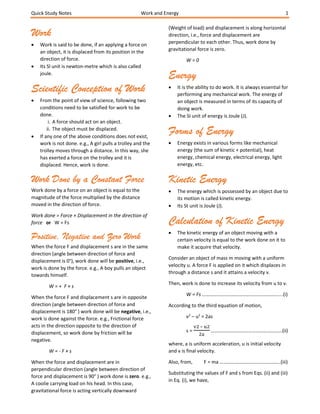
force or W = Fs
Positive, Negative and Zero Work
When the force F and displacement s are in the same
direction (angle between direction of force and
displacement is 0°), work done will be positive, i.e.,
work is done by the force. e.g., A boy pulls an object
towards himself.
W = + F × s
When the force F and displacement s are in opposite
direction (angle between direction of force and
displacement is 180° ) work done will be negative, i.e.,
work is done against the force. e.g., Frictional force
acts in the direction opposite to the direction of
displacement, so work done by friction will be
negative.
W = - F × s
When the force and displacement are in
perpendicular direction (angle between direction of
force and displacement is 90° ) work done is zero. e.g.,
A coolie carrying load on his head. In this case,
gravitational force is acting vertically downward
(Weight of load) and displacement is along horizontal
direction, i.e., force and displacement are
perpendicular to each other. Thus, work done by
gravitational force is zero.
W = 0
Energy
 It is the ability to do work. It is always essential for
performing any mechanical work. The energy of
an object is measured in terms of its capacity of
doing work.
 The SI unit of energy is Joule (J).
Forms of Energy
 Energy exists in various forms like mechanical
energy (the sum of kinetic + potential), heat
energy, chemical energy, electrical energy, light
energy, etc.
Kinetic Energy
 The energy which is possessed by an object due to
its motion is called kinetic energy.
 Its St unit is Joule (J).
Calculation of Kinetic Energy
 The kinetic energy of an object moving with a
certain velocity is equal to the work done on it to
make it acquire that velocity.
Consider an object of mass m moving with a uniform
velocity u. A force F is applied on it which displaces in
through a distance s and it attains a velocity v.
Then, work is done to increase its velocity from u to v.
W = Fs ………………………………………………………..(i)
According to the third equation of motion,
v2
– u2
= 2as
s =
–
……………………………………….………..(ii)
where, a is uniform acceleration, u is initial velocity
and v is final velocity.
Also, from, F = ma ………………………………………….(iii)
Substituting the values of F and s from Eqs. (ii) and (iii)
in Eq. (i), we have,
Quick Study Notes Work and Energy 2
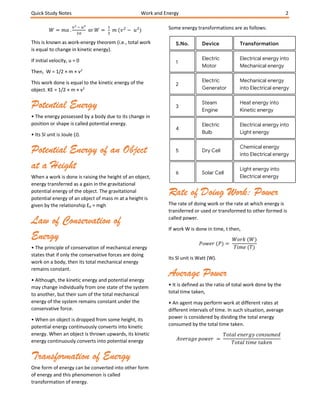
𝑊 = 𝑚𝑎 . or 𝑊 = 𝑚 (𝑣 − 𝑢 )
This is known as work-energy theorem (i.e., total work
is equal to change in kinetic energy).
If initial velocity, u = 0
Then, W = 1/2 × m × v2
This work done is equal to the kinetic energy of the
object. KE = 1/2 × m × v2
Potential Energy
• The energy possessed by a body due to its change in
position or shape is called potential energy.
• Its Sl unit is Joule (J).
Potential Energy of an Object
at a Height
When a work is done is raising the height of an object,
energy transferred as a gain in the gravitational
potential energy of the object. The gravitational
potential energy of an object of mass m at a height is
given by the relationship Ep = mgh
Law of Conservation of
Energy
• The principle of conservation of mechanical energy
states that if only the conservative forces are doing
work on a body, then its total mechanical energy
remains constant.
• Although, the kinetic energy and potential energy
may change individually from one state of the system
to another, but their sum of the total mechanical
energy of the system remains constant under the
conservative force.
• When on object is dropped from some height, its
potential energy continuously converts into kinetic
energy. When an object is thrown upwards, its kinetic
energy continuously converts into potential energy
Transformation of Energy
One form of energy can be converted into other form
of energy and this phenomenon is called
transformation of energy.
Some energy transformations are as follows:
S.No. Device Transformation
1
Electric
Motor
Electrical energy into
Mechanical energy
2
Electric
Generator
Mechanical energy
into Electrical energy
3
Steam
Engine
Heat energy into
Kinetic energy
4
Electric
Bulb
Electrical energy into
Light energy
5 Dry Cell
Chemical energy
into Electrical energy
6 Solar Cell
Light energy into
Electrical energy
Rate of Doing Work: Power
The rate of doing work or the rate at which energy is
transferred or used or transformed to other formed is
called power.
If work W is done in time, t then,
𝑃𝑜𝑤𝑒𝑟 (𝑃) =
𝑊𝑜𝑟𝑘 (𝑊)
𝑇𝑖𝑚𝑒 (𝑇)
Its Sl unit is Watt (W).
Average Power
• It is defined as the ratio of total work done by the
total time taken,
• An agent may perform work at different rates at
different intervals of time. In such situation, average
power is considered by dividing the total energy
consumed by the total time taken.
𝐴𝑣𝑒𝑟𝑎𝑔𝑒 𝑝𝑜𝑤𝑒𝑟 =
𝑇𝑜𝑡𝑎𝑙 𝑒𝑛𝑒𝑟𝑔𝑦 𝑐𝑜𝑛𝑠𝑢𝑚𝑒𝑑
𝑇𝑜𝑡𝑎𝑙 𝑡𝑖𝑚𝑒 𝑡𝑎𝑘𝑒𝑛

iSucceed Quick Study Notes, Work and Energy.pdf

  • 1.
    Quick Study NotesWork and Energy 1 Work  Work is said to be done, if an applying a force on an object, it is displaced from its position in the direction of force.  Its Sl unit is newton-metre which is also called joule. Scientific Conception of Work  From the point of view of science, following two conditions need to be satisfied for work to be done. i. A force should act on an object. ii. The object must be displaced.  If any one of the above conditions does not exist, work is not done. e.g., A girl pulls a trolley and the trolley moves through a distance. In this way, she has exerted a force on the trolley and it is displaced. Hence, work is done. Work Done by a Constant Force Work done by a force on an object is equal to the magnitude of the force multiplied by the distance moved in the direction of force. Work done = Force × Displacement in the direction of force or W = Fs Positive, Negative and Zero Work When the force F and displacement s are in the same direction (angle between direction of force and displacement is 0°), work done will be positive, i.e., work is done by the force. e.g., A boy pulls an object towards himself. W = + F × s When the force F and displacement s are in opposite direction (angle between direction of force and displacement is 180° ) work done will be negative, i.e., work is done against the force. e.g., Frictional force acts in the direction opposite to the direction of displacement, so work done by friction will be negative. W = - F × s When the force and displacement are in perpendicular direction (angle between direction of force and displacement is 90° ) work done is zero. e.g., A coolie carrying load on his head. In this case, gravitational force is acting vertically downward (Weight of load) and displacement is along horizontal direction, i.e., force and displacement are perpendicular to each other. Thus, work done by gravitational force is zero. W = 0 Energy  It is the ability to do work. It is always essential for performing any mechanical work. The energy of an object is measured in terms of its capacity of doing work.  The SI unit of energy is Joule (J). Forms of Energy  Energy exists in various forms like mechanical energy (the sum of kinetic + potential), heat energy, chemical energy, electrical energy, light energy, etc. Kinetic Energy  The energy which is possessed by an object due to its motion is called kinetic energy.  Its St unit is Joule (J). Calculation of Kinetic Energy  The kinetic energy of an object moving with a certain velocity is equal to the work done on it to make it acquire that velocity. Consider an object of mass m moving with a uniform velocity u. A force F is applied on it which displaces in through a distance s and it attains a velocity v. Then, work is done to increase its velocity from u to v. W = Fs ………………………………………………………..(i) According to the third equation of motion, v2 – u2 = 2as s = – ……………………………………….………..(ii) where, a is uniform acceleration, u is initial velocity and v is final velocity. Also, from, F = ma ………………………………………….(iii) Substituting the values of F and s from Eqs. (ii) and (iii) in Eq. (i), we have,
  • 2.
    Quick Study NotesWork and Energy 2 𝑊 = 𝑚𝑎 . or 𝑊 = 𝑚 (𝑣 − 𝑢 ) This is known as work-energy theorem (i.e., total work is equal to change in kinetic energy). If initial velocity, u = 0 Then, W = 1/2 × m × v2 This work done is equal to the kinetic energy of the object. KE = 1/2 × m × v2 Potential Energy • The energy possessed by a body due to its change in position or shape is called potential energy. • Its Sl unit is Joule (J). Potential Energy of an Object at a Height When a work is done is raising the height of an object, energy transferred as a gain in the gravitational potential energy of the object. The gravitational potential energy of an object of mass m at a height is given by the relationship Ep = mgh Law of Conservation of Energy • The principle of conservation of mechanical energy states that if only the conservative forces are doing work on a body, then its total mechanical energy remains constant. • Although, the kinetic energy and potential energy may change individually from one state of the system to another, but their sum of the total mechanical energy of the system remains constant under the conservative force. • When on object is dropped from some height, its potential energy continuously converts into kinetic energy. When an object is thrown upwards, its kinetic energy continuously converts into potential energy Transformation of Energy One form of energy can be converted into other form of energy and this phenomenon is called transformation of energy. Some energy transformations are as follows: S.No. Device Transformation 1 Electric Motor Electrical energy into Mechanical energy 2 Electric Generator Mechanical energy into Electrical energy 3 Steam Engine Heat energy into Kinetic energy 4 Electric Bulb Electrical energy into Light energy 5 Dry Cell Chemical energy into Electrical energy 6 Solar Cell Light energy into Electrical energy Rate of Doing Work: Power The rate of doing work or the rate at which energy is transferred or used or transformed to other formed is called power. If work W is done in time, t then, 𝑃𝑜𝑤𝑒𝑟 (𝑃) = 𝑊𝑜𝑟𝑘 (𝑊) 𝑇𝑖𝑚𝑒 (𝑇) Its Sl unit is Watt (W). Average Power • It is defined as the ratio of total work done by the total time taken, • An agent may perform work at different rates at different intervals of time. In such situation, average power is considered by dividing the total energy consumed by the total time taken. 𝐴𝑣𝑒𝑟𝑎𝑔𝑒 𝑝𝑜𝑤𝑒𝑟 = 𝑇𝑜𝑡𝑎𝑙 𝑒𝑛𝑒𝑟𝑔𝑦 𝑐𝑜𝑛𝑠𝑢𝑚𝑒𝑑 𝑇𝑜𝑡𝑎𝑙 𝑡𝑖𝑚𝑒 𝑡𝑎𝑘𝑒𝑛