Mechanics
Topic 2.3 Work, Energy and Power
Work
 A simple definition of work is the force
 multiplied by the distance moved
 However this does not take in to account of
 the case when the force applied is not in the
 direction of the motion
 Here we have to calculate the component of
 the force doing the work in the direction
 moved
 i.e. Work is equal to the magnitude of the
 component of the force in the direction
 moved multiplied by the distance moved
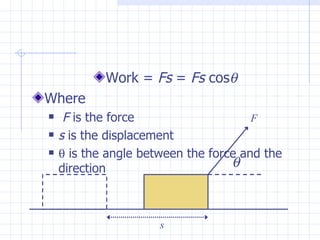
Work = Fs = Fs cosθ
Where
    F is the force                    F
   s is the displacement
   θ is the angle between the force and the
    direction                      θ


                      s
The SI unit of work is the newton-metre
(Nm) and it is called the joule (J)

Work is a scalar quantity
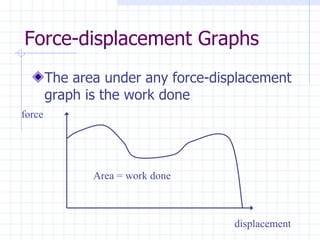
Force-displacement Graphs
        The area under any force-displacement
        graph is the work done
force


               Area = work done


                                    displacement
Energy and Power
  Kinetic Energy
     This is the energy that a body possesses
      by virtue of its motion
     If the mass of a body is m and its velocity
      is v then its kinetic energy, Ek = ½ m v2
Energy and Power
  Gravitational Potential Energy
     This is the energy that a body possesses
      by virtue of its position in the gravitational
      field
     If the mass of a body is m and its height
      above a fixed position is h then its change
      in gravitational potential energy,
      ∆Ep = mg∆h
      where g = the acceleration due to gravity
The Principle of Conservation
of Energy
  Energy can be transformed
  from one form to another, but it
  cannot be created nor
  destroyed, i.e. the total energy
  of a system is constant
  Energy is measured in joules
  and it is a scalar quantity
Types of Energy
Kinetic
Gravitational Potential
Elastic
Heat (often refered to as internal)
Light
Sound
Electrical
Chemical
Nuclear
Energy and Power
  Elastic Potential Energy
     This is the energy that a body possesses
      by virtue of its position from the
      equilibrium condition of the spring
     If the mass of a body is m and its
      displacement from the equilibrium position
      is s then its elastic potential energy,
      ∆E elas = ½ k s2
      where k = the spring constant
In Mechanical Situations
  Falling objects and roller coaster rides
  are situations where Ep + Ek = constant
  if we ignore the effects of air resistance
  and friction.
  Inclined planes and falling objects can
  often be solved more simply using this
  principle rather than the kinematics
  equations
In all collisions and explosions momentum is
conserved, but generally there is a loss of
kinetic energy, usually to internal energy
(heat) and to a small extent to sound
In an inelastic collision there is a loss of
kinetic energy (momentum is still conserved)
In an elastic collision the kinetic energy is
conserved (as well as momentum)
Power
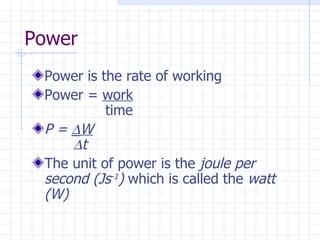
 Power is the rate of working
 Power = work
           time
 P = ∆W
     ∆t
 The unit of power is the joule per
 second (Js-1) which is called the watt
 (W)
Power and Velocity
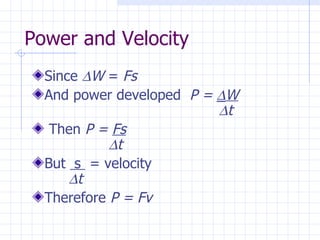
  Since ∆W = Fs
  And power developed P = ∆W
                          ∆t
   Then P = Fs
            ∆t
  But s = velocity
      ∆t
  Therefore P = Fv
Efficiency
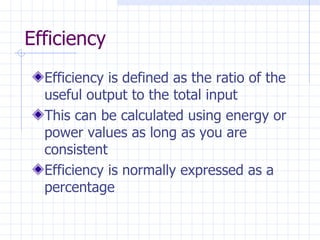
  Efficiency is defined as the ratio of the
  useful output to the total input
  This can be calculated using energy or
  power values as long as you are
  consistent
  Efficiency is normally expressed as a
  percentage

2.3 - Work Energy & Power

  • 1.
    Mechanics Topic 2.3 Work,Energy and Power
  • 2.
    Work A simpledefinition of work is the force multiplied by the distance moved However this does not take in to account of the case when the force applied is not in the direction of the motion Here we have to calculate the component of the force doing the work in the direction moved i.e. Work is equal to the magnitude of the component of the force in the direction moved multiplied by the distance moved
  • 3.
    Work = Fs= Fs cosθ Where  F is the force F  s is the displacement  θ is the angle between the force and the direction θ s
  • 4.
    The SI unitof work is the newton-metre (Nm) and it is called the joule (J) Work is a scalar quantity
  • 5.
    Force-displacement Graphs The area under any force-displacement graph is the work done force Area = work done displacement
  • 6.
    Energy and Power Kinetic Energy  This is the energy that a body possesses by virtue of its motion  If the mass of a body is m and its velocity is v then its kinetic energy, Ek = ½ m v2
  • 7.
    Energy and Power Gravitational Potential Energy  This is the energy that a body possesses by virtue of its position in the gravitational field  If the mass of a body is m and its height above a fixed position is h then its change in gravitational potential energy, ∆Ep = mg∆h  where g = the acceleration due to gravity
  • 8.
    The Principle ofConservation of Energy Energy can be transformed from one form to another, but it cannot be created nor destroyed, i.e. the total energy of a system is constant Energy is measured in joules and it is a scalar quantity
  • 9.
    Types of Energy Kinetic GravitationalPotential Elastic Heat (often refered to as internal) Light Sound Electrical Chemical Nuclear
  • 10.
    Energy and Power Elastic Potential Energy  This is the energy that a body possesses by virtue of its position from the equilibrium condition of the spring  If the mass of a body is m and its displacement from the equilibrium position is s then its elastic potential energy, ∆E elas = ½ k s2  where k = the spring constant
  • 11.
    In Mechanical Situations Falling objects and roller coaster rides are situations where Ep + Ek = constant if we ignore the effects of air resistance and friction. Inclined planes and falling objects can often be solved more simply using this principle rather than the kinematics equations
  • 12.
    In all collisionsand explosions momentum is conserved, but generally there is a loss of kinetic energy, usually to internal energy (heat) and to a small extent to sound In an inelastic collision there is a loss of kinetic energy (momentum is still conserved) In an elastic collision the kinetic energy is conserved (as well as momentum)
  • 13.
    Power Power isthe rate of working Power = work time P = ∆W ∆t The unit of power is the joule per second (Js-1) which is called the watt (W)
  • 14.
    Power and Velocity Since ∆W = Fs And power developed P = ∆W ∆t Then P = Fs ∆t But s = velocity ∆t Therefore P = Fv
  • 15.
    Efficiency Efficiencyis defined as the ratio of the useful output to the total input This can be calculated using energy or power values as long as you are consistent Efficiency is normally expressed as a percentage