What is physics? 
Physics is a way of describing the physical 
world 
• 6th Century B.C. in the Greek city of 
Miletus (now in Turkey) a group of men 
called “physikoi” tried to answer questions 
about the natural world. Physics comes 
from the Greek word φύσης “physis” 
meaning “nature”, and the Latin word 
“physica” meaning natural things.
Investigations in physics generally follow 
the scientific method
Units in Physics 
Some old measuring units
• Physics experiments involve the 
measurement of a variety of 
quantities. 
• These measurements should be 
accurate. 
• The first step in ensuring accuracy is 
defining the units in which the 
measurements are made.
The Nature of Measurement 
A Measurement is a quantitative 
observation consisting of TWO parts 
Part 1 – number 
Part 2 - scale (unit) 
Examples: 
20 grams 
6.63 x 10⁻³⁴ Joules
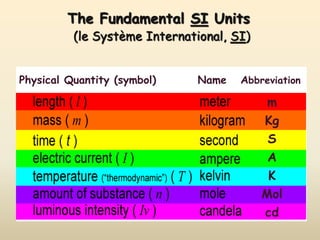
The Fundamental SI Units 
(le Système International, SI) 
Physical Quantity (symbol) Name Abbreviation 
m 
Kg 
S 
A 
K 
Mol 
cd
SI Definitions 
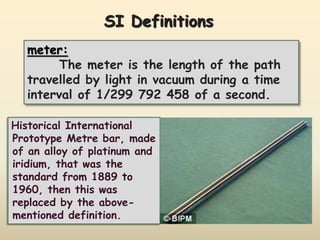
meter: 
The meter is the length of the path 
travelled by light in vacuum during a time 
interval of 1/299 792 458 of a second. 
Historical International 
Prototype Metre bar, made 
of an alloy of platinum and 
iridium, that was the 
standard from 1889 to 
1960, then this was 
replaced by the above-mentioned 
definition.
SI Definitions 
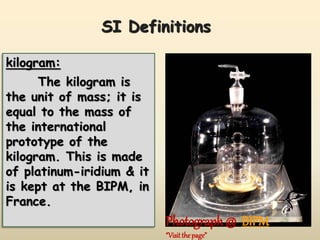
kilogram: 
The kilogram is 
the unit of mass; it is 
equal to the mass of 
the international 
prototype of the 
kilogram. This is made 
of platinum-iridium & it 
is kept at the BIPM, in 
France. 
Photograph @ BIPM 
“Visit the page”
SI Definitions 
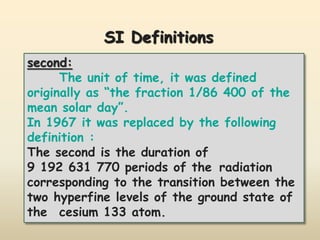
second: 
The unit of time, it was defined 
originally as “the fraction 1/86 400 of the 
mean solar day”. 
In 1967 it was replaced by the following 
definition : 
The second is the duration of 
9 192 631 770 periods of the radiation 
corresponding to the transition between the 
two hyperfine levels of the ground state of 
the cesium 133 atom.
SI Definitions 
ampere: 
The ampere is that constant current 
which, if maintained in two straight parallel 
conductors of infinite length, of negligible 
circular cross-section, and placed 1 meter 
apart in vacuum, would produce between 
these conductors a force equal to 2 x 10⁻⁷ 
newton per meter of length.
SI Definitions 
candela: 
The candela is the luminous 
intensity, in a given direction, of 
a source that emits 
monochromatic radiation of 
frequency 540 x 1012 hertz and 
that has a radiant intensity in 
that direction of 1/683 watt per 
steradian 
(http://en.wikipedia.org/wiki/Steradian)
SI Definitions 
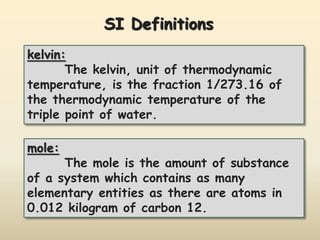
kelvin: 
The kelvin, unit of thermodynamic 
temperature, is the fraction 1/273.16 of 
the thermodynamic temperature of the 
triple point of water. 
mole: 
The mole is the amount of substance 
of a system which contains as many 
elementary entities as there are atoms in 
0.012 kilogram of carbon 12.
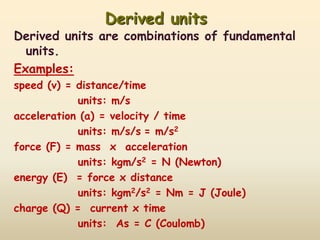
Derived units 
Derived units are combinations of fundamental 
units. 
Examples: 
speed (v) = distance/time 
units: m/s 
acceleration (a) = velocity / time 
units: m/s/s = m/s2 
force (F) = mass x acceleration 
units: kgm/s2 = N (Newton) 
energy (E) = force x distance 
units: kgm2/s2 = Nm = J (Joule) 
charge (Q) = current x time 
units: As = C (Coulomb)
SI Derived Units
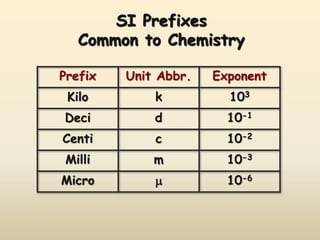
SI Prefixes 
Common to Chemistry 
Prefix Unit Abbr. Exponent 
Kilo k 103 
Deci d 10-1 
Centi c 10-2 
Milli m 10-3 
Micro  10-6
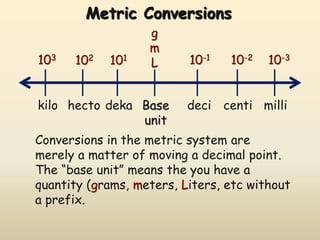
Metric Conversions 
g 
m 
103 102 101 L 10-1 10-2 10-3 
kilo hecto deka deci centi milli 
Base 
unit 
Conversions in the metric system are 
merely a matter of moving a decimal point. 
The “base unit” means the you have a 
quantity (grams, meters, Liters, etc without 
a prefix.
Metric Conversions 
g 
m 
103 102 101 L 10-1 10-2 10-3 
kilo hecto deka deci centi milli 
Base 
unit 
18 L 
1 2 3 
18 liters = 18 000 milliliters 
Example #1: Convert 18 liters to milliliters
Metric Conversions 
g 
m 
103 102 101 L 10-1 10-2 10-3 
kilo hecto deka deci centi milli 
Base 
unit 
3 2 1 
450 mg = 0.450 g 450 mg 
Example #2: Convert 450 milligrams to grams
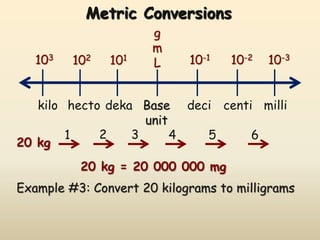
Metric Conversions 
g 
m 
103 102 101 L 10-1 10-2 10-3 
kilo hecto deka deci centi milli 
Base 
unit 
20 kg 
1 2 3 4 5 6 
20 kg = 20 000 000 mg 
Example #3: Convert 20 kilograms to milligrams

Si Units

  • 1.
    What is physics? Physics is a way of describing the physical world • 6th Century B.C. in the Greek city of Miletus (now in Turkey) a group of men called “physikoi” tried to answer questions about the natural world. Physics comes from the Greek word φύσης “physis” meaning “nature”, and the Latin word “physica” meaning natural things.
  • 2.
    Investigations in physicsgenerally follow the scientific method
  • 3.
    Units in Physics Some old measuring units
  • 4.
    • Physics experimentsinvolve the measurement of a variety of quantities. • These measurements should be accurate. • The first step in ensuring accuracy is defining the units in which the measurements are made.
  • 5.
    The Nature ofMeasurement A Measurement is a quantitative observation consisting of TWO parts Part 1 – number Part 2 - scale (unit) Examples: 20 grams 6.63 x 10⁻³⁴ Joules
  • 6.
    The Fundamental SIUnits (le Système International, SI) Physical Quantity (symbol) Name Abbreviation m Kg S A K Mol cd
  • 7.
    SI Definitions meter: The meter is the length of the path travelled by light in vacuum during a time interval of 1/299 792 458 of a second. Historical International Prototype Metre bar, made of an alloy of platinum and iridium, that was the standard from 1889 to 1960, then this was replaced by the above-mentioned definition.
  • 8.
    SI Definitions kilogram: The kilogram is the unit of mass; it is equal to the mass of the international prototype of the kilogram. This is made of platinum-iridium & it is kept at the BIPM, in France. Photograph @ BIPM “Visit the page”
  • 9.
    SI Definitions second: The unit of time, it was defined originally as “the fraction 1/86 400 of the mean solar day”. In 1967 it was replaced by the following definition : The second is the duration of 9 192 631 770 periods of the radiation corresponding to the transition between the two hyperfine levels of the ground state of the cesium 133 atom.
  • 10.
    SI Definitions ampere: The ampere is that constant current which, if maintained in two straight parallel conductors of infinite length, of negligible circular cross-section, and placed 1 meter apart in vacuum, would produce between these conductors a force equal to 2 x 10⁻⁷ newton per meter of length.
  • 11.
    SI Definitions candela: The candela is the luminous intensity, in a given direction, of a source that emits monochromatic radiation of frequency 540 x 1012 hertz and that has a radiant intensity in that direction of 1/683 watt per steradian (http://en.wikipedia.org/wiki/Steradian)
  • 12.
    SI Definitions kelvin: The kelvin, unit of thermodynamic temperature, is the fraction 1/273.16 of the thermodynamic temperature of the triple point of water. mole: The mole is the amount of substance of a system which contains as many elementary entities as there are atoms in 0.012 kilogram of carbon 12.
  • 13.
    Derived units Derivedunits are combinations of fundamental units. Examples: speed (v) = distance/time units: m/s acceleration (a) = velocity / time units: m/s/s = m/s2 force (F) = mass x acceleration units: kgm/s2 = N (Newton) energy (E) = force x distance units: kgm2/s2 = Nm = J (Joule) charge (Q) = current x time units: As = C (Coulomb)
  • 14.
  • 15.
    SI Prefixes Commonto Chemistry Prefix Unit Abbr. Exponent Kilo k 103 Deci d 10-1 Centi c 10-2 Milli m 10-3 Micro  10-6
  • 16.
    Metric Conversions g m 103 102 101 L 10-1 10-2 10-3 kilo hecto deka deci centi milli Base unit Conversions in the metric system are merely a matter of moving a decimal point. The “base unit” means the you have a quantity (grams, meters, Liters, etc without a prefix.
  • 17.
    Metric Conversions g m 103 102 101 L 10-1 10-2 10-3 kilo hecto deka deci centi milli Base unit 18 L 1 2 3 18 liters = 18 000 milliliters Example #1: Convert 18 liters to milliliters
  • 18.
    Metric Conversions g m 103 102 101 L 10-1 10-2 10-3 kilo hecto deka deci centi milli Base unit 3 2 1 450 mg = 0.450 g 450 mg Example #2: Convert 450 milligrams to grams
  • 19.
    Metric Conversions g m 103 102 101 L 10-1 10-2 10-3 kilo hecto deka deci centi milli Base unit 20 kg 1 2 3 4 5 6 20 kg = 20 000 000 mg Example #3: Convert 20 kilograms to milligrams