How will you determine if
one object moves?
Objective:
Describe the motion of an object in
terms of distance or displacement,
speed or velocity, and acceleration.
Motion in One Dimension
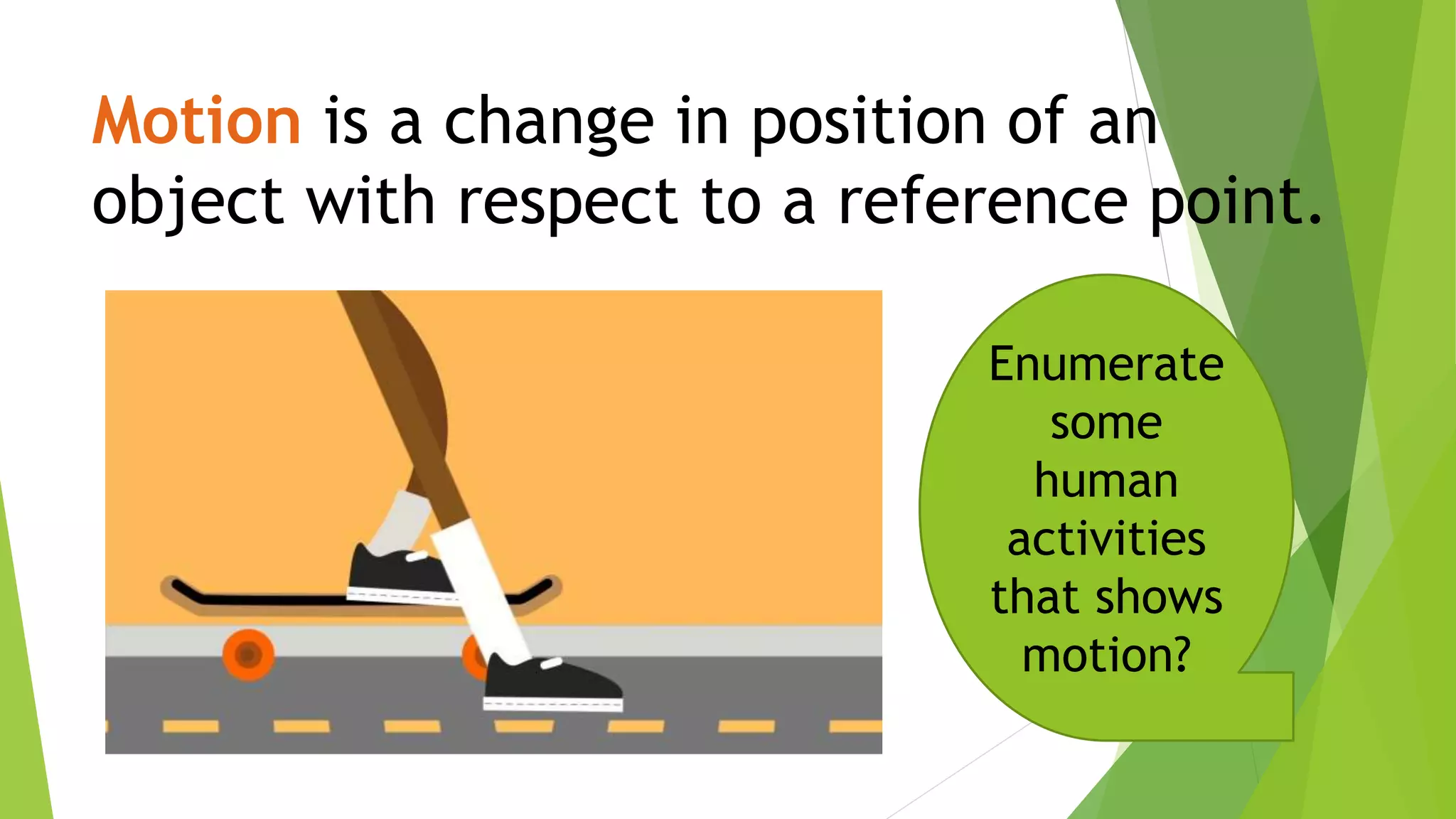
Motion is a change in position of an
object with respect to a reference point.
Enumerate
some
human
activities
that shows
motion?
Examples of Motion
People in the streets rush to get a ride
Children cannot keep still in their seats
Walking
Running
Draw it in your scratch 
Example:
The lady walks 10 m to the north,
then she turns and continues walking
30 m due east. How far did the lady
walked?
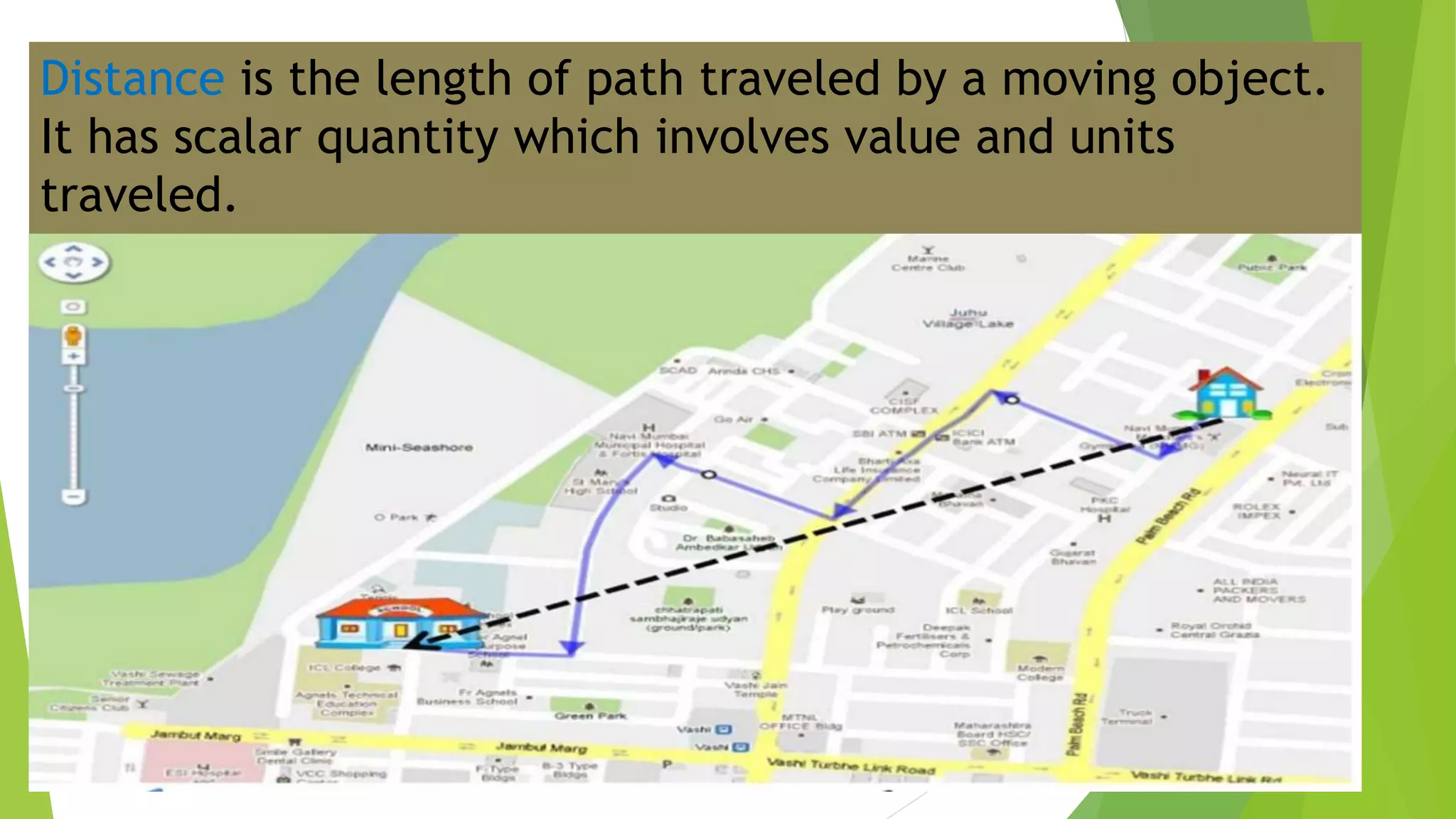
Distance is the length of path traveled by a moving object.
It has scalar quantity which involves value and units
traveled.
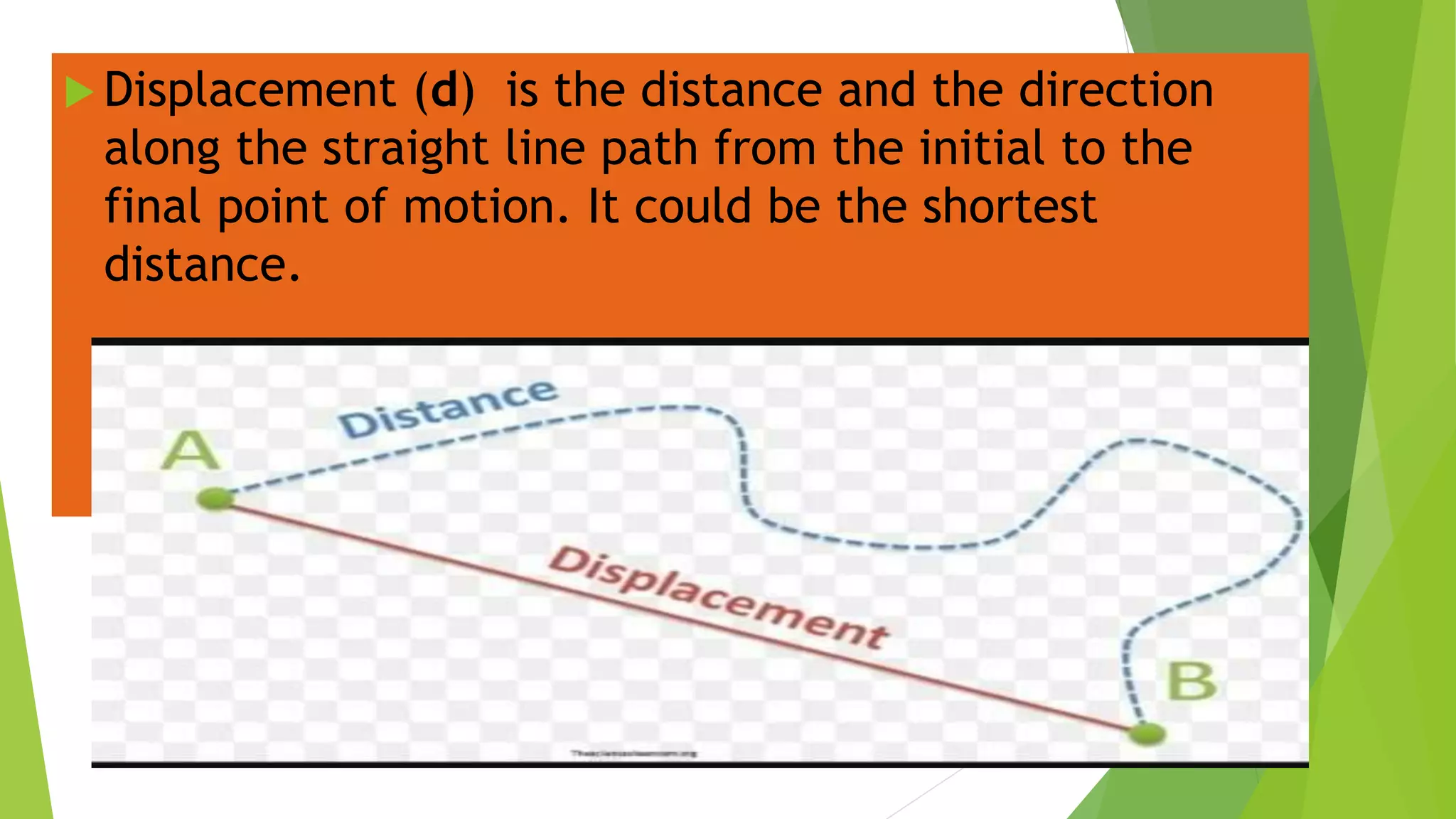
 Displacement (d) is the distance and the direction
along the straight line path from the initial to the
final point of motion. It could be the shortest
distance.
Example 1 of Displacement
 What is the displacement of the cross-country team if
they begin at the school, run 10 miles and finish back at
the school?
Answer: The displacement of the runners is 0 miles.
While they have covered a distance of 10 miles,
they are not "out of place" or displaced. They finish
where they started. Round-trip motions always
have a displacement of 0.
 A boy walks 10 meters east from A to B. Determine the
distance traveled and the displacement of the boy from her
starting point?
Example 2 of Displacement
Answer: Distance that the boy traveled is simply the
length of the path while the displacement not only the
magnitude of the path but also its direction.
Speed – describe the distance traveled per unit
time.
Who can still recall the formula of speed?
Speed = distance divided by
time
Speed – describe the distance traveled per unit
time.
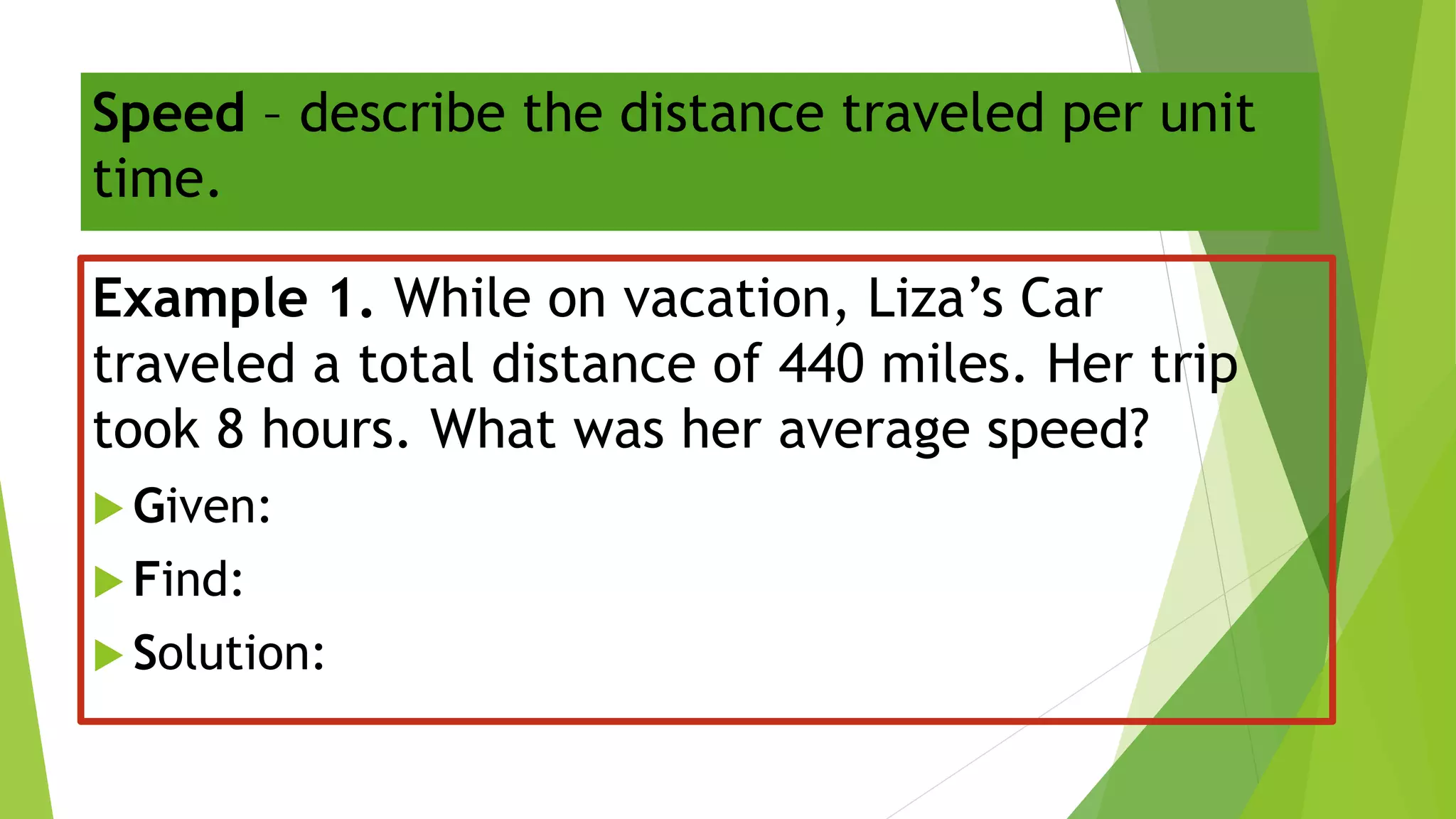
Example 1. While on vacation, Liza’s Car
traveled a total distance of 440 miles. Her trip
took 8 hours. What was her average speed?
 Given:
 Find:
 Solution:
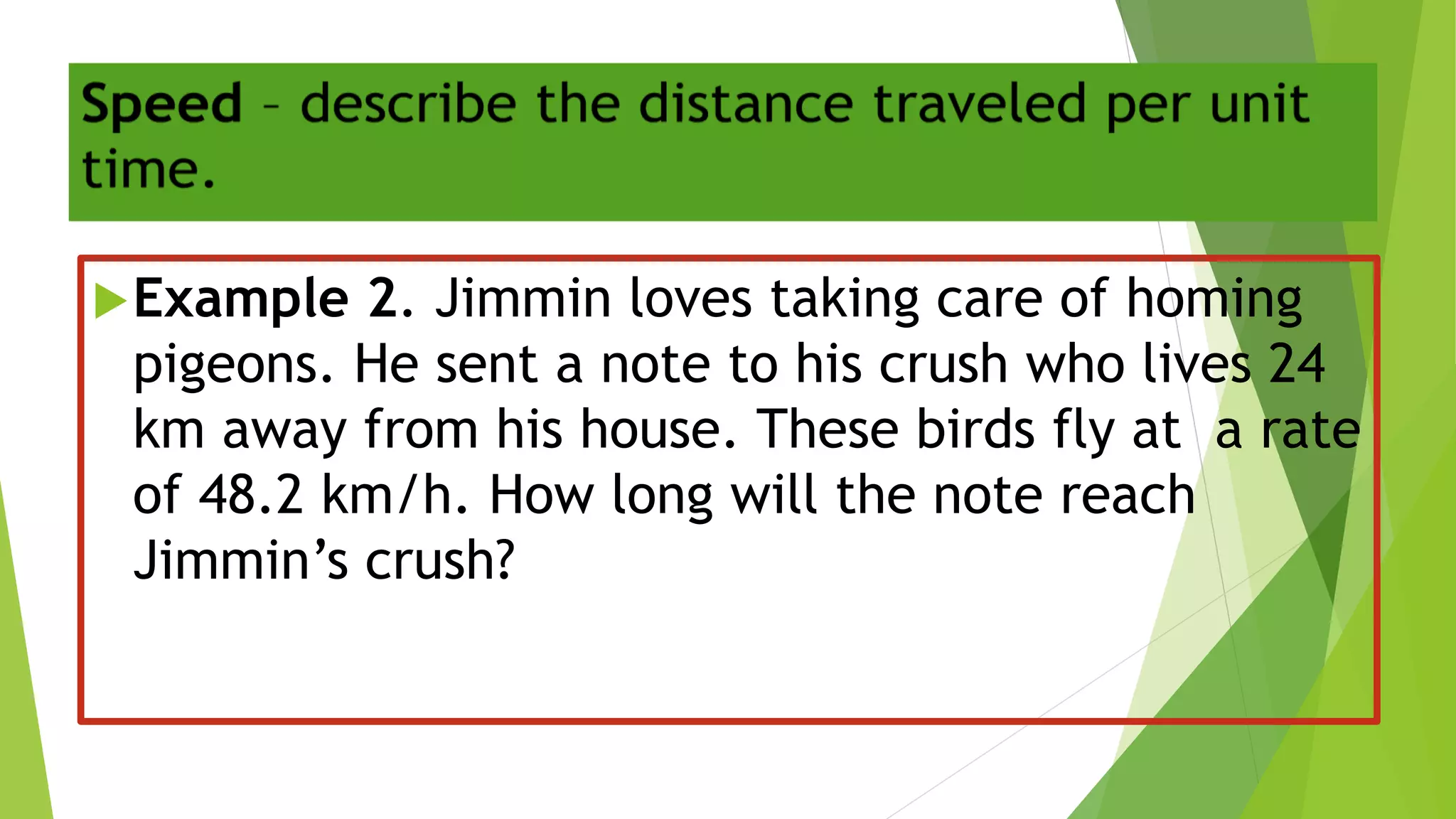
Example 2. Jimmin loves taking care of homing
pigeons. He sent a note to his crush who lives 24
km away from his house. These birds fly at a rate
of 48.2 km/h. How long will the note reach
Jimmin’s crush?
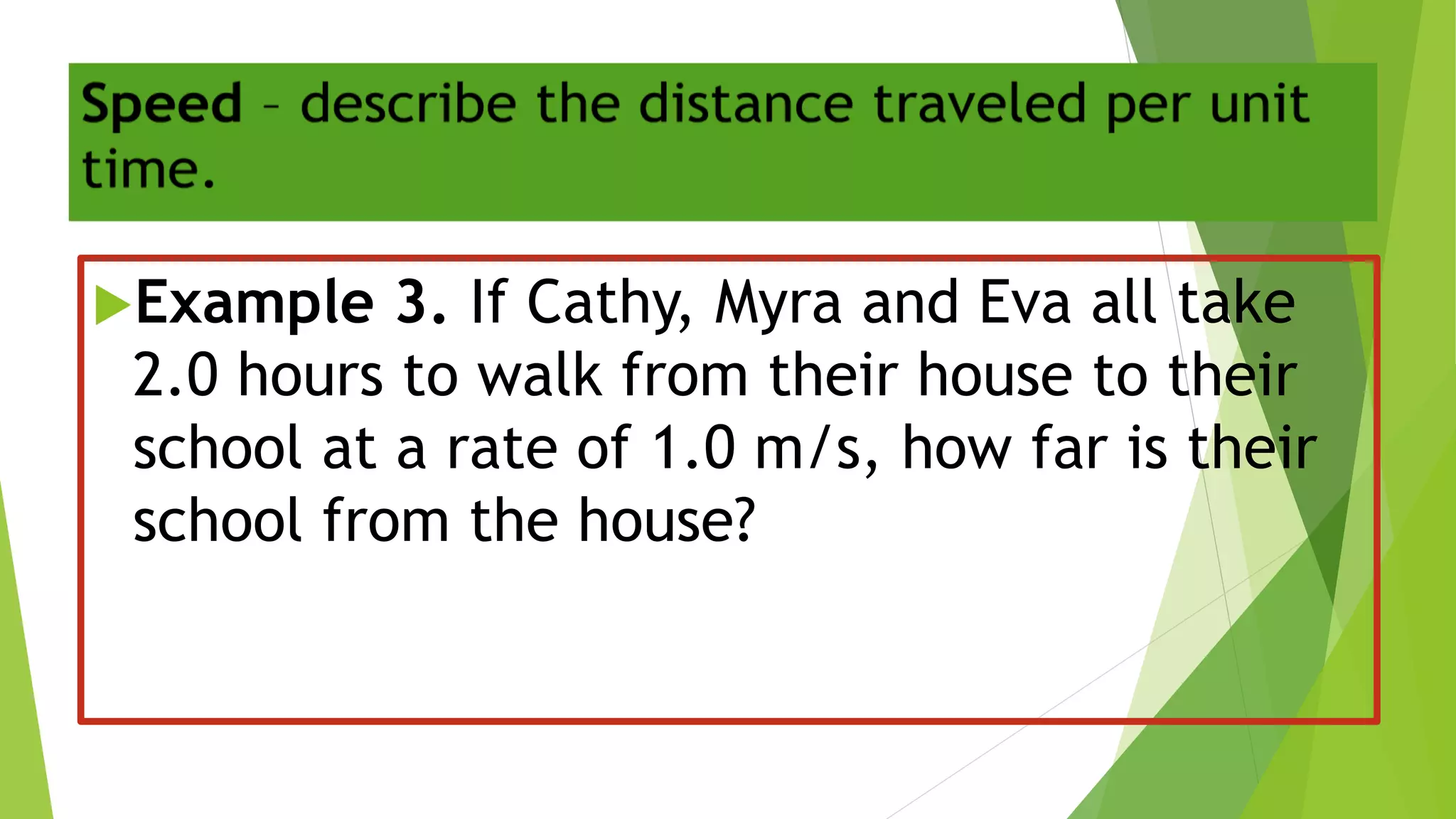
Example 3. If Cathy, Myra and Eva all take
2.0 hours to walk from their house to their
school at a rate of 1.0 m/s, how far is their
school from the house?
Instantaneous Speed
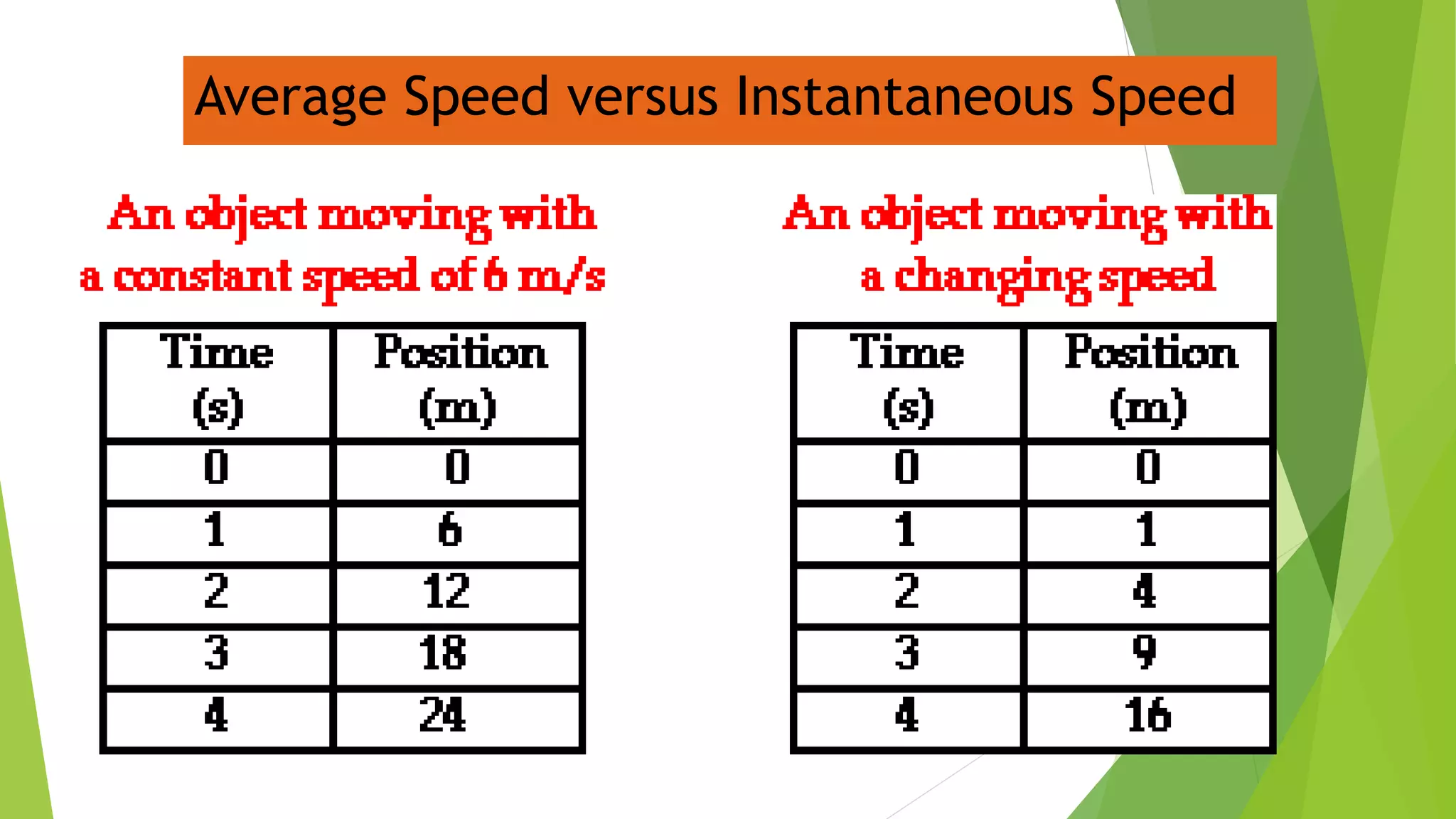
 During a typical trip to school, your car will undergo a series of changes in
its speed. If you were to inspect the speedometer readings at regular
intervals, you would notice that it changes often. The speedometer of a
car reveals information about the instantaneous speed of your car.
Average Speed versus Instantaneous Speed
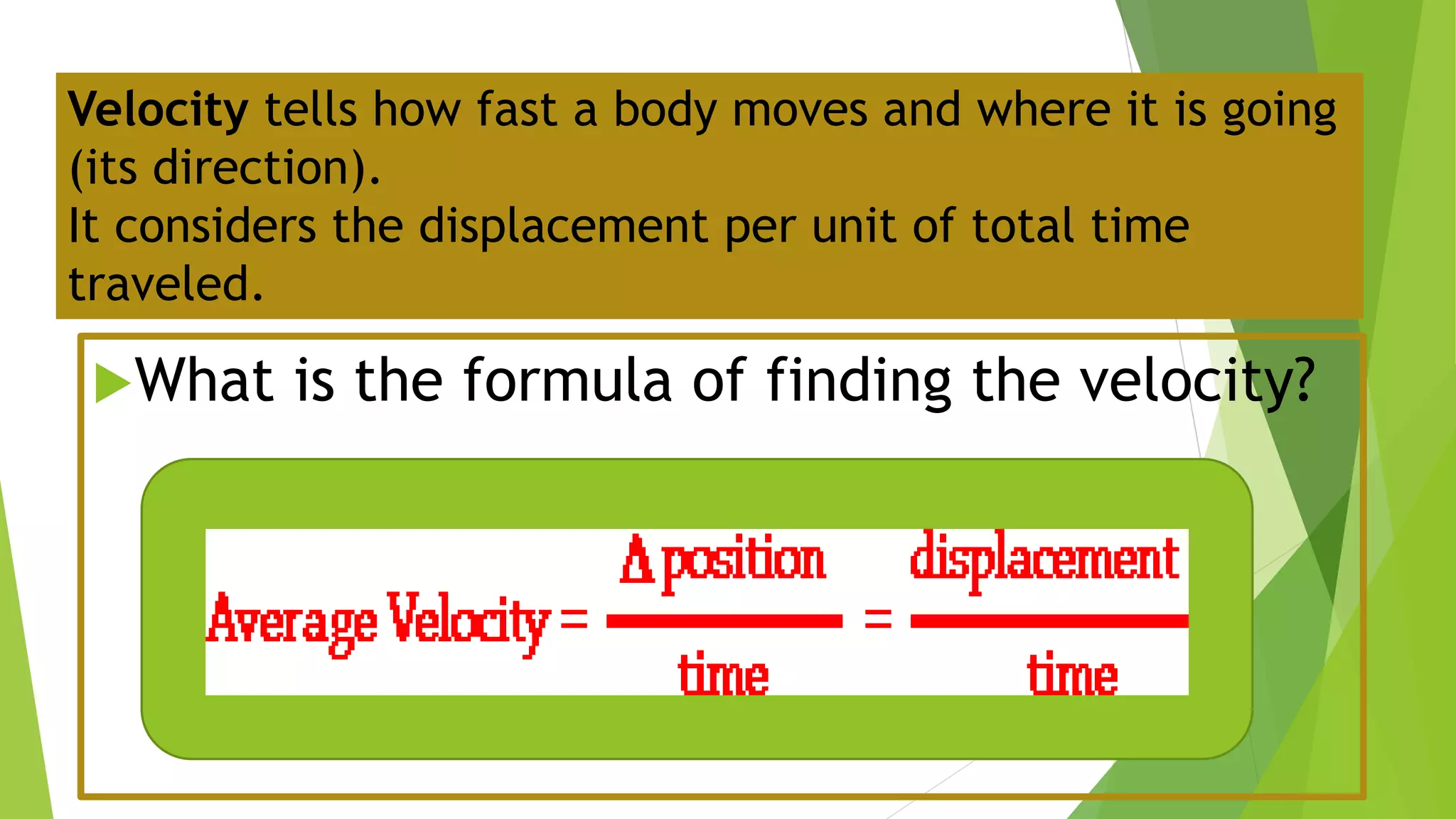
Velocity tells how fast a body moves and where it is going
(its direction).
It considers the displacement per unit of total time
traveled.
What is the formula of finding the velocity?
.
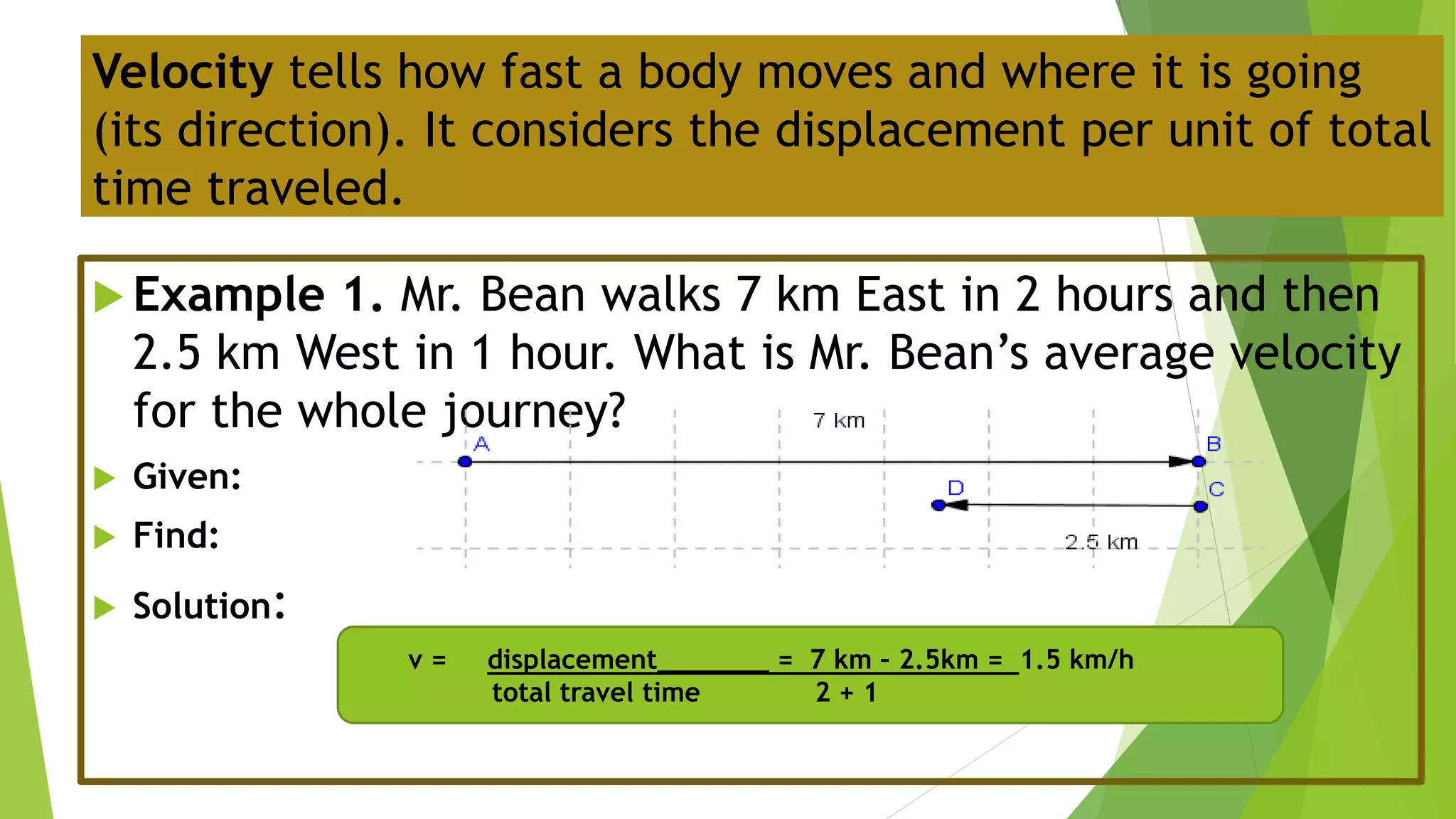
 Example 1. Mr. Bean walks 7 km East in 2 hours and then
2.5 km West in 1 hour. What is Mr. Bean’s average velocity
for the whole journey?
 Given:
 Find:
 Solution:
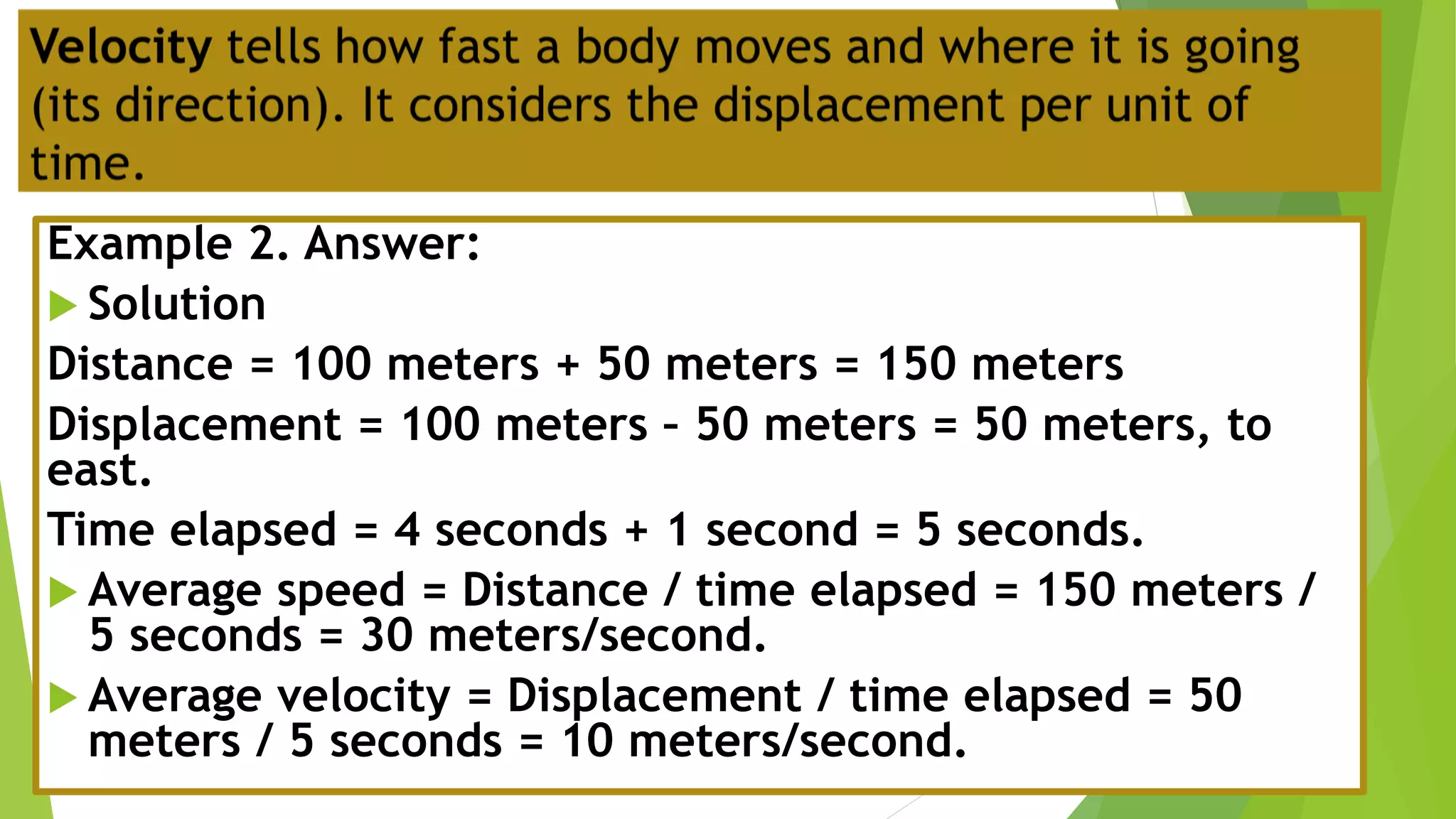
Velocity tells how fast a body moves and where it is going
(its direction). It considers the displacement per unit of total
time traveled.
 Example 1. Mr. Bean walks 7 km East in 2 hours and then
2.5 km West in 1 hour. What is Mr. Bean’s average velocity
for the whole journey?
 Given:
 Find:
 Solution:
Velocity tells how fast a body moves and where it is going
(its direction). It considers the displacement per unit of total
time traveled.
v = displacement_______ = 7 km – 2.5km = 1.5 km/h
total travel time 2 + 1
Example 2. A car travels along a straight road to the east
for 100 meters in 4 seconds, then go the west for 50
meters in 1 second. Determine average speed and
average velocity.
Given:
Find:
Solution:
Example 2. Answer:
 Solution
Distance = 100 meters + 50 meters = 150 meters
Displacement = 100 meters – 50 meters = 50 meters, to
east.
Time elapsed = 4 seconds + 1 second = 5 seconds.
 Average speed = Distance / time elapsed = 150 meters /
5 seconds = 30 meters/second.
 Average velocity = Displacement / time elapsed = 50
meters / 5 seconds = 10 meters/second.
Acceleration occurs when velocities change due to
the change of its speed or direction.
It measures in meters per second squared.
 What is the formula of finding the acceleration of the
moving object?
Acceleration occurs when velocities change due to
the change of its speed or direction.
It measures in meters per second squared.
Example 1. Martin rides a bicycle at 1.5 m/s south. Ten
seconds later, he is pedaling at 3.0 m/s south. What is
Martin’s acceleration?
 Given:
 Find:
 Solution:
Acceleration occurs when velocities change due to
the change of its speed or direction.
It measures in meters per second squared.
Example 2. Calculate the acceleration of a car from rest
that travels at 24 m/s due east in 30 seconds.
Given:
Find:
Solution:
QUIZ in 1 whole sheet of paper:
 1.What is the distance and the displacement of the race car drivers in
the Indy 500?
 2. If a driver takes 30 minutes to get to the town market, which is 1500
km away from his house, what is his average speed?
 3. If a bus traveling at 60 km/h will cover a distance of 600 km, how
many hours will it take to reach its destination?
 4. During a hard sneeze, your eyes might shut for 0.50 s. If you are
driving a car at 90 km/h during such a sneeze, how far does the care
move during that time?
 5. A car travels at uniform velocity a distance of 100 m in 4 seconds.
What is the velocity of the car? (Answer: 25 m/s)
II. Essay
How do you detect and measure
motion in your environment?
How can you make roads safer?
Answer to the Quiz:
 1.What is the distance and the displacement of the race car drivers in the Indy
500? -The displacement of the cars is somewhere near 0 miles since they virtually
finish where they started. Yet the successful cars have covered a distance of 500
miles
 2. If a driver takes 30 minutes to get to the town market, which is 1500 km away
from his house, what is his average speed?
 3. If a bus traveling at 60 km/h will cover a distance of 600 km, how many hours
will it take to reach its destination?
 4. During a hard sneeze, your eyes might shut for 0.50 s. If you are driving a car at
90 km/h during such a sneeze, how far does the care move during that time?
 5. A car travels at uniform velocity a distance of 100 m in 4 seconds. What is the
velocity of the car? (Answer: 25 m/s)
References:
 //www.real-world-physics-problems.com/velocity-problems.html
 www.physicsclassroom.com/mmedia/kinema/trip.cfm
 Exploring Life Through Science 2nd Edition by Pavico, et al., 2017, Phoenix
Publishing House, Inc.

Motion in One Dimension: Distance, Displacement, speed or velocity and acceleration

  • 1.
    How will youdetermine if one object moves?
  • 2.
    Objective: Describe the motionof an object in terms of distance or displacement, speed or velocity, and acceleration. Motion in One Dimension
  • 3.
    Motion is achange in position of an object with respect to a reference point. Enumerate some human activities that shows motion?
  • 4.
    Examples of Motion Peoplein the streets rush to get a ride Children cannot keep still in their seats Walking Running
  • 5.
    Draw it inyour scratch  Example: The lady walks 10 m to the north, then she turns and continues walking 30 m due east. How far did the lady walked?
  • 6.
    Distance is thelength of path traveled by a moving object. It has scalar quantity which involves value and units traveled.
  • 7.
     Displacement (d)is the distance and the direction along the straight line path from the initial to the final point of motion. It could be the shortest distance.
  • 8.
    Example 1 ofDisplacement  What is the displacement of the cross-country team if they begin at the school, run 10 miles and finish back at the school? Answer: The displacement of the runners is 0 miles. While they have covered a distance of 10 miles, they are not "out of place" or displaced. They finish where they started. Round-trip motions always have a displacement of 0.
  • 9.
     A boywalks 10 meters east from A to B. Determine the distance traveled and the displacement of the boy from her starting point? Example 2 of Displacement Answer: Distance that the boy traveled is simply the length of the path while the displacement not only the magnitude of the path but also its direction.
  • 10.
    Speed – describethe distance traveled per unit time. Who can still recall the formula of speed? Speed = distance divided by time
  • 11.
    Speed – describethe distance traveled per unit time. Example 1. While on vacation, Liza’s Car traveled a total distance of 440 miles. Her trip took 8 hours. What was her average speed?  Given:  Find:  Solution:
  • 12.
    Example 2. Jimminloves taking care of homing pigeons. He sent a note to his crush who lives 24 km away from his house. These birds fly at a rate of 48.2 km/h. How long will the note reach Jimmin’s crush?
  • 13.
    Example 3. IfCathy, Myra and Eva all take 2.0 hours to walk from their house to their school at a rate of 1.0 m/s, how far is their school from the house?
  • 14.
    Instantaneous Speed  Duringa typical trip to school, your car will undergo a series of changes in its speed. If you were to inspect the speedometer readings at regular intervals, you would notice that it changes often. The speedometer of a car reveals information about the instantaneous speed of your car.
  • 15.
    Average Speed versusInstantaneous Speed
  • 16.
    Velocity tells howfast a body moves and where it is going (its direction). It considers the displacement per unit of total time traveled. What is the formula of finding the velocity? .
  • 17.
     Example 1.Mr. Bean walks 7 km East in 2 hours and then 2.5 km West in 1 hour. What is Mr. Bean’s average velocity for the whole journey?  Given:  Find:  Solution: Velocity tells how fast a body moves and where it is going (its direction). It considers the displacement per unit of total time traveled.
  • 18.
     Example 1.Mr. Bean walks 7 km East in 2 hours and then 2.5 km West in 1 hour. What is Mr. Bean’s average velocity for the whole journey?  Given:  Find:  Solution: Velocity tells how fast a body moves and where it is going (its direction). It considers the displacement per unit of total time traveled. v = displacement_______ = 7 km – 2.5km = 1.5 km/h total travel time 2 + 1
  • 19.
    Example 2. Acar travels along a straight road to the east for 100 meters in 4 seconds, then go the west for 50 meters in 1 second. Determine average speed and average velocity. Given: Find: Solution:
  • 20.
    Example 2. Answer: Solution Distance = 100 meters + 50 meters = 150 meters Displacement = 100 meters – 50 meters = 50 meters, to east. Time elapsed = 4 seconds + 1 second = 5 seconds.  Average speed = Distance / time elapsed = 150 meters / 5 seconds = 30 meters/second.  Average velocity = Displacement / time elapsed = 50 meters / 5 seconds = 10 meters/second.
  • 21.
    Acceleration occurs whenvelocities change due to the change of its speed or direction. It measures in meters per second squared.  What is the formula of finding the acceleration of the moving object?
  • 22.
    Acceleration occurs whenvelocities change due to the change of its speed or direction. It measures in meters per second squared. Example 1. Martin rides a bicycle at 1.5 m/s south. Ten seconds later, he is pedaling at 3.0 m/s south. What is Martin’s acceleration?  Given:  Find:  Solution:
  • 23.
    Acceleration occurs whenvelocities change due to the change of its speed or direction. It measures in meters per second squared. Example 2. Calculate the acceleration of a car from rest that travels at 24 m/s due east in 30 seconds. Given: Find: Solution:
  • 24.
    QUIZ in 1whole sheet of paper:  1.What is the distance and the displacement of the race car drivers in the Indy 500?  2. If a driver takes 30 minutes to get to the town market, which is 1500 km away from his house, what is his average speed?  3. If a bus traveling at 60 km/h will cover a distance of 600 km, how many hours will it take to reach its destination?  4. During a hard sneeze, your eyes might shut for 0.50 s. If you are driving a car at 90 km/h during such a sneeze, how far does the care move during that time?  5. A car travels at uniform velocity a distance of 100 m in 4 seconds. What is the velocity of the car? (Answer: 25 m/s)
  • 25.
    II. Essay How doyou detect and measure motion in your environment? How can you make roads safer?
  • 26.
    Answer to theQuiz:  1.What is the distance and the displacement of the race car drivers in the Indy 500? -The displacement of the cars is somewhere near 0 miles since they virtually finish where they started. Yet the successful cars have covered a distance of 500 miles  2. If a driver takes 30 minutes to get to the town market, which is 1500 km away from his house, what is his average speed?  3. If a bus traveling at 60 km/h will cover a distance of 600 km, how many hours will it take to reach its destination?  4. During a hard sneeze, your eyes might shut for 0.50 s. If you are driving a car at 90 km/h during such a sneeze, how far does the care move during that time?  5. A car travels at uniform velocity a distance of 100 m in 4 seconds. What is the velocity of the car? (Answer: 25 m/s)
  • 27.
    References:  //www.real-world-physics-problems.com/velocity-problems.html  www.physicsclassroom.com/mmedia/kinema/trip.cfm Exploring Life Through Science 2nd Edition by Pavico, et al., 2017, Phoenix Publishing House, Inc.