Light – Wave or Particle
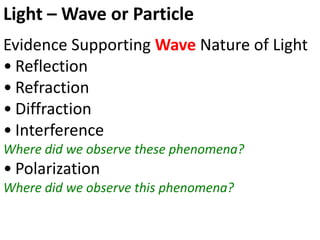
Evidence Supporting Wave Nature of Light
• Reflection
• Refraction
• Diffraction
• Interference
Where did we observe these phenomena?
• Polarization
Where did we observe this phenomena?
Light – Wave or Particle
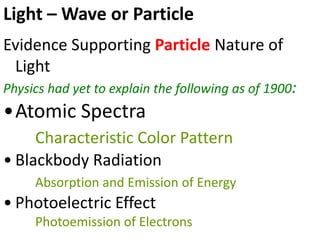
Evidence Supporting Particle Nature of
 Light
Physics had yet to explain the following as of 1900:
•Atomic Spectra
     Characteristic Color Pattern
• Blackbody Radiation
     Absorption and Emission of Energy
• Photoelectric Effect
     Photoemission of Electrons
Every element has its own signature
emission and absorption spectrum
Blackbody Radiation
A blackbody is an object/system that absorbs
  all radiation in which it comes in contact.

  Blackbody Radiation is the radiation emitted
 from a blackbody based only on temperature.
(usually associated with stars, we can measure
      temperature but not radiation levels)
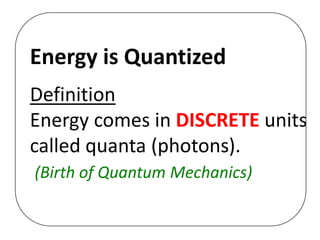
Energy is Quantized
Definition
Energy comes in DISCRETE units
called quanta (photons).
(Birth of Quantum Mechanics)
Photoelectric Effect
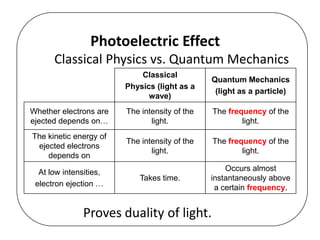
      Classical Physics vs. Quantum Mechanics
                            Classical
                                               Quantum Mechanics
                        Physics (light as a
                                                (light as a particle)
                              wave)
Whether electrons are   The intensity of the   The frequency of the
ejected depends on…            light.                  light.
The kinetic energy of
                        The intensity of the   The frequency of the
 ejected electrons
                               light.                  light.
    depends on

  At low intensities,                              Occurs almost
                            Takes time.        instantaneously above
 electron ejection …                            a certain frequency.


               Proves duality of light.
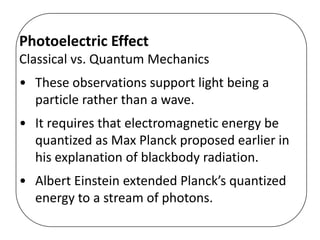
Photoelectric Effect
Classical vs. Quantum Mechanics
• These observations support light being a
  particle rather than a wave.
• It requires that electromagnetic energy be
  quantized as Max Planck proposed earlier in
  his explanation of blackbody radiation.
• Albert Einstein extended Planck’s quantized
  energy to a stream of photons.
Work Function
Definition
The minimum amount of energy required for an
electron to escape from a metal.

The value of the work function depends ONLY
on the metal.
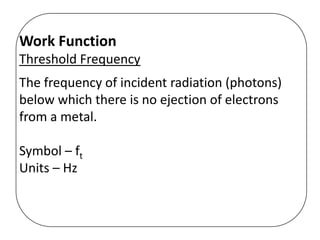
Work Function
Threshold Frequency
The frequency of incident radiation (photons)
below which there is no ejection of electrons
from a metal.

Symbol – ft
Units – Hz
Photoelectric Effect Explained:

           Light is going to hit the metal.
      If the frequency of the light is above the
    threshold frequency, then the loosely bound
electrons will be emitted (released from the metal).

 Metals with more loosely bound electrons
  will have a lower Threshold frequency,
 so it will require less energy to release the
                   Electrons.

Photoelectric effect ppt

  • 1.
    Light – Waveor Particle Evidence Supporting Wave Nature of Light • Reflection • Refraction • Diffraction • Interference Where did we observe these phenomena? • Polarization Where did we observe this phenomena?
  • 2.
    Light – Waveor Particle Evidence Supporting Particle Nature of Light Physics had yet to explain the following as of 1900: •Atomic Spectra Characteristic Color Pattern • Blackbody Radiation Absorption and Emission of Energy • Photoelectric Effect Photoemission of Electrons
  • 3.
    Every element hasits own signature emission and absorption spectrum
  • 4.
    Blackbody Radiation A blackbodyis an object/system that absorbs all radiation in which it comes in contact. Blackbody Radiation is the radiation emitted from a blackbody based only on temperature. (usually associated with stars, we can measure temperature but not radiation levels)
  • 5.
    Energy is Quantized Definition Energycomes in DISCRETE units called quanta (photons). (Birth of Quantum Mechanics)
  • 6.
  • 7.
    Photoelectric Effect Classical Physics vs. Quantum Mechanics Classical Quantum Mechanics Physics (light as a (light as a particle) wave) Whether electrons are The intensity of the The frequency of the ejected depends on… light. light. The kinetic energy of The intensity of the The frequency of the ejected electrons light. light. depends on At low intensities, Occurs almost Takes time. instantaneously above electron ejection … a certain frequency. Proves duality of light.
  • 8.
    Photoelectric Effect Classical vs.Quantum Mechanics • These observations support light being a particle rather than a wave. • It requires that electromagnetic energy be quantized as Max Planck proposed earlier in his explanation of blackbody radiation. • Albert Einstein extended Planck’s quantized energy to a stream of photons.
  • 9.
    Work Function Definition The minimumamount of energy required for an electron to escape from a metal. The value of the work function depends ONLY on the metal.
  • 10.
    Work Function Threshold Frequency Thefrequency of incident radiation (photons) below which there is no ejection of electrons from a metal. Symbol – ft Units – Hz
  • 11.
    Photoelectric Effect Explained: Light is going to hit the metal. If the frequency of the light is above the threshold frequency, then the loosely bound electrons will be emitted (released from the metal). Metals with more loosely bound electrons will have a lower Threshold frequency, so it will require less energy to release the Electrons.