Weight Maintenance
The STATS 60% of U.S. adults are overweight ~40% of these are obese Childhood obesity is on the rise Chronic diseases, morbidity, mortality associated with weight increasing
Energy Balance Positive energy balance: Energy in >  energy out Negative energy balance: Energy in <  energy out Energy balance: Energy in = energy out
Nutrients in Energy Balance CHO is first choice for energy use in body Fat is preferentially stored Excess CHO and protein in diet    decreased use of fat for energy and increased fat storage Animals in lab studies fed high-fat diets tend to gain more weight than controls
Questions? Why might higher fat intake contribute to fat storage and weight gain? Why does excess CHO and protein consumption contribute to fat storage and weight gain?
Energy Output Three factors: Basal metabolism (60-70%) Physical activity (up to 25-40%) Thermic effect of food (5-10%)
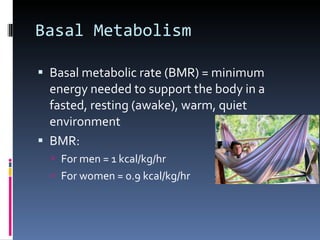
Basal Metabolism Basal metabolic rate (BMR) = minimum energy needed to support the body in a fasted, resting (awake), warm, quiet environment BMR: For men = 1 kcal/kg/hr For women = 0.9 kcal/kg/hr
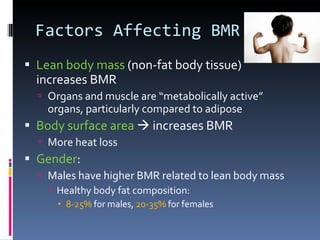
Factors Affecting BMR Lean body mass  (non-fat body tissue)  increases BMR Organs and muscle are “metabolically active” organs, particularly compared to adipose Body surface area    increases BMR More heat loss Gender : Males have higher BMR related to lean body mass Healthy body fat composition: 8-25%  for males,  20-35%  for females
Factors Affecting BMR Body temperature  (fever and cold)    increases BMR Fever/sweating and cold/shivering Thyroid hormones  directly increase BMR ??Why can hypothyroidism lead to weight gain?? Some  nervous system activity Age     decreased BMR (associated with diminished lean body mass)
Factors Affecting BMR Nutritional state Starvation    decreases BMR to conserve energy (up to 10-20%!) Dieting    decreases BMR to conserve energy ??When someone ends a diet program and returns to normal eating patterns, why is it easy to gain the weight back so quickly?? Pregnancy  increases BMR Caffeine  and  tobacco  use increases BMR ??Why should smoking cessation be accompanied by a weight control plan??
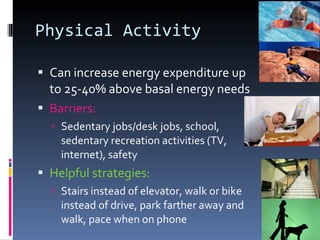
Physical Activity Can increase energy expenditure up to 25-40% above basal energy needs Barriers: Sedentary jobs/desk jobs, school, sedentary recreation activities (TV, internet), safety Helpful strategies: Stairs instead of elevator, walk or bike instead of drive, park farther away and walk, pace when on phone
Physical Activity Nonexercise activity thermogenesis Fidgeting increases energy expenditure In some people, overeating triggers involuntary fidgeting, maintenance of muscle tone and body posture
Thermic Effect of Food Energy required to digest, absorb, and use/metabolize food nutrients 5-10% of total energy expenditure TEF higher for CHO and protein-rich meals than for fat-rich meals Takes less energy to place absorbed fat into adipose stores than to metabolize CHO into glycogen and excess amino acids into fat
“ Healthy” Weight Fitness = ability to perform an activity without undue fatigue A sedentary person may be at higher risk for cardiovascular disease than a fit, overweight person Cultural “ideal” weight vs. “healthy” weight Can you think of ways that printed and digital media contribute to the perception of ideal body size in our culture?
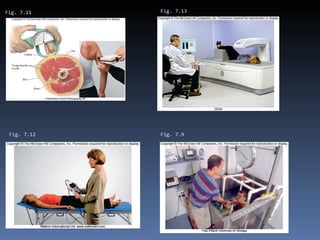
Determining Body Fat Composition Anthropometrics – skinfold thickness test Bioelectrical impedance – fat resists electrical flow Underwater weighing – gold standard, “fat floats” Bod Pod – air displacement, like UWW DEXA scan – full body x-ray scan
Fig. 7.11 Fig. 7.12 Fig. 7.13 Fig. 7.9
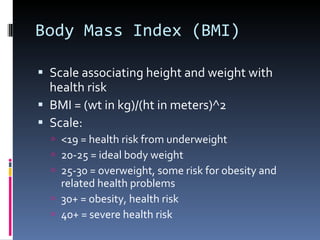
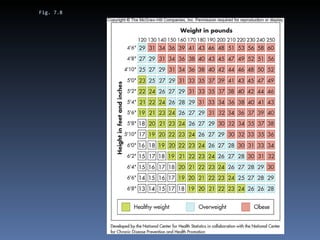
Body Mass Index (BMI) Scale associating height and weight with health risk BMI = (wt in kg)/(ht in meters)^2 Scale: <19 = health risk from underweight 20-25 = ideal body weight 25-30 = overweight, some risk for obesity and related health problems 30+ = obesity, health risk 40+ = severe health risk
Fig. 7.8
Problems Associated with Excess Body Fat Surgery risk, anesthesia needs, wound infections Pulmonary disease, sleep disorders Cardiovascular disease Hypertension Type 2 diabetes Bone and joint disorders Gallstones
Problems Associated with Excess Body Fat Skin disorders Decreased physical agility, increased risk for accidents and falls Some cancers (breast, colon, pancreas, gall bladder) Early puberty    short stature, complications in growth Menstrual irregularities, infertility Pregnancy risks Premature death
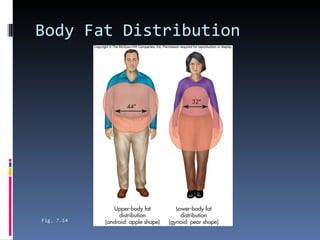
Body Fat Distribution Upper body (android or abdominal obesity) = “apple” shape Typical male pattern, encouraged by testosterone, alcohol, yo-yo dieting Higher health risk for cardiovascular disease, hypertension, type 2 diabetes Waist circumference over 40” for men, 35” for women Lower body (gynoid) = “pear” shape Characteristic female pattern Less health risk
Body Fat Distribution Fig. 7.14
Nature vs. Nurture Some genetic predisposition Environmental influences: Sedentary jobs Sedentary leisure activities Safety Time pressures Pre-prepared, processed convenience foods Overeating habits
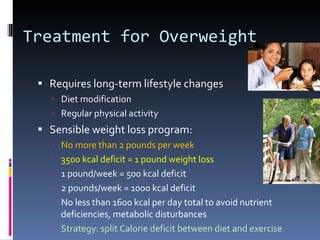
Treatment for Overweight Requires long-term lifestyle changes Diet modification Regular physical activity Sensible weight loss program: No more than 2 pounds per week 3500 kcal deficit = 1 pound weight loss 1 pound/week = 500 kcal deficit 2 pounds/week = 1000 kcal deficit No less than 1600 kcal per day total to avoid nutrient deficiencies, metabolic disturbances Strategy: split Calorie deficit between diet and exercise
Treatment for Overweight Commercial diet plans Only about 5% success rate Most regain weight in 3-5 years Weight cycling (“yo-yo dieting”)    increased risk for upper body fat accumulation, possibly lowered HDL, negative effect on emotions/self image
Treatment for Overweight Medical intervention: Rx – short-term only, sometimes do not work, severe side effects Very low Calorie diet – 400-800 kcal/day with most from high quality protein Requires careful MD monitoring May cause ketosis, heart problems, gallstones, nutrient deficiencies, metabolic disturbances Regain of weight possible Surgery – stomach “stapling” or bariatric surgery Permanent effect on GI system, metabolism, risk for nutrient deficiencies

Energy balance ch7

  • 1.
  • 2.
    The STATS 60%of U.S. adults are overweight ~40% of these are obese Childhood obesity is on the rise Chronic diseases, morbidity, mortality associated with weight increasing
  • 3.
    Energy Balance Positiveenergy balance: Energy in > energy out Negative energy balance: Energy in < energy out Energy balance: Energy in = energy out
  • 4.
    Nutrients in EnergyBalance CHO is first choice for energy use in body Fat is preferentially stored Excess CHO and protein in diet  decreased use of fat for energy and increased fat storage Animals in lab studies fed high-fat diets tend to gain more weight than controls
  • 5.
    Questions? Why mighthigher fat intake contribute to fat storage and weight gain? Why does excess CHO and protein consumption contribute to fat storage and weight gain?
  • 6.
    Energy Output Threefactors: Basal metabolism (60-70%) Physical activity (up to 25-40%) Thermic effect of food (5-10%)
  • 7.
    Basal Metabolism Basalmetabolic rate (BMR) = minimum energy needed to support the body in a fasted, resting (awake), warm, quiet environment BMR: For men = 1 kcal/kg/hr For women = 0.9 kcal/kg/hr
  • 8.
    Factors Affecting BMRLean body mass (non-fat body tissue) increases BMR Organs and muscle are “metabolically active” organs, particularly compared to adipose Body surface area  increases BMR More heat loss Gender : Males have higher BMR related to lean body mass Healthy body fat composition: 8-25% for males, 20-35% for females
  • 9.
    Factors Affecting BMRBody temperature (fever and cold)  increases BMR Fever/sweating and cold/shivering Thyroid hormones directly increase BMR ??Why can hypothyroidism lead to weight gain?? Some nervous system activity Age  decreased BMR (associated with diminished lean body mass)
  • 10.
    Factors Affecting BMRNutritional state Starvation  decreases BMR to conserve energy (up to 10-20%!) Dieting  decreases BMR to conserve energy ??When someone ends a diet program and returns to normal eating patterns, why is it easy to gain the weight back so quickly?? Pregnancy increases BMR Caffeine and tobacco use increases BMR ??Why should smoking cessation be accompanied by a weight control plan??
  • 11.
    Physical Activity Canincrease energy expenditure up to 25-40% above basal energy needs Barriers: Sedentary jobs/desk jobs, school, sedentary recreation activities (TV, internet), safety Helpful strategies: Stairs instead of elevator, walk or bike instead of drive, park farther away and walk, pace when on phone
  • 12.
    Physical Activity Nonexerciseactivity thermogenesis Fidgeting increases energy expenditure In some people, overeating triggers involuntary fidgeting, maintenance of muscle tone and body posture
  • 13.
    Thermic Effect ofFood Energy required to digest, absorb, and use/metabolize food nutrients 5-10% of total energy expenditure TEF higher for CHO and protein-rich meals than for fat-rich meals Takes less energy to place absorbed fat into adipose stores than to metabolize CHO into glycogen and excess amino acids into fat
  • 14.
    “ Healthy” WeightFitness = ability to perform an activity without undue fatigue A sedentary person may be at higher risk for cardiovascular disease than a fit, overweight person Cultural “ideal” weight vs. “healthy” weight Can you think of ways that printed and digital media contribute to the perception of ideal body size in our culture?
  • 15.
    Determining Body FatComposition Anthropometrics – skinfold thickness test Bioelectrical impedance – fat resists electrical flow Underwater weighing – gold standard, “fat floats” Bod Pod – air displacement, like UWW DEXA scan – full body x-ray scan
  • 16.
    Fig. 7.11 Fig.7.12 Fig. 7.13 Fig. 7.9
  • 17.
    Body Mass Index(BMI) Scale associating height and weight with health risk BMI = (wt in kg)/(ht in meters)^2 Scale: <19 = health risk from underweight 20-25 = ideal body weight 25-30 = overweight, some risk for obesity and related health problems 30+ = obesity, health risk 40+ = severe health risk
  • 18.
  • 19.
    Problems Associated withExcess Body Fat Surgery risk, anesthesia needs, wound infections Pulmonary disease, sleep disorders Cardiovascular disease Hypertension Type 2 diabetes Bone and joint disorders Gallstones
  • 20.
    Problems Associated withExcess Body Fat Skin disorders Decreased physical agility, increased risk for accidents and falls Some cancers (breast, colon, pancreas, gall bladder) Early puberty  short stature, complications in growth Menstrual irregularities, infertility Pregnancy risks Premature death
  • 21.
    Body Fat DistributionUpper body (android or abdominal obesity) = “apple” shape Typical male pattern, encouraged by testosterone, alcohol, yo-yo dieting Higher health risk for cardiovascular disease, hypertension, type 2 diabetes Waist circumference over 40” for men, 35” for women Lower body (gynoid) = “pear” shape Characteristic female pattern Less health risk
  • 22.
  • 23.
    Nature vs. NurtureSome genetic predisposition Environmental influences: Sedentary jobs Sedentary leisure activities Safety Time pressures Pre-prepared, processed convenience foods Overeating habits
  • 24.
    Treatment for OverweightRequires long-term lifestyle changes Diet modification Regular physical activity Sensible weight loss program: No more than 2 pounds per week 3500 kcal deficit = 1 pound weight loss 1 pound/week = 500 kcal deficit 2 pounds/week = 1000 kcal deficit No less than 1600 kcal per day total to avoid nutrient deficiencies, metabolic disturbances Strategy: split Calorie deficit between diet and exercise
  • 25.
    Treatment for OverweightCommercial diet plans Only about 5% success rate Most regain weight in 3-5 years Weight cycling (“yo-yo dieting”)  increased risk for upper body fat accumulation, possibly lowered HDL, negative effect on emotions/self image
  • 26.
    Treatment for OverweightMedical intervention: Rx – short-term only, sometimes do not work, severe side effects Very low Calorie diet – 400-800 kcal/day with most from high quality protein Requires careful MD monitoring May cause ketosis, heart problems, gallstones, nutrient deficiencies, metabolic disturbances Regain of weight possible Surgery – stomach “stapling” or bariatric surgery Permanent effect on GI system, metabolism, risk for nutrient deficiencies