Intermittent Fasting for
Weight-Loss and Wellness
Scheduled Eating as a Healthy, Sustainable and
Free Solution
© 2015 FoodCanWait.com
About Me
Disclaimer
• I am not a health professional or nutrition
expert.
• I am not offering medical advise.
• You should consult your doctor (I did).
© 2015 FoodCanWait.com
About Me
Expertise:
I’ve been there…
• Struggled with weight
most of my adult life
• Was an overeater and
emotional eater
• Loved (and still really
like) carbs
© 2015 FoodCanWait.com
About Me
Expertise:
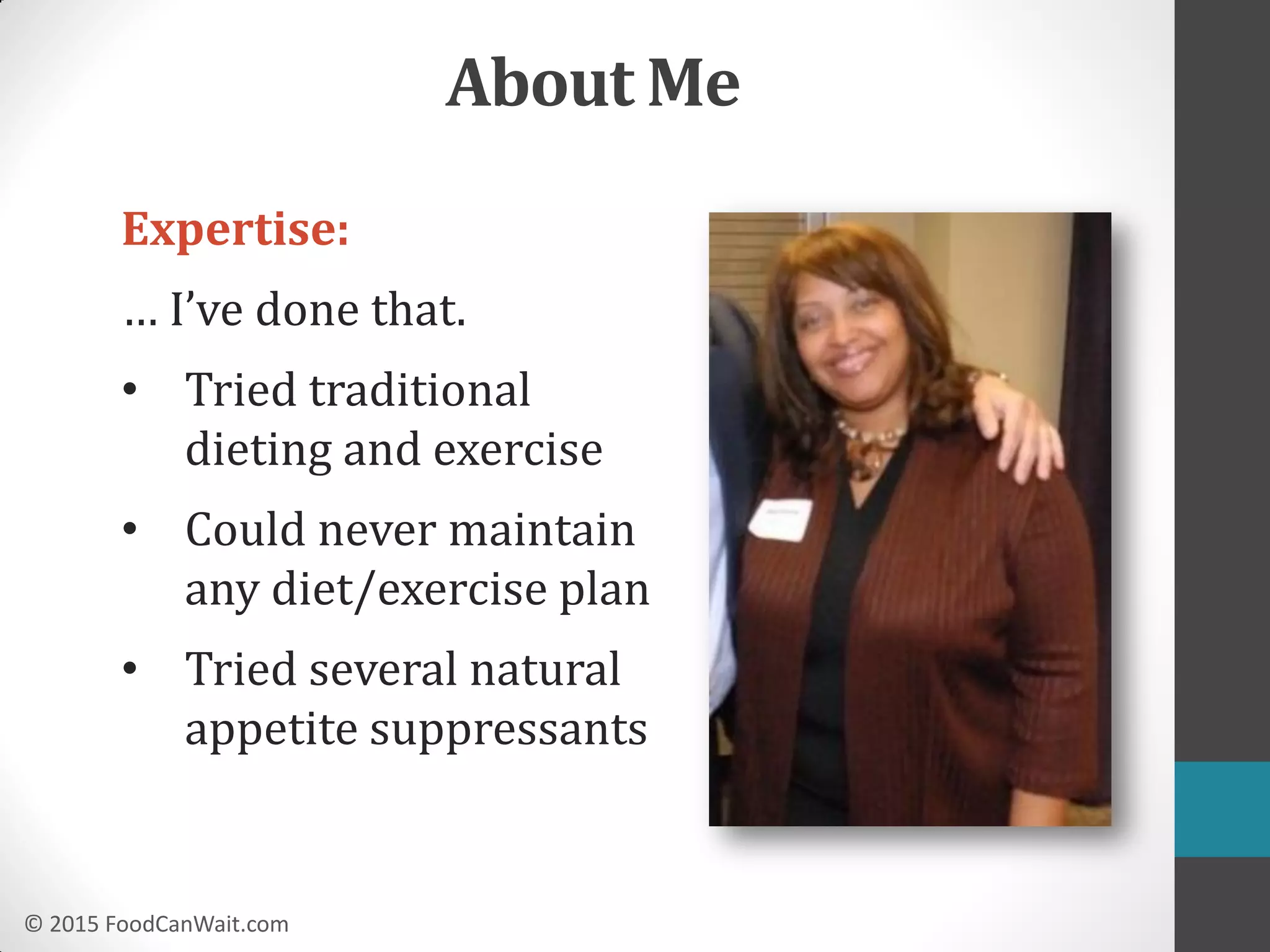
… I’ve done that.
• Tried traditional
dieting and exercise
• Could never maintain
any diet/exercise plan
• Tried several natural
appetite suppressants
© 2015 FoodCanWait.com
About Me
Expertise (Cont.):
I’m still “there”…
I began practicing daily
intermittent fasting on
July 1, 2014 at 237 lbs.
and a BMI of 39. I’ve
lost 67 lbs. to date.
Still working toward my
goal of being with a
“normal” weight range.
Before During
© 2015 FoodCanWait.com
About Me
• Adopted intermittent fasting as a permanent
lifestyle change
• Passionate about spreading the word about
intermittent fasting
• Started FoodCanWait.com (formerly
thedailyfastingblog.com)
in September of 2014
• Nothing to sell you and
no paid endorsements
to promote
© 2015 FoodCanWait.com
What is Intermittent Fasting?
© 2015 FoodCanWait.com
What is Intermittent Fasting?
Intermittent fasting (IF) is a term used to
describe various eating patterns that cycle
between scheduled periods of eating and not
eating (fasting).
Intermittent fasting is one form of caloric
restriction (CR) - a dietary regimen that is
based on low (or lower than previous) caloric
intake.
© 2015 FoodCanWait.com
What is Intermittent Fasting?
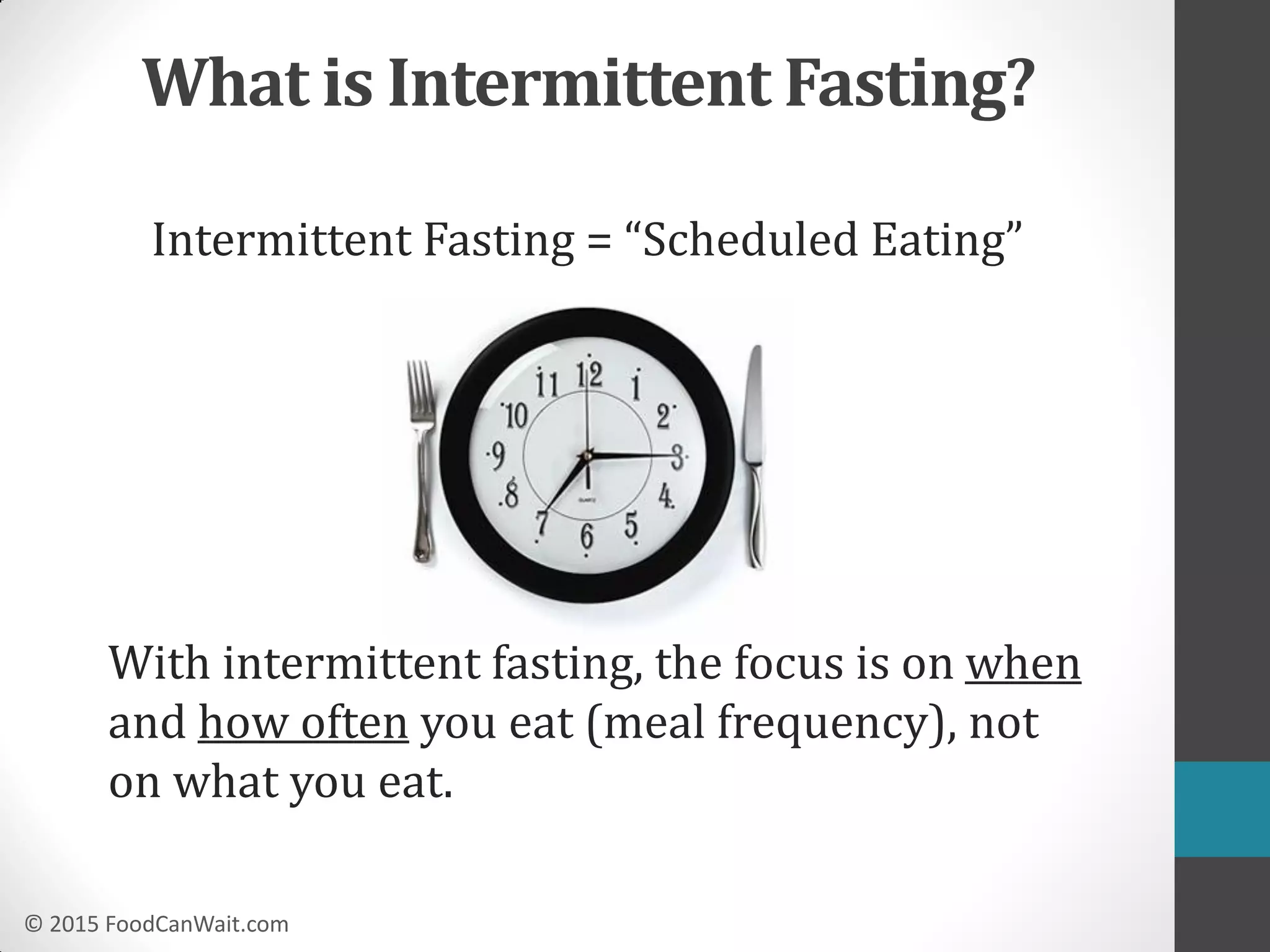
Intermittent Fasting = “Scheduled Eating”
With intermittent fasting, the focus is on when
and how often you eat (meal frequency), not
on what you eat.
© 2015 FoodCanWait.com
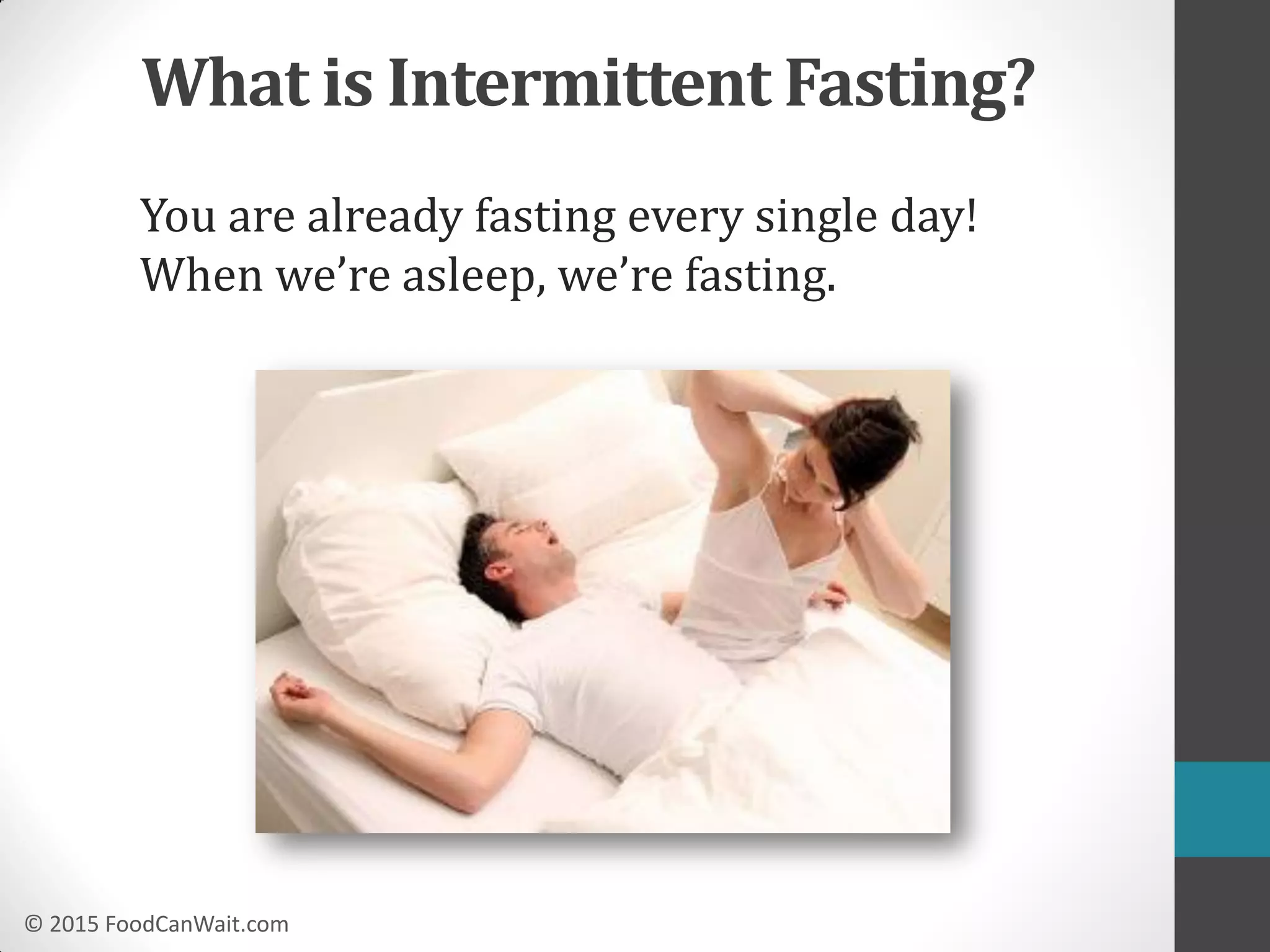
You are already fasting every single day!
When we’re asleep, we’re fasting.
What is Intermittent Fasting?
© 2015 FoodCanWait.com
WhatIntermittentFastingisNot
• Not a diet (in the traditional sense). No
calorie-counting and no forbidden foods)
• Not “starvation”
• Not a quick fix
• Not right for everyone - nothing is
• Not without side-effects
• Not a fad
What is Intermittent Fasting?
© 2015 FoodCanWait.com
What is Intermittent Fasting?
I fast for greater physical and mental efficiency.
~Plato
To lengthen thy life, lessen thy meals.
~Benjamin Franklin
The best of all medicines are rest and fasting.
~Benjamin Franklin
Fasting is the greatest remedy, the physician within.
~Paracelsus
© 2015 FoodCanWait.com
What is Intermittent Fasting?
There are three intermittent fasting protocols:
• Daily Fasting: Eating only within certain
hours of the day, everyday
• Alternate-Day Fasting (ADF): Fasting for
a few times per week, on non-consecutive
days, and eating “normally” on the other
days
• Random: Fasting every now and then (e.g.,
once per month, or once a year)
© 2015 FoodCanWait.com
The Science of IF
© 2015 FoodCanWait.com
QuestionstoExplore
What happens when we fast?
How can fasting help us lose
weight?
The Science of IF
© 2015 FoodCanWait.com
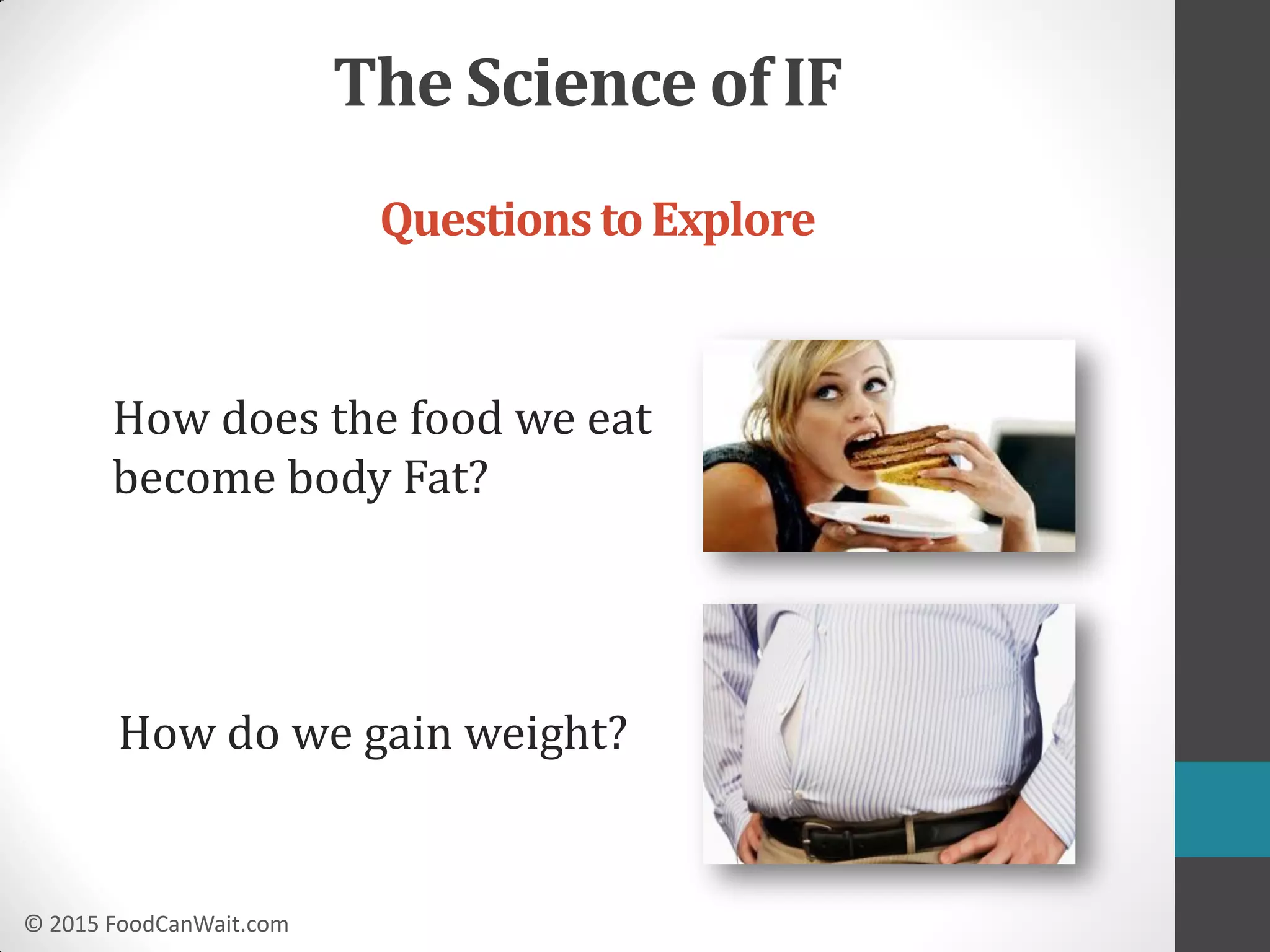
How do we gain weight?
How does the food we eat
become body Fat?
QuestionstoExplore
The Science of IF
© 2015 FoodCanWait.com
• Breakfast is the most important meal of
the day.
• You should eat several small meals a day
to rev up metabolism.
• Skipping meals is counterproductive to
weight-loss.
• IF is dangerous and/or ineffective,
especially for women, the
elderly, etc.
CommonBeliefs: NutritionFactorFiction?
The Science of IF
© 2015 FoodCanWait.com
How does the
food we eat
become body fat?
QuestionstoExplore
The Science of IF
© 2015 FoodCanWait.com
In order to
understand how
intermittent fasting
works, one of the
most fundamental
concepts we need to
grasp is metabolism
– how the body
converts food we eat
into the energy it
needs.
The Science of IF
© 2015 FoodCanWait.com
The Science of IF
They are three of human body's primary
sources of fuel.
Answer: What are carbohydrates, fat and protein?
© 2015 FoodCanWait.com
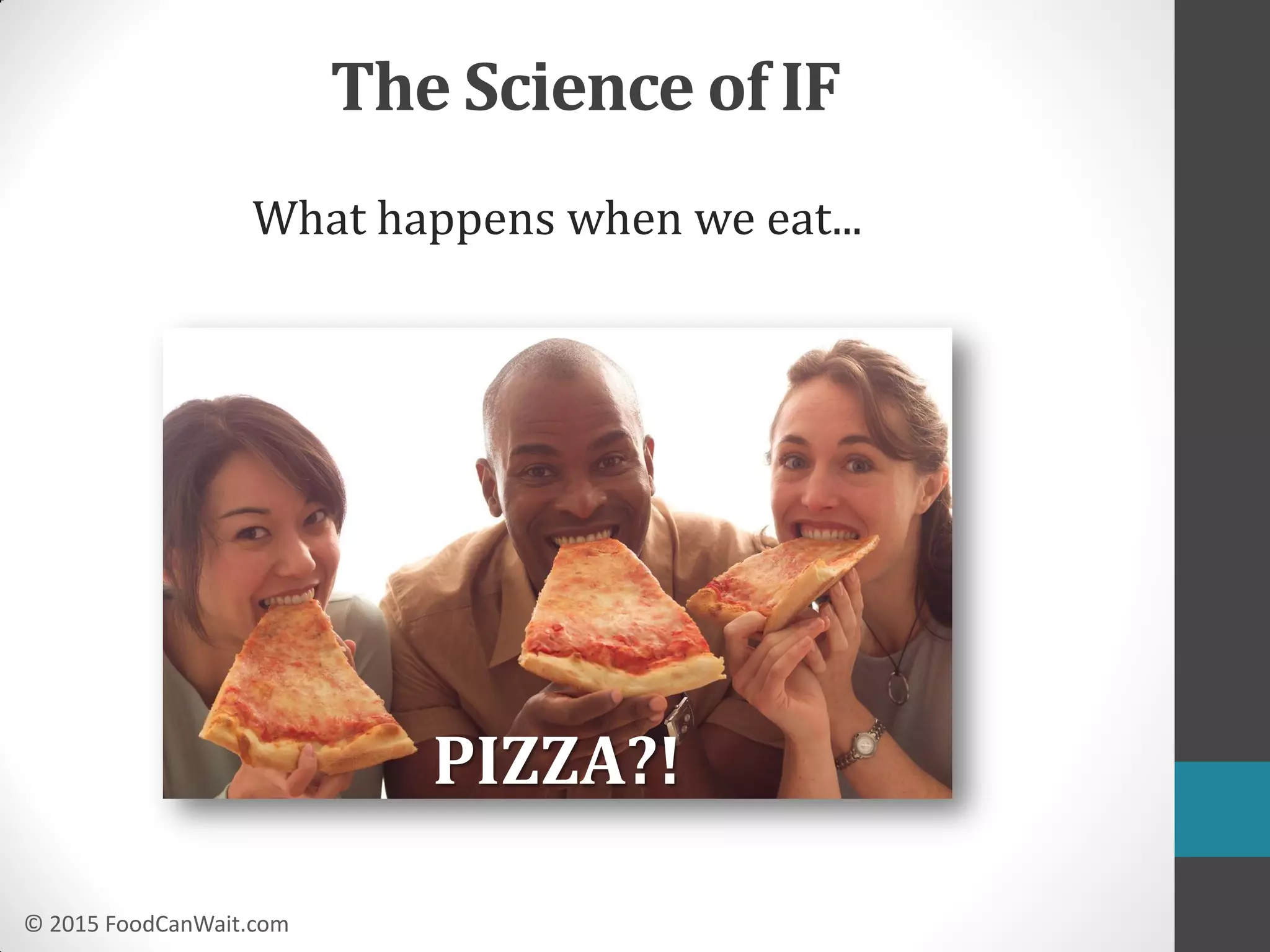
What happens when we eat...
The Science of IF
PIZZA?!
© 2015 FoodCanWait.com
How Food Becomes Body Fat*
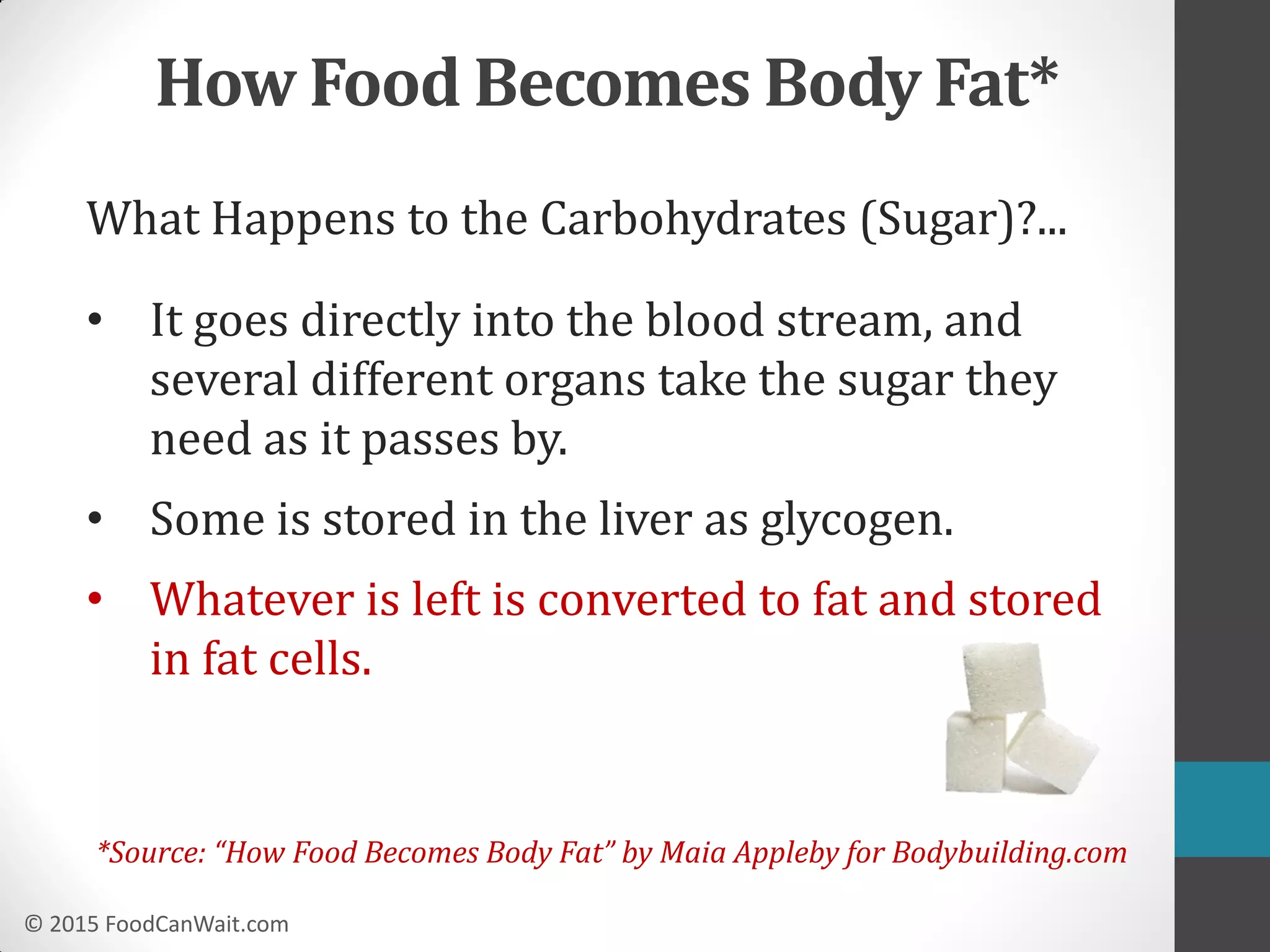
What Happens to the Carbohydrates (Sugar)?...
• It goes directly into the blood stream, and
several different organs take the sugar they
need as it passes by.
• Some is stored in the liver as glycogen.
• Whatever is left is converted to fat and stored
in fat cells.
*Source: “How Food Becomes Body Fat” by Maia Appleby for Bodybuilding.com
© 2015 FoodCanWait.com
What Happens to the Fat?...
• First, it goes into the blood stream and
travels to the liver.
• The liver burns some of the fat, converts
some to other substances (such as
cholesterol) and sends the rest to fat cells,
where they wait until they are needed.
How Food Becomes Body Fat
(Cont.)
© 2015 FoodCanWait.com
What Happens to the Protein?...
• It is broken down into building blocks
known as peptides, then further broken
down to become amino acids.
• The amino acids are absorbed through the
small intestine's lining and enter the blood
stream.
How Food Becomes Body Fat
(Cont.)
© 2015 FoodCanWait.com
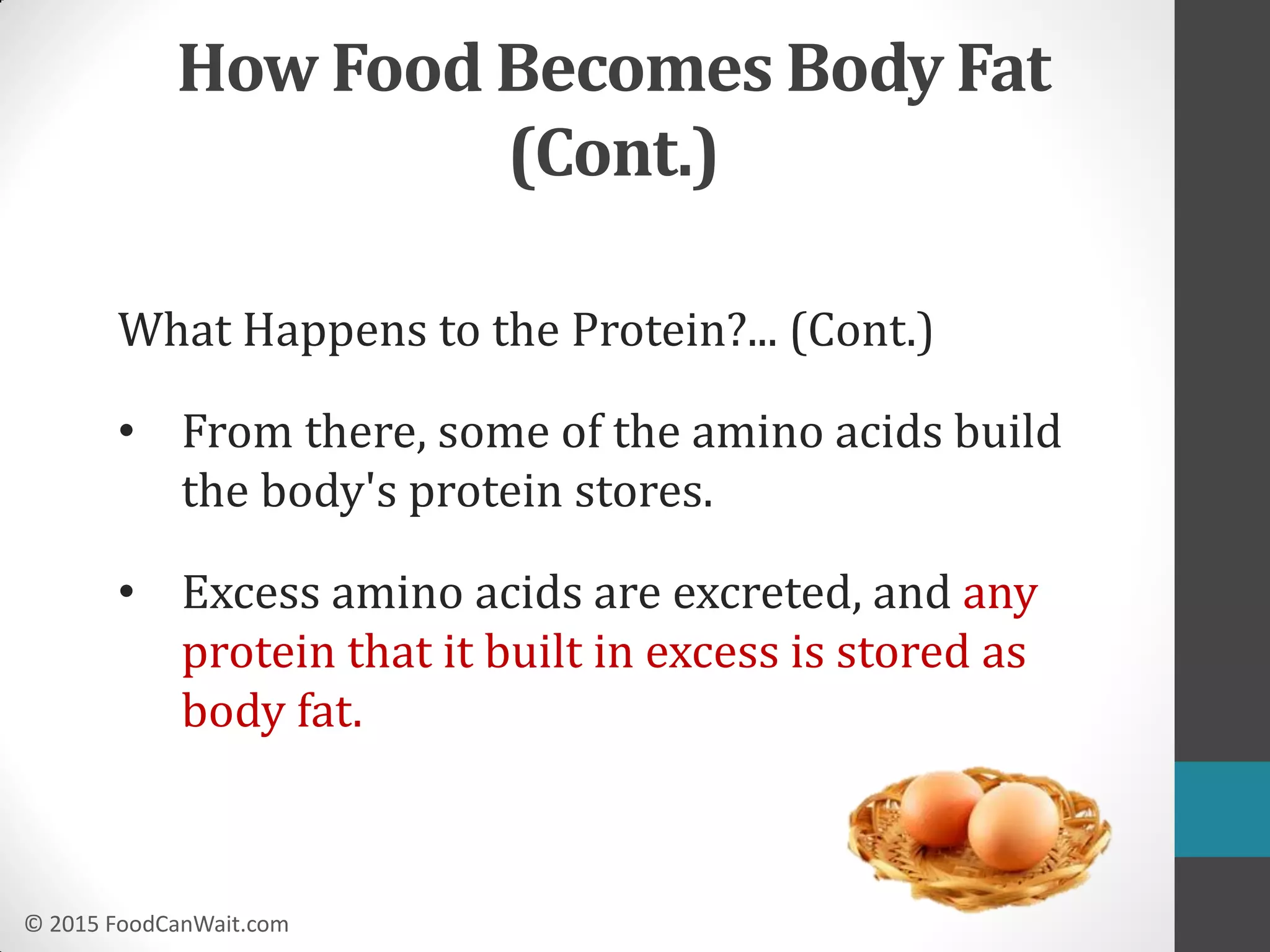
What Happens to the Protein?... (Cont.)
• From there, some of the amino acids build
the body's protein stores.
• Excess amino acids are excreted, and any
protein that it built in excess is stored as
body fat.
How Food Becomes Body Fat
(Cont.)
© 2015 FoodCanWait.com
Bottom Line
Consuming more food than what the body needs
will cause it to store body fat.
How Food Becomes Body Fat
(Cont.)
© 2015 FoodCanWait.com
Fat cells are like the
body’s refrigerator.
Your body takes
whatever it can't use
- carbohydrates, fat
or protein - and
sends it to fat cells
for later use.
How Food Becomes Body Fat
(Cont.)
“The Body’s Refrigerator”
© 2015 FoodCanWait.com
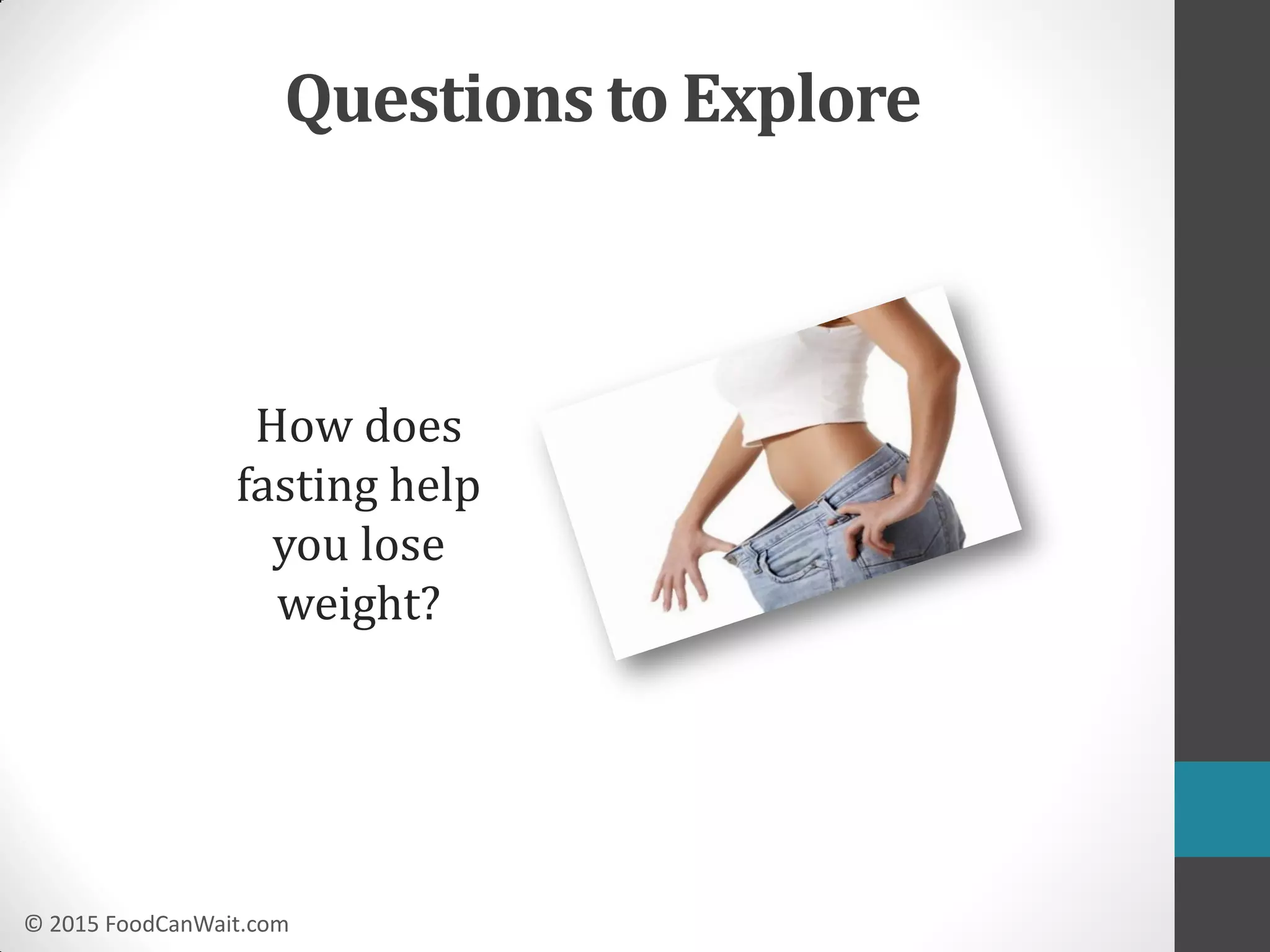
Questions to Explore
How does
fasting help
you lose
weight?
© 2015 FoodCanWait.com
The Science of IF
A key component of weight loss is creating a…
C _ _ _ _ _ _ D_ _ _ _ _ _
Answer: Caloric Deficit
© 2015 FoodCanWait.com
Typical Eating Schedule vs. IF
Breakfast
400 cal.
Lunch
600 cal.
Dinner
1000 cal.
Typical Schedule
Total = 2,350
Snack
150 cal.
Dessert
200 cal.
© 2015 FoodCanWait.com
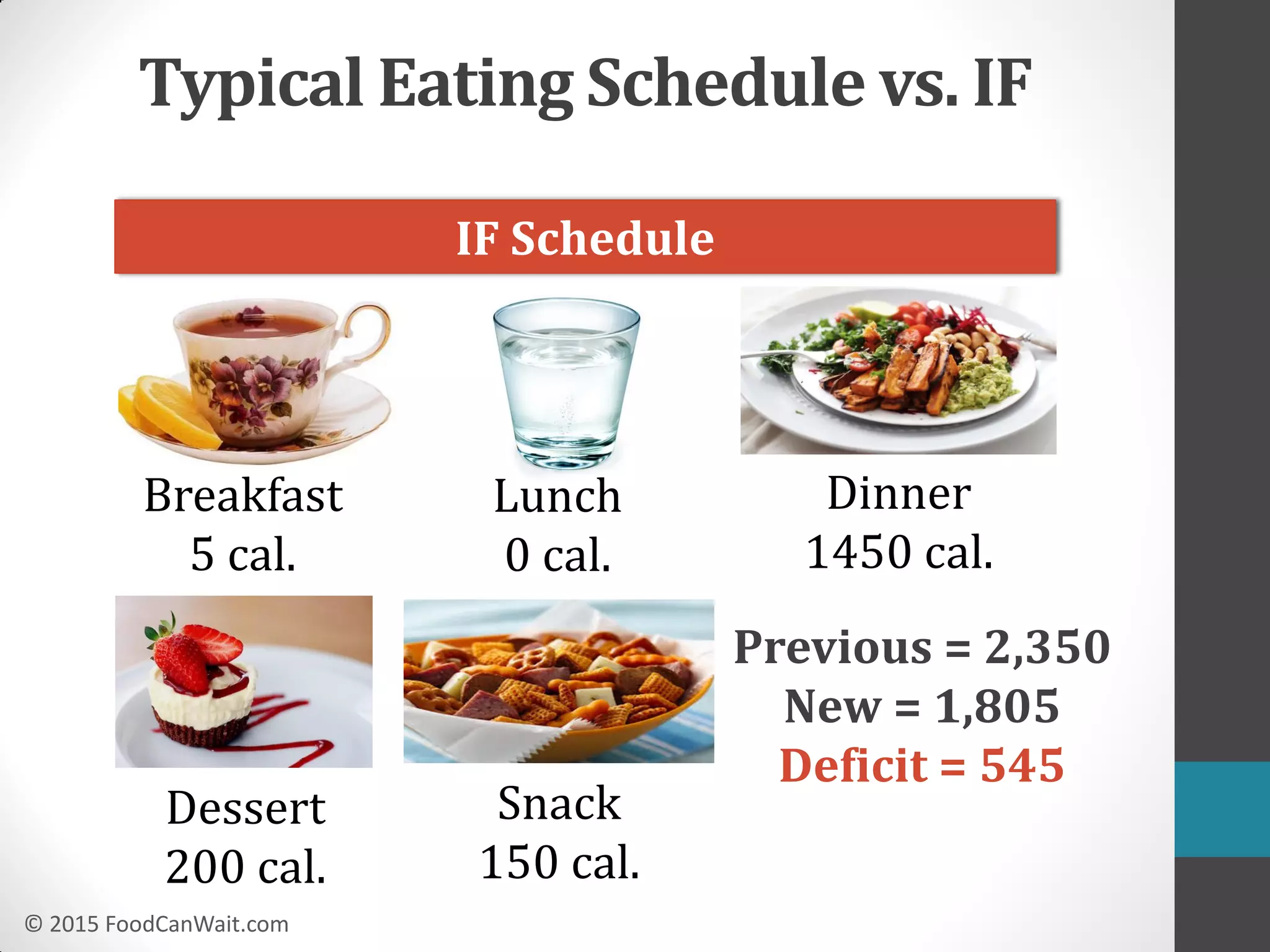
Typical Eating Schedule vs. IF
Breakfast
5 cal.
Lunch
0 cal.
Dinner
1450 cal.
IF Schedule
Previous = 2,350
New = 1,805
Deficit = 545
Snack
150 cal.
Dessert
200 cal.
© 2015 FoodCanWait.com
Theoretically*, in order to lose one pound of fat
per week , you should create a 3,500 weekly
calorie deficit.
545 daily caloric deficit x 7 days = 3,815 weekly
deficit. 1 lb. per week weight loss = 52 lbs. lost
per year (theoretically).
*Other factors include: Insulin levels, body
composition, activity level, age, hormones,
chronic diseases, medication, quality of
diet, etc.
Caloric Deficit (Cont.)
© 2015 FoodCanWait.com
Bottom Line
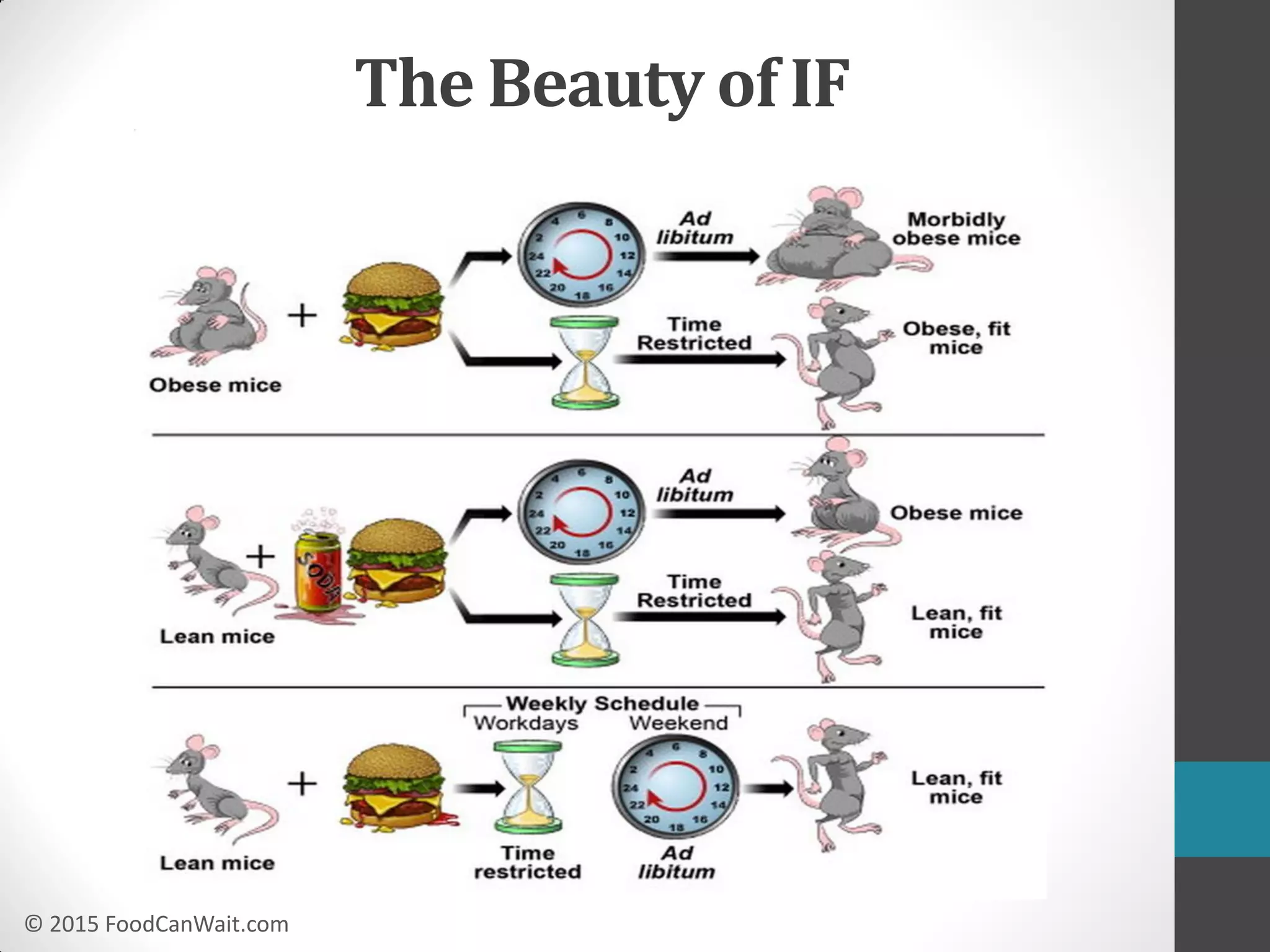
Intermittent fasting enables us to create a caloric
deficit without “dieting” or calorie-counting.
However, even without restricting calories, IF is
beneficial for weight loss, according to some
studies.
The Beauty of IF
© 2015 FoodCanWait.com
The Beauty of IF
© 2015 FoodCanWait.com
In addition to it’s weight-loss benefits, IF has
numerous other health benefits.*
The Science of IF
*Source: “10 Evidence-Based Health Benefits of Intermittent Fasting”
Kris Gunnars, AuthorityNutrition.com
© 2015 FoodCanWait.com
• Inflammation: Some studies have shown a
reduction in inflammation– a condition
linked to several chronic diseases including
asthma and rheumatoid arthritis.
• Insulin resistance:
IF may reduce insulin
resistance thus lowering
the risk of type 2 diabetes.
Health Benefits of IF
© 2015 FoodCanWait.com
• Brain Health: Intermittent fasting increases
BDNF. High BDNF is tied to lower Alzheimer's
risk.
• Cancer: Some animal studies suggest that
intermittent fasting may help prevent cancer.
• Anti-aging: Intermittent
fasting has been shown
to extend the lifespan
of rats by as much as 83%.
Health Benefits of IF
© 2015 FoodCanWait.com
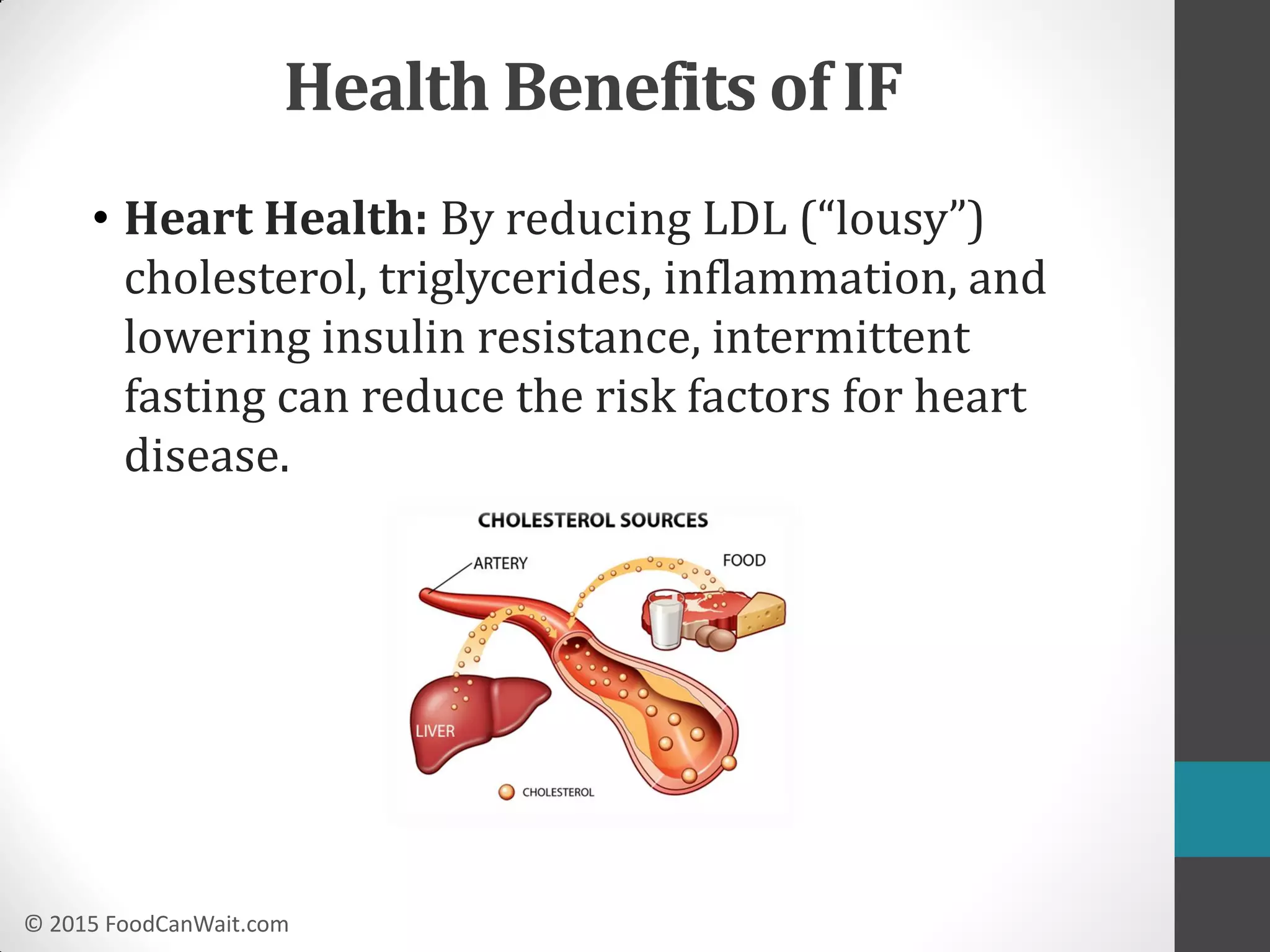
• Heart Health: By reducing LDL (“lousy”)
cholesterol, triglycerides, inflammation, and
lowering insulin resistance, intermittent
fasting can reduce the risk factors for heart
disease.
Health Benefits of IF
© 2015 FoodCanWait.com
The Science of IF
The condition produced when the body doesn't
have enough carbohydrates from food for cells
to burn for energy, so it burns fat instead.
Answer: What is ketosis?
© 2015 FoodCanWait.com
When your body becomes
efficient at switching from
mostly burning glucose to
mostly burning stored fat as
fuel you have become “fat-
adapted.”
Some people experience
side-effects while becoming
fat-adapted including
dizziness, “brain fog,” and,
of course, hunger.
The Science of IF
© 2015 FoodCanWait.com
The Science of IF
Derived from the Greek word “phagein, "to
eat“; It’s the body’s catabolic cellular clean-up
mechanism.
Answer: What is autophagy?
© 2015 FoodCanWait.com
IF triggers autophagy – recognized as a crucial
defense mechanism against malignancy, infection
and neurodegenerative diseases.
The Science of IF
© 2015 FoodCanWait.com
Autophagy is a process of cellular self-digestion.
Through autophagy, starving cells degrade
materials within their own cells to provide
necessary nutrients for more essential
processes.
Autophagy is the way
our cells “clean house”
and “recycle the trash”.
The Science of IF
*Source: “Autophagy – The Housekeeper in Every Cell that Fights Aging”
James P Watson and Vince Giuliano
© 2015 FoodCanWait.com
In Summary…
“…beneficial effects of fasting are supported by
observational data and abundant evidence
from experimental research which found
caloric restriction and intermittent fasting
being associated with deceleration or
prevention of most chronic degenerative and
chronic inflammatory diseases."
–Andreas Michalsen
The Science of IF
© 2015 FoodCanWait.com
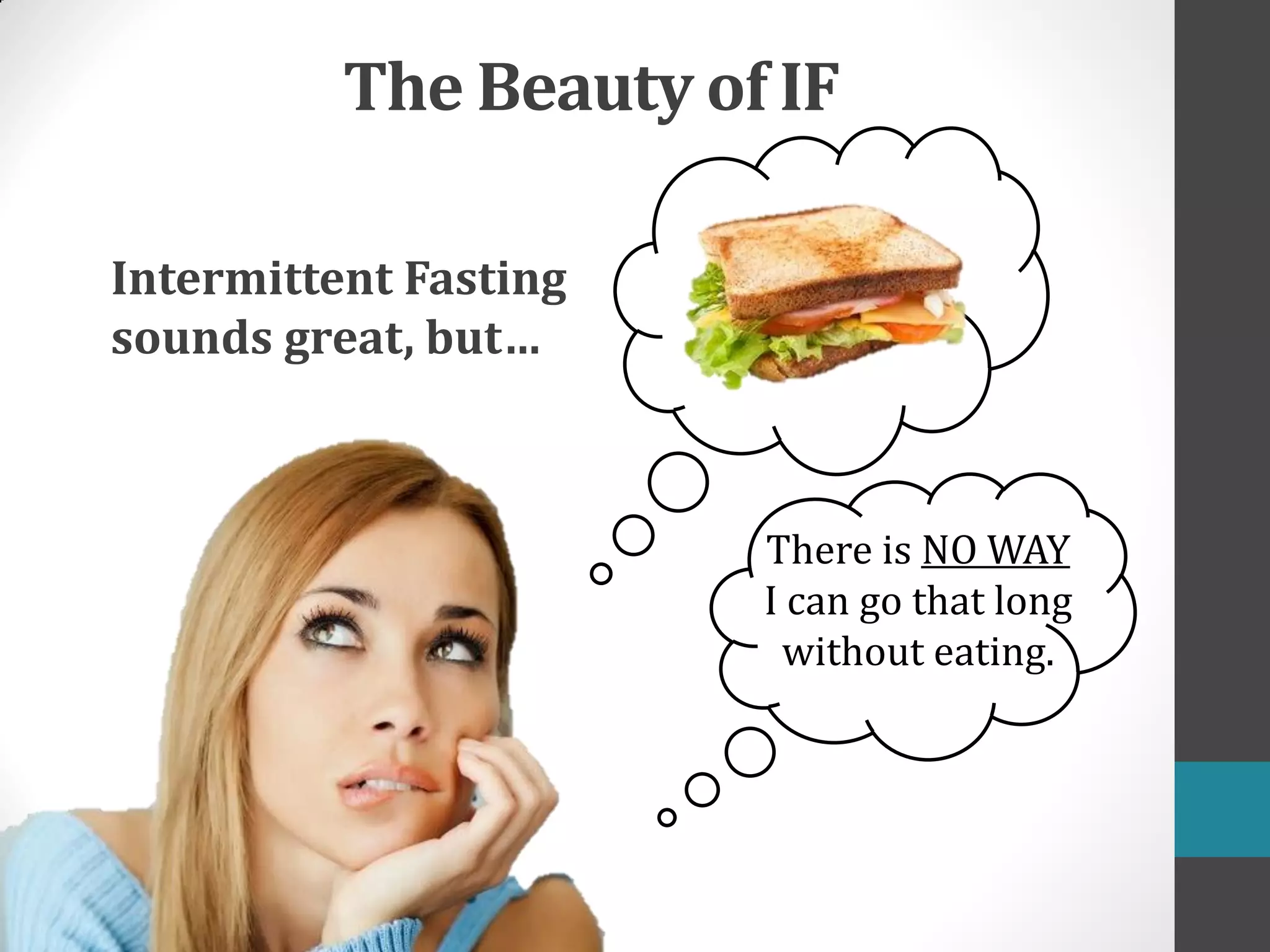
Intermittent Fasting
sounds great, but…
There is NO WAY
I can go that long
without eating.
The Beauty of IF
© 2015 FoodCanWait.com
Remember, youarealreadypracticing
dailyintermittentfasting!
The Beauty of IF
© 2015 FoodCanWait.com
Intermittent Fasting can normalize appetite!
After becoming accustomed to IF, you are likely
to experience “appetite correction”:
• Less of an urge to eat all day
• Lessened (or eliminated) cravings
• Less tendency to overeat within your window
• Tendency to eat healthier
• More refined palette
The Beauty of IF
© 2015 FoodCanWait.com
Four Steps to Get Started
 Learn the science of IF
2. Choose the type of IF that’s right for you
3. Choose your eating window
4. Tweak your diet if needed
How to Get Started?
© 2015 FoodCanWait.com
What is Intermittent Fasting?
What constitutes a fast varies by the fasting
protocol. Examples include:
• No food or water (dry fast)
• Zero-calorie beverages, but no food
• Less than 40 calories total (e.g., a teaspoon
of lemon in tea is permitted)
• Foods that do not trigger a significant insulin
response (e.g., whey protein, berries)
• Less than 500 calories
© 2015 FoodCanWait.com
What is Intermittent Fasting?
What method you succeed with may largely
depend on what does or does not trigger
“limbic hunger” for you, which varies by
individual.
Limbic hunger is a combination of emotional,
hormonal and psychological factors that cause
craving for food despite not being in a state of
true hunger.
© 2015 FoodCanWait.com
What is Intermittent Fasting?
Chewing gum
Cream in coffee
Lemon in tea
Drinking water
Consuming 10 calories
Time of day
Cooking for others
Boredom
Common Limbic Hunger Triggers
© 2015 FoodCanWait.com
How to Get Started?
There are several different “fasting protocols”
or ways of practicing intermittent fasting
either daily or on alternate days of the week.
The most popular methods have a significant
online community available for information
and support.
© 2015 FoodCanWait.com
Popular intermittent fasting protocols include:
Lean Gains: A 16:8 daily fast during which you
skip breakfast and eat only within an eight
hour window
Martin Berkhan
How to Get Started?
© 2015 FoodCanWait.com
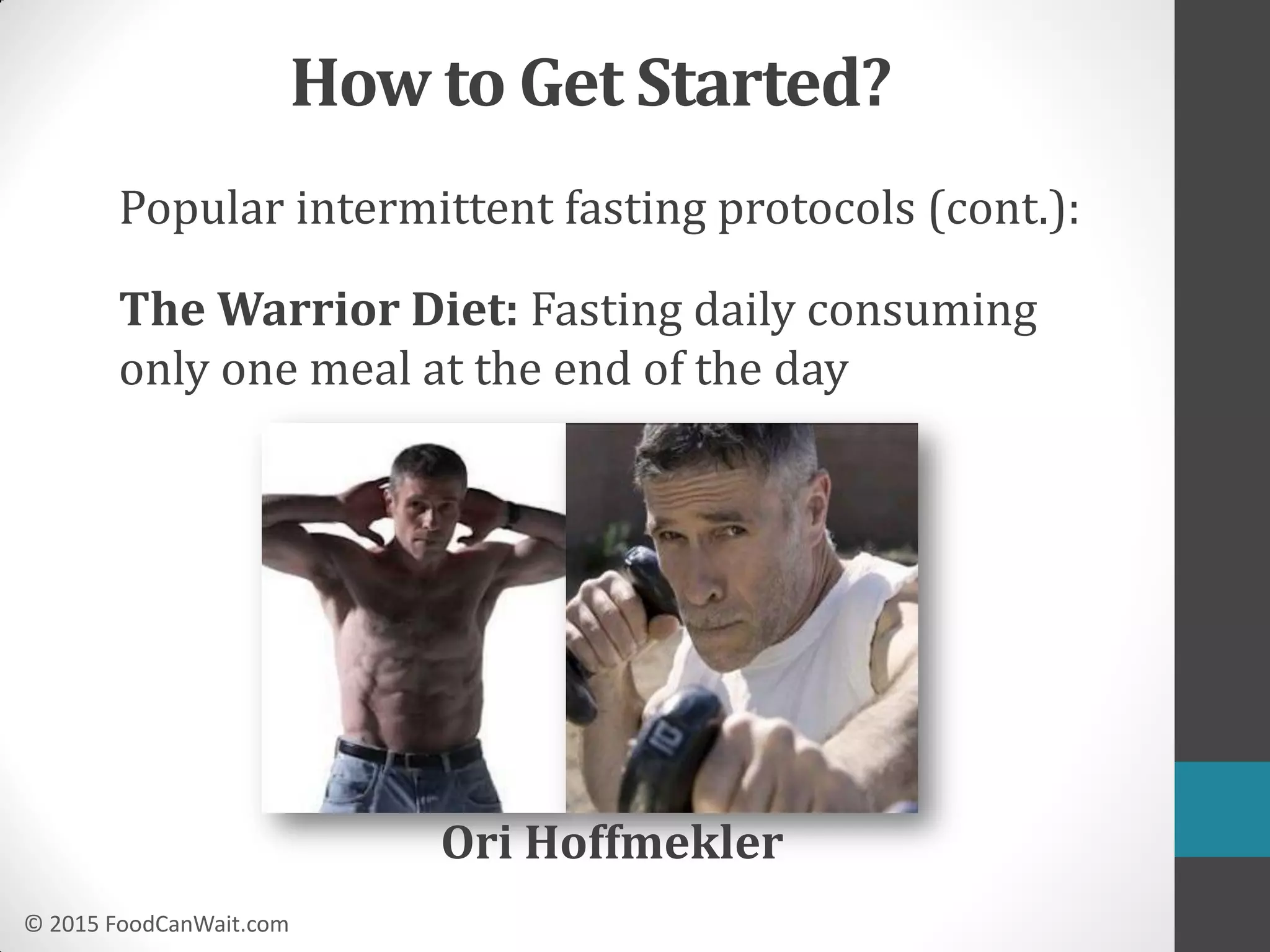
Popular intermittent fasting protocols (cont.):
The Warrior Diet: Fasting daily consuming
only one meal at the end of the day
Ori Hoffmekler
How to Get Started?
© 2015 FoodCanWait.com
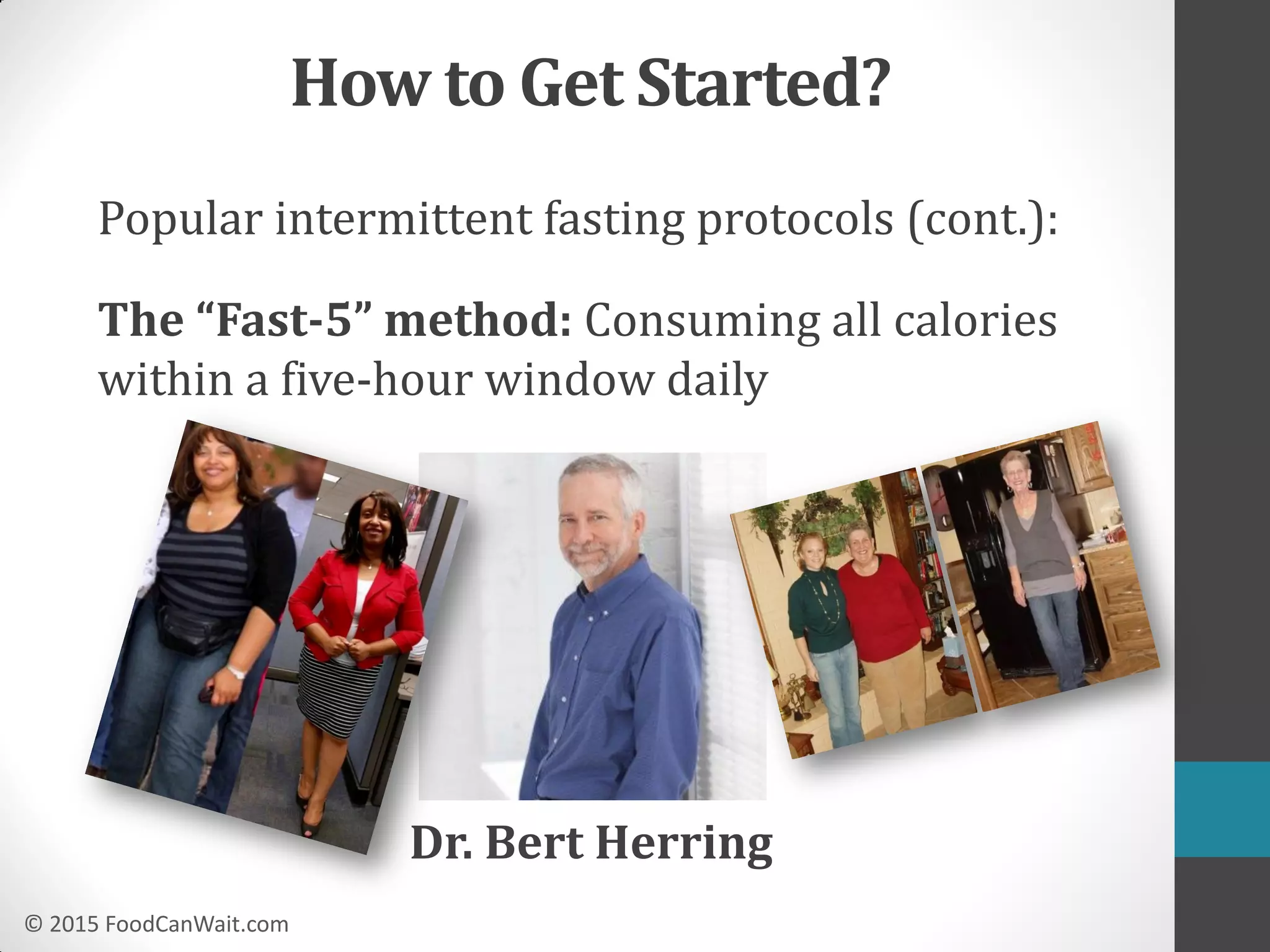
Popular intermittent fasting protocols (cont.):
The “Fast-5” method: Consuming all calories
within a five-hour window daily
Dr. Bert Herring
How to Get Started?
© 2015 FoodCanWait.com
Popular intermittent fasting protocols (cont.):
“Eat-Stop-Eat”: Fasting for a full day (24 hours)
once or twice a week
Brad Pilon
How to Get Started?
© 2015 FoodCanWait.com
Popular intermittent fasting protocols (cont.):
The “5:2” “Fast Diet”: An alternate day (every
other day) fasting schedule that involves two
days of intermittent fasting during the week
Dr. Michael Mosley
How to Get Started?
© 2015 FoodCanWait.com
Sources and Further Reading
For more detailed information on the science of
intermittent fasting you may want to visit…
BertHerringMD.com
AuthorityNutrition.com
Mercola.com
© 2015 FoodCanWait.com
Contact Me
Website: FoodCanWait.com
Facebook Page: Food Can Wait
Twitter and Blab: @foodcanwait
YouTube and Google+: Food Can Wait
Email: mimi@foodcanwait.com
© 2015 FoodCanWait.com
Questions?

Intermittent Fasting for Weight Loss and Wellness | Food Can Wait

  • 1.
    Intermittent Fasting for Weight-Lossand Wellness Scheduled Eating as a Healthy, Sustainable and Free Solution
  • 2.
    © 2015 FoodCanWait.com AboutMe Disclaimer • I am not a health professional or nutrition expert. • I am not offering medical advise. • You should consult your doctor (I did).
  • 3.
    © 2015 FoodCanWait.com AboutMe Expertise: I’ve been there… • Struggled with weight most of my adult life • Was an overeater and emotional eater • Loved (and still really like) carbs
  • 4.
    © 2015 FoodCanWait.com AboutMe Expertise: … I’ve done that. • Tried traditional dieting and exercise • Could never maintain any diet/exercise plan • Tried several natural appetite suppressants
  • 5.
    © 2015 FoodCanWait.com AboutMe Expertise (Cont.): I’m still “there”… I began practicing daily intermittent fasting on July 1, 2014 at 237 lbs. and a BMI of 39. I’ve lost 67 lbs. to date. Still working toward my goal of being with a “normal” weight range. Before During
  • 6.
    © 2015 FoodCanWait.com AboutMe • Adopted intermittent fasting as a permanent lifestyle change • Passionate about spreading the word about intermittent fasting • Started FoodCanWait.com (formerly thedailyfastingblog.com) in September of 2014 • Nothing to sell you and no paid endorsements to promote
  • 7.
    © 2015 FoodCanWait.com Whatis Intermittent Fasting?
  • 8.
    © 2015 FoodCanWait.com Whatis Intermittent Fasting? Intermittent fasting (IF) is a term used to describe various eating patterns that cycle between scheduled periods of eating and not eating (fasting). Intermittent fasting is one form of caloric restriction (CR) - a dietary regimen that is based on low (or lower than previous) caloric intake.
  • 9.
    © 2015 FoodCanWait.com Whatis Intermittent Fasting? Intermittent Fasting = “Scheduled Eating” With intermittent fasting, the focus is on when and how often you eat (meal frequency), not on what you eat.
  • 10.
    © 2015 FoodCanWait.com Youare already fasting every single day! When we’re asleep, we’re fasting. What is Intermittent Fasting?
  • 11.
    © 2015 FoodCanWait.com WhatIntermittentFastingisNot •Not a diet (in the traditional sense). No calorie-counting and no forbidden foods) • Not “starvation” • Not a quick fix • Not right for everyone - nothing is • Not without side-effects • Not a fad What is Intermittent Fasting?
  • 12.
    © 2015 FoodCanWait.com Whatis Intermittent Fasting? I fast for greater physical and mental efficiency. ~Plato To lengthen thy life, lessen thy meals. ~Benjamin Franklin The best of all medicines are rest and fasting. ~Benjamin Franklin Fasting is the greatest remedy, the physician within. ~Paracelsus
  • 13.
    © 2015 FoodCanWait.com Whatis Intermittent Fasting? There are three intermittent fasting protocols: • Daily Fasting: Eating only within certain hours of the day, everyday • Alternate-Day Fasting (ADF): Fasting for a few times per week, on non-consecutive days, and eating “normally” on the other days • Random: Fasting every now and then (e.g., once per month, or once a year)
  • 14.
  • 15.
    © 2015 FoodCanWait.com QuestionstoExplore Whathappens when we fast? How can fasting help us lose weight? The Science of IF
  • 16.
    © 2015 FoodCanWait.com Howdo we gain weight? How does the food we eat become body Fat? QuestionstoExplore The Science of IF
  • 17.
    © 2015 FoodCanWait.com •Breakfast is the most important meal of the day. • You should eat several small meals a day to rev up metabolism. • Skipping meals is counterproductive to weight-loss. • IF is dangerous and/or ineffective, especially for women, the elderly, etc. CommonBeliefs: NutritionFactorFiction? The Science of IF
  • 18.
    © 2015 FoodCanWait.com Howdoes the food we eat become body fat? QuestionstoExplore The Science of IF
  • 19.
    © 2015 FoodCanWait.com Inorder to understand how intermittent fasting works, one of the most fundamental concepts we need to grasp is metabolism – how the body converts food we eat into the energy it needs. The Science of IF
  • 20.
    © 2015 FoodCanWait.com TheScience of IF They are three of human body's primary sources of fuel. Answer: What are carbohydrates, fat and protein?
  • 21.
    © 2015 FoodCanWait.com Whathappens when we eat... The Science of IF PIZZA?!
  • 22.
    © 2015 FoodCanWait.com HowFood Becomes Body Fat* What Happens to the Carbohydrates (Sugar)?... • It goes directly into the blood stream, and several different organs take the sugar they need as it passes by. • Some is stored in the liver as glycogen. • Whatever is left is converted to fat and stored in fat cells. *Source: “How Food Becomes Body Fat” by Maia Appleby for Bodybuilding.com
  • 23.
    © 2015 FoodCanWait.com WhatHappens to the Fat?... • First, it goes into the blood stream and travels to the liver. • The liver burns some of the fat, converts some to other substances (such as cholesterol) and sends the rest to fat cells, where they wait until they are needed. How Food Becomes Body Fat (Cont.)
  • 24.
    © 2015 FoodCanWait.com WhatHappens to the Protein?... • It is broken down into building blocks known as peptides, then further broken down to become amino acids. • The amino acids are absorbed through the small intestine's lining and enter the blood stream. How Food Becomes Body Fat (Cont.)
  • 25.
    © 2015 FoodCanWait.com WhatHappens to the Protein?... (Cont.) • From there, some of the amino acids build the body's protein stores. • Excess amino acids are excreted, and any protein that it built in excess is stored as body fat. How Food Becomes Body Fat (Cont.)
  • 26.
    © 2015 FoodCanWait.com BottomLine Consuming more food than what the body needs will cause it to store body fat. How Food Becomes Body Fat (Cont.)
  • 27.
    © 2015 FoodCanWait.com Fatcells are like the body’s refrigerator. Your body takes whatever it can't use - carbohydrates, fat or protein - and sends it to fat cells for later use. How Food Becomes Body Fat (Cont.) “The Body’s Refrigerator”
  • 28.
    © 2015 FoodCanWait.com Questionsto Explore How does fasting help you lose weight?
  • 29.
    © 2015 FoodCanWait.com TheScience of IF A key component of weight loss is creating a… C _ _ _ _ _ _ D_ _ _ _ _ _ Answer: Caloric Deficit
  • 30.
    © 2015 FoodCanWait.com TypicalEating Schedule vs. IF Breakfast 400 cal. Lunch 600 cal. Dinner 1000 cal. Typical Schedule Total = 2,350 Snack 150 cal. Dessert 200 cal.
  • 31.
    © 2015 FoodCanWait.com TypicalEating Schedule vs. IF Breakfast 5 cal. Lunch 0 cal. Dinner 1450 cal. IF Schedule Previous = 2,350 New = 1,805 Deficit = 545 Snack 150 cal. Dessert 200 cal.
  • 32.
    © 2015 FoodCanWait.com Theoretically*,in order to lose one pound of fat per week , you should create a 3,500 weekly calorie deficit. 545 daily caloric deficit x 7 days = 3,815 weekly deficit. 1 lb. per week weight loss = 52 lbs. lost per year (theoretically). *Other factors include: Insulin levels, body composition, activity level, age, hormones, chronic diseases, medication, quality of diet, etc. Caloric Deficit (Cont.)
  • 33.
    © 2015 FoodCanWait.com BottomLine Intermittent fasting enables us to create a caloric deficit without “dieting” or calorie-counting. However, even without restricting calories, IF is beneficial for weight loss, according to some studies. The Beauty of IF
  • 34.
  • 35.
    © 2015 FoodCanWait.com Inaddition to it’s weight-loss benefits, IF has numerous other health benefits.* The Science of IF *Source: “10 Evidence-Based Health Benefits of Intermittent Fasting” Kris Gunnars, AuthorityNutrition.com
  • 36.
    © 2015 FoodCanWait.com •Inflammation: Some studies have shown a reduction in inflammation– a condition linked to several chronic diseases including asthma and rheumatoid arthritis. • Insulin resistance: IF may reduce insulin resistance thus lowering the risk of type 2 diabetes. Health Benefits of IF
  • 37.
    © 2015 FoodCanWait.com •Brain Health: Intermittent fasting increases BDNF. High BDNF is tied to lower Alzheimer's risk. • Cancer: Some animal studies suggest that intermittent fasting may help prevent cancer. • Anti-aging: Intermittent fasting has been shown to extend the lifespan of rats by as much as 83%. Health Benefits of IF
  • 38.
    © 2015 FoodCanWait.com •Heart Health: By reducing LDL (“lousy”) cholesterol, triglycerides, inflammation, and lowering insulin resistance, intermittent fasting can reduce the risk factors for heart disease. Health Benefits of IF
  • 39.
    © 2015 FoodCanWait.com TheScience of IF The condition produced when the body doesn't have enough carbohydrates from food for cells to burn for energy, so it burns fat instead. Answer: What is ketosis?
  • 40.
    © 2015 FoodCanWait.com Whenyour body becomes efficient at switching from mostly burning glucose to mostly burning stored fat as fuel you have become “fat- adapted.” Some people experience side-effects while becoming fat-adapted including dizziness, “brain fog,” and, of course, hunger. The Science of IF
  • 41.
    © 2015 FoodCanWait.com TheScience of IF Derived from the Greek word “phagein, "to eat“; It’s the body’s catabolic cellular clean-up mechanism. Answer: What is autophagy?
  • 42.
    © 2015 FoodCanWait.com IFtriggers autophagy – recognized as a crucial defense mechanism against malignancy, infection and neurodegenerative diseases. The Science of IF
  • 43.
    © 2015 FoodCanWait.com Autophagyis a process of cellular self-digestion. Through autophagy, starving cells degrade materials within their own cells to provide necessary nutrients for more essential processes. Autophagy is the way our cells “clean house” and “recycle the trash”. The Science of IF *Source: “Autophagy – The Housekeeper in Every Cell that Fights Aging” James P Watson and Vince Giuliano
  • 44.
    © 2015 FoodCanWait.com InSummary… “…beneficial effects of fasting are supported by observational data and abundant evidence from experimental research which found caloric restriction and intermittent fasting being associated with deceleration or prevention of most chronic degenerative and chronic inflammatory diseases." –Andreas Michalsen The Science of IF
  • 45.
    © 2015 FoodCanWait.com IntermittentFasting sounds great, but… There is NO WAY I can go that long without eating. The Beauty of IF
  • 46.
    © 2015 FoodCanWait.com Remember,youarealreadypracticing dailyintermittentfasting! The Beauty of IF
  • 47.
    © 2015 FoodCanWait.com IntermittentFasting can normalize appetite! After becoming accustomed to IF, you are likely to experience “appetite correction”: • Less of an urge to eat all day • Lessened (or eliminated) cravings • Less tendency to overeat within your window • Tendency to eat healthier • More refined palette The Beauty of IF
  • 48.
    © 2015 FoodCanWait.com FourSteps to Get Started  Learn the science of IF 2. Choose the type of IF that’s right for you 3. Choose your eating window 4. Tweak your diet if needed How to Get Started?
  • 49.
    © 2015 FoodCanWait.com Whatis Intermittent Fasting? What constitutes a fast varies by the fasting protocol. Examples include: • No food or water (dry fast) • Zero-calorie beverages, but no food • Less than 40 calories total (e.g., a teaspoon of lemon in tea is permitted) • Foods that do not trigger a significant insulin response (e.g., whey protein, berries) • Less than 500 calories
  • 50.
    © 2015 FoodCanWait.com Whatis Intermittent Fasting? What method you succeed with may largely depend on what does or does not trigger “limbic hunger” for you, which varies by individual. Limbic hunger is a combination of emotional, hormonal and psychological factors that cause craving for food despite not being in a state of true hunger.
  • 51.
    © 2015 FoodCanWait.com Whatis Intermittent Fasting? Chewing gum Cream in coffee Lemon in tea Drinking water Consuming 10 calories Time of day Cooking for others Boredom Common Limbic Hunger Triggers
  • 52.
    © 2015 FoodCanWait.com Howto Get Started? There are several different “fasting protocols” or ways of practicing intermittent fasting either daily or on alternate days of the week. The most popular methods have a significant online community available for information and support.
  • 53.
    © 2015 FoodCanWait.com Popularintermittent fasting protocols include: Lean Gains: A 16:8 daily fast during which you skip breakfast and eat only within an eight hour window Martin Berkhan How to Get Started?
  • 54.
    © 2015 FoodCanWait.com Popularintermittent fasting protocols (cont.): The Warrior Diet: Fasting daily consuming only one meal at the end of the day Ori Hoffmekler How to Get Started?
  • 55.
    © 2015 FoodCanWait.com Popularintermittent fasting protocols (cont.): The “Fast-5” method: Consuming all calories within a five-hour window daily Dr. Bert Herring How to Get Started?
  • 56.
    © 2015 FoodCanWait.com Popularintermittent fasting protocols (cont.): “Eat-Stop-Eat”: Fasting for a full day (24 hours) once or twice a week Brad Pilon How to Get Started?
  • 57.
    © 2015 FoodCanWait.com Popularintermittent fasting protocols (cont.): The “5:2” “Fast Diet”: An alternate day (every other day) fasting schedule that involves two days of intermittent fasting during the week Dr. Michael Mosley How to Get Started?
  • 58.
    © 2015 FoodCanWait.com Sourcesand Further Reading For more detailed information on the science of intermittent fasting you may want to visit… BertHerringMD.com AuthorityNutrition.com Mercola.com
  • 59.
    © 2015 FoodCanWait.com ContactMe Website: FoodCanWait.com Facebook Page: Food Can Wait Twitter and Blab: @foodcanwait YouTube and Google+: Food Can Wait Email: mimi@foodcanwait.com
  • 60.