ENERGY BALANCE
Session Objectives
Identify factors affecting energy input and output
Differentiate factors affecting energy output
Determine the body mass index and ideal body
weights
Perform calculations to estimate energy requirements
INTRODUCTION
Everything humans do, physical or mental
requires ENERGY.
CHO, Prot and Fats yield energy, but they are not
used equally.
CHO and Fats are the preferred energy sources
3
TOTAL ENERGY
REQUIREMENTSENERGY INPUT
4
BASAL METABOLIC NEEDS
BASAL METABOLIC RATE
5
BASAL METABOLIC RATE
Energy used by the body at rest is defned as in
terms of basal energy expenditure or resting
energy expenditure.
These are measured in terms of basal metabolic
rate (BMR) or Resting Metabolic Rate (RMR)
The measurement is made with the body at
complete physical and mental rest, relaxed but
not sleep several hours after any strenuous
exercise or activity and in a comfortable
temperature and environment
6
NOTE: BMR OR RMR MEASURE REE MR
MEASURE REE
Includes energy needed to fuel all organs while at
rest
• TEE = REE + TEF + EEPA
• REE constitutes about 60-75% of TEE
• EEPA constitutes about 25% of TEE
• TEF constitutes 6-10% of TEE
7
FACTORS AFFECTING BMR
Body size and composition: Lean Body Mass
Lean body mass includes muscles, bones,
connective tissue such as ligaments and tendons,
and internal organs.
One of the largest contributors to overall
metabolic rate is the relative percent of lean body
mass. the more lean body mass a person has, the
higher the person’s BMR. This is caused by the
greater metabolic activity that occurs in lean tissue
vs less active tissues of fat and bone
Other factors (e.g. age, sex) are thought to
primarily infuence the metabolic rate as they relate
to the lean body mass
8
FACTORS AFFECTING BMR
Growth Periods
During rapid growth periods, human growth
hormone stimulates cell regeneration and raises
BEE to support anabolic metabolism.
Thus, growth spurts during childhood and
adolescence refect periods of elevated BEE and
energy needs per kilogram of body weight.
As growth and the rate of cellular regeneration
slow with age, so does BMR.
9
FACTORS AFFECTING BMR
Fever and Climate
The body’s energy expenditure is signifcantly
altered in response to changes in body
temperature.
BMR lowers rise in response to lower
environmental temperatures as the body takes
action to increase production and minimize heat
loss
Fever increases BMR by approximately 7% for
every 1°C above normal body temperature.
10
FACTORS AFFECTING BMR
Hormonal Status
Energy expenditure is also infuenced by
hormonal secretions.
Thyroid hormone plays a signifcant role in
regulating metabolism. Individuals with an
underactive thyroid gland may develop
hypothyroidism, which results in a decreased
metabolic rate.
Growth hormone increases metabolism,
alternatively, a defciency of normal growth
hormone secretions attenuates the metabolic rate.
Other hormones (e.g. insulin, cortisol) also
increase metabolism
11
FACTORS AFFECTING BMR
Disease State
The presence of disease may alter a patient’s
BMR. Depending on the disease, the BMR may be
increased or decreased.
Diseases such as cancer, cardiac failure, HIV,
Kidney failure increases BMR cause loss of weight
and muscles
In PEM and starvation BMR decreases in response
to the drop in energy intake and loss of
metabolically active tissues
12
PHYSICAL ACTIVITY
Physical activity contributes to the total daily energy
expenditure. An average sedentary person expends
about 25% of his intake on physical activity
Top athletes use more per day on physical activity.
Aerobic activities such as aerobic dancing, cross
country running, bicycling tend to use more energy.
Anaerobic exercises such as weight lifting do not use
as much energy.
Spontaneous activities such as walking, climbing the
stairs, mowing the lawn, etc also tend to use more
energy
13
THERMIC EFFECT OF FOOD
Is the increase in energy expenditure associated
with consumption of food. It can be measured for
several hours after a meal.
Thermogenesis - The production of body heat in
response to food intake and in the non-shivering
response to cold.
Heat is produced when the food we eat is
digested, absorbed, transported and metabolized
and stored
It constitute 6-10% of TEE
Fat has less TEF, followed by CHO and then
Protein
14
FACTORS AFFECTING TEF
Diet Composition
TEF increases after protein and CHO ingestion
than after ingestion of a fatty meal
Spicy Food
Increases TEF for more than 3 hours
Cafeine & Nicotine
Increase TEF
15
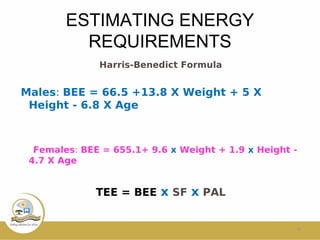
ESTIMATING ENERGY
REQUIREMENTS
Harris-Benedict Formula
Males: BEE = 66.5 +13.8 X Weight + 5 X
Height - 6.8 X Age
Females: BEE = 655.1+ 9.6 x Weight + 1.9 x Height -
4.7 X Age
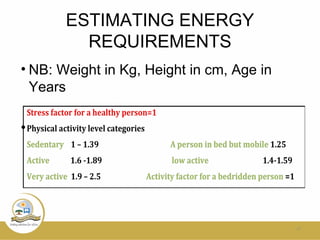
TEE = BEE x SF x PAL
16
ESTIMATING ENERGY
REQUIREMENTS
• NB: Weight in Kg, Height in cm, Age in
Years
•
17
Determining the Body Mass
Index (BMI) and Ideal Body
Weight (IBW)
Body Mass Index
Body Mass Index=Weight (kg)/Height (M)2
<18.5 Under weight
18.5 - 24.9 Normal weight
25 – 29.9Overweight
>30 Obese
18
IDEAL BODY WEIGHT
19
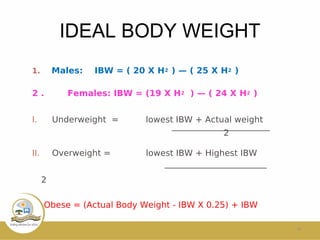
1. Males: IBW = ( 20 X H2 ) — ( 25 X H2 )
2 . Females: IBW = (19 X H2 ) — ( 24 X H2 )
I. Underweight = lowest IBW + Actual weight
_______________________
2
II. Overweight = lowest IBW + Highest IBW
________________________
2
Obese = (Actual Body Weight - IBW X 0.25) + IBW
Abdominal Fat/ Waist
Circumference
The position of fat influence health and disease risk.
WHR is 0.9 or less for men and 0.8 or less for
women= Smaller waist and larger hip measurement
Waist circumference of > 88 cm in women and
> 102 cm in men indicate abdominal obesity
20
ENERGY DISTRIBUTION
21
PRUDENT DIETARY GUIDELINES
PRUDENT DIETARY GUIDELINES SOUTH AFRICAN GUIDELINES
SOUTH AFRICAN GUIDELINES
CHO : 55 - 60%
Fat : 25 - 30%
Prot : 12 - 15%
 CHO : 50 - 65%
 Fat : 25 - 30%
 Prot : 10 - 20%
ENERGY VALUES OF FOOD
22
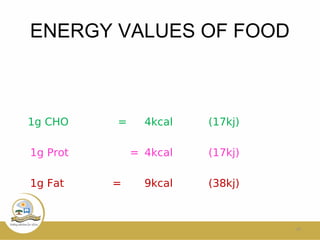
1g CHO = 4kcal (17kj)
1g Prot = 4kcal (17kj)
1g Fat = 9kcal (38kj)
CALCALCULATIONSLATIONS
23
1. Calculate energy of food if
the food contains 12g CHO, 8g
PROTEIN, 5g FAT
• 2. Complete A, B and C page 187
• Discuss with your mates- NB in test 2
24
Finding a Healthy Weight
• Developing a healthy lifestyle is key
• South African Food based dietary
guidelines - Self study-NB
25

ENERGY BALANCE.ppt.pdf

  • 1.
  • 2.
    Session Objectives Identify factorsaffecting energy input and output Differentiate factors affecting energy output Determine the body mass index and ideal body weights Perform calculations to estimate energy requirements
  • 3.
    INTRODUCTION Everything humans do,physical or mental requires ENERGY. CHO, Prot and Fats yield energy, but they are not used equally. CHO and Fats are the preferred energy sources 3
  • 4.
  • 5.
  • 6.
    BASAL METABOLIC RATE Energyused by the body at rest is defned as in terms of basal energy expenditure or resting energy expenditure. These are measured in terms of basal metabolic rate (BMR) or Resting Metabolic Rate (RMR) The measurement is made with the body at complete physical and mental rest, relaxed but not sleep several hours after any strenuous exercise or activity and in a comfortable temperature and environment 6
  • 7.
    NOTE: BMR ORRMR MEASURE REE MR MEASURE REE Includes energy needed to fuel all organs while at rest • TEE = REE + TEF + EEPA • REE constitutes about 60-75% of TEE • EEPA constitutes about 25% of TEE • TEF constitutes 6-10% of TEE 7
  • 8.
    FACTORS AFFECTING BMR Bodysize and composition: Lean Body Mass Lean body mass includes muscles, bones, connective tissue such as ligaments and tendons, and internal organs. One of the largest contributors to overall metabolic rate is the relative percent of lean body mass. the more lean body mass a person has, the higher the person’s BMR. This is caused by the greater metabolic activity that occurs in lean tissue vs less active tissues of fat and bone Other factors (e.g. age, sex) are thought to primarily infuence the metabolic rate as they relate to the lean body mass 8
  • 9.
    FACTORS AFFECTING BMR GrowthPeriods During rapid growth periods, human growth hormone stimulates cell regeneration and raises BEE to support anabolic metabolism. Thus, growth spurts during childhood and adolescence refect periods of elevated BEE and energy needs per kilogram of body weight. As growth and the rate of cellular regeneration slow with age, so does BMR. 9
  • 10.
    FACTORS AFFECTING BMR Feverand Climate The body’s energy expenditure is signifcantly altered in response to changes in body temperature. BMR lowers rise in response to lower environmental temperatures as the body takes action to increase production and minimize heat loss Fever increases BMR by approximately 7% for every 1°C above normal body temperature. 10
  • 11.
    FACTORS AFFECTING BMR HormonalStatus Energy expenditure is also infuenced by hormonal secretions. Thyroid hormone plays a signifcant role in regulating metabolism. Individuals with an underactive thyroid gland may develop hypothyroidism, which results in a decreased metabolic rate. Growth hormone increases metabolism, alternatively, a defciency of normal growth hormone secretions attenuates the metabolic rate. Other hormones (e.g. insulin, cortisol) also increase metabolism 11
  • 12.
    FACTORS AFFECTING BMR DiseaseState The presence of disease may alter a patient’s BMR. Depending on the disease, the BMR may be increased or decreased. Diseases such as cancer, cardiac failure, HIV, Kidney failure increases BMR cause loss of weight and muscles In PEM and starvation BMR decreases in response to the drop in energy intake and loss of metabolically active tissues 12
  • 13.
    PHYSICAL ACTIVITY Physical activitycontributes to the total daily energy expenditure. An average sedentary person expends about 25% of his intake on physical activity Top athletes use more per day on physical activity. Aerobic activities such as aerobic dancing, cross country running, bicycling tend to use more energy. Anaerobic exercises such as weight lifting do not use as much energy. Spontaneous activities such as walking, climbing the stairs, mowing the lawn, etc also tend to use more energy 13
  • 14.
    THERMIC EFFECT OFFOOD Is the increase in energy expenditure associated with consumption of food. It can be measured for several hours after a meal. Thermogenesis - The production of body heat in response to food intake and in the non-shivering response to cold. Heat is produced when the food we eat is digested, absorbed, transported and metabolized and stored It constitute 6-10% of TEE Fat has less TEF, followed by CHO and then Protein 14
  • 15.
    FACTORS AFFECTING TEF DietComposition TEF increases after protein and CHO ingestion than after ingestion of a fatty meal Spicy Food Increases TEF for more than 3 hours Cafeine & Nicotine Increase TEF 15
  • 16.
    ESTIMATING ENERGY REQUIREMENTS Harris-Benedict Formula Males:BEE = 66.5 +13.8 X Weight + 5 X Height - 6.8 X Age Females: BEE = 655.1+ 9.6 x Weight + 1.9 x Height - 4.7 X Age TEE = BEE x SF x PAL 16
  • 17.
    ESTIMATING ENERGY REQUIREMENTS • NB:Weight in Kg, Height in cm, Age in Years • 17
  • 18.
    Determining the BodyMass Index (BMI) and Ideal Body Weight (IBW) Body Mass Index Body Mass Index=Weight (kg)/Height (M)2 <18.5 Under weight 18.5 - 24.9 Normal weight 25 – 29.9Overweight >30 Obese 18
  • 19.
    IDEAL BODY WEIGHT 19 1.Males: IBW = ( 20 X H2 ) — ( 25 X H2 ) 2 . Females: IBW = (19 X H2 ) — ( 24 X H2 ) I. Underweight = lowest IBW + Actual weight _______________________ 2 II. Overweight = lowest IBW + Highest IBW ________________________ 2 Obese = (Actual Body Weight - IBW X 0.25) + IBW
  • 20.
    Abdominal Fat/ Waist Circumference Theposition of fat influence health and disease risk. WHR is 0.9 or less for men and 0.8 or less for women= Smaller waist and larger hip measurement Waist circumference of > 88 cm in women and > 102 cm in men indicate abdominal obesity 20
  • 21.
    ENERGY DISTRIBUTION 21 PRUDENT DIETARYGUIDELINES PRUDENT DIETARY GUIDELINES SOUTH AFRICAN GUIDELINES SOUTH AFRICAN GUIDELINES CHO : 55 - 60% Fat : 25 - 30% Prot : 12 - 15%  CHO : 50 - 65%  Fat : 25 - 30%  Prot : 10 - 20%
  • 22.
    ENERGY VALUES OFFOOD 22 1g CHO = 4kcal (17kj) 1g Prot = 4kcal (17kj) 1g Fat = 9kcal (38kj)
  • 23.
  • 24.
    1. Calculate energyof food if the food contains 12g CHO, 8g PROTEIN, 5g FAT • 2. Complete A, B and C page 187 • Discuss with your mates- NB in test 2 24
  • 25.
    Finding a HealthyWeight • Developing a healthy lifestyle is key • South African Food based dietary guidelines - Self study-NB 25