NUTRITION
DR SHAMIM AKRAM
INTRODUCTION
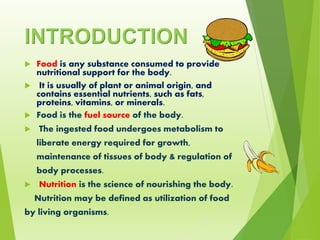
 Food is any substance consumed to provide
nutritional support for the body.
 It is usually of plant or animal origin, and
contains essential nutrients, such as fats,
proteins, vitamins, or minerals.
 Food is the fuel source of the body.
 The ingested food undergoes metabolism to
liberate energy required for growth,
maintenance of tissues of body & regulation of
body processes.
 Nutrition is the science of nourishing the body.
Nutrition may be defined as utilization of food
by living organisms.
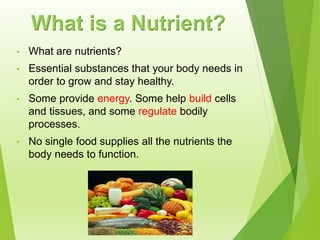
• What are nutrients?
• Essential substances that your body needs in
order to grow and stay healthy.
• Some provide energy. Some help build cells
and tissues, and some regulate bodily
processes.
• No single food supplies all the nutrients the
body needs to function.
What is a Nutrient?
Food Energy
Food energy is energy that animals (including humans) derive
from their food, through the process of cellular respiration,
the process of joining oxygen with the molecules of food
(aerobic respiration) or of reorganizing the atoms within the
molecules for anaerobic respiration.
MEASUREMENT OF ENERGY
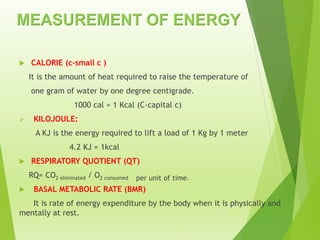
 CALORIE (c-small c )
It is the amount of heat required to raise the temperature of
one gram of water by one degree centigrade.
1000 cal = 1 Kcal (C-capital c)
 KILOJOULE:
A KJ is the energy required to lift a load of 1 Kg by 1 meter
4.2 KJ = 1kcal
 RESPIRATORY QUOTIENT (QT)
RQ= CO2 eliminated / O2 consumed per unit of time.
 BASAL METABOLIC RATE (BMR)
It is rate of energy expenditure by the body when it is physically and
mentally at rest.
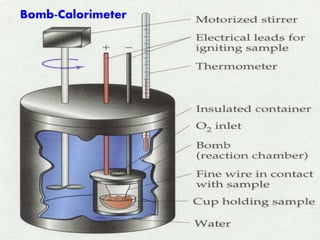
 Bomb-calorimeter is a metal vessel in which the
weighed food is ignited in an atmosphere of
oxygen under pressure by electric spark.
 A measured volume of water surrounds the
vessel.
 When the temperature is multiplied by the
volume of water surrounding the vessel, the
total number of calories liberated by the
combustion of the food is obtained.
Bomb-Calorimeter
Gross caloric values:
By using bomb-calorimeter
 1gm of carbohydrates yields 4.1 calories
 1gm of fat yields 9.3 calories
 1gm of proteins yields 5.3 calories
Digestible caloric values:
Digestible caloric value of foods are
 1gm of carbohydrates = 4.0 calories,
 1gm of fat = 9.0 calories
 1gm of proteins = 4.0calories (1.3 less) .
Note: Carb and fats are completiy oxidized
to CO2 n H2O while Proteins are not
completely oxidized in the body .
A proper combination of fruits,
vegetables, grains and dairy
product will undoubtedly ensure a
balanced diet.
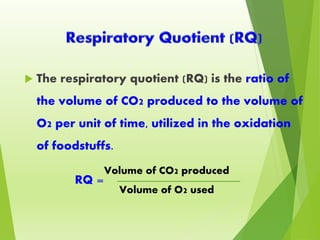
 The respiratory quotient (RQ) is the ratio of
the volume of CO2 produced to the volume of
O2 per unit of time, utilized in the oxidation
of foodstuffs.
Volume of CO2 produced
Volume of O2 used
RQ =
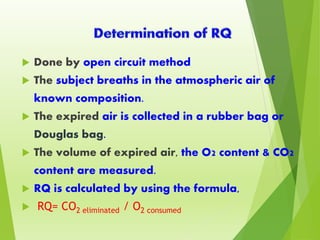
 Done by open circuit method
 The subject breaths in the atmospheric air of
known composition.
 The expired air is collected in a rubber bag or
Douglas bag.
 The volume of expired air, the O2 content & CO2
content are measured.
 RQ is calculated by using the formula,
 RQ= CO2 eliminated / O2 consumed
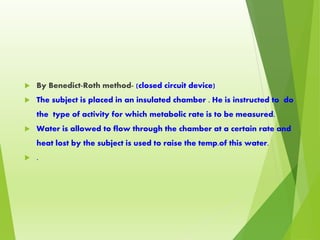
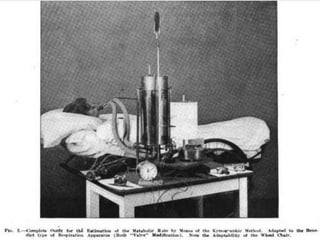
 By Benedict-Roth method- (closed circuit device)
 The subject is placed in an insulated chamber . He is instructed to do
the type of activity for which metabolic rate is to be measured.
 Water is allowed to flow through the chamber at a certain rate and
heat lost by the subject is used to raise the temp.of this water.
 .
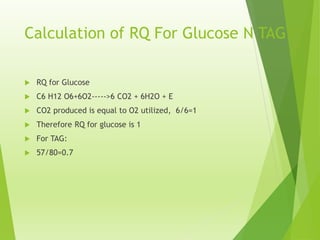
Calculation of RQ For Glucose N TAG
 RQ for Glucose
 C6 H12 O6+6O2----->6 CO2 + 6H2O + E
 CO2 produced is equal to O2 utilized, 6/6=1
 Therefore RQ for glucose is 1
 For TAG:
 57/80=0.7
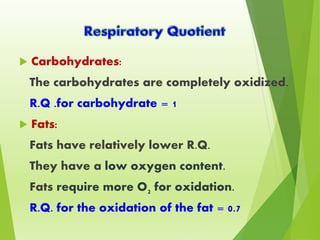
 Carbohydrates:
The carbohydrates are completely oxidized.
R.Q .for carbohydrate = 1
 Fats:
Fats have relatively lower R.Q.
They have a low oxygen content.
Fats require more O2 for oxidation.
R.Q. for the oxidation of the fat = 0.7
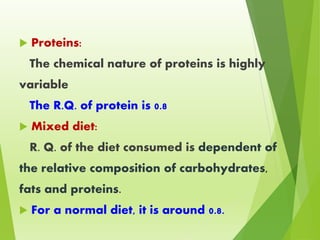
 Proteins:
The chemical nature of proteins is highly
variable
The R.Q. of protein is 0.8
 Mixed diet:
R. Q. of the diet consumed is dependent of
the relative composition of carbohydrates,
fats and proteins.
 For a normal diet, it is around 0.8.
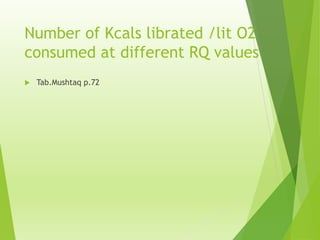
Number of Kcals librated /lit O2
consumed at different RQ values
 Tab.Mushtaq p.72
RQ of body organs
 The determination of RQ of an organ can give
information on what type of fuel is being utilized by
that organ.
 For example RQ of brain is 0.97 to 0.99:This indicates
that glucose is being utilized as the main source of
energy.
 To find out RQ of an organ Arterio-venous differences of
blood gases and the blood flow to the organ per unit
time is calculated.
 Three process to meet fuel demand of
the body…….
 Basal metabolic rate (BMR)
 Specific dynamic action (SDA)
 Physical activity.
 BMR is defined as the minimum amount of
energy required by the body to maintain
life at complete physical and mental rest in
the post-absorptive state (i.e. 12 hours after
the last meal).
 It may be noted that resting metabolic rate
(RMR) is in recent use for BMR.
 Several functions within the body
continuously occur.
 These include working of heart & other
organs, Respiration, Blood circulation,
Conduction of nerve impulse, Reabsorption
by renal tubules, Gastrointestinal motility &
ion transport across membranes, Na+ -K+
pump, Synthesis of macromolecules.
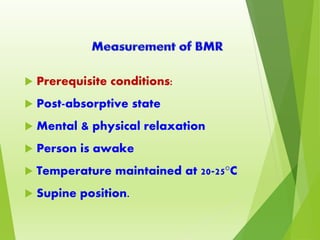
 Prerequisite conditions:
 Post-absorptive state
 Mental & physical relaxation
 Person is awake
 Temperature maintained at 20-25°C
 Supine position.
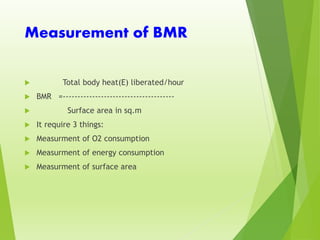
Measurement of BMR
 Total body heat(E) liberated/hour
 BMR =--------------------------------------
 Surface area in sq.m
 It require 3 things:
 Measurment of O2 consumption
 Measurment of energy consumption
 Measurment of surface area
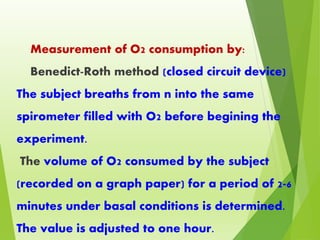
Measurement of O2 consumption by:
Benedict-Roth method (closed circuit device)
The subject breaths from n into the same
spirometer filled with O2 before begining the
experiment.
The volume of O2 consumed by the subject
(recorded on a graph paper) for a period of 2-6
minutes under basal conditions is determined.
The value is adjusted to one hour.
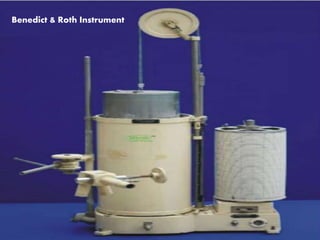
Benedict & Roth Instrument
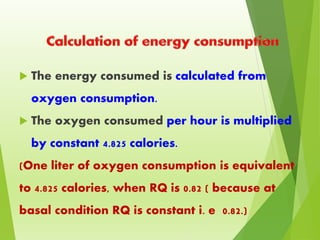
 The energy consumed is calculated from
oxygen consumption.
 The oxygen consumed per hour is multiplied
by constant 4.825 calories.
(One liter of oxygen consumption is equivalent
to 4.825 calories, when RQ is 0.82 ( because at
basal condition RQ is constant i. e 0.82.)
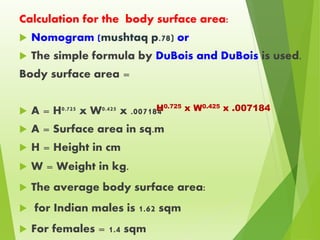
Calculation for the body surface area:
 Nomogram (mushtaq p.78) or
 The simple formula by DuBois and DuBois is used.
Body surface area =
 A = H0.725 x W0.425 x .007184
 A = Surface area in sq.m
 H = Height in cm
 W = Weight in kg.
 The average body surface area:
 for Indian males is 1.62 sqm
 For females = 1.4 sqm
H0.725 x W0.425 x .007184
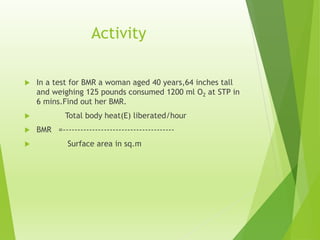
Activity
 In a test for BMR a woman aged 40 years,64 inches tall
and weighing 125 pounds consumed 1200 ml O2 at STP in
6 mins.Find out her BMR.
 Total body heat(E) liberated/hour
 BMR =--------------------------------------
 Surface area in sq.m
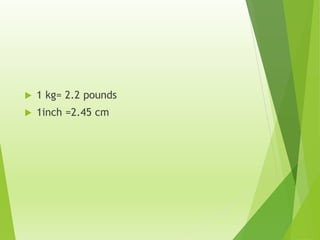
 1 kg= 2.2 pounds
 1inch =2.45 cm
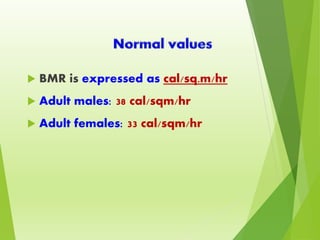
 BMR is expressed as cal/sq.m/hr
 Adult males: 38 cal/sqm/hr
 Adult females: 33 cal/sqm/hr
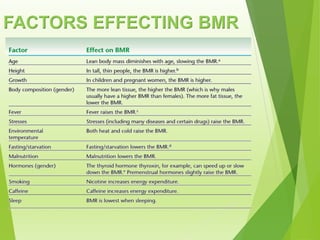
FACTORS EFFECTING BMR
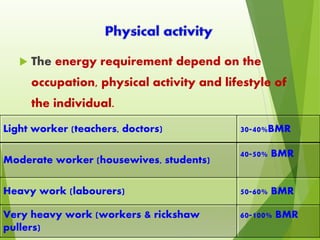
 The energy requirement depend on the
occupation, physical activity and lifestyle of
the individual.
Light worker (teachers, doctors) 30-40%BMR
Moderate worker (housewives, students)
40-50% BMR
Heavy work (labourers) 50-60% BMR
Very heavy work (workers & rickshaw
pullers)
60-100% BMR
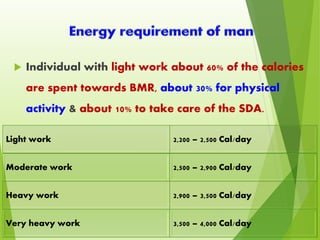
 Individual with light work about 60% of the calories
are spent towards BMR, about 30% for physical
activity & about 10% to take care of the SDA.
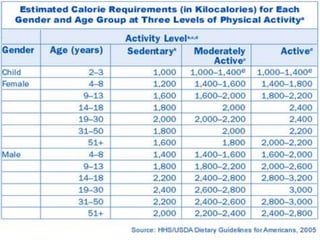
Light work 2,200 – 2,500 Cal/day
Moderate work 2,500 – 2,900 Cal/day
Heavy work 2,900 – 3,500 Cal/day
Very heavy work 3,500 – 4,000 Cal/day
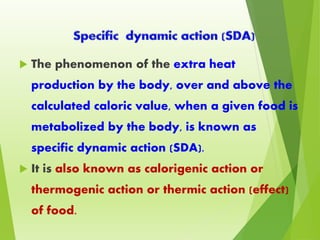
 The phenomenon of the extra heat
production by the body, over and above the
calculated caloric value, when a given food is
metabolized by the body, is known as
specific dynamic action (SDA).
 It is also known as calorigenic action or
thermogenic action or thermic action (effect)
of food.
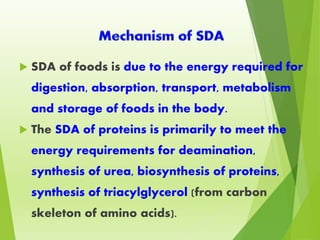
 SDA of foods is due to the energy required for
digestion, absorption, transport, metabolism
and storage of foods in the body.
 The SDA of proteins is primarily to meet the
energy requirements for deamination,
synthesis of urea, biosynthesis of proteins,
synthesis of triacylglycerol (from carbon
skeleton of amino acids).
 SDA for different foods:
 For a food containing 25 g of protein, the heat
production from the caloric value is 100 Cal (25
x 4 Cal).
 When 25 g protein is utilized by the body, 130
Cal of heat is liberated.
 The extra 30 Cal is the SDA of protein.
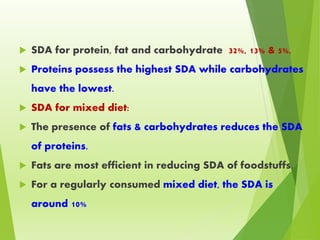
 SDA for protein, fat and carbohydrate 32%, 13% & 5%,
 Proteins possess the highest SDA while carbohydrates
have the lowest.
 SDA for mixed diet:
 The presence of fats & carbohydrates reduces the SDA
of proteins.
 Fats are most efficient in reducing SDA of foodstuffs.
 For a regularly consumed mixed diet, the SDA is
around 10%
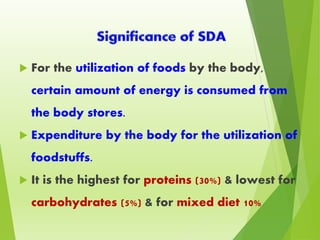
 For the utilization of foods by the body,
certain amount of energy is consumed from
the body stores.
 Expenditure by the body for the utilization of
foodstuffs.
 It is the highest for proteins (30%) & lowest for
carbohydrates (5%) & for mixed diet 10%
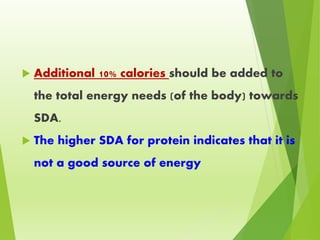
 Additional 10% calories should be added to
the total energy needs (of the body) towards
SDA.
 The higher SDA for protein indicates that it is
not a good source of energy
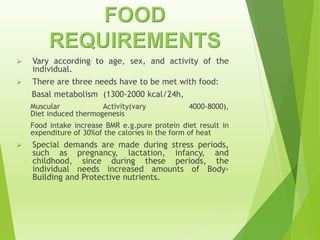
FOOD
REQUIREMENTS
 Vary according to age, sex, and activity of the
individual.
 There are three needs have to be met with food:
Basal metabolism (1300-2000 kcal/24h,
Muscular Activity(vary 4000-8000),
Diet induced thermogenesis
Food intake increase BMR e.g.pure protein diet result in
expenditure of 30%of the calories in the form of heat
 Special demands are made during stress periods,
such as pregnancy, lactation, infancy, and
childhood, since during these periods, the
individual needs increased amounts of Body-
Building and Protective nutrients.
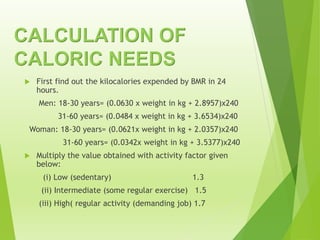
CALCULATION OF
CALORIC NEEDS
 First find out the kilocalories expended by BMR in 24
hours.
Men: 18-30 years= (0.0630 x weight in kg + 2.8957)x240
31-60 years= (0.0484 x weight in kg + 3.6534)x240
Woman: 18-30 years= (0.0621x weight in kg + 2.0357)x240
31-60 years= (0.0342x weight in kg + 3.5377)x240
 Multiply the value obtained with activity factor given
below:
(i) Low (sedentary) 1.3
(ii) Intermediate (some regular exercise) 1.5
(iii) High( regular activity (demanding job) 1.7
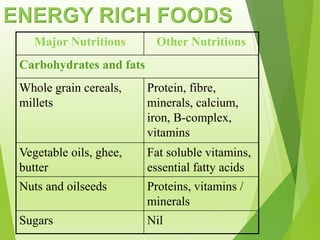
ENERGY RICH FOODS
Major Nutritions Other Nutritions
Carbohydrates and fats
Whole grain cereals,
millets
Protein, fibre,
minerals, calcium,
iron, B-complex,
vitamins
Vegetable oils, ghee,
butter
Fat soluble vitamins,
essential fatty acids
Nuts and oilseeds Proteins, vitamins /
minerals
Sugars Nil
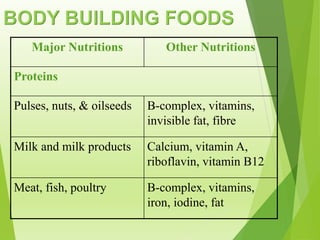
BODY BUILDING FOODS
Major Nutritions Other Nutritions
Proteins
Pulses, nuts, & oilseeds B-complex, vitamins,
invisible fat, fibre
Milk and milk products Calcium, vitamin A,
riboflavin, vitamin B12
Meat, fish, poultry B-complex, vitamins,
iron, iodine, fat
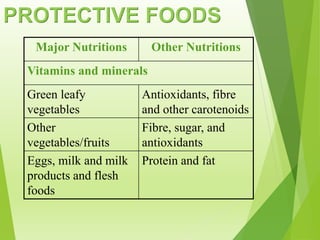
PROTECTIVE FOODS
Major Nutritions Other Nutritions
Vitamins and minerals
Green leafy
vegetables
Antioxidants, fibre
and other carotenoids
Other
vegetables/fruits
Fibre, sugar, and
antioxidants
Eggs, milk and milk
products and flesh
foods
Protein and fat
THANK
YOU

BMR

  • 2.
  • 3.
    INTRODUCTION  Food isany substance consumed to provide nutritional support for the body.  It is usually of plant or animal origin, and contains essential nutrients, such as fats, proteins, vitamins, or minerals.  Food is the fuel source of the body.  The ingested food undergoes metabolism to liberate energy required for growth, maintenance of tissues of body & regulation of body processes.  Nutrition is the science of nourishing the body. Nutrition may be defined as utilization of food by living organisms.
  • 4.
    • What arenutrients? • Essential substances that your body needs in order to grow and stay healthy. • Some provide energy. Some help build cells and tissues, and some regulate bodily processes. • No single food supplies all the nutrients the body needs to function. What is a Nutrient?
  • 5.
    Food Energy Food energyis energy that animals (including humans) derive from their food, through the process of cellular respiration, the process of joining oxygen with the molecules of food (aerobic respiration) or of reorganizing the atoms within the molecules for anaerobic respiration.
  • 6.
    MEASUREMENT OF ENERGY CALORIE (c-small c ) It is the amount of heat required to raise the temperature of one gram of water by one degree centigrade. 1000 cal = 1 Kcal (C-capital c)  KILOJOULE: A KJ is the energy required to lift a load of 1 Kg by 1 meter 4.2 KJ = 1kcal  RESPIRATORY QUOTIENT (QT) RQ= CO2 eliminated / O2 consumed per unit of time.  BASAL METABOLIC RATE (BMR) It is rate of energy expenditure by the body when it is physically and mentally at rest.
  • 7.
     Bomb-calorimeter isa metal vessel in which the weighed food is ignited in an atmosphere of oxygen under pressure by electric spark.  A measured volume of water surrounds the vessel.  When the temperature is multiplied by the volume of water surrounding the vessel, the total number of calories liberated by the combustion of the food is obtained.
  • 8.
  • 9.
    Gross caloric values: Byusing bomb-calorimeter  1gm of carbohydrates yields 4.1 calories  1gm of fat yields 9.3 calories  1gm of proteins yields 5.3 calories
  • 10.
    Digestible caloric values: Digestiblecaloric value of foods are  1gm of carbohydrates = 4.0 calories,  1gm of fat = 9.0 calories  1gm of proteins = 4.0calories (1.3 less) . Note: Carb and fats are completiy oxidized to CO2 n H2O while Proteins are not completely oxidized in the body .
  • 11.
    A proper combinationof fruits, vegetables, grains and dairy product will undoubtedly ensure a balanced diet.
  • 12.
     The respiratoryquotient (RQ) is the ratio of the volume of CO2 produced to the volume of O2 per unit of time, utilized in the oxidation of foodstuffs. Volume of CO2 produced Volume of O2 used RQ =
  • 13.
     Done byopen circuit method  The subject breaths in the atmospheric air of known composition.  The expired air is collected in a rubber bag or Douglas bag.  The volume of expired air, the O2 content & CO2 content are measured.  RQ is calculated by using the formula,  RQ= CO2 eliminated / O2 consumed
  • 14.
     By Benedict-Rothmethod- (closed circuit device)  The subject is placed in an insulated chamber . He is instructed to do the type of activity for which metabolic rate is to be measured.  Water is allowed to flow through the chamber at a certain rate and heat lost by the subject is used to raise the temp.of this water.  .
  • 15.
    Calculation of RQFor Glucose N TAG  RQ for Glucose  C6 H12 O6+6O2----->6 CO2 + 6H2O + E  CO2 produced is equal to O2 utilized, 6/6=1  Therefore RQ for glucose is 1  For TAG:  57/80=0.7
  • 16.
     Carbohydrates: The carbohydratesare completely oxidized. R.Q .for carbohydrate = 1  Fats: Fats have relatively lower R.Q. They have a low oxygen content. Fats require more O2 for oxidation. R.Q. for the oxidation of the fat = 0.7
  • 17.
     Proteins: The chemicalnature of proteins is highly variable The R.Q. of protein is 0.8  Mixed diet: R. Q. of the diet consumed is dependent of the relative composition of carbohydrates, fats and proteins.  For a normal diet, it is around 0.8.
  • 18.
    Number of Kcalslibrated /lit O2 consumed at different RQ values  Tab.Mushtaq p.72
  • 19.
    RQ of bodyorgans  The determination of RQ of an organ can give information on what type of fuel is being utilized by that organ.  For example RQ of brain is 0.97 to 0.99:This indicates that glucose is being utilized as the main source of energy.  To find out RQ of an organ Arterio-venous differences of blood gases and the blood flow to the organ per unit time is calculated.
  • 20.
     Three processto meet fuel demand of the body…….  Basal metabolic rate (BMR)  Specific dynamic action (SDA)  Physical activity.
  • 21.
     BMR isdefined as the minimum amount of energy required by the body to maintain life at complete physical and mental rest in the post-absorptive state (i.e. 12 hours after the last meal).  It may be noted that resting metabolic rate (RMR) is in recent use for BMR.
  • 22.
     Several functionswithin the body continuously occur.  These include working of heart & other organs, Respiration, Blood circulation, Conduction of nerve impulse, Reabsorption by renal tubules, Gastrointestinal motility & ion transport across membranes, Na+ -K+ pump, Synthesis of macromolecules.
  • 23.
     Prerequisite conditions: Post-absorptive state  Mental & physical relaxation  Person is awake  Temperature maintained at 20-25°C  Supine position.
  • 24.
    Measurement of BMR Total body heat(E) liberated/hour  BMR =--------------------------------------  Surface area in sq.m  It require 3 things:  Measurment of O2 consumption  Measurment of energy consumption  Measurment of surface area
  • 25.
    Measurement of O2consumption by: Benedict-Roth method (closed circuit device) The subject breaths from n into the same spirometer filled with O2 before begining the experiment. The volume of O2 consumed by the subject (recorded on a graph paper) for a period of 2-6 minutes under basal conditions is determined. The value is adjusted to one hour.
  • 26.
    Benedict & RothInstrument
  • 28.
     The energyconsumed is calculated from oxygen consumption.  The oxygen consumed per hour is multiplied by constant 4.825 calories. (One liter of oxygen consumption is equivalent to 4.825 calories, when RQ is 0.82 ( because at basal condition RQ is constant i. e 0.82.)
  • 29.
    Calculation for thebody surface area:  Nomogram (mushtaq p.78) or  The simple formula by DuBois and DuBois is used. Body surface area =  A = H0.725 x W0.425 x .007184  A = Surface area in sq.m  H = Height in cm  W = Weight in kg.  The average body surface area:  for Indian males is 1.62 sqm  For females = 1.4 sqm H0.725 x W0.425 x .007184
  • 30.
    Activity  In atest for BMR a woman aged 40 years,64 inches tall and weighing 125 pounds consumed 1200 ml O2 at STP in 6 mins.Find out her BMR.  Total body heat(E) liberated/hour  BMR =--------------------------------------  Surface area in sq.m
  • 31.
     1 kg=2.2 pounds  1inch =2.45 cm
  • 32.
     BMR isexpressed as cal/sq.m/hr  Adult males: 38 cal/sqm/hr  Adult females: 33 cal/sqm/hr
  • 33.
  • 34.
     The energyrequirement depend on the occupation, physical activity and lifestyle of the individual. Light worker (teachers, doctors) 30-40%BMR Moderate worker (housewives, students) 40-50% BMR Heavy work (labourers) 50-60% BMR Very heavy work (workers & rickshaw pullers) 60-100% BMR
  • 35.
     Individual withlight work about 60% of the calories are spent towards BMR, about 30% for physical activity & about 10% to take care of the SDA. Light work 2,200 – 2,500 Cal/day Moderate work 2,500 – 2,900 Cal/day Heavy work 2,900 – 3,500 Cal/day Very heavy work 3,500 – 4,000 Cal/day
  • 36.
     The phenomenonof the extra heat production by the body, over and above the calculated caloric value, when a given food is metabolized by the body, is known as specific dynamic action (SDA).  It is also known as calorigenic action or thermogenic action or thermic action (effect) of food.
  • 37.
     SDA offoods is due to the energy required for digestion, absorption, transport, metabolism and storage of foods in the body.  The SDA of proteins is primarily to meet the energy requirements for deamination, synthesis of urea, biosynthesis of proteins, synthesis of triacylglycerol (from carbon skeleton of amino acids).
  • 38.
     SDA fordifferent foods:  For a food containing 25 g of protein, the heat production from the caloric value is 100 Cal (25 x 4 Cal).  When 25 g protein is utilized by the body, 130 Cal of heat is liberated.  The extra 30 Cal is the SDA of protein.
  • 39.
     SDA forprotein, fat and carbohydrate 32%, 13% & 5%,  Proteins possess the highest SDA while carbohydrates have the lowest.  SDA for mixed diet:  The presence of fats & carbohydrates reduces the SDA of proteins.  Fats are most efficient in reducing SDA of foodstuffs.  For a regularly consumed mixed diet, the SDA is around 10%
  • 40.
     For theutilization of foods by the body, certain amount of energy is consumed from the body stores.  Expenditure by the body for the utilization of foodstuffs.  It is the highest for proteins (30%) & lowest for carbohydrates (5%) & for mixed diet 10%
  • 41.
     Additional 10%calories should be added to the total energy needs (of the body) towards SDA.  The higher SDA for protein indicates that it is not a good source of energy
  • 42.
    FOOD REQUIREMENTS  Vary accordingto age, sex, and activity of the individual.  There are three needs have to be met with food: Basal metabolism (1300-2000 kcal/24h, Muscular Activity(vary 4000-8000), Diet induced thermogenesis Food intake increase BMR e.g.pure protein diet result in expenditure of 30%of the calories in the form of heat  Special demands are made during stress periods, such as pregnancy, lactation, infancy, and childhood, since during these periods, the individual needs increased amounts of Body- Building and Protective nutrients.
  • 43.
    CALCULATION OF CALORIC NEEDS First find out the kilocalories expended by BMR in 24 hours. Men: 18-30 years= (0.0630 x weight in kg + 2.8957)x240 31-60 years= (0.0484 x weight in kg + 3.6534)x240 Woman: 18-30 years= (0.0621x weight in kg + 2.0357)x240 31-60 years= (0.0342x weight in kg + 3.5377)x240  Multiply the value obtained with activity factor given below: (i) Low (sedentary) 1.3 (ii) Intermediate (some regular exercise) 1.5 (iii) High( regular activity (demanding job) 1.7
  • 45.
    ENERGY RICH FOODS MajorNutritions Other Nutritions Carbohydrates and fats Whole grain cereals, millets Protein, fibre, minerals, calcium, iron, B-complex, vitamins Vegetable oils, ghee, butter Fat soluble vitamins, essential fatty acids Nuts and oilseeds Proteins, vitamins / minerals Sugars Nil
  • 46.
    BODY BUILDING FOODS MajorNutritions Other Nutritions Proteins Pulses, nuts, & oilseeds B-complex, vitamins, invisible fat, fibre Milk and milk products Calcium, vitamin A, riboflavin, vitamin B12 Meat, fish, poultry B-complex, vitamins, iron, iodine, fat
  • 47.
    PROTECTIVE FOODS Major NutritionsOther Nutritions Vitamins and minerals Green leafy vegetables Antioxidants, fibre and other carotenoids Other vegetables/fruits Fibre, sugar, and antioxidants Eggs, milk and milk products and flesh foods Protein and fat
  • 48.