
ENDOCRINE
SYSTEM
GLANDS, HORMONESAND DISORDERS.
WHAT IS PITUITARY
GLAND?
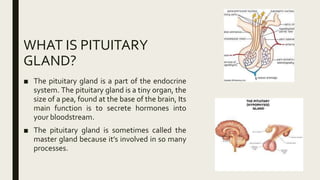
■ The pituitary gland is a part of the endocrine
system. The pituitary gland is a tiny organ, the
size of a pea, found at the base of the brain, Its
main function is to secrete hormones into
your bloodstream.
■ The pituitary gland is sometimes called the
master gland because it’s involved in so many
processes.
LOCATION
AND
FUNCTION
OF
PITUITARY
GLAND
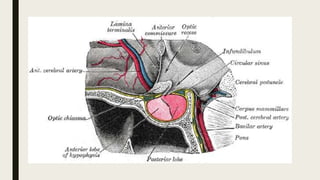
Also called hypophysis is located in the
Turkish chair of the sphenoid bone, at
the base of the skull, it is small in size
and is anatomically and functionally
related to the nervous system.
Helps us to make all those hormonal
responses that occur in the body are
well coordinated with each other and
keep us in a state of harmony in relation
to what happens in the environment.
How Does the Normal Pituitary
Work?
■ The pituitary gland
produces a number of
hormones. Hormones are
essential for many aspects
of life. Some send
messages to other
endocrine glands to tell
them to increase or
decrease production of
their hormones
Diseases of the pituitary gland
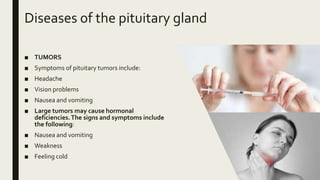
■ TUMORS
■ Symptoms of pituitary tumors include:
■ Headache
■ Vision problems
■ Nausea and vomiting
■ Large tumors may cause hormonal
deficiencies.The signs and symptoms include
the following:
■ Nausea and vomiting
■ Weakness
■ Feeling cold
POSTERIOR AND ANTERIOR
PITUITARY GLAND
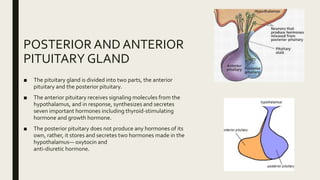
■ The pituitary gland is divided into two parts, the anterior
pituitary and the posterior pituitary.
■ The anterior pituitary receives signaling molecules from the
hypothalamus, and in response, synthesizes and secretes
seven important hormones including thyroid-stimulating
hormone and growth hormone.
■ The posterior pituitary does not produce any hormones of its
own, rather, it stores and secretes two hormones made in the
hypothalamus— oxytocin and
anti-diuretic hormone.
Target cell
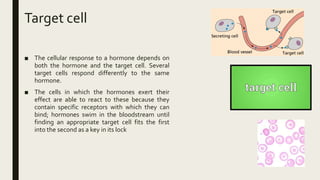
■ The cellular response to a hormone depends on
both the hormone and the target cell. Several
target cells respond differently to the same
hormone.
■ The cells in which the hormones exert their
effect are able to react to these because they
contain specific receptors with which they can
bind; hormones swim in the bloodstream until
finding an appropriate target cell fits the first
into the second as a key in its lock
Pineal Gland
Definition and Function
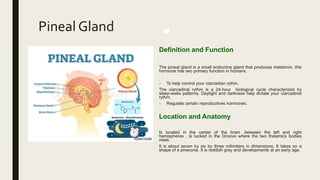
The pineal gland is a small endocrine gland that produces melatonin, this
hormone has two primary function in humans:
– To help control your ciarcadian rythm.
The ciarcadinal rythm is a 24-hour biological cycle characterized by
sleep-wake patterns. Daylight and darkness help dictate your ciarcadinal
rythm.
– Regulate certain reproductives hormones.
Location and Anatomy
Is located in the center of the brain ,between the left and right
hemispheres , is tucked in the Groove where the two thalamics bodies
meet.
It is about seven by six by three milimiters in dimensions. It takes on a
shape of a pinecone. It is reddish gray and developments at an early age.
Pineal Gland
Melatonin
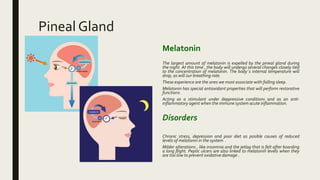
The largest amount of melatonin is expelled by the pineal gland during
the night. At this time , the body will undergo several changes closely tied
to the concentration of melatonin. The body´s internal temperature will
drop, as will our breathing rate.
These experience are the ones we most associate with falling sleep.
Melatonin has special antioxidant properties that will perform restorative
functions .
Acting as a stimulant under deppressive conditions and as an anti-
inflammatory agent when the immune system acute inflammation.
Disorders
Chronic stress, depression and poor diet as posible causes of reduced
levels of melatonin in the system .
Milder alterations , like insomnia and the jetlag that is felt after boarding
a long flight. Peptic ulcers are also linked to melatonin levels when they
are too low to prevent oxidative damage .
THYMUS
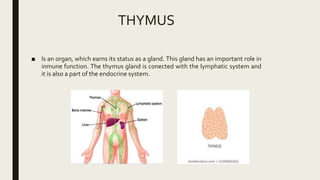
■ Is an organ, which earns its status as a gland. This gland has an important role in
inmune function. The thymus gland is conected with the lymphatic system and
it is also a part of the endocrine system.
Gland
Location
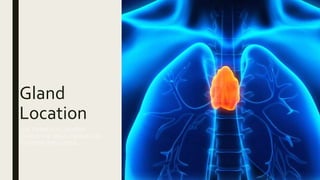
THETHYMUS IS LOCATED
BEHINDTHE BREASTBONEAND
BETWEENTHE LUNGS.
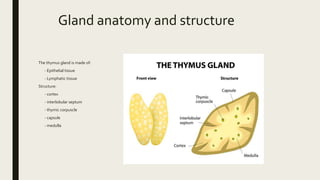
Gland anatomy and structure
The thymus gland is made of:
- Epithelial tissue
- Lymphatic tissue
Structure:
- cortex
- interlobular septum
- thymic corpuscle
- capsule
- medulla
Function
■ The main function of the thymus gland is to realease thymosin hormone.
■ Once theT cells have madurated, they will migrate to the lymph nodes which are the
store of inmune cells in the body.
■ Once the thymus receives the cells, they will be trained to only attack foreign agents.
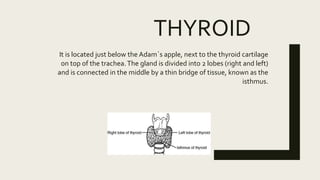
THYROID
It is located just below the Adam´s apple, next to the thyroid cartilage
on top of the trachea.The gland is divided into 2 lobes (right and left)
and is connected in the middle by a thin bridge of tissue, known as the
isthmus.
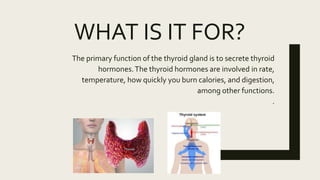
WHAT IS IT FOR?
The primary function of the thyroid gland is to secrete thyroid
hormones.The thyroid hormones are involved in rate,
temperature, how quickly you burn calories, and digestion,
among other functions.
.
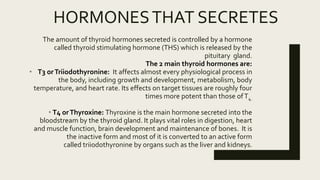
HORMONESTHAT SECRETES
The amount of thyroid hormones secreted is controlled by a hormone
called thyroid stimulating hormone (THS) which is released by the
pituitary gland.
The 2 main thyroid hormones are:
• T3 orTriiodothyronine: It affects almost every physiological process in
the body, including growth and development, metabolism, body
temperature, and heart rate. Its effects on target tissues are roughly four
times more potent than those ofT4.
• T4 orThyroxine: Thyroxine is the main hormone secreted into the
bloodstream by the thyroid gland. It plays vital roles in digestion, heart
and muscle function, brain development and maintenance of bones. It is
the inactive form and most of it is converted to an active form
called triiodothyronine by organs such as the liver and kidneys.
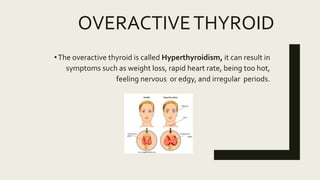
OVERACTIVETHYROID
•The overactive thyroid is called Hyperthyroidism, it can result in
symptoms such as weight loss, rapid heart rate, being too hot,
feeling nervous or edgy, and irregular periods.
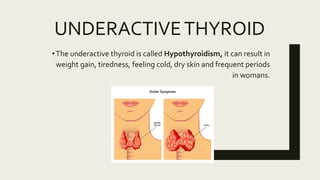
UNDERACTIVETHYROID
•The underactive thyroid is called Hypothyroidism, it can result in
weight gain, tiredness, feeling cold, dry skin and frequent periods
in womans.
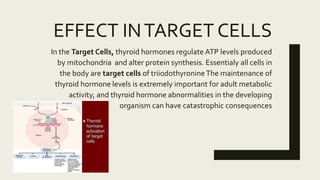
EFFECT INTARGET CELLS
In the Target Cells, thyroid hormones regulate ATP levels produced
by mitochondria and alter protein synthesis. Essentialy all cells in
the body are target cells of triiodothyronineThe maintenance of
thyroid hormone levels is extremely important for adult metabolic
activity, and thyroid hormone abnormalities in the developing
organism can have catastrophic consequences
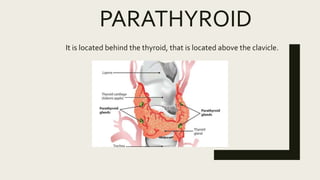
PARATHYROID
It is located behind the thyroid, that is located above the clavicle.
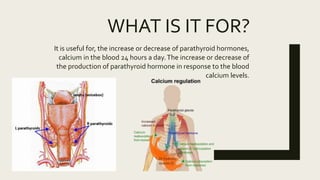
WHAT IS IT FOR?
It is useful for, the increase or decrease of parathyroid hormones,
calcium in the blood 24 hours a day.The increase or decrease of
the production of parathyroid hormone in response to the blood
calcium levels.
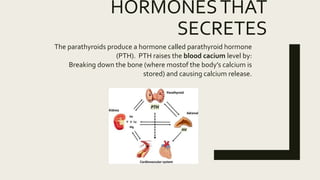
HORMONESTHAT
SECRETES
The parathyroids produce a hormone called parathyroid hormone
(PTH). PTH raises the blood cacium level by:
Breaking down the bone (where mostof the body’s calcium is
stored) and causing calcium release.
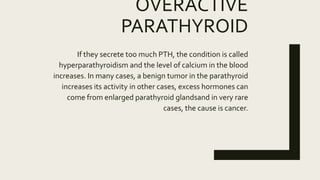
OVERACTIVE
PARATHYROID
If they secrete too much PTH, the condition is called
hyperparathyroidism and the level of calcium in the blood
increases. In many cases, a benign tumor in the parathyroid
increases its activity in other cases, excess hormones can
come from enlarged parathyroid glandsand in very rare
cases, the cause is cancer.
UNDERACTIVE
PARATHYROID
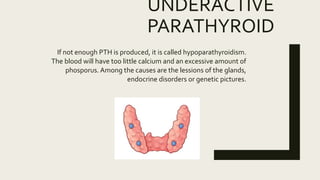
If not enough PTH is produced, it is called hypoparathyroidism.
The blood will have too little calcium and an excessive amount of
phosporus. Among the causes are the lessions of the glands,
endocrine disorders or genetic pictures.
WHAT IS THE PANCREAS?
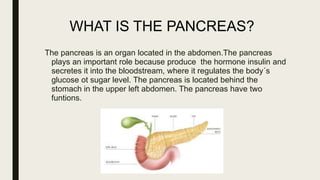
The pancreas is an organ located in the abdomen.The pancreas
plays an important role because produce the hormone insulin and
secretes it into the bloodstream, where it regulates the body´s
glucose ot sugar level. The pancreas is located behind the
stomach in the upper left abdomen. The pancreas have two
funtions.
PANCREA’S FUNCTIONS
EXOCRINE: Is to produce and release digestive fluids.After food
enters to stomach, digestive enzymes called pancreatic juice travel
through several small ducts to the main pancreatic duct and then
to the bile duct.
ENDOCRINE: The most important is that Endocrine produce the
hormones,also the most importan is the insulin, which is essential
for the cells responsible for the production of these hormones are
not distributed homogeneously troughout the pancreas, but are
concentrated in groups of cells that are called isiets of langerhans.
Blood Glucose Homeostasis
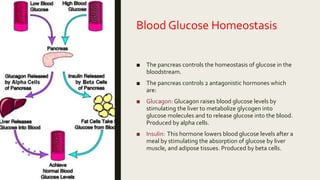
■ The pancreas controls the homeostasis of glucose in the
bloodstream.
■ The pancreas controls 2 antagonistic hormones which
are:
■ Glucagon: Glucagon raises blood glucose levels by
stimulating the liver to metabolize glycogen into
glucose molecules and to release glucose into the blood.
Produced by alpha cells.
■ Insulin: This hormone lowers blood glucose levels after a
meal by stimulating the absorption of glucose by liver
muscle, and adipose tissues. Produced by beta cells.
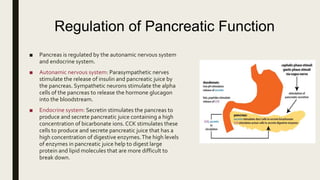
Regulation of Pancreatic Function
■ Pancreas is regulated by the autonamic nervous system
and endocrine system.
■ Autonamic nervous system: Parasympathetic nerves
stimulate the release of insulin and pancreatic juice by
the pancreas. Sympathetic neurons stimulate the alpha
cells of the pancreas to release the hormone glucagon
into the bloodstream.
■ Endocrine system: Secretin stimulates the pancreas to
produce and secrete pancreatic juice containing a high
concentration of bicarbonate ions. CCK stimulates these
cells to produce and secrete pancreatic juice that has a
high concentration of digestive enzymes.The high levels
of enzymes in pancreatic juice help to digest large
protein and lipid molecules that are more difficult to
break down.
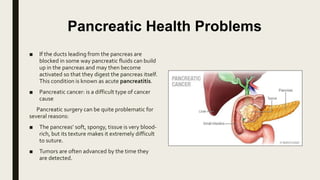
Pancreatic Health Problems
■ If the ducts leading from the pancreas are
blocked in some way pancreatic fluids can build
up in the pancreas and may then become
activated so that they digest the pancreas itself.
This condition is known as acute pancreatitis.
■ Pancreatic cancer: is a difficult type of cancer
cause
Pancreatic surgery can be quite problematic for
several reasons:
■ The pancreas’ soft, spongy, tissue is very blood-
rich, but its texture makes it extremely difficult
to suture.
■ Tumors are often advanced by the time they
are detected.

Endocrine system

  • 1.
  • 2.
    WHAT IS PITUITARY GLAND? ■The pituitary gland is a part of the endocrine system. The pituitary gland is a tiny organ, the size of a pea, found at the base of the brain, Its main function is to secrete hormones into your bloodstream. ■ The pituitary gland is sometimes called the master gland because it’s involved in so many processes.
  • 3.
    LOCATION AND FUNCTION OF PITUITARY GLAND Also called hypophysisis located in the Turkish chair of the sphenoid bone, at the base of the skull, it is small in size and is anatomically and functionally related to the nervous system. Helps us to make all those hormonal responses that occur in the body are well coordinated with each other and keep us in a state of harmony in relation to what happens in the environment.
  • 4.
    How Does theNormal Pituitary Work? ■ The pituitary gland produces a number of hormones. Hormones are essential for many aspects of life. Some send messages to other endocrine glands to tell them to increase or decrease production of their hormones
  • 5.
    Diseases of thepituitary gland ■ TUMORS ■ Symptoms of pituitary tumors include: ■ Headache ■ Vision problems ■ Nausea and vomiting ■ Large tumors may cause hormonal deficiencies.The signs and symptoms include the following: ■ Nausea and vomiting ■ Weakness ■ Feeling cold
  • 6.
    POSTERIOR AND ANTERIOR PITUITARYGLAND ■ The pituitary gland is divided into two parts, the anterior pituitary and the posterior pituitary. ■ The anterior pituitary receives signaling molecules from the hypothalamus, and in response, synthesizes and secretes seven important hormones including thyroid-stimulating hormone and growth hormone. ■ The posterior pituitary does not produce any hormones of its own, rather, it stores and secretes two hormones made in the hypothalamus— oxytocin and anti-diuretic hormone.
  • 8.
    Target cell ■ Thecellular response to a hormone depends on both the hormone and the target cell. Several target cells respond differently to the same hormone. ■ The cells in which the hormones exert their effect are able to react to these because they contain specific receptors with which they can bind; hormones swim in the bloodstream until finding an appropriate target cell fits the first into the second as a key in its lock
  • 9.
    Pineal Gland Definition andFunction The pineal gland is a small endocrine gland that produces melatonin, this hormone has two primary function in humans: – To help control your ciarcadian rythm. The ciarcadinal rythm is a 24-hour biological cycle characterized by sleep-wake patterns. Daylight and darkness help dictate your ciarcadinal rythm. – Regulate certain reproductives hormones. Location and Anatomy Is located in the center of the brain ,between the left and right hemispheres , is tucked in the Groove where the two thalamics bodies meet. It is about seven by six by three milimiters in dimensions. It takes on a shape of a pinecone. It is reddish gray and developments at an early age.
  • 10.
    Pineal Gland Melatonin The largestamount of melatonin is expelled by the pineal gland during the night. At this time , the body will undergo several changes closely tied to the concentration of melatonin. The body´s internal temperature will drop, as will our breathing rate. These experience are the ones we most associate with falling sleep. Melatonin has special antioxidant properties that will perform restorative functions . Acting as a stimulant under deppressive conditions and as an anti- inflammatory agent when the immune system acute inflammation. Disorders Chronic stress, depression and poor diet as posible causes of reduced levels of melatonin in the system . Milder alterations , like insomnia and the jetlag that is felt after boarding a long flight. Peptic ulcers are also linked to melatonin levels when they are too low to prevent oxidative damage .
  • 11.
    THYMUS ■ Is anorgan, which earns its status as a gland. This gland has an important role in inmune function. The thymus gland is conected with the lymphatic system and it is also a part of the endocrine system.
  • 12.
    Gland Location THETHYMUS IS LOCATED BEHINDTHEBREASTBONEAND BETWEENTHE LUNGS.
  • 13.
    Gland anatomy andstructure The thymus gland is made of: - Epithelial tissue - Lymphatic tissue Structure: - cortex - interlobular septum - thymic corpuscle - capsule - medulla
  • 14.
    Function ■ The mainfunction of the thymus gland is to realease thymosin hormone. ■ Once theT cells have madurated, they will migrate to the lymph nodes which are the store of inmune cells in the body. ■ Once the thymus receives the cells, they will be trained to only attack foreign agents.
  • 15.
    THYROID It is locatedjust below the Adam´s apple, next to the thyroid cartilage on top of the trachea.The gland is divided into 2 lobes (right and left) and is connected in the middle by a thin bridge of tissue, known as the isthmus.
  • 16.
    WHAT IS ITFOR? The primary function of the thyroid gland is to secrete thyroid hormones.The thyroid hormones are involved in rate, temperature, how quickly you burn calories, and digestion, among other functions. .
  • 17.
    HORMONESTHAT SECRETES The amountof thyroid hormones secreted is controlled by a hormone called thyroid stimulating hormone (THS) which is released by the pituitary gland. The 2 main thyroid hormones are: • T3 orTriiodothyronine: It affects almost every physiological process in the body, including growth and development, metabolism, body temperature, and heart rate. Its effects on target tissues are roughly four times more potent than those ofT4. • T4 orThyroxine: Thyroxine is the main hormone secreted into the bloodstream by the thyroid gland. It plays vital roles in digestion, heart and muscle function, brain development and maintenance of bones. It is the inactive form and most of it is converted to an active form called triiodothyronine by organs such as the liver and kidneys.
  • 18.
    OVERACTIVETHYROID •The overactive thyroidis called Hyperthyroidism, it can result in symptoms such as weight loss, rapid heart rate, being too hot, feeling nervous or edgy, and irregular periods.
  • 19.
    UNDERACTIVETHYROID •The underactive thyroidis called Hypothyroidism, it can result in weight gain, tiredness, feeling cold, dry skin and frequent periods in womans.
  • 20.
    EFFECT INTARGET CELLS Inthe Target Cells, thyroid hormones regulate ATP levels produced by mitochondria and alter protein synthesis. Essentialy all cells in the body are target cells of triiodothyronineThe maintenance of thyroid hormone levels is extremely important for adult metabolic activity, and thyroid hormone abnormalities in the developing organism can have catastrophic consequences
  • 21.
    PARATHYROID It is locatedbehind the thyroid, that is located above the clavicle.
  • 22.
    WHAT IS ITFOR? It is useful for, the increase or decrease of parathyroid hormones, calcium in the blood 24 hours a day.The increase or decrease of the production of parathyroid hormone in response to the blood calcium levels.
  • 23.
    HORMONESTHAT SECRETES The parathyroids producea hormone called parathyroid hormone (PTH). PTH raises the blood cacium level by: Breaking down the bone (where mostof the body’s calcium is stored) and causing calcium release.
  • 24.
    OVERACTIVE PARATHYROID If they secretetoo much PTH, the condition is called hyperparathyroidism and the level of calcium in the blood increases. In many cases, a benign tumor in the parathyroid increases its activity in other cases, excess hormones can come from enlarged parathyroid glandsand in very rare cases, the cause is cancer.
  • 25.
    UNDERACTIVE PARATHYROID If not enoughPTH is produced, it is called hypoparathyroidism. The blood will have too little calcium and an excessive amount of phosporus. Among the causes are the lessions of the glands, endocrine disorders or genetic pictures.
  • 26.
    WHAT IS THEPANCREAS? The pancreas is an organ located in the abdomen.The pancreas plays an important role because produce the hormone insulin and secretes it into the bloodstream, where it regulates the body´s glucose ot sugar level. The pancreas is located behind the stomach in the upper left abdomen. The pancreas have two funtions.
  • 27.
    PANCREA’S FUNCTIONS EXOCRINE: Isto produce and release digestive fluids.After food enters to stomach, digestive enzymes called pancreatic juice travel through several small ducts to the main pancreatic duct and then to the bile duct. ENDOCRINE: The most important is that Endocrine produce the hormones,also the most importan is the insulin, which is essential for the cells responsible for the production of these hormones are not distributed homogeneously troughout the pancreas, but are concentrated in groups of cells that are called isiets of langerhans.
  • 28.
    Blood Glucose Homeostasis ■The pancreas controls the homeostasis of glucose in the bloodstream. ■ The pancreas controls 2 antagonistic hormones which are: ■ Glucagon: Glucagon raises blood glucose levels by stimulating the liver to metabolize glycogen into glucose molecules and to release glucose into the blood. Produced by alpha cells. ■ Insulin: This hormone lowers blood glucose levels after a meal by stimulating the absorption of glucose by liver muscle, and adipose tissues. Produced by beta cells.
  • 29.
    Regulation of PancreaticFunction ■ Pancreas is regulated by the autonamic nervous system and endocrine system. ■ Autonamic nervous system: Parasympathetic nerves stimulate the release of insulin and pancreatic juice by the pancreas. Sympathetic neurons stimulate the alpha cells of the pancreas to release the hormone glucagon into the bloodstream. ■ Endocrine system: Secretin stimulates the pancreas to produce and secrete pancreatic juice containing a high concentration of bicarbonate ions. CCK stimulates these cells to produce and secrete pancreatic juice that has a high concentration of digestive enzymes.The high levels of enzymes in pancreatic juice help to digest large protein and lipid molecules that are more difficult to break down.
  • 30.
    Pancreatic Health Problems ■If the ducts leading from the pancreas are blocked in some way pancreatic fluids can build up in the pancreas and may then become activated so that they digest the pancreas itself. This condition is known as acute pancreatitis. ■ Pancreatic cancer: is a difficult type of cancer cause Pancreatic surgery can be quite problematic for several reasons: ■ The pancreas’ soft, spongy, tissue is very blood- rich, but its texture makes it extremely difficult to suture. ■ Tumors are often advanced by the time they are detected.