ENDOCRINE SYSTEM
Definition 
Endocrine System refers to the collection of glands of an organism that 
secrete hormones directly into the circulatory system to be carried toward a distant 
target organ. 
includes all of the glands of the body and the hormones produced by those glands. 
Major endocrine glands 
 pineal gland 
 pituitary gland 
 pancreas 
 ovaries 
 testes 
 thyroid gland 
 parathyroid gland 
 hypothalamus 
 gastrointestinal tract 
 adrenal glands 
There are up to 20 major 
hormones secreted by the 
gland in the endocrine system 
which are essential to different 
tasks throughout the body.
Here are a few of the areas governed 
by the endocrine system 
 Reproduction 
 Responses to stress and injuries 
 Growth and sexual development 
 Body energy levels 
 Internal balance of body systems 
 Bone and muscle strength
Functions of the Endocrine System 
 Controls the processes involved in movement and 
physiological equilibrium 
 Includes all tissues or glands that secrete hormones into the 
blood 
 Secrete hormones directly into the bloodstream. 
 Integrate body systems
TERMS 
 ENDOCRINE GLAND a gland that secretes hormones 
directly into the bloodstream; a ductless gland. 
 HORMONES is a very powerful substance secreted by an 
endocrine gland into the bloodstream, that affects the 
function of another cell or "target cell". 
 HOMEOSTASIS is the maintenance of the constant 
internal environment which include the function of 
kidney, liver, skin, etc.
Major Endocrine Glands
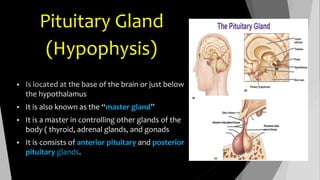
Pituitary Gland 
(Hypophysis) 
 
 It is also known as the “master gland” 
 It is a master in controlling other glands of the 
body ( thyroid, adrenal glands, and gonads 
 It is consists of anterior pituitary and posterior 
pituitary glands.
Anterior Pituitary Glands 
( Adenohypophysis) 
 Hormone stimulates the thyroid gland, 
adrenal glands and gonads 
 It secretes other hormones like 
melanocyte stimulating hormone 
responsible for skin color 
 Prolactin stimulating milk production 
for lactating mothers 
 Somatotropin (growth hormone) 
 Giantism and dwarfism 
 LH,MSH, FLH
Anterior Pituitary Glands 
 It has three region : 
1. Pars distalis – It is the largest and 
vascular lobe, it is the major secretory 
of the gland 
2. Pars tuberalis – it joins the pituitary 
stalk arising from the posterior gland 
3. Pars intermedia – it is located 
between the pars distalis and posterior 
gland, it serves as the boundary 
between anterior and posterior gland ( 
it is very small and indistinct to 
humans)
Posterior Pituitary Glands 
(Neurohypophysis) 
 It releases vasopressin 
hormones to control the amount 
of water 
 Oxytocin secreted during 
childbirth in stimulating 
muscular contraction of the 
uterus and ejection of milk from 
lactating mammary gland
2 Regions of the Posterior Pituitary 
Gland 
 Pars Nervosa 
- It is also called as “posterior lobe” 
- Is the storage site of Oxytocin and Vasopressin 
 Infundibular stalk 
- the connection between the hypothalamus and the posterior 
pituitary.
Thyroid Glands 
 It is located in the neck at the back of the 
Adam’s apple 
 It secretes three hormones : 
- T3 (triiodothyronine) 
- T4 (thyroxin) 
- Calcitonin – lowers down the blood 
calcium level of the body 
 Both T3 and T4 contain the iodine element 
which regulate the metabolism and play a 
crucial role in development ad maturation. 
 Hyperthyroidism- excess of T3 and T4 
 Hypothyroidism- insufficient of T3 and 
T4
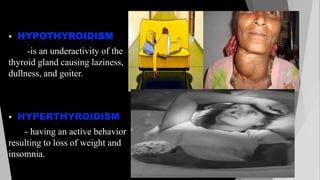
 HYPOTHYROIDISM 
-is an underactivity of the 
thyroid gland causing laziness, 
dullness, and goiter. 
 HYPERTHYROIDISM 
- having an active behavior 
resulting to loss of weight and 
insomnia.
Parathyroid Gland 
 It is located at the back of the thyroid 
gland 
 The parathormone regulates the 
utilization of calcium and phosphorus in 
the blood level of the body 
 Too much secretion of the parathormone 
presents poor physical coordination 
 Less secretion can lead to “tetany” is 
the intermittent, involuntary twitching and 
spasms of the muscle
Adrenal Glands 
 It is located at the top or above the kidney 
 Adrenalin, the hormone it produces 
 It has two parts the inner part which is the 
“medulla” and the outer part which is the 
“cortex” 
 Medulla is the source of epinephrine(adrenalin) 
and Non-epinephrine. Epinephrine raises blood 
sugar levels, cause nervousness and perspirations 
on acute emergencies. 
 Cortex releases cortisone which is essential 
for adapting to stress and maintaining blood sugar 
level and aldosterone that regulates the salt 
and water balance of the body.
Gonads 
 It stimulates the secondary sex 
characteristics for boys and girls during 
puberty stage 
 The appearance of pubic hair, hair at the 
armpit etc. 
 The male gonads secrete the hormone 
“androgen” that contain testosterone which 
influences the growth of prostate, seminal 
vesicles, the production of sperm 
 The female gonads secrete the hormones 
“estrogen” which is necessary for the 
development of the reproductive organ and “ 
progesterone” which is essential for 
maintaining pregnancy located at the paired 
ovaries
Pancreas 
 It is located near the stomach at the 
right side of the abdomen at the level 
of the umbilicus 
 The hormones and insulin are found at 
the “Islets of Langerhans” of the 
pancreas. 
 Insulin plays an important role in 
keeping the levels of sugar(glucose) in 
the bloodstream under control. 
 Glucagon increases the level of sugar 
in the body if the insulin is absent or 
lacking.
Pineal Gland 
 It is situated at the mid-cerebrum 
 It releases melatonin that 
regulates body rhythms and 
sleeping patterns.
THE 
END!!!  
Prepared By: 
Prepared by: 
Patricia Francisco 
Monique Burgos

Endocrine system

  • 1.
  • 3.
    Definition Endocrine Systemrefers to the collection of glands of an organism that secrete hormones directly into the circulatory system to be carried toward a distant target organ. includes all of the glands of the body and the hormones produced by those glands. Major endocrine glands  pineal gland  pituitary gland  pancreas  ovaries  testes  thyroid gland  parathyroid gland  hypothalamus  gastrointestinal tract  adrenal glands There are up to 20 major hormones secreted by the gland in the endocrine system which are essential to different tasks throughout the body.
  • 4.
    Here are afew of the areas governed by the endocrine system  Reproduction  Responses to stress and injuries  Growth and sexual development  Body energy levels  Internal balance of body systems  Bone and muscle strength
  • 5.
    Functions of theEndocrine System  Controls the processes involved in movement and physiological equilibrium  Includes all tissues or glands that secrete hormones into the blood  Secrete hormones directly into the bloodstream.  Integrate body systems
  • 6.
    TERMS  ENDOCRINEGLAND a gland that secretes hormones directly into the bloodstream; a ductless gland.  HORMONES is a very powerful substance secreted by an endocrine gland into the bloodstream, that affects the function of another cell or "target cell".  HOMEOSTASIS is the maintenance of the constant internal environment which include the function of kidney, liver, skin, etc.
  • 7.
  • 8.
    Pituitary Gland (Hypophysis)   It is also known as the “master gland”  It is a master in controlling other glands of the body ( thyroid, adrenal glands, and gonads  It is consists of anterior pituitary and posterior pituitary glands.
  • 9.
    Anterior Pituitary Glands ( Adenohypophysis)  Hormone stimulates the thyroid gland, adrenal glands and gonads  It secretes other hormones like melanocyte stimulating hormone responsible for skin color  Prolactin stimulating milk production for lactating mothers  Somatotropin (growth hormone)  Giantism and dwarfism  LH,MSH, FLH
  • 10.
    Anterior Pituitary Glands  It has three region : 1. Pars distalis – It is the largest and vascular lobe, it is the major secretory of the gland 2. Pars tuberalis – it joins the pituitary stalk arising from the posterior gland 3. Pars intermedia – it is located between the pars distalis and posterior gland, it serves as the boundary between anterior and posterior gland ( it is very small and indistinct to humans)
  • 11.
    Posterior Pituitary Glands (Neurohypophysis)  It releases vasopressin hormones to control the amount of water  Oxytocin secreted during childbirth in stimulating muscular contraction of the uterus and ejection of milk from lactating mammary gland
  • 12.
    2 Regions ofthe Posterior Pituitary Gland  Pars Nervosa - It is also called as “posterior lobe” - Is the storage site of Oxytocin and Vasopressin  Infundibular stalk - the connection between the hypothalamus and the posterior pituitary.
  • 13.
    Thyroid Glands It is located in the neck at the back of the Adam’s apple  It secretes three hormones : - T3 (triiodothyronine) - T4 (thyroxin) - Calcitonin – lowers down the blood calcium level of the body  Both T3 and T4 contain the iodine element which regulate the metabolism and play a crucial role in development ad maturation.  Hyperthyroidism- excess of T3 and T4  Hypothyroidism- insufficient of T3 and T4
  • 14.
     HYPOTHYROIDISM -isan underactivity of the thyroid gland causing laziness, dullness, and goiter.  HYPERTHYROIDISM - having an active behavior resulting to loss of weight and insomnia.
  • 15.
    Parathyroid Gland It is located at the back of the thyroid gland  The parathormone regulates the utilization of calcium and phosphorus in the blood level of the body  Too much secretion of the parathormone presents poor physical coordination  Less secretion can lead to “tetany” is the intermittent, involuntary twitching and spasms of the muscle
  • 16.
    Adrenal Glands It is located at the top or above the kidney  Adrenalin, the hormone it produces  It has two parts the inner part which is the “medulla” and the outer part which is the “cortex”  Medulla is the source of epinephrine(adrenalin) and Non-epinephrine. Epinephrine raises blood sugar levels, cause nervousness and perspirations on acute emergencies.  Cortex releases cortisone which is essential for adapting to stress and maintaining blood sugar level and aldosterone that regulates the salt and water balance of the body.
  • 17.
    Gonads  Itstimulates the secondary sex characteristics for boys and girls during puberty stage  The appearance of pubic hair, hair at the armpit etc.  The male gonads secrete the hormone “androgen” that contain testosterone which influences the growth of prostate, seminal vesicles, the production of sperm  The female gonads secrete the hormones “estrogen” which is necessary for the development of the reproductive organ and “ progesterone” which is essential for maintaining pregnancy located at the paired ovaries
  • 18.
    Pancreas  Itis located near the stomach at the right side of the abdomen at the level of the umbilicus  The hormones and insulin are found at the “Islets of Langerhans” of the pancreas.  Insulin plays an important role in keeping the levels of sugar(glucose) in the bloodstream under control.  Glucagon increases the level of sugar in the body if the insulin is absent or lacking.
  • 19.
    Pineal Gland It is situated at the mid-cerebrum  It releases melatonin that regulates body rhythms and sleeping patterns.
  • 20.
    THE END!!!  Prepared By: Prepared by: Patricia Francisco Monique Burgos