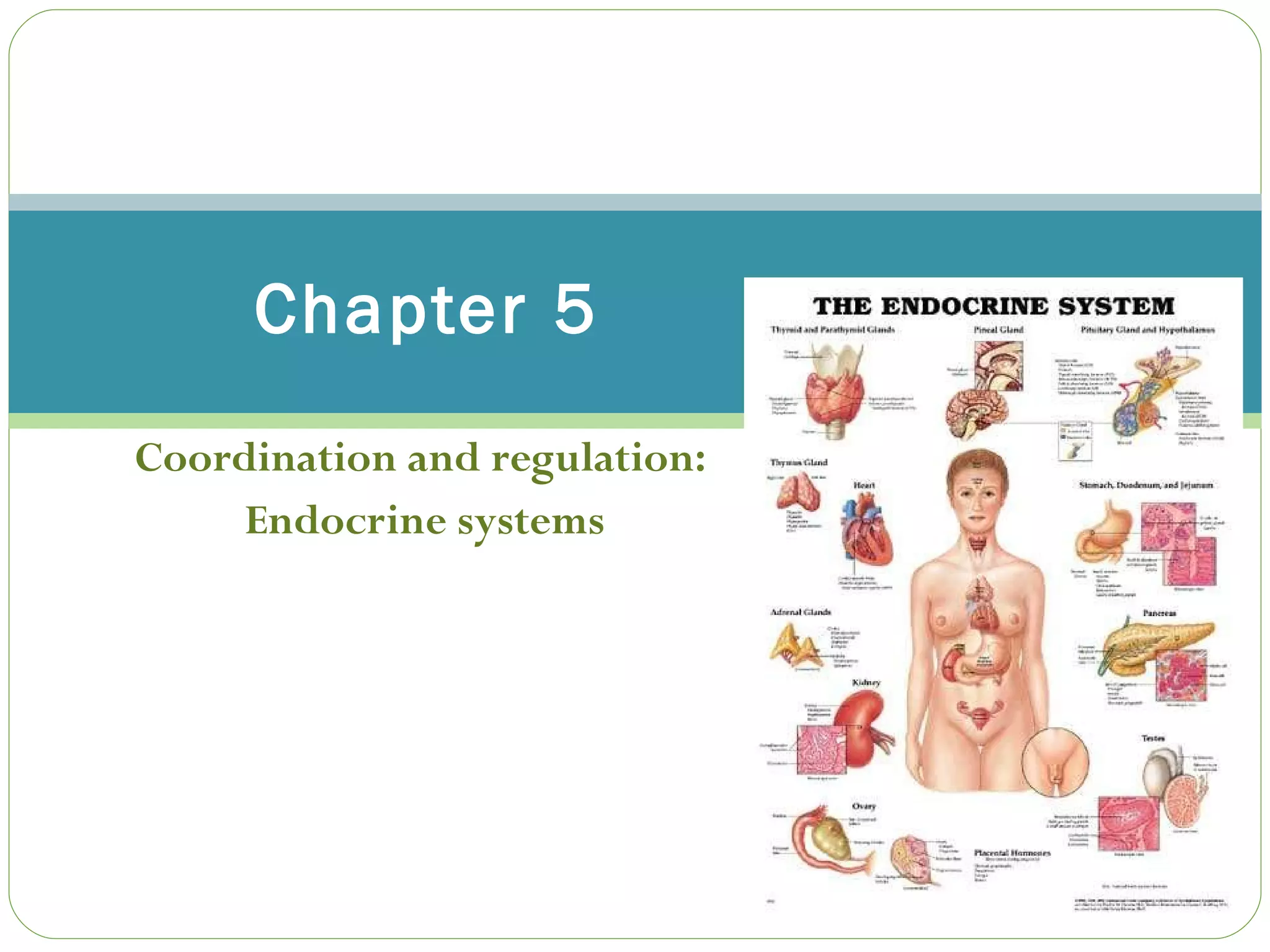
Coordination and regulation:  Endocrine systems Chapter 5
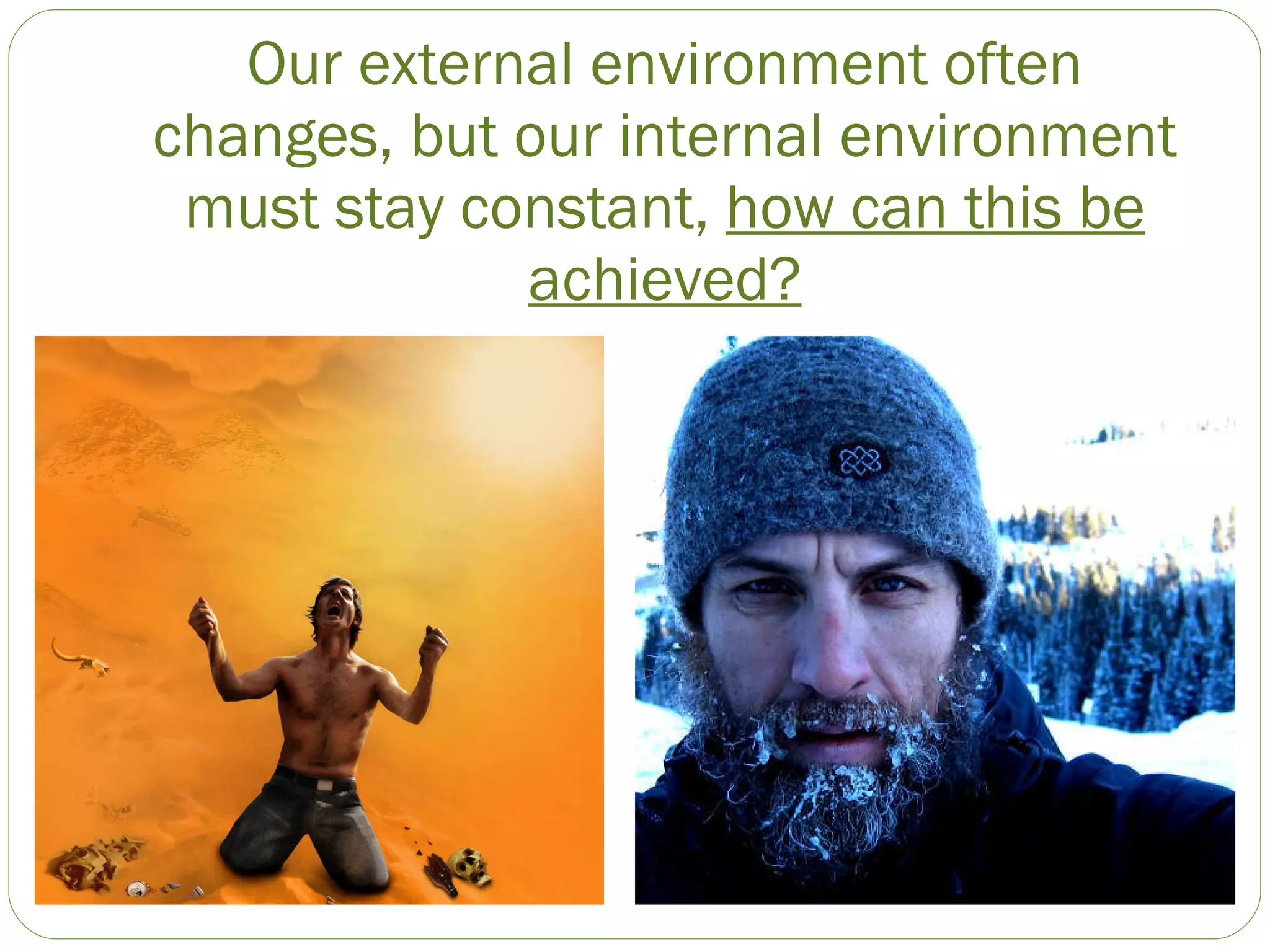
Our external environment often changes, but our internal environment must stay constant,  how can this be achieved?
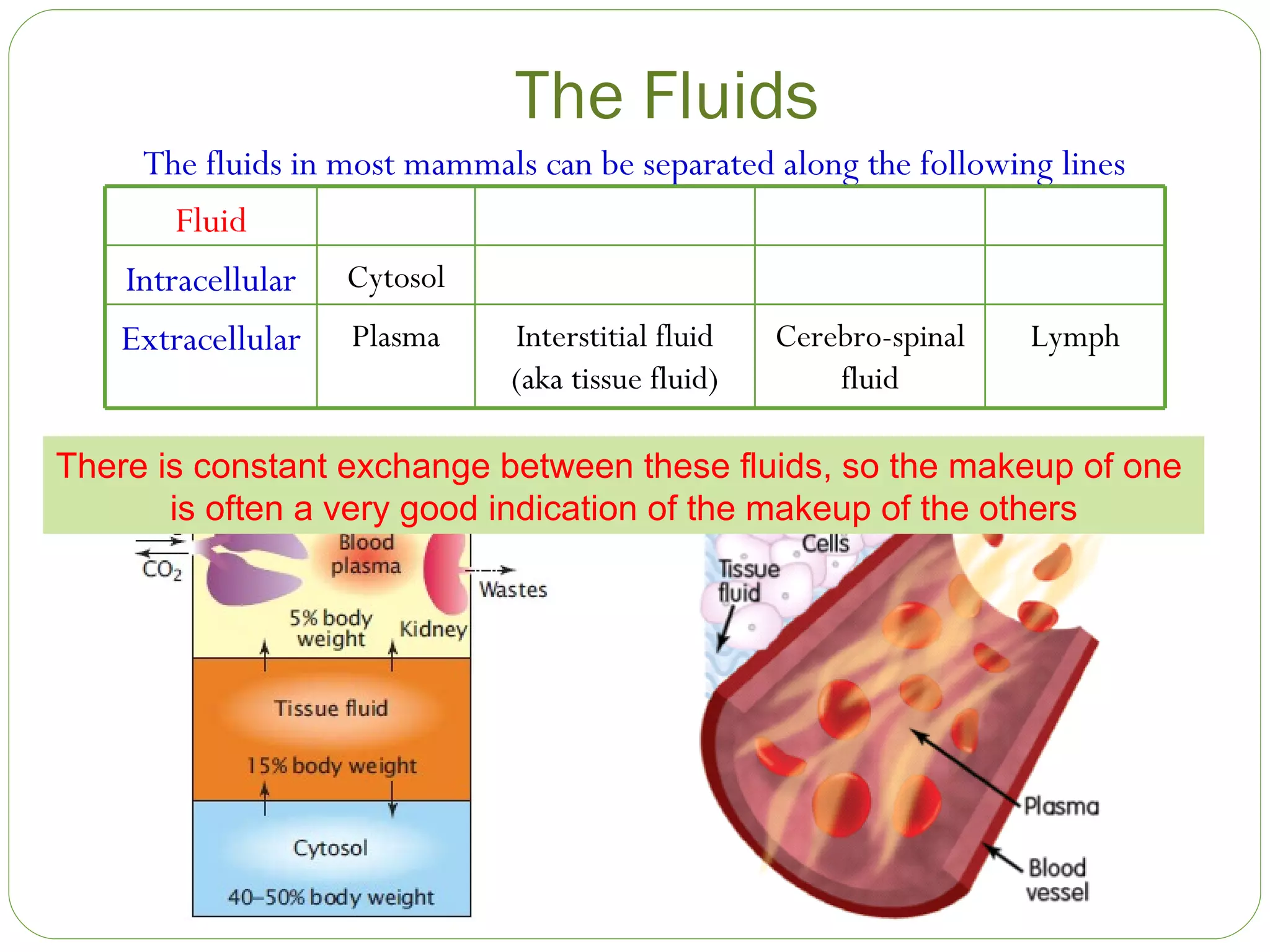
The Fluids The fluids in most mammals can be separated along the following lines There is constant exchange between these fluids, so the makeup of one  is often a very good indication of the makeup of the others Cerebro-spinal fluid Interstitial fluid (aka tissue fluid) Plasma Cytosol Lymph Extracellular Intracellular Fluid
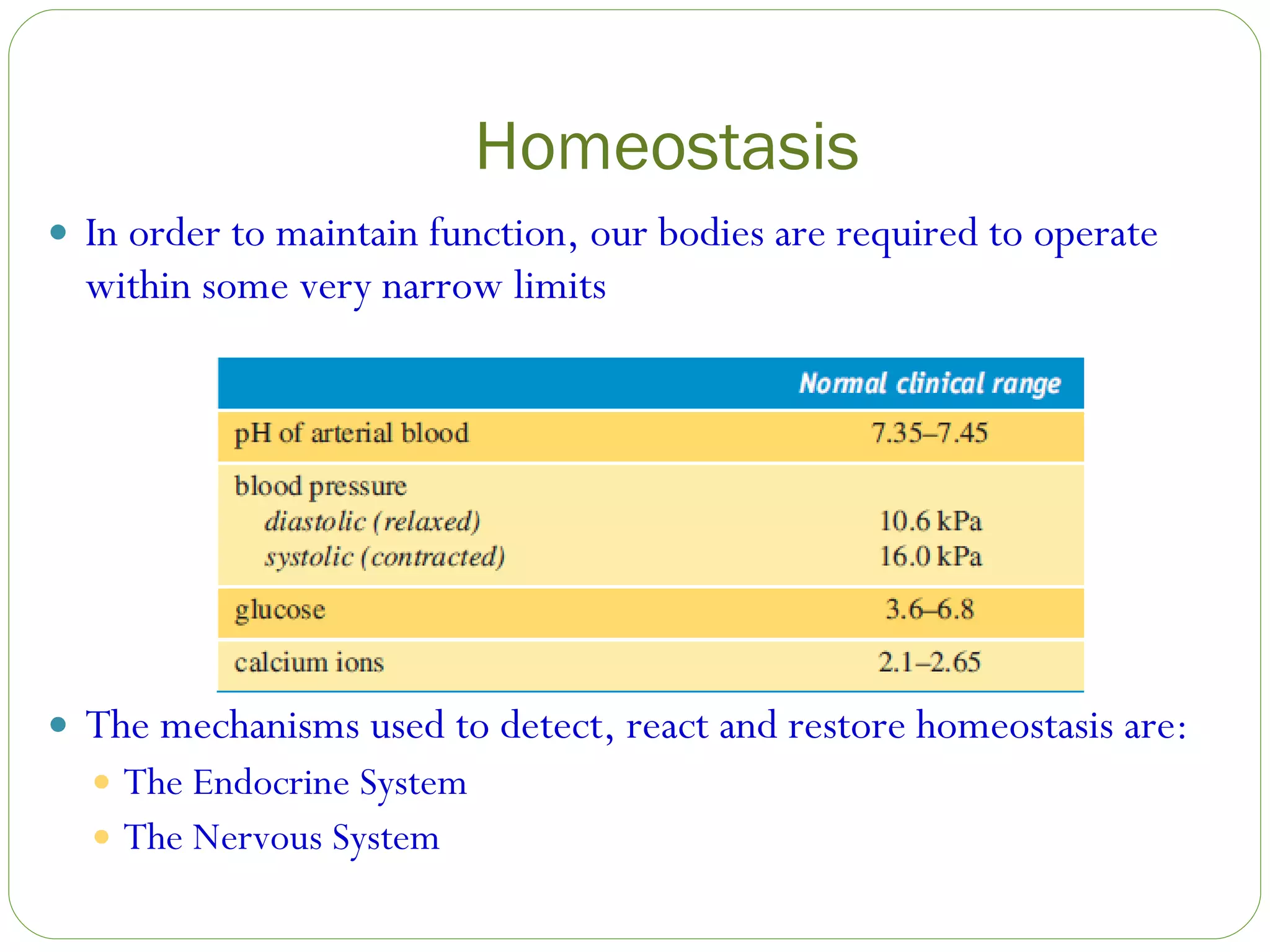
Homeostasis In order to maintain function, our bodies are required to operate within some very narrow limits The mechanisms used to detect, react and restore homeostasis are: The Endocrine System The Nervous System
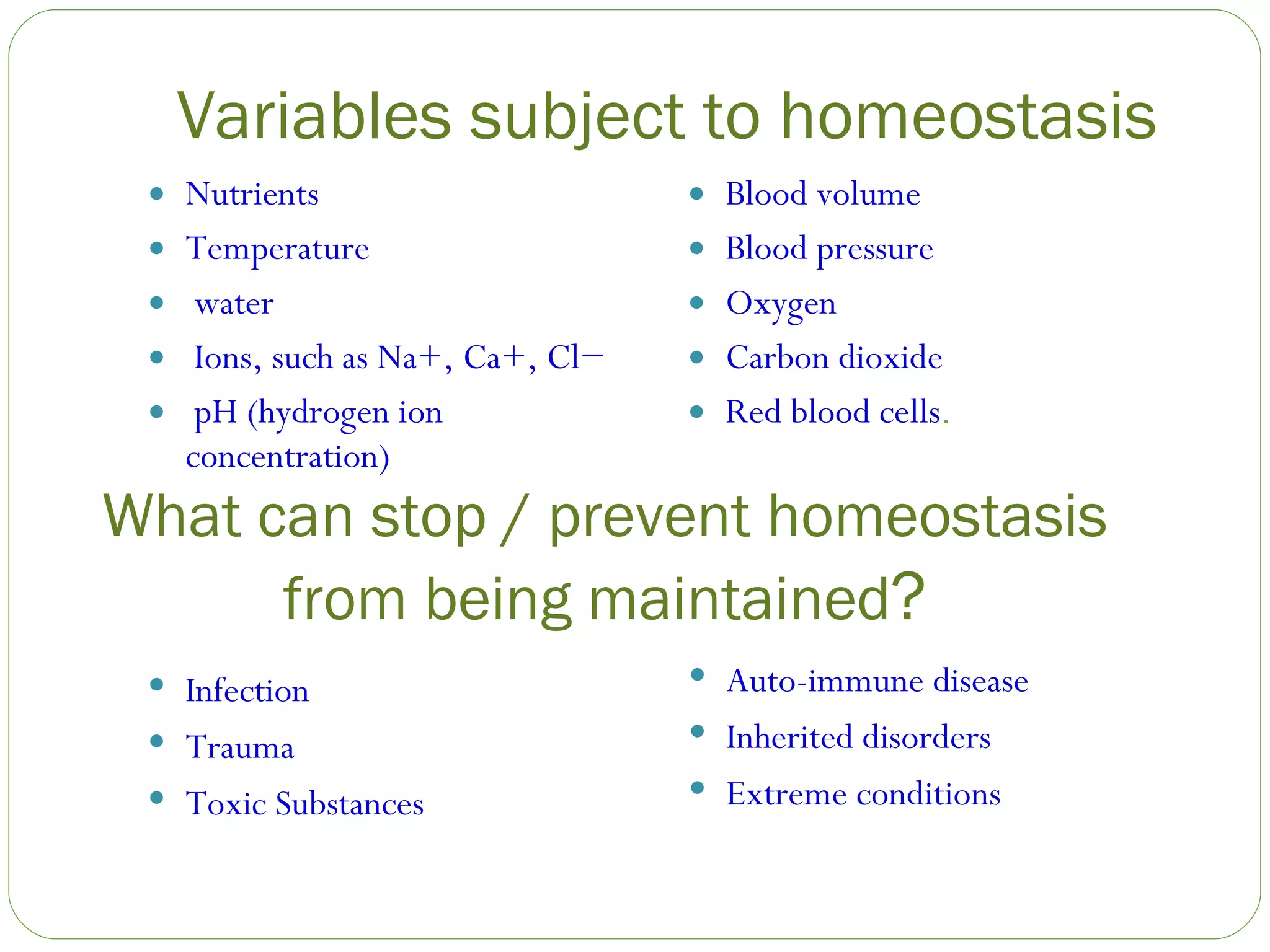
Variables subject to homeostasis Nutrients Temperature water Ions, such as Na+, Ca+, Cl− pH (hydrogen ion concentration) Blood volume Blood pressure Oxygen Carbon dioxide Red blood cells . What can stop / prevent homeostasis from being maintained ? Infection Trauma Toxic Substances Auto-immune disease Inherited disorders Extreme conditions
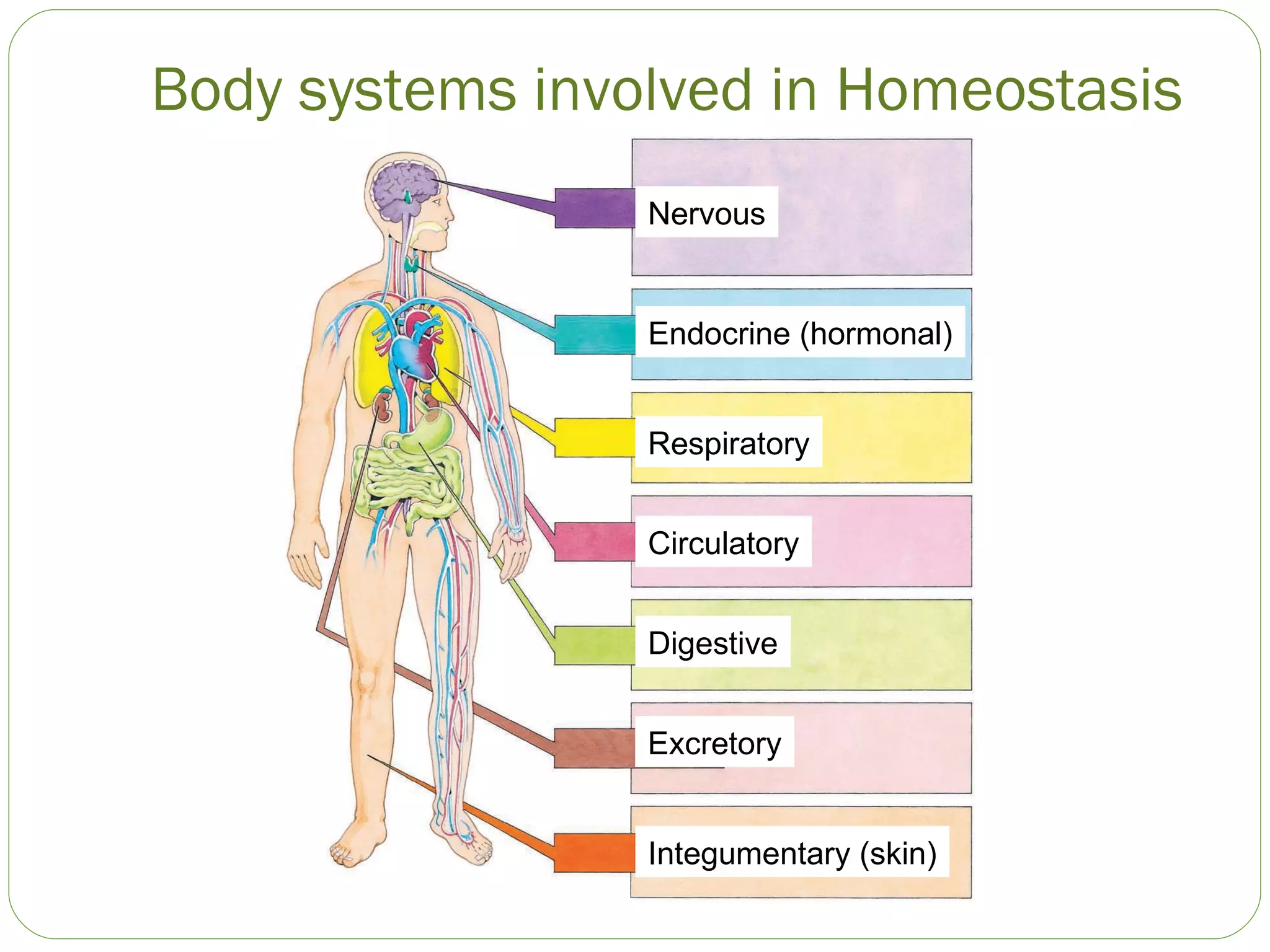
Body systems involved in Homeostasis Nervous Endocrine (hormonal) Respiratory Circulatory Digestive Excretory Integumentary (skin)
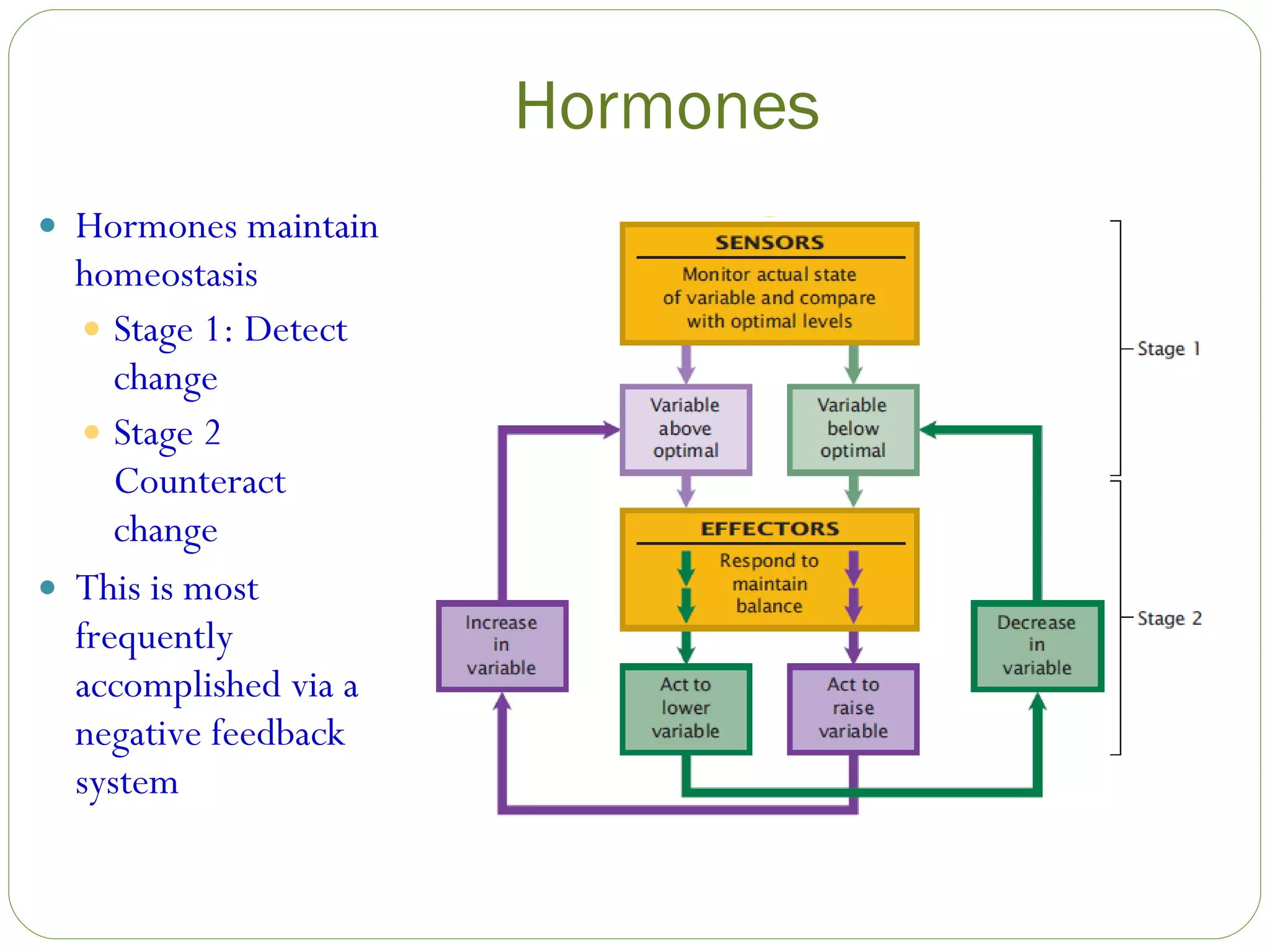
Hormones Hormones maintain homeostasis Stage 1: Detect change Stage 2 Counteract change This is most frequently accomplished via a negative feedback system
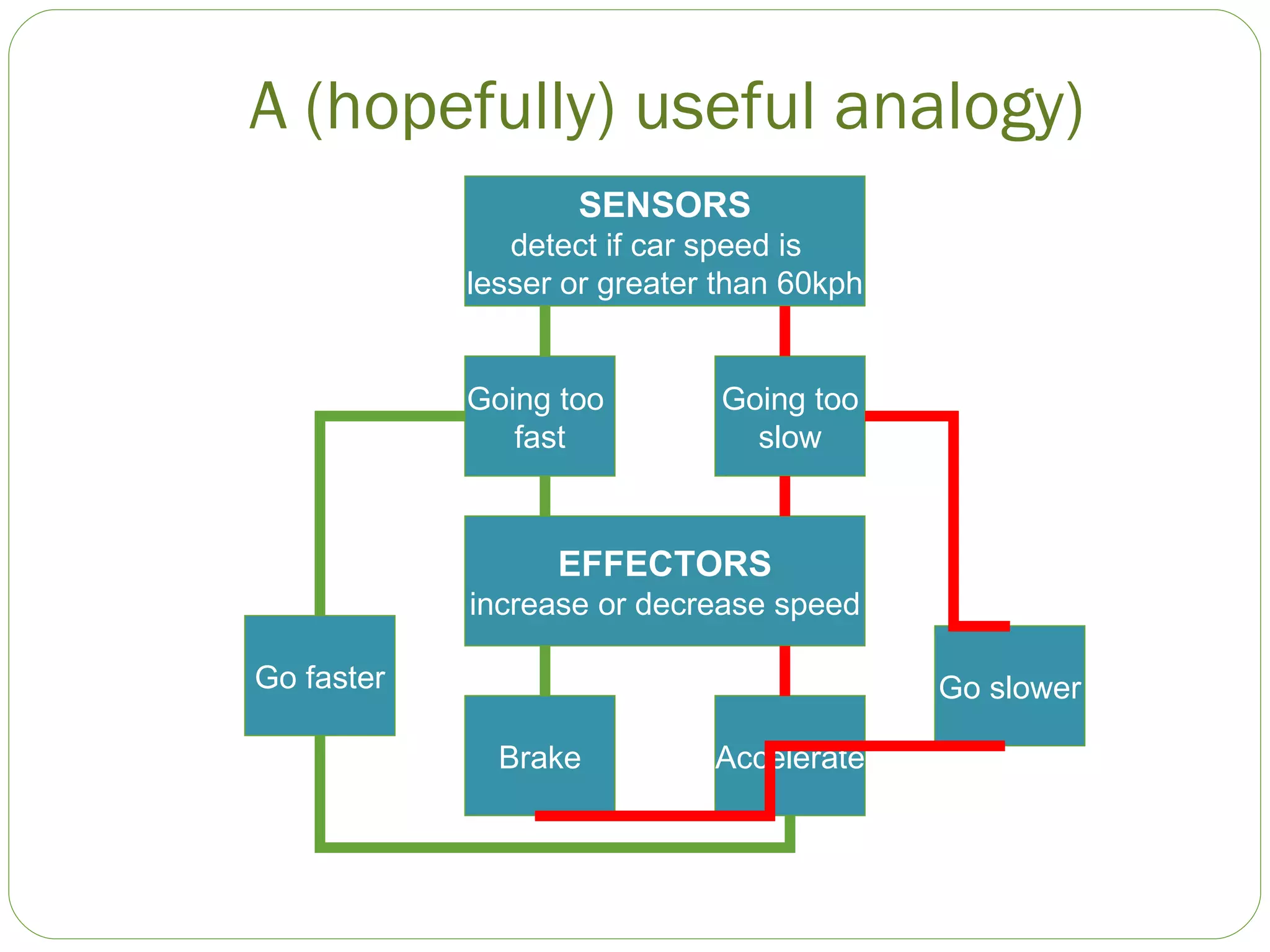
A (hopefully) useful analogy) SENSORS detect if car speed is  lesser or greater than 60kph Going too  fast Going too slow Brake Accelerate Go slower Go faster EFFECTORS increase or decrease speed
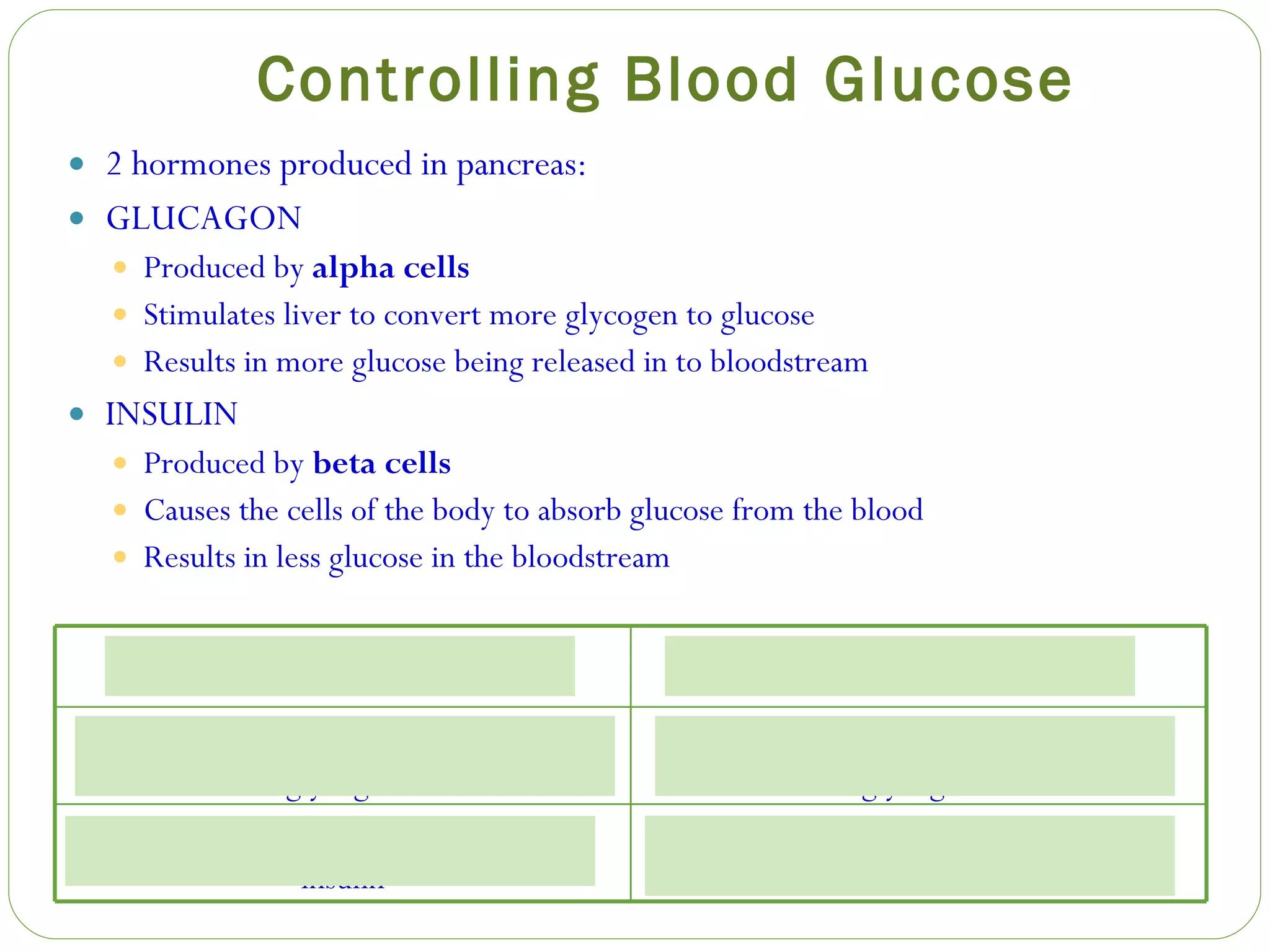
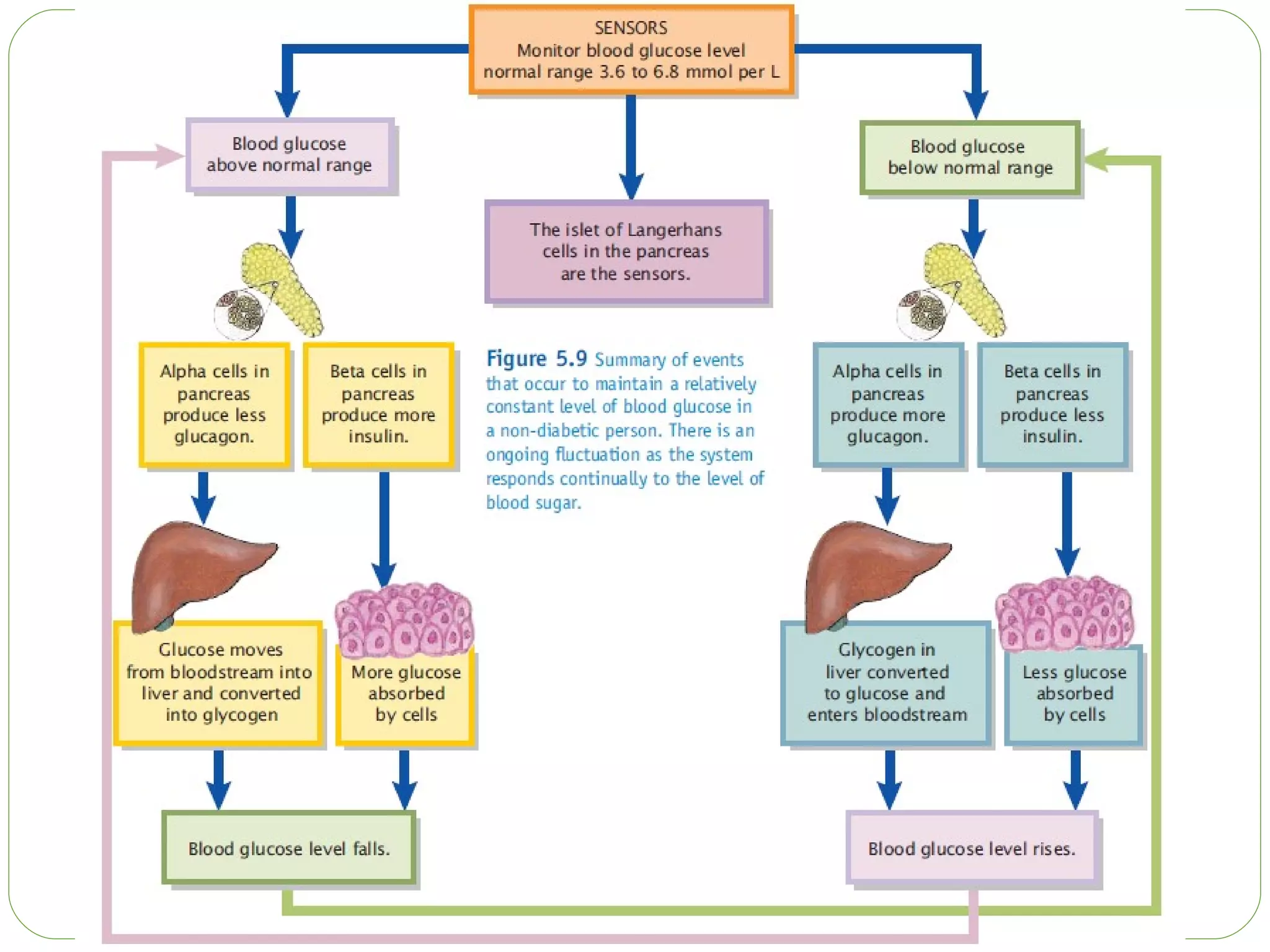
Controlling Blood Glucose 2 hormones produced in pancreas: GLUCAGON Produced by  alpha cells Stimulates liver to convert more glycogen to glucose Results in more glucose being released in to bloodstream INSULIN Produced by  beta cells Causes the cells of the body to absorb glucose from the blood Results in less glucose in the bloodstream Beta cells  decreasing  production of insulin Beta cells  increasing  production of insulin Alpha cells  increasing  production of glycogen Alpha cells  decreasing  production of glycogen Blood glucose can be  raised  by: Blood glucose can be  lowered  by:
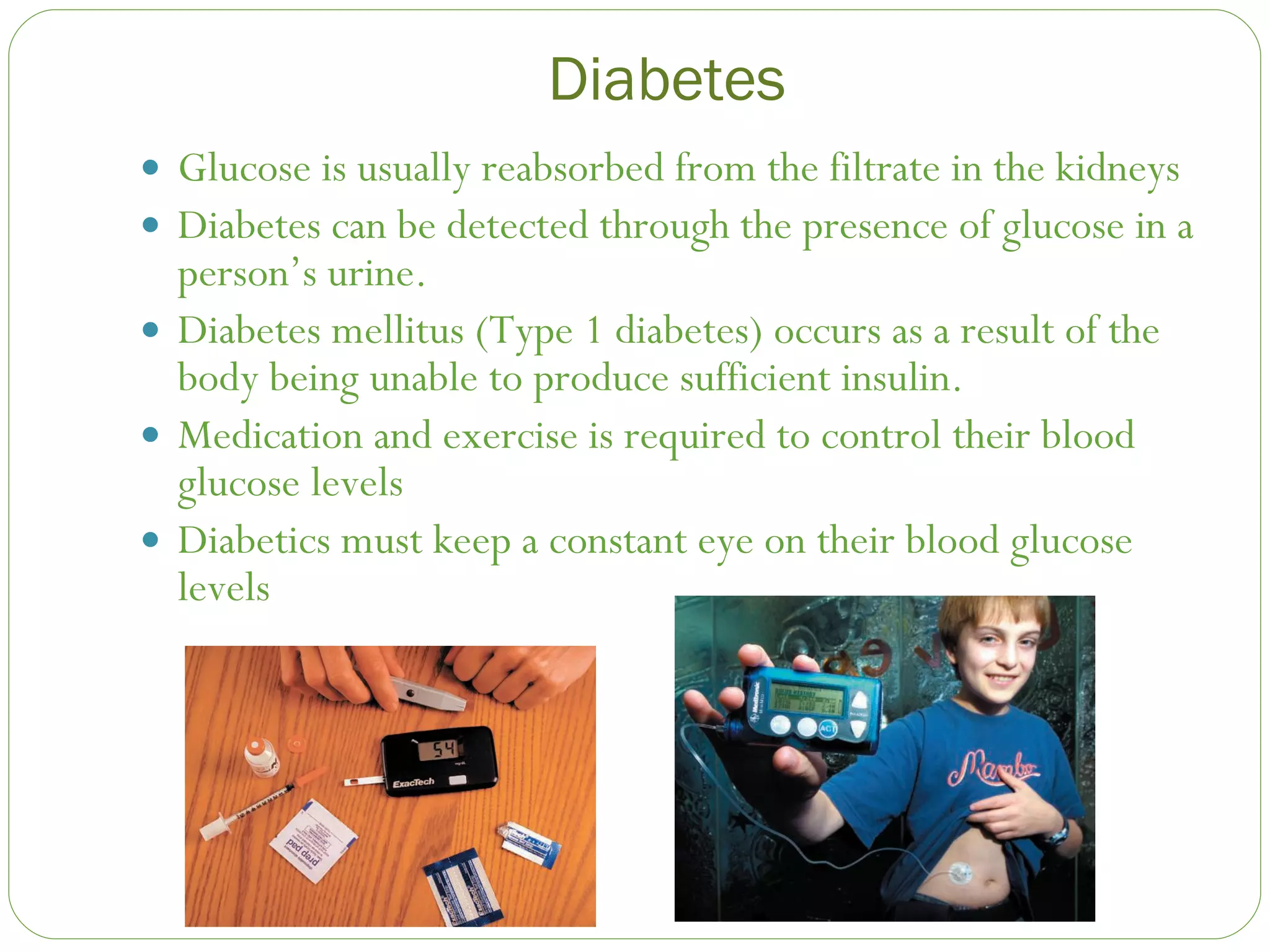
Diabetes Glucose is usually reabsorbed from the filtrate in the kidneys Diabetes can be detected through the presence of glucose in a person’s urine. Diabetes mellitus (Type 1 diabetes) occurs as a result of the body being unable to produce sufficient insulin. Medication and exercise is required to control their blood glucose levels Diabetics must keep a constant eye on their blood glucose levels
 
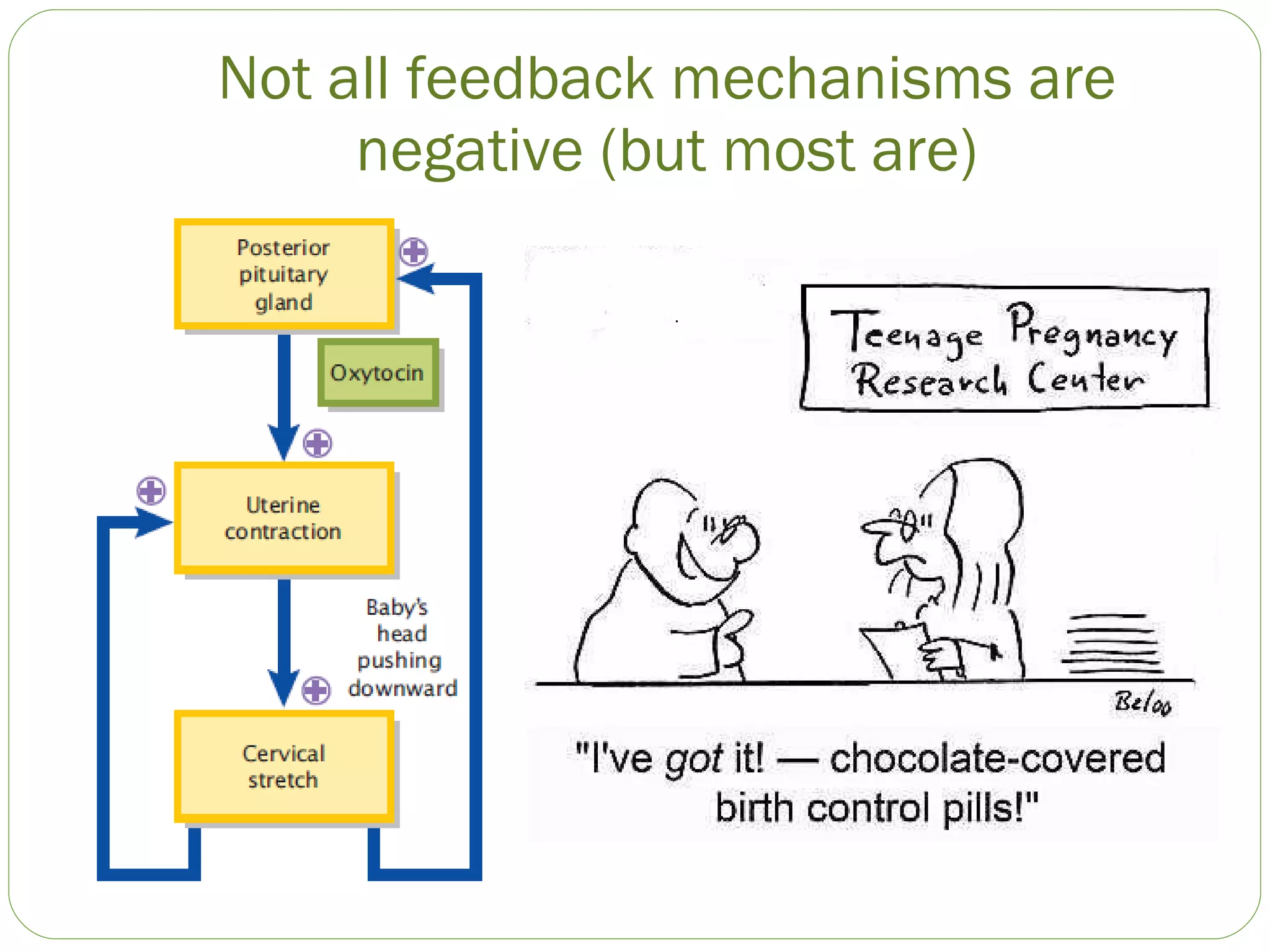
Not all feedback mechanisms are negative (but most are)
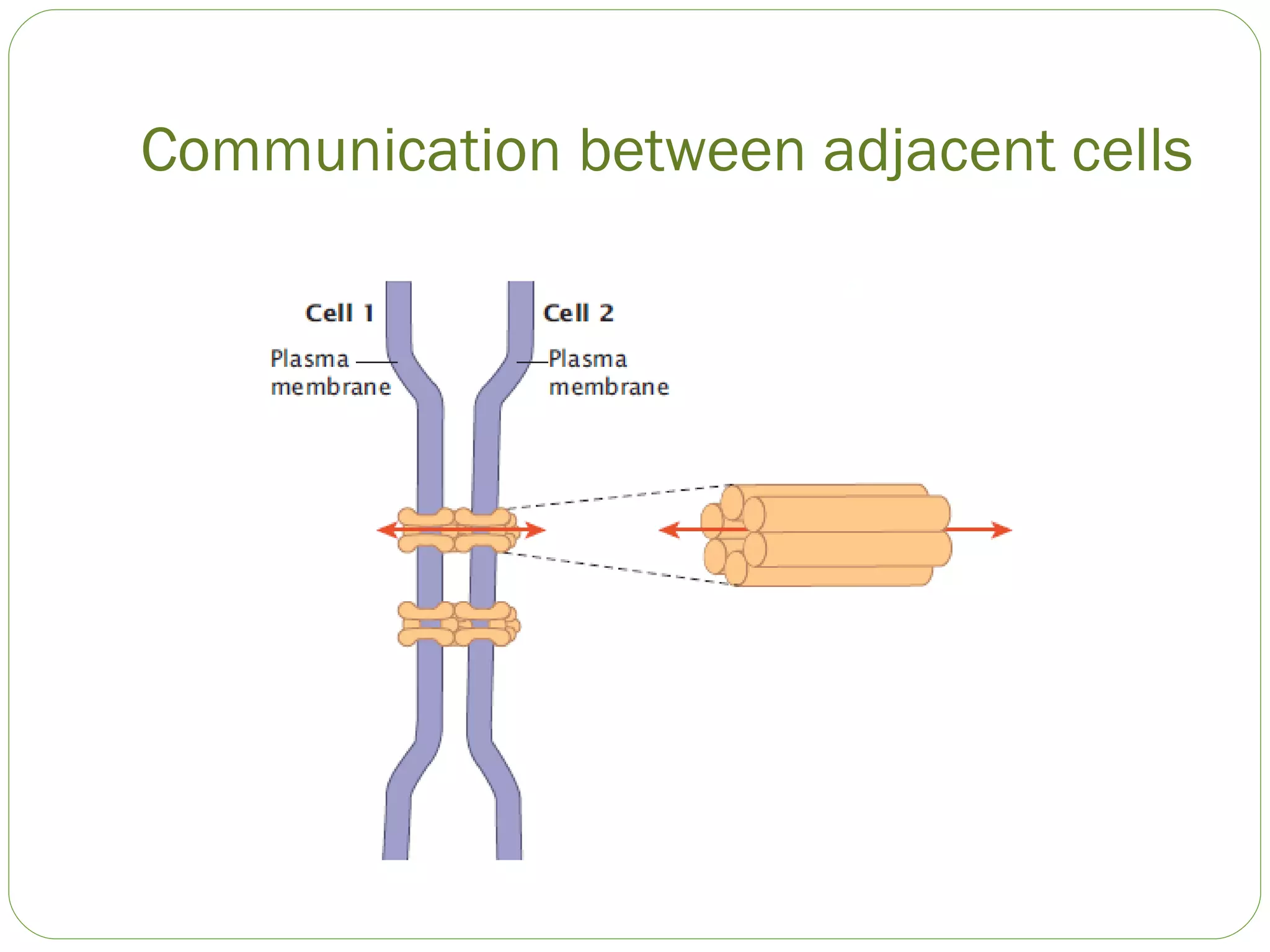
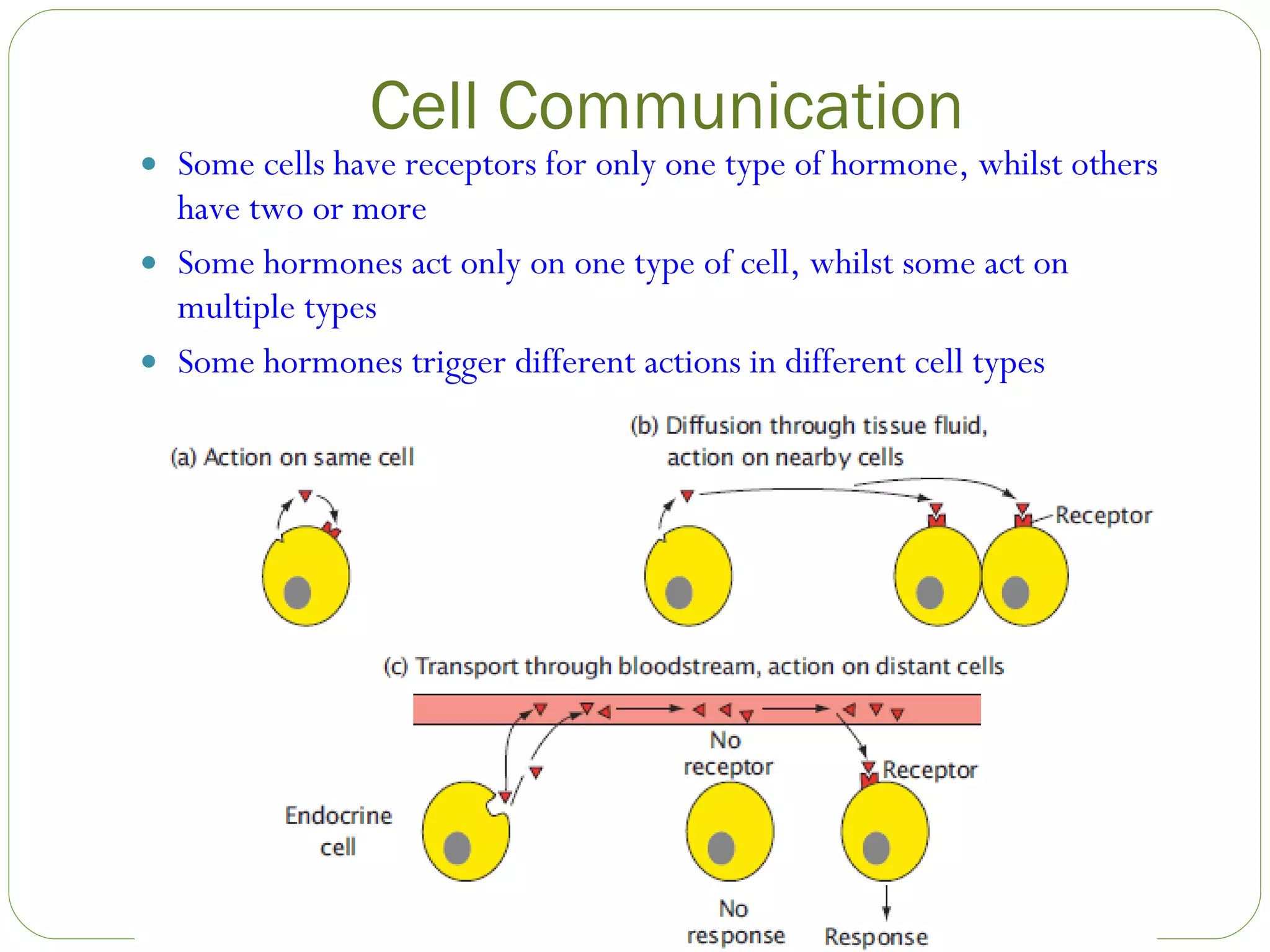
Cell Communication Adjacent cells can communicate through  communicating junctions  (see chapter 2). How can cells that are further apart communicate with each other? HORMONES Hormones are produced by cells and can then travel through the bloodstream, where they are picked up by the  receptors  of the intended cell NOT ALL hormones go in to the bloodstream, some just go to the adjacent cell and others are excreted only in to the extracellular fluid.
Communication between adjacent cells
Cell Communication Some cells have receptors for only one type of hormone, whilst others have two or more Some hormones act only on one type of cell, whilst some act on multiple types Some hormones trigger different actions in different cell types
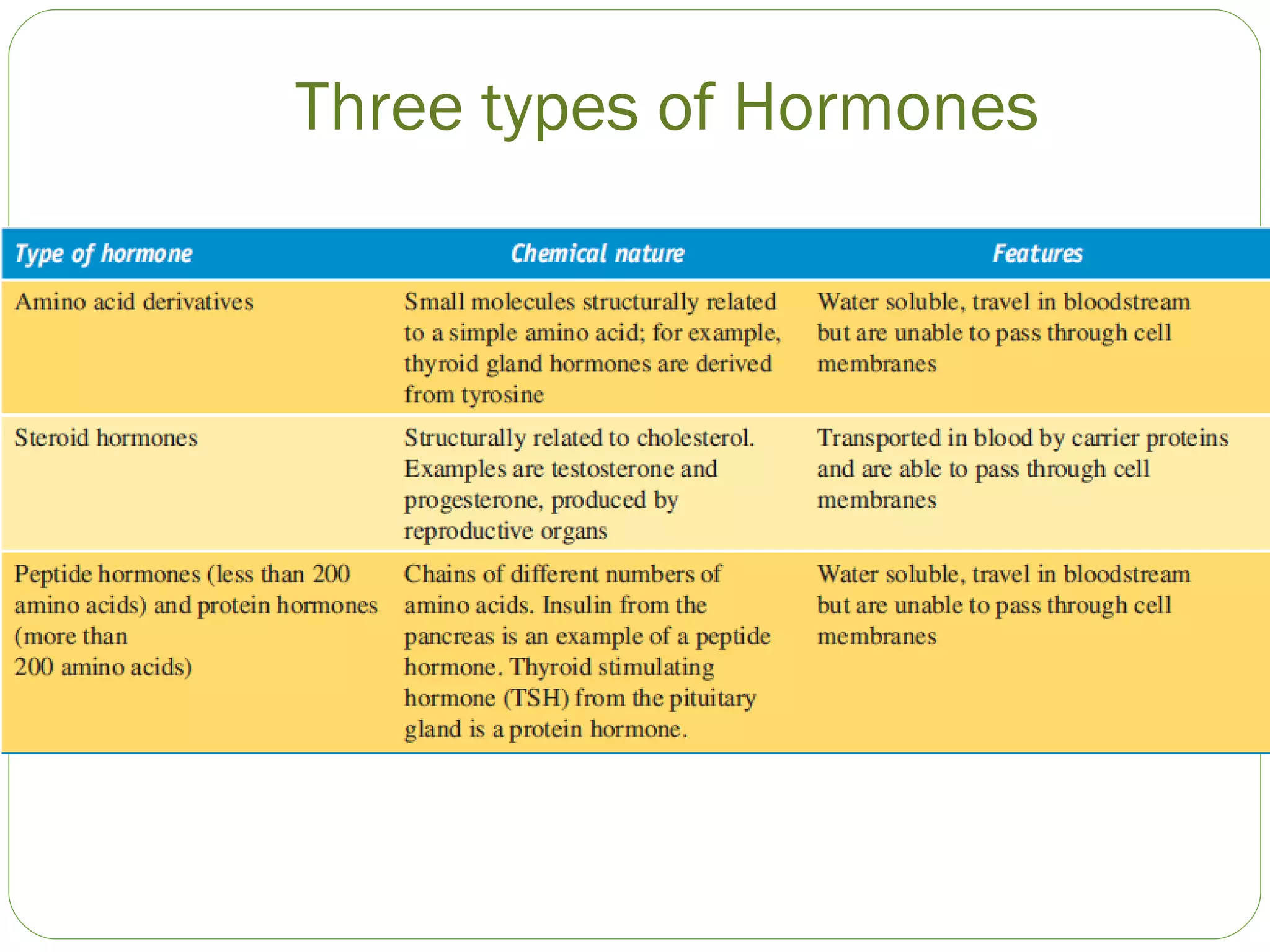
Three types of Hormones Amino acid derivatives Made in advance Stored in precursor form (in secretory vessicle) Leave cell via exocytosis (if a hormone) / simple diffusion (if a precursor) Short life span Steroid Hormone Synthesised on demand (from precursor in cell) Leave cell via simple diffusion Long life span Protein hormones & peptide hormones Made in advance Stored in precursor form Leave cell via exocytosis Short life span
Three types of Hormones
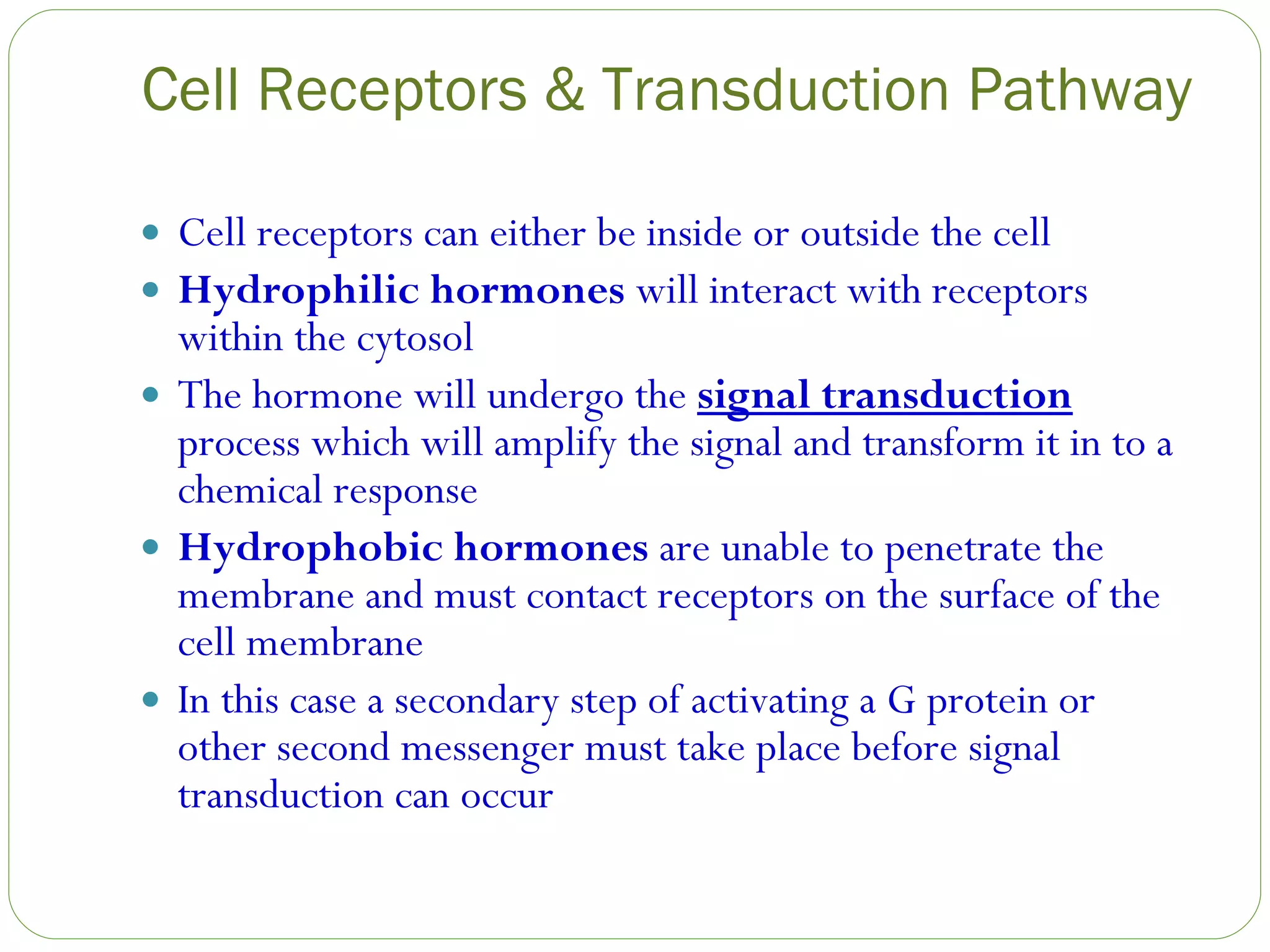
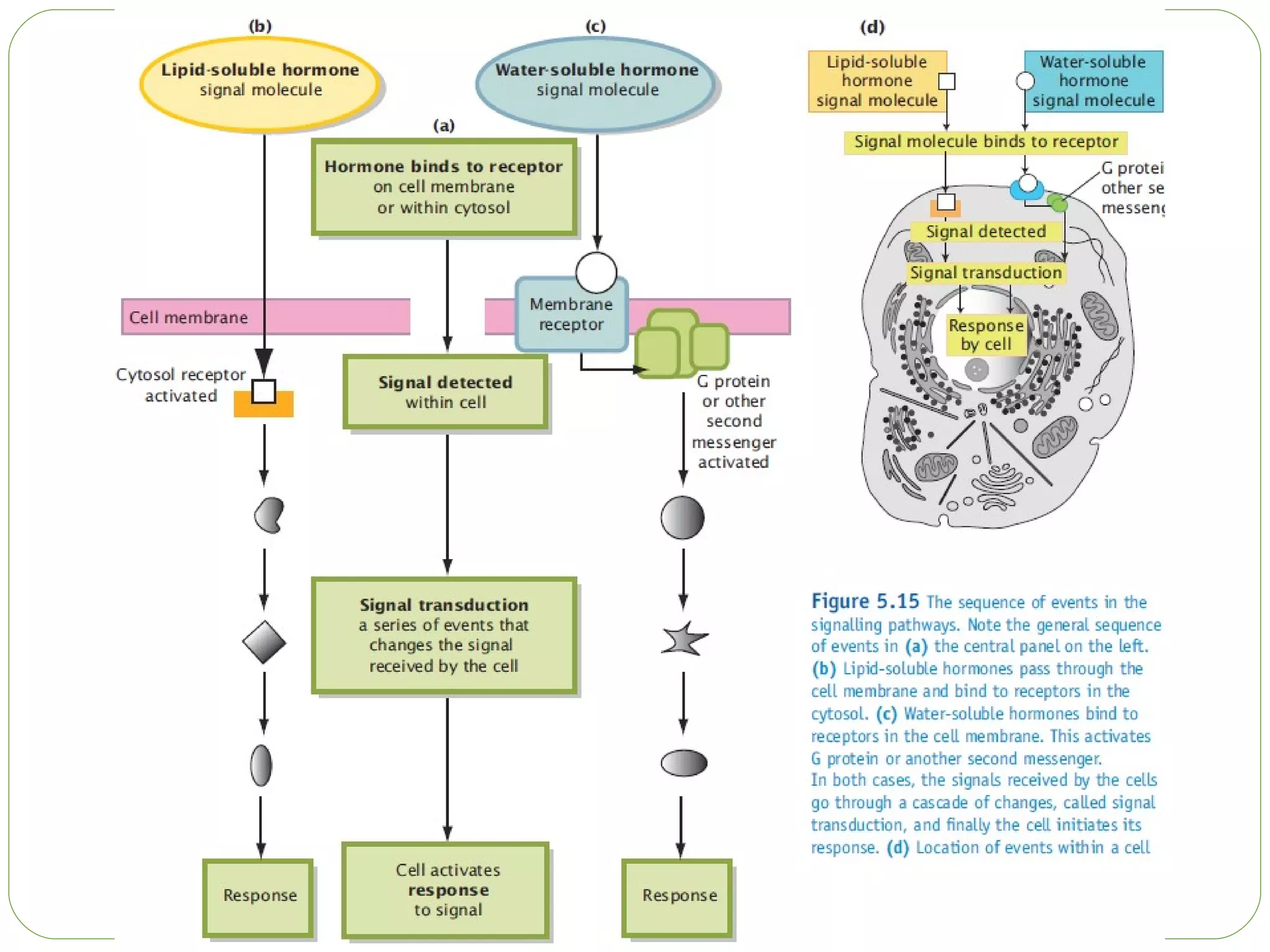
Cell Receptors & Transduction Pathway Cell receptors can either be inside or outside the cell Hydrophilic hormones  will interact with receptors within the cytosol The hormone will undergo the  signal transduction  process which will amplify the signal and transform it in to a chemical response Hydrophobic hormones  are unable to penetrate the membrane and must contact receptors on the surface of the cell membrane In this case a secondary step of activating a G protein or other second messenger must take place before signal transduction can occur
 
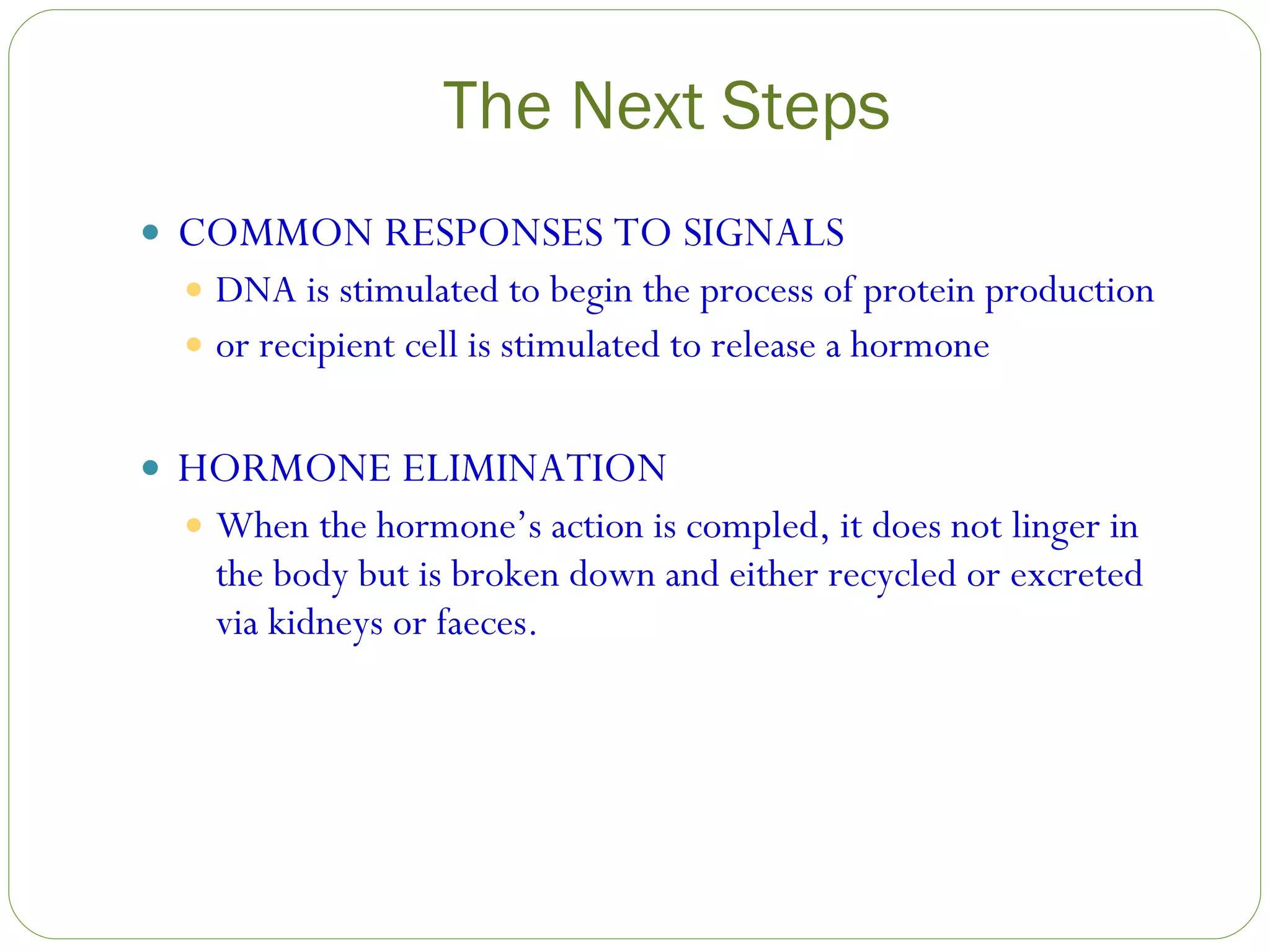
The Next Steps COMMON RESPONSES TO SIGNALS DNA is stimulated to begin the process of protein production or recipient cell is stimulated to release a hormone HORMONE ELIMINATION When the hormone’s action is compled, it does not linger in the body but is broken down and either recycled or excreted via kidneys or faeces.
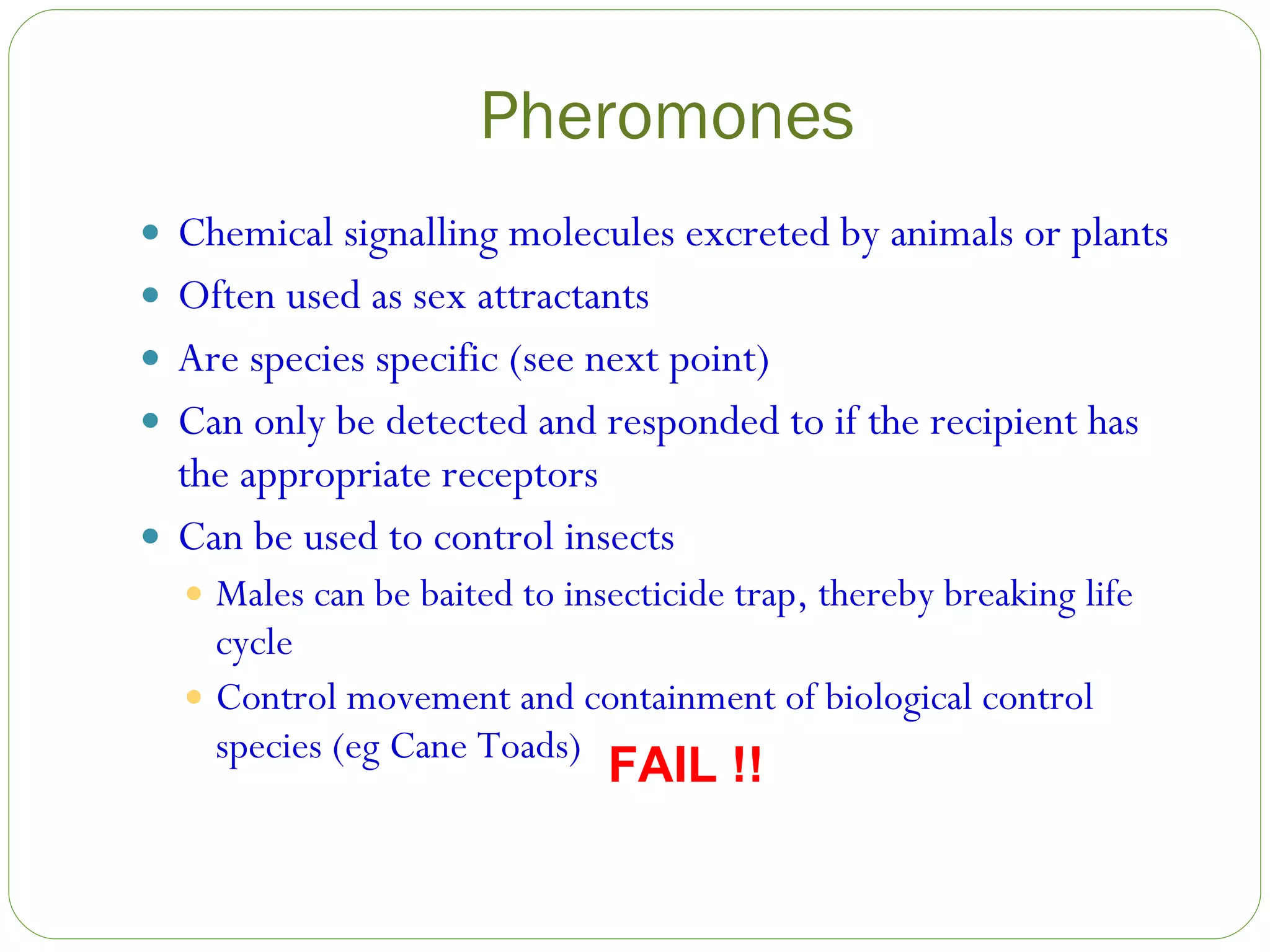
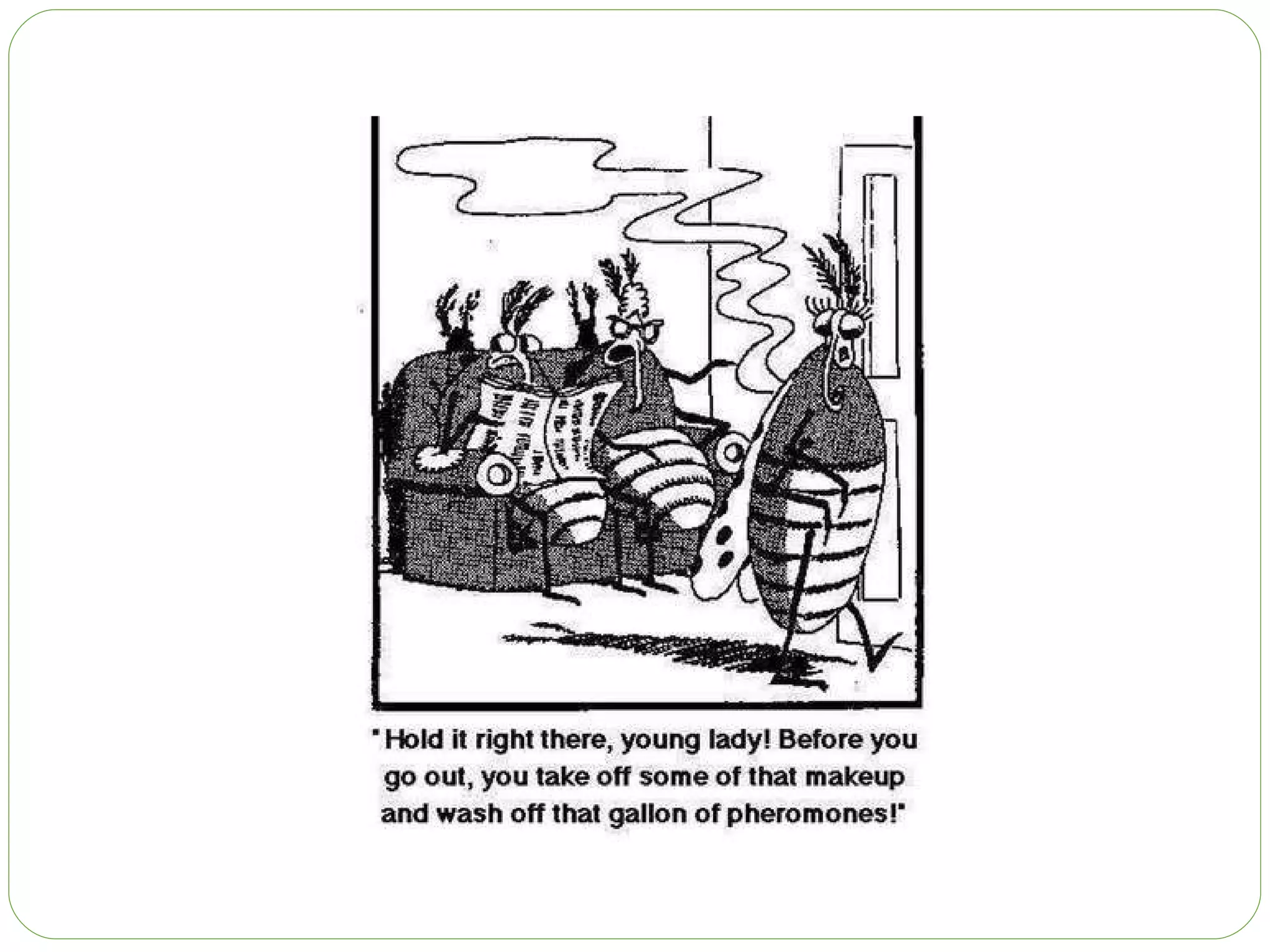
Pheromones Chemical signalling molecules excreted by animals or plants Often used as sex attractants Are species specific (see next point) Can only be detected and responded to if the recipient has the appropriate receptors Can be used to control insects Males can be baited to insecticide trap, thereby breaking life cycle Control movement and containment of biological control species (eg Cane Toads) FAIL !!
 
Plant growth and development Plant growth and development (formation of buds, expanding of leaves, lengthening of stems, ripening of fruits, etc) is influenced by internal and external factors. Internal factors Hormones External factors (egs) Light intensity Day length Gravity
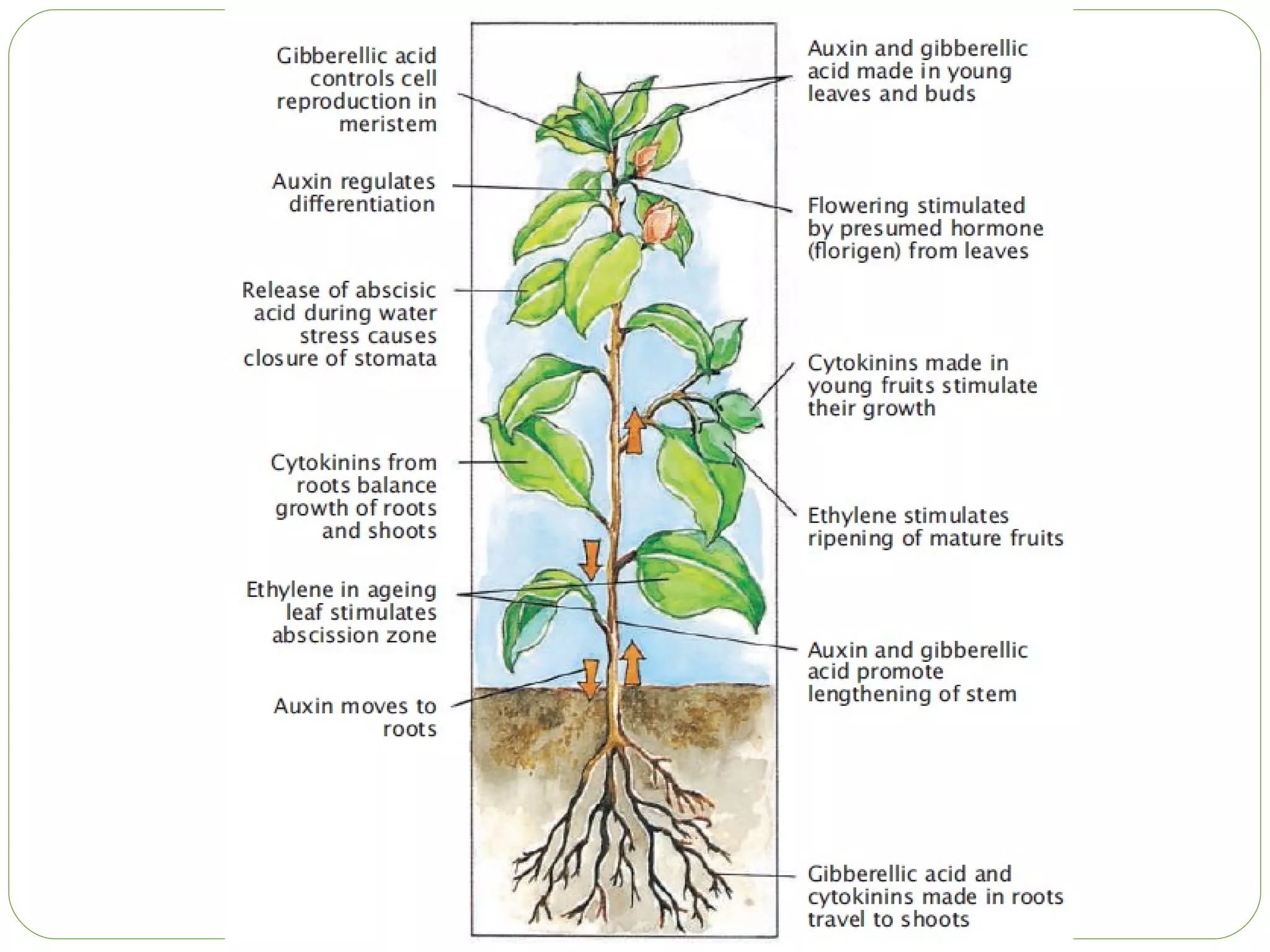
Plant Hormones Some stimulate growth & development, some inhibit it Transported via the xylem, phloem or both Only small amounts required as response is amplified Evident mainly in developing plants Can act in different ways in different parts of the plant 5 distinct groups Auxins Cytokynins Gibberellins Abscisic Acid Ethylene
 
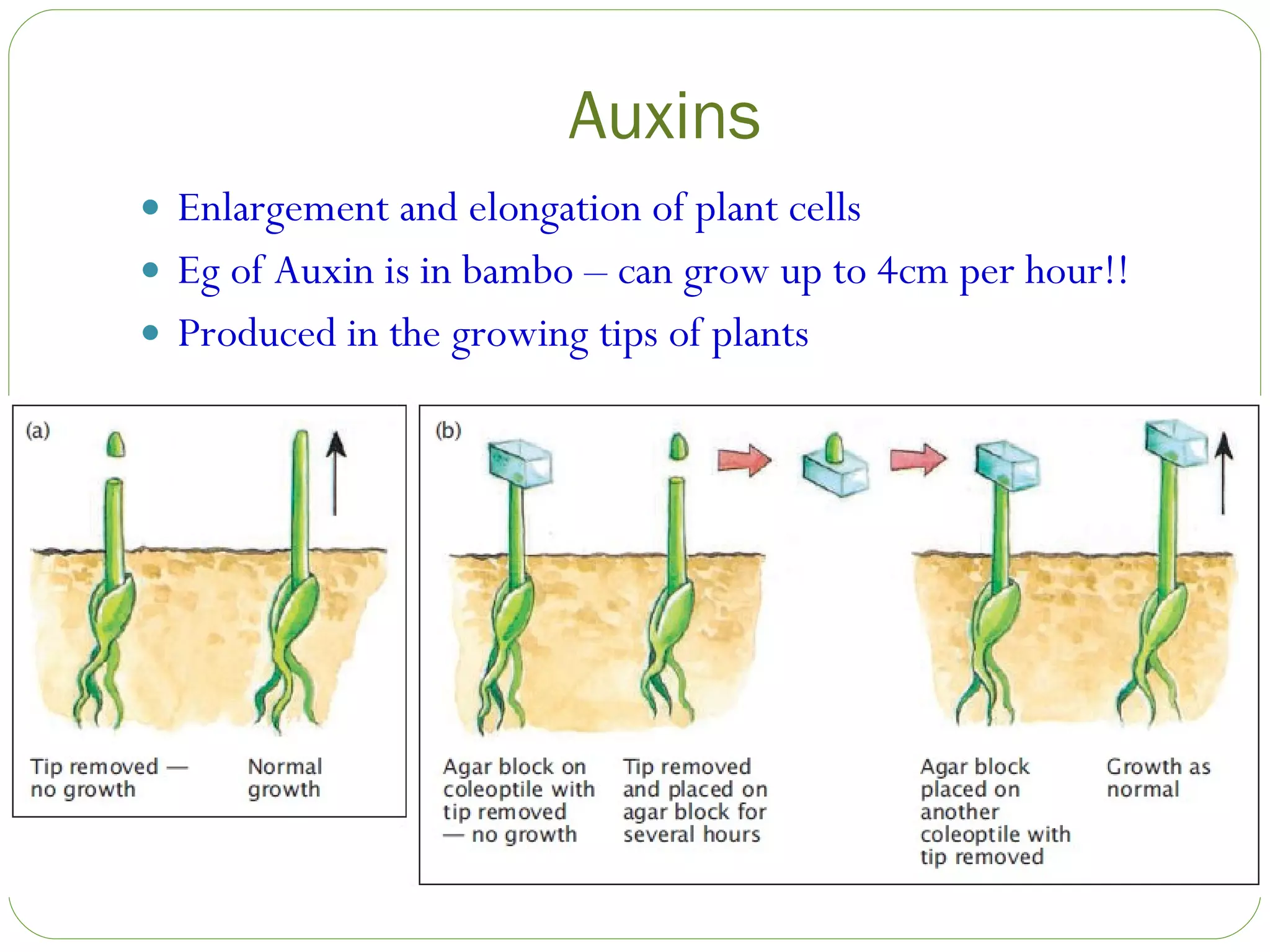
Auxins Enlargement and elongation of plant cells Eg of Auxin is in bambo – can grow up to 4cm per hour!! Produced in the growing tips of plants
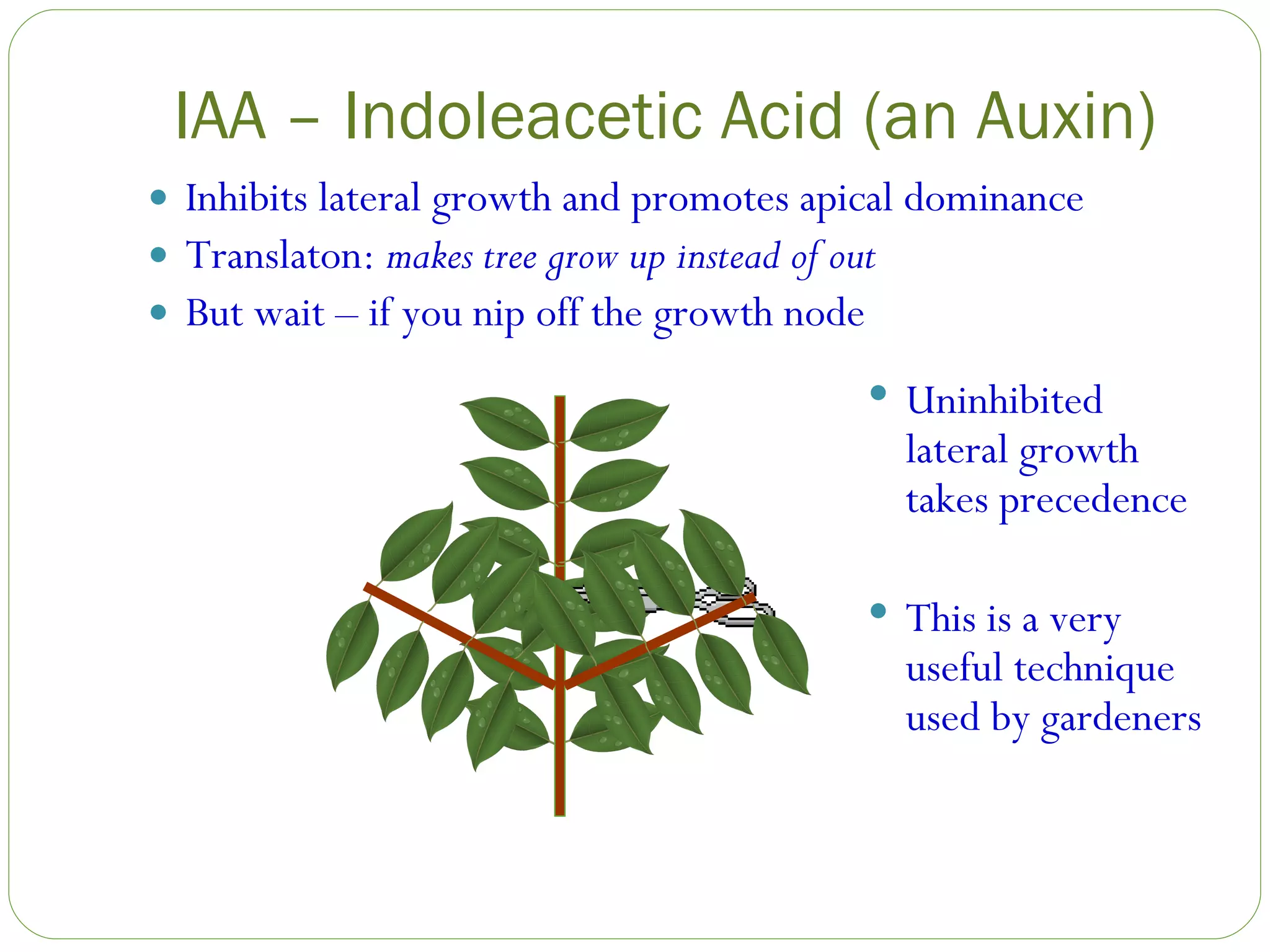
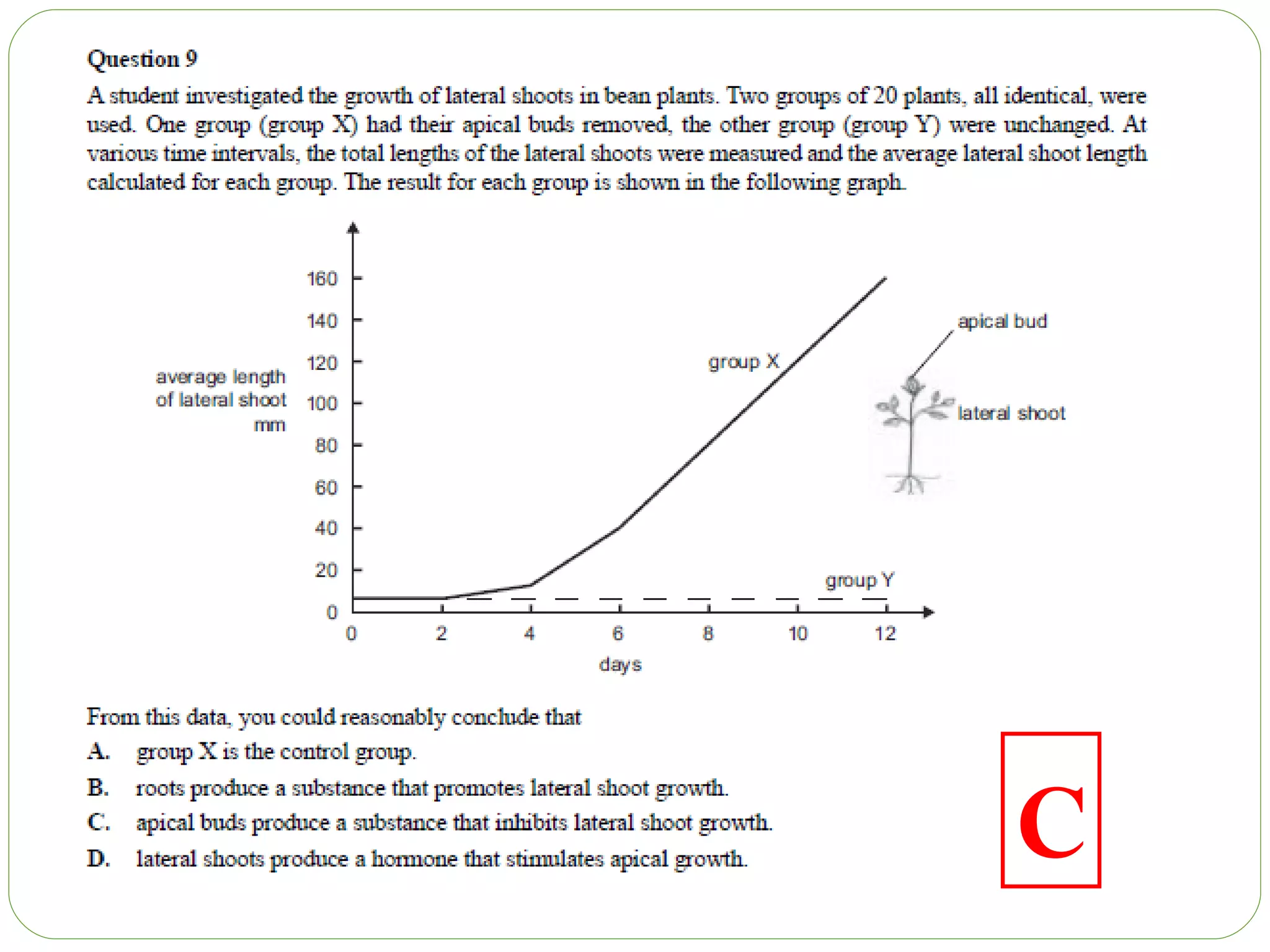
IAA – Indoleacetic Acid (an Auxin) Inhibits lateral growth and promotes apical dominance Translaton:  makes tree grow up instead of out But wait – if you nip off the growth node Uninhibited lateral growth takes precedence This is a very useful technique used by gardeners
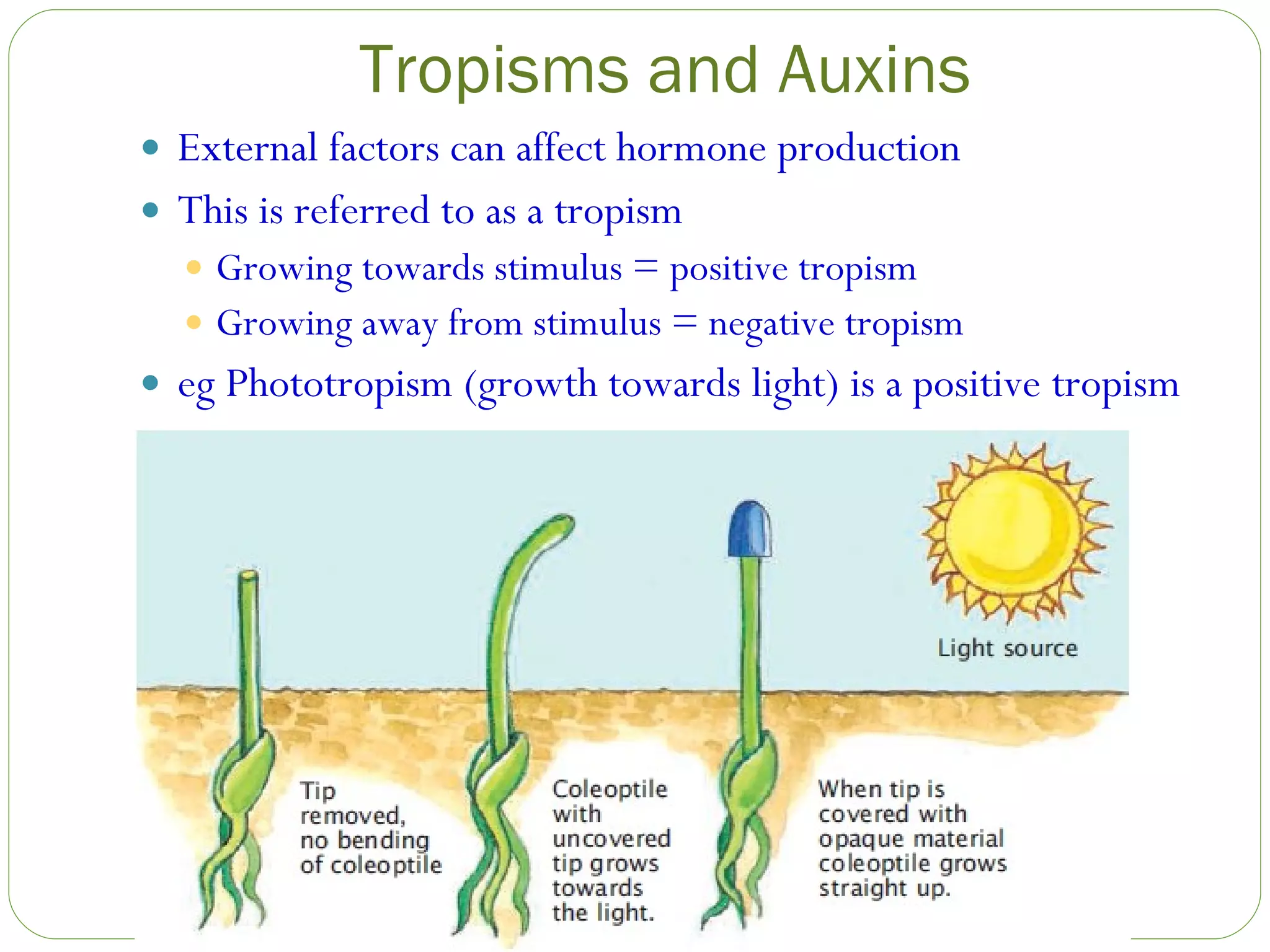
Tropisms and Auxins External factors can affect hormone production This is referred to as a tropism Growing towards stimulus = positive tropism Growing away from stimulus = negative tropism eg Phototropism (growth towards light) is a positive tropism
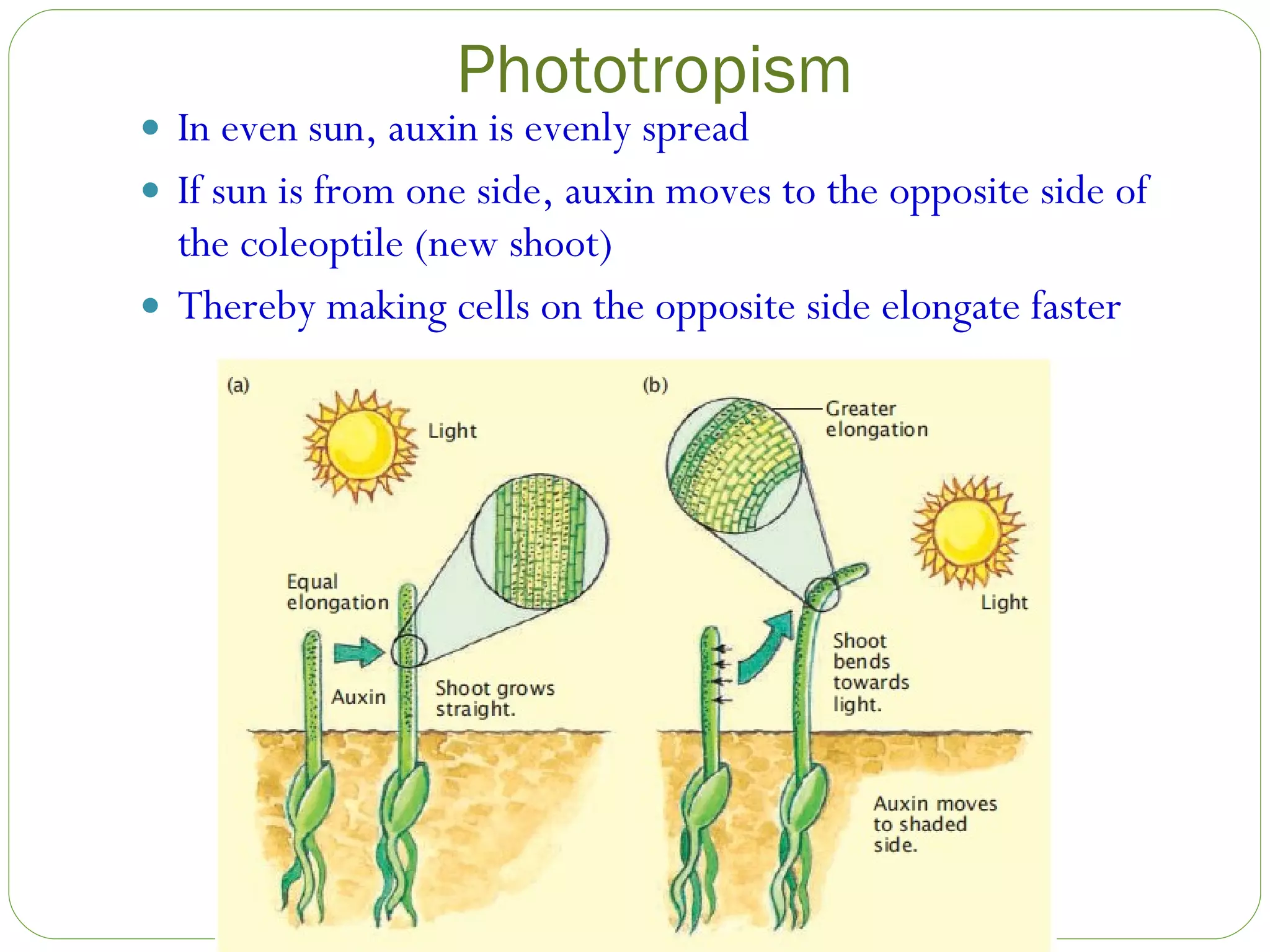
Phototropism In even sun, auxin is evenly spread If sun is from one side, auxin moves to the opposite side of the coleoptile (new shoot) Thereby making cells on the opposite side elongate faster
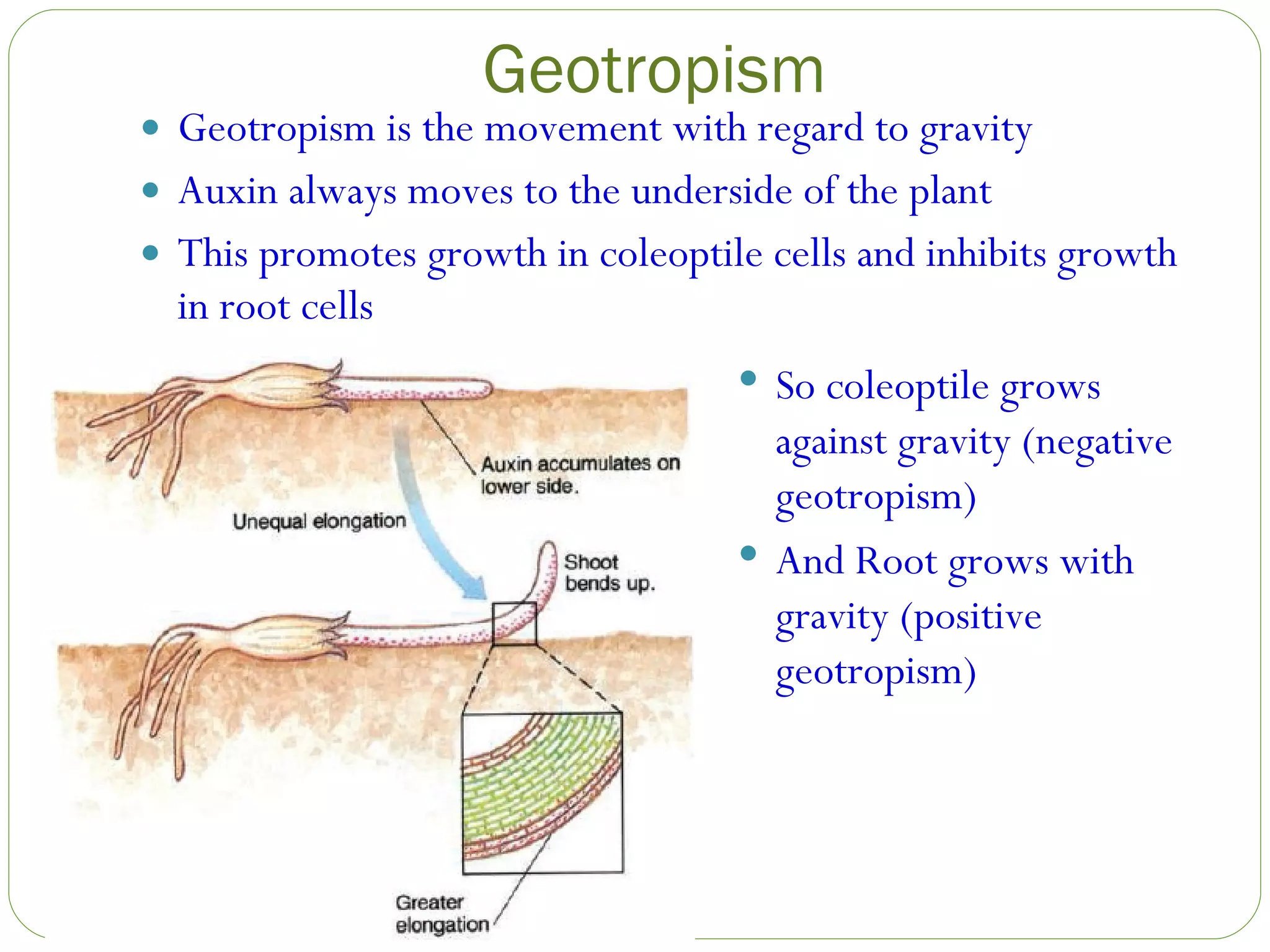
Geotropism Geotropism is the movement with regard to gravity Auxin always moves to the underside of the plant This promotes growth in coleoptile cells and inhibits growth in root cells So coleoptile grows against gravity (negative geotropism) And Root grows with gravity (positive geotropism)
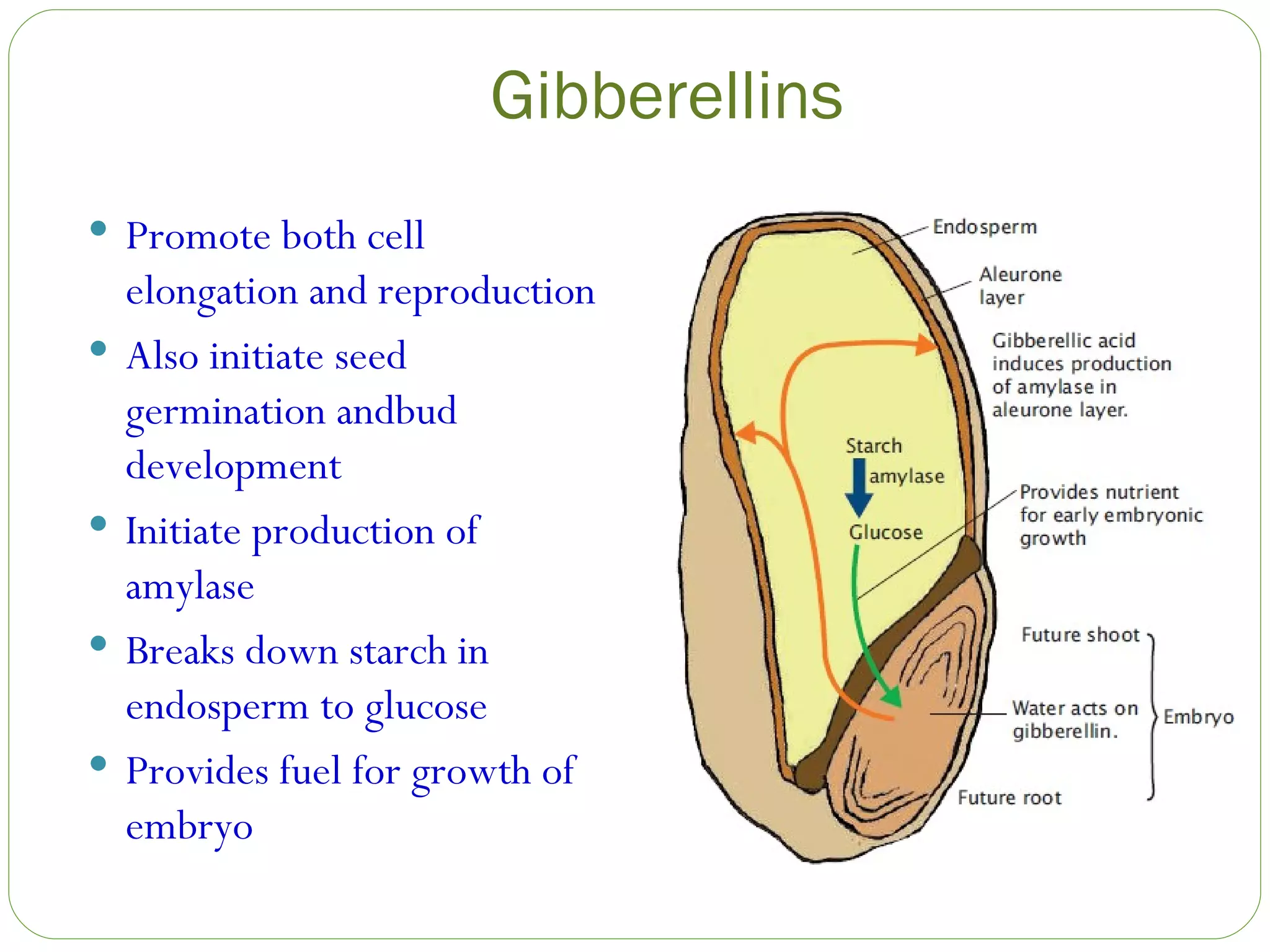
Gibberellins Promote both cell elongation and reproduction Also initiate seed germination andbud development  Initiate production of amylase Breaks down starch in endosperm to glucose Provides fuel for growth of embryo
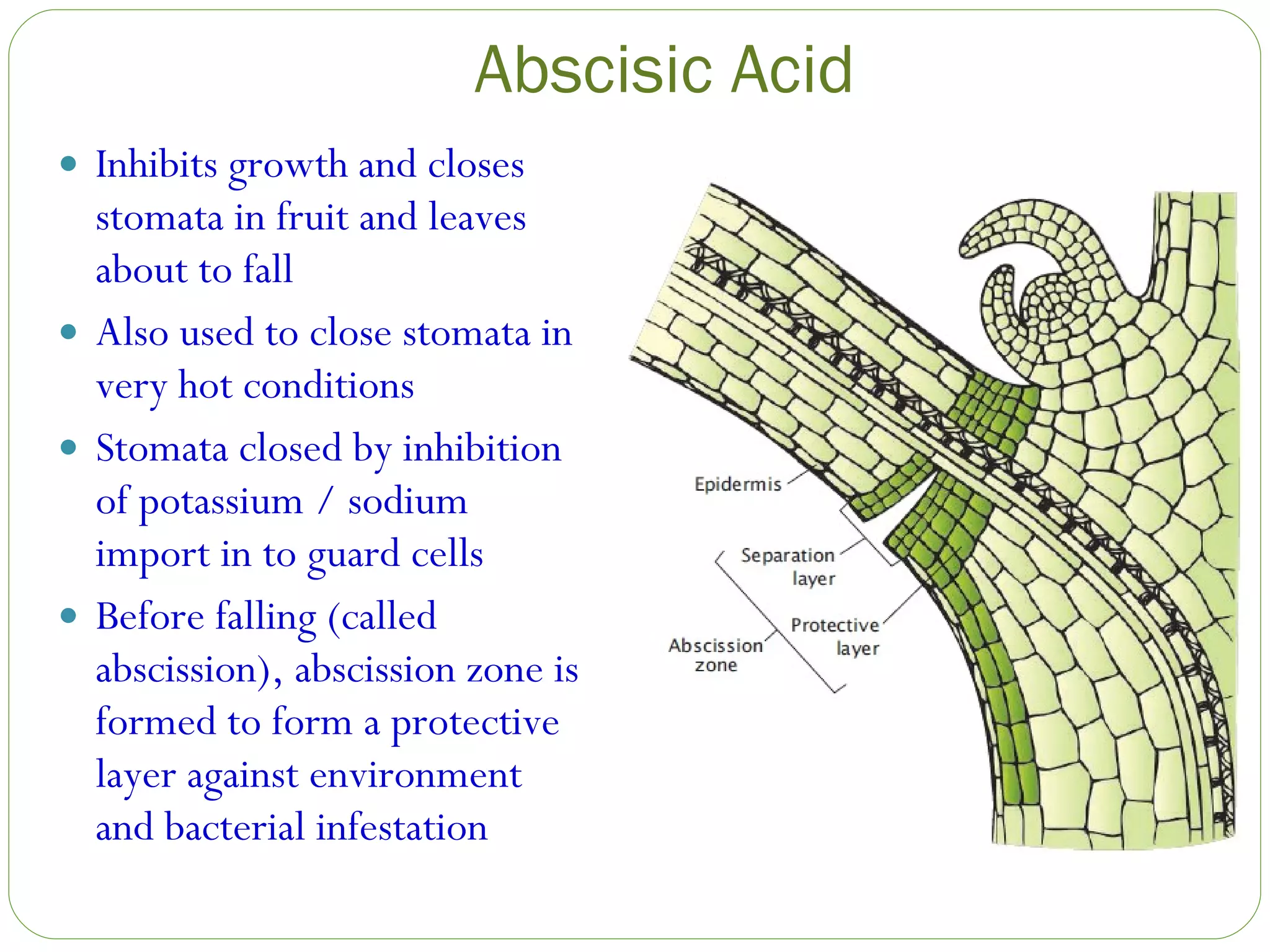
Abscisic Acid Inhibits growth and closes stomata in fruit and leaves about to fall Also used to close stomata in very hot conditions Stomata closed by inhibition of potassium / sodium import in to guard cells Before falling (called abscission), abscission zone is formed to form a protective layer against environment and bacterial infestation
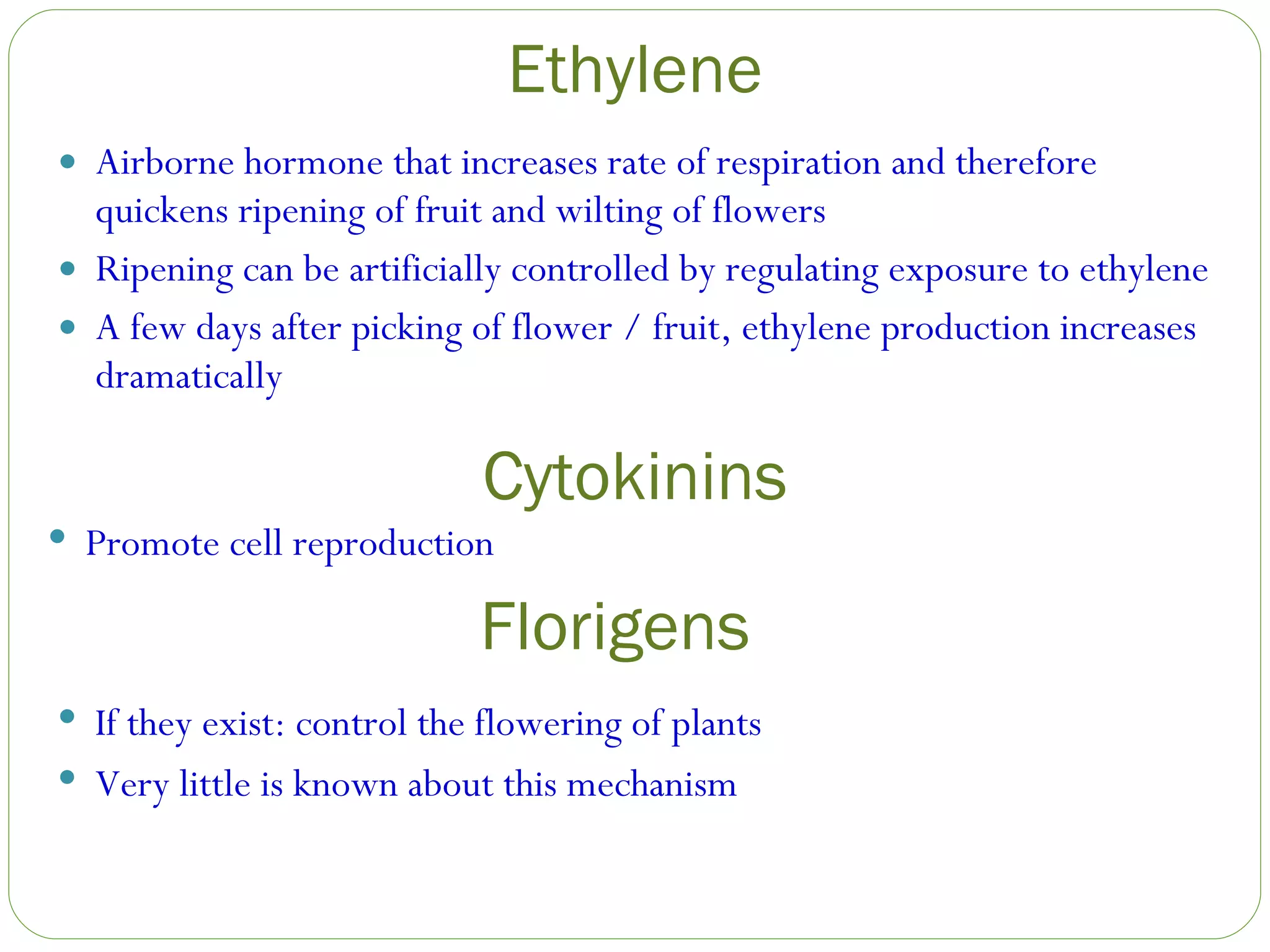
Ethylene Airborne hormone that increases rate of respiration and therefore quickens ripening of fruit and wilting of flowers Ripening can be artificially controlled by regulating exposure to ethylene A few days after picking of flower / fruit, ethylene production increases dramatically Promote cell reproduction Cytokinins Florigens If they exist: control the flowering of plants Very little is known about this mechanism
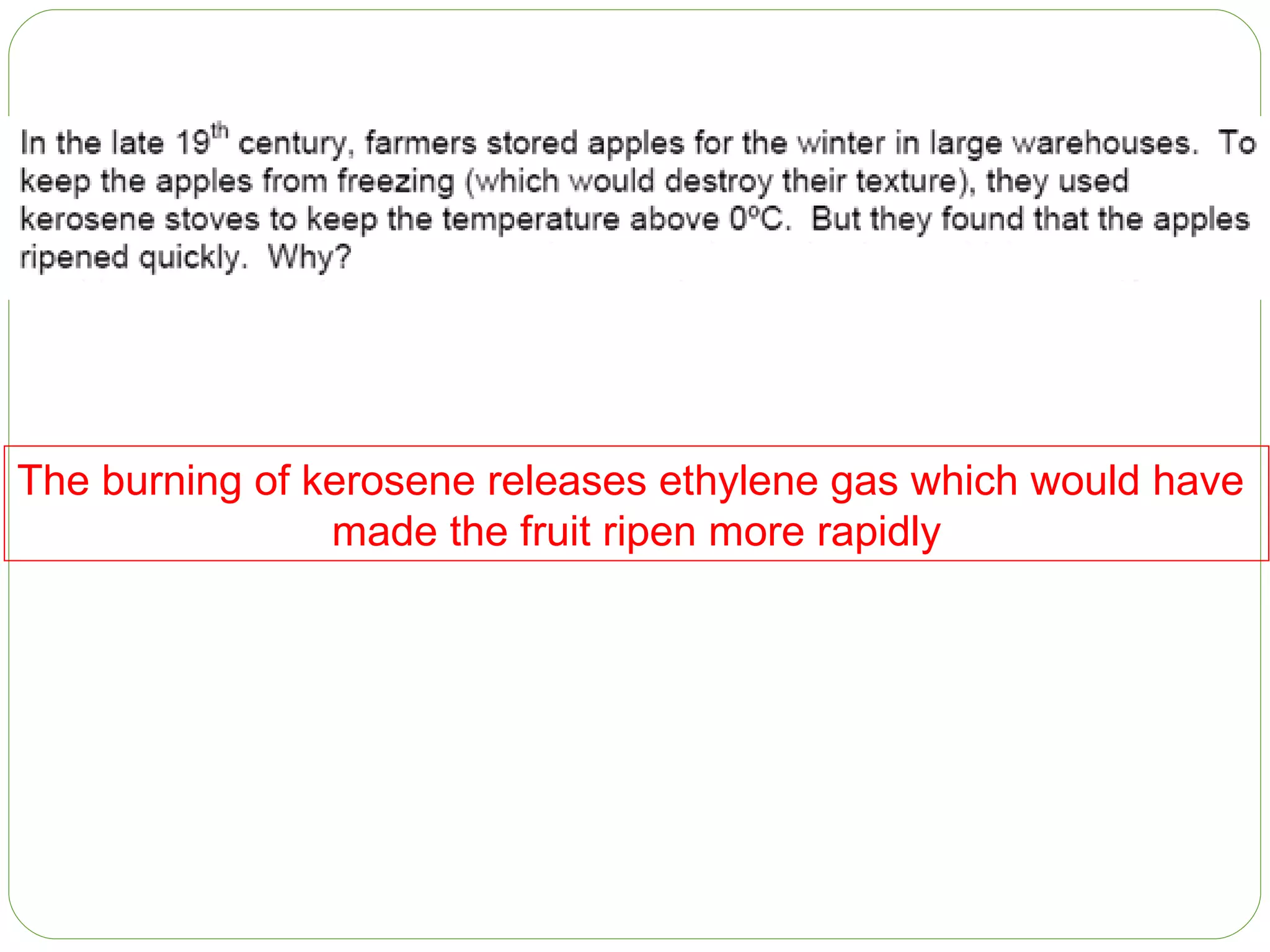
The burning of kerosene releases ethylene gas which would have  made the fruit ripen more rapidly
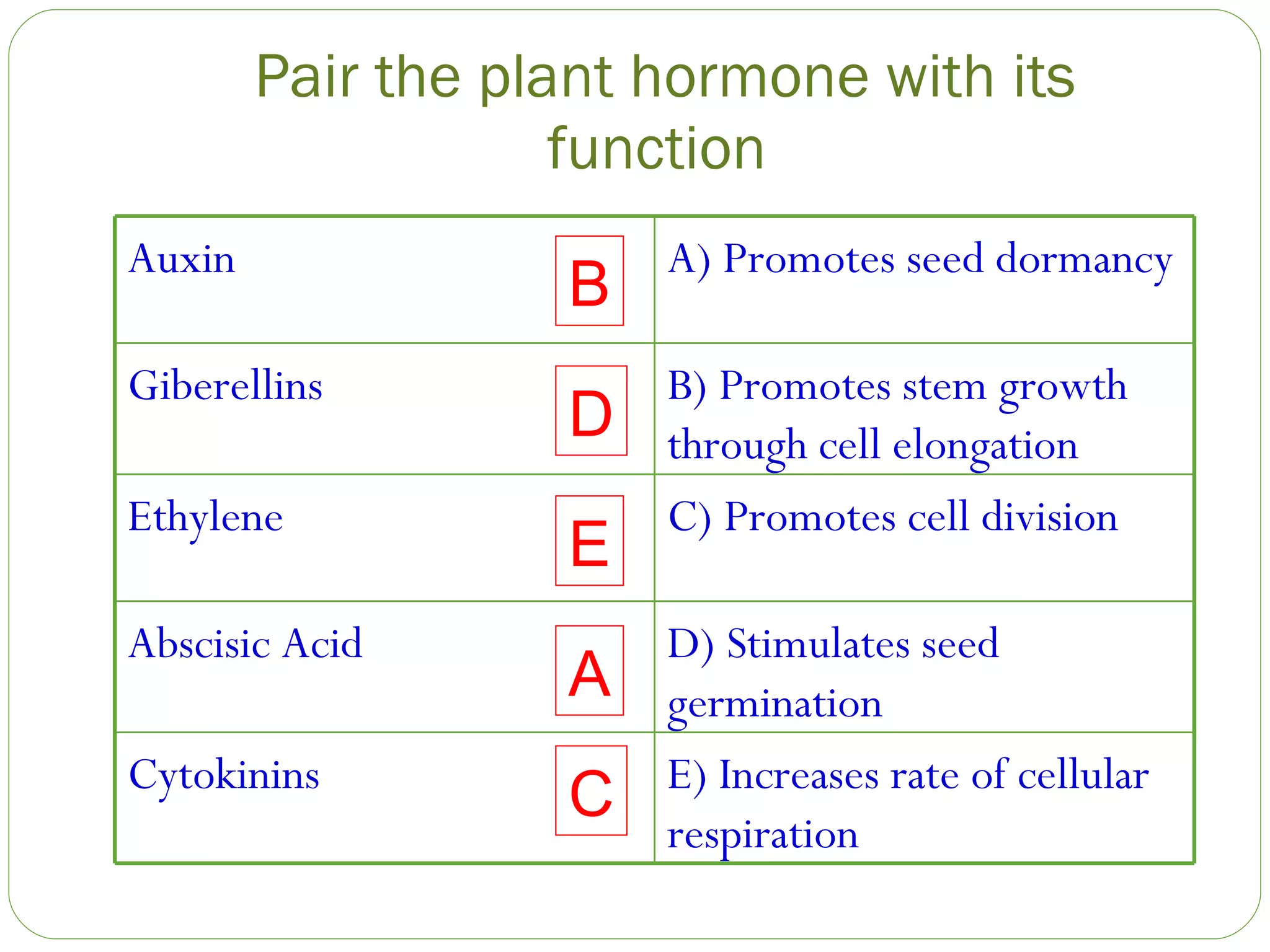
Pair the plant hormone with its function  B D E A C E) Increases rate of cellular respiration Cytokinins D) Stimulates seed germination Abscisic Acid C) Promotes cell division Ethylene B) Promotes stem growth through cell elongation Giberellins A) Promotes seed dormancy Auxin
C
D
Holiday Homework!! Chapter 5 review Qs 2-8 Biozone pp 56 - 60

5 - Detecting and responding

  • 1.
    Coordination and regulation: Endocrine systems Chapter 5
  • 2.
    Our external environmentoften changes, but our internal environment must stay constant, how can this be achieved?
  • 3.
    The Fluids Thefluids in most mammals can be separated along the following lines There is constant exchange between these fluids, so the makeup of one is often a very good indication of the makeup of the others Cerebro-spinal fluid Interstitial fluid (aka tissue fluid) Plasma Cytosol Lymph Extracellular Intracellular Fluid
  • 4.
    Homeostasis In orderto maintain function, our bodies are required to operate within some very narrow limits The mechanisms used to detect, react and restore homeostasis are: The Endocrine System The Nervous System
  • 5.
    Variables subject tohomeostasis Nutrients Temperature water Ions, such as Na+, Ca+, Cl− pH (hydrogen ion concentration) Blood volume Blood pressure Oxygen Carbon dioxide Red blood cells . What can stop / prevent homeostasis from being maintained ? Infection Trauma Toxic Substances Auto-immune disease Inherited disorders Extreme conditions
  • 6.
    Body systems involvedin Homeostasis Nervous Endocrine (hormonal) Respiratory Circulatory Digestive Excretory Integumentary (skin)
  • 7.
    Hormones Hormones maintainhomeostasis Stage 1: Detect change Stage 2 Counteract change This is most frequently accomplished via a negative feedback system
  • 8.
    A (hopefully) usefulanalogy) SENSORS detect if car speed is lesser or greater than 60kph Going too fast Going too slow Brake Accelerate Go slower Go faster EFFECTORS increase or decrease speed
  • 9.
    Controlling Blood Glucose2 hormones produced in pancreas: GLUCAGON Produced by alpha cells Stimulates liver to convert more glycogen to glucose Results in more glucose being released in to bloodstream INSULIN Produced by beta cells Causes the cells of the body to absorb glucose from the blood Results in less glucose in the bloodstream Beta cells decreasing production of insulin Beta cells increasing production of insulin Alpha cells increasing production of glycogen Alpha cells decreasing production of glycogen Blood glucose can be raised by: Blood glucose can be lowered by:
  • 10.
    Diabetes Glucose isusually reabsorbed from the filtrate in the kidneys Diabetes can be detected through the presence of glucose in a person’s urine. Diabetes mellitus (Type 1 diabetes) occurs as a result of the body being unable to produce sufficient insulin. Medication and exercise is required to control their blood glucose levels Diabetics must keep a constant eye on their blood glucose levels
  • 11.
  • 12.
    Not all feedbackmechanisms are negative (but most are)
  • 13.
    Cell Communication Adjacentcells can communicate through communicating junctions (see chapter 2). How can cells that are further apart communicate with each other? HORMONES Hormones are produced by cells and can then travel through the bloodstream, where they are picked up by the receptors of the intended cell NOT ALL hormones go in to the bloodstream, some just go to the adjacent cell and others are excreted only in to the extracellular fluid.
  • 14.
  • 15.
    Cell Communication Somecells have receptors for only one type of hormone, whilst others have two or more Some hormones act only on one type of cell, whilst some act on multiple types Some hormones trigger different actions in different cell types
  • 16.
    Three types ofHormones Amino acid derivatives Made in advance Stored in precursor form (in secretory vessicle) Leave cell via exocytosis (if a hormone) / simple diffusion (if a precursor) Short life span Steroid Hormone Synthesised on demand (from precursor in cell) Leave cell via simple diffusion Long life span Protein hormones & peptide hormones Made in advance Stored in precursor form Leave cell via exocytosis Short life span
  • 17.
  • 18.
    Cell Receptors &Transduction Pathway Cell receptors can either be inside or outside the cell Hydrophilic hormones will interact with receptors within the cytosol The hormone will undergo the signal transduction process which will amplify the signal and transform it in to a chemical response Hydrophobic hormones are unable to penetrate the membrane and must contact receptors on the surface of the cell membrane In this case a secondary step of activating a G protein or other second messenger must take place before signal transduction can occur
  • 19.
  • 20.
    The Next StepsCOMMON RESPONSES TO SIGNALS DNA is stimulated to begin the process of protein production or recipient cell is stimulated to release a hormone HORMONE ELIMINATION When the hormone’s action is compled, it does not linger in the body but is broken down and either recycled or excreted via kidneys or faeces.
  • 21.
    Pheromones Chemical signallingmolecules excreted by animals or plants Often used as sex attractants Are species specific (see next point) Can only be detected and responded to if the recipient has the appropriate receptors Can be used to control insects Males can be baited to insecticide trap, thereby breaking life cycle Control movement and containment of biological control species (eg Cane Toads) FAIL !!
  • 22.
  • 23.
    Plant growth anddevelopment Plant growth and development (formation of buds, expanding of leaves, lengthening of stems, ripening of fruits, etc) is influenced by internal and external factors. Internal factors Hormones External factors (egs) Light intensity Day length Gravity
  • 24.
    Plant Hormones Somestimulate growth & development, some inhibit it Transported via the xylem, phloem or both Only small amounts required as response is amplified Evident mainly in developing plants Can act in different ways in different parts of the plant 5 distinct groups Auxins Cytokynins Gibberellins Abscisic Acid Ethylene
  • 25.
  • 26.
    Auxins Enlargement andelongation of plant cells Eg of Auxin is in bambo – can grow up to 4cm per hour!! Produced in the growing tips of plants
  • 27.
    IAA – IndoleaceticAcid (an Auxin) Inhibits lateral growth and promotes apical dominance Translaton: makes tree grow up instead of out But wait – if you nip off the growth node Uninhibited lateral growth takes precedence This is a very useful technique used by gardeners
  • 28.
    Tropisms and AuxinsExternal factors can affect hormone production This is referred to as a tropism Growing towards stimulus = positive tropism Growing away from stimulus = negative tropism eg Phototropism (growth towards light) is a positive tropism
  • 29.
    Phototropism In evensun, auxin is evenly spread If sun is from one side, auxin moves to the opposite side of the coleoptile (new shoot) Thereby making cells on the opposite side elongate faster
  • 30.
    Geotropism Geotropism isthe movement with regard to gravity Auxin always moves to the underside of the plant This promotes growth in coleoptile cells and inhibits growth in root cells So coleoptile grows against gravity (negative geotropism) And Root grows with gravity (positive geotropism)
  • 31.
    Gibberellins Promote bothcell elongation and reproduction Also initiate seed germination andbud development Initiate production of amylase Breaks down starch in endosperm to glucose Provides fuel for growth of embryo
  • 32.
    Abscisic Acid Inhibitsgrowth and closes stomata in fruit and leaves about to fall Also used to close stomata in very hot conditions Stomata closed by inhibition of potassium / sodium import in to guard cells Before falling (called abscission), abscission zone is formed to form a protective layer against environment and bacterial infestation
  • 33.
    Ethylene Airborne hormonethat increases rate of respiration and therefore quickens ripening of fruit and wilting of flowers Ripening can be artificially controlled by regulating exposure to ethylene A few days after picking of flower / fruit, ethylene production increases dramatically Promote cell reproduction Cytokinins Florigens If they exist: control the flowering of plants Very little is known about this mechanism
  • 34.
    The burning ofkerosene releases ethylene gas which would have made the fruit ripen more rapidly
  • 35.
    Pair the planthormone with its function B D E A C E) Increases rate of cellular respiration Cytokinins D) Stimulates seed germination Abscisic Acid C) Promotes cell division Ethylene B) Promotes stem growth through cell elongation Giberellins A) Promotes seed dormancy Auxin
  • 36.
  • 37.
  • 38.
    Holiday Homework!! Chapter5 review Qs 2-8 Biozone pp 56 - 60