Slide 2.1
Human AnatomyHuman Anatomy
Endocrine System
Pavemedicine.comPavemedicine.com
Slide 9.23a
Thyroid GlandThyroid Gland
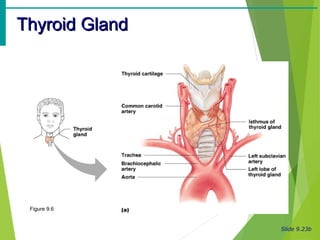
• Found at the base of the throat
• Consists of two lobes and a connecting
isthmus
• Produces two hormones
• Thyroid hormone
• Calcitonin
Slide 9.23b
Thyroid GlandThyroid Gland
Figure 9.6
Slide 9.24
Thyroid HormoneThyroid Hormone
• Major metabolic hormone
• Composed of two active iodine-
containing hormones
• Thyroxine (T4) – secreted by thyroid
follicles
• Triiodothyronine (T3) – conversion of T4 at
target tissues
Slide 9.24
Thyroid HormoneThyroid Hormone
• Target: all body cells
• Action:
• Regulation of cell metabolism
• Oxygen utilization
Slide 9.25
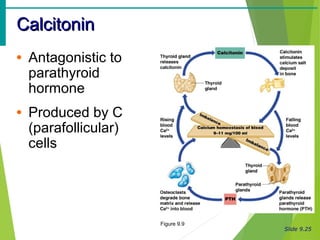
CalcitoninCalcitonin
• Antagonistic to
parathyroid
hormone
• Produced by C
(parafollicular)
cells
Figure 9.9
Slide 9.25
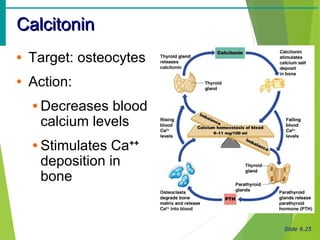
CalcitoninCalcitonin
• Target: osteocytes
• Action:
• Decreases blood
calcium levels
• Stimulates Ca++
deposition in
bone
Slide 9.26
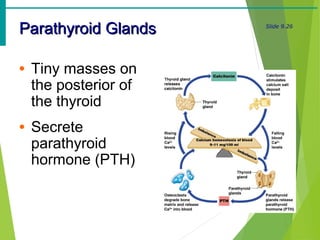
Parathyroid GlandsParathyroid Glands
• Tiny masses on
the posterior of
the thyroid
• Secrete
parathyroid
hormone (PTH)
Slide 9.26
Parathyroid GlandsParathyroid Glands
• Target: Osteoclasts
• Action:
• Stimulate osteoclasts to remove calcium
from bone
• Stimulate the kidneys and intestine to
absorb more calcium
• Raise calcium levels in the blood
Slide 9.27
Adrenal GlandsAdrenal Glands
• Paired glands above kidneys
• Cortex
• outer glandular region
• in three layers
• Medulla – inner neural tissue region
Slide 9.28a
Hormones of the Adrenal CortexHormones of the Adrenal Cortex
Copyright © 2003 Pearson Education, Inc. publishing as Benjamin Cummings
• Mineralocorticoids (mainly aldosterone)
• Target: the kidneys
• Action:
• Regulate mineral content in blood
• Water, electrolyte balance (Na+
retention)
• Increase blood pressure
Slide 9.28b
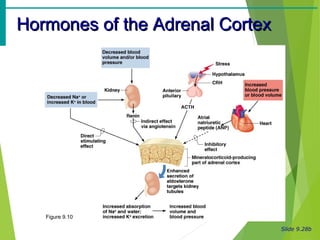
Hormones of the Adrenal CortexHormones of the Adrenal Cortex
Figure 9.10
Slide 9.29a
Hormones of the Adrenal CortexHormones of the Adrenal Cortex
• Glucocorticoids (including cortisone and
cortisol)
• Target: Most body cells
• Actions:
• Promote normal cell metabolism
• Help resist long-term stressors
• Depress immune response
Slide 9.29b
Hormones of the Adrenal CortexHormones of the Adrenal Cortex
• Sex hormones
• Produced in the inner layer of the adrenal
cortex
• Androgens (male) and some estrogen
(female)
• Target: gonadal tissue
• Action: development of secondary sex
characteristics
Slide 9.30
Hormones of the Adrenal MedullaHormones of the Adrenal Medulla
• Produces Epinephrine, Norepinephrine
• Target: Sympathetic nervous system
• Action:
• Prepare the body to deal with short-term
stress
• Potentiate sympathetic response
Slide 9.31
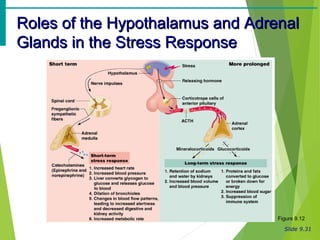
Roles of the Hypothalamus and AdrenalRoles of the Hypothalamus and Adrenal
Glands in the Stress ResponseGlands in the Stress Response
Figure 9.12
Slide 9.32a
Pancreatic IsletsPancreatic Islets
• The pancreas is both endocrine and
exocrine
• The islet cells produce hormones
• Insulin – produced by ß cells
• Target: all cells, esp. muscle, adipose
• Action: enhances glucose transport
across plasma membranes
Slide 9.32a
Pancreatic IsletsPancreatic Islets
• Glucagon – produced by α cells
• Target: the liver
• Action:
•breakdown of glycogen to glucose
•Increases blood sugar
• These hormones are antagonists that
maintain blood sugar homeostasis
Slide 9.32b
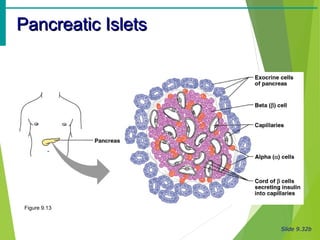
Pancreatic IsletsPancreatic Islets
Figure 9.13
Slide 9.33
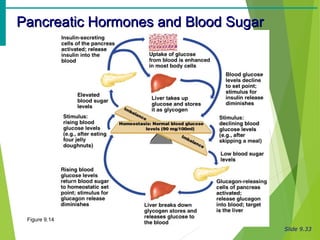
Pancreatic Hormones and Blood SugarPancreatic Hormones and Blood Sugar
Figure 9.14
Slide 9.34
Pineal Gland (“Third Eye”)Pineal Gland (“Third Eye”)
• Found above third ventricle of the brain
• Secretes melatonin
• Target: Sleep centers in brain, gonads
• Action:
• Helps establish the body’s Circadian
rhythms
• Affects timing of puberty
Slide 9.35
ThymusThymus
• Located posterior to the sternum
• Largest in infants and children
• Produces thymosin, thymopoietin
• Target: immature white blood cells
• Action:
• Maturation of T-cells
• Important in developing the immune system
Slide 9.36
Hormones of the OvariesHormones of the Ovaries
• Estrogens
• Produced by Graafian follicles or the placenta
• Targets:
• Gonadal tissue
• Female reproductive organs
Slide 9.36
Hormones of the OvariesHormones of the Ovaries
• Actions:
• Stimulates the development of secondary
female characteristics
• Matures female reproductive organs
• Helps prepare the uterus to receive a fertilized
egg
• Helps maintain pregnancy
• Prepares the breasts to produce milk
Slide 9.37
Hormones of the OvariesHormones of the Ovaries
• Progesterone
• Produced by the corpus luteum
• Target: Uterus, breast tissue
• Action:
• Acts with estrogen to regulate the
menstrual cycle
• Helps maintain pregnancy
Slide 9.38
Hormones of the TestesHormones of the Testes
• Interstitial cells produce several
androgens
• Testosterone is the most important
• Target:
• Male reproductive organs
• Skeletal muscle
• Skeletal system
• Larynx
Slide 9.38
Hormones of the TestesHormones of the Testes
• Actions:
• Responsible for adult male secondary sex
characteristics
• Promotes growth and maturation of male
reproductive system
• Required for sperm cell production
Slide 9.39
Other Hormone-Producing TissuesOther Hormone-Producing Tissues
and Organsand Organs
• Parts of the small intestine
• Parts of the stomach
• Kidneys
• Heart
• Many other areas have scattered
endocrine cells
Slide 9.40
Endocrine Function of the Placenta:Endocrine Function of the Placenta:
FYIFYI
• Produces hormones that maintain the
pregnancy
• Some hormones play a part in the
delivery of the baby
• Produces HCG in addition to estrogen,
progesterone, and other hormones
Slide 9.41
Developmental Aspects of theDevelopmental Aspects of the
Endocrine System: FYIEndocrine System: FYI
• Most endocrine organs operate smoothly
until old age
• Menopause is brought about by lack of
efficiency of the ovaries
• Problems associated with reduced estrogen
are common
• Growth hormone production declines with age
• Many endocrine glands decrease output with
age

Endocrine system

  • 1.
    Slide 2.1 Human AnatomyHumanAnatomy Endocrine System Pavemedicine.comPavemedicine.com
  • 2.
    Slide 9.23a Thyroid GlandThyroidGland • Found at the base of the throat • Consists of two lobes and a connecting isthmus • Produces two hormones • Thyroid hormone • Calcitonin
  • 3.
  • 4.
    Slide 9.24 Thyroid HormoneThyroidHormone • Major metabolic hormone • Composed of two active iodine- containing hormones • Thyroxine (T4) – secreted by thyroid follicles • Triiodothyronine (T3) – conversion of T4 at target tissues
  • 5.
    Slide 9.24 Thyroid HormoneThyroidHormone • Target: all body cells • Action: • Regulation of cell metabolism • Oxygen utilization
  • 6.
    Slide 9.25 CalcitoninCalcitonin • Antagonisticto parathyroid hormone • Produced by C (parafollicular) cells Figure 9.9
  • 7.
    Slide 9.25 CalcitoninCalcitonin • Target:osteocytes • Action: • Decreases blood calcium levels • Stimulates Ca++ deposition in bone
  • 8.
    Slide 9.26 Parathyroid GlandsParathyroidGlands • Tiny masses on the posterior of the thyroid • Secrete parathyroid hormone (PTH)
  • 9.
    Slide 9.26 Parathyroid GlandsParathyroidGlands • Target: Osteoclasts • Action: • Stimulate osteoclasts to remove calcium from bone • Stimulate the kidneys and intestine to absorb more calcium • Raise calcium levels in the blood
  • 10.
    Slide 9.27 Adrenal GlandsAdrenalGlands • Paired glands above kidneys • Cortex • outer glandular region • in three layers • Medulla – inner neural tissue region
  • 11.
    Slide 9.28a Hormones ofthe Adrenal CortexHormones of the Adrenal Cortex Copyright © 2003 Pearson Education, Inc. publishing as Benjamin Cummings • Mineralocorticoids (mainly aldosterone) • Target: the kidneys • Action: • Regulate mineral content in blood • Water, electrolyte balance (Na+ retention) • Increase blood pressure
  • 12.
    Slide 9.28b Hormones ofthe Adrenal CortexHormones of the Adrenal Cortex Figure 9.10
  • 13.
    Slide 9.29a Hormones ofthe Adrenal CortexHormones of the Adrenal Cortex • Glucocorticoids (including cortisone and cortisol) • Target: Most body cells • Actions: • Promote normal cell metabolism • Help resist long-term stressors • Depress immune response
  • 14.
    Slide 9.29b Hormones ofthe Adrenal CortexHormones of the Adrenal Cortex • Sex hormones • Produced in the inner layer of the adrenal cortex • Androgens (male) and some estrogen (female) • Target: gonadal tissue • Action: development of secondary sex characteristics
  • 15.
    Slide 9.30 Hormones ofthe Adrenal MedullaHormones of the Adrenal Medulla • Produces Epinephrine, Norepinephrine • Target: Sympathetic nervous system • Action: • Prepare the body to deal with short-term stress • Potentiate sympathetic response
  • 16.
    Slide 9.31 Roles ofthe Hypothalamus and AdrenalRoles of the Hypothalamus and Adrenal Glands in the Stress ResponseGlands in the Stress Response Figure 9.12
  • 17.
    Slide 9.32a Pancreatic IsletsPancreaticIslets • The pancreas is both endocrine and exocrine • The islet cells produce hormones • Insulin – produced by ß cells • Target: all cells, esp. muscle, adipose • Action: enhances glucose transport across plasma membranes
  • 18.
    Slide 9.32a Pancreatic IsletsPancreaticIslets • Glucagon – produced by α cells • Target: the liver • Action: •breakdown of glycogen to glucose •Increases blood sugar • These hormones are antagonists that maintain blood sugar homeostasis
  • 19.
  • 20.
    Slide 9.33 Pancreatic Hormonesand Blood SugarPancreatic Hormones and Blood Sugar Figure 9.14
  • 21.
    Slide 9.34 Pineal Gland(“Third Eye”)Pineal Gland (“Third Eye”) • Found above third ventricle of the brain • Secretes melatonin • Target: Sleep centers in brain, gonads • Action: • Helps establish the body’s Circadian rhythms • Affects timing of puberty
  • 22.
    Slide 9.35 ThymusThymus • Locatedposterior to the sternum • Largest in infants and children • Produces thymosin, thymopoietin • Target: immature white blood cells • Action: • Maturation of T-cells • Important in developing the immune system
  • 23.
    Slide 9.36 Hormones ofthe OvariesHormones of the Ovaries • Estrogens • Produced by Graafian follicles or the placenta • Targets: • Gonadal tissue • Female reproductive organs
  • 24.
    Slide 9.36 Hormones ofthe OvariesHormones of the Ovaries • Actions: • Stimulates the development of secondary female characteristics • Matures female reproductive organs • Helps prepare the uterus to receive a fertilized egg • Helps maintain pregnancy • Prepares the breasts to produce milk
  • 25.
    Slide 9.37 Hormones ofthe OvariesHormones of the Ovaries • Progesterone • Produced by the corpus luteum • Target: Uterus, breast tissue • Action: • Acts with estrogen to regulate the menstrual cycle • Helps maintain pregnancy
  • 26.
    Slide 9.38 Hormones ofthe TestesHormones of the Testes • Interstitial cells produce several androgens • Testosterone is the most important • Target: • Male reproductive organs • Skeletal muscle • Skeletal system • Larynx
  • 27.
    Slide 9.38 Hormones ofthe TestesHormones of the Testes • Actions: • Responsible for adult male secondary sex characteristics • Promotes growth and maturation of male reproductive system • Required for sperm cell production
  • 28.
    Slide 9.39 Other Hormone-ProducingTissuesOther Hormone-Producing Tissues and Organsand Organs • Parts of the small intestine • Parts of the stomach • Kidneys • Heart • Many other areas have scattered endocrine cells
  • 29.
    Slide 9.40 Endocrine Functionof the Placenta:Endocrine Function of the Placenta: FYIFYI • Produces hormones that maintain the pregnancy • Some hormones play a part in the delivery of the baby • Produces HCG in addition to estrogen, progesterone, and other hormones
  • 30.
    Slide 9.41 Developmental Aspectsof theDevelopmental Aspects of the Endocrine System: FYIEndocrine System: FYI • Most endocrine organs operate smoothly until old age • Menopause is brought about by lack of efficiency of the ovaries • Problems associated with reduced estrogen are common • Growth hormone production declines with age • Many endocrine glands decrease output with age