

Emotional Intelligence for Leaders
People Smart Strategies For The New Workplace
Why
Emotional Intelligence?
© NETWORTH CONTINUAL LEARNING & TRAINING 2011
Emotional Intelligence?
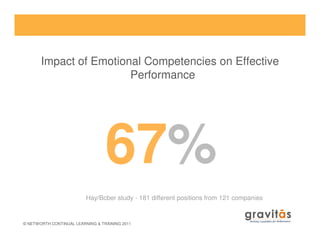
67%
Impact of Emotional Competencies on Effective
Performance
© NETWORTH CONTINUAL LEARNING & TRAINING 2011
67%
›Hay/Bcber study - 181 different positions from 121 companies
© NETWORTH CONTINUAL LEARNING & TRAINING 2011
"A leader's intelligence has to have a strong emotional component.
She has to have high levels of self-awareness, maturity and self-
control… No doubt emotional intelligence is more rare than book
smarts, but my experience says it is actually more important in the
© NETWORTH CONTINUAL LEARNING & TRAINING 2011
smarts, but my experience says it is actually more important in the
making of a leader. You just can't ignore it."
JACK WELCH,
Chairman of general electric speaking to THE WALL STREET JOURNAL
"Research shows convincingly that EQ is more important than IQ in
almost every role and many times more important in leadership
roles. This finding is accentuated as we move from the control
philosophy of the industrial age to an empowering release
© NETWORTH CONTINUAL LEARNING & TRAINING 2011
philosophy of the industrial age to an empowering release
philosophy of the knowledge worker age.”
-DR. STEPHEN COVEY,
Author of the 7 HABITS OF HIGHLY EFFECTIVE PEOPLE
“In the fields I have studied, emotional intelligence is much more
powerful than IQ in determining who emerges as a leader. IQ is a
threshold competence. You need it, but it doesn't make you a star.
Emotional Intelligence can.”
© NETWORTH CONTINUAL LEARNING & TRAINING 2011
WARREN BENNIS,
RENOWNED LEADERSHIP PIONEER, AUTHOR AND RESEARCHER
Harvard Business SchoolHarvard Business SchoolHarvard Business SchoolHarvard Business School
› Empathy
› Perspective taking
© NETWORTH CONTINUAL LEARNING & TRAINING 2011
› Perspective taking
› Rapport building
› Cooperation
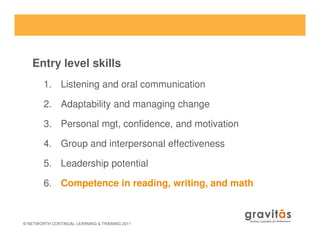
Entry level skills
1. Listening and oral communication
2. Adaptability and managing change
3. Personal mgt, confidence, and motivation
© NETWORTH CONTINUAL LEARNING & TRAINING 2011
3. Personal mgt, confidence, and motivation
4. Group and interpersonal effectiveness
5. Leadership potential
6. Competence in reading, writing, and math
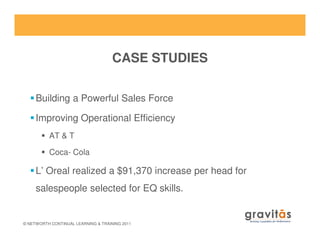
Building a Powerful Sales Force
Improving Operational Efficiency
CASE STUDIES
© NETWORTH CONTINUAL LEARNING & TRAINING 2011
AT & T
Coca- Cola
L’ Oreal realized a $91,370 increase per head for
salespeople selected for EQ skills.
Emotional Intelligence
So…Why
© NETWORTH CONTINUAL LEARNING & TRAINING 2011
Emotional Intelligence
Now?
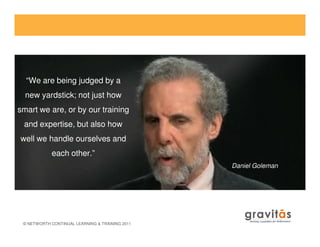
“We are being judged by a
new yardstick; not just how
smart we are, or by our training
and expertise, but also how
© NETWORTH CONTINUAL LEARNING & TRAINING 2011
and expertise, but also how
well we handle ourselves and
each other.”
Daniel Goleman
And…What is
Emotional Intelligence?
© NETWORTH CONTINUAL LEARNING & TRAINING 2011
Emotional Intelligence?
“The capacity for recognizing our own feelings and those of
others, for motivating ourselves, for managing emotions
well in ourselves and in our relationships.”
EI Defined…
© NETWORTH CONTINUAL LEARNING & TRAINING 2011
well in ourselves and in our relationships.”
Daniel Goleman
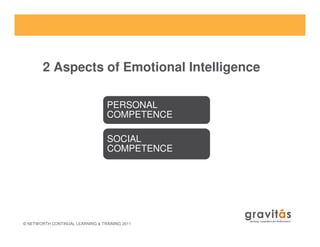
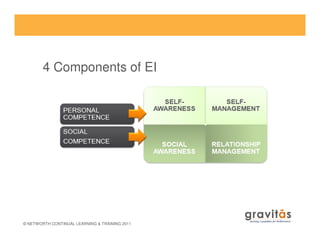
2 Aspects of Emotional Intelligence
PERSONAL
COMPETENCE
© NETWORTH CONTINUAL LEARNING & TRAINING 2011
SOCIAL
COMPETENCE
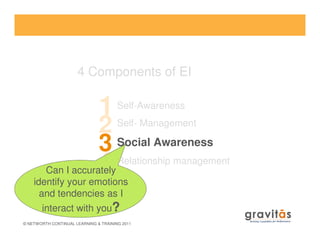
4 Components of EI
© NETWORTH CONTINUAL LEARNING & TRAINING 2011
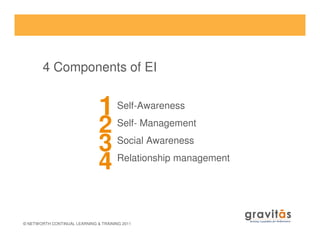
4 Components of EI
Self-Awareness
Self- Management
1
2
© NETWORTH CONTINUAL LEARNING & TRAINING 2011
Self- Management
Social Awareness
Relationship management
2
3
4
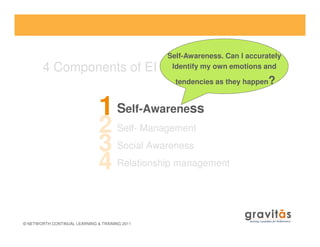
Self-Awareness
Self- Management
1
2
Self-Awareness. Can I accurately
Identify my own emotions and
tendencies as they happen?
4 Components of EI
© NETWORTH CONTINUAL LEARNING & TRAINING 2011
Self- Management
Social Awareness
Relationship management
2
3
4
Self-Awareness
Self- Management
1
2
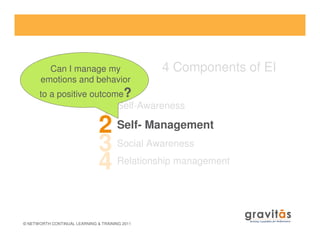
Can I manage my
emotions and behavior
to a positive outcome?
4 Components of EI
© NETWORTH CONTINUAL LEARNING & TRAINING 2011
Self- Management
Social Awareness
Relationship management
2
3
4
Self-Awareness
Self- Management
1
2
4 Components of EI
© NETWORTH CONTINUAL LEARNING & TRAINING 2011
Self- Management
Social Awareness
Relationship management
2
3
4Can I accurately
identify your emotions
and tendencies as I
interact with you?
Self-Awareness
Self- Management
1
2
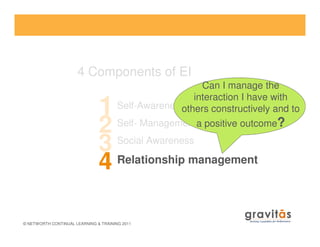
Can I manage the
interaction I have with
others constructively and to
a positive outcome?
4 Components of EI
© NETWORTH CONTINUAL LEARNING & TRAINING 2011
Self- Management
Social Awareness
Relationship management
2
3
4
a positive outcome?
What Emotional Intelligence is Not?What Emotional Intelligence is Not?What Emotional Intelligence is Not?What Emotional Intelligence is Not?
o Emotional intelligence is not about being nice all the time.
– It is about being honest.
© NETWORTH CONTINUAL LEARNING & TRAINING 2011
o Emotional intelligence is not about being “touchy-feely.”
– It is about being aware of your feelings, and those of
others.
o Emotional intelligence is not about being emotional.
– It is about being smart with your emotions.
How much can
people really
© NETWORTH CONTINUAL LEARNING & TRAINING 2011
people really
change their EQ?
HARI SADU
© NETWORTH CONTINUAL LEARNING & TRAINING 2011
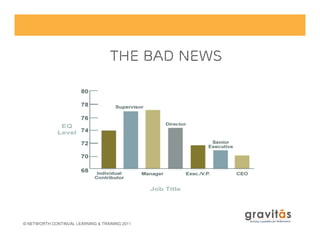
The Bad News
© NETWORTH CONTINUAL LEARNING & TRAINING 2011
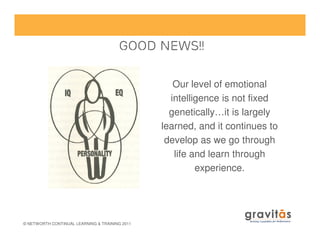
Good News!!
Our level of emotional
intelligence is not fixed
genetically…it is largely
learned, and it continues to
© NETWORTH CONTINUAL LEARNING & TRAINING 2011
learned, and it continues to
develop as we go through
life and learn through
experience.
Learning Objectives- Level 1
1. Emotional Self- awareness
2. Accurate self- assessment2. Accurate self- assessment
3. Self motivation
4. Emotional self management
Emotional
Self- Awareness
© NETWORTH CONTINUAL LEARNING & TRAINING 2011
Self- Awareness
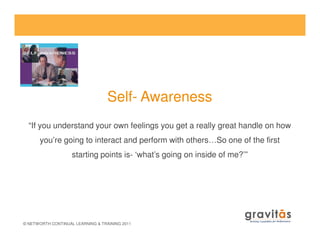
“If you understand your own feelings you get a really great handle on how
Self- Awareness
© NETWORTH CONTINUAL LEARNING & TRAINING 2011
“If you understand your own feelings you get a really great handle on how
you’re going to interact and perform with others…So one of the first
starting points is- ‘what’s going on inside of me?’”
Awareness of your beliefs
Awareness of your capabilities
Self- Awareness
© NETWORTH CONTINUAL LEARNING & TRAINING 2011
Awareness of your capabilities
Awareness of your skills and knowledge
Awareness of your thoughts and emotions.
Or
Imaginary
© NETWORTH CONTINUAL LEARNING & TRAINING 2011
Or
Real
© NETWORTH CONTINUAL LEARNING & TRAINING 2011
Thought Experiment
What thoughts do you have when something goes wrong
in your life?
What thoughts do you have when something
© NETWORTH CONTINUAL LEARNING & TRAINING 2011
What thoughts do you have when something
pleasurable happens?
What thoughts do you have when learning something
new?
© NETWORTH CONTINUAL LEARNING & TRAINING 2011
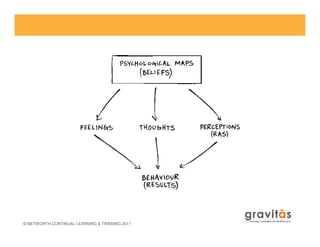
RAS
Reticular Activating system- The part of brain that filters
information and allows into our conscious mind only the
information consistent with our current beliefs.information consistent with our current beliefs.
Thoughts
These thinking patterns will have a direct impact upon your
performance and the results you get in life.performance and the results you get in life.
Feelings
Physical responses for
various feelings:
panic attacks
memory loss
nausea
perspiration
© NETWORTH CONTINUAL LEARNING & TRAINING 2011
panic attacks
poor physical co-
ordination
palpitations
perspiration
dry mouth
low energy
fainting.
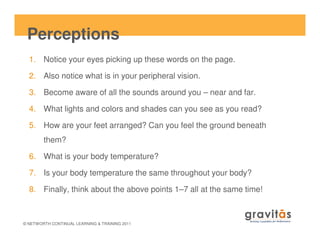
Perceptions
1. Notice your eyes picking up these words on the page.
2. Also notice what is in your peripheral vision.
3. Become aware of all the sounds around you – near and far.
4. What lights and colors and shades can you see as you read?
5. How are your feet arranged? Can you feel the ground beneath
© NETWORTH CONTINUAL LEARNING & TRAINING 2011
5. How are your feet arranged? Can you feel the ground beneath
them?
6. What is your body temperature?
7. Is your body temperature the same throughout your body?
8. Finally, think about the above points 1–7 all at the same time!
So…If you are going to change the quality of your life
Where you lack awareness – conscious recognition – you
allow the unconscious patterns to control our destiny.
So…If you are going to change the quality of your life
then you may need to change the way you think, feel
and behave. In other words, you are going to have to
learn new thoughts, feelings and behaviours.
© NETWORTH CONTINUAL LEARNING & TRAINING 2011
Until we make the unconscious
conscious, it will rule our life and
Self- Awareness
conscious, it will rule our life and
we will call it fate.
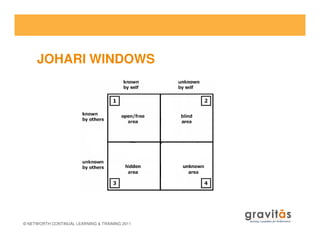
JOHARI WINDOWS
© NETWORTH CONTINUAL LEARNING & TRAINING 2011
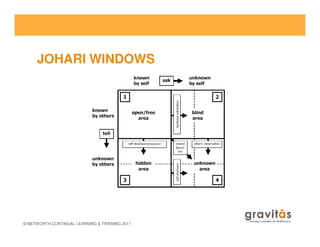
JOHARI WINDOWS
© NETWORTH CONTINUAL LEARNING & TRAINING 2011
Accurate
Self- Assessment
© NETWORTH CONTINUAL LEARNING & TRAINING 2011
Self- Assessment
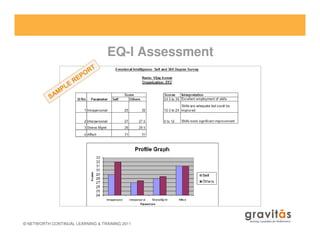
EQ-I Assessment
© NETWORTH CONTINUAL LEARNING & TRAINING 2011
Self
Motivation
© NETWORTH CONTINUAL LEARNING & TRAINING 2011
Motivation
© NETWORTH CONTINUAL LEARNING & TRAINING 2011
“High performers are those who are able to see with some
clarity, to what degree they are responsible for a setback
and to what degree it may be circumstance or other
people. As a result they are able to be more persistent.”
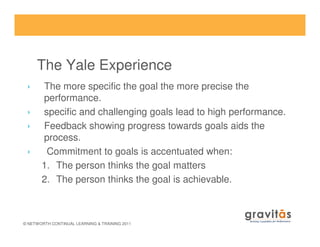
The Yale Experience
› The more specific the goal the more precise the
performance.
› specific and challenging goals lead to high performance.
› Feedback showing progress towards goals aids the
© NETWORTH CONTINUAL LEARNING & TRAINING 2011
› Feedback showing progress towards goals aids the
process.
› Commitment to goals is accentuated when:
1. The person thinks the goal matters
2. The person thinks the goal is achievable.
Goals & RAS
When goals are vague then inputs are vague
and your outcomes are . . . vague.and your outcomes are . . . vague.
Self
Management
© NETWORTH CONTINUAL LEARNING & TRAINING 2011
Management
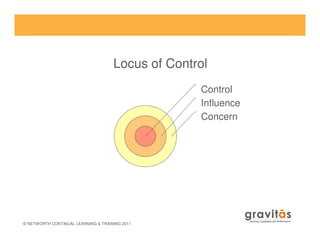
Locus of Control
Concern
Influence
Control
© NETWORTH CONTINUAL LEARNING & TRAINING 2011
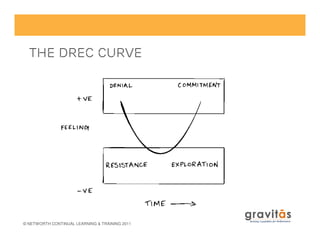
The DREC curve
© NETWORTH CONTINUAL LEARNING & TRAINING 2011
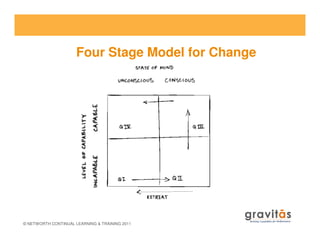
Four Stage Model for Change
© NETWORTH CONTINUAL LEARNING & TRAINING 2011
Circle of Concern
‘God grant me the serenity to accept the things I cannot
change, the courage to change the things I can, and the
wisdom to know the difference.’
It is evident that people who have a high quality of
life invariably have large zones of control andlife invariably have large zones of control and
influence.

Emotional intelligence for new leaders

  • 1.
    Emotional Intelligence forLeaders People Smart Strategies For The New Workplace
  • 2.
    Why Emotional Intelligence? © NETWORTHCONTINUAL LEARNING & TRAINING 2011 Emotional Intelligence?
  • 3.
    67% Impact of EmotionalCompetencies on Effective Performance © NETWORTH CONTINUAL LEARNING & TRAINING 2011 67% ›Hay/Bcber study - 181 different positions from 121 companies
  • 4.
    © NETWORTH CONTINUALLEARNING & TRAINING 2011
  • 5.
    "A leader's intelligencehas to have a strong emotional component. She has to have high levels of self-awareness, maturity and self- control… No doubt emotional intelligence is more rare than book smarts, but my experience says it is actually more important in the © NETWORTH CONTINUAL LEARNING & TRAINING 2011 smarts, but my experience says it is actually more important in the making of a leader. You just can't ignore it." JACK WELCH, Chairman of general electric speaking to THE WALL STREET JOURNAL
  • 6.
    "Research shows convincinglythat EQ is more important than IQ in almost every role and many times more important in leadership roles. This finding is accentuated as we move from the control philosophy of the industrial age to an empowering release © NETWORTH CONTINUAL LEARNING & TRAINING 2011 philosophy of the industrial age to an empowering release philosophy of the knowledge worker age.” -DR. STEPHEN COVEY, Author of the 7 HABITS OF HIGHLY EFFECTIVE PEOPLE
  • 7.
    “In the fieldsI have studied, emotional intelligence is much more powerful than IQ in determining who emerges as a leader. IQ is a threshold competence. You need it, but it doesn't make you a star. Emotional Intelligence can.” © NETWORTH CONTINUAL LEARNING & TRAINING 2011 WARREN BENNIS, RENOWNED LEADERSHIP PIONEER, AUTHOR AND RESEARCHER
  • 8.
    Harvard Business SchoolHarvardBusiness SchoolHarvard Business SchoolHarvard Business School › Empathy › Perspective taking © NETWORTH CONTINUAL LEARNING & TRAINING 2011 › Perspective taking › Rapport building › Cooperation
  • 9.
    Entry level skills 1.Listening and oral communication 2. Adaptability and managing change 3. Personal mgt, confidence, and motivation © NETWORTH CONTINUAL LEARNING & TRAINING 2011 3. Personal mgt, confidence, and motivation 4. Group and interpersonal effectiveness 5. Leadership potential 6. Competence in reading, writing, and math
  • 10.
    Building a PowerfulSales Force Improving Operational Efficiency CASE STUDIES © NETWORTH CONTINUAL LEARNING & TRAINING 2011 AT & T Coca- Cola L’ Oreal realized a $91,370 increase per head for salespeople selected for EQ skills.
  • 11.
    Emotional Intelligence So…Why © NETWORTHCONTINUAL LEARNING & TRAINING 2011 Emotional Intelligence Now?
  • 12.
    “We are beingjudged by a new yardstick; not just how smart we are, or by our training and expertise, but also how © NETWORTH CONTINUAL LEARNING & TRAINING 2011 and expertise, but also how well we handle ourselves and each other.” Daniel Goleman
  • 13.
    And…What is Emotional Intelligence? ©NETWORTH CONTINUAL LEARNING & TRAINING 2011 Emotional Intelligence?
  • 14.
    “The capacity forrecognizing our own feelings and those of others, for motivating ourselves, for managing emotions well in ourselves and in our relationships.” EI Defined… © NETWORTH CONTINUAL LEARNING & TRAINING 2011 well in ourselves and in our relationships.” Daniel Goleman
  • 15.
    2 Aspects ofEmotional Intelligence PERSONAL COMPETENCE © NETWORTH CONTINUAL LEARNING & TRAINING 2011 SOCIAL COMPETENCE
  • 16.
    4 Components ofEI © NETWORTH CONTINUAL LEARNING & TRAINING 2011
  • 17.
    4 Components ofEI Self-Awareness Self- Management 1 2 © NETWORTH CONTINUAL LEARNING & TRAINING 2011 Self- Management Social Awareness Relationship management 2 3 4
  • 18.
    Self-Awareness Self- Management 1 2 Self-Awareness. CanI accurately Identify my own emotions and tendencies as they happen? 4 Components of EI © NETWORTH CONTINUAL LEARNING & TRAINING 2011 Self- Management Social Awareness Relationship management 2 3 4
  • 19.
    Self-Awareness Self- Management 1 2 Can Imanage my emotions and behavior to a positive outcome? 4 Components of EI © NETWORTH CONTINUAL LEARNING & TRAINING 2011 Self- Management Social Awareness Relationship management 2 3 4
  • 20.
    Self-Awareness Self- Management 1 2 4 Componentsof EI © NETWORTH CONTINUAL LEARNING & TRAINING 2011 Self- Management Social Awareness Relationship management 2 3 4Can I accurately identify your emotions and tendencies as I interact with you?
  • 21.
    Self-Awareness Self- Management 1 2 Can Imanage the interaction I have with others constructively and to a positive outcome? 4 Components of EI © NETWORTH CONTINUAL LEARNING & TRAINING 2011 Self- Management Social Awareness Relationship management 2 3 4 a positive outcome?
  • 22.
    What Emotional Intelligenceis Not?What Emotional Intelligence is Not?What Emotional Intelligence is Not?What Emotional Intelligence is Not? o Emotional intelligence is not about being nice all the time. – It is about being honest. © NETWORTH CONTINUAL LEARNING & TRAINING 2011 o Emotional intelligence is not about being “touchy-feely.” – It is about being aware of your feelings, and those of others. o Emotional intelligence is not about being emotional. – It is about being smart with your emotions.
  • 23.
    How much can peoplereally © NETWORTH CONTINUAL LEARNING & TRAINING 2011 people really change their EQ?
  • 24.
    HARI SADU © NETWORTHCONTINUAL LEARNING & TRAINING 2011
  • 25.
    The Bad News ©NETWORTH CONTINUAL LEARNING & TRAINING 2011
  • 26.
    Good News!! Our levelof emotional intelligence is not fixed genetically…it is largely learned, and it continues to © NETWORTH CONTINUAL LEARNING & TRAINING 2011 learned, and it continues to develop as we go through life and learn through experience.
  • 27.
    Learning Objectives- Level1 1. Emotional Self- awareness 2. Accurate self- assessment2. Accurate self- assessment 3. Self motivation 4. Emotional self management
  • 28.
    Emotional Self- Awareness © NETWORTHCONTINUAL LEARNING & TRAINING 2011 Self- Awareness
  • 29.
    “If you understandyour own feelings you get a really great handle on how Self- Awareness © NETWORTH CONTINUAL LEARNING & TRAINING 2011 “If you understand your own feelings you get a really great handle on how you’re going to interact and perform with others…So one of the first starting points is- ‘what’s going on inside of me?’”
  • 30.
    Awareness of yourbeliefs Awareness of your capabilities Self- Awareness © NETWORTH CONTINUAL LEARNING & TRAINING 2011 Awareness of your capabilities Awareness of your skills and knowledge Awareness of your thoughts and emotions.
  • 31.
    Or Imaginary © NETWORTH CONTINUALLEARNING & TRAINING 2011 Or Real
  • 32.
    © NETWORTH CONTINUALLEARNING & TRAINING 2011
  • 33.
    Thought Experiment What thoughtsdo you have when something goes wrong in your life? What thoughts do you have when something © NETWORTH CONTINUAL LEARNING & TRAINING 2011 What thoughts do you have when something pleasurable happens? What thoughts do you have when learning something new?
  • 34.
    © NETWORTH CONTINUALLEARNING & TRAINING 2011
  • 35.
    RAS Reticular Activating system-The part of brain that filters information and allows into our conscious mind only the information consistent with our current beliefs.information consistent with our current beliefs.
  • 36.
    Thoughts These thinking patternswill have a direct impact upon your performance and the results you get in life.performance and the results you get in life.
  • 37.
    Feelings Physical responses for variousfeelings: panic attacks memory loss nausea perspiration © NETWORTH CONTINUAL LEARNING & TRAINING 2011 panic attacks poor physical co- ordination palpitations perspiration dry mouth low energy fainting.
  • 38.
    Perceptions 1. Notice youreyes picking up these words on the page. 2. Also notice what is in your peripheral vision. 3. Become aware of all the sounds around you – near and far. 4. What lights and colors and shades can you see as you read? 5. How are your feet arranged? Can you feel the ground beneath © NETWORTH CONTINUAL LEARNING & TRAINING 2011 5. How are your feet arranged? Can you feel the ground beneath them? 6. What is your body temperature? 7. Is your body temperature the same throughout your body? 8. Finally, think about the above points 1–7 all at the same time!
  • 39.
    So…If you aregoing to change the quality of your life Where you lack awareness – conscious recognition – you allow the unconscious patterns to control our destiny. So…If you are going to change the quality of your life then you may need to change the way you think, feel and behave. In other words, you are going to have to learn new thoughts, feelings and behaviours.
  • 40.
    © NETWORTH CONTINUALLEARNING & TRAINING 2011
  • 41.
    Until we makethe unconscious conscious, it will rule our life and Self- Awareness conscious, it will rule our life and we will call it fate.
  • 42.
    JOHARI WINDOWS © NETWORTHCONTINUAL LEARNING & TRAINING 2011
  • 43.
    JOHARI WINDOWS © NETWORTHCONTINUAL LEARNING & TRAINING 2011
  • 44.
    Accurate Self- Assessment © NETWORTHCONTINUAL LEARNING & TRAINING 2011 Self- Assessment
  • 45.
    EQ-I Assessment © NETWORTHCONTINUAL LEARNING & TRAINING 2011
  • 46.
    Self Motivation © NETWORTH CONTINUALLEARNING & TRAINING 2011 Motivation
  • 47.
    © NETWORTH CONTINUALLEARNING & TRAINING 2011 “High performers are those who are able to see with some clarity, to what degree they are responsible for a setback and to what degree it may be circumstance or other people. As a result they are able to be more persistent.”
  • 48.
    The Yale Experience ›The more specific the goal the more precise the performance. › specific and challenging goals lead to high performance. › Feedback showing progress towards goals aids the © NETWORTH CONTINUAL LEARNING & TRAINING 2011 › Feedback showing progress towards goals aids the process. › Commitment to goals is accentuated when: 1. The person thinks the goal matters 2. The person thinks the goal is achievable.
  • 49.
    Goals & RAS Whengoals are vague then inputs are vague and your outcomes are . . . vague.and your outcomes are . . . vague.
  • 50.
    Self Management © NETWORTH CONTINUALLEARNING & TRAINING 2011 Management
  • 51.
    Locus of Control Concern Influence Control ©NETWORTH CONTINUAL LEARNING & TRAINING 2011
  • 52.
    The DREC curve ©NETWORTH CONTINUAL LEARNING & TRAINING 2011
  • 53.
    Four Stage Modelfor Change © NETWORTH CONTINUAL LEARNING & TRAINING 2011
  • 54.
    Circle of Concern ‘Godgrant me the serenity to accept the things I cannot change, the courage to change the things I can, and the wisdom to know the difference.’
  • 55.
    It is evidentthat people who have a high quality of life invariably have large zones of control andlife invariably have large zones of control and influence.