www.smrhrgroup.com
“Emotions have taught mankind to reason.”
- Vauvenargues
1
Emotional Intelligence
Helping People Learn & Perform
www.smrhrgroup.com
What is Emotional Intelligence
“Your ability to recognise and understand
emotions, and your skill at using this
awareness to manage yourself and your
relationships with others.”
Drs. Travis Bradberry and Jean Greaves,
authors of The Emotional Intelligence Quick Book
2
www.smrhrgroup.com 3
Emotional Intelligence
• The Aristotle quote
– Getting angry is okay so long as you get angry for
the right reason with the right person to the right
degree using the right words with the right tone of
voice and appropriate language.
www.smrhrgroup.com
www.smrhrgroup.com 4
Smarts – Head and Heart
• Redefining IQ – EQ – SQ
• IQ – Modest contribution to life’s success,
stable over time after a certain stage.
• EQ – High contribution. Grows all the time.
• Costs for the organisation - Emotional
ineptitude
• Superior performers - IQ follows EQ
www.smrhrgroup.com
www.smrhrgroup.com
Applications
• Organizational applications – Leadership,
Talent development, Team work
www.smrhrgroup.com
Why is EQ Critical Now?
 Knowledge and relationships are the currency
of the new economy
 EQ links to job and bottom line performance
 Changes in the “emotional” brain are possible
 It always has been!
6
www.smrhrgroup.com
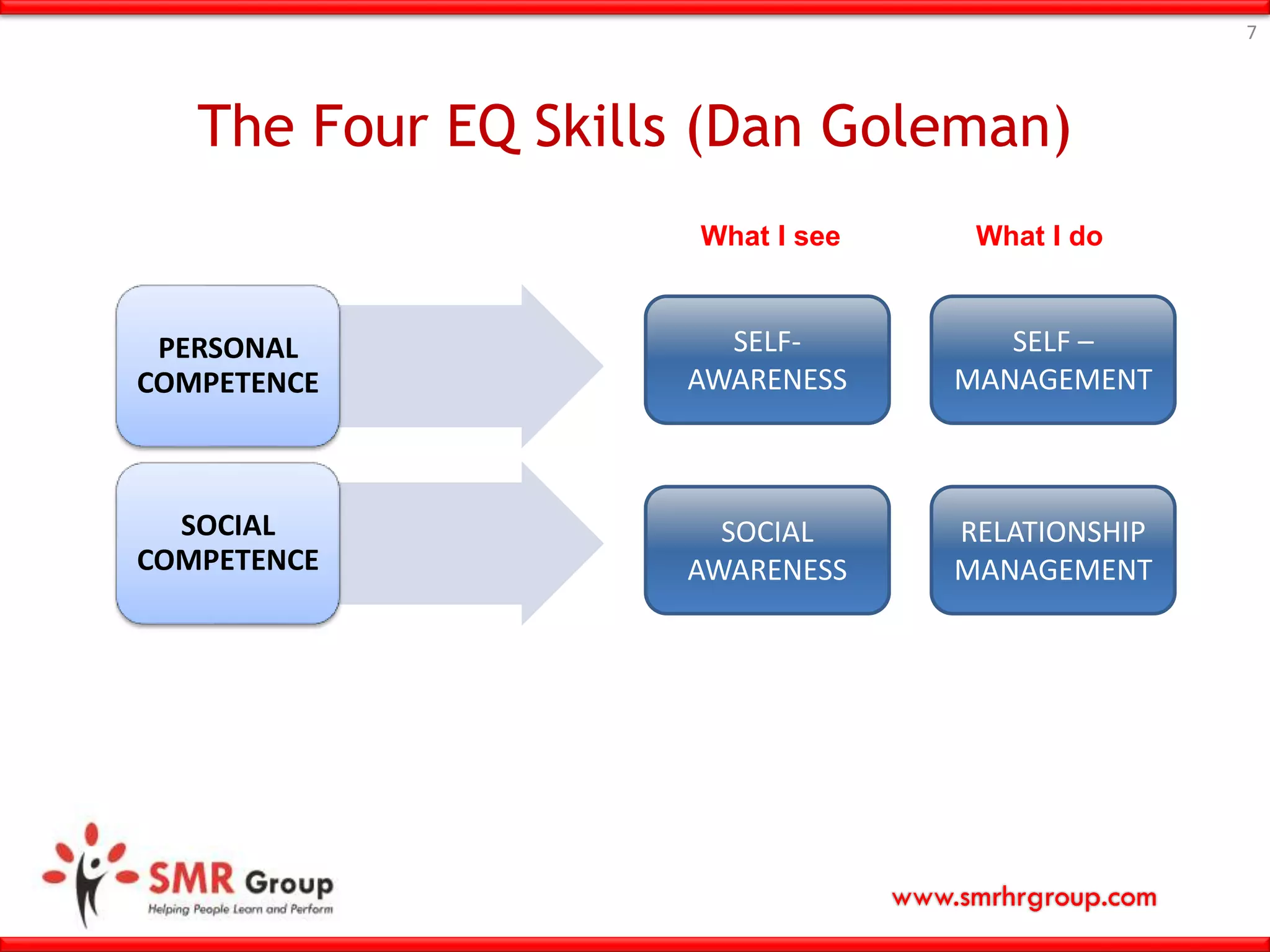
The Four EQ Skills (Dan Goleman)
7
PERSONAL
COMPETENCE
SOCIAL
COMPETENCE
SELF-
AWARENESS
SELF –
MANAGEMENT
SOCIAL
AWARENESS
RELATIONSHIP
MANAGEMENT
What I see What I do
www.smrhrgroup.com
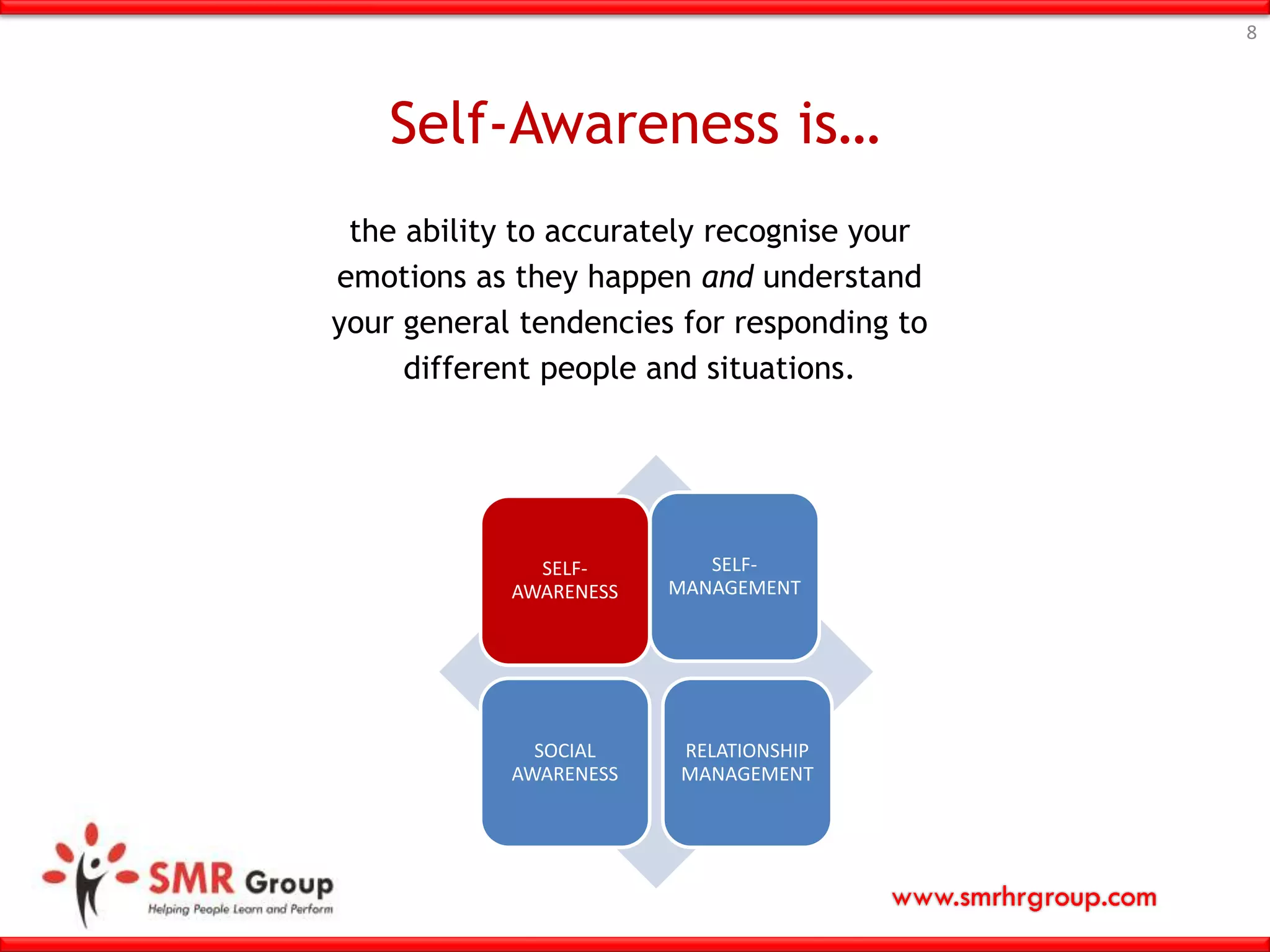
Self-Awareness is…
8
the ability to accurately recognise your
emotions as they happen and understand
your general tendencies for responding to
different people and situations.
SELF-
AWARENESS
SELF-
MANAGEMENT
SOCIAL
AWARENESS
RELATIONSHIP
MANAGEMENT
www.smrhrgroup.com
Knowing your Emotions
Keeping track of your own emotions.
Knowing why you think, feel and behave the
way you do ( What are the emotions that are,
for you, the most difficult to handle? Physical
symptoms? What situation/ who sets off this
negative emotion? ) --- THE SELF-AWARE, THE
ENGULFED and THE ACCEPTING.
Confidence in your self worth and capabilities.
9
www.smrhrgroup.com
www.smrhrgroup.com
10
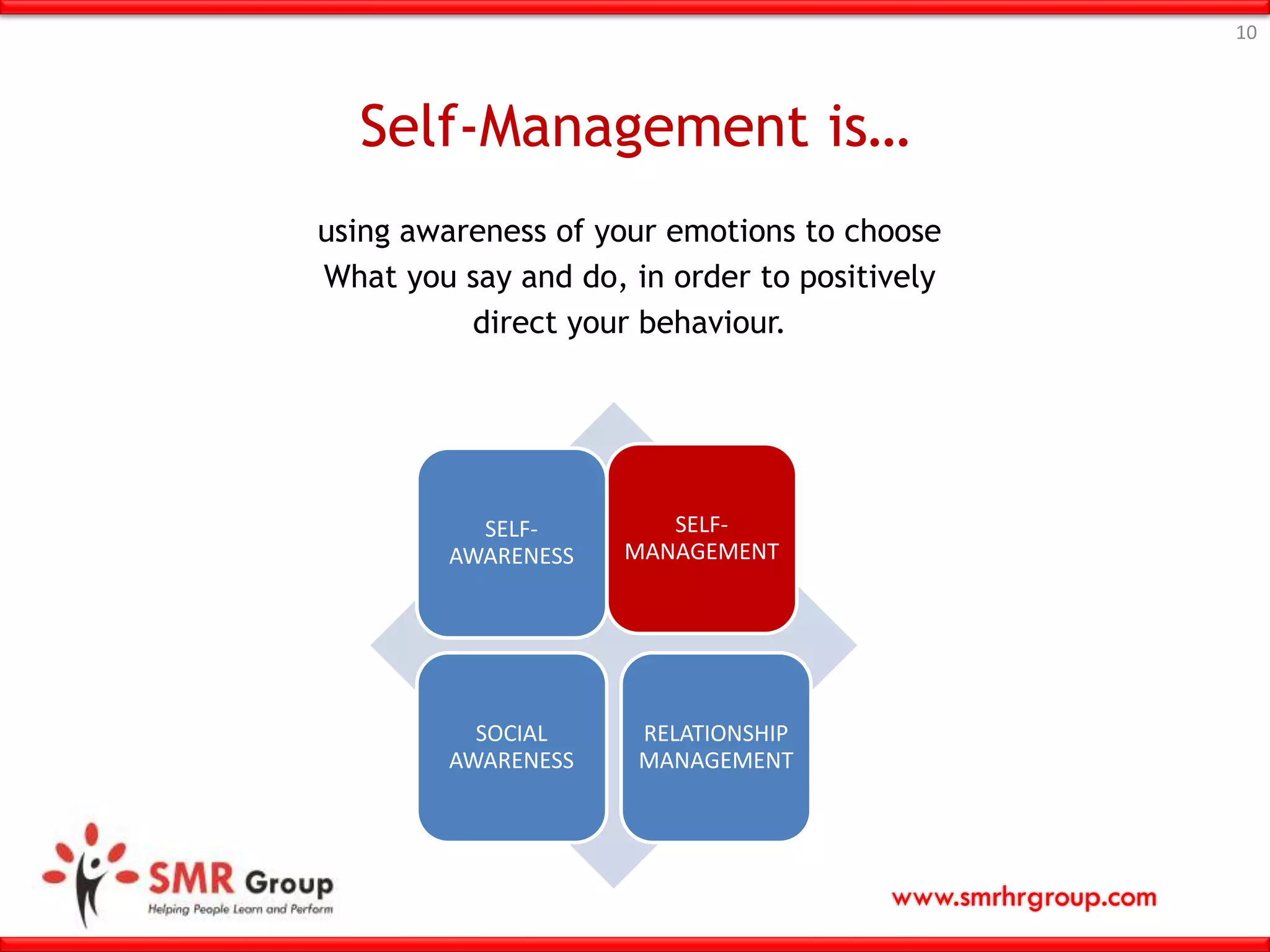
Self-Management is…
using awareness of your emotions to choose
What you say and do, in order to positively
direct your behaviour.
SELF-
AWARENESS
SELF-
MANAGEMENT
SOCIAL
AWARENESS
RELATIONSHIP
MANAGEMENT
www.smrhrgroup.com
Managing your Emotions
Marshmallow Test.
Self Control – Regulating your emotions. Delay
of an impulse. Avoiding emotional explosion.
Freedom to choose your own response. It is
not so much what happens to us, but rather
our own response that hurts us.
11
www.smrhrgroup.com
www.smrhrgroup.com
Managing your Emotions (cont)
The way we see the problem is the problem.
Standing apart and observing our own feeling,
moods, and thoughts.
Our greatest power is our freedom to choose
our response. It is not what happens to us
that hurts us. It is our response that hurts us.
12
www.smrhrgroup.com
www.smrhrgroup.com
Motivating Yourself
Optimism – Ability to look at the brighter side
of life and maintain positive attitude.
Persistence in pursuing goals. Ability to get
more out of life; have a positive job
description.
Contentment – Ability to enjoy oneself. Feel
satisfied with one’s life.
Pessimist ascribes failure to his / her
limitations. Optimists tend to find reasons in
external circumstances.
13
www.smrhrgroup.com
www.smrhrgroup.com
Motivating Yourself (Cont)
The elephant technique – Break large task into
‘bite-size’ pieces; schedule these as regular
tasks of the day / week / month; Make sure
you “eat” a bite every day beyond your
routine tasks.
Being a “maintenance” person Vs. being a
“development” person. Visualizing your
desired end results.
14
www.smrhrgroup.com
www.smrhrgroup.com
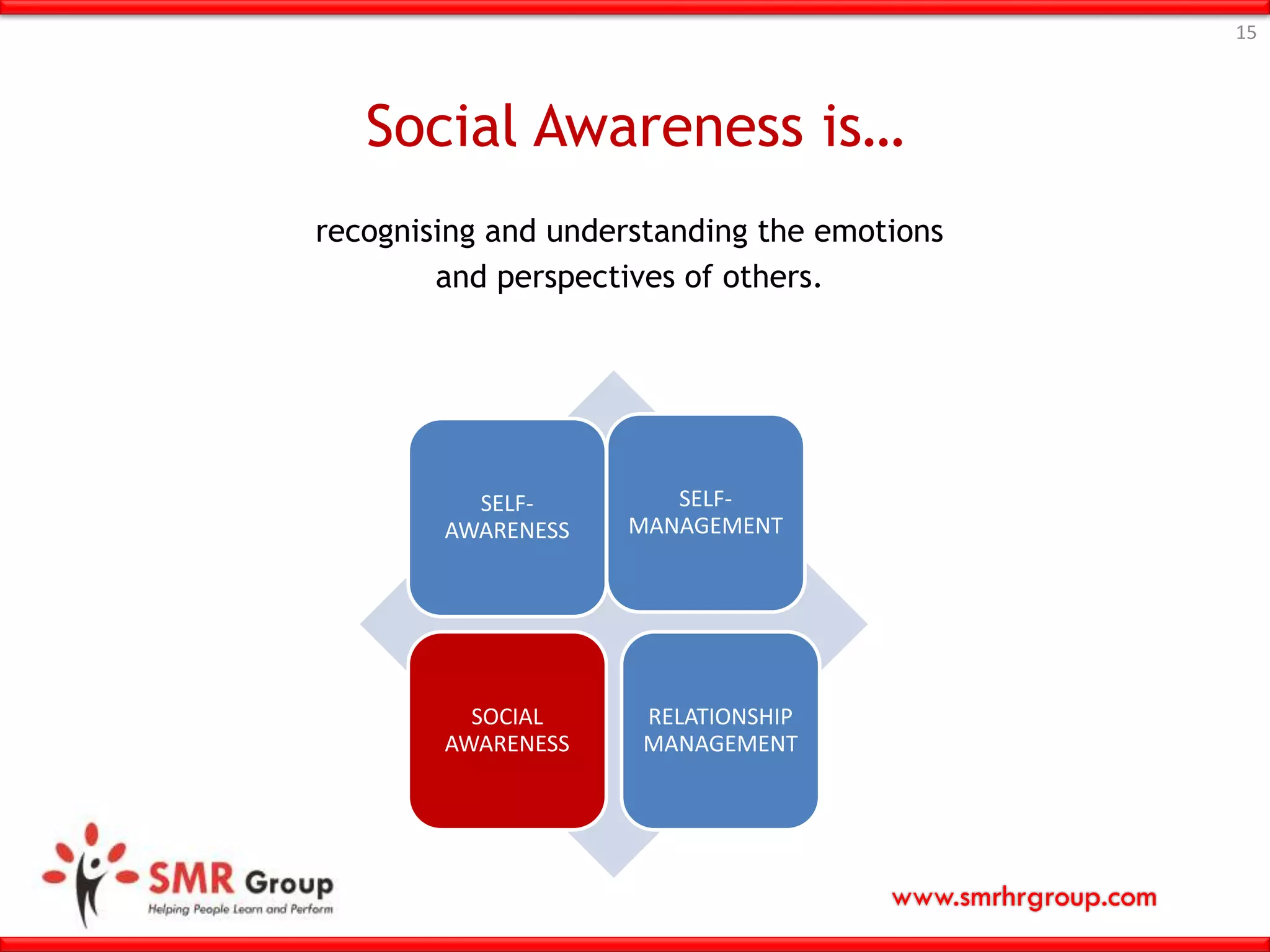
Social Awareness is…
15
recognising and understanding the emotions
and perspectives of others.
SELF-
AWARENESS
SELF-
MANAGEMENT
SOCIAL
AWARENESS
RELATIONSHIP
MANAGEMENT
www.smrhrgroup.com
Empathy
Recognizing emotions in others
Caring / Accepting / Understanding
Listening – 5 Levels
Ignoring
Pretending we are Listening
Selective Listening
Attentive Listening
Empathic Listening
16
www.smrhrgroup.com
www.smrhrgroup.com
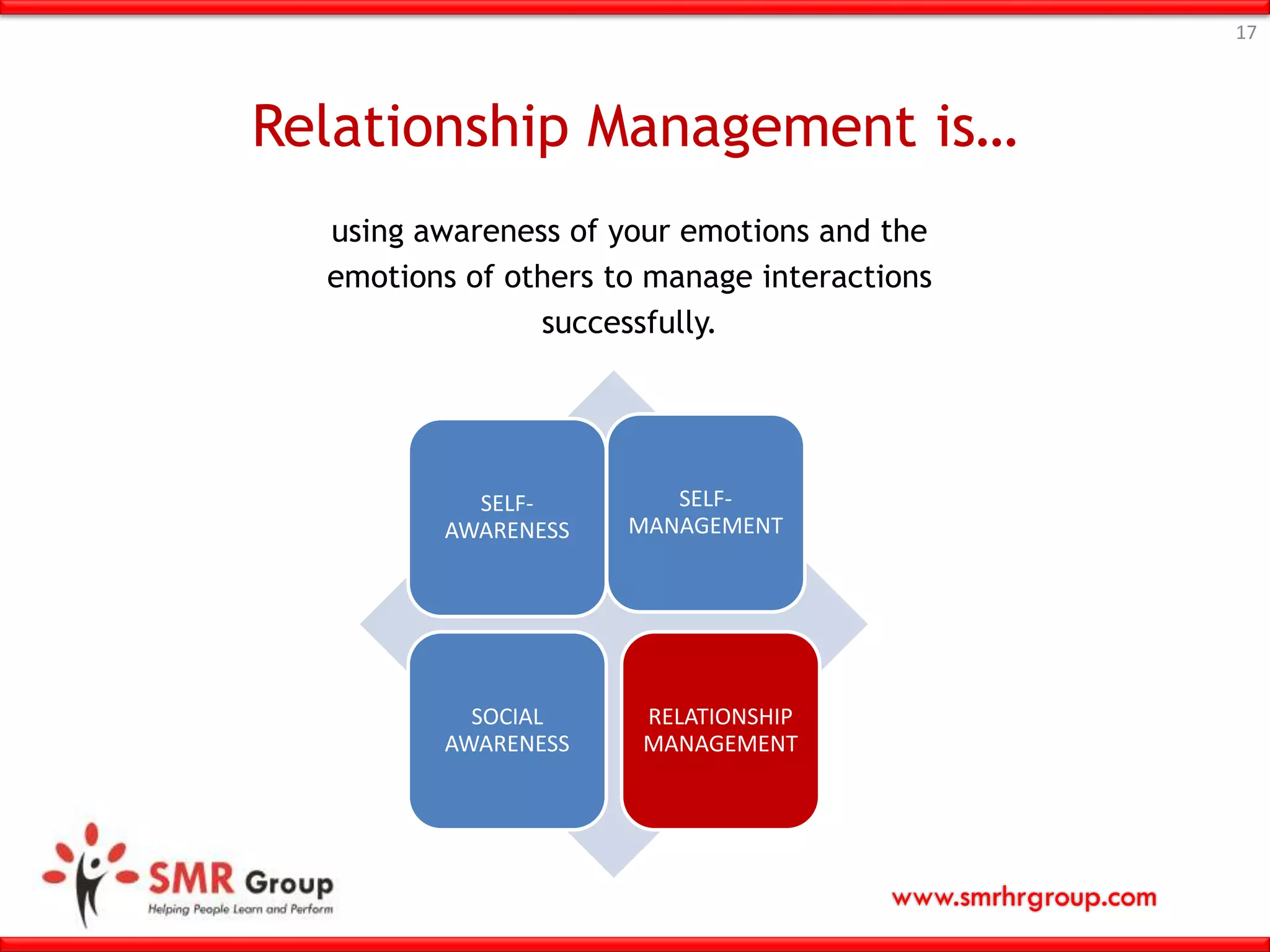
Relationship Management is…
17
using awareness of your emotions and the
emotions of others to manage interactions
successfully.
SELF-
AWARENESS
SELF-
MANAGEMENT
SOCIAL
AWARENESS
RELATIONSHIP
MANAGEMENT
www.smrhrgroup.com
Social Skills
Managing your relationships
Making people a little better or a little worse
Emotions are contagious. Do we spread
ripples of good feeling? Make each other feel
better?
18
www.smrhrgroup.com
www.smrhrgroup.com
Use EQ Skills to…
19
 Know yourself
 Understand others
 Make better decisions
 See and seize opportunities
 Identify problems before they escalate
 Manage difficult situations and conversations
www.smrhrgroup.com
Action Implications
Ways to Recover
Change things that happen to you
Change the way you look at things
Change the way your mind / body reacts to it
 Amygdale Short-circuit / Hijack
Get out of negative cycle. Clam down. Think.
Deescalate
Understand yourself; find a model. Take time out.
Choose appropriate response.
Learn though repetition.
20
www.smrhrgroup.com
www.smrhrgroup.com
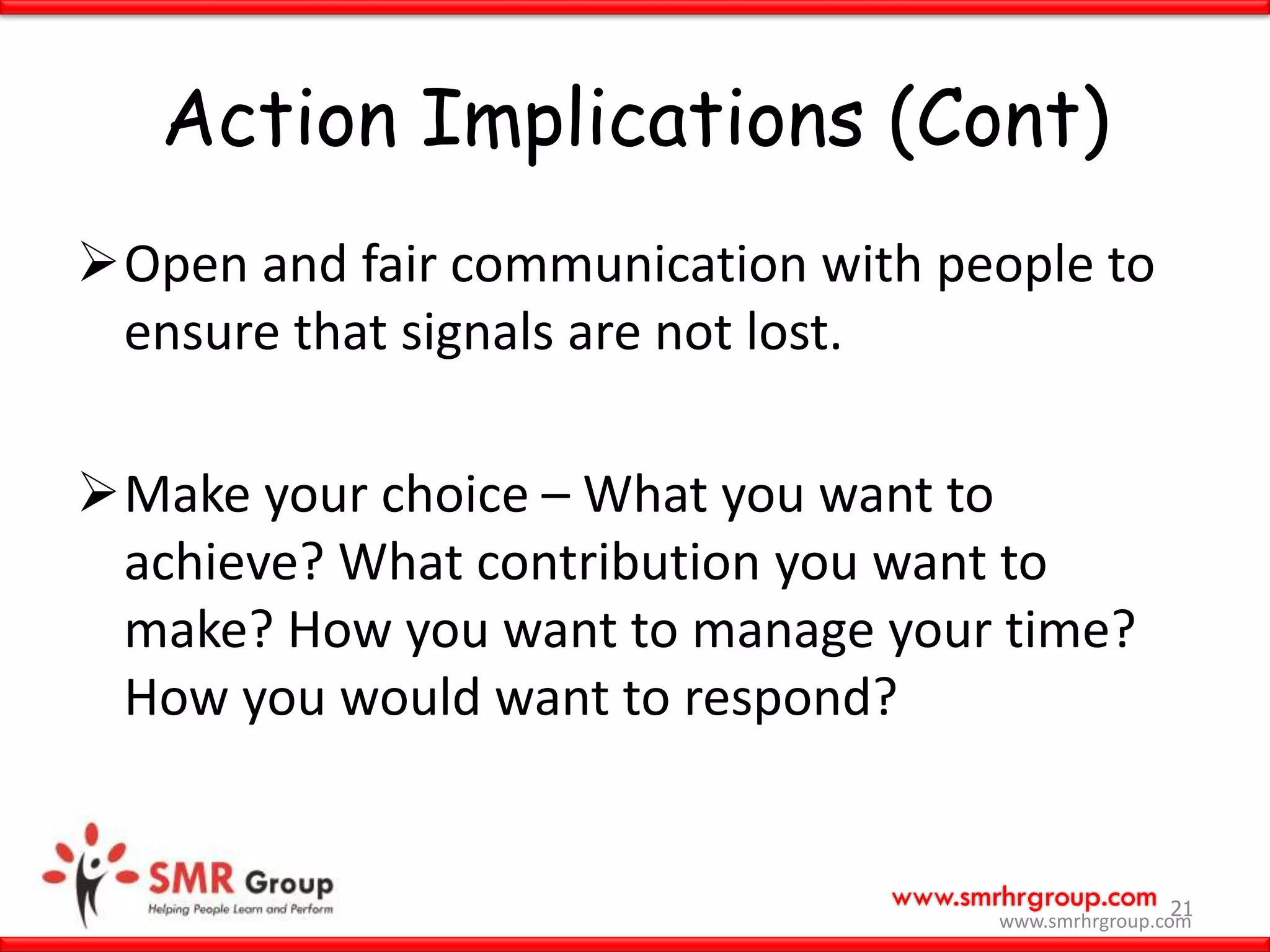
Action Implications (Cont)
Open and fair communication with people to
ensure that signals are not lost.
Make your choice – What you want to
achieve? What contribution you want to
make? How you want to manage your time?
How you would want to respond?
21
www.smrhrgroup.com
www.smrhrgroup.com
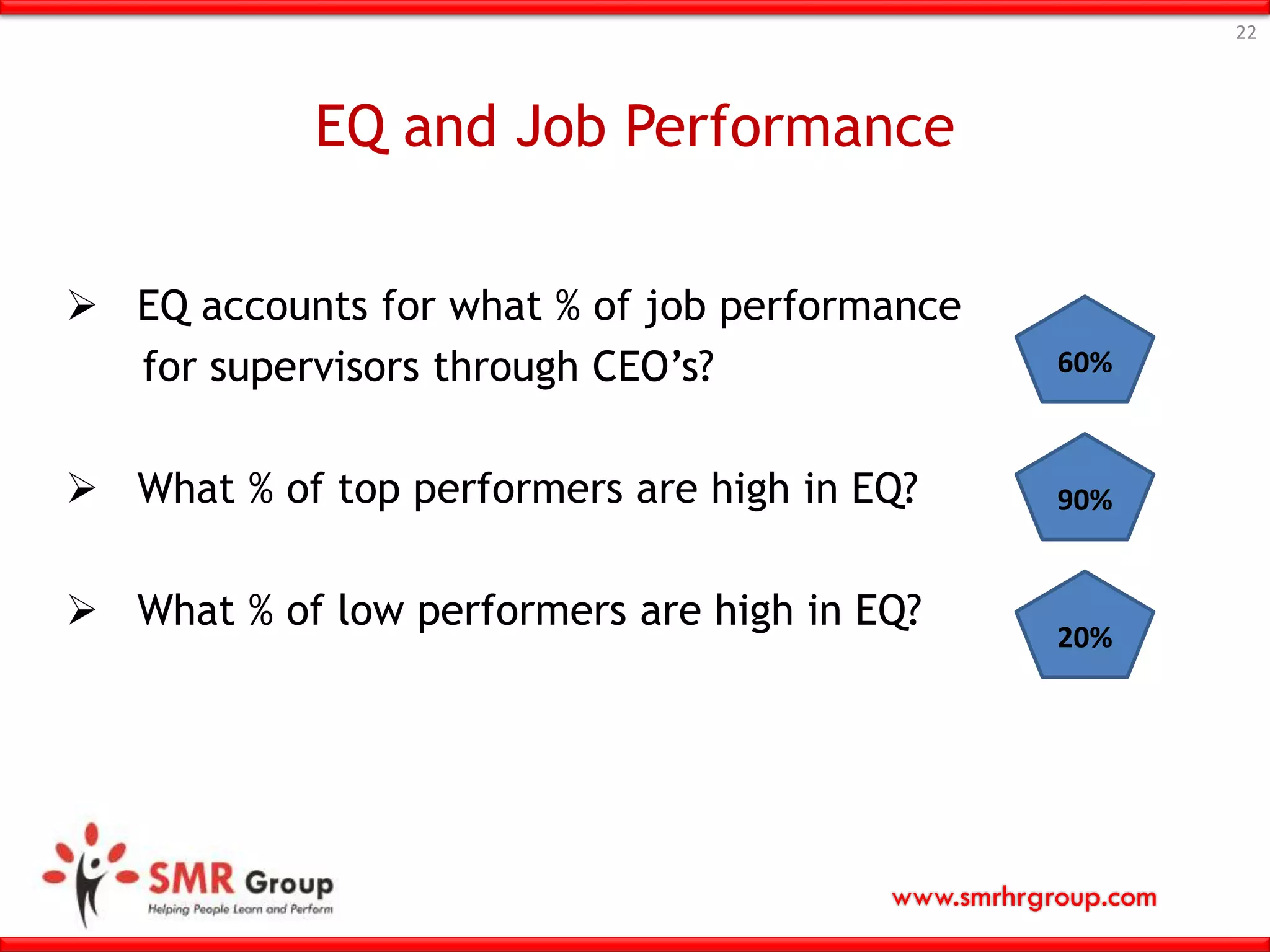
EQ and Job Performance
22
 EQ accounts for what % of job performance
for supervisors through CEO’s?
 What % of top performers are high in EQ?
 What % of low performers are high in EQ?
60%
90%
20%
www.smrhrgroup.com
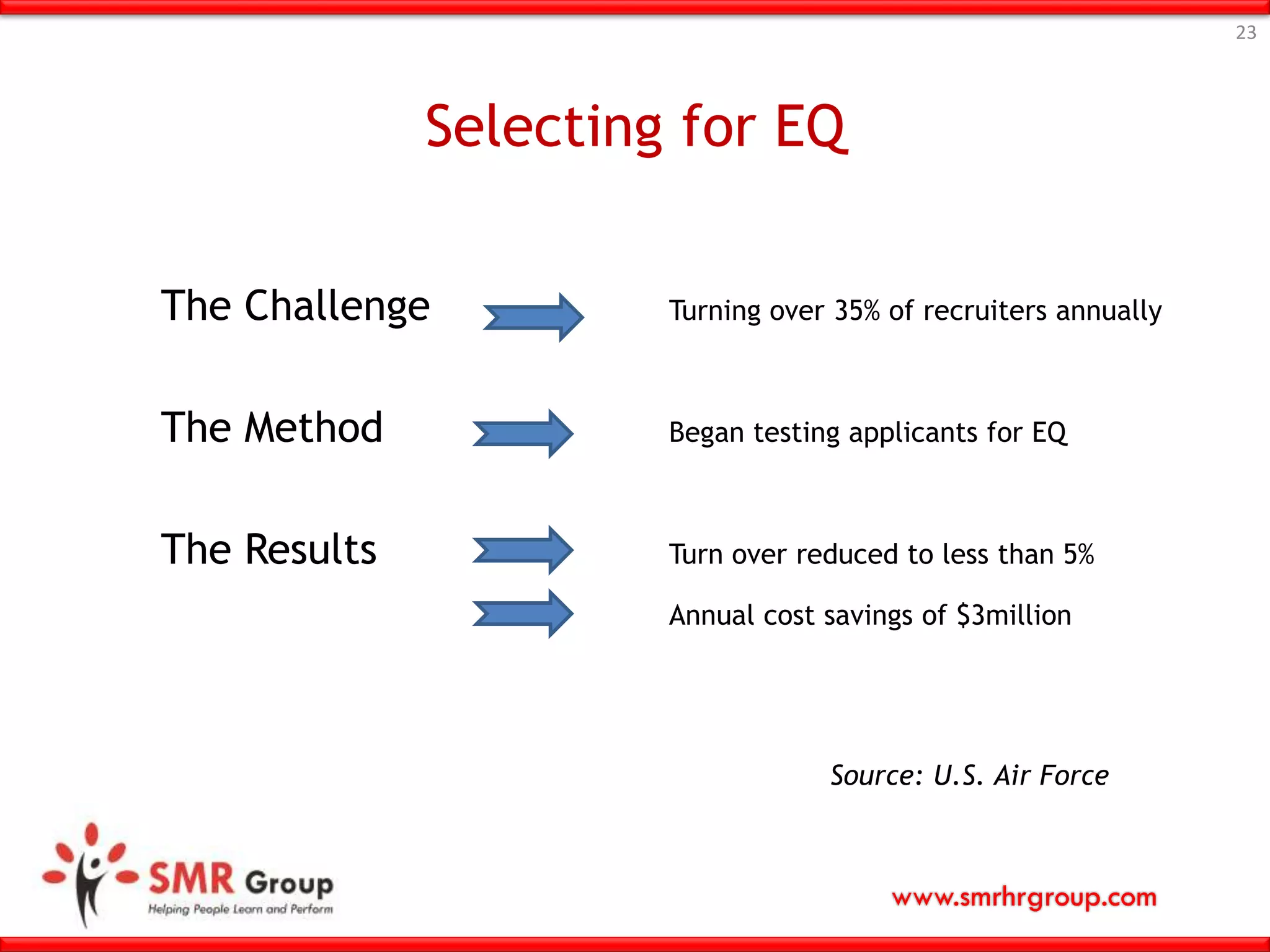
Selecting for EQ
23
The Challenge Turning over 35% of recruiters annually
The Method Began testing applicants for EQ
The Results Turn over reduced to less than 5%
Annual cost savings of $3million
Source: U.S. Air Force
www.smrhrgroup.com
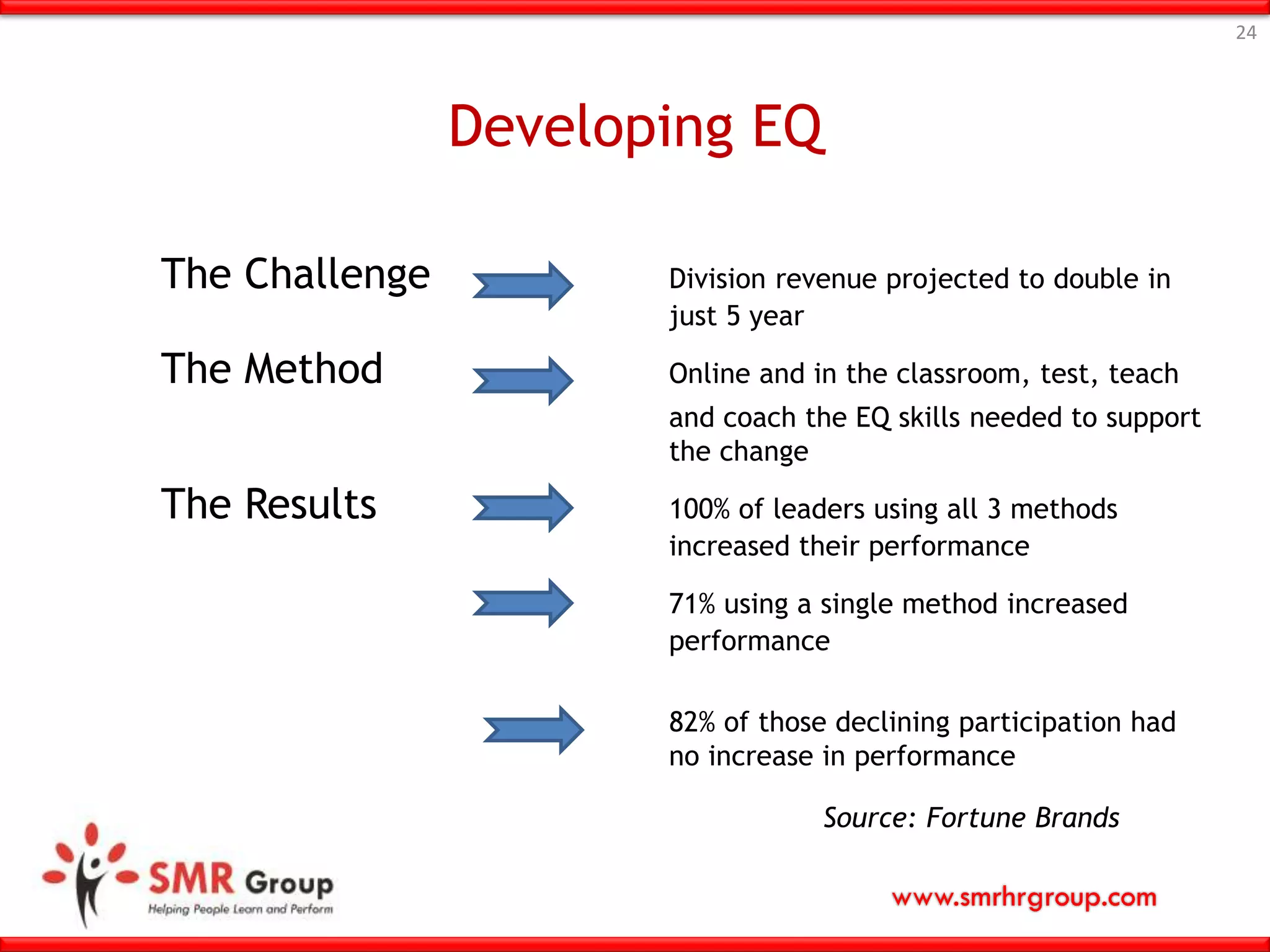
Developing EQ
24
The Challenge Division revenue projected to double in
just 5 year
The Method Online and in the classroom, test, teach
and coach the EQ skills needed to support
the change
The Results 100% of leaders using all 3 methods
increased their performance
71% using a single method increased
performance
82% of those declining participation had
no increase in performance
Source: Fortune Brands
www.smrhrgroup.com
A Final Thought…
“In the fields I have studied, emotional intelligence
is much more powerful than IQ in determining
who emerges as a leader. IQ is a threshold
competence. You need it, but it doesn’t make
you a star. Emotional intelligence can.”
25
Warren Bennis, author of On Becoming a Leader
www.smrhrgroup.com 26
Thank you
• www.smrhrgroup.com
• www.palan.org
• info@smrhrgroup.com
www.smrhrgroup.com

Emotional intelligence for linked in

  • 1.
    www.smrhrgroup.com “Emotions have taughtmankind to reason.” - Vauvenargues 1 Emotional Intelligence Helping People Learn & Perform
  • 2.
    www.smrhrgroup.com What is EmotionalIntelligence “Your ability to recognise and understand emotions, and your skill at using this awareness to manage yourself and your relationships with others.” Drs. Travis Bradberry and Jean Greaves, authors of The Emotional Intelligence Quick Book 2
  • 3.
    www.smrhrgroup.com 3 Emotional Intelligence •The Aristotle quote – Getting angry is okay so long as you get angry for the right reason with the right person to the right degree using the right words with the right tone of voice and appropriate language. www.smrhrgroup.com
  • 4.
    www.smrhrgroup.com 4 Smarts –Head and Heart • Redefining IQ – EQ – SQ • IQ – Modest contribution to life’s success, stable over time after a certain stage. • EQ – High contribution. Grows all the time. • Costs for the organisation - Emotional ineptitude • Superior performers - IQ follows EQ www.smrhrgroup.com
  • 5.
    www.smrhrgroup.com Applications • Organizational applications– Leadership, Talent development, Team work
  • 6.
    www.smrhrgroup.com Why is EQCritical Now?  Knowledge and relationships are the currency of the new economy  EQ links to job and bottom line performance  Changes in the “emotional” brain are possible  It always has been! 6
  • 7.
    www.smrhrgroup.com The Four EQSkills (Dan Goleman) 7 PERSONAL COMPETENCE SOCIAL COMPETENCE SELF- AWARENESS SELF – MANAGEMENT SOCIAL AWARENESS RELATIONSHIP MANAGEMENT What I see What I do
  • 8.
    www.smrhrgroup.com Self-Awareness is… 8 the abilityto accurately recognise your emotions as they happen and understand your general tendencies for responding to different people and situations. SELF- AWARENESS SELF- MANAGEMENT SOCIAL AWARENESS RELATIONSHIP MANAGEMENT
  • 9.
    www.smrhrgroup.com Knowing your Emotions Keepingtrack of your own emotions. Knowing why you think, feel and behave the way you do ( What are the emotions that are, for you, the most difficult to handle? Physical symptoms? What situation/ who sets off this negative emotion? ) --- THE SELF-AWARE, THE ENGULFED and THE ACCEPTING. Confidence in your self worth and capabilities. 9 www.smrhrgroup.com
  • 10.
    www.smrhrgroup.com 10 Self-Management is… using awarenessof your emotions to choose What you say and do, in order to positively direct your behaviour. SELF- AWARENESS SELF- MANAGEMENT SOCIAL AWARENESS RELATIONSHIP MANAGEMENT
  • 11.
    www.smrhrgroup.com Managing your Emotions MarshmallowTest. Self Control – Regulating your emotions. Delay of an impulse. Avoiding emotional explosion. Freedom to choose your own response. It is not so much what happens to us, but rather our own response that hurts us. 11 www.smrhrgroup.com
  • 12.
    www.smrhrgroup.com Managing your Emotions(cont) The way we see the problem is the problem. Standing apart and observing our own feeling, moods, and thoughts. Our greatest power is our freedom to choose our response. It is not what happens to us that hurts us. It is our response that hurts us. 12 www.smrhrgroup.com
  • 13.
    www.smrhrgroup.com Motivating Yourself Optimism –Ability to look at the brighter side of life and maintain positive attitude. Persistence in pursuing goals. Ability to get more out of life; have a positive job description. Contentment – Ability to enjoy oneself. Feel satisfied with one’s life. Pessimist ascribes failure to his / her limitations. Optimists tend to find reasons in external circumstances. 13 www.smrhrgroup.com
  • 14.
    www.smrhrgroup.com Motivating Yourself (Cont) Theelephant technique – Break large task into ‘bite-size’ pieces; schedule these as regular tasks of the day / week / month; Make sure you “eat” a bite every day beyond your routine tasks. Being a “maintenance” person Vs. being a “development” person. Visualizing your desired end results. 14 www.smrhrgroup.com
  • 15.
    www.smrhrgroup.com Social Awareness is… 15 recognisingand understanding the emotions and perspectives of others. SELF- AWARENESS SELF- MANAGEMENT SOCIAL AWARENESS RELATIONSHIP MANAGEMENT
  • 16.
    www.smrhrgroup.com Empathy Recognizing emotions inothers Caring / Accepting / Understanding Listening – 5 Levels Ignoring Pretending we are Listening Selective Listening Attentive Listening Empathic Listening 16 www.smrhrgroup.com
  • 17.
    www.smrhrgroup.com Relationship Management is… 17 usingawareness of your emotions and the emotions of others to manage interactions successfully. SELF- AWARENESS SELF- MANAGEMENT SOCIAL AWARENESS RELATIONSHIP MANAGEMENT
  • 18.
    www.smrhrgroup.com Social Skills Managing yourrelationships Making people a little better or a little worse Emotions are contagious. Do we spread ripples of good feeling? Make each other feel better? 18 www.smrhrgroup.com
  • 19.
    www.smrhrgroup.com Use EQ Skillsto… 19  Know yourself  Understand others  Make better decisions  See and seize opportunities  Identify problems before they escalate  Manage difficult situations and conversations
  • 20.
    www.smrhrgroup.com Action Implications Ways toRecover Change things that happen to you Change the way you look at things Change the way your mind / body reacts to it  Amygdale Short-circuit / Hijack Get out of negative cycle. Clam down. Think. Deescalate Understand yourself; find a model. Take time out. Choose appropriate response. Learn though repetition. 20 www.smrhrgroup.com
  • 21.
    www.smrhrgroup.com Action Implications (Cont) Openand fair communication with people to ensure that signals are not lost. Make your choice – What you want to achieve? What contribution you want to make? How you want to manage your time? How you would want to respond? 21 www.smrhrgroup.com
  • 22.
    www.smrhrgroup.com EQ and JobPerformance 22  EQ accounts for what % of job performance for supervisors through CEO’s?  What % of top performers are high in EQ?  What % of low performers are high in EQ? 60% 90% 20%
  • 23.
    www.smrhrgroup.com Selecting for EQ 23 TheChallenge Turning over 35% of recruiters annually The Method Began testing applicants for EQ The Results Turn over reduced to less than 5% Annual cost savings of $3million Source: U.S. Air Force
  • 24.
    www.smrhrgroup.com Developing EQ 24 The ChallengeDivision revenue projected to double in just 5 year The Method Online and in the classroom, test, teach and coach the EQ skills needed to support the change The Results 100% of leaders using all 3 methods increased their performance 71% using a single method increased performance 82% of those declining participation had no increase in performance Source: Fortune Brands
  • 25.
    www.smrhrgroup.com A Final Thought… “Inthe fields I have studied, emotional intelligence is much more powerful than IQ in determining who emerges as a leader. IQ is a threshold competence. You need it, but it doesn’t make you a star. Emotional intelligence can.” 25 Warren Bennis, author of On Becoming a Leader
  • 26.
    www.smrhrgroup.com 26 Thank you •www.smrhrgroup.com • www.palan.org • info@smrhrgroup.com www.smrhrgroup.com