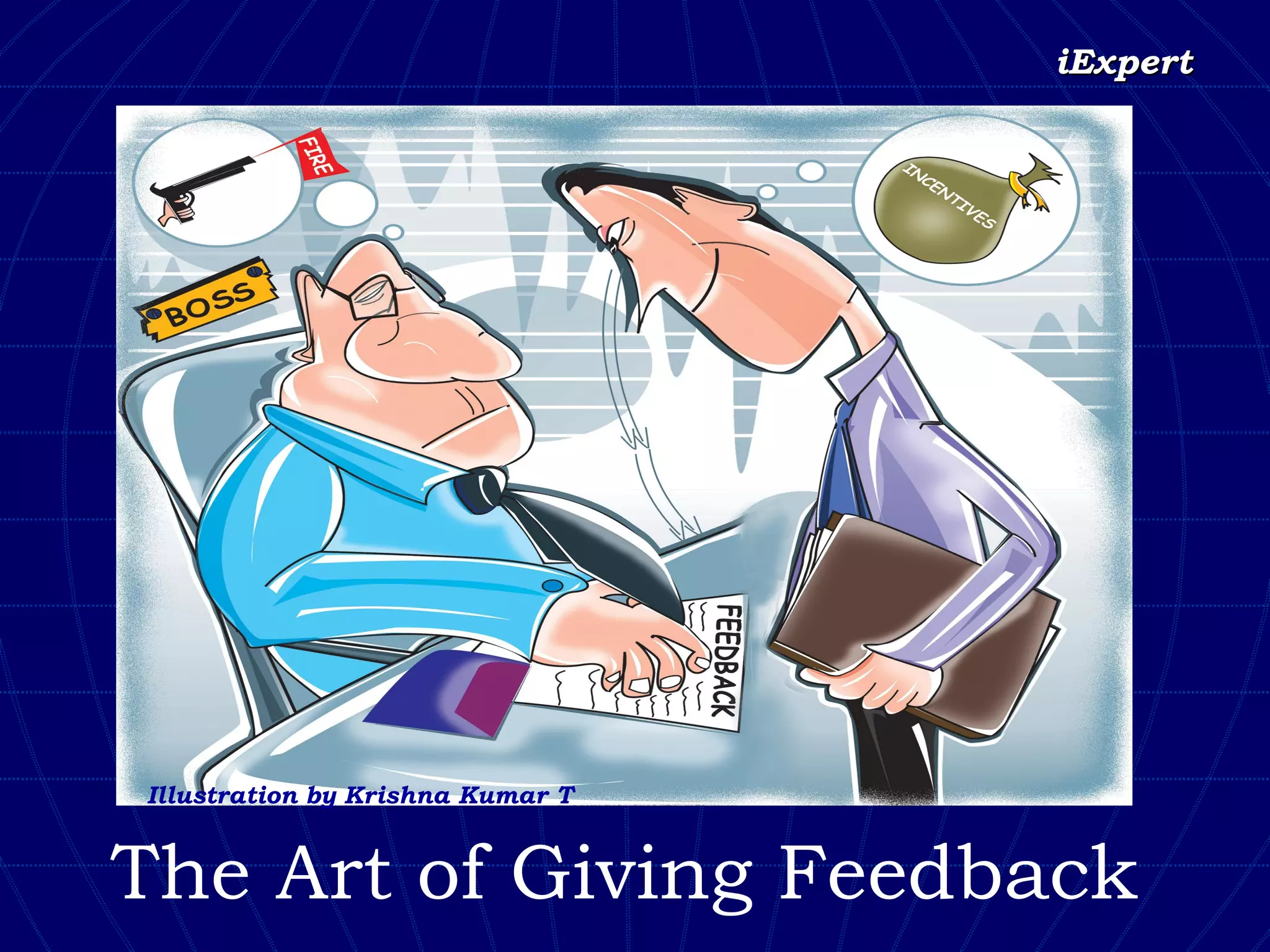
The Art of Giving Feedback Illustration by Krishna Kumar T
“ God grant me the serenity to accept the things I cannot change, the courage to change the things I can, And the wisdom to know the difference”
Constructive Feedback  Positive  Developmental Constructive  feedback improves Interpersonal relationships  Feedback must be honest , based on facts , observable behaviour Honesty promotes TRUST amongst groups Feedbacks are  results of perceptions. Before giving the Feedback one needs to prepare. This helps to bring Adult to Adult conversation.
Steps for Preparation Set SMART GOALS & Document This is done at the beginning of an assignment / year. This brings clarity & acceptance from the recipient too In case of changes – important to document the changes The Research work :  Few Questions to be addressed are  What Happened? What were the expectations? Why are we providing feedback? STEP I STEP II
What Happened? The challenge is to  LISTEN  rather than getting judgmental about WHAT the recipient is saying or HOW they are saying it. The focus therefore is on the “INTENT” rather than “STYLE”
What were the Expectations? Revisit the Goals  Helps to Bridge the Gaps Highlights areas of Improvement Helps to build on Strengths & prior success “ Accentuate the POSITIVE”  - The WHALE DONE approach
Why are we providing feedback? Must be done with utmost care & must not appear Casual Done to ensure continuous improvement in the performance  Help to motivate & strengthen the Positives Learning from past mistakes or failures and see the impact on the organization. Opportunity to work out actionables for future
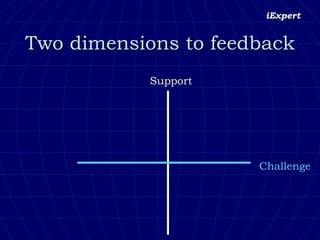
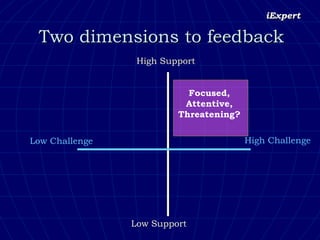
Two dimensions to feedback Challenge Support
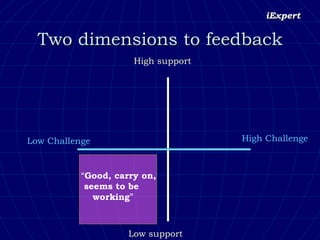
Two dimensions to feedback High Challenge High support Low support Low Challenge “ Good, carry on, seems to be  working ”
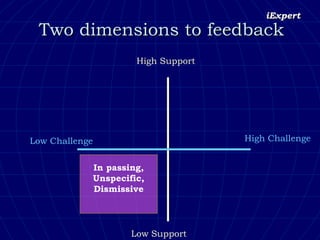
Two dimensions to feedback High Challenge High Support Low Support Low Challenge In passing, Unspecific, Dismissive
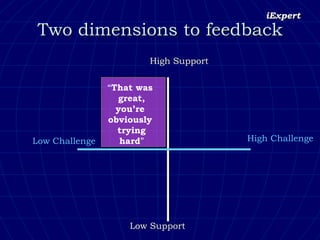
Two dimensions to feedback High Challenge High Support Low Support Low Challenge “ That was  great, you’re  obviously  trying hard ”
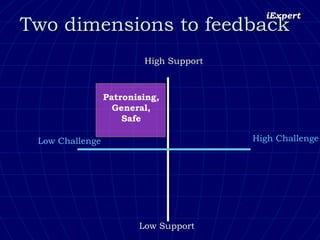
Two dimensions to feedback High Challenge High Support Low Support Low Challenge Patronising, General, Safe
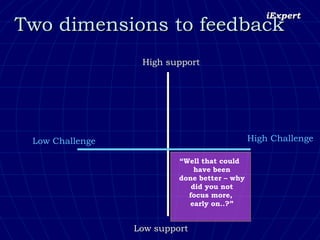
Two dimensions to feedback High Challenge High support Low support Low Challenge “ Well that could  have been done better – why did you not focus more,  early on..?”
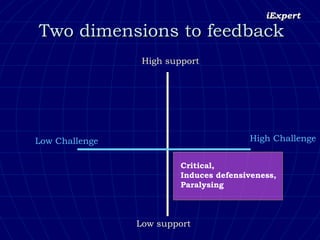
Two dimensions to feedback High Challenge High support Low support Low Challenge Critical, Induces defensiveness, Paralysing
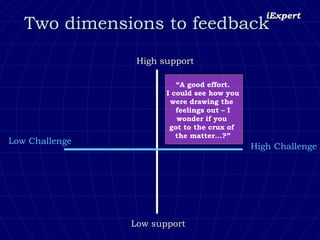
Two dimensions to feedback High Challenge High support Low support Low Challenge “ A good effort. I could see how you were drawing the  feelings out – I wonder if you  got to the crux of  the matter…?”
Two dimensions to feedback High Challenge High Support Low Support Low Challenge Focused, Attentive, Threatening?
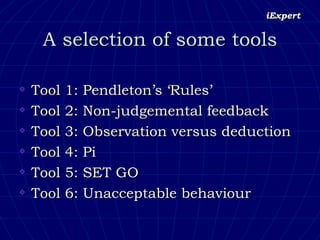
A selection of some tools Tool 1: Pendleton’s ‘Rules’ Tool 2: Non-judgemental feedback Tool 3: Observation versus deduction Tool 4: Pi Tool 5: SET GO Tool 6: Unacceptable behaviour
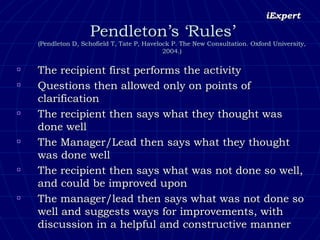
Pendleton’s ‘Rules’ (Pendleton D, Schofield T, Tate P, Havelock P. The New Consultation. Oxford University, 2004.) The recipient first performs the activity Questions then allowed only on points of clarification The recipient then says what they thought was done well The Manager/Lead then says what they thought was done well The recipient then says what was not done so well, and could be improved upon The manager/lead then says what was not done so well and suggests ways for improvements, with discussion in a helpful and constructive manner
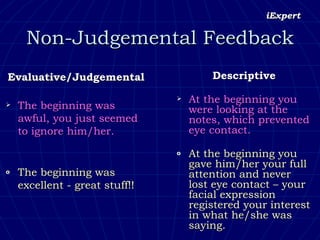
Non-Judgemental Feedback Evaluative/Judgemental The beginning was awful, you just seemed to ignore him/her. The beginning was excellent - great stuff!! Descriptive At the beginning you were looking at the notes, which prevented eye contact. At the beginning you gave him/her your full attention and never lost eye contact – your facial expression registered your interest in what he/she was saying.
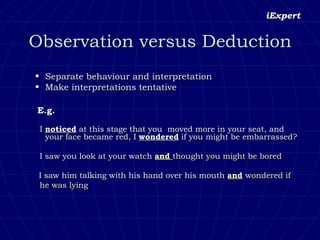
Observation versus Deduction Separate behaviour and interpretation Make interpretations tentative E.g.   I  noticed  at this stage that you  moved more in your seat, and your face became red, I  wondered  if you might be embarrassed?   I saw you look at your watch  and  thought you might be bored   I saw him talking with his hand over his mouth  and   wondered if  he was lying
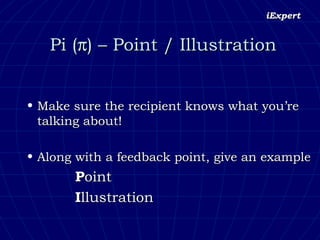
Pi (  ) – Point / Illustration Make sure the recipient knows what you’re talking about! Along with a feedback point, give an example P oint I llustration
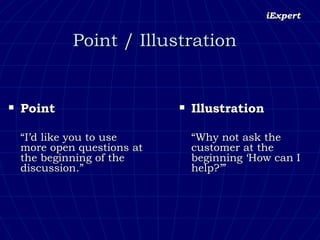
Point / Illustration Point “ I’d like you to use more open questions at the beginning of the discussion.” Illustration “ Why not ask the customer at the beginning ‘How can I help?’”
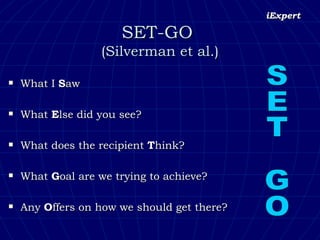
SET-GO  (Silverman et al.) What I  S aw What  E lse did you see?  What does the recipient  T hink?  What  G oal are we trying to achieve?  Any  O ffers on how we should get there? SET GO
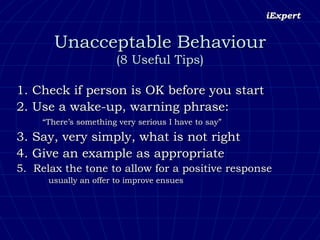
Unacceptable Behaviour (8 Useful Tips) 1. Check if person is OK before you start 2. Use a wake-up, warning phrase: “ There’s something very serious I have to say” 3. Say, very simply, what is not right 4. Give an example as appropriate 5.  Relax the tone to allow for a positive response  usually an offer to improve ensues
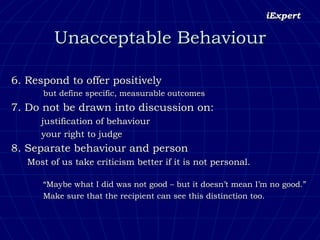
6. Respond to offer positively  but define specific, measurable outcomes 7. Do not be drawn into discussion on:  justification of behaviour  your right to judge 8. Separate behaviour and person   Most of us take criticism better if it is not personal. “ Maybe what I did was not good – but it doesn’t mean I’m no good.” Make sure that the recipient can see this distinction too. Unacceptable Behaviour
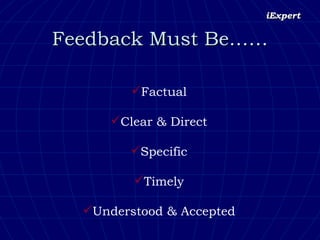
Feedback Must Be…… Factual Clear & Direct Specific Timely Understood & Accepted
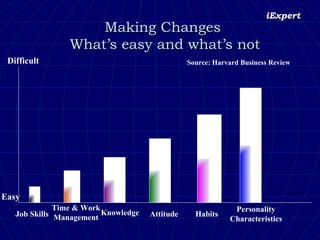
Making Changes  What’s easy and what’s not Difficult Easy Job Skills Time & Work Management Knowledge Attitude Habits Personality Characteristics Source: Harvard Business Review
Consequences of Poor  or  No Feedback………………. Poor performance is repeated Quality goes down Associates don’t improve and learn Associates may become anxious and uncertain Managers lose credibility Productivity goes down Star performers become discouraged
Some complaints about Feedback… Not enough feedback Too much feedback Too much negative feedback, not enough positive Unfair feedback (jumps to conclusions) Vague feedback (a look, a comment like “why did you do it that way?”) Too hurried or rushed Feedback too long after the event (happened months ago)
Write in at contactiexpert@gmail.com Hope you find this useful &  easy to read

Feedback The Art And Science

  • 1.
    The Art ofGiving Feedback Illustration by Krishna Kumar T
  • 2.
    “ God grantme the serenity to accept the things I cannot change, the courage to change the things I can, And the wisdom to know the difference”
  • 3.
    Constructive Feedback Positive Developmental Constructive feedback improves Interpersonal relationships Feedback must be honest , based on facts , observable behaviour Honesty promotes TRUST amongst groups Feedbacks are results of perceptions. Before giving the Feedback one needs to prepare. This helps to bring Adult to Adult conversation.
  • 4.
    Steps for PreparationSet SMART GOALS & Document This is done at the beginning of an assignment / year. This brings clarity & acceptance from the recipient too In case of changes – important to document the changes The Research work : Few Questions to be addressed are What Happened? What were the expectations? Why are we providing feedback? STEP I STEP II
  • 5.
    What Happened? Thechallenge is to LISTEN rather than getting judgmental about WHAT the recipient is saying or HOW they are saying it. The focus therefore is on the “INTENT” rather than “STYLE”
  • 6.
    What were theExpectations? Revisit the Goals Helps to Bridge the Gaps Highlights areas of Improvement Helps to build on Strengths & prior success “ Accentuate the POSITIVE” - The WHALE DONE approach
  • 7.
    Why are weproviding feedback? Must be done with utmost care & must not appear Casual Done to ensure continuous improvement in the performance Help to motivate & strengthen the Positives Learning from past mistakes or failures and see the impact on the organization. Opportunity to work out actionables for future
  • 8.
    Two dimensions tofeedback Challenge Support
  • 9.
    Two dimensions tofeedback High Challenge High support Low support Low Challenge “ Good, carry on, seems to be working ”
  • 10.
    Two dimensions tofeedback High Challenge High Support Low Support Low Challenge In passing, Unspecific, Dismissive
  • 11.
    Two dimensions tofeedback High Challenge High Support Low Support Low Challenge “ That was great, you’re obviously trying hard ”
  • 12.
    Two dimensions tofeedback High Challenge High Support Low Support Low Challenge Patronising, General, Safe
  • 13.
    Two dimensions tofeedback High Challenge High support Low support Low Challenge “ Well that could have been done better – why did you not focus more, early on..?”
  • 14.
    Two dimensions tofeedback High Challenge High support Low support Low Challenge Critical, Induces defensiveness, Paralysing
  • 15.
    Two dimensions tofeedback High Challenge High support Low support Low Challenge “ A good effort. I could see how you were drawing the feelings out – I wonder if you got to the crux of the matter…?”
  • 16.
    Two dimensions tofeedback High Challenge High Support Low Support Low Challenge Focused, Attentive, Threatening?
  • 17.
    A selection ofsome tools Tool 1: Pendleton’s ‘Rules’ Tool 2: Non-judgemental feedback Tool 3: Observation versus deduction Tool 4: Pi Tool 5: SET GO Tool 6: Unacceptable behaviour
  • 18.
    Pendleton’s ‘Rules’ (PendletonD, Schofield T, Tate P, Havelock P. The New Consultation. Oxford University, 2004.) The recipient first performs the activity Questions then allowed only on points of clarification The recipient then says what they thought was done well The Manager/Lead then says what they thought was done well The recipient then says what was not done so well, and could be improved upon The manager/lead then says what was not done so well and suggests ways for improvements, with discussion in a helpful and constructive manner
  • 19.
    Non-Judgemental Feedback Evaluative/JudgementalThe beginning was awful, you just seemed to ignore him/her. The beginning was excellent - great stuff!! Descriptive At the beginning you were looking at the notes, which prevented eye contact. At the beginning you gave him/her your full attention and never lost eye contact – your facial expression registered your interest in what he/she was saying.
  • 20.
    Observation versus DeductionSeparate behaviour and interpretation Make interpretations tentative E.g. I noticed at this stage that you moved more in your seat, and your face became red, I wondered if you might be embarrassed? I saw you look at your watch and thought you might be bored I saw him talking with his hand over his mouth and wondered if he was lying
  • 21.
    Pi ( ) – Point / Illustration Make sure the recipient knows what you’re talking about! Along with a feedback point, give an example P oint I llustration
  • 22.
    Point / IllustrationPoint “ I’d like you to use more open questions at the beginning of the discussion.” Illustration “ Why not ask the customer at the beginning ‘How can I help?’”
  • 23.
    SET-GO (Silvermanet al.) What I S aw What E lse did you see? What does the recipient T hink? What G oal are we trying to achieve? Any O ffers on how we should get there? SET GO
  • 24.
    Unacceptable Behaviour (8Useful Tips) 1. Check if person is OK before you start 2. Use a wake-up, warning phrase: “ There’s something very serious I have to say” 3. Say, very simply, what is not right 4. Give an example as appropriate 5. Relax the tone to allow for a positive response usually an offer to improve ensues
  • 25.
    6. Respond tooffer positively but define specific, measurable outcomes 7. Do not be drawn into discussion on: justification of behaviour your right to judge 8. Separate behaviour and person Most of us take criticism better if it is not personal. “ Maybe what I did was not good – but it doesn’t mean I’m no good.” Make sure that the recipient can see this distinction too. Unacceptable Behaviour
  • 26.
    Feedback Must Be……Factual Clear & Direct Specific Timely Understood & Accepted
  • 27.
    Making Changes What’s easy and what’s not Difficult Easy Job Skills Time & Work Management Knowledge Attitude Habits Personality Characteristics Source: Harvard Business Review
  • 28.
    Consequences of Poor or No Feedback………………. Poor performance is repeated Quality goes down Associates don’t improve and learn Associates may become anxious and uncertain Managers lose credibility Productivity goes down Star performers become discouraged
  • 29.
    Some complaints aboutFeedback… Not enough feedback Too much feedback Too much negative feedback, not enough positive Unfair feedback (jumps to conclusions) Vague feedback (a look, a comment like “why did you do it that way?”) Too hurried or rushed Feedback too long after the event (happened months ago)
  • 30.
    Write in atcontactiexpert@gmail.com Hope you find this useful & easy to read