PRESENTATION ON EMOTIONAL
INTELLIGENCE
Submitted By:
Rajpal Kaur
Um10506
ECE
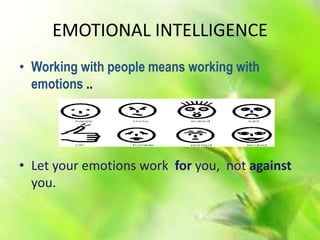
EMOTIONAL INTELLIGENCE
• Working with people means working with
emotions ..
• Let your emotions work for you, not against
you.
What is Emotional Intelligence?
• Ability to identify, assess and control emotions
of oneself , of others and of groups.
• (Salovey and Mayer 1990) defined EI as a
form of social intelligence that involves the
ability to monitor one's own and others'
feelings and emotions, to discriminate among
them, and to use this information to guide
one's thinking and action.
EI as related to mental abilities
• The ability to recognize emotion/Perception of
emotion.
• The ability to access and generate emotions so
as to assist thought process
• The ability to Understanding emotions/aware
of emotion
• The ability to Managing emotions
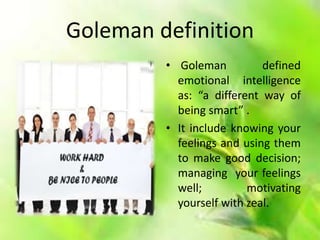
Goleman definition
• Goleman defined
emotional intelligence
as: “a different way of
being smart” .
• It include knowing your
feelings and using them
to make good decision;
managing your feelings
well; motivating
yourself with zeal.
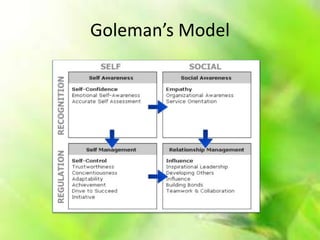
Goleman’s Model
Self Awareness:
The Core of Emotional Intelligence
• Leaders who are self-aware know their
strengths and limitations
• They have the ability to stay true to their
own feelings, values, and vision.
• Also known as realistic self-assessment
• These leaders are also aware of areas that
need improvement and make continuous
improvement a priority in their lives.
Self Management
• Leaders who manage their emotions well have
the ability to remain optimistic and to maintain
self control.
• They find ways to manage negative emotions and
impulses and to persist in seeking goals despite of
obstacles and setbacks.
• Achievement: The drive to improve performance
to meet inner standards of excellence
• Initiative: Readiness to act and seize opportunities
• Optimism: Seeing the upside in events
Social awareness
• Empathy: Sensing others' emotions,
understanding their perspective, and taking
active interest in their concerns
• Organizational awareness: Reading the
currents, decision networks, and politics at the
organizational level
• Service: Recognizing and meeting follower,
client, or customer needs
Relationship management
(or social skills)
• Inspirational leadership: Guiding and motivating with a compelling vision
• Developing others: Bolstering others' abilities through feedback and guidance
• Change catalyst: Initiating, managing, and leading in a new direction
• Conflict management: Resolving disagreements
• Building bonds: Cultivating and maintaining a web of relationships
• Teamwork and collaboration: Cooperation and team building
• A star leader will show people she appreciates them while giving them a
consistent stream of positive and constructive performance feedback and
praise.
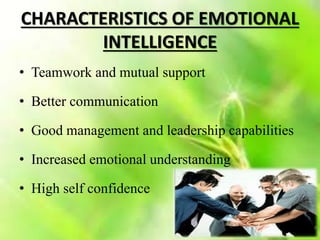
CHARACTERISTICS OF EMOTIONAL
INTELLIGENCE
• Teamwork and mutual support
• Better communication
• Good management and leadership capabilities
• Increased emotional understanding
• High self confidence
IQ & EQ
• IQ scores may predict a person’s success in
the classroom but do not necessarily predict
success in occupational or personal pursuits.
EQ & IQ DIFFERENCE
• According to bourey and Miller, “EQ and IQ are distinctive
yet complementary forms of our overall intelligence. while
people need a certain baseline of IQ to perform well at job
but rest is EQ that differentiates outstanding teams leaders
organizations from others.”
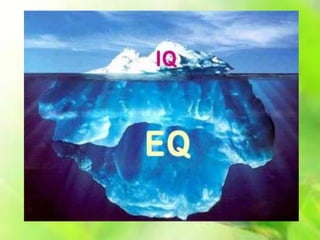
• It is increasingly recognized that IQ may account for about
20 per cent of an individual’s success in life. The remaining
80 per cent depends largely on his emotional intelligence.
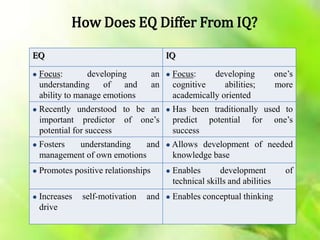
How Does EQ Differ From IQ?
EQ IQ
 Focus: developing an
understanding of and an
ability to manage emotions
 Focus: developing one’s
cognitive abilities; more
academically oriented
 Recently understood to be an
important predictor of one’s
potential for success
 Has been traditionally used to
predict potential for one’s
success
 Fosters understanding and
management of own emotions
 Allows development of needed
knowledge base
 Promotes positive relationships  Enables development of
technical skills and abilities
 Increases self-motivation and
drive
 Enables conceptual thinking
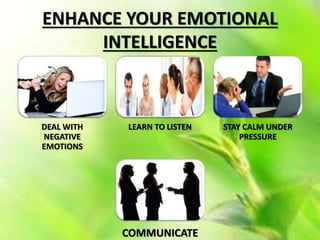
ENHANCE YOUR EMOTIONAL
INTELLIGENCE
DEAL WITH
NEGATIVE
EMOTIONS
LEARN TO LISTEN STAY CALM UNDER
PRESSURE
COMMUNICATE
HOW TO INCREASE BRAIN POWER?
• Breath deep
• Meditate
• Use dead time
• Learn a language
• Sleep better
• Develop your creativity
• Brain exercises
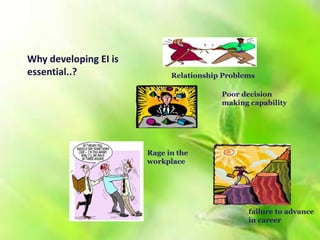
Why developing EI is
essential..? Relationship Problems
Poor decision
making capability
Rage in the
workplace
failure to advance
in career
WHY EMOTIONAL INTELLIGENCE
IS NECESSARY
• Helps to handle adversity and set back.
• Help to manage effective relationship.
• Emotional intelligence is also very useful in
leadership purpose.
• Teaches employees cope with change.
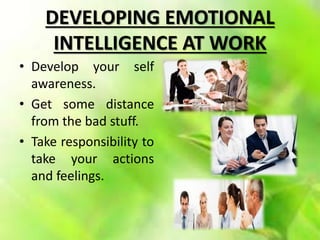
DEVELOPING EMOTIONAL
INTELLIGENCE AT WORK
• Develop your self
awareness.
• Get some distance
from the bad stuff.
• Take responsibility to
take your actions
and feelings.
BENEFITS OF EMOTIONAL
INTELLIGENCE
• Build safety and trust.
• Capture the attention and interest of others.
• Respond to others with empathy and
compassion.
• Resolve conflict and repair wounded feelings.
• Be more creative.
• How to deal in difficult situations then taking the
decision that will benefit both parts in situation
of conflicts.
Emotional Intelligence in Teams
• Collaboration replaces competitiveness
• After all, if you are on the same team, why would you want to
operate against each other? A team that has high EQ acknowledges
the importance of individual and collective moods, emotions, and
relationships. A good team leader is important, but it is critical that
all team members recognize the wisdom of collaboration
• Higher productivity
• Improved morale
• Increased employee tenure
• Increased job satisfaction
• Job and company engagement
• Better communication
• Effective communication outside of the team
10 ACTIVITIES TO IMPROVE
EMOTIONAL INTELLIGENCE
• The listener
must take
care to
attend to the
speaker fully.
LEARN TO
LISTEN
• “Life is
change.
Growth is
optional.
Choose
wisely”
ADAPTIVE
• “Our greatest
glory in not in
never failing,
but in rising
up every time
we fail”
NEVER
GIVE UP
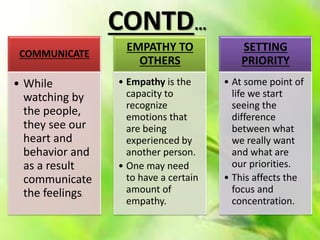
CONTD…
COMMUNICATE
• While
watching by
the people,
they see our
heart and
behavior and
as a result
communicate
the feelings.
EMPATHY TO
OTHERS
• Empathy is the
capacity to
recognize
emotions that
are being
experienced by
another person.
• One may need
to have a certain
amount of
empathy.
SETTING
PRIORITY
• At some point of
life we start
seeing the
difference
between what
we really want
and what are
our priorities.
• This affects the
focus and
concentration.
CONTD..
GO WITH
EXTRA MILE
FORGIVENESS LIVING IN
DIFFERENT
KEEP SMILE
John Poirier, Ed.D.
www.poirierassociates.com
26
Conclusion
• Emotional Intelligence is critical aspect in
leadership and individual effectiveness
• EI is made up of competencies that can be
observed, assessed, learned and developed
• Being intelligent about emotions means that
we can perceive and use emotions to create
optimal relationships and produce desired
outcomes.

emotional intelligence

  • 1.
  • 2.
    EMOTIONAL INTELLIGENCE • Workingwith people means working with emotions .. • Let your emotions work for you, not against you.
  • 3.
    What is EmotionalIntelligence? • Ability to identify, assess and control emotions of oneself , of others and of groups. • (Salovey and Mayer 1990) defined EI as a form of social intelligence that involves the ability to monitor one's own and others' feelings and emotions, to discriminate among them, and to use this information to guide one's thinking and action.
  • 4.
    EI as relatedto mental abilities • The ability to recognize emotion/Perception of emotion. • The ability to access and generate emotions so as to assist thought process • The ability to Understanding emotions/aware of emotion • The ability to Managing emotions
  • 5.
    Goleman definition • Golemandefined emotional intelligence as: “a different way of being smart” . • It include knowing your feelings and using them to make good decision; managing your feelings well; motivating yourself with zeal.
  • 6.
  • 7.
    Self Awareness: The Coreof Emotional Intelligence • Leaders who are self-aware know their strengths and limitations • They have the ability to stay true to their own feelings, values, and vision. • Also known as realistic self-assessment • These leaders are also aware of areas that need improvement and make continuous improvement a priority in their lives.
  • 8.
    Self Management • Leaderswho manage their emotions well have the ability to remain optimistic and to maintain self control. • They find ways to manage negative emotions and impulses and to persist in seeking goals despite of obstacles and setbacks. • Achievement: The drive to improve performance to meet inner standards of excellence • Initiative: Readiness to act and seize opportunities • Optimism: Seeing the upside in events
  • 9.
    Social awareness • Empathy:Sensing others' emotions, understanding their perspective, and taking active interest in their concerns • Organizational awareness: Reading the currents, decision networks, and politics at the organizational level • Service: Recognizing and meeting follower, client, or customer needs
  • 10.
    Relationship management (or socialskills) • Inspirational leadership: Guiding and motivating with a compelling vision • Developing others: Bolstering others' abilities through feedback and guidance • Change catalyst: Initiating, managing, and leading in a new direction • Conflict management: Resolving disagreements • Building bonds: Cultivating and maintaining a web of relationships • Teamwork and collaboration: Cooperation and team building • A star leader will show people she appreciates them while giving them a consistent stream of positive and constructive performance feedback and praise.
  • 11.
    CHARACTERISTICS OF EMOTIONAL INTELLIGENCE •Teamwork and mutual support • Better communication • Good management and leadership capabilities • Increased emotional understanding • High self confidence
  • 12.
    IQ & EQ •IQ scores may predict a person’s success in the classroom but do not necessarily predict success in occupational or personal pursuits.
  • 13.
    EQ & IQDIFFERENCE • According to bourey and Miller, “EQ and IQ are distinctive yet complementary forms of our overall intelligence. while people need a certain baseline of IQ to perform well at job but rest is EQ that differentiates outstanding teams leaders organizations from others.” • It is increasingly recognized that IQ may account for about 20 per cent of an individual’s success in life. The remaining 80 per cent depends largely on his emotional intelligence.
  • 15.
    How Does EQDiffer From IQ? EQ IQ  Focus: developing an understanding of and an ability to manage emotions  Focus: developing one’s cognitive abilities; more academically oriented  Recently understood to be an important predictor of one’s potential for success  Has been traditionally used to predict potential for one’s success  Fosters understanding and management of own emotions  Allows development of needed knowledge base  Promotes positive relationships  Enables development of technical skills and abilities  Increases self-motivation and drive  Enables conceptual thinking
  • 16.
    ENHANCE YOUR EMOTIONAL INTELLIGENCE DEALWITH NEGATIVE EMOTIONS LEARN TO LISTEN STAY CALM UNDER PRESSURE COMMUNICATE
  • 17.
    HOW TO INCREASEBRAIN POWER? • Breath deep • Meditate • Use dead time • Learn a language • Sleep better • Develop your creativity • Brain exercises
  • 18.
    Why developing EIis essential..? Relationship Problems Poor decision making capability Rage in the workplace failure to advance in career
  • 19.
    WHY EMOTIONAL INTELLIGENCE ISNECESSARY • Helps to handle adversity and set back. • Help to manage effective relationship. • Emotional intelligence is also very useful in leadership purpose. • Teaches employees cope with change.
  • 20.
    DEVELOPING EMOTIONAL INTELLIGENCE ATWORK • Develop your self awareness. • Get some distance from the bad stuff. • Take responsibility to take your actions and feelings.
  • 21.
    BENEFITS OF EMOTIONAL INTELLIGENCE •Build safety and trust. • Capture the attention and interest of others. • Respond to others with empathy and compassion. • Resolve conflict and repair wounded feelings. • Be more creative. • How to deal in difficult situations then taking the decision that will benefit both parts in situation of conflicts.
  • 22.
    Emotional Intelligence inTeams • Collaboration replaces competitiveness • After all, if you are on the same team, why would you want to operate against each other? A team that has high EQ acknowledges the importance of individual and collective moods, emotions, and relationships. A good team leader is important, but it is critical that all team members recognize the wisdom of collaboration • Higher productivity • Improved morale • Increased employee tenure • Increased job satisfaction • Job and company engagement • Better communication • Effective communication outside of the team
  • 23.
    10 ACTIVITIES TOIMPROVE EMOTIONAL INTELLIGENCE • The listener must take care to attend to the speaker fully. LEARN TO LISTEN • “Life is change. Growth is optional. Choose wisely” ADAPTIVE • “Our greatest glory in not in never failing, but in rising up every time we fail” NEVER GIVE UP
  • 24.
    CONTD… COMMUNICATE • While watching by thepeople, they see our heart and behavior and as a result communicate the feelings. EMPATHY TO OTHERS • Empathy is the capacity to recognize emotions that are being experienced by another person. • One may need to have a certain amount of empathy. SETTING PRIORITY • At some point of life we start seeing the difference between what we really want and what are our priorities. • This affects the focus and concentration.
  • 25.
    CONTD.. GO WITH EXTRA MILE FORGIVENESSLIVING IN DIFFERENT KEEP SMILE
  • 26.
    John Poirier, Ed.D. www.poirierassociates.com 26 Conclusion •Emotional Intelligence is critical aspect in leadership and individual effectiveness • EI is made up of competencies that can be observed, assessed, learned and developed • Being intelligent about emotions means that we can perceive and use emotions to create optimal relationships and produce desired outcomes.