Aditya DixitMHRM(2010-12)IIT KharagpurEQ CASE Study
What is EQ?the ability to use emotions effectively.measurable, learnable skill.has twice the power of IQ to predict performance. makes a significant impact on organizational performance.assist in engaging people, influencing across boundaries and cultures, being proactive, caring for customers, building enduring sales relationships, and creating workplaces where people can excel.
EQ definitionEmotional intelligence is the ability to perceive emotions, to access and generate emotions so as to assist thought, to understand emotions and emotional knowledge, and to reflectively regulate emotions so as to promote emotional and intellectual growth.  Mayer & Salovey, 1973
EQ ResearchFirst article published in 1997 in HBR by psychologist and author Daniel Goleman.“"In hard times, the soft stuff often goes away. But emotional intelligence, it turns out, isn't so soft.”“Emotional intelligence isn't a luxury you can dispense with in tough times. It's a basic tool that, deployed with finesse, is the key to professional success”

Benefits of higher EQyield significantly higher productivity, retention, and profitability, and emotional intelligence appears key to this competitive advantage.using EQ in training and organizational climate change can reduce costs associated with turnover, absenteeism, and low performance. At Pepsico, EQ competencies generated 10% more productivity.
Biology of Feelingsemotional intelligence comes from grounding in rigorous science.when emotional intelligence is working – people are able to self-regulate their feelings and reduce the kind of reactivity that otherwise escalates into counter-productivity.Emotion can lead to our worst decisions or our best ones: The difference is emotional intelligence.”
Some implementation strategiesincreased sales performance through recruiting and training more emotionally intelligent salespeople.improved customer service through recruiting higher EQ customer service reps.superior leadership performance by developing and recruiting for executive EQ.
Sales and Customer Loyalty: The Customer Perspective To attract and retain customers, companies must create loyal customers, organizations must endeavour for "customer delight.“Emotional intelligence is at the core of relationships, and a sales maxim is that "relationships are everything.“At L’Oreal salespeople selected on the basis of emotional competence sold $91,370 more than other salespeople.
Findings of Bass Brewers in the UKThose with higher self-ratings on emotional intelligence tended to have higher overall performance. Those with higher emotional intelligence self-ratings also tended to  perform better on product distribution, the number of new accounts sold, and employee promotions earned.Where manager-ratings were higher, employees tended to have overall higher performance and a larger number of new accounts sold.
Employee Performance and Retention: The Internal Business Perspectivehigher EQ leaders build a workplace environment where team members can excel, and higher EQ team members use their business strengths more effectively and excel as star performers."Emotional competence is the single most important personal quality that each of us must develop and access to experience a breakthrough."
International Petroleum Corporationa 2006 study to find out how important is EQ in distinguishing high performers.participants more frequently identify emotional intelligence factors than expertise and cognitive factorsof the 10 most commonly cited performance factors, the seven items categorized as reflecting emotionally intelligent behaviours were identified 44% of the time.
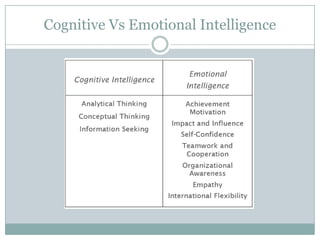
Cognitive Vs Emotional Intelligence
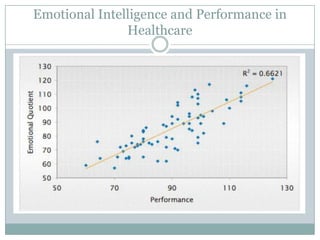
Emotional Intelligence and Performance in Healthcare
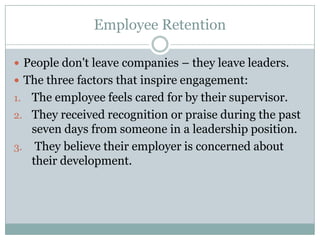
Employee RetentionPeople don't leave companies – they leave leaders.The three factors that inspire engagement:The employee feels cared for by their supervisor.They received recognition or praise during the past seven days from someone in a leadership position.They believe their employer is concerned about their development.
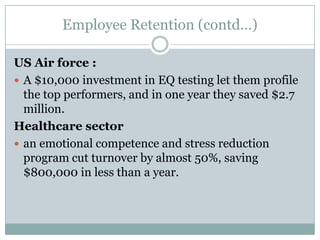
Employee Retention (contd…)US Air force :A $10,000 investment in EQ testing let them profile the top performers, and in one year they saved $2.7 million.Healthcare sectoran emotional competence and stress reduction program cut turnover by almost 50%, saving $800,000 in less than a year.
Leadership and Financial Performance:The Bottom Line Perspective“No doubt emotional intelligence is more rare than book smarts, but my experience says it is actually more important in the making of a leader. You just can't ignore it.”Jack WelshIn real organizations today, leaders face a much more complex challenge of inspiration.Emotional competence differentiates successful leaders.
Leadership and Financial Performance:The Bottom Line Perspective(contd)Leaders who use their emotional resources to foster "engagement are :50% more likely to have lower turnover56% more likely to have higher-than-average customer loyalty.38% more likely to have above-average productivity.27% more likely to report higher profitability
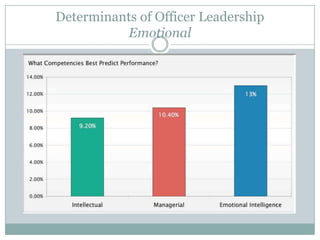
Determinants of Officer LeadershipEmotional
Findings at PepsicoLink between EQ and leadership10% increase in productivity.87% decrease in executive turnover ($4m).$3.75m added economic value.over 1000% return on investment
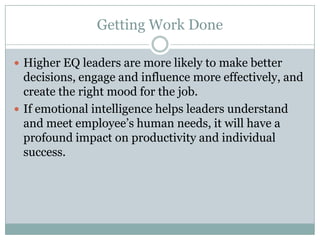
Getting Work DoneHigher EQ leaders are more likely to make better decisions, engage and influence more effectively, and create the right mood for the job.If emotional intelligence helps leaders understand and meet employee’s human needs, it will have a profound impact on productivity and individual success.
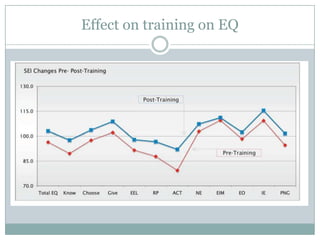
Effect on training on EQ
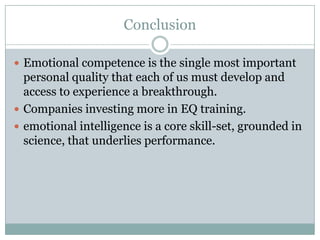
ConclusionEmotional competence is the single most important personal quality that each of us must develop and access to experience a breakthrough.Companies investing more in EQ training.emotional intelligence is a core skill-set, grounded in science, that underlies performance.
Thank You

Eq case study

  • 1.
  • 2.
    What is EQ?theability to use emotions effectively.measurable, learnable skill.has twice the power of IQ to predict performance. makes a significant impact on organizational performance.assist in engaging people, influencing across boundaries and cultures, being proactive, caring for customers, building enduring sales relationships, and creating workplaces where people can excel.
  • 3.
    EQ definitionEmotional intelligenceis the ability to perceive emotions, to access and generate emotions so as to assist thought, to understand emotions and emotional knowledge, and to reflectively regulate emotions so as to promote emotional and intellectual growth. Mayer & Salovey, 1973
  • 4.
    EQ ResearchFirst articlepublished in 1997 in HBR by psychologist and author Daniel Goleman.“"In hard times, the soft stuff often goes away. But emotional intelligence, it turns out, isn't so soft.”“Emotional intelligence isn't a luxury you can dispense with in tough times. It's a basic tool that, deployed with finesse, is the key to professional success”
  • 5.
    Benefits of higherEQyield significantly higher productivity, retention, and profitability, and emotional intelligence appears key to this competitive advantage.using EQ in training and organizational climate change can reduce costs associated with turnover, absenteeism, and low performance. At Pepsico, EQ competencies generated 10% more productivity.
  • 6.
    Biology of Feelingsemotionalintelligence comes from grounding in rigorous science.when emotional intelligence is working – people are able to self-regulate their feelings and reduce the kind of reactivity that otherwise escalates into counter-productivity.Emotion can lead to our worst decisions or our best ones: The difference is emotional intelligence.”
  • 7.
    Some implementation strategiesincreasedsales performance through recruiting and training more emotionally intelligent salespeople.improved customer service through recruiting higher EQ customer service reps.superior leadership performance by developing and recruiting for executive EQ.
  • 8.
    Sales and CustomerLoyalty: The Customer Perspective To attract and retain customers, companies must create loyal customers, organizations must endeavour for "customer delight.“Emotional intelligence is at the core of relationships, and a sales maxim is that "relationships are everything.“At L’Oreal salespeople selected on the basis of emotional competence sold $91,370 more than other salespeople.
  • 9.
    Findings of BassBrewers in the UKThose with higher self-ratings on emotional intelligence tended to have higher overall performance. Those with higher emotional intelligence self-ratings also tended to perform better on product distribution, the number of new accounts sold, and employee promotions earned.Where manager-ratings were higher, employees tended to have overall higher performance and a larger number of new accounts sold.
  • 10.
    Employee Performance andRetention: The Internal Business Perspectivehigher EQ leaders build a workplace environment where team members can excel, and higher EQ team members use their business strengths more effectively and excel as star performers."Emotional competence is the single most important personal quality that each of us must develop and access to experience a breakthrough."
  • 11.
    International Petroleum Corporationa2006 study to find out how important is EQ in distinguishing high performers.participants more frequently identify emotional intelligence factors than expertise and cognitive factorsof the 10 most commonly cited performance factors, the seven items categorized as reflecting emotionally intelligent behaviours were identified 44% of the time.
  • 12.
  • 13.
    Emotional Intelligence andPerformance in Healthcare
  • 14.
    Employee RetentionPeople don'tleave companies – they leave leaders.The three factors that inspire engagement:The employee feels cared for by their supervisor.They received recognition or praise during the past seven days from someone in a leadership position.They believe their employer is concerned about their development.
  • 15.
    Employee Retention (contd…)USAir force :A $10,000 investment in EQ testing let them profile the top performers, and in one year they saved $2.7 million.Healthcare sectoran emotional competence and stress reduction program cut turnover by almost 50%, saving $800,000 in less than a year.
  • 16.
    Leadership and FinancialPerformance:The Bottom Line Perspective“No doubt emotional intelligence is more rare than book smarts, but my experience says it is actually more important in the making of a leader. You just can't ignore it.”Jack WelshIn real organizations today, leaders face a much more complex challenge of inspiration.Emotional competence differentiates successful leaders.
  • 17.
    Leadership and FinancialPerformance:The Bottom Line Perspective(contd)Leaders who use their emotional resources to foster "engagement are :50% more likely to have lower turnover56% more likely to have higher-than-average customer loyalty.38% more likely to have above-average productivity.27% more likely to report higher profitability
  • 18.
    Determinants of OfficerLeadershipEmotional
  • 19.
    Findings at PepsicoLinkbetween EQ and leadership10% increase in productivity.87% decrease in executive turnover ($4m).$3.75m added economic value.over 1000% return on investment
  • 20.
    Getting Work DoneHigherEQ leaders are more likely to make better decisions, engage and influence more effectively, and create the right mood for the job.If emotional intelligence helps leaders understand and meet employee’s human needs, it will have a profound impact on productivity and individual success.
  • 21.
  • 22.
    ConclusionEmotional competence isthe single most important personal quality that each of us must develop and access to experience a breakthrough.Companies investing more in EQ training.emotional intelligence is a core skill-set, grounded in science, that underlies performance.
  • 23.