Antenna Engineering CHO, Yong Heui Electromagnetic Wave
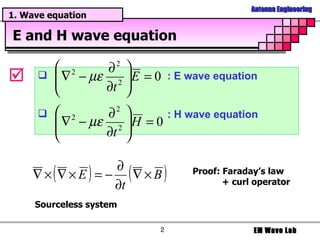
1. Wave equation E and H wave equation  : E wave equation : H wave equation Proof: Faraday’s law  + curl operator  Sourceless system
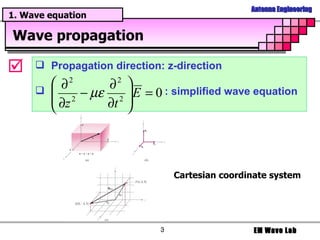
Wave propagation  Propagation direction: z-direction : simplified wave equation Cartesian coordinate system 1. Wave equation
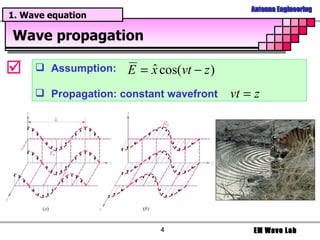
Wave propagation  Assumption:  Propagation: constant wavefront 1. Wave equation
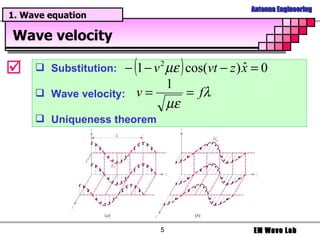
Wave velocity  Substitution:  Wave velocity: Uniqueness theorem 1. Wave equation
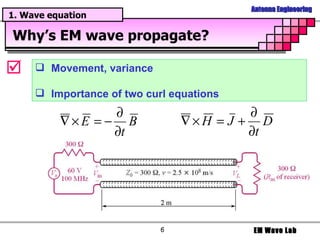
Why’s EM wave propagate?  Movement, variance Importance of two curl equations 1. Wave equation
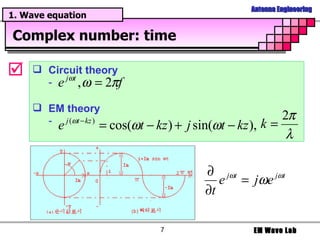
Complex number: time  Circuit theory EM theory 1. Wave equation
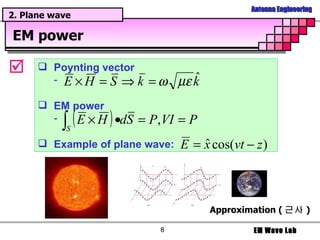
2. Plane wave EM power  Poynting vector EM power Example of plane wave: Approximation ( 근사 )
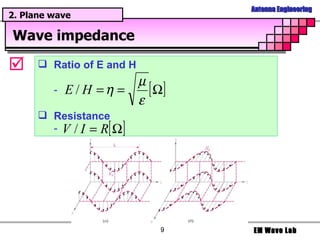
Wave impedance  Ratio of E and H Resistance 2. Plane wave
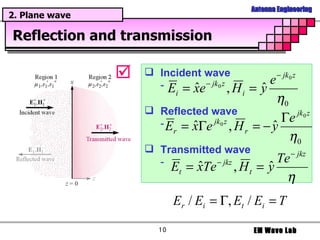
Reflection and transmission  Incident wave Reflected wave Transmitted wave 2. Plane wave
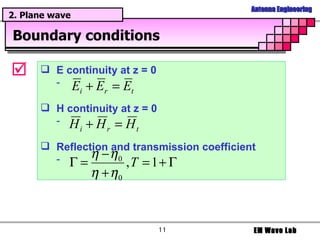
Boundary conditions  E continuity at z = 0 H continuity at z = 0 Reflection and transmission coefficient 2. Plane wave
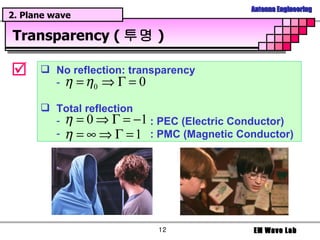
Transparency ( 투명 )  No reflection: transparency Total reflection : PEC (Electric Conductor)  : PMC (Magnetic Conductor)  2. Plane wave
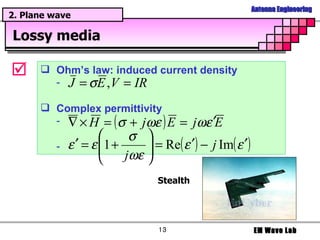
Lossy media  Ohm’s law: induced current density Complex permittivity Stealth 2. Plane wave
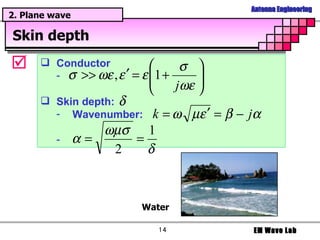
Skin depth  Conductor Skin depth: Wavenumber:  Water 2. Plane wave
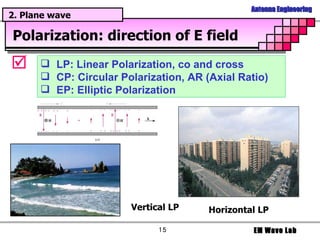
Polarization: direction of E field 2. Plane wave  LP: Linear Polarization, co and cross CP: Circular Polarization, AR (Axial Ratio) EP: Elliptic Polarization Vertical LP Horizontal LP
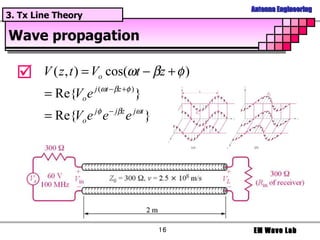
Wave propagation  3. Tx Line Theory
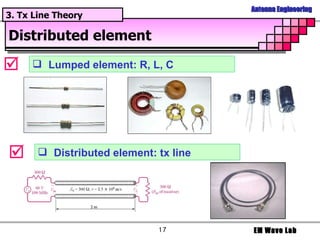
Distributed element  Lumped element: R, L, C  Distributed element: tx line 3. Tx Line Theory
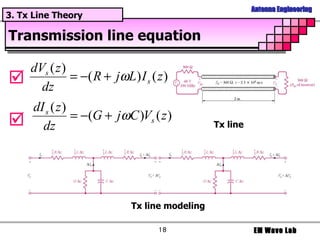
Transmission line equation   Tx line Tx line modeling 3. Tx Line Theory
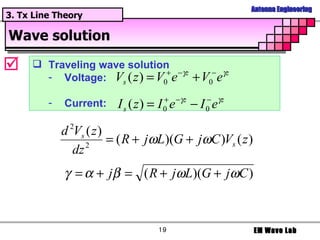
Wave solution  Traveling wave solution Voltage:  Current:  3. Tx Line Theory
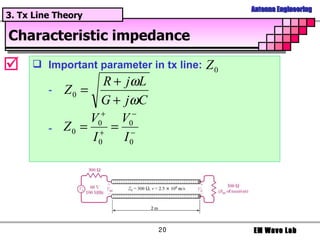
Characteristic impedance  Important parameter in tx line: 3. Tx Line Theory
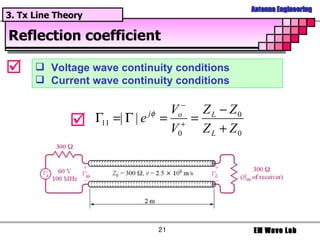
Reflection coefficient   Voltage wave continuity conditions Current wave continuity conditions 3. Tx Line Theory
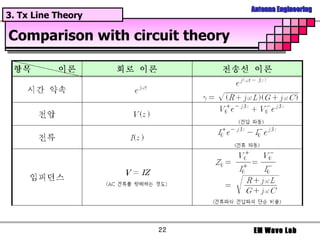
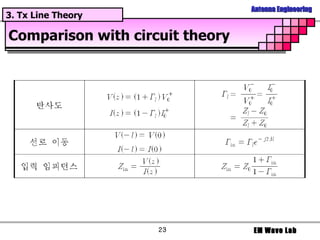
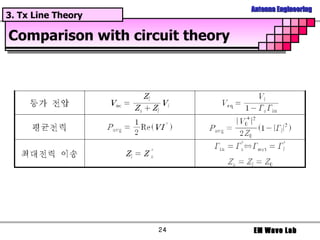
Comparison with circuit theory 3. Tx Line Theory

Electromagnetic Wave