`
Today’s Topics
• Quantum Theory
• Wave Properties
• The Electromagnetic Spectrum
History of Quantum Theory
• Classic Mechanics:
– Molecules behave like balls
• Pro – Explained things like pressure
• Con – Did not explain molecule well
• Quantum Theory
– Maxwell Planck (1858 – 1947)
• Discovered that atoms & molecules emit / absorb
energy only in certain discrete quantities called
quanta.
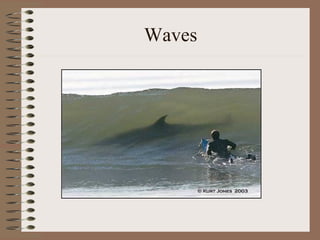
Waves
Not those waves, these waves
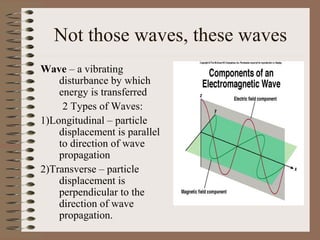
Wave – a vibrating
disturbance by which
energy is transferred
2 Types of Waves:
1)Longitudinal – particle
displacement is parallel
to direction of wave
propagation
2)Transverse – particle
displacement is
perpendicular to the
direction of wave
propagation.
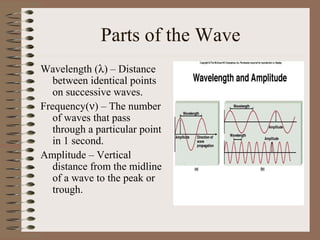
Parts of the Wave
Wavelength (λ) – Distance
between identical points
on successive waves.
Frequency(ν) – The number
of waves that pass
through a particular point
in 1 second.
Amplitude – Vertical
distance from the midline
of a wave to the peak or
trough.
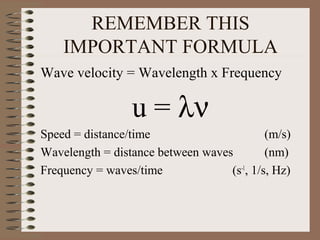
REMEMBER THIS
IMPORTANT FORMULA
Wave velocity = Wavelength x Frequency
u = λν
Speed = distance/time (m/s)
Wavelength = distance between waves (nm)
Frequency = waves/time (s-1
, 1/s, Hz)
James Maxwell
1873 – Proposed that light is an electromagnetic wave.
Electromagnetic wave – Has an electric field component
and a magnetic field component with the same
wavelength and frequency, but travels in perpendicular
planes.
Electromagnetic Radiation – emission and transmission of
energy in the form of electromagnetic waves.
Electromagnetic waves travel at 3.00x10⁸
m/s in a vacuum.
The speed of light (c) = 3.00x10⁸
m/s
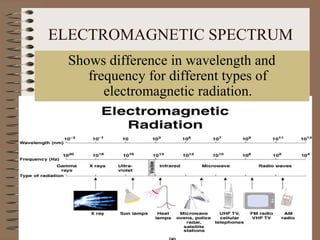
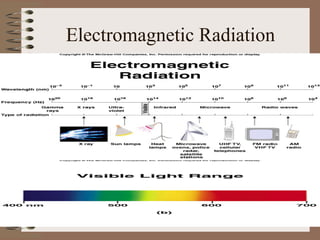
ELECTROMAGNETIC SPECTRUM
Shows difference in wavelength and
frequency for different types of
electromagnetic radiation.
Electromagnetic Radiation
Review
• Wave
• Wavelength
• Frequency
• Amplitude
• Electromagnetic Radiation
How do you cook a meal in 3 minutes?
Use a microwave oven
Microwave – electromagnetic radiation, which is a
type of wave.
Wave – Vibrating disturbance by which energy is
transmitted.
Microwave frequency = 2500 MHz or 2.5 GHz
This frequency is readily absorbed by water, but not
plastic or glass. The absorbed energy is then
converted to atomic motion, which we all know
is heat!

Waves classic to quantum

  • 1.
  • 2.
    Today’s Topics • QuantumTheory • Wave Properties • The Electromagnetic Spectrum
  • 3.
    History of QuantumTheory • Classic Mechanics: – Molecules behave like balls • Pro – Explained things like pressure • Con – Did not explain molecule well • Quantum Theory – Maxwell Planck (1858 – 1947) • Discovered that atoms & molecules emit / absorb energy only in certain discrete quantities called quanta.
  • 4.
  • 5.
    Not those waves,these waves Wave – a vibrating disturbance by which energy is transferred 2 Types of Waves: 1)Longitudinal – particle displacement is parallel to direction of wave propagation 2)Transverse – particle displacement is perpendicular to the direction of wave propagation.
  • 6.
    Parts of theWave Wavelength (λ) – Distance between identical points on successive waves. Frequency(ν) – The number of waves that pass through a particular point in 1 second. Amplitude – Vertical distance from the midline of a wave to the peak or trough.
  • 7.
    REMEMBER THIS IMPORTANT FORMULA Wavevelocity = Wavelength x Frequency u = λν Speed = distance/time (m/s) Wavelength = distance between waves (nm) Frequency = waves/time (s-1 , 1/s, Hz)
  • 8.
    James Maxwell 1873 –Proposed that light is an electromagnetic wave. Electromagnetic wave – Has an electric field component and a magnetic field component with the same wavelength and frequency, but travels in perpendicular planes. Electromagnetic Radiation – emission and transmission of energy in the form of electromagnetic waves. Electromagnetic waves travel at 3.00x10⁸ m/s in a vacuum. The speed of light (c) = 3.00x10⁸ m/s
  • 9.
    ELECTROMAGNETIC SPECTRUM Shows differencein wavelength and frequency for different types of electromagnetic radiation.
  • 10.
  • 11.
    Review • Wave • Wavelength •Frequency • Amplitude • Electromagnetic Radiation
  • 12.
    How do youcook a meal in 3 minutes? Use a microwave oven Microwave – electromagnetic radiation, which is a type of wave. Wave – Vibrating disturbance by which energy is transmitted. Microwave frequency = 2500 MHz or 2.5 GHz This frequency is readily absorbed by water, but not plastic or glass. The absorbed energy is then converted to atomic motion, which we all know is heat!