INTRODUCTIONTO
MICROWAVE ENGINEERING
WEEK 1
• CLASS 1: Introduction to Microwave Engineering,
Applications of Microwave Engineering, Maxwelll’s
Equations
• CLASS 2:The wave equation and basic plane wave
solutions, Poynting’sTheorem and Wave Power
WEEK 2
• CLASS 3: Plane wave reflection from a media
interface, Refraction, Diffraction
• CLASS 4: S-Parameters, Propagation in good
conductors: skin effect
INTRODUCTION
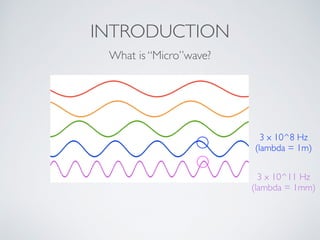
What is “Micro”wave?
3 x 10^8 Hz
(lambda = 1m)
3 x 10^11 Hz
(lambda = 1mm)
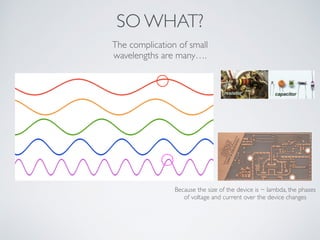
SO WHAT?
The complication of small
wavelengths are many….
Because the size of the device is ~ lambda, the phases
of voltage and current over the device changes
APPLICATIONS
OF
MICROWAVE
ENGINEERING
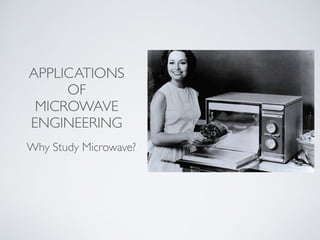
Why Study Microwave?
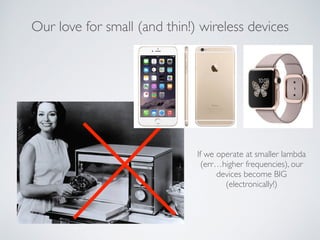
Our love for small (and thin!) wireless devices
If we operate at smaller lambda
(err…higher frequencies), our
devices become BIG
(electronically!)
The 5G standard
(operating at 28 GHz) will be 100
times faster than 4G,
with data rate of ~ 10GB/sec!
Our love for juice!
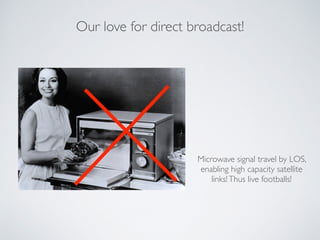
Microwave signal travel by LOS,
enabling high capacity satellite
links!Thus live footballs!
Our love for direct broadcast!
REVISITING OUR ELDERS
“IF I HAVE SEEN FURTHER, IT IS BY STANDING ON THE SHOULDERS OF GIANTS”
- ISAAC NEWTON
!THE MAXWELL’S EQUATIONS !
(Macroscopic electric and magnetic phenomena are described by these equations)
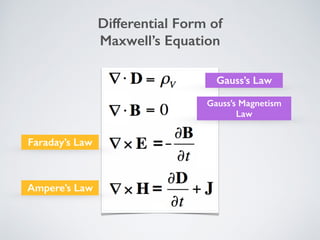
Differential Form of
Maxwell’s Equation
Gauss’s Law
Gauss’s Magnetism
Law
Faraday’s Law
Ampere’s Law
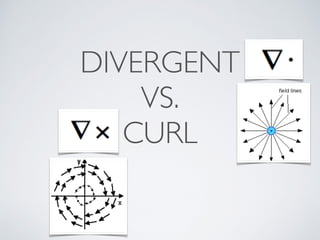
DIVERGENT
VS.
CURL
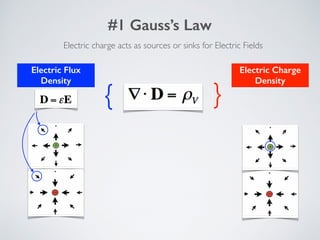
Electric Flux
Density
#1 Gauss’s Law
{
Electric charge acts as sources or sinks for Electric Fields
Electric Charge
Density
{
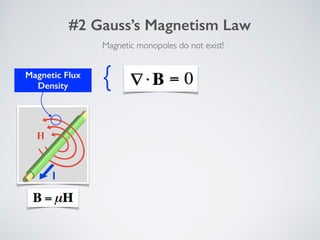
Magnetic Flux
Density
#2 Gauss’s Magnetism Law
{
Magnetic monopoles do not exist!
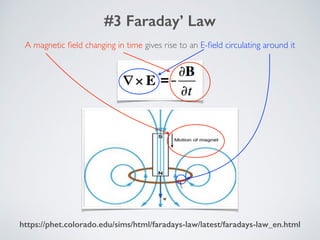
#3 Faraday’ Law
A magnetic field changing in time gives rise to an E-field circulating around it
https://phet.colorado.edu/sims/html/faradays-law/latest/faradays-law_en.html
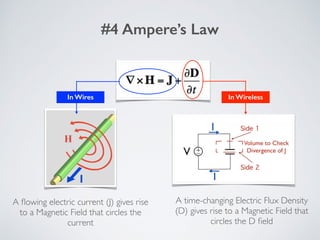
#4 Ampere’s Law
A time-changing Electric Flux Density
(D) gives rise to a Magnetic Field that
circles the D field
A flowing electric current (J) gives rise
to a Magnetic Field that circles the
current
In Wires In Wireless
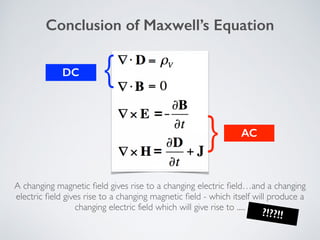
DC
Conclusion of Maxwell’s Equation
{
{
AC
A changing magnetic field gives rise to a changing electric field…and a changing
electric field gives rise to a changing magnetic field - which itself will produce a
changing electric field which will give rise to .....
?!??!!
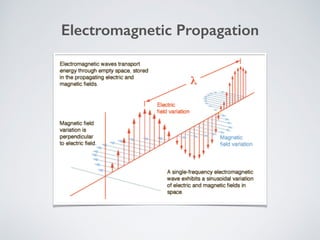
Electromagnetic Propagation
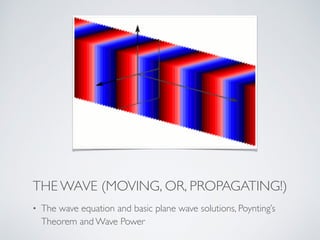
THE WAVE (MOVING, OR, PROPAGATING!)
• The wave equation and basic plane wave solutions, Poynting’s
Theorem and Wave Power
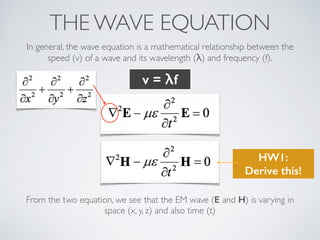
THE WAVE EQUATION
In general, the wave equation is a mathematical relationship between the
speed (v) of a wave and its wavelength (λ) and frequency (f).
v = λf
From the two equation, we see that the EM wave (E and H) is varying in
space (x, y, z) and also time (t)
HW1:
Derive this!
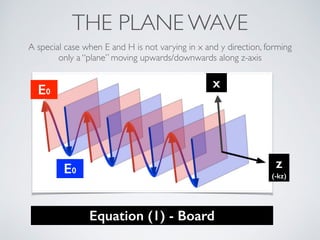
THE PLANE WAVE
A special case when E and H is not varying in x and y direction, forming
only a “plane” moving upwards/downwards along z-axis
z
(-kz)
E0
x
E0
Equation (1) - Board
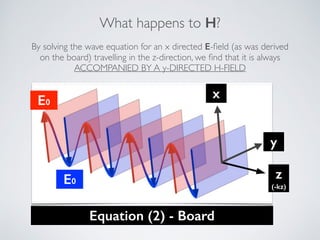
What happens to H?
By solving the wave equation for an x directed E-field (as was derived
on the board) travelling in the z-direction, we find that it is always
ACCOMPANIED BY A y-DIRECTED H-FIELD
z
(-kz)
E0
x
E0
y
Equation (2) - Board
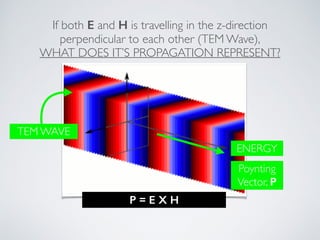
If both E and H is travelling in the z-direction
perpendicular to each other (TEM Wave),
WHAT DOES IT’S PROPAGATION REPRESENT?
ENERGY
TEM WAVE
Poynting
Vector, P
ENERGY
P = E X H
z
(-kz)
E0
x
E0
y
• Example Question (on board)
PROPAGATION IN LOSSY MEDIUM
• CLASS 3: Plane wave reflection from a media interface,
Refraction, Diffraction
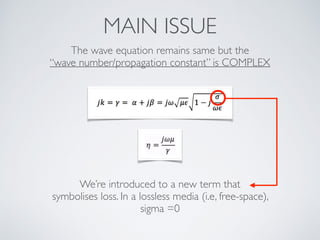
The wave equation remains same but the
“wave number/propagation constant” is COMPLEX
We’re introduced to a new term that
symbolises loss. In a lossless media (i.e, free-space),
sigma =0
MAIN ISSUE
The general effect of a complex “k” is a travelling wave that
changes its amplitude with distance
Equation (3) - Board
WAVE EQUATION WITH COMPLEX ‘K’
REGARDLESS OF PROPAGATION
(IN FREE SPACE/ A MEDIUM)…
What is the speed of the electromagnetic wave?
Equation (4) - Board
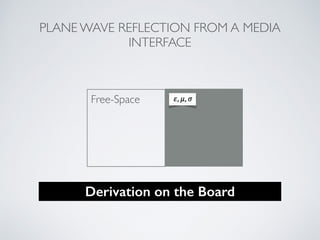
PLANE WAVE REFLECTION FROM A MEDIA
INTERFACE
Free-Space
Derivation on the Board
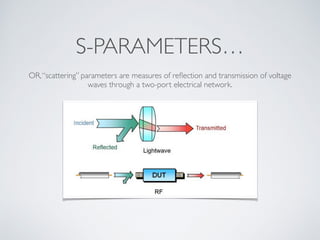
S-PARAMETERS…
OR,“scattering” parameters are measures of reflection and transmission of voltage
waves through a two-port electrical network.
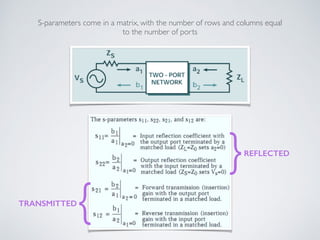
S-parameters come in a matrix, with the number of rows and columns equal
to the number of ports
}
{
REFLECTED
TRANSMITTED
THE END CH 1

Microwave engineering ch1

  • 1.
  • 2.
    WEEK 1 • CLASS1: Introduction to Microwave Engineering, Applications of Microwave Engineering, Maxwelll’s Equations • CLASS 2:The wave equation and basic plane wave solutions, Poynting’sTheorem and Wave Power
  • 3.
    WEEK 2 • CLASS3: Plane wave reflection from a media interface, Refraction, Diffraction • CLASS 4: S-Parameters, Propagation in good conductors: skin effect
  • 4.
    INTRODUCTION What is “Micro”wave? 3x 10^8 Hz (lambda = 1m) 3 x 10^11 Hz (lambda = 1mm)
  • 5.
    SO WHAT? The complicationof small wavelengths are many…. Because the size of the device is ~ lambda, the phases of voltage and current over the device changes
  • 6.
  • 7.
    Our love forsmall (and thin!) wireless devices If we operate at smaller lambda (err…higher frequencies), our devices become BIG (electronically!)
  • 8.
    The 5G standard (operatingat 28 GHz) will be 100 times faster than 4G, with data rate of ~ 10GB/sec! Our love for juice!
  • 9.
    Microwave signal travelby LOS, enabling high capacity satellite links!Thus live footballs! Our love for direct broadcast!
  • 10.
    REVISITING OUR ELDERS “IFI HAVE SEEN FURTHER, IT IS BY STANDING ON THE SHOULDERS OF GIANTS” - ISAAC NEWTON !THE MAXWELL’S EQUATIONS ! (Macroscopic electric and magnetic phenomena are described by these equations)
  • 11.
    Differential Form of Maxwell’sEquation Gauss’s Law Gauss’s Magnetism Law Faraday’s Law Ampere’s Law
  • 12.
  • 13.
    Electric Flux Density #1 Gauss’sLaw { Electric charge acts as sources or sinks for Electric Fields Electric Charge Density {
  • 14.
    Magnetic Flux Density #2 Gauss’sMagnetism Law { Magnetic monopoles do not exist!
  • 15.
    #3 Faraday’ Law Amagnetic field changing in time gives rise to an E-field circulating around it https://phet.colorado.edu/sims/html/faradays-law/latest/faradays-law_en.html
  • 16.
    #4 Ampere’s Law Atime-changing Electric Flux Density (D) gives rise to a Magnetic Field that circles the D field A flowing electric current (J) gives rise to a Magnetic Field that circles the current In Wires In Wireless
  • 17.
    DC Conclusion of Maxwell’sEquation { { AC A changing magnetic field gives rise to a changing electric field…and a changing electric field gives rise to a changing magnetic field - which itself will produce a changing electric field which will give rise to ..... ?!??!!
  • 18.
  • 19.
    THE WAVE (MOVING,OR, PROPAGATING!) • The wave equation and basic plane wave solutions, Poynting’s Theorem and Wave Power
  • 20.
    THE WAVE EQUATION Ingeneral, the wave equation is a mathematical relationship between the speed (v) of a wave and its wavelength (λ) and frequency (f). v = λf From the two equation, we see that the EM wave (E and H) is varying in space (x, y, z) and also time (t) HW1: Derive this!
  • 21.
    THE PLANE WAVE Aspecial case when E and H is not varying in x and y direction, forming only a “plane” moving upwards/downwards along z-axis z (-kz) E0 x E0 Equation (1) - Board
  • 22.
    What happens toH? By solving the wave equation for an x directed E-field (as was derived on the board) travelling in the z-direction, we find that it is always ACCOMPANIED BY A y-DIRECTED H-FIELD z (-kz) E0 x E0 y Equation (2) - Board
  • 23.
    If both Eand H is travelling in the z-direction perpendicular to each other (TEM Wave), WHAT DOES IT’S PROPAGATION REPRESENT? ENERGY TEM WAVE Poynting Vector, P ENERGY P = E X H
  • 24.
  • 25.
  • 26.
    PROPAGATION IN LOSSYMEDIUM • CLASS 3: Plane wave reflection from a media interface, Refraction, Diffraction
  • 27.
    The wave equationremains same but the “wave number/propagation constant” is COMPLEX We’re introduced to a new term that symbolises loss. In a lossless media (i.e, free-space), sigma =0 MAIN ISSUE
  • 28.
    The general effectof a complex “k” is a travelling wave that changes its amplitude with distance Equation (3) - Board WAVE EQUATION WITH COMPLEX ‘K’
  • 29.
    REGARDLESS OF PROPAGATION (INFREE SPACE/ A MEDIUM)… What is the speed of the electromagnetic wave? Equation (4) - Board
  • 30.
    PLANE WAVE REFLECTIONFROM A MEDIA INTERFACE Free-Space Derivation on the Board
  • 31.
    S-PARAMETERS… OR,“scattering” parameters aremeasures of reflection and transmission of voltage waves through a two-port electrical network.
  • 32.
    S-parameters come ina matrix, with the number of rows and columns equal to the number of ports } { REFLECTED TRANSMITTED
  • 33.