PHY-401
Waves and Oscillations
BS Physics
4th Semester
Dr. Ejaz Ahmed
Department of Physics
Abdul Wali Khan University Mardan
Lecture 3: Topics to be Covered
1. Simple Harmonic Oscillation
2. Mass Attached to a Spring
Simple Harmonic Motion (SHM)
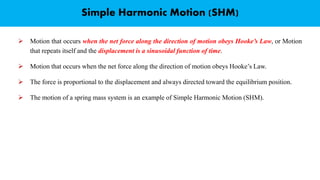
➢ Motion that occurs when the net force along the direction of motion obeys Hooke’s Law, or Motion
that repeats itself and the displacement is a sinusoidal function of time.
➢ Motion that occurs when the net force along the direction of motion obeys Hooke’s Law.
➢ The force is proportional to the displacement and always directed toward the equilibrium position.
➢ The motion of a spring mass system is an example of Simple Harmonic Motion (SHM).
Mass Attached to a Spring
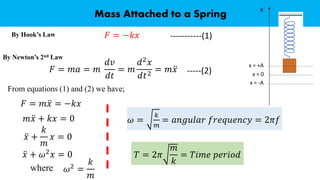
By Hook’s Law 𝐹 = −𝑘𝑥
By Newton’s 2nd Law
𝐹 = 𝑚𝑎 = 𝑚
𝑑𝑣
𝑑𝑡
= 𝑚
𝑑2𝑥
𝑑𝑡2
= 𝑚 ሷ
𝑥
-----------(1)
-----(2)
From equations (1) and (2) we have;
𝐹 = 𝑚 ሷ
𝑥 = −𝑘𝑥
𝑚 ሷ
𝑥 + 𝑘𝑥 = 0
ሷ
𝑥 +
𝑘
𝑚
𝑥 = 0
ሷ
𝑥 + 𝜔2𝑥 = 0
where 𝜔2 =
𝑘
𝑚
𝜔 =
𝑘
𝑚
= 𝑎𝑛𝑔𝑢𝑙𝑎𝑟 𝑓𝑟𝑒𝑞𝑢𝑒𝑛𝑐𝑦 = 2𝜋𝑓
x
x = 0
x = +A
x = -A
𝑇 = 2𝜋
𝑚
𝑘
= 𝑇𝑖𝑚𝑒 𝑝𝑒𝑟𝑖𝑜𝑑
x
x = 0
x = +A
x = -A
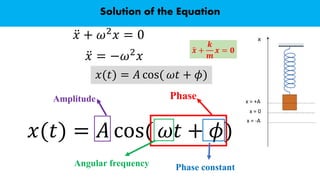
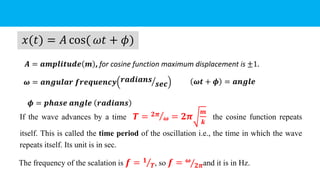
𝑥(𝑡) = 𝐴 cos( 𝜔𝑡 + 𝜙)
Phase
Amplitude
Phase constant
Angular frequency
Solution of the Equation
ሷ
𝑥 + 𝜔2
𝑥 = 0
𝑥(𝑡) = 𝐴 cos( 𝜔𝑡 + 𝜙)
ሷ
𝑥 = −𝜔2
𝑥
ሷ
𝒙 +
𝒌
𝒎
𝒙 = 𝟎
If the wave advances by a time 𝑻 = Τ
𝟐𝝅
𝝎 = 𝟐𝝅
𝒎
𝒌
the cosine function repeats
itself. This is called the time period of the oscillation i.e., the time in which the wave
repeats itself. Its unit is in sec.
𝑥(𝑡) = 𝐴 cos( 𝜔𝑡 + 𝜙)
𝝎 = 𝒂𝒏𝒈𝒖𝒍𝒂𝒓 𝒇𝒓𝒆𝒒𝒖𝒆𝒏𝒄𝒚 ൗ
𝒓𝒂𝒅𝒊𝒂𝒏𝒔
𝒔𝒆𝒄
𝑨 = 𝒂𝒎𝒑𝒍𝒊𝒕𝒖𝒅𝒆 𝒎 , for cosine function maximum displacement is ±1.
𝝓 = 𝒑𝒉𝒂𝒔𝒆 𝒂𝒏𝒈𝒍𝒆 𝒓𝒂𝒅𝒊𝒂𝒏𝒔
The frequency of the scalation is 𝒇 = Τ
𝟏
𝑻, so 𝒇 = Τ
𝝎
𝟐𝝅and it is in Hz.
𝝎𝒕 + 𝝓 = 𝒂𝒏𝒈𝒍𝒆
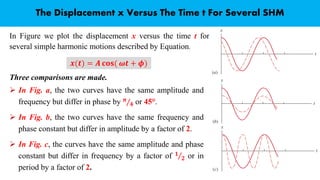
The Displacement x Versus The Time t For Several SHM
In Figure we plot the displacement x versus the time t for
several simple harmonic motions described by Equation.
➢ In Fig. a, the two curves have the same amplitude and
frequency but differ in phase by Τ
𝝅
𝟒 or 45°.
➢ In Fig. b, the two curves have the same frequency and
phase constant but differ in amplitude by a factor of 2.
➢ In Fig. c, the curves have the same amplitude and phase
constant but differ in frequency by a factor of Τ
𝟏
𝟐 or in
period by a factor of 2.
𝒙(𝒕) = 𝑨 𝐜𝐨𝐬( 𝝎𝒕 + 𝝓)
Three comparisons are made.
Video Lectures to Watch
1. https://www.youtube.com/watch?v=tNpuTx7UQbw (8.01x- Lect 10 - Hooke's Law, Springs,
Pendulums, Simple Harmonic Motion)
2. https://www.youtube.com/watch?v=GOdrEXTkWyI&list=PLIKpuUo6d5pIy313eSfqgHxx1P2cd5O7
n&index=181 (Energy in SHM)
3. https://www.youtube.com/watch?v=SmuCOSwuoOs&list=PLIKpuUo6d5pIy313eSfqgHxx1P2cd5O
7n&index=182 (Dynamics of SHM)

wave and oscillation

  • 1.
    PHY-401 Waves and Oscillations BSPhysics 4th Semester Dr. Ejaz Ahmed Department of Physics Abdul Wali Khan University Mardan
  • 2.
    Lecture 3: Topicsto be Covered 1. Simple Harmonic Oscillation 2. Mass Attached to a Spring
  • 3.
    Simple Harmonic Motion(SHM) ➢ Motion that occurs when the net force along the direction of motion obeys Hooke’s Law, or Motion that repeats itself and the displacement is a sinusoidal function of time. ➢ Motion that occurs when the net force along the direction of motion obeys Hooke’s Law. ➢ The force is proportional to the displacement and always directed toward the equilibrium position. ➢ The motion of a spring mass system is an example of Simple Harmonic Motion (SHM).
  • 4.
    Mass Attached toa Spring By Hook’s Law 𝐹 = −𝑘𝑥 By Newton’s 2nd Law 𝐹 = 𝑚𝑎 = 𝑚 𝑑𝑣 𝑑𝑡 = 𝑚 𝑑2𝑥 𝑑𝑡2 = 𝑚 ሷ 𝑥 -----------(1) -----(2) From equations (1) and (2) we have; 𝐹 = 𝑚 ሷ 𝑥 = −𝑘𝑥 𝑚 ሷ 𝑥 + 𝑘𝑥 = 0 ሷ 𝑥 + 𝑘 𝑚 𝑥 = 0 ሷ 𝑥 + 𝜔2𝑥 = 0 where 𝜔2 = 𝑘 𝑚 𝜔 = 𝑘 𝑚 = 𝑎𝑛𝑔𝑢𝑙𝑎𝑟 𝑓𝑟𝑒𝑞𝑢𝑒𝑛𝑐𝑦 = 2𝜋𝑓 x x = 0 x = +A x = -A 𝑇 = 2𝜋 𝑚 𝑘 = 𝑇𝑖𝑚𝑒 𝑝𝑒𝑟𝑖𝑜𝑑
  • 5.
    x x = 0 x= +A x = -A 𝑥(𝑡) = 𝐴 cos( 𝜔𝑡 + 𝜙) Phase Amplitude Phase constant Angular frequency Solution of the Equation ሷ 𝑥 + 𝜔2 𝑥 = 0 𝑥(𝑡) = 𝐴 cos( 𝜔𝑡 + 𝜙) ሷ 𝑥 = −𝜔2 𝑥 ሷ 𝒙 + 𝒌 𝒎 𝒙 = 𝟎
  • 6.
    If the waveadvances by a time 𝑻 = Τ 𝟐𝝅 𝝎 = 𝟐𝝅 𝒎 𝒌 the cosine function repeats itself. This is called the time period of the oscillation i.e., the time in which the wave repeats itself. Its unit is in sec. 𝑥(𝑡) = 𝐴 cos( 𝜔𝑡 + 𝜙) 𝝎 = 𝒂𝒏𝒈𝒖𝒍𝒂𝒓 𝒇𝒓𝒆𝒒𝒖𝒆𝒏𝒄𝒚 ൗ 𝒓𝒂𝒅𝒊𝒂𝒏𝒔 𝒔𝒆𝒄 𝑨 = 𝒂𝒎𝒑𝒍𝒊𝒕𝒖𝒅𝒆 𝒎 , for cosine function maximum displacement is ±1. 𝝓 = 𝒑𝒉𝒂𝒔𝒆 𝒂𝒏𝒈𝒍𝒆 𝒓𝒂𝒅𝒊𝒂𝒏𝒔 The frequency of the scalation is 𝒇 = Τ 𝟏 𝑻, so 𝒇 = Τ 𝝎 𝟐𝝅and it is in Hz. 𝝎𝒕 + 𝝓 = 𝒂𝒏𝒈𝒍𝒆
  • 7.
    The Displacement xVersus The Time t For Several SHM In Figure we plot the displacement x versus the time t for several simple harmonic motions described by Equation. ➢ In Fig. a, the two curves have the same amplitude and frequency but differ in phase by Τ 𝝅 𝟒 or 45°. ➢ In Fig. b, the two curves have the same frequency and phase constant but differ in amplitude by a factor of 2. ➢ In Fig. c, the curves have the same amplitude and phase constant but differ in frequency by a factor of Τ 𝟏 𝟐 or in period by a factor of 2. 𝒙(𝒕) = 𝑨 𝐜𝐨𝐬( 𝝎𝒕 + 𝝓) Three comparisons are made.
  • 8.
    Video Lectures toWatch 1. https://www.youtube.com/watch?v=tNpuTx7UQbw (8.01x- Lect 10 - Hooke's Law, Springs, Pendulums, Simple Harmonic Motion) 2. https://www.youtube.com/watch?v=GOdrEXTkWyI&list=PLIKpuUo6d5pIy313eSfqgHxx1P2cd5O7 n&index=181 (Energy in SHM) 3. https://www.youtube.com/watch?v=SmuCOSwuoOs&list=PLIKpuUo6d5pIy313eSfqgHxx1P2cd5O 7n&index=182 (Dynamics of SHM)