VARACTOR DIODE
By
Sindhupriya S
Vanamala Vaasanthika L
VARACTOR DIODE
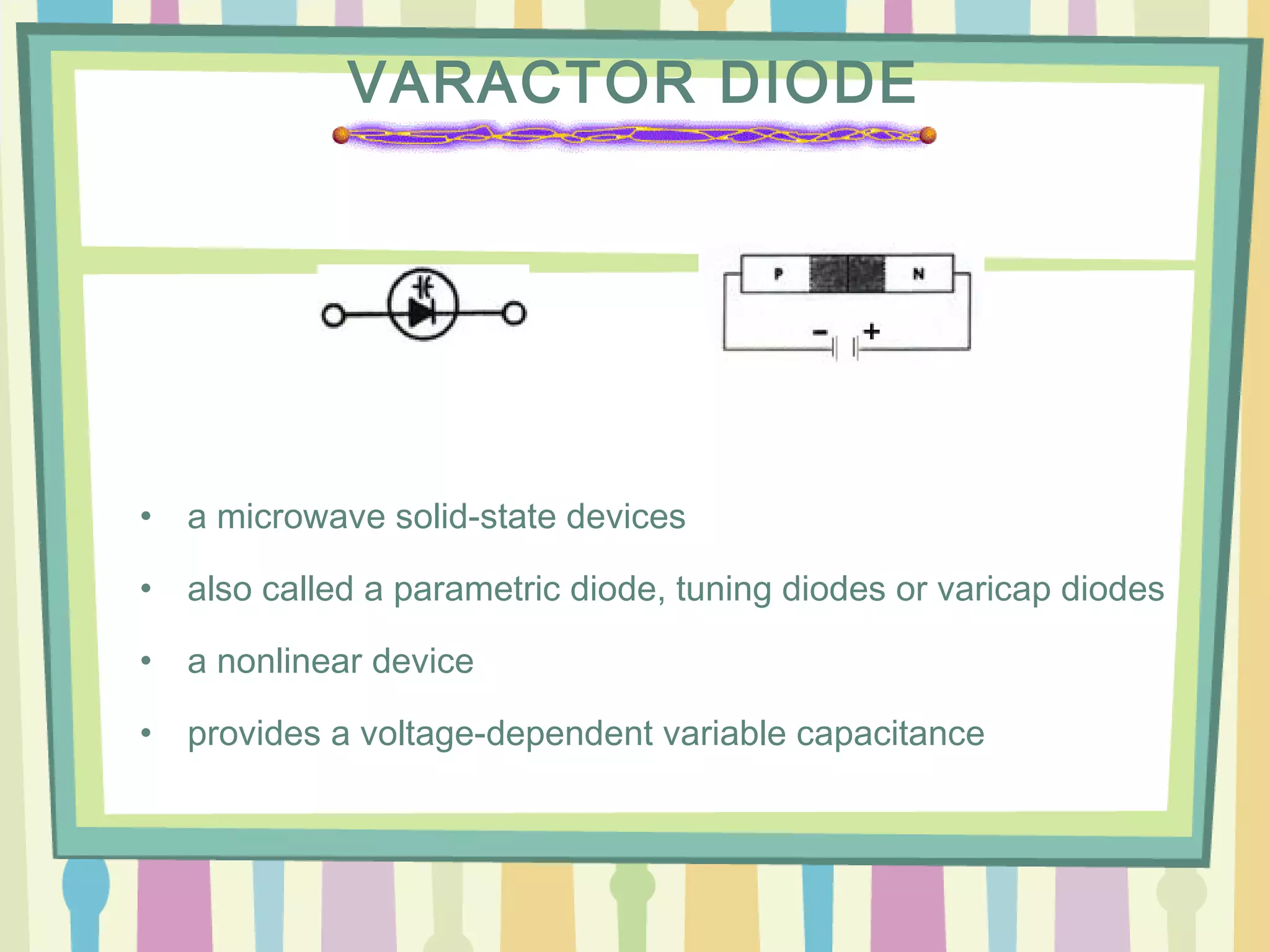
• a microwave solid-state devices
• also called a parametric diode, tuning diodes or varicap diodes
• a nonlinear device
• provides a voltage-dependent variable capacitance
TYPES OF VARACTOR DIODES
• Abrupt and hyper abrupt type : When the changeover p-n
junction is abrupt then it is called abrupt type. When change is very
abrupt, they are called hyper abrupt type. They are used in
oscillators to sweep for different frequencies.
• Gallium-arsenide varactor diodes : The semiconductor
material used is gallium arsenide. They are used for frequencies
from 18 GHz up to and beyond 600 GHz.
IMPORTANT CRITERIA
• Capacitance : Capacitance of the device. Capacitance from a few picoFarads to
hundreds of picoFarads is provided.
• Capacitance range : Range of capacitance produced when voltage is varied.
• Voltage range : The minimum and maximum voltage that can be applied to the
device.
• Bias current : The bias is always reverse. This means that the varactor diode does
not conduct electricity. If the bias is turned positive then the device will start
conducting.
• Other criteria to be considered include : reverse and breakdown voltage,
leakage current, junction temperature.
• Voltage and other transients must be avoided. Transients can occur if the DC voltage
is put off.
CHARACTERISTICS
• Low-noise characteristic : produce much less
noise than most conventional amplifiers.
• Low cost
• High reliability
• Light weight
• Small size
CHARACTERISTICS
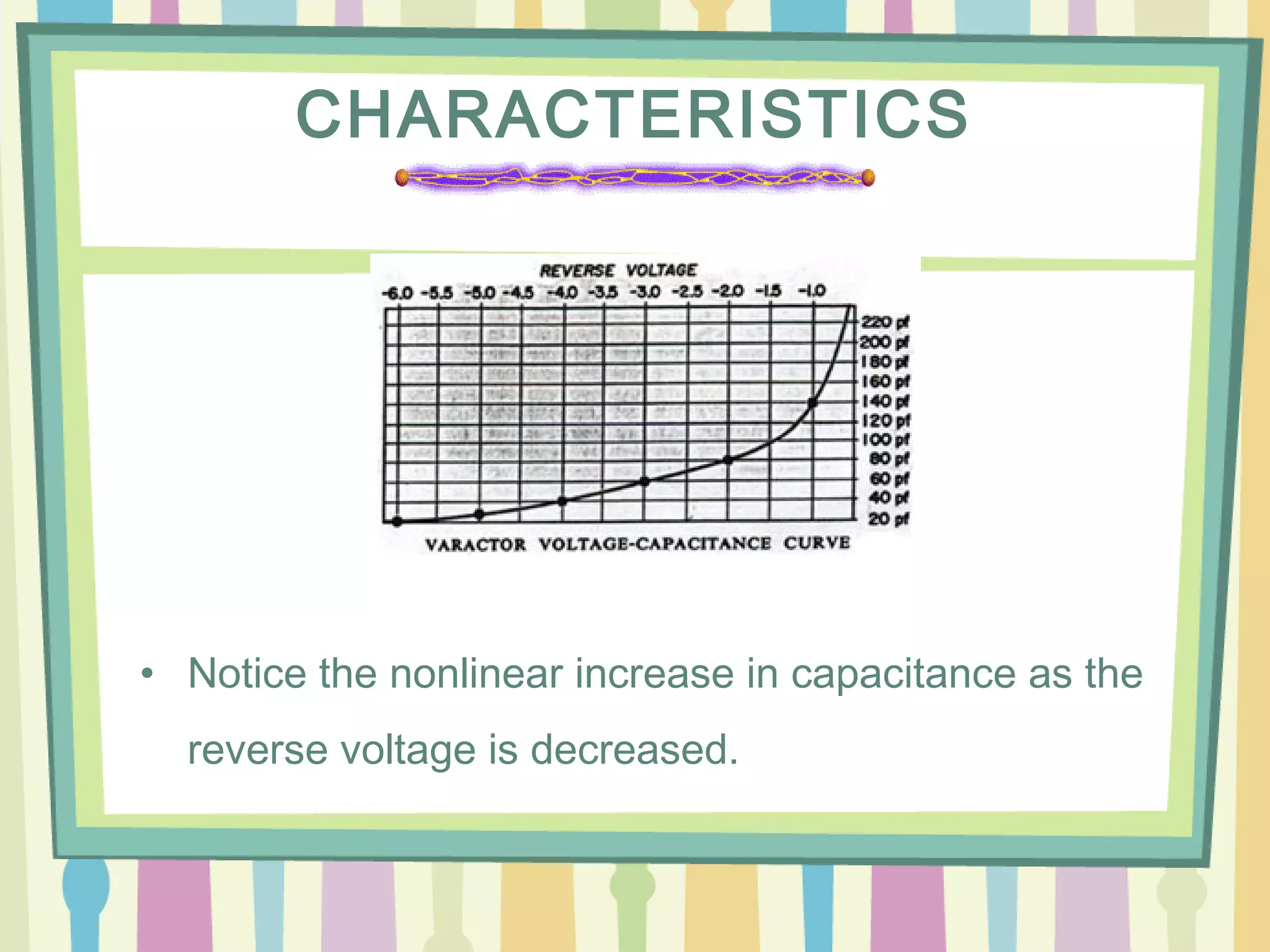
• Notice the nonlinear increase in capacitance as the
reverse voltage is decreased.
OPERATION
• It has a p-n junction of semiconducting
material and is always reverse biased.
• The depletion zone width depends on the
applied voltage and this makes the capacitance
vary with the applied voltage.
APPLICATIONS
• FREQUENCY MULTIPLIERS - used in applications
where it’s difficult to generate microwave signals
• producing relatively high power outputs at frequencies
up to 100GHz
• does not have gain ; in fact, it produces a signal power
loss
• output can be as high as 80% of the input
APPLICATIONS
• PARAMETRIC AMPLIFIERS. - named for the time-
varying parameter, or value of capacitance, associated
with the operation.
• Since the underlying principle of operation is based on
reactance, the parametric amplifier is sometimes called a
REACTANCE AMPLIFIER.
APPLICATIONS
• TUNING - Since the frequency can be made to vary they are used
as electronic tuning devices in tuners for television, mobiles.
• Other Applications:
They are used in PLL, voltage controlled oscillators, harmonic
generation, electronic tuning devices in tuners for television,
mobiles, parametric amplification, AM radios, voltage-variable
tuning, frequency multipliers, etc.
~THE END~~THE END~

Varactor diode

  • 1.
  • 2.
    VARACTOR DIODE • amicrowave solid-state devices • also called a parametric diode, tuning diodes or varicap diodes • a nonlinear device • provides a voltage-dependent variable capacitance
  • 3.
    TYPES OF VARACTORDIODES • Abrupt and hyper abrupt type : When the changeover p-n junction is abrupt then it is called abrupt type. When change is very abrupt, they are called hyper abrupt type. They are used in oscillators to sweep for different frequencies. • Gallium-arsenide varactor diodes : The semiconductor material used is gallium arsenide. They are used for frequencies from 18 GHz up to and beyond 600 GHz.
  • 4.
    IMPORTANT CRITERIA • Capacitance: Capacitance of the device. Capacitance from a few picoFarads to hundreds of picoFarads is provided. • Capacitance range : Range of capacitance produced when voltage is varied. • Voltage range : The minimum and maximum voltage that can be applied to the device. • Bias current : The bias is always reverse. This means that the varactor diode does not conduct electricity. If the bias is turned positive then the device will start conducting. • Other criteria to be considered include : reverse and breakdown voltage, leakage current, junction temperature. • Voltage and other transients must be avoided. Transients can occur if the DC voltage is put off.
  • 5.
    CHARACTERISTICS • Low-noise characteristic: produce much less noise than most conventional amplifiers. • Low cost • High reliability • Light weight • Small size
  • 6.
    CHARACTERISTICS • Notice thenonlinear increase in capacitance as the reverse voltage is decreased.
  • 7.
    OPERATION • It hasa p-n junction of semiconducting material and is always reverse biased. • The depletion zone width depends on the applied voltage and this makes the capacitance vary with the applied voltage.
  • 8.
    APPLICATIONS • FREQUENCY MULTIPLIERS- used in applications where it’s difficult to generate microwave signals • producing relatively high power outputs at frequencies up to 100GHz • does not have gain ; in fact, it produces a signal power loss • output can be as high as 80% of the input
  • 9.
    APPLICATIONS • PARAMETRIC AMPLIFIERS.- named for the time- varying parameter, or value of capacitance, associated with the operation. • Since the underlying principle of operation is based on reactance, the parametric amplifier is sometimes called a REACTANCE AMPLIFIER.
  • 10.
    APPLICATIONS • TUNING -Since the frequency can be made to vary they are used as electronic tuning devices in tuners for television, mobiles. • Other Applications: They are used in PLL, voltage controlled oscillators, harmonic generation, electronic tuning devices in tuners for television, mobiles, parametric amplification, AM radios, voltage-variable tuning, frequency multipliers, etc.
  • 11.