Co-ordinate Systems
By,
S.T.Suganthi,
HOD/EEE,
S.Veerasamy Chettiar college of Engineering and
Technology,
Puliangudi-627855
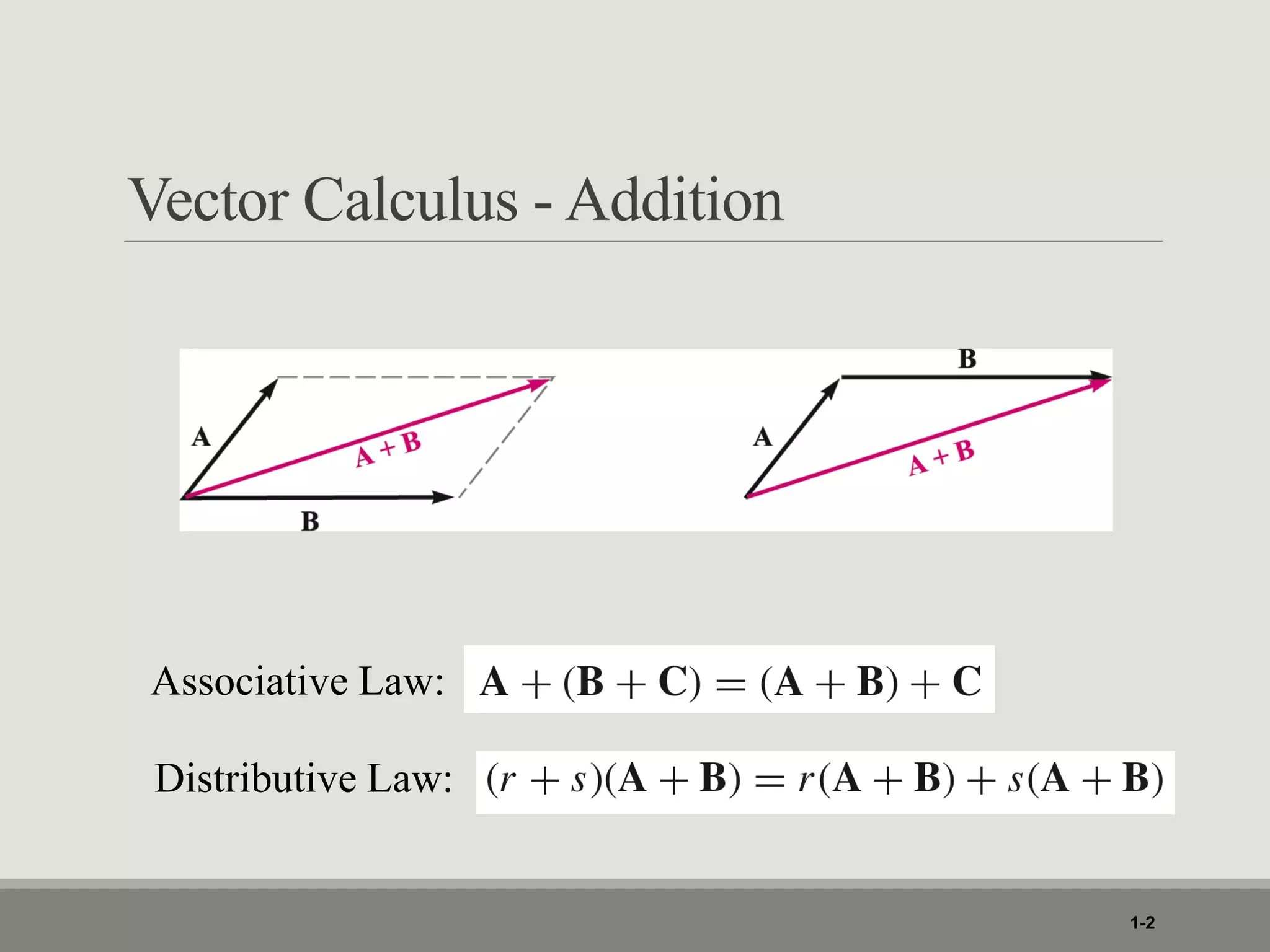
Vector Calculus - Addition
1-2
Associative Law:
Distributive Law:
Scalar and Vector Fields
A scalar field is a function that gives us a single value of some variable
for every point in space.
◦ Examples: voltage, current, energy, temperature
A vector is a quantity which has both a magnitude and a direction in
space.
◦ Examples: velocity, momentum, acceleration and force
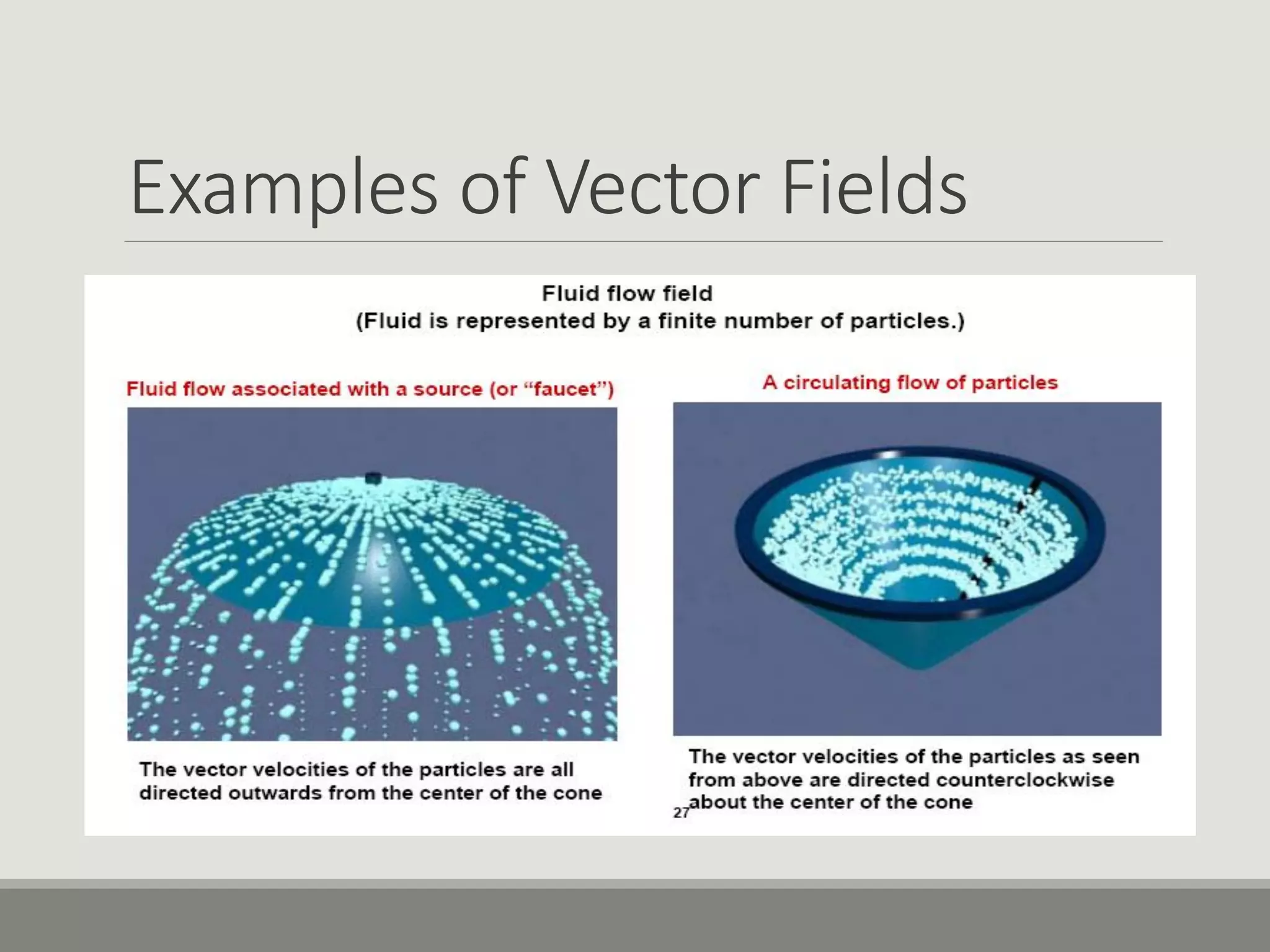
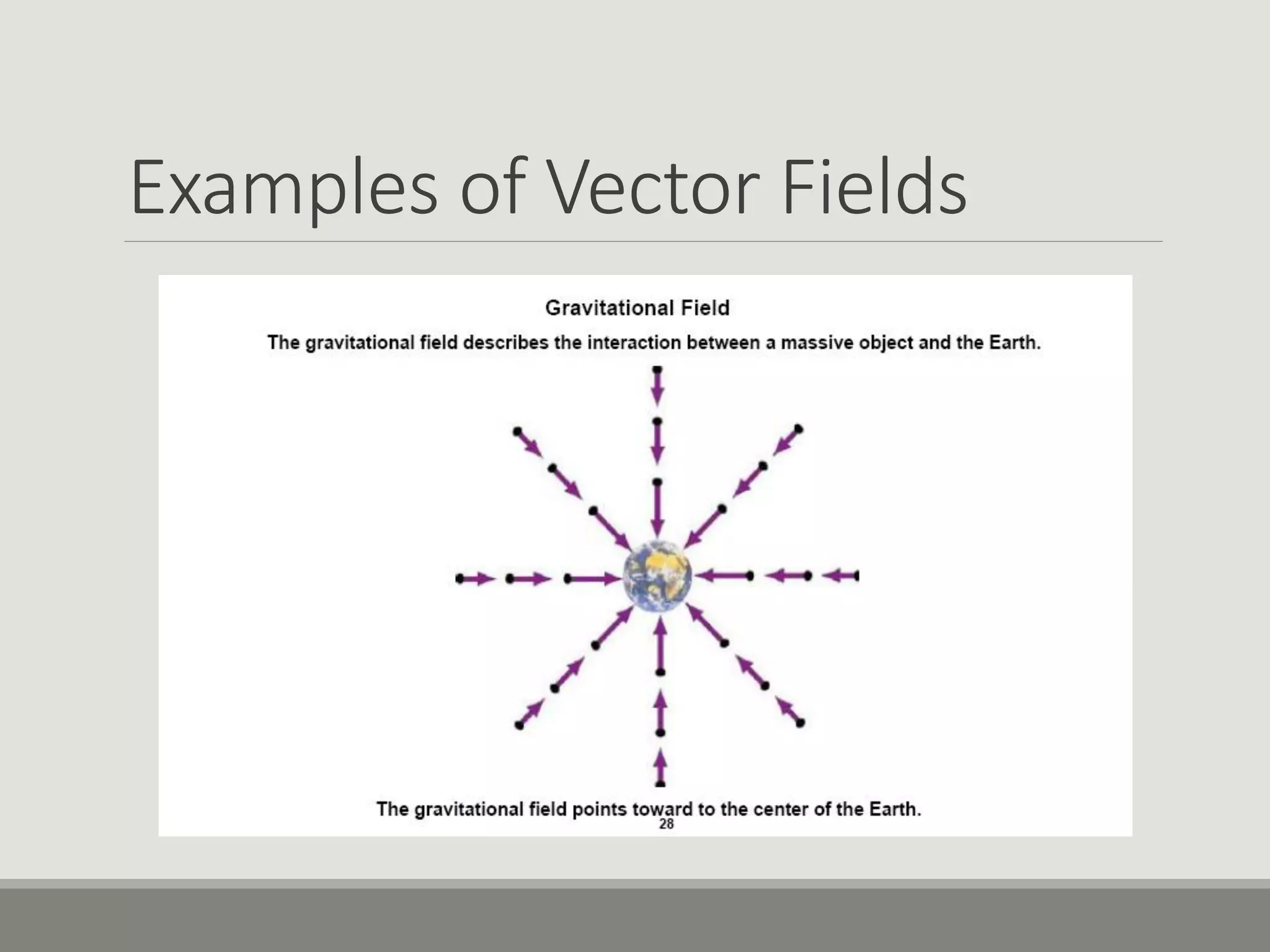
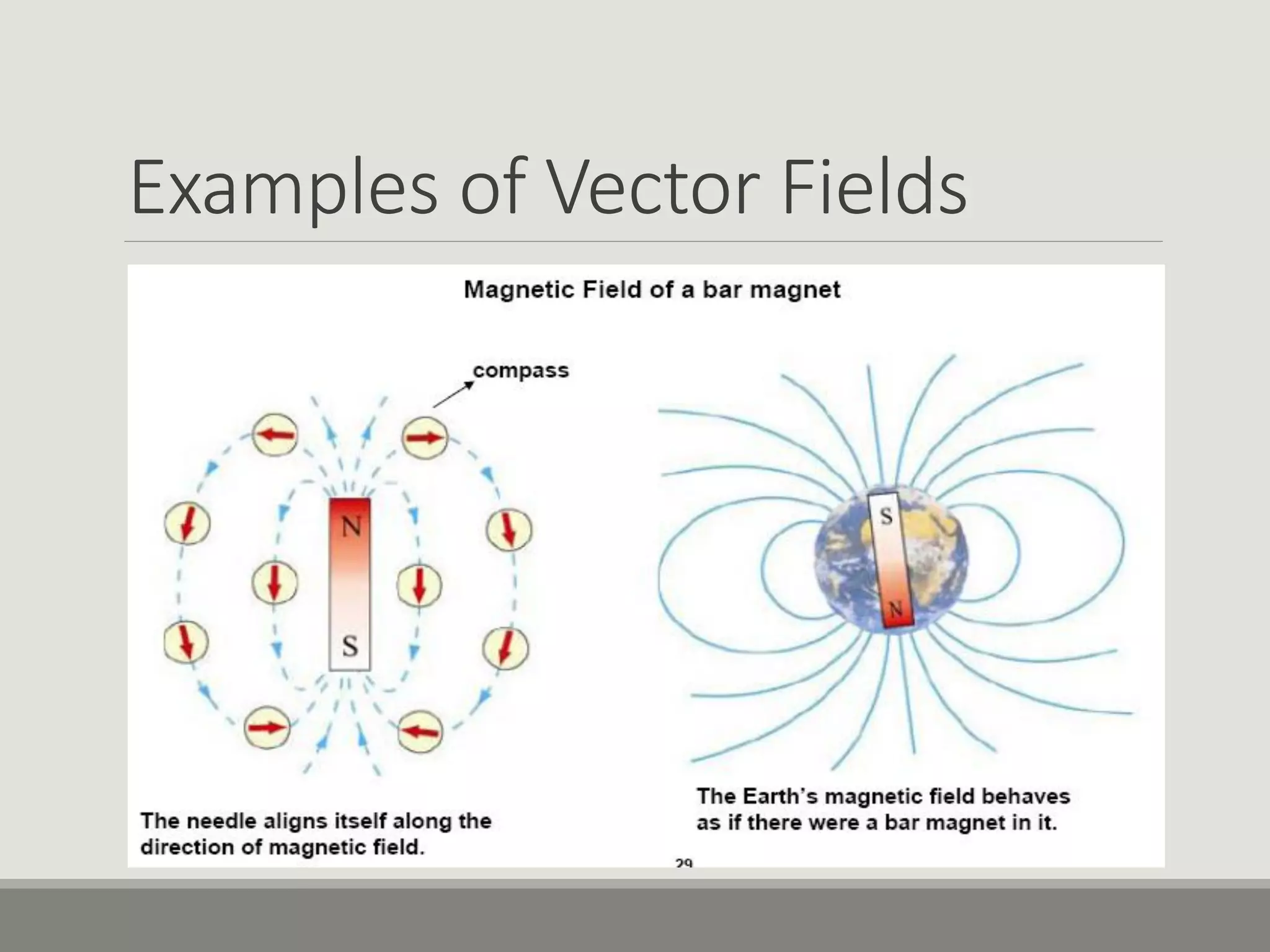
Examples of Vector Fields
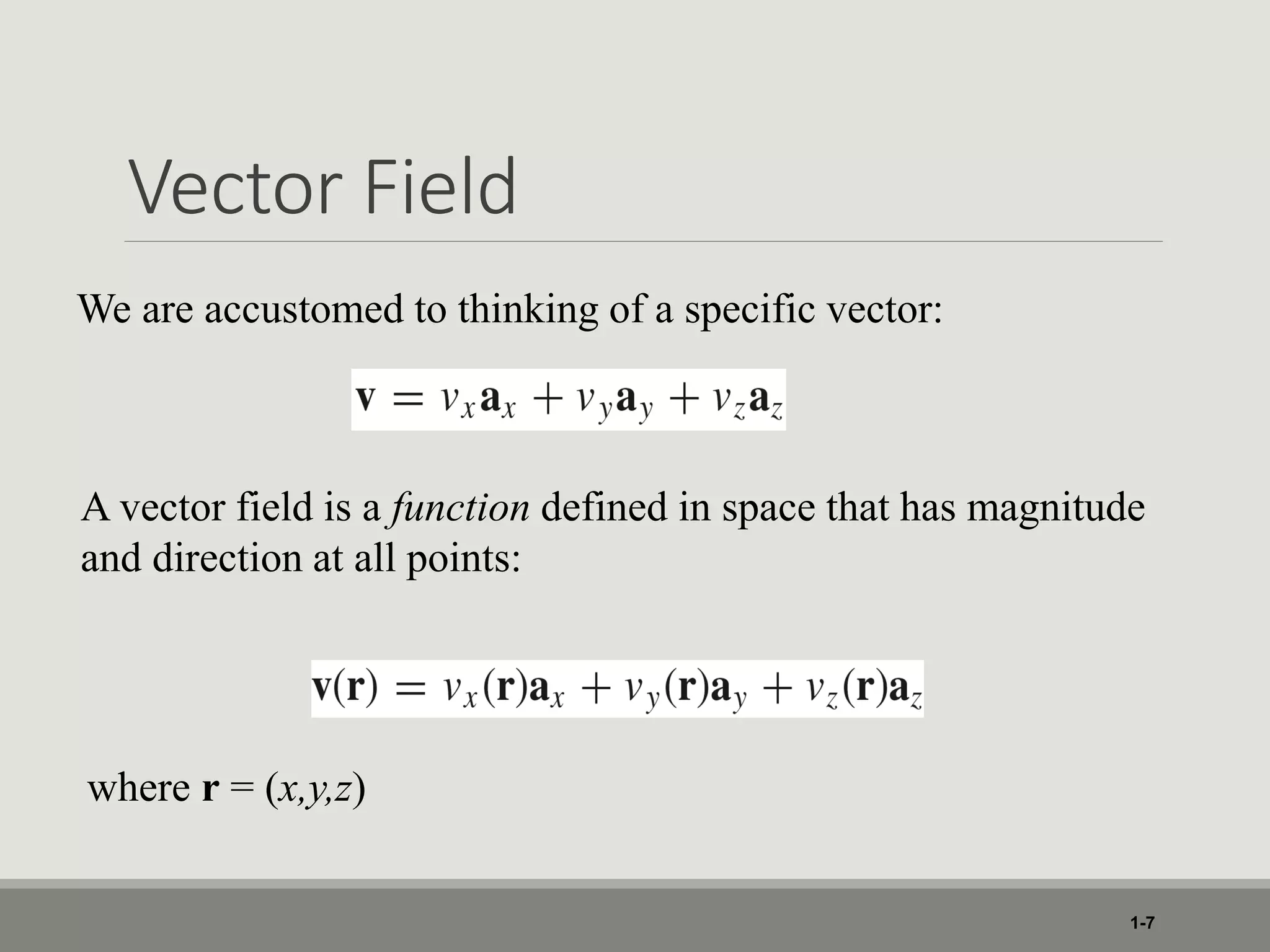
Vector Field
1-7
We are accustomed to thinking of a specific vector:
A vector field is a function defined in space that has magnitude
and direction at all points:
where r = (x,y,z)
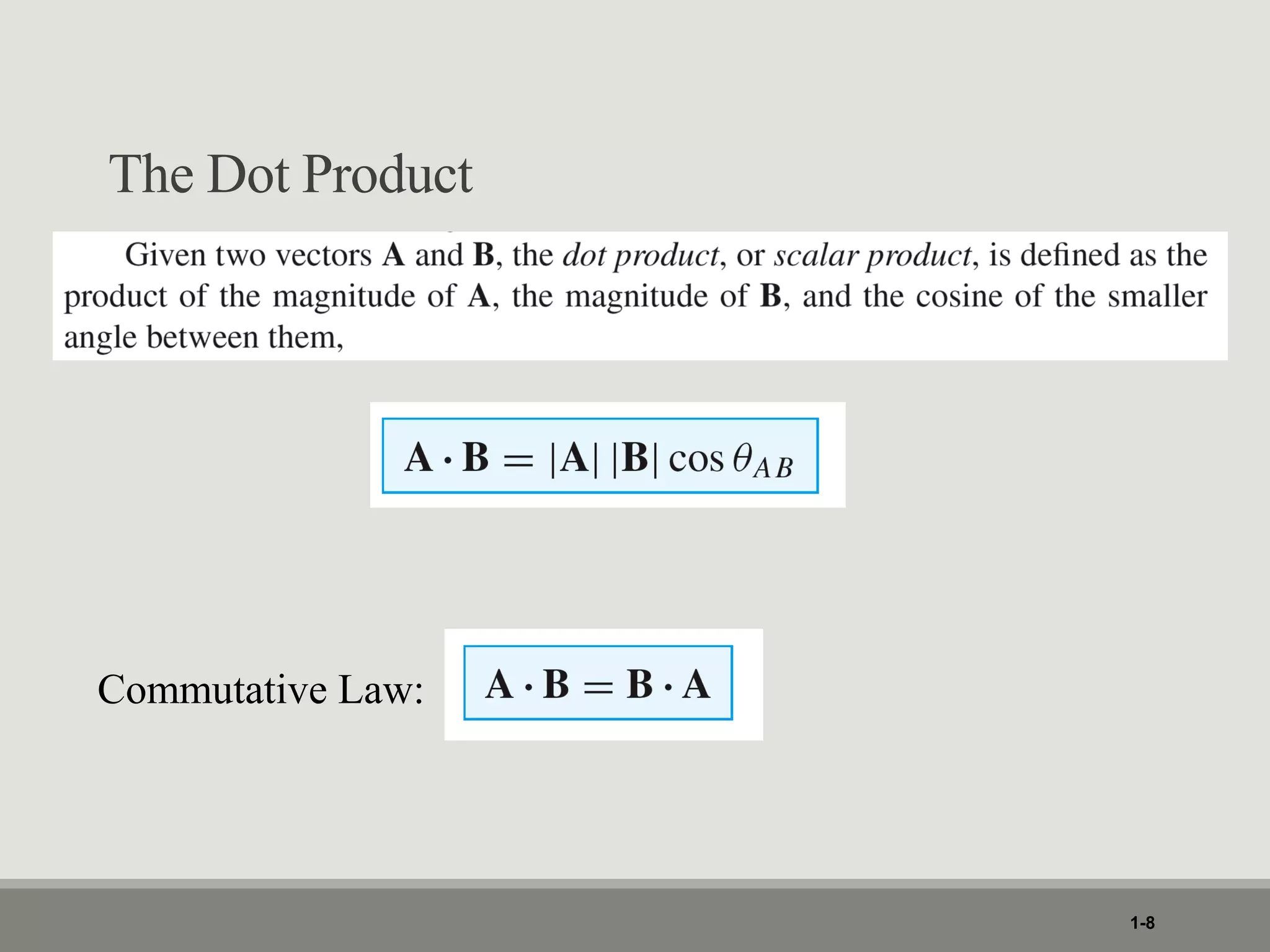
The Dot Product
1-8
Commutative Law:
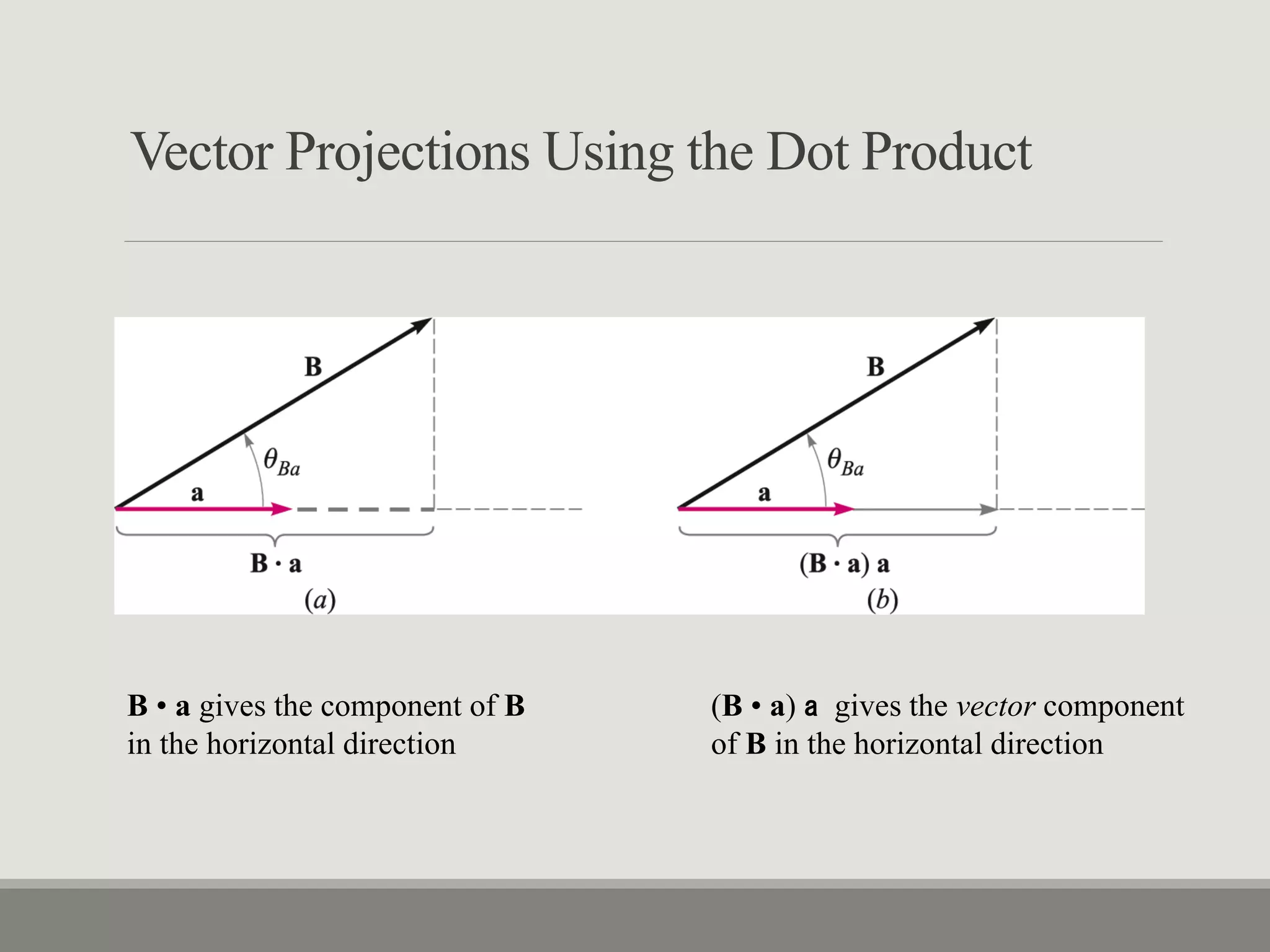
Vector Projections Using the Dot Product
B • a gives the component of B
in the horizontal direction
(B • a) a gives the vector component
of B in the horizontal direction
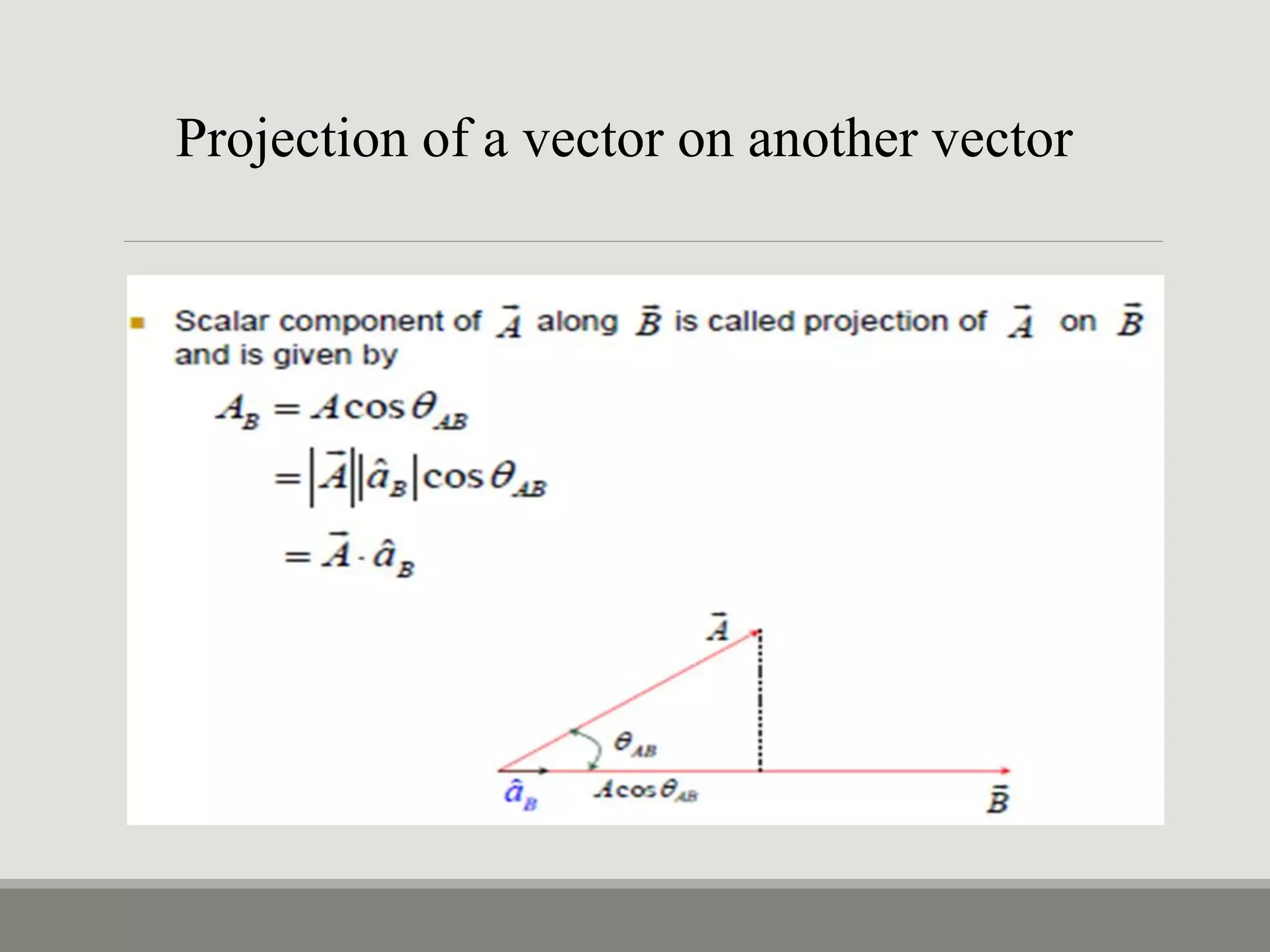
Projection of a vector on another vector
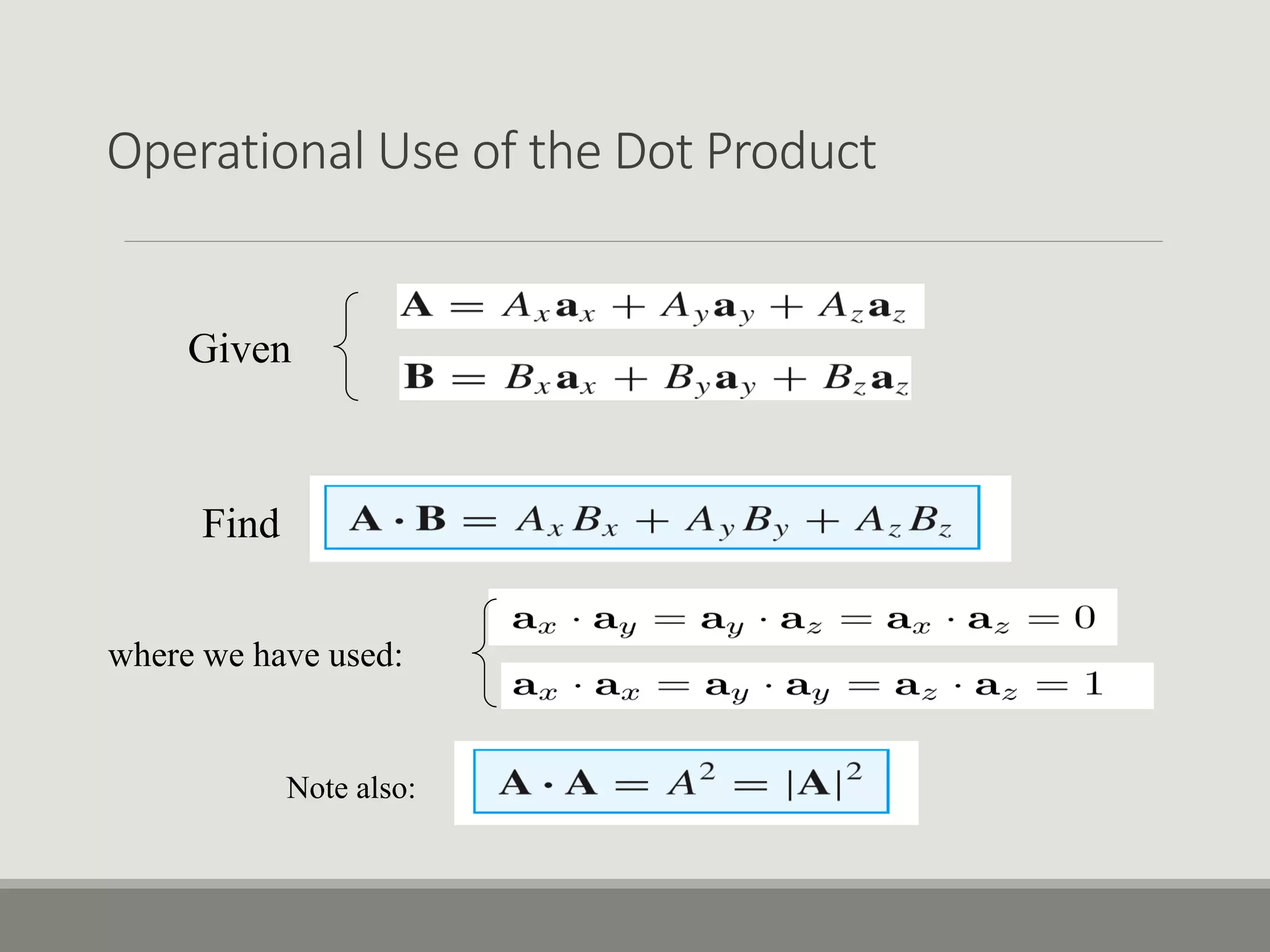
Operational Use of the Dot Product
Given
Find
where we have used:
Note also:
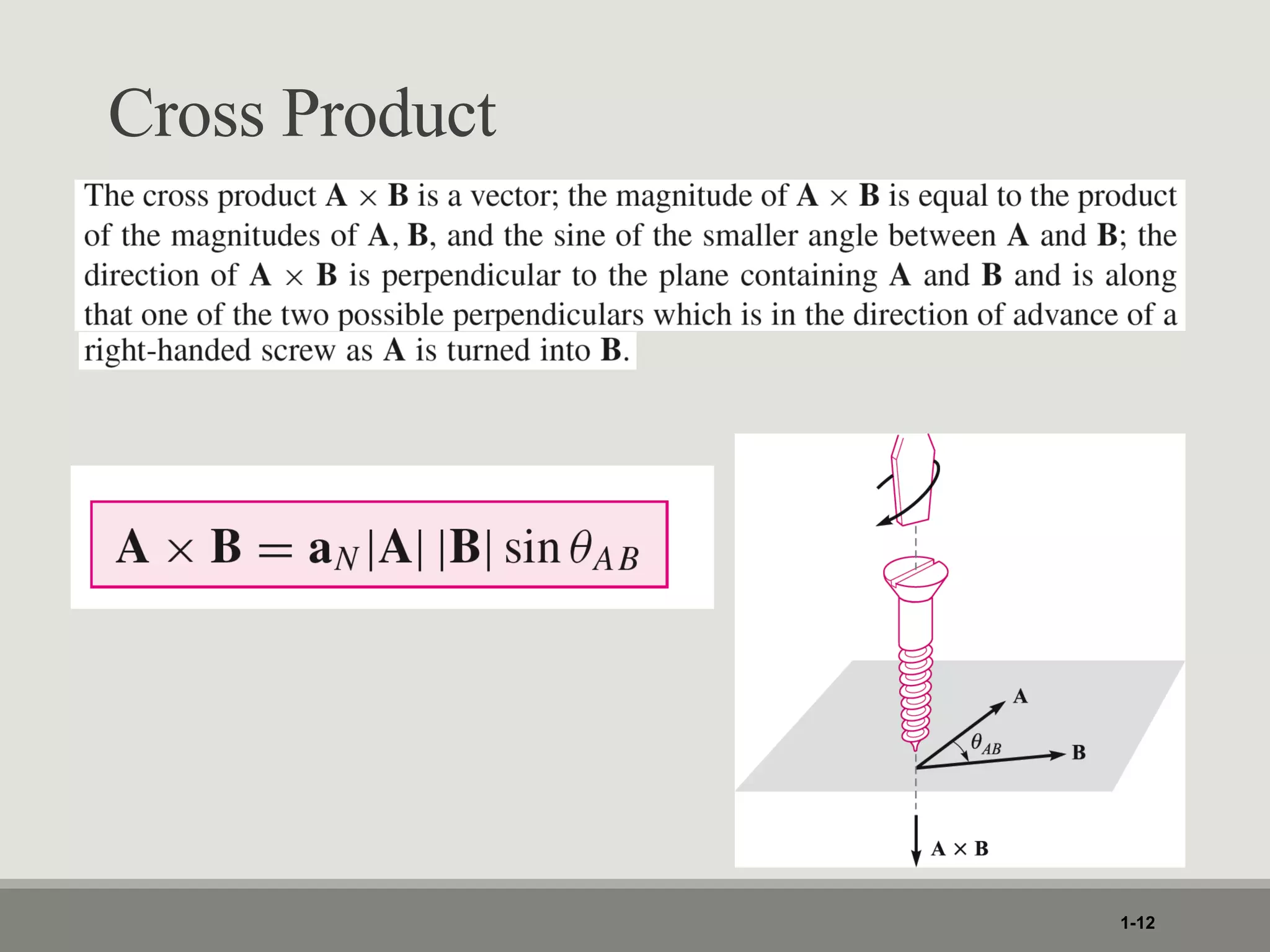
Cross Product
1-12
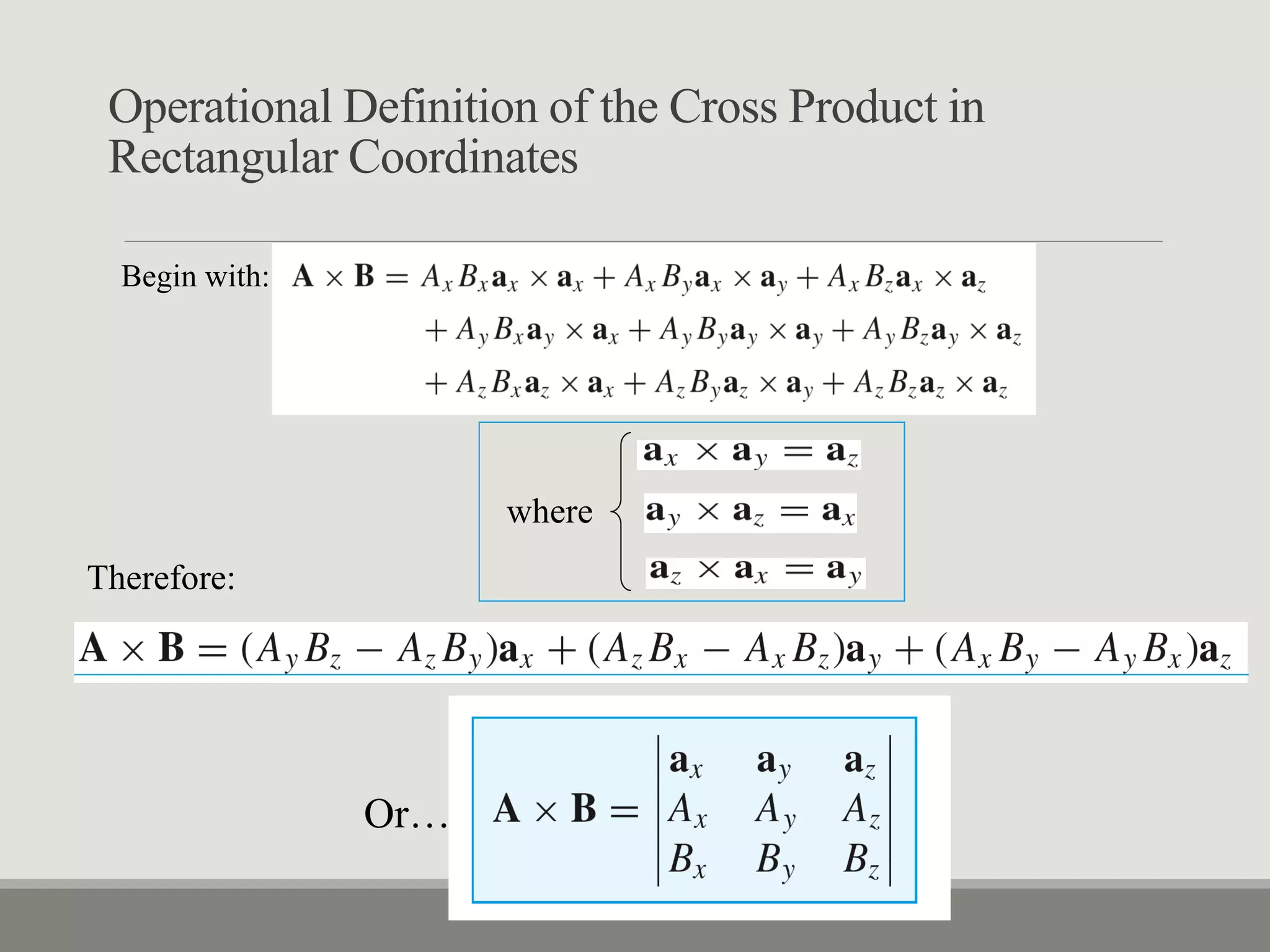
Operational Definition of the Cross Product in
Rectangular Coordinates
Therefore:
Or…
Begin with:
where
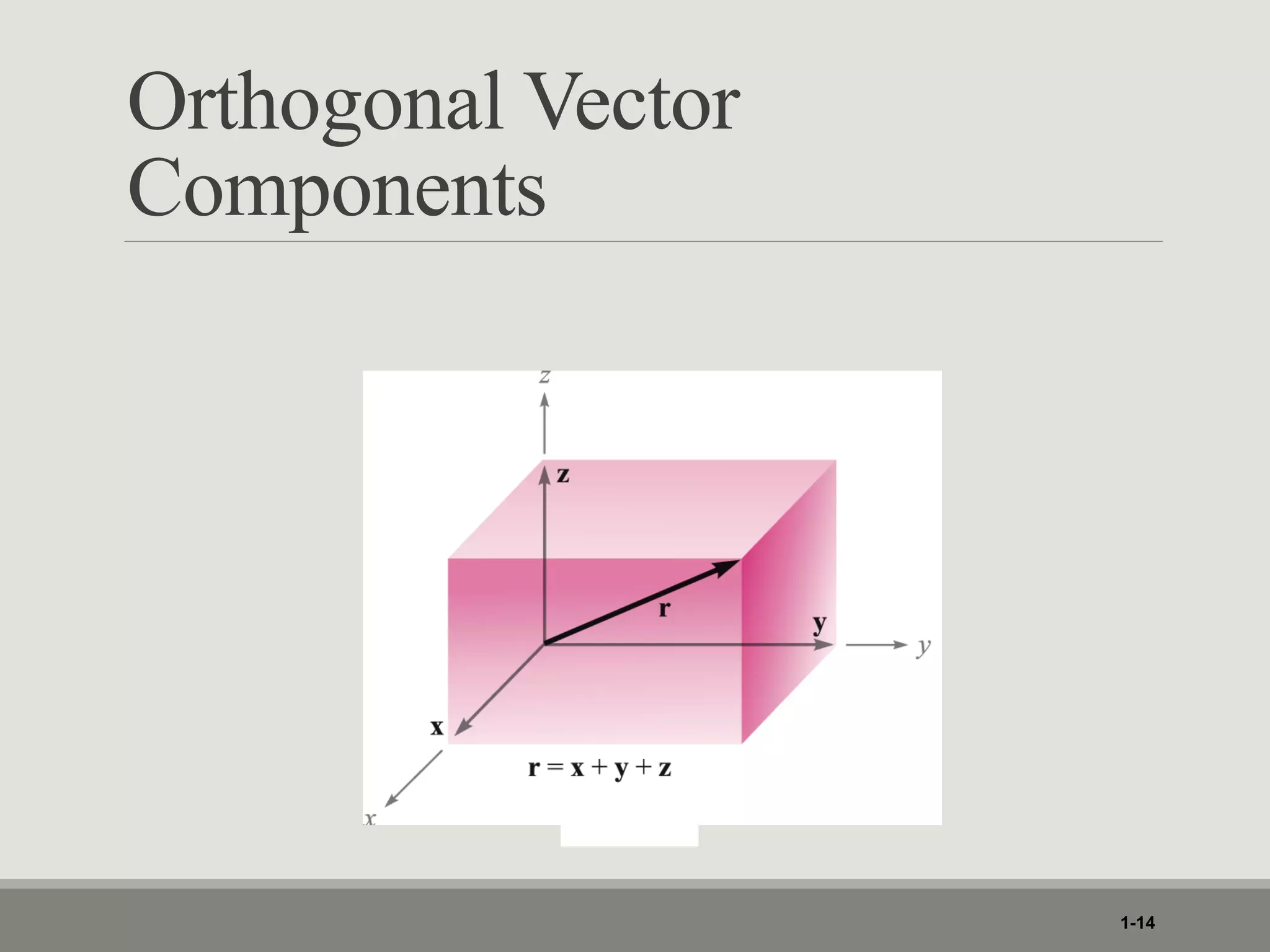
Orthogonal Vector
Components
1-14
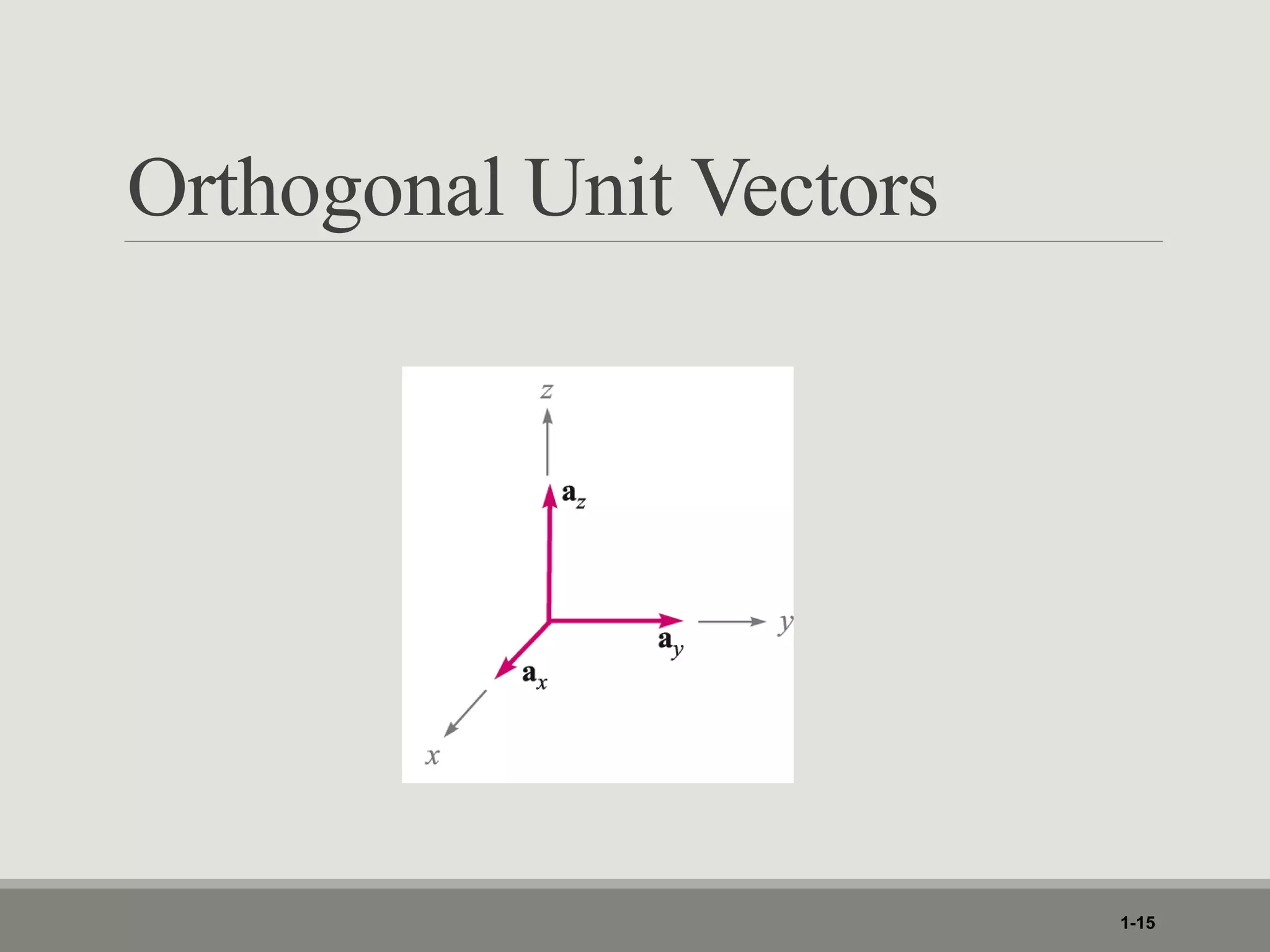
Orthogonal Unit Vectors
1-15
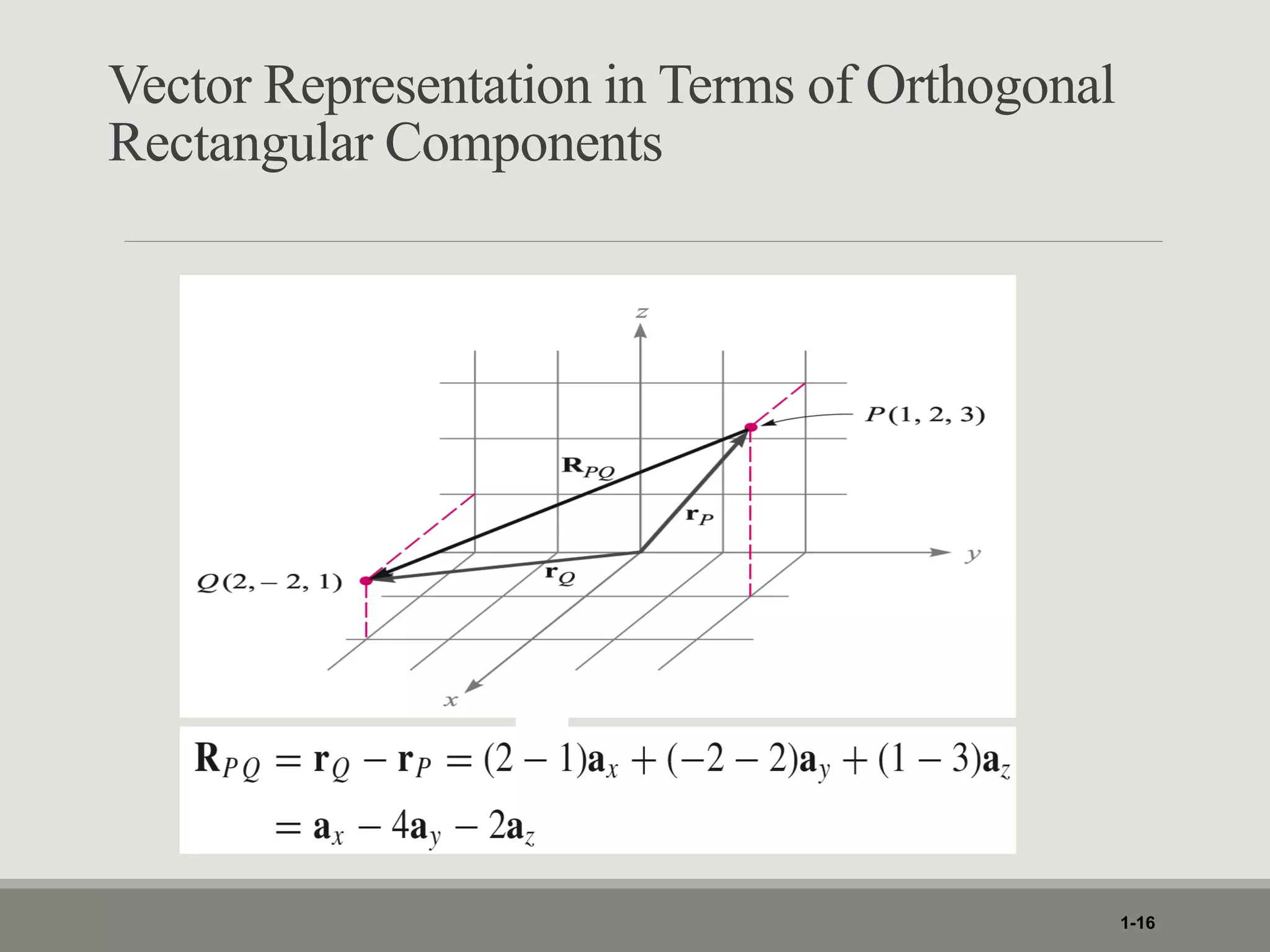
Vector Representation in Terms of Orthogonal
Rectangular Components
1-16
Co-ordinate System
To describe a vector accurately such as lengths, angles, and
projections etc…
Three types of Co-ordinate system
 Rectangular (or) Cartesian Co-ordinates
 Cylindrical Co-ordinates
 Spherical Co-ordinates
1-17
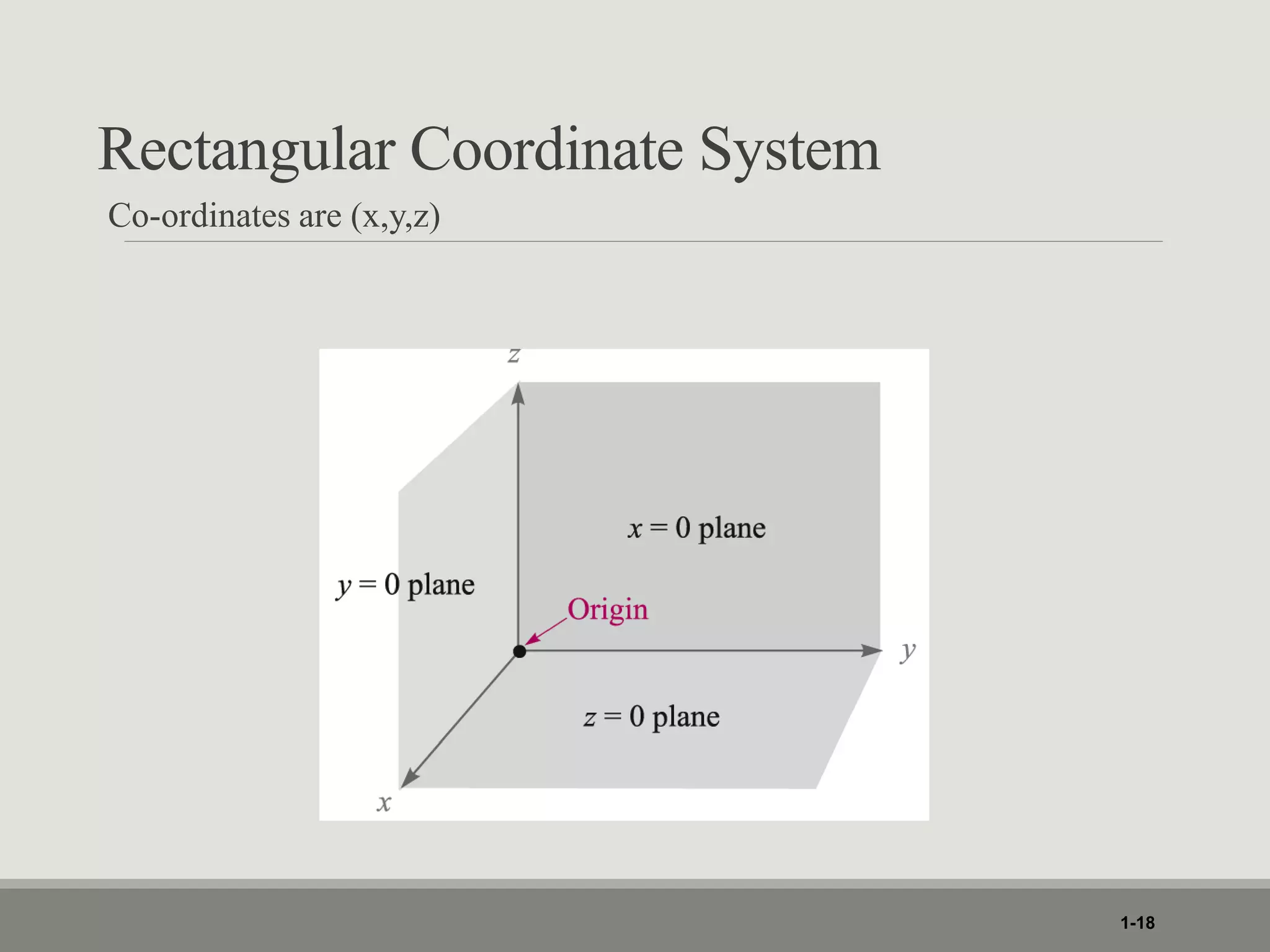
Rectangular Coordinate System
Co-ordinates are (x,y,z)
1-18
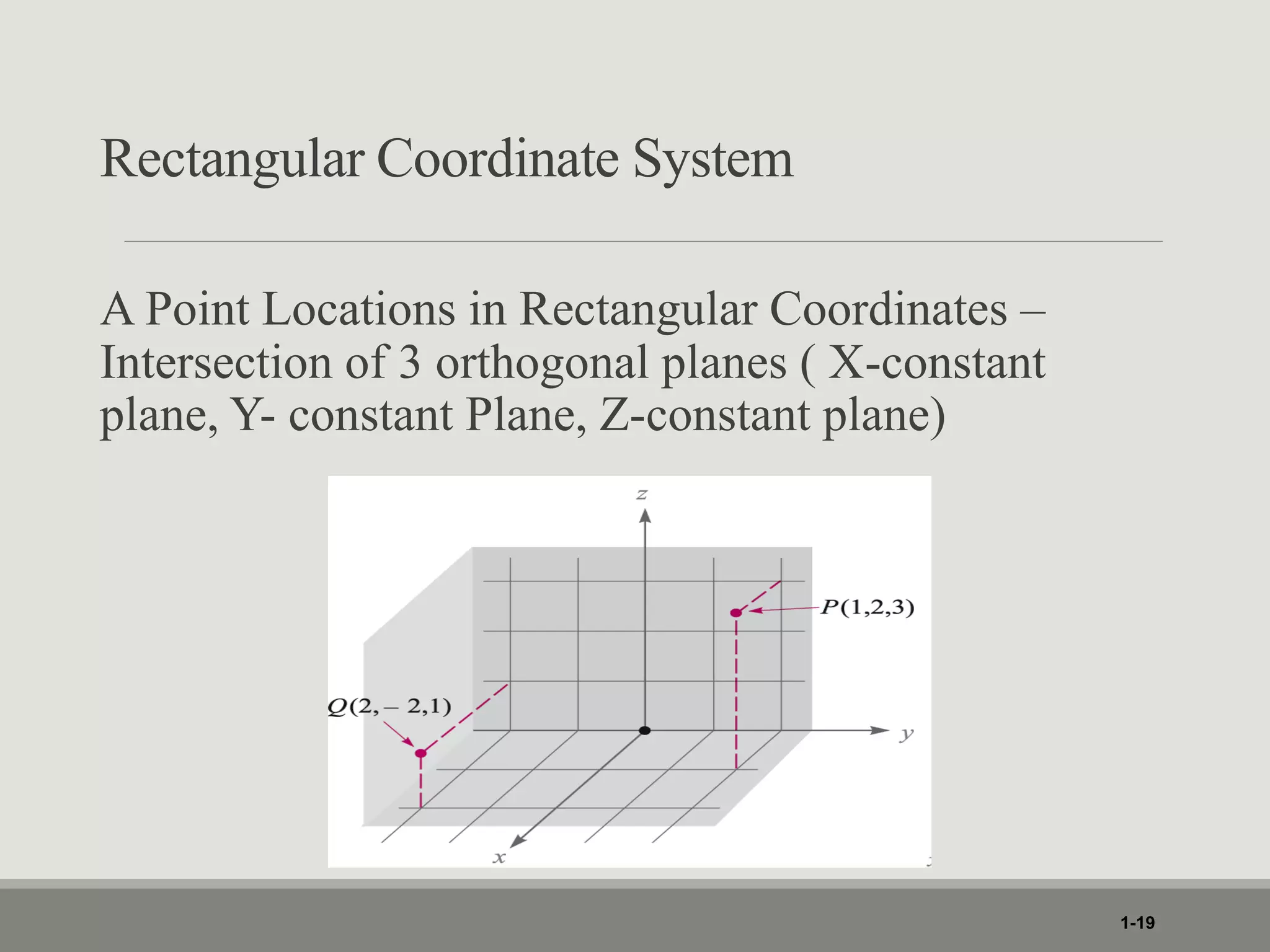
Rectangular Coordinate System
A Point Locations in Rectangular Coordinates –
Intersection of 3 orthogonal planes ( X-constant
plane, Y- constant Plane, Z-constant plane)
1-19
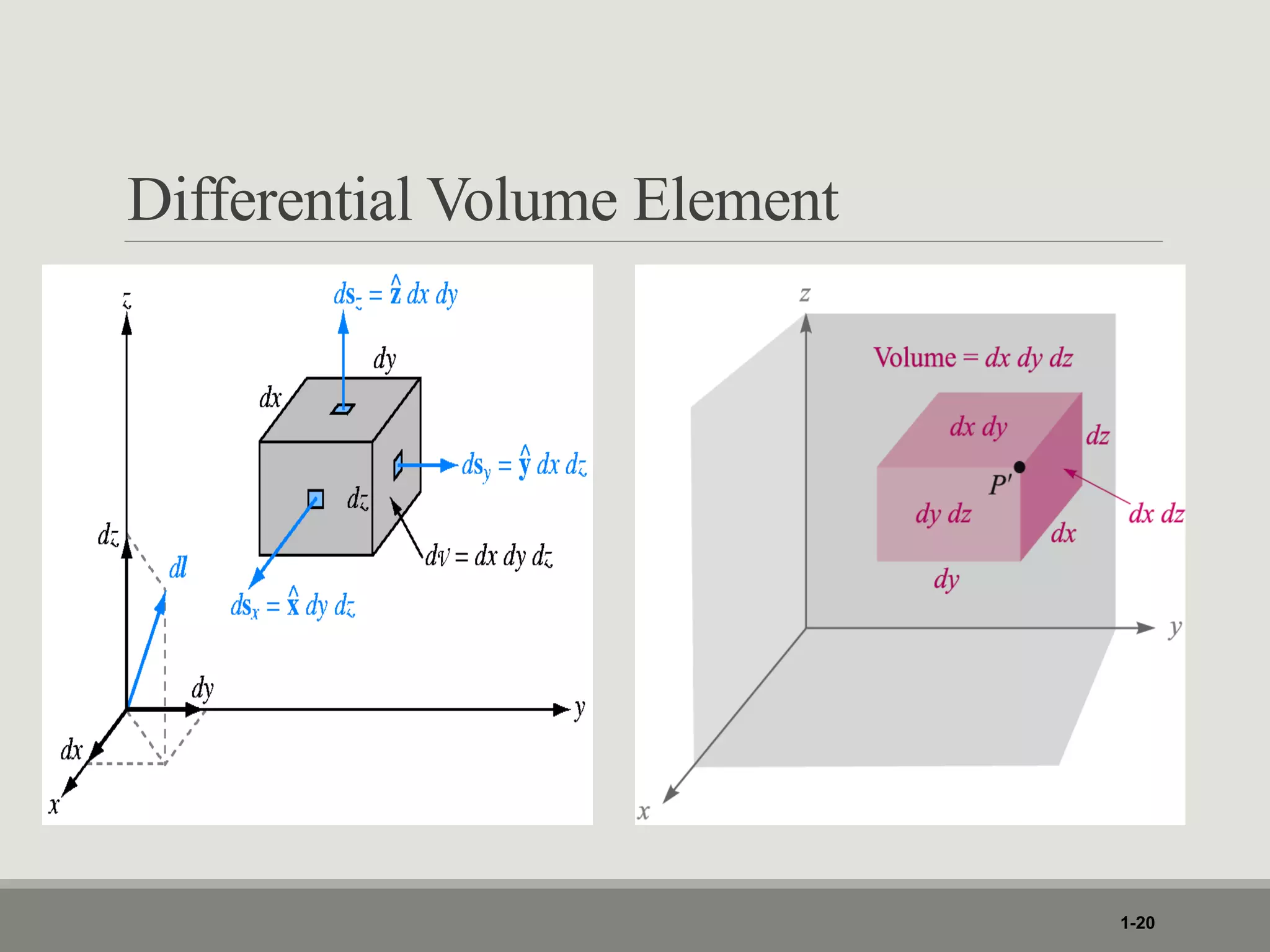
Differential Volume Element
1-20
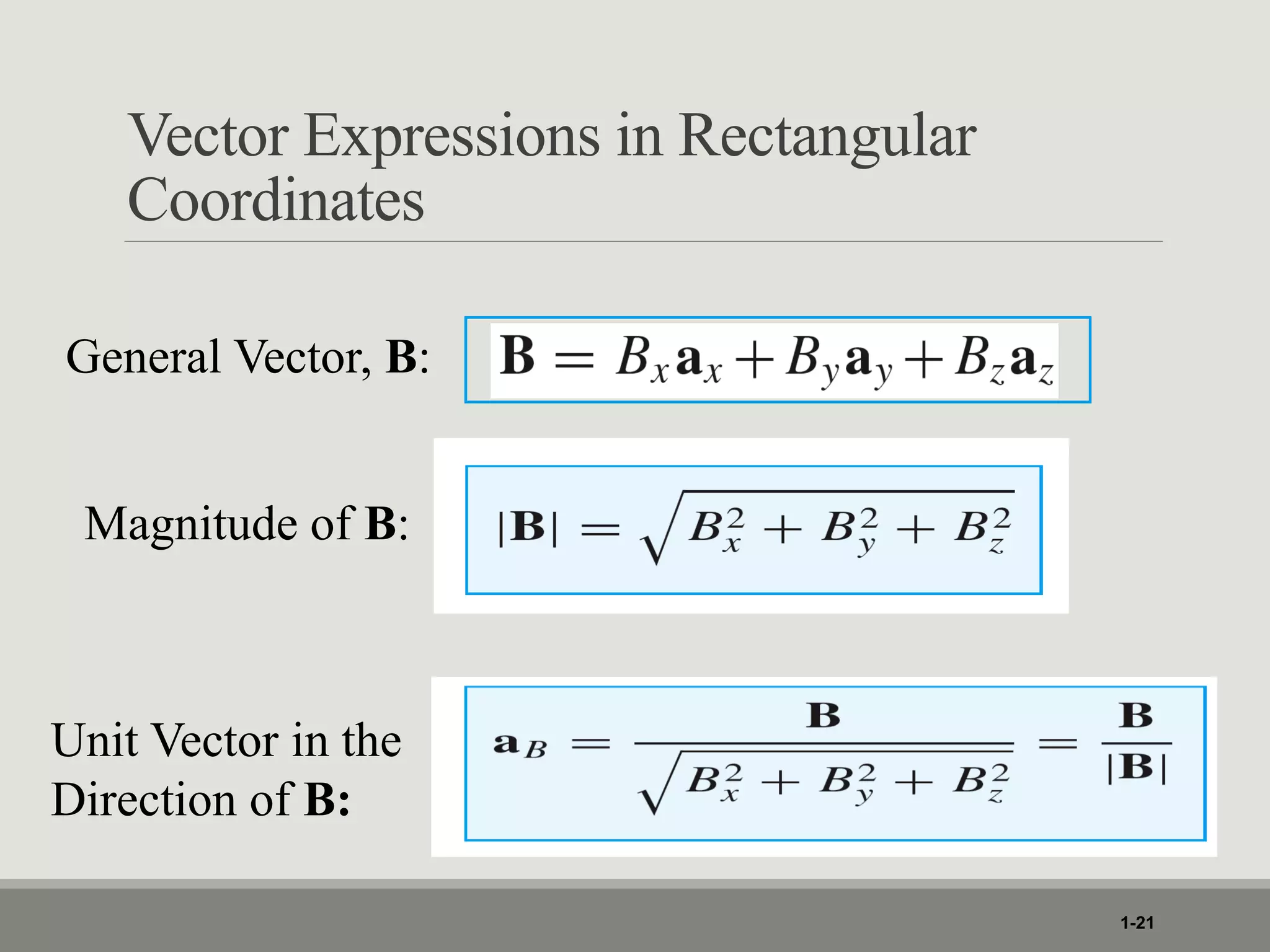
Vector Expressions in Rectangular
Coordinates
1-21
General Vector, B:
Magnitude of B:
Unit Vector in the
Direction of B:
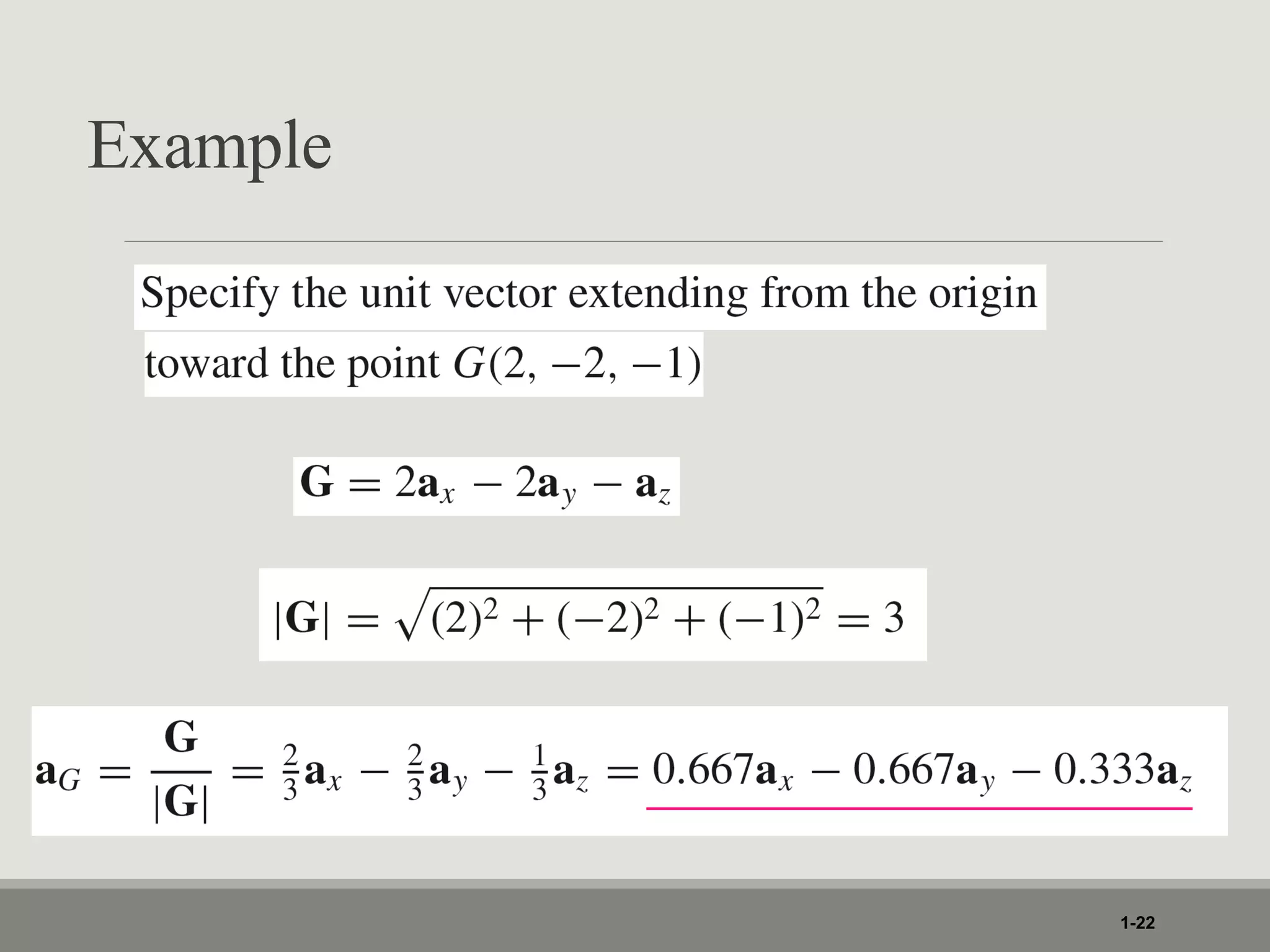
Example
1-22
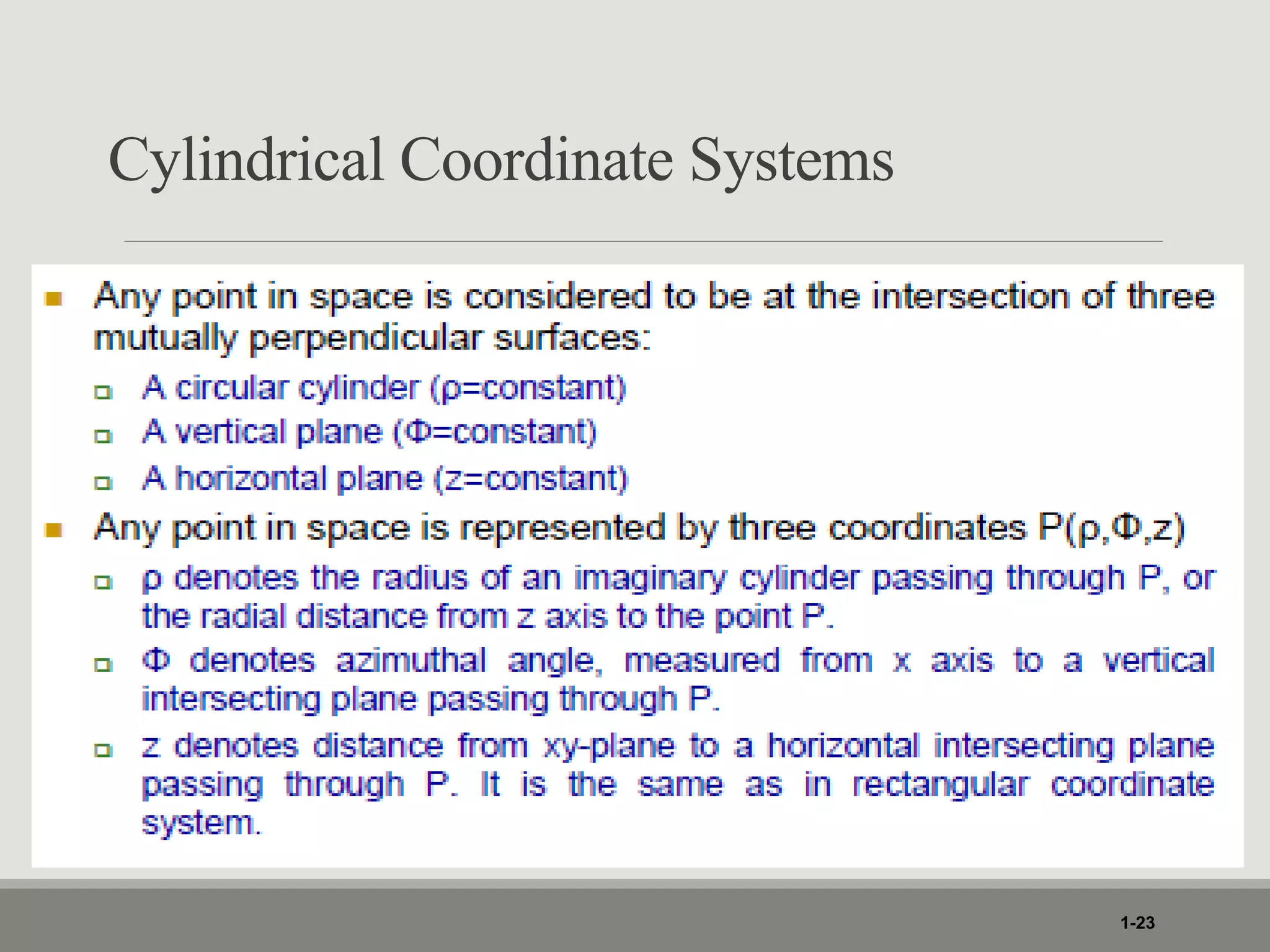
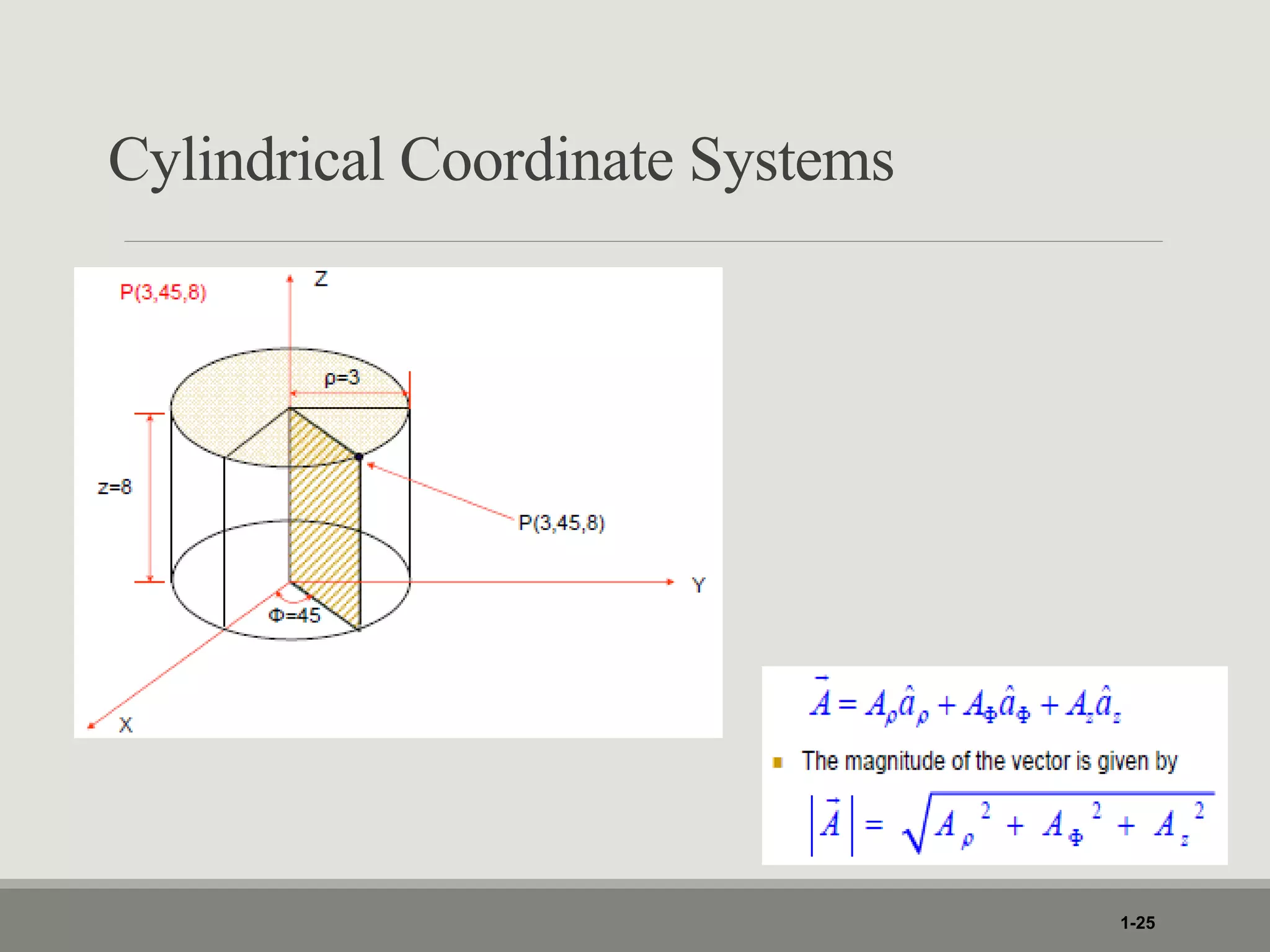
Cylindrical Coordinate Systems
1-23
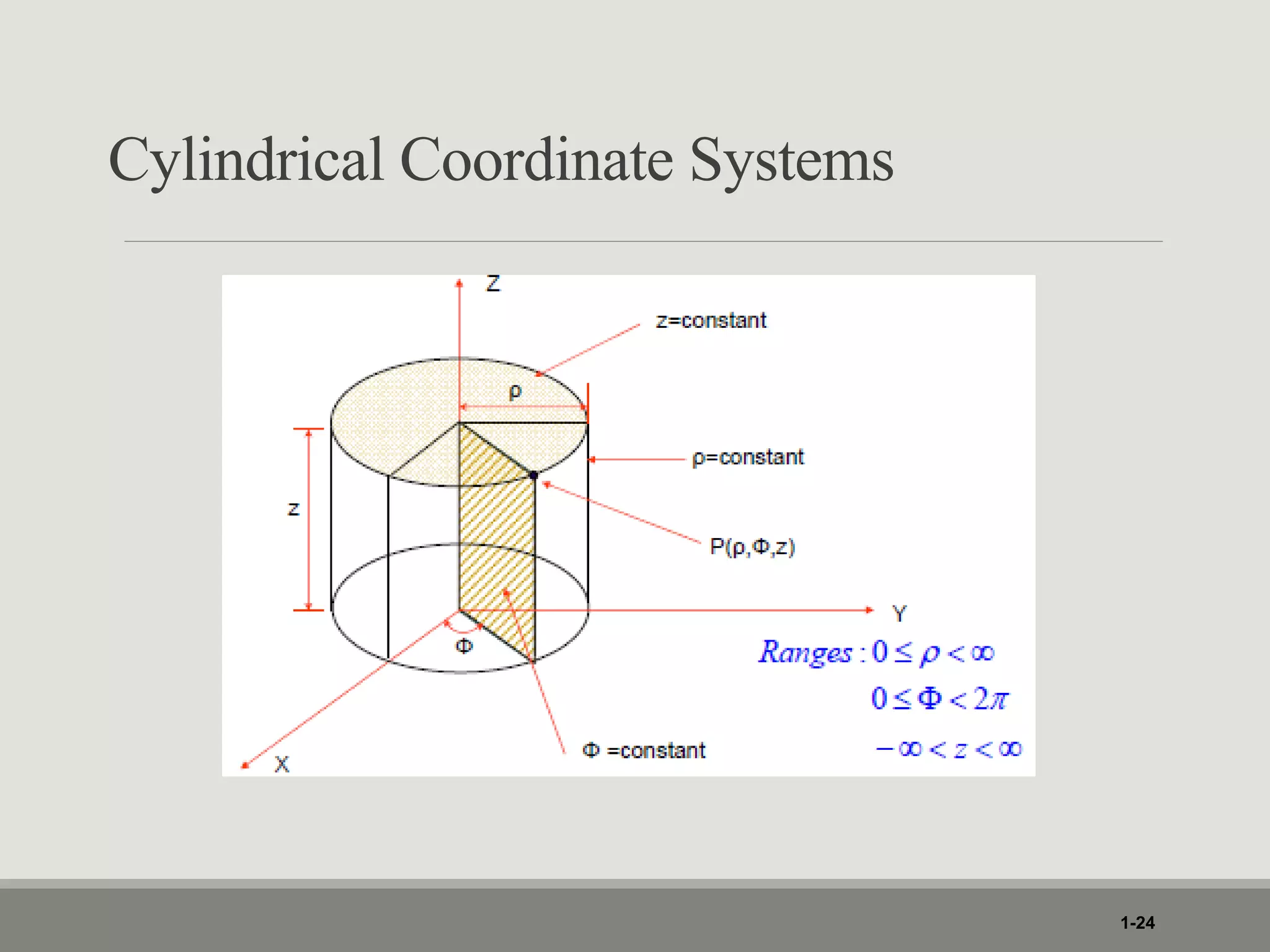
Cylindrical Coordinate Systems
1-24
Cylindrical Coordinate Systems
1-25
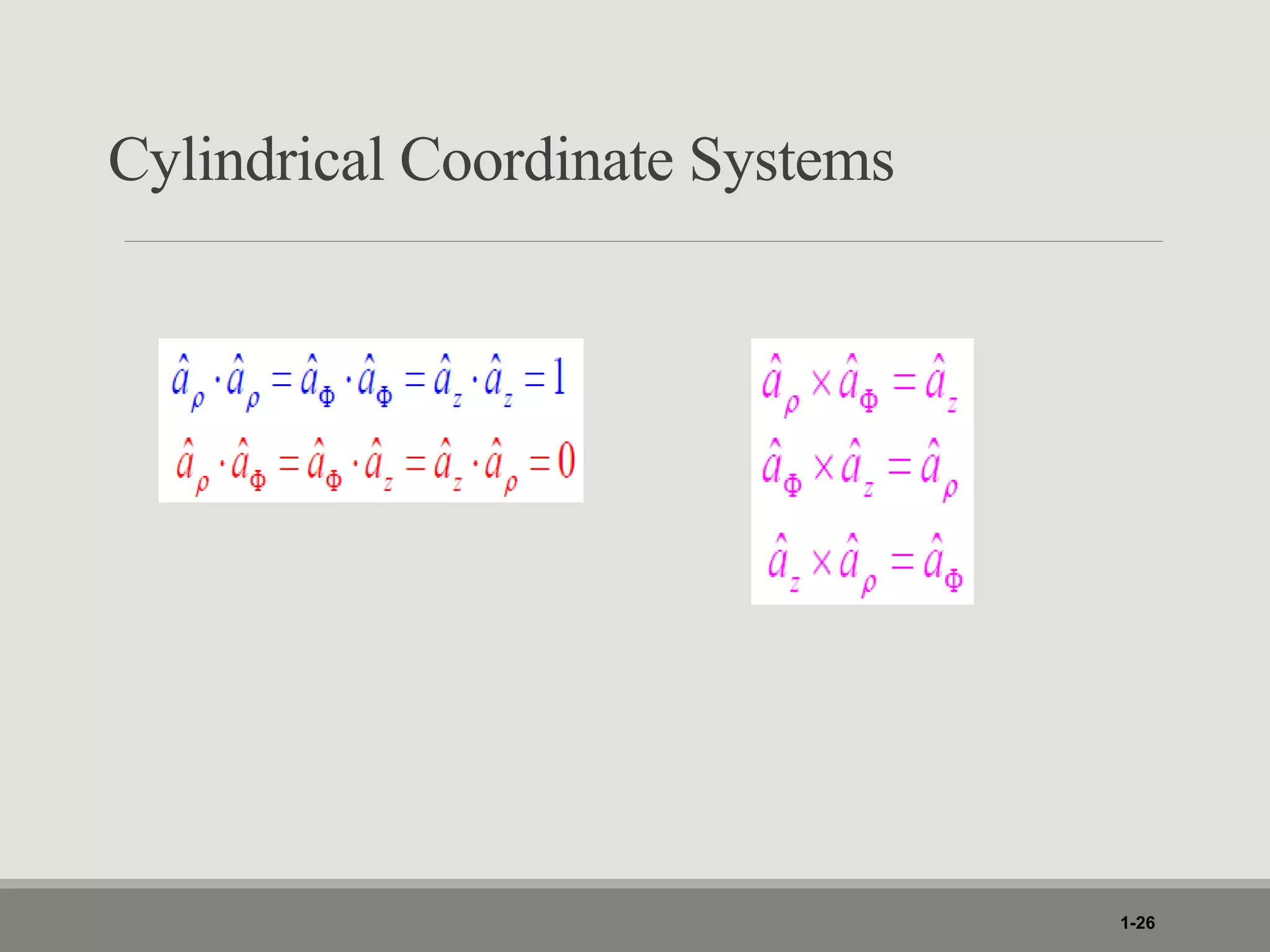
Cylindrical Coordinate Systems
1-26
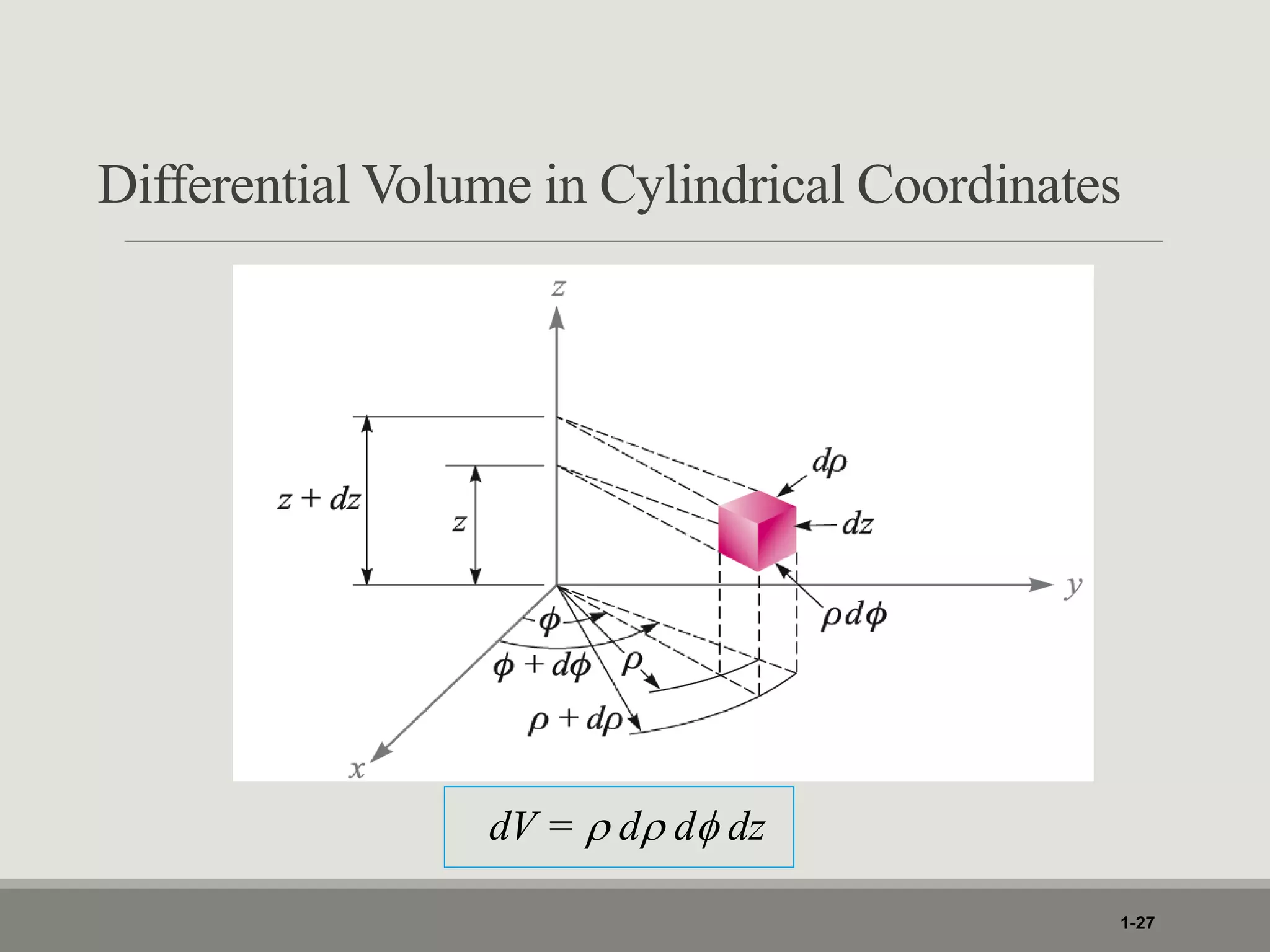
Differential Volume in Cylindrical Coordinates
1-27
dV = dddz
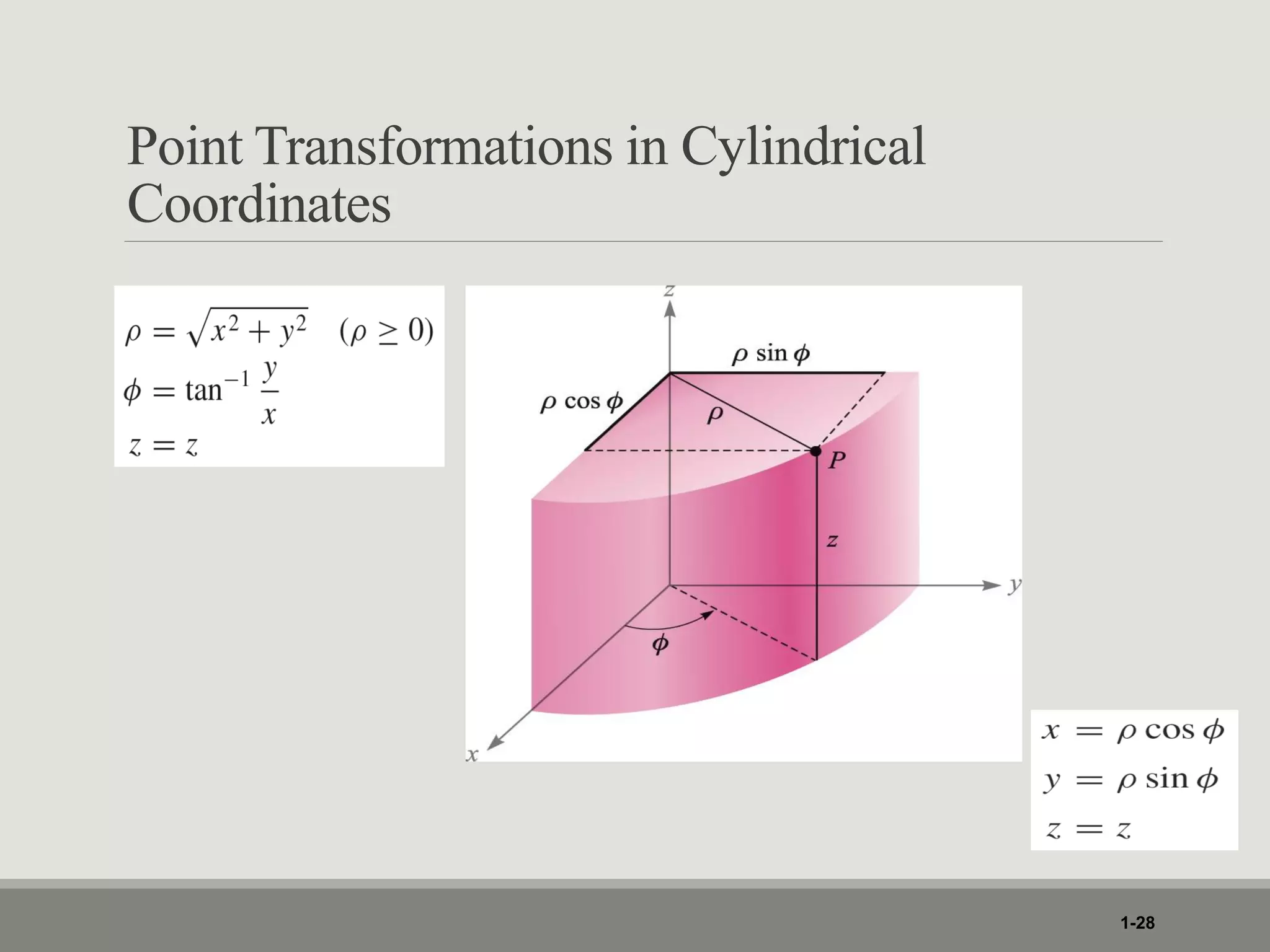
Point Transformations in Cylindrical
Coordinates
1-28
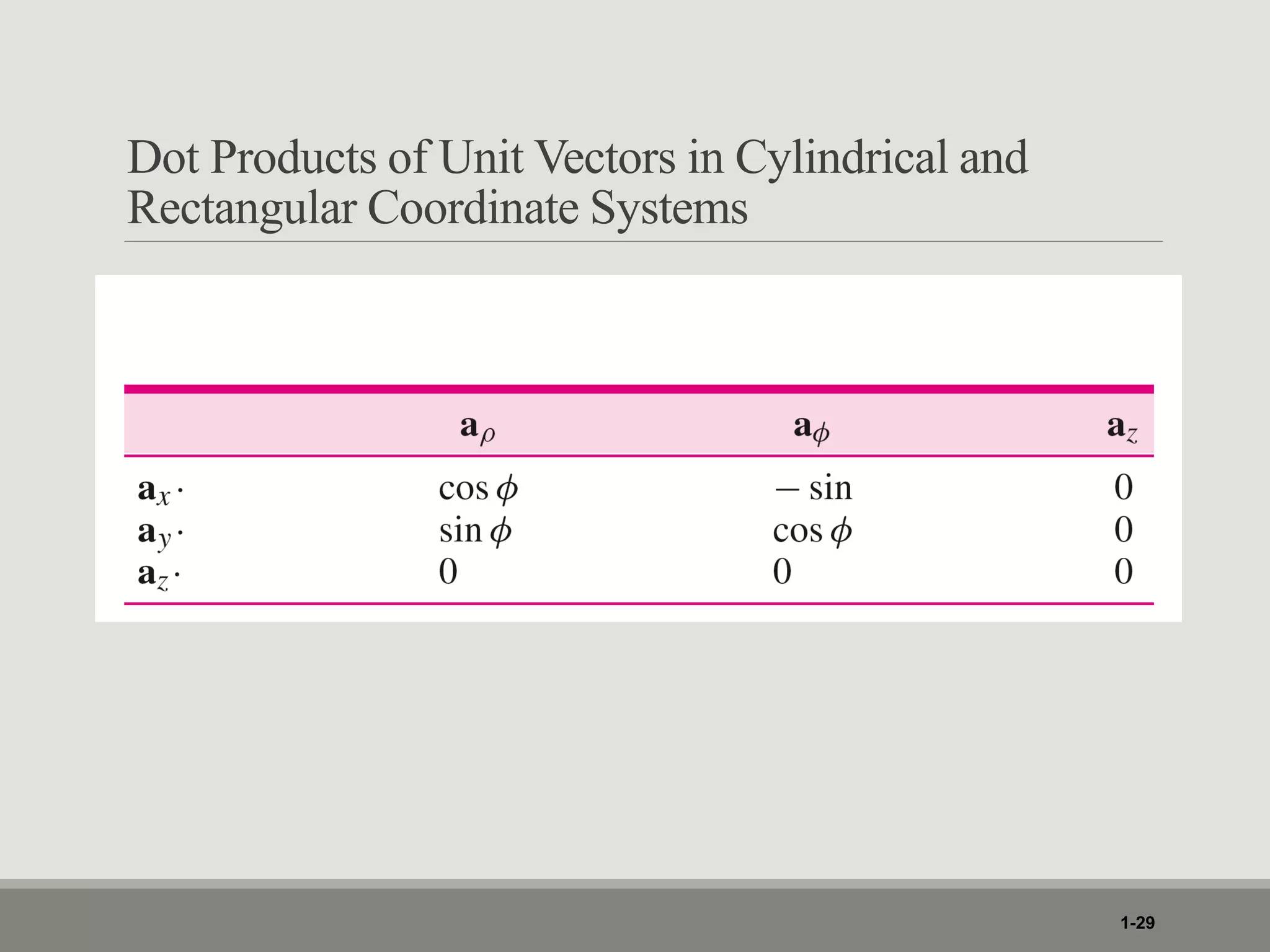
Dot Products of Unit Vectors in Cylindrical and
Rectangular Coordinate Systems
1-29
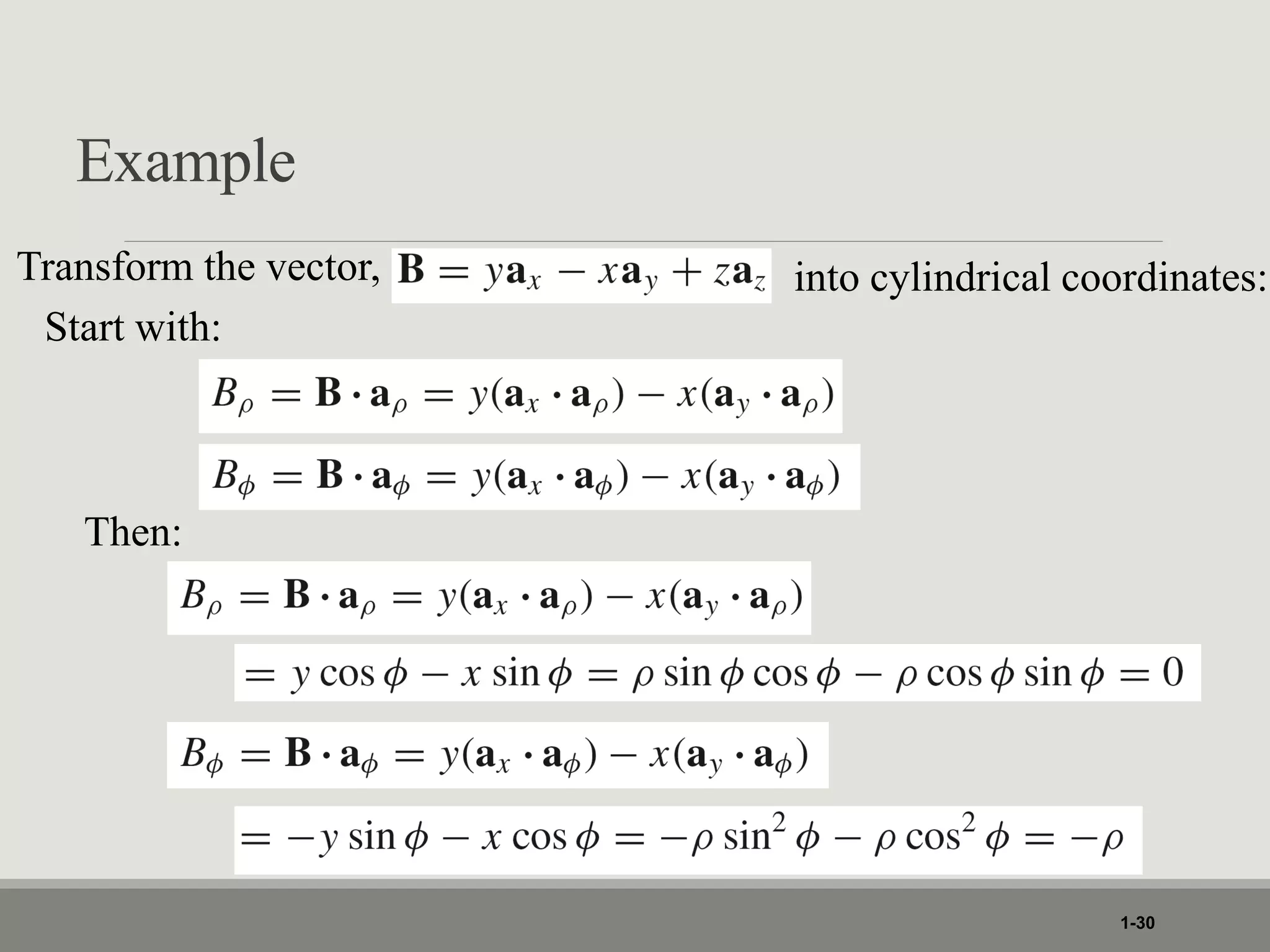
Example
1-30
Transform the vector, into cylindrical coordinates:
Start with:
Then:
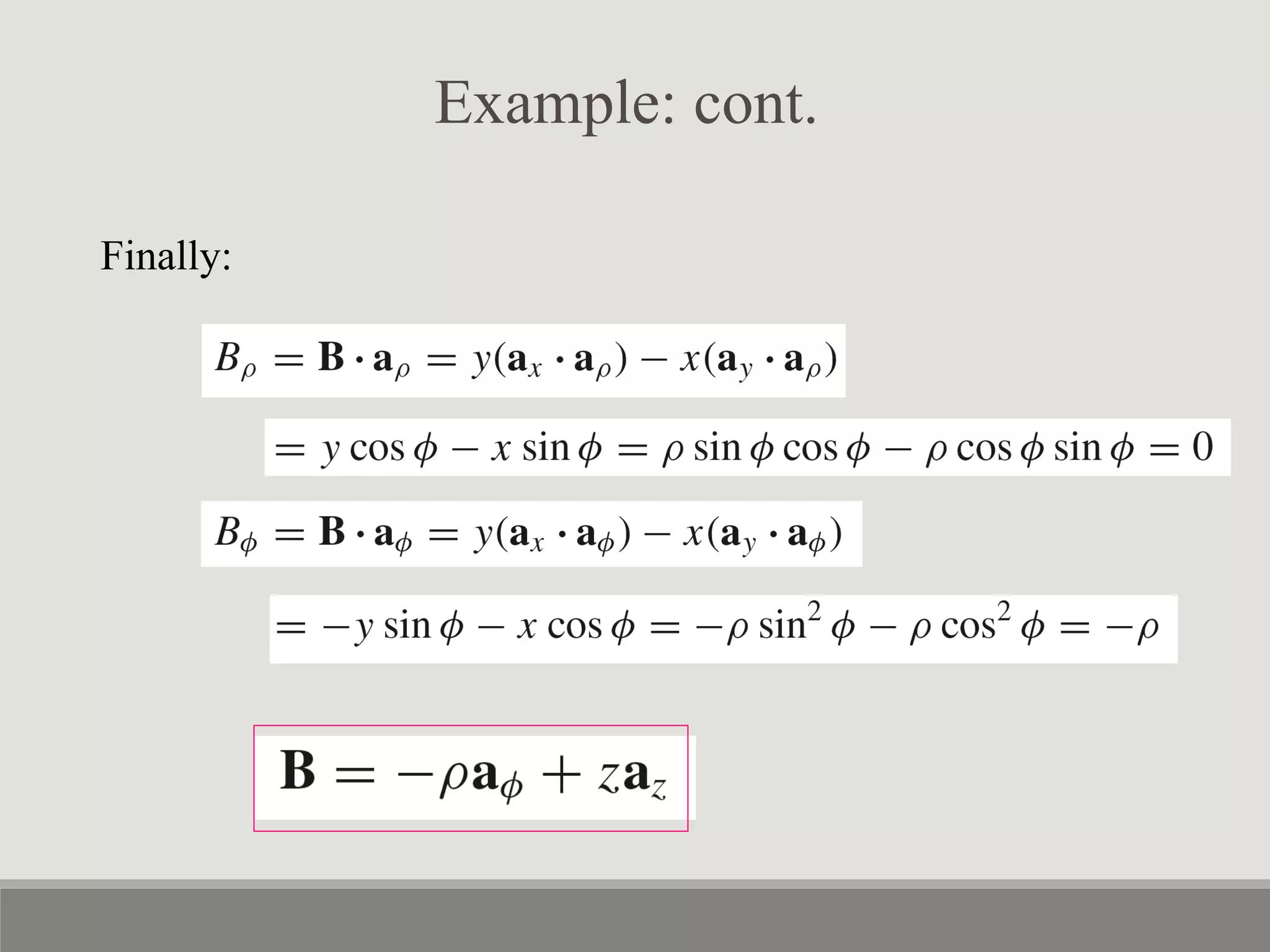
Finally:
Example: cont.
1-32
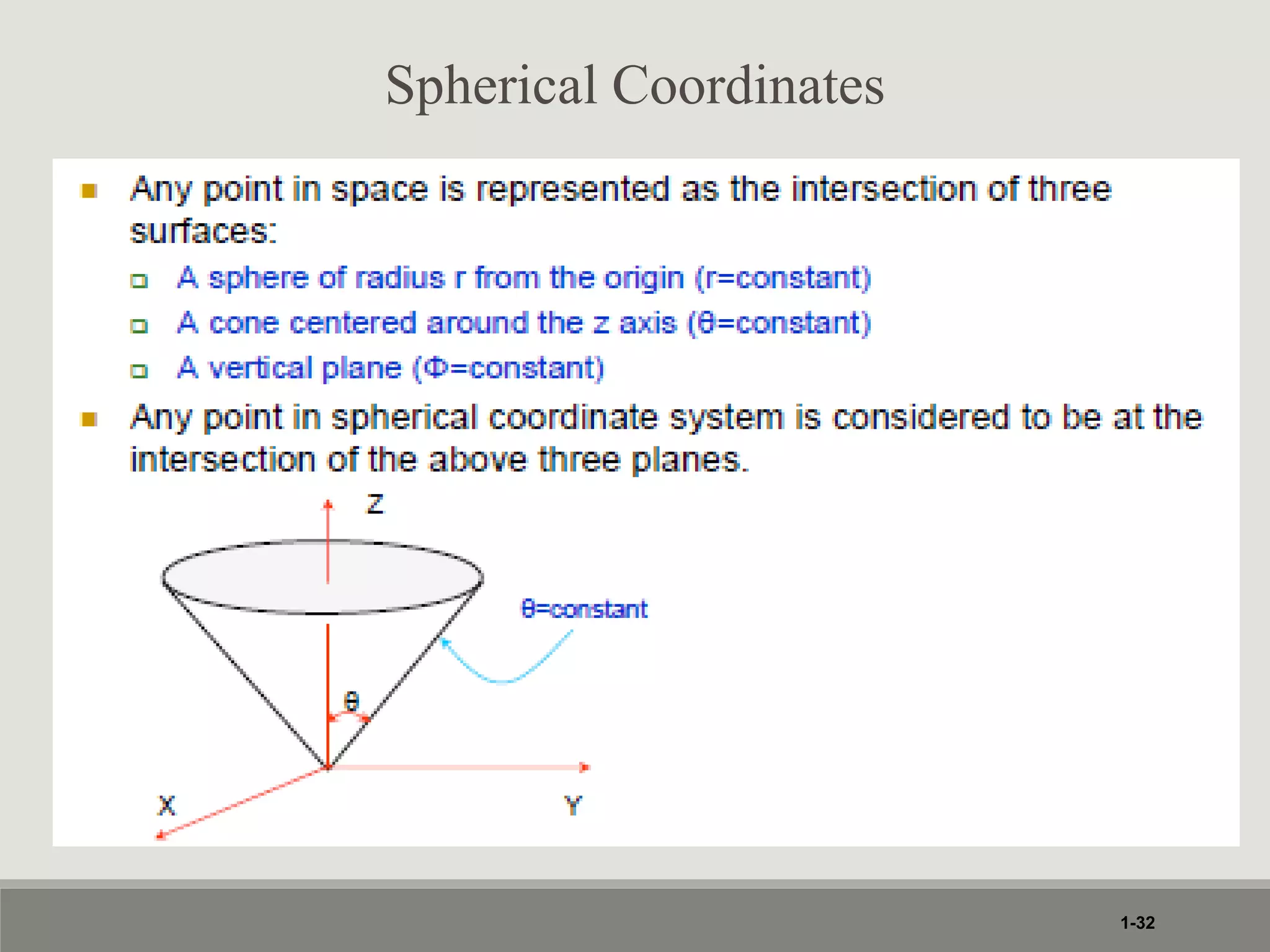
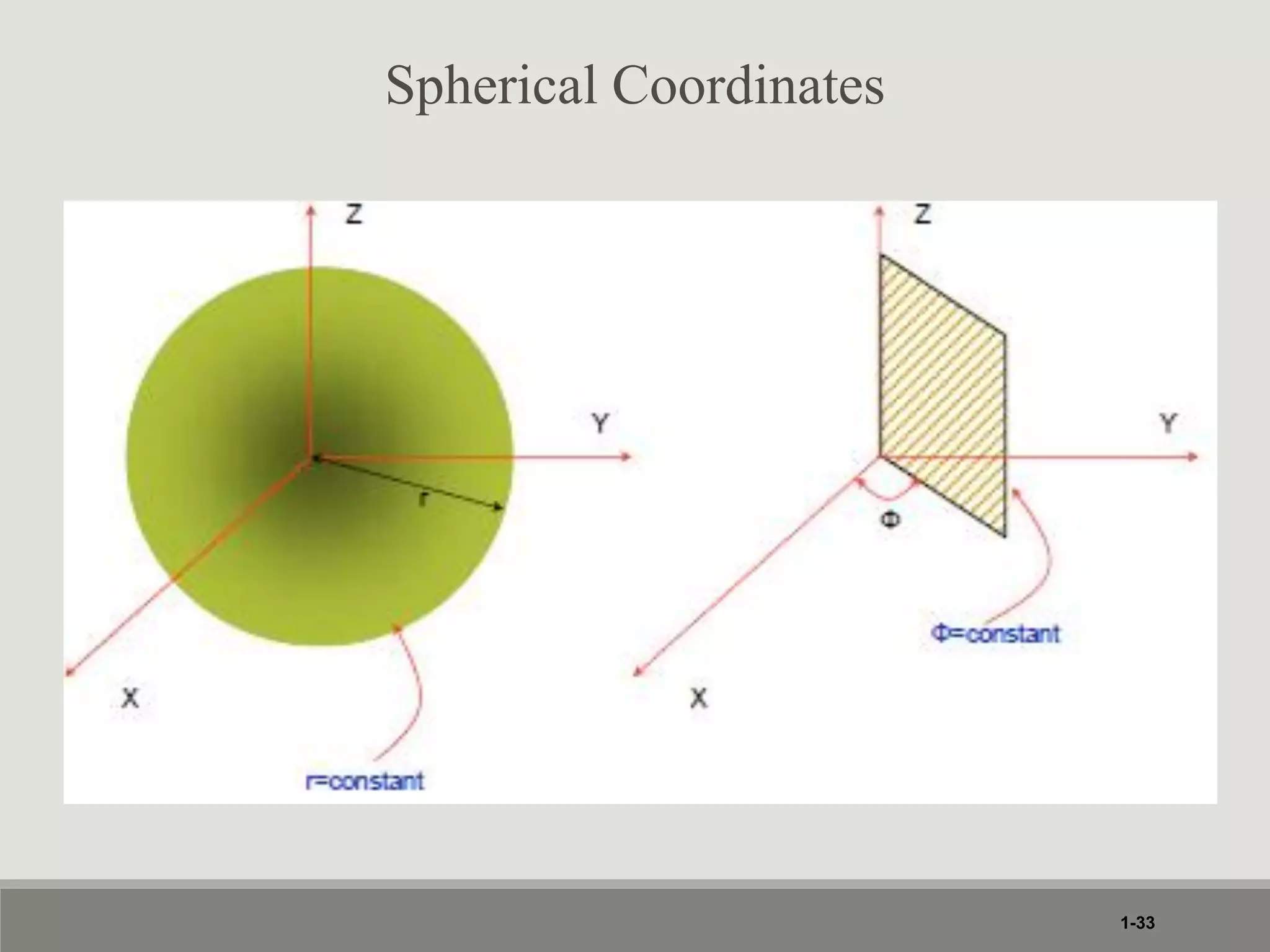
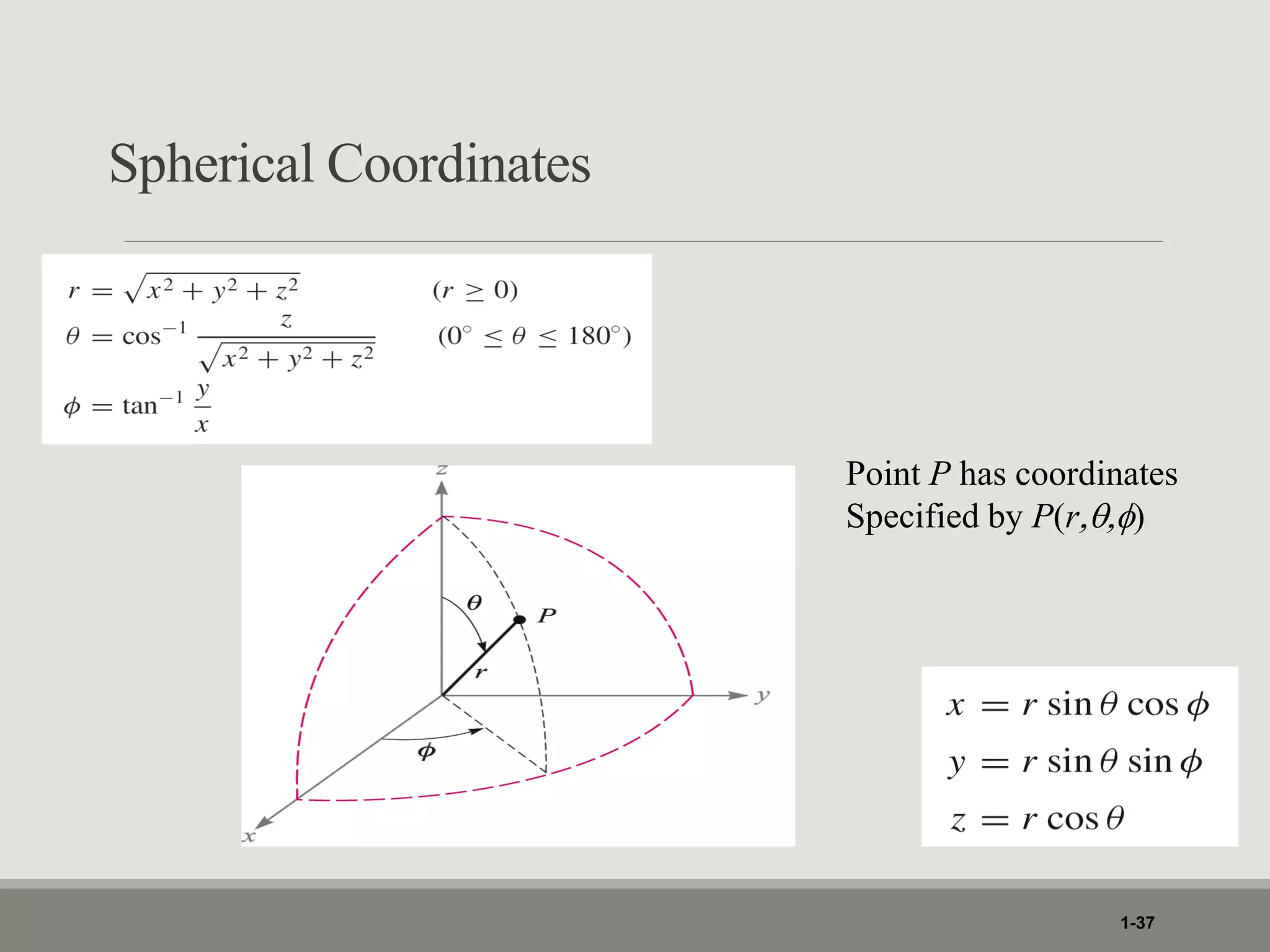
Spherical Coordinates
1-33
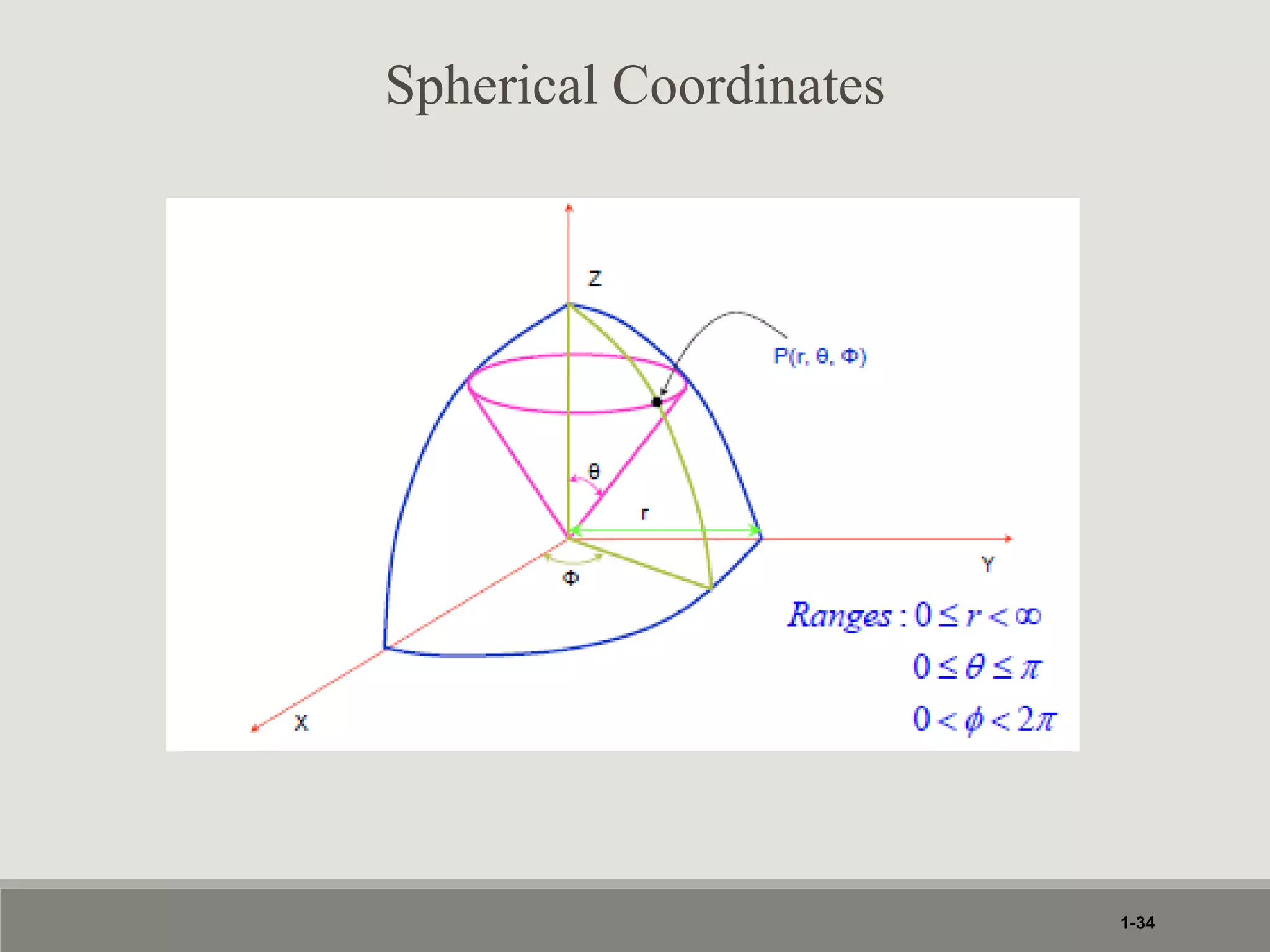
Spherical Coordinates
1-34
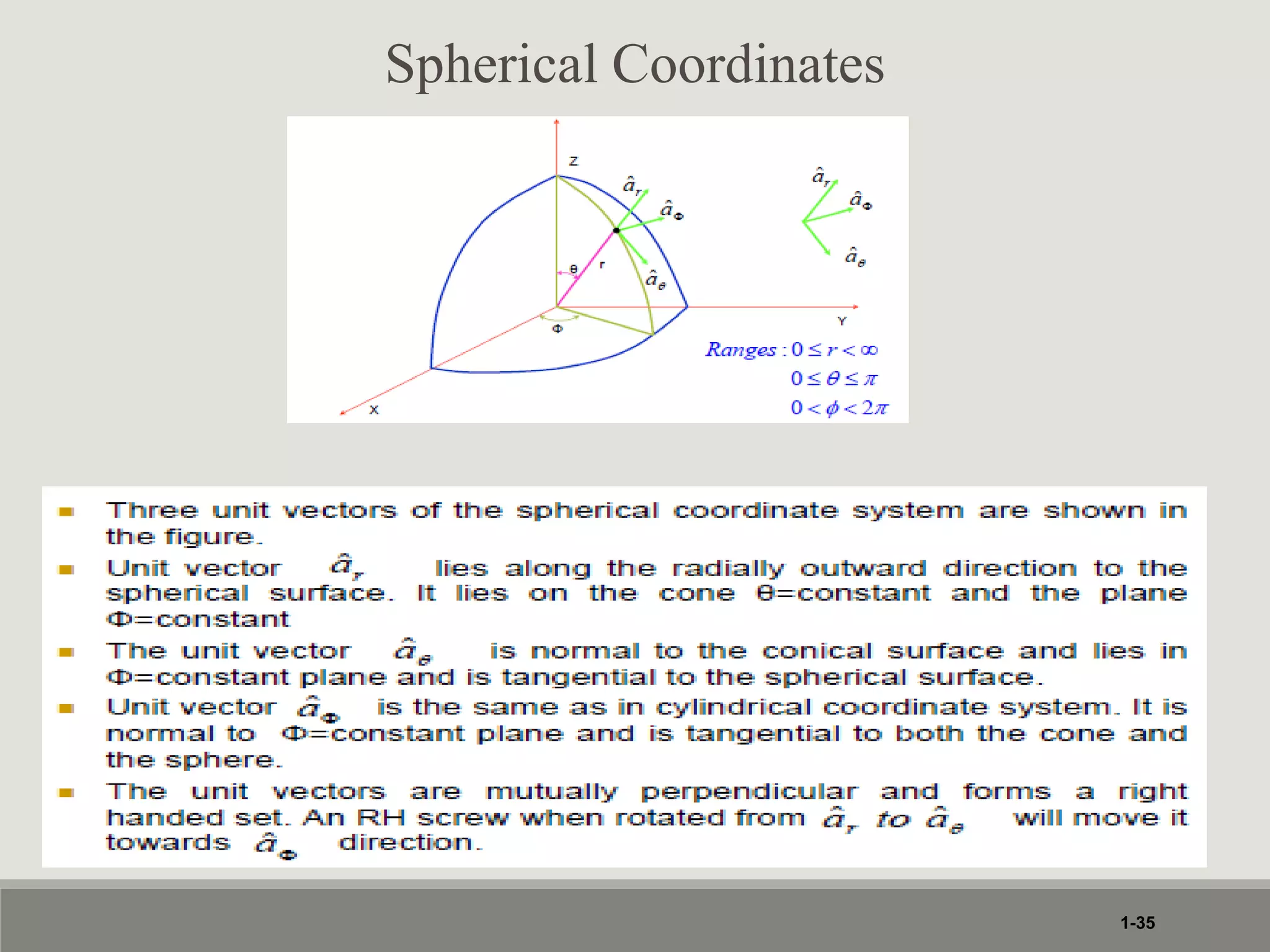
Spherical Coordinates
1-35
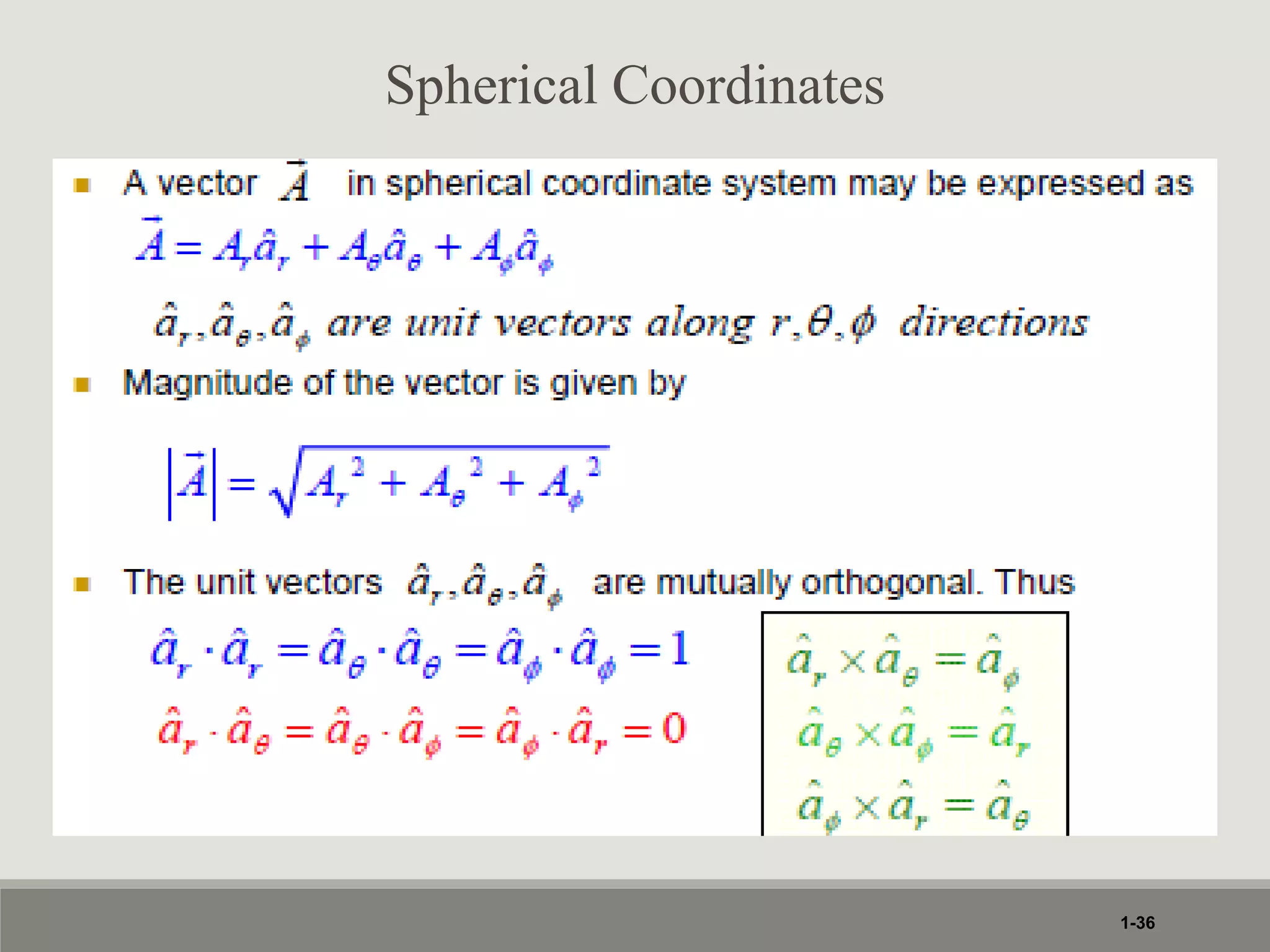
Spherical Coordinates
1-36
Spherical Coordinates
1-37
Point P has coordinates
Specified by P(r)
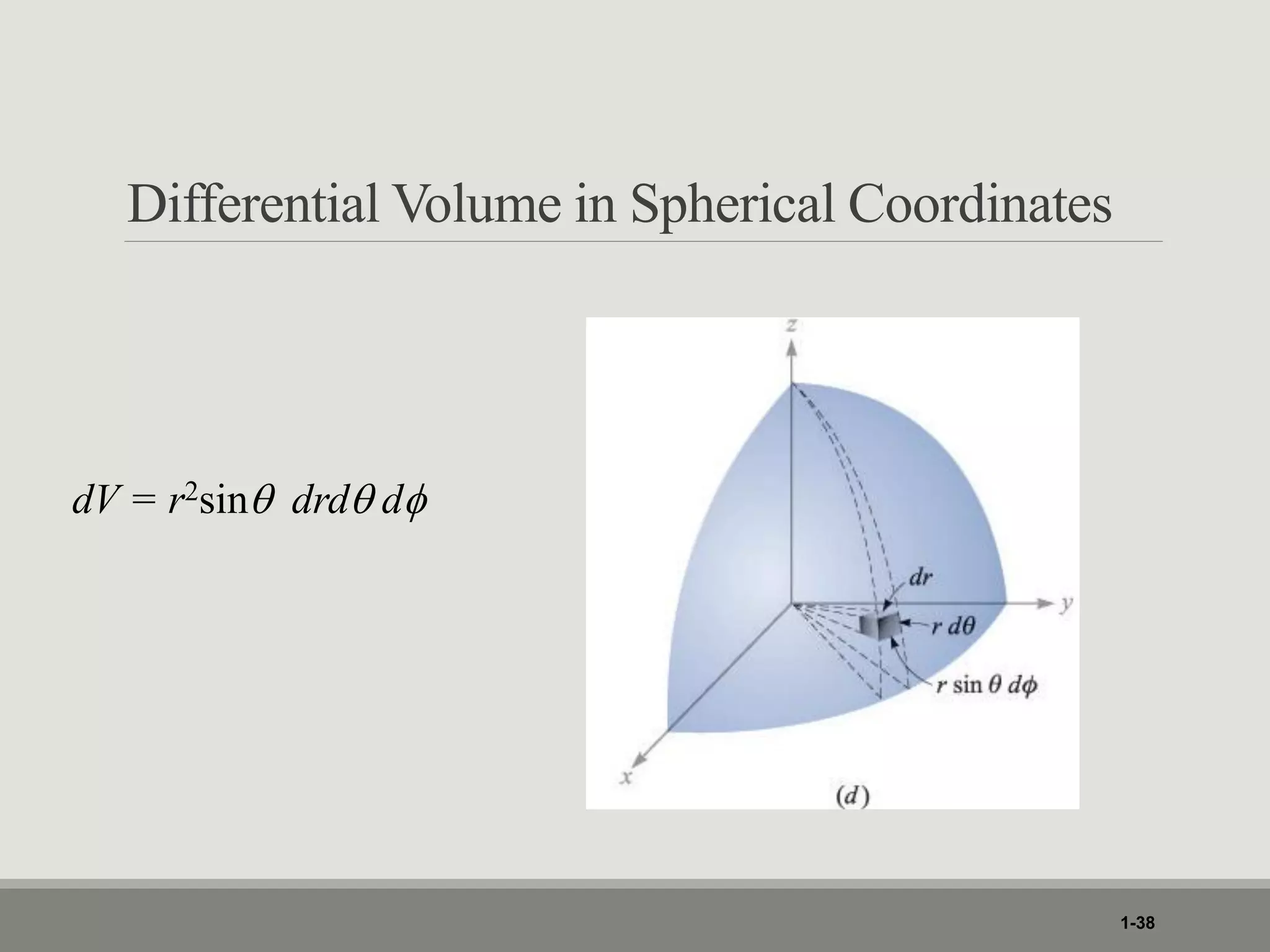
Differential Volume in Spherical Coordinates
1-38
dV = r2sindrdd
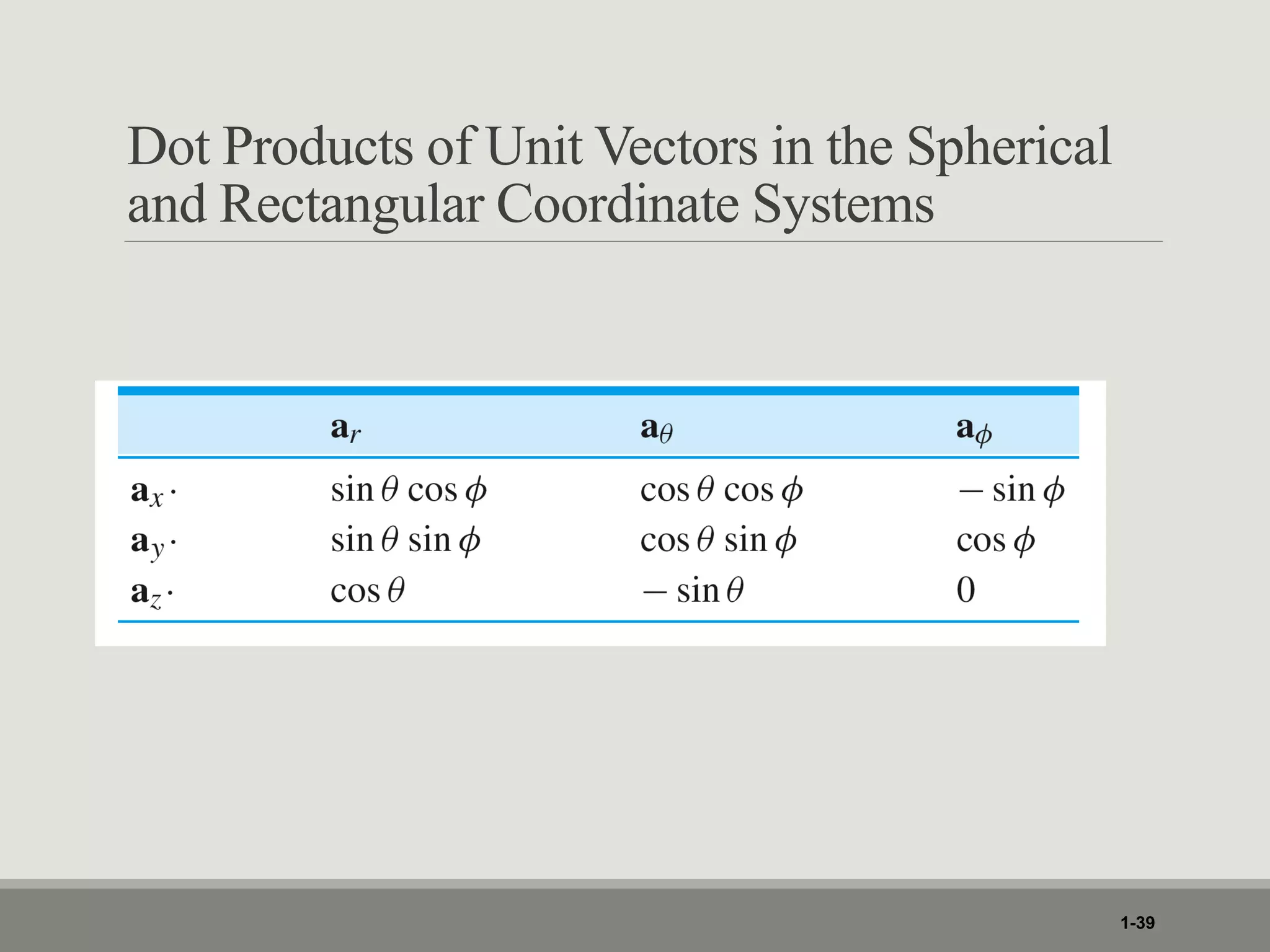
Dot Products of Unit Vectors in the Spherical
and Rectangular Coordinate Systems
1-39
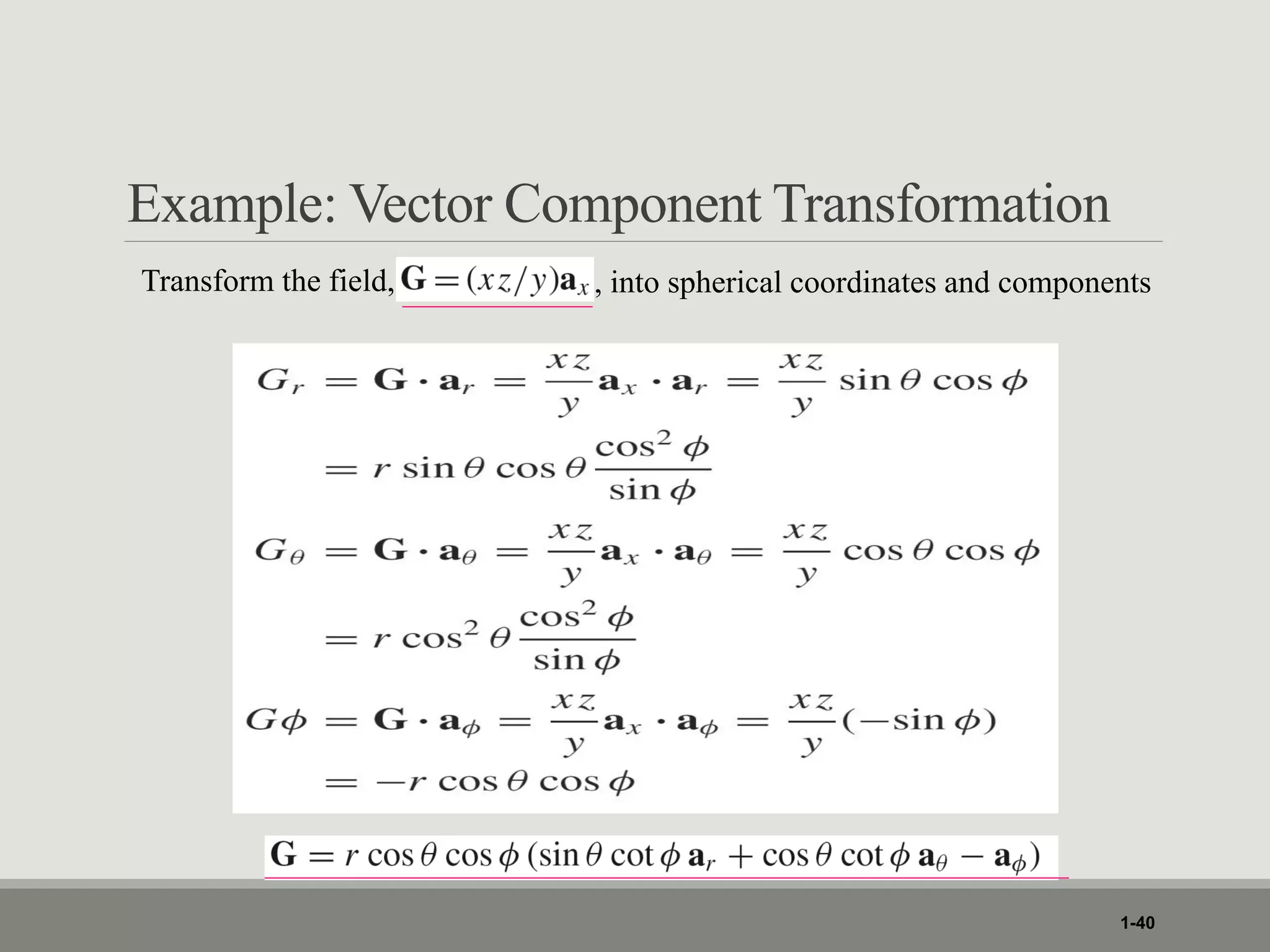
Example: Vector Component Transformation
1-40
Transform the field, , into spherical coordinates and components
Constant coordinate surfaces-
Cartesian system
1-41
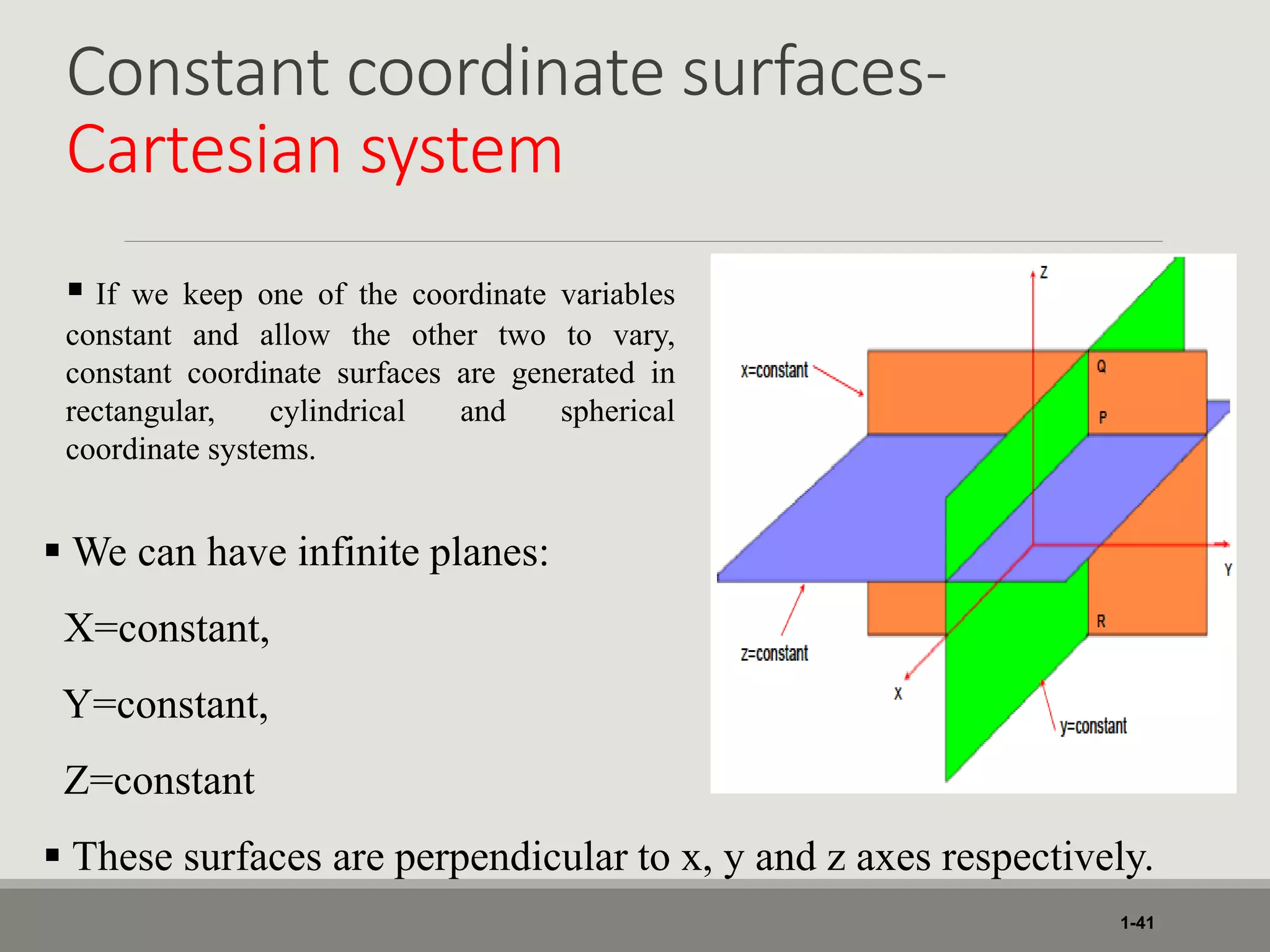
 If we keep one of the coordinate variables
constant and allow the other two to vary,
constant coordinate surfaces are generated in
rectangular, cylindrical and spherical
coordinate systems.
 We can have infinite planes:
X=constant,
Y=constant,
Z=constant
 These surfaces are perpendicular to x, y and z axes respectively.
Constant coordinate surfaces-
cylindrical system
1-42
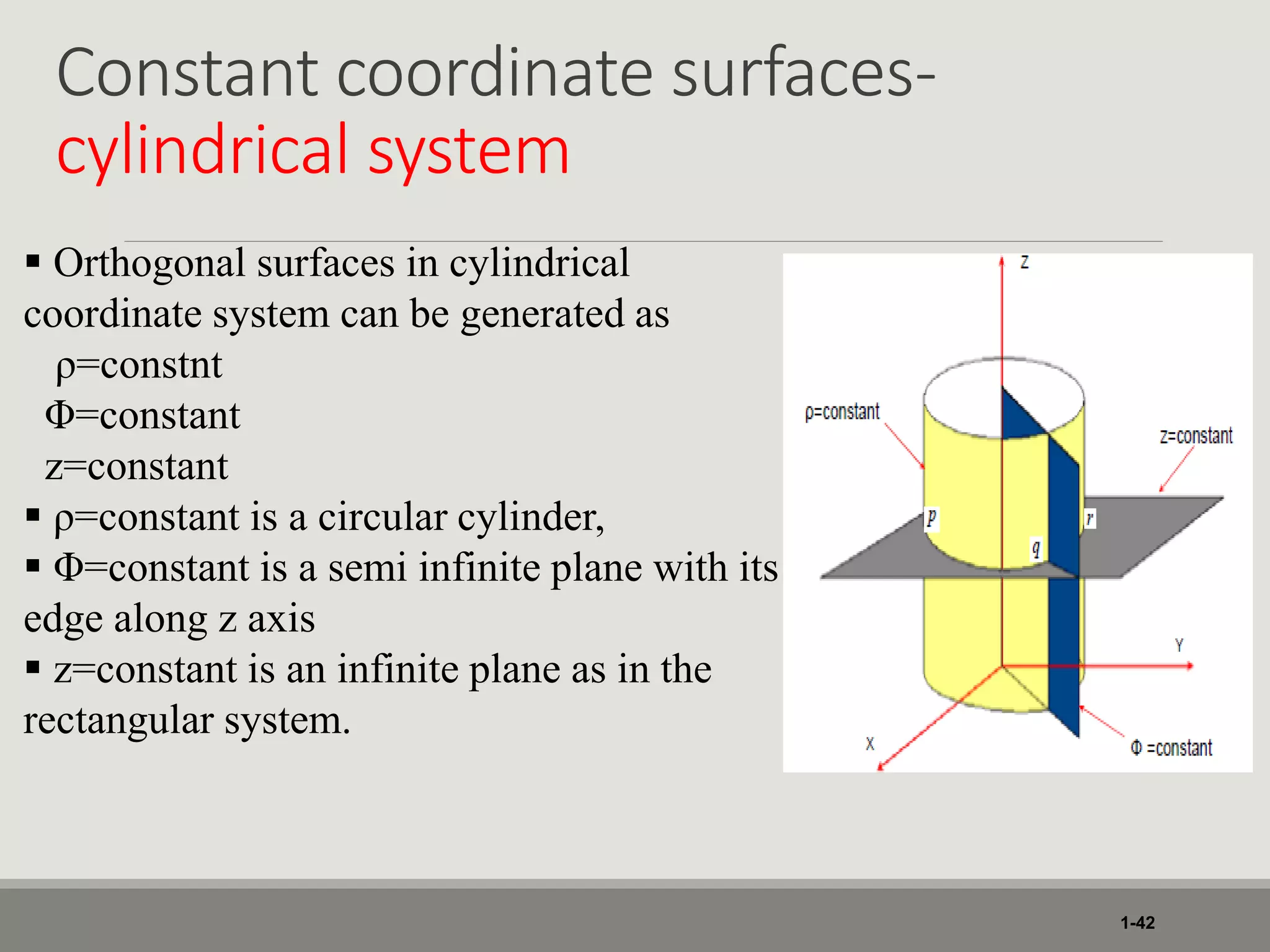
 Orthogonal surfaces in cylindrical
coordinate system can be generated as
ρ=constnt
Φ=constant
z=constant
 ρ=constant is a circular cylinder,
 Φ=constant is a semi infinite plane with its
edge along z axis
 z=constant is an infinite plane as in the
rectangular system.
Constant coordinate surfaces-
Spherical system
1-43
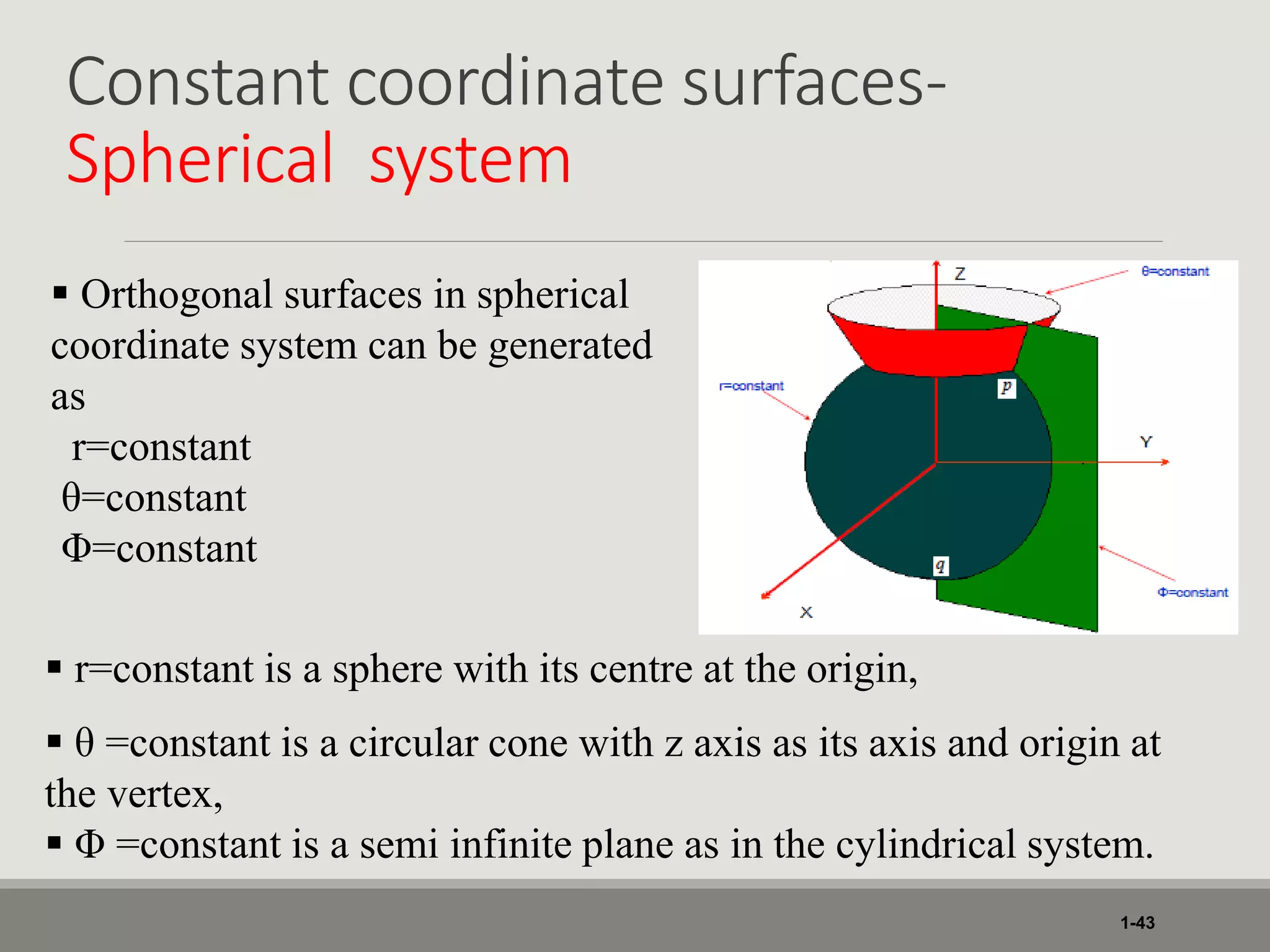
 Orthogonal surfaces in spherical
coordinate system can be generated
as
r=constant
θ=constant
Φ=constant
 θ =constant is a circular cone with z axis as its axis and origin at
the vertex,
 Φ =constant is a semi infinite plane as in the cylindrical system.
 r=constant is a sphere with its centre at the origin,
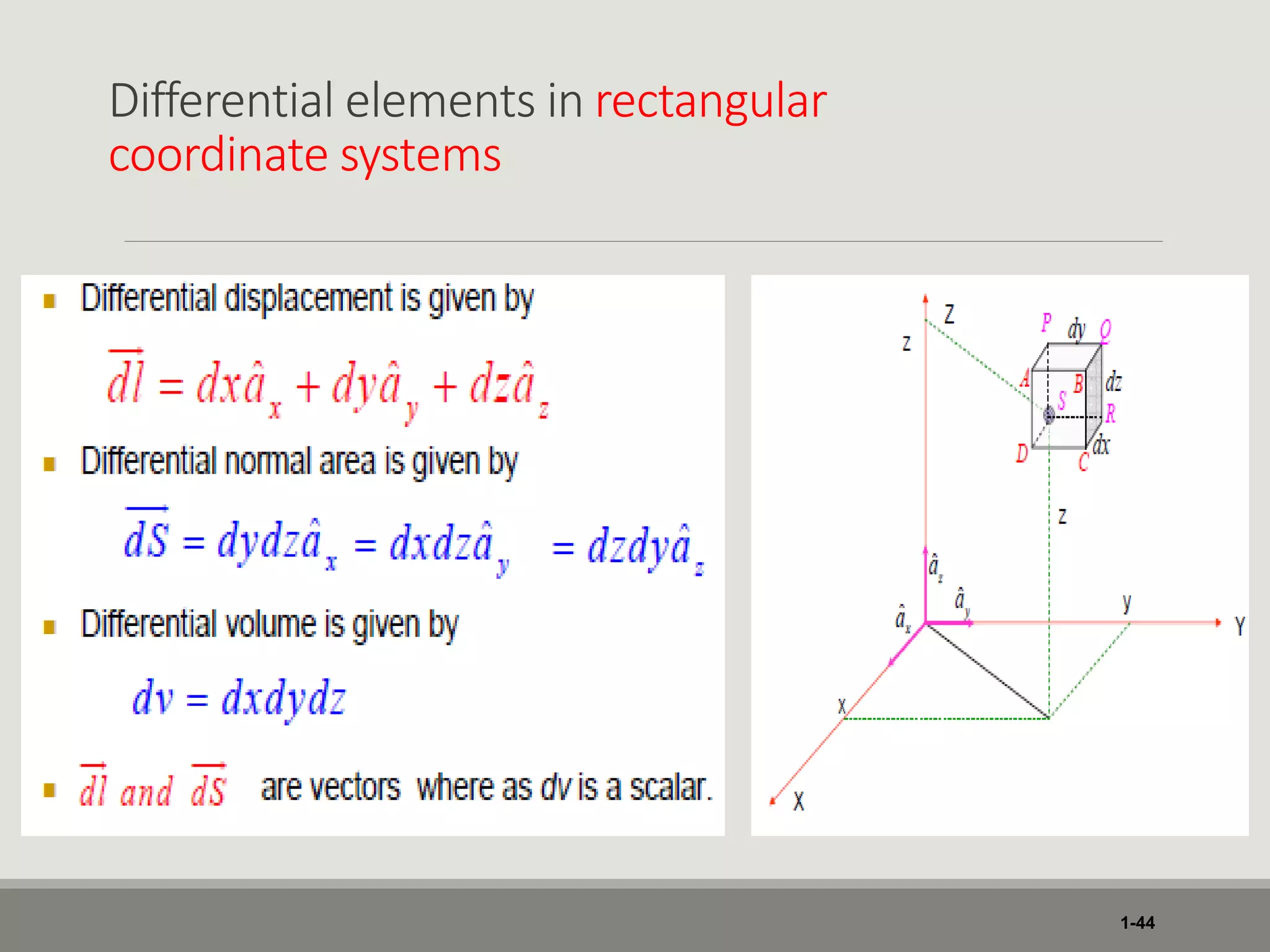
Differential elements in rectangular
coordinate systems
1-44
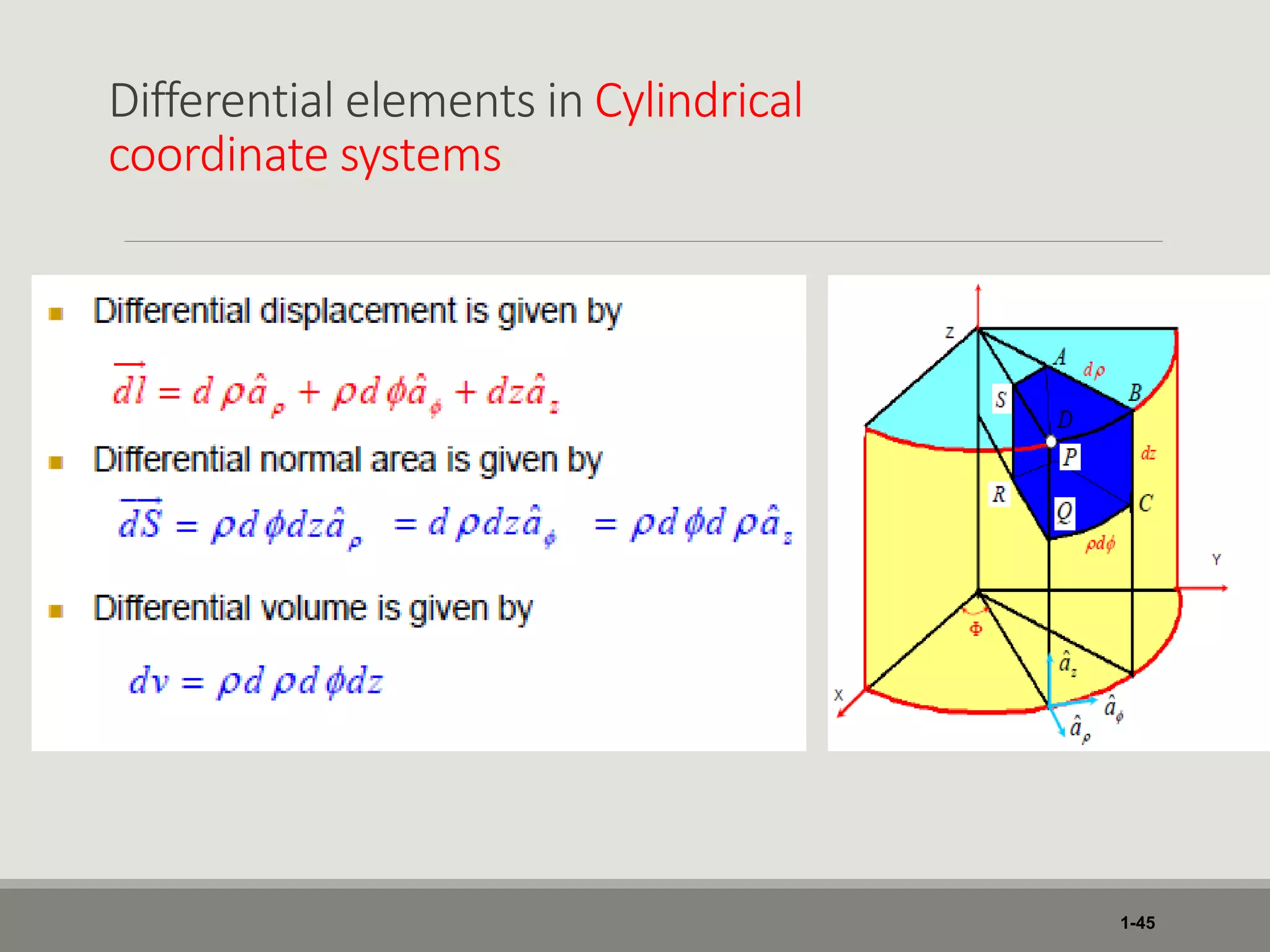
Differential elements in Cylindrical
coordinate systems
1-45
Differential elements in Spherical
coordinate systems
1-46
1-47
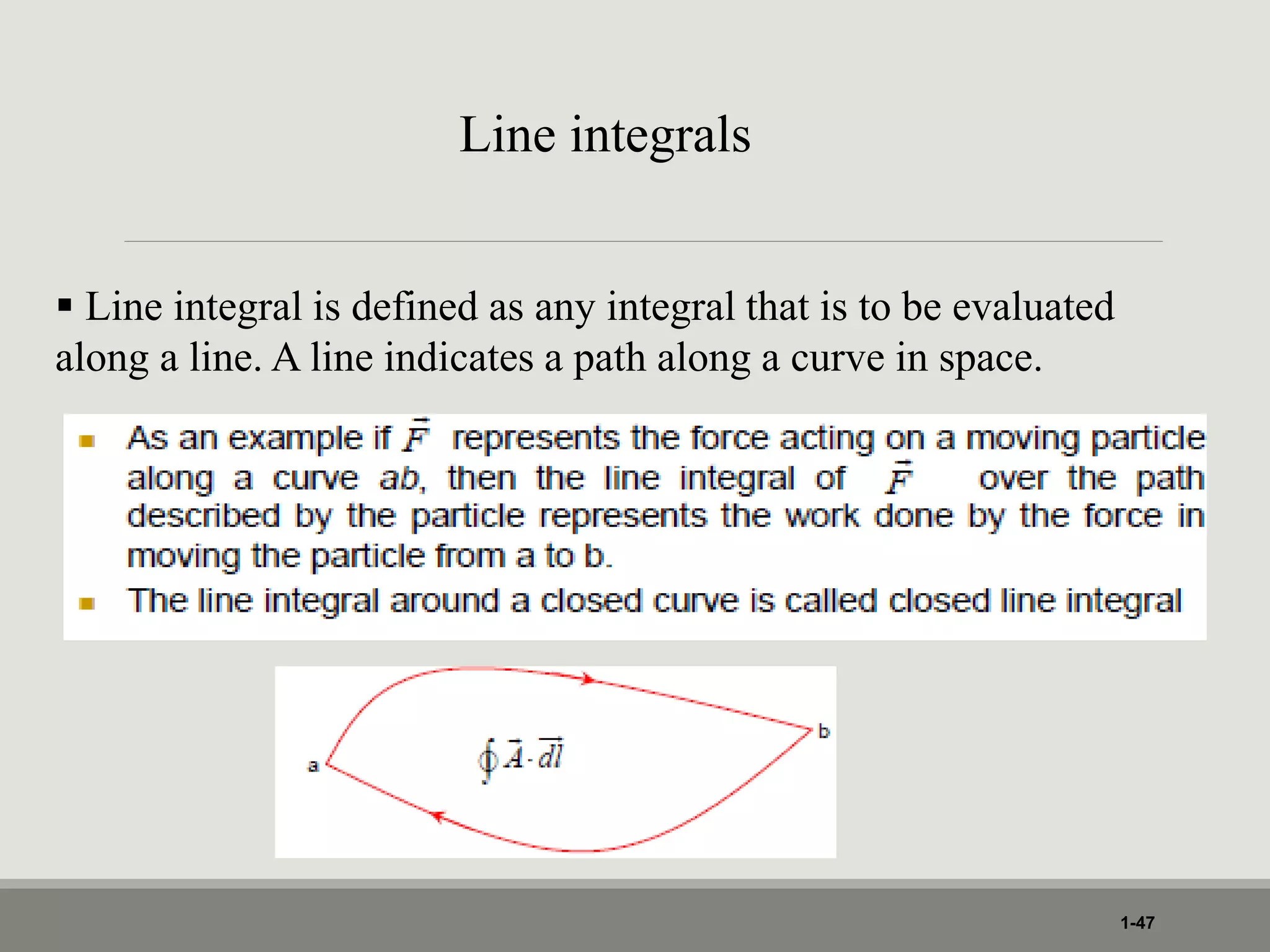
Line integrals
 Line integral is defined as any integral that is to be evaluated
along a line. A line indicates a path along a curve in space.
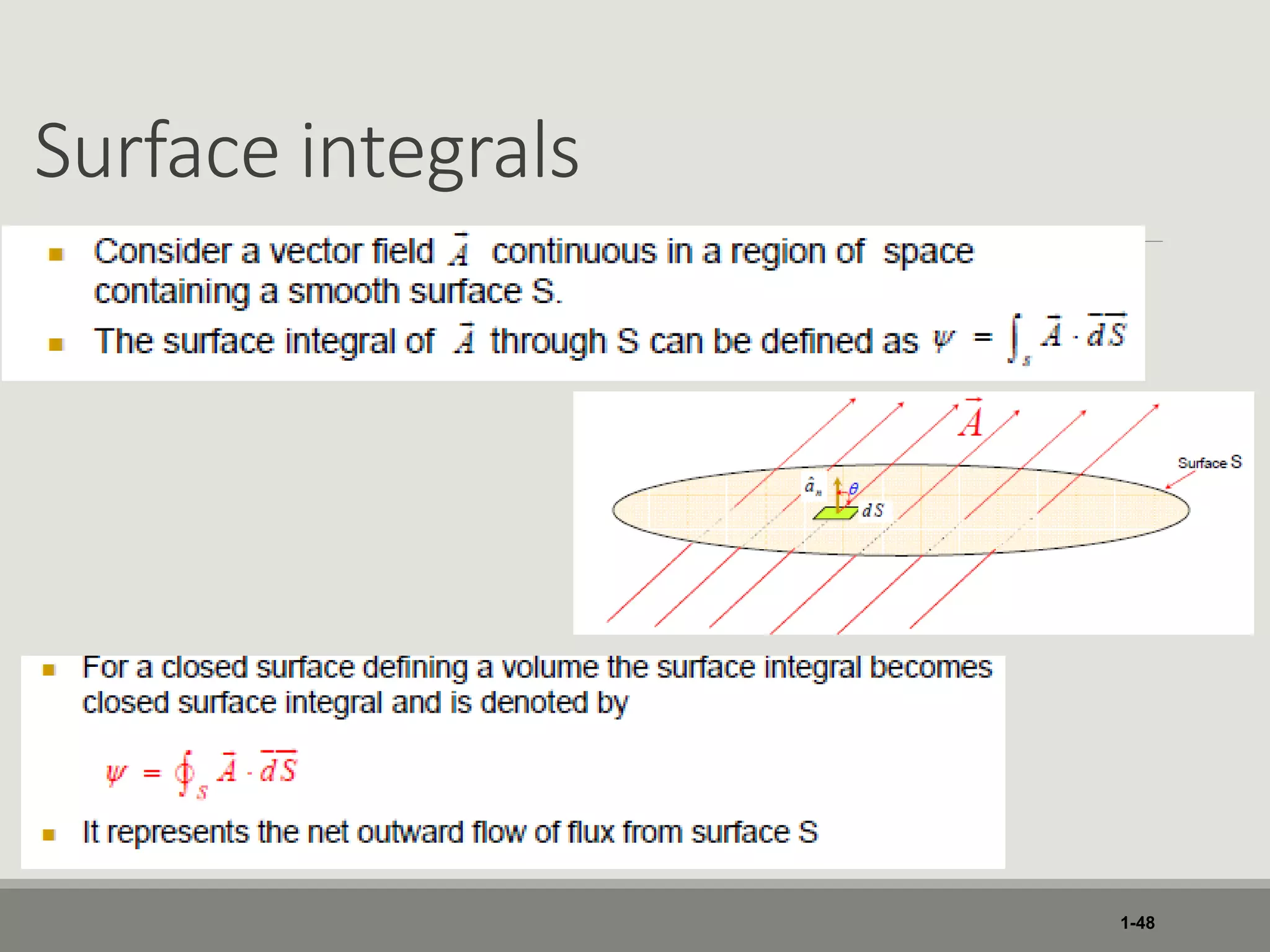
Surface integrals
1-48
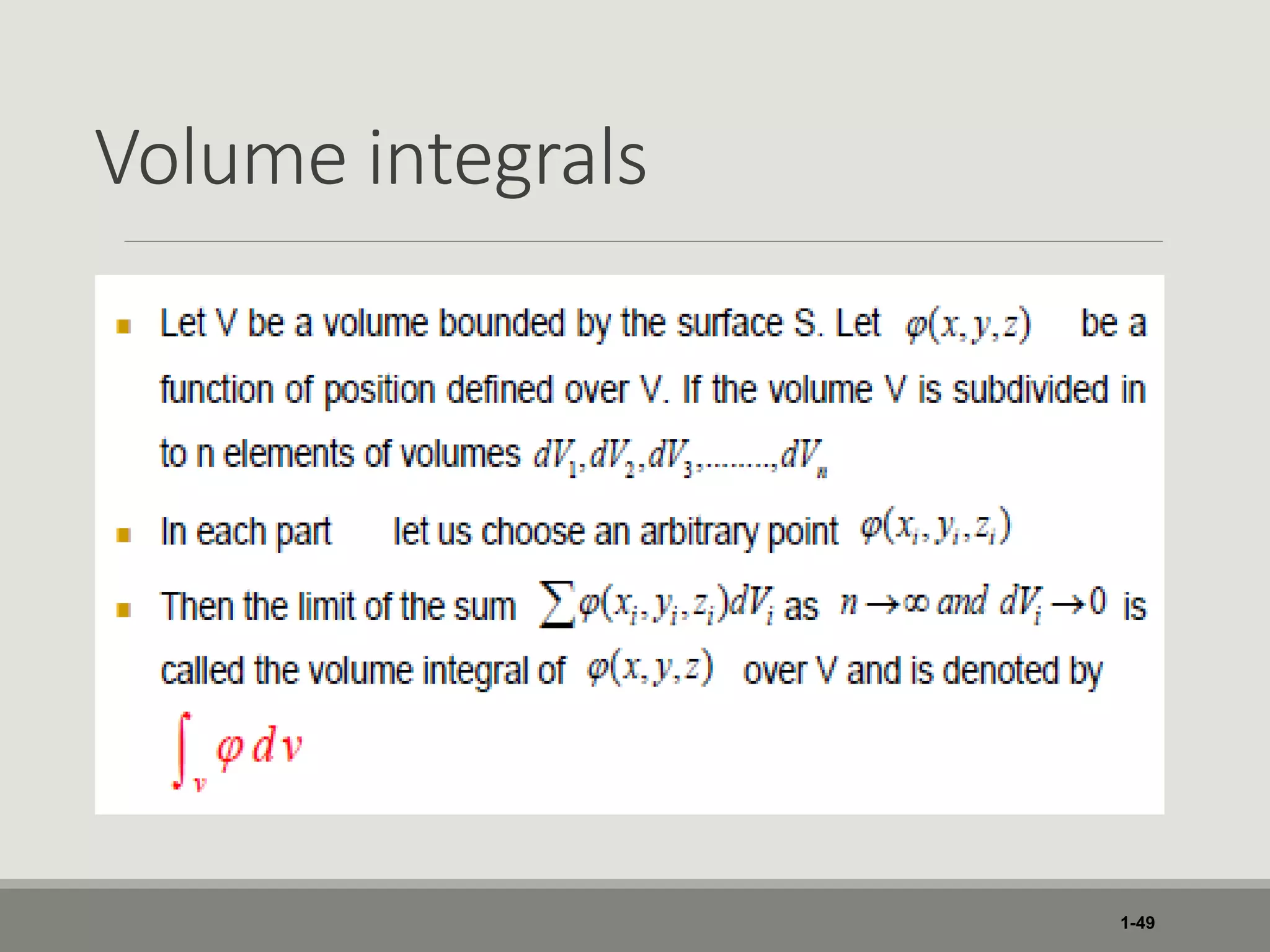
Volume integrals
1-49
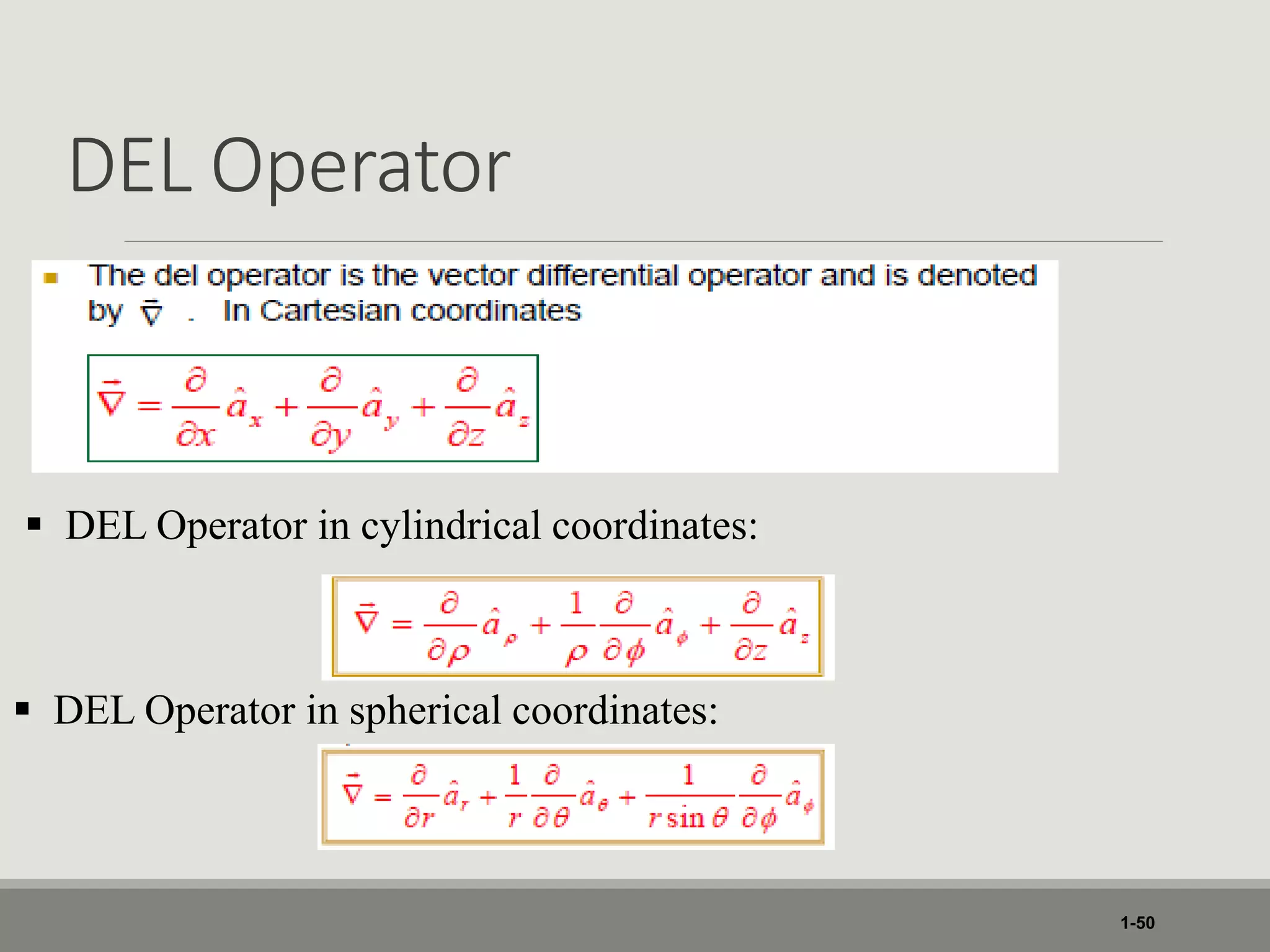
DEL Operator
1-50
 DEL Operator in cylindrical coordinates:
 DEL Operator in spherical coordinates:
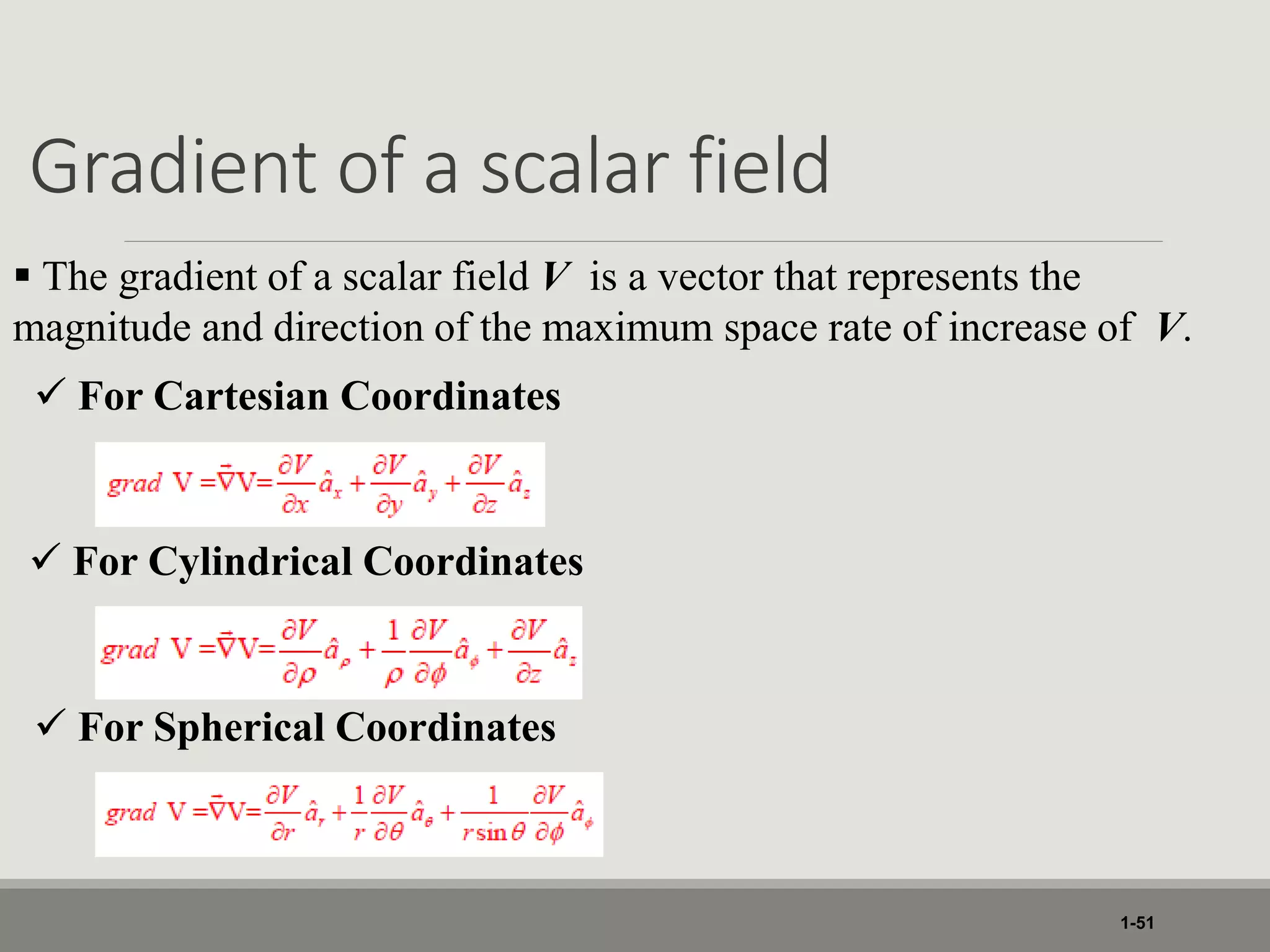
Gradient of a scalar field
1-51
 The gradient of a scalar field V is a vector that represents the
magnitude and direction of the maximum space rate of increase of V.
 For Cartesian Coordinates
 For Cylindrical Coordinates
 For Spherical Coordinates
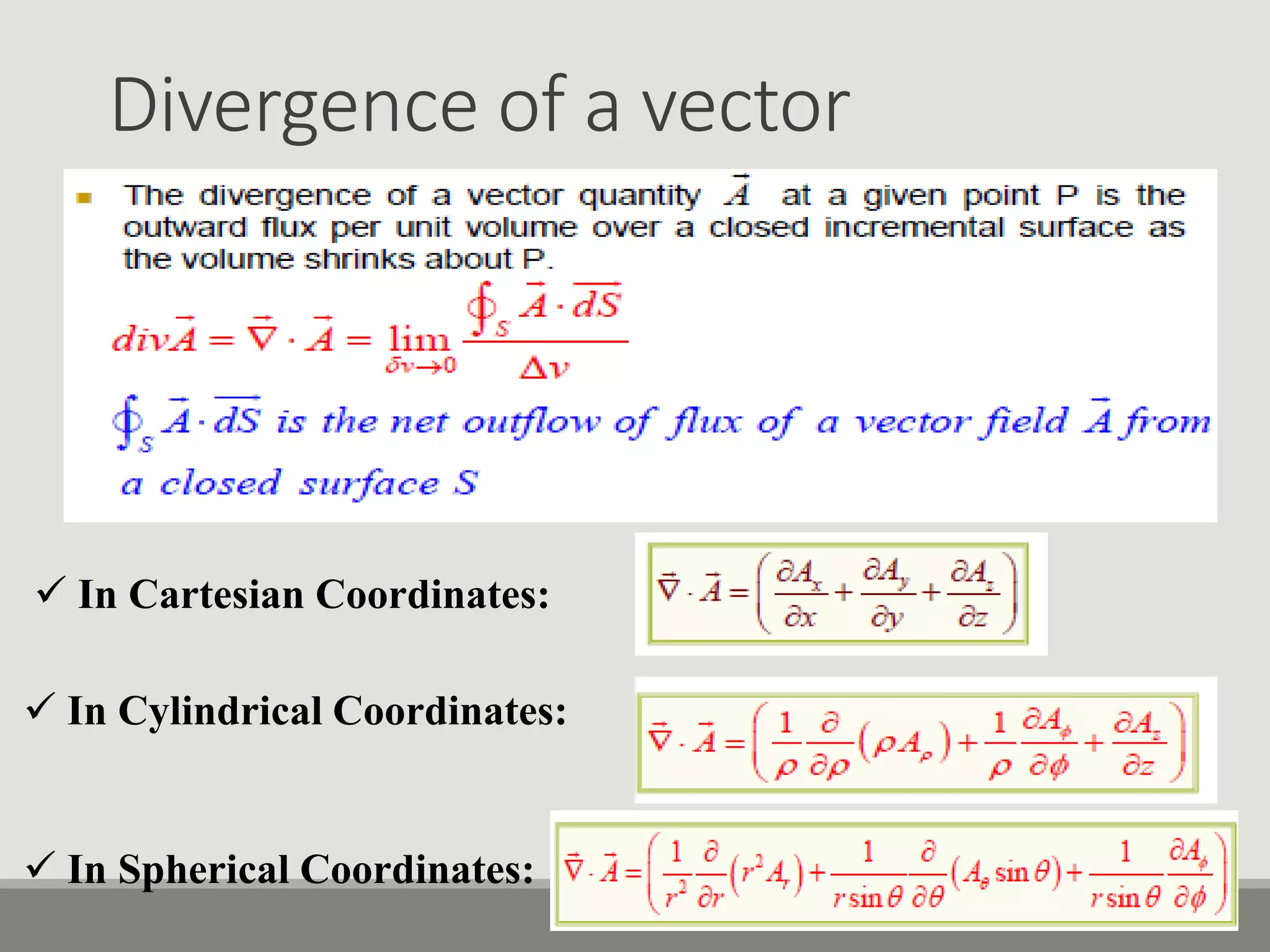
Divergence of a vector
1-52
 In Cartesian Coordinates:
 In Cylindrical Coordinates:
 In Spherical Coordinates:
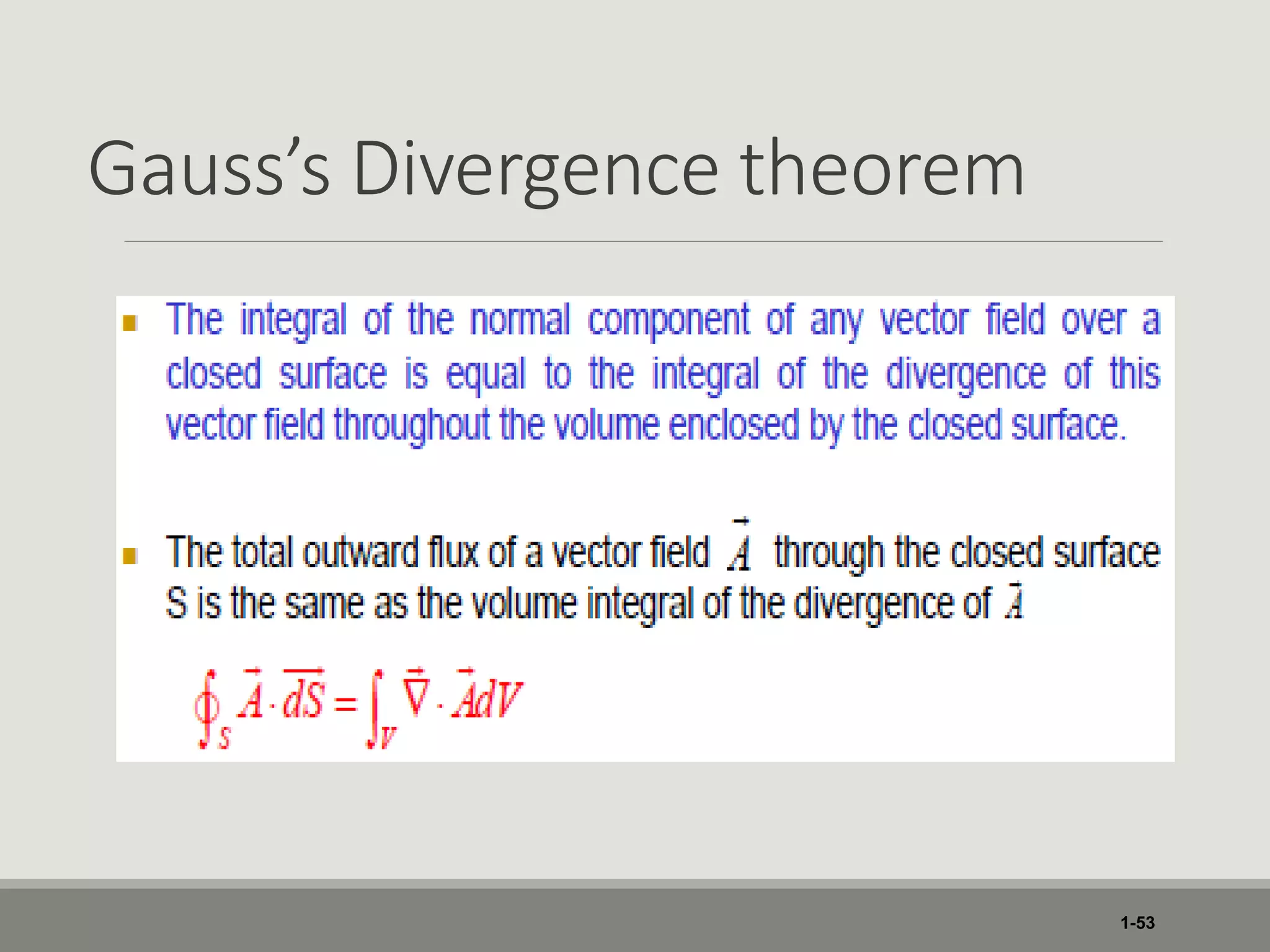
Gauss’s Divergence theorem
1-53
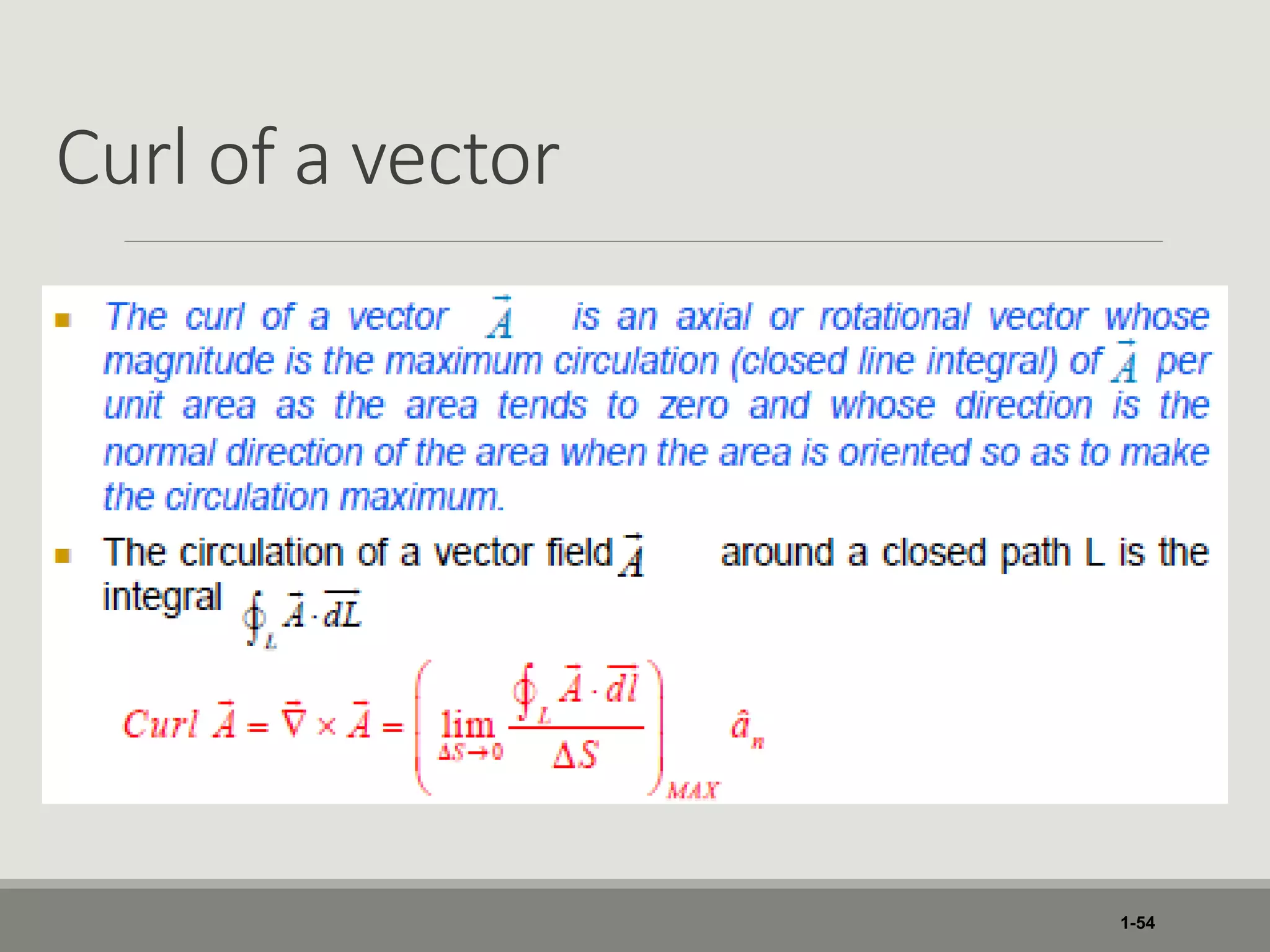
Curl of a vector
1-54
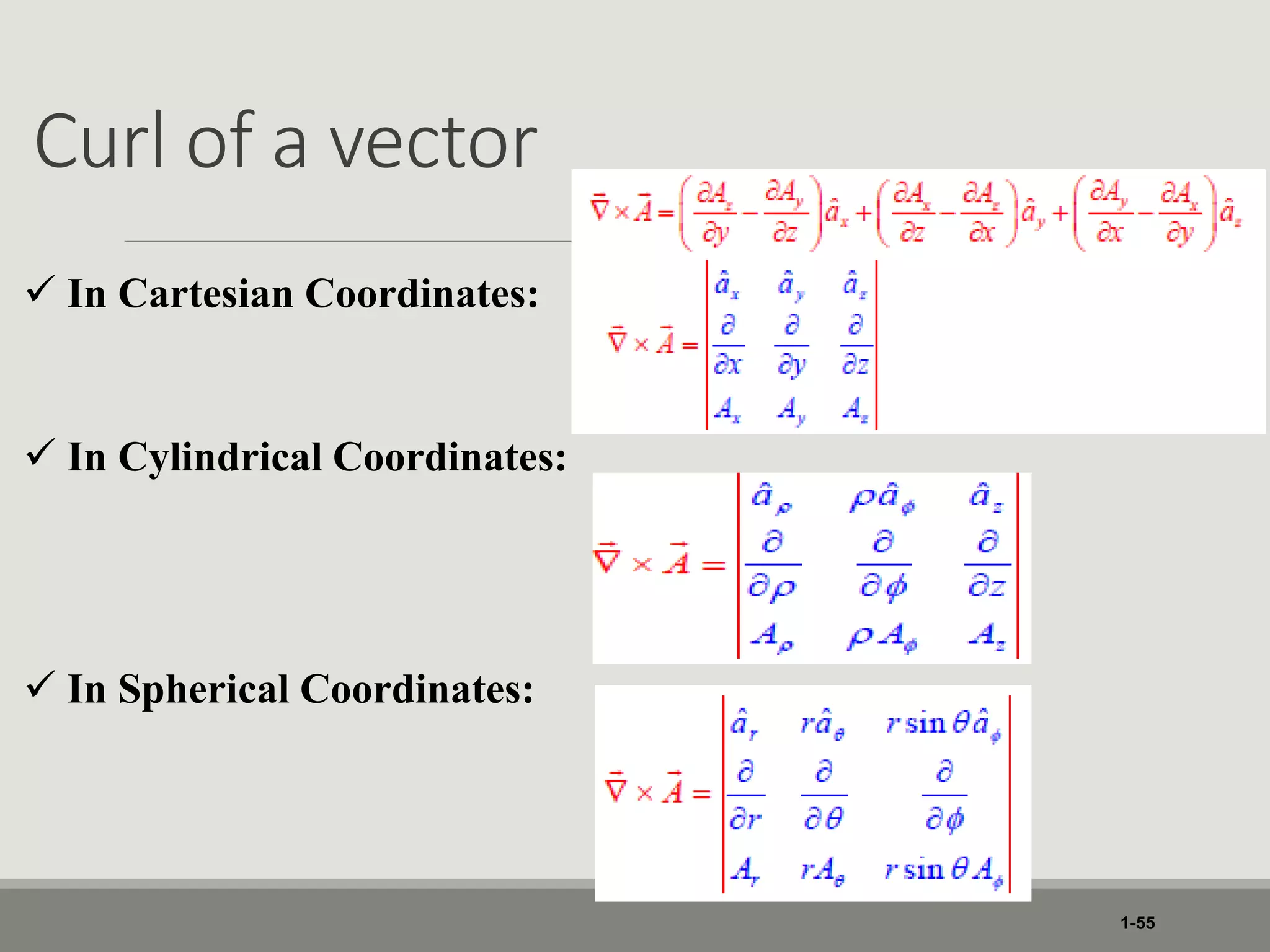
Curl of a vector
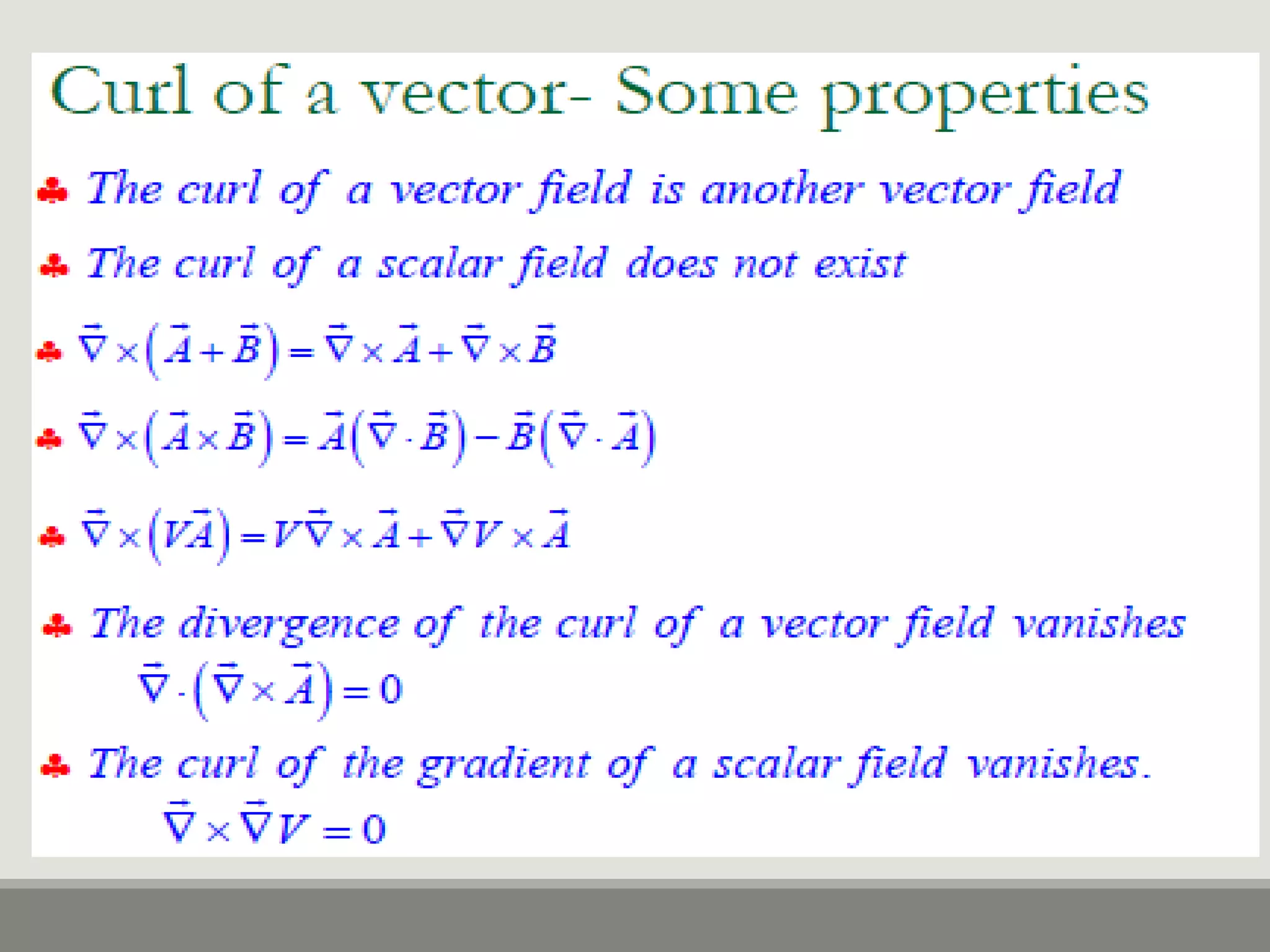
1-55
 In Cartesian Coordinates:
 In Cylindrical Coordinates:
 In Spherical Coordinates:
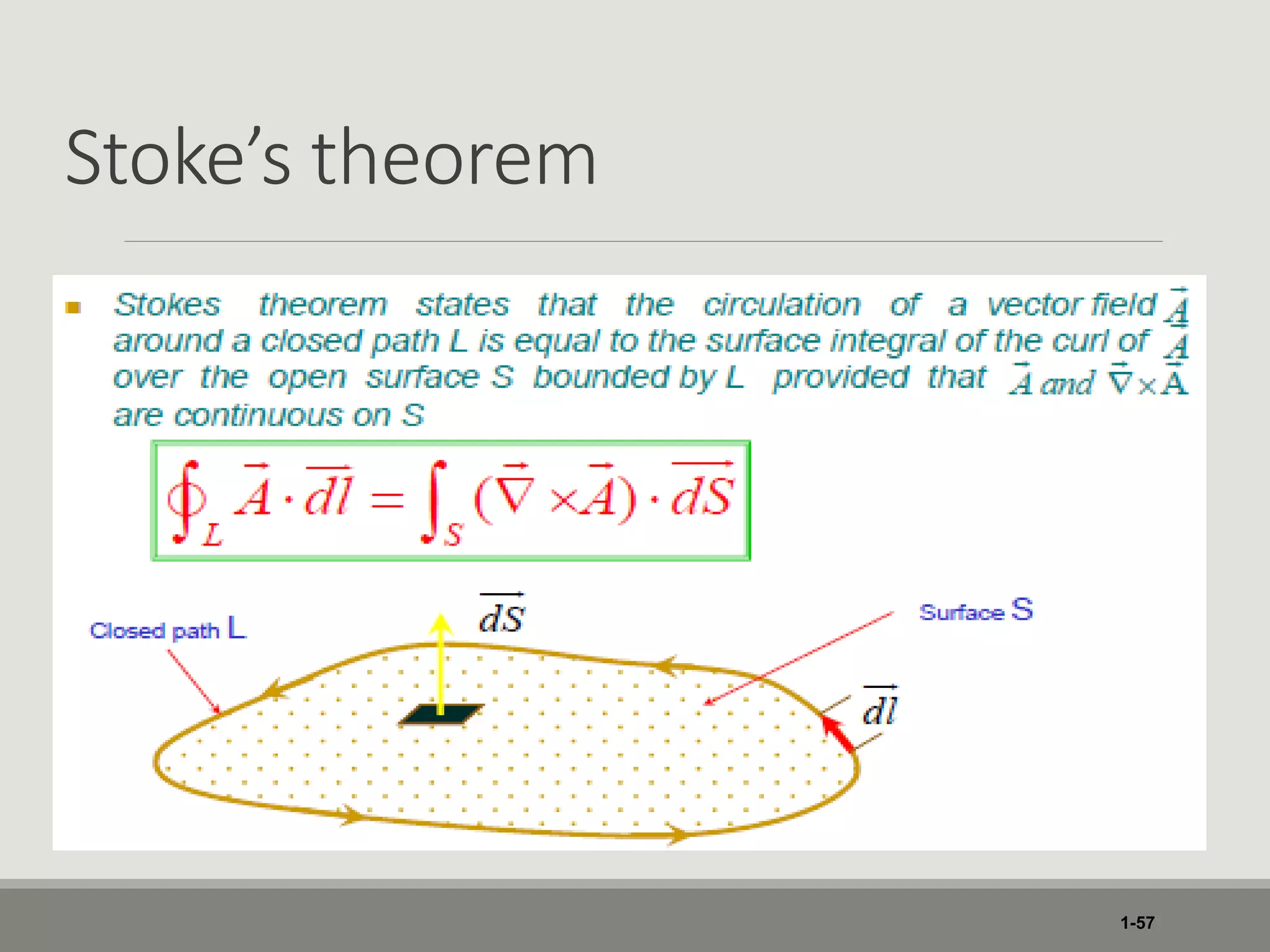
Stoke’s theorem
1-57
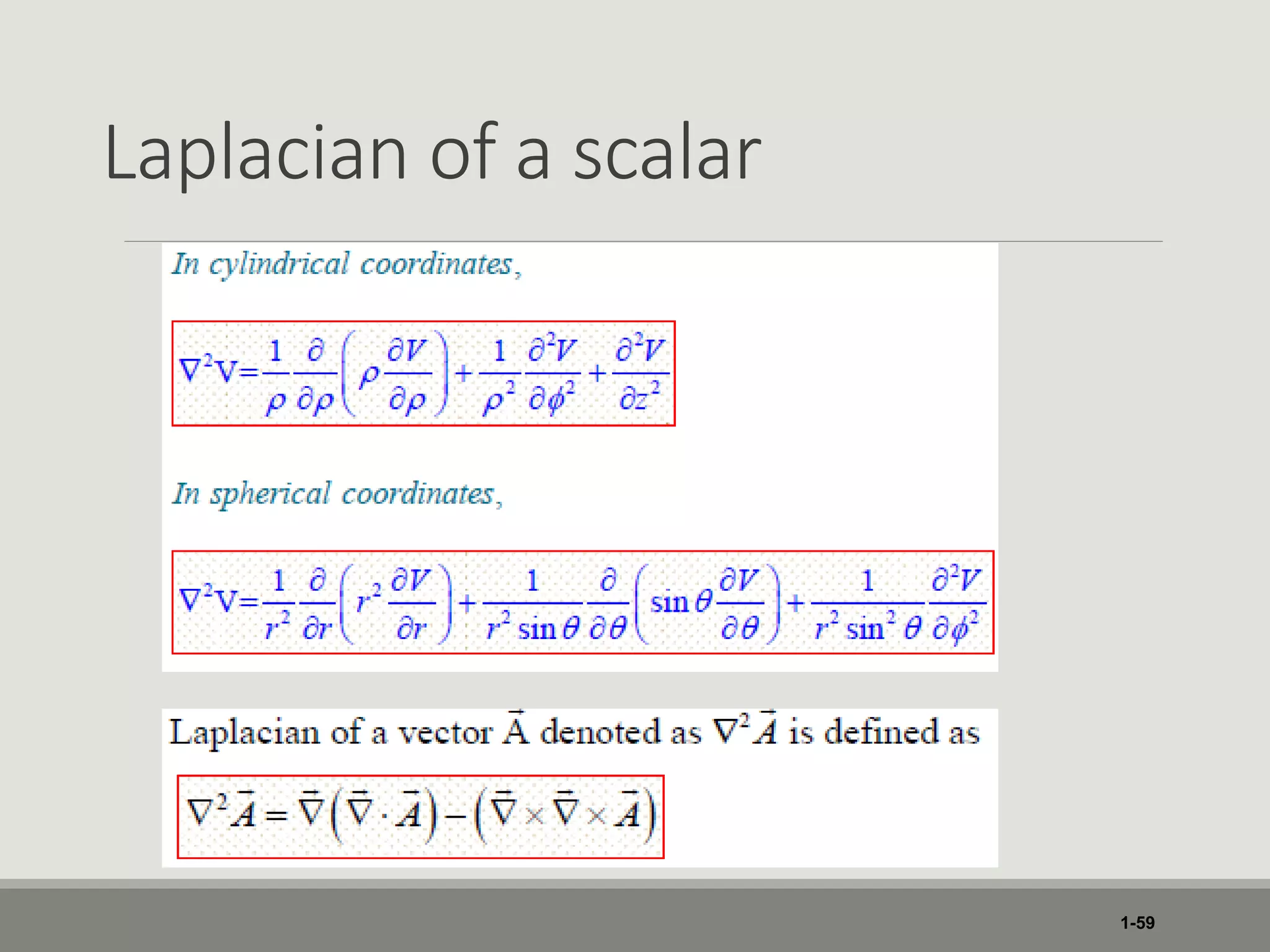
Laplacian of a scalar
1-58
Laplacian of a scalar
1-59

co-ordinate systems