

ELECTROMAGNETIC BLOOD FLOW
METER
BY
ARAVINDKUMAR B
INTRODUCTION
 Electromagnetic blood flow meters are based on
the principle of electromagnetic induction.
According to Fleming's right hand rule, the EMF
induced in the conductor under the influence of
magnetic field is directly proportional to the velocity
of motion of conductor.
 Here we consider the blood vessel carrying blood
as the conductor.
 So here the velocity of motion is simply the blood
flow through the blood vessel.
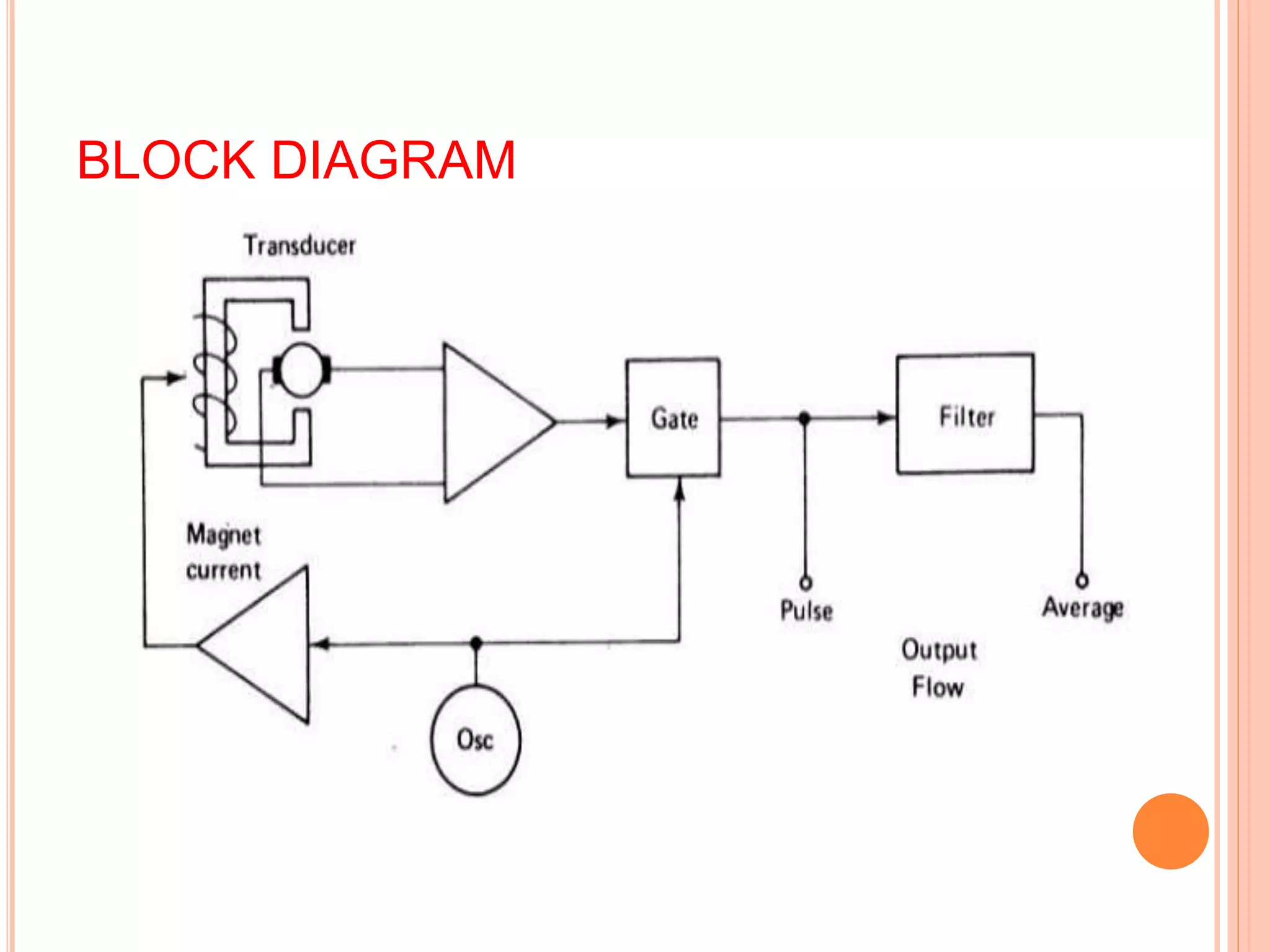
BLOCK DIAGRAM
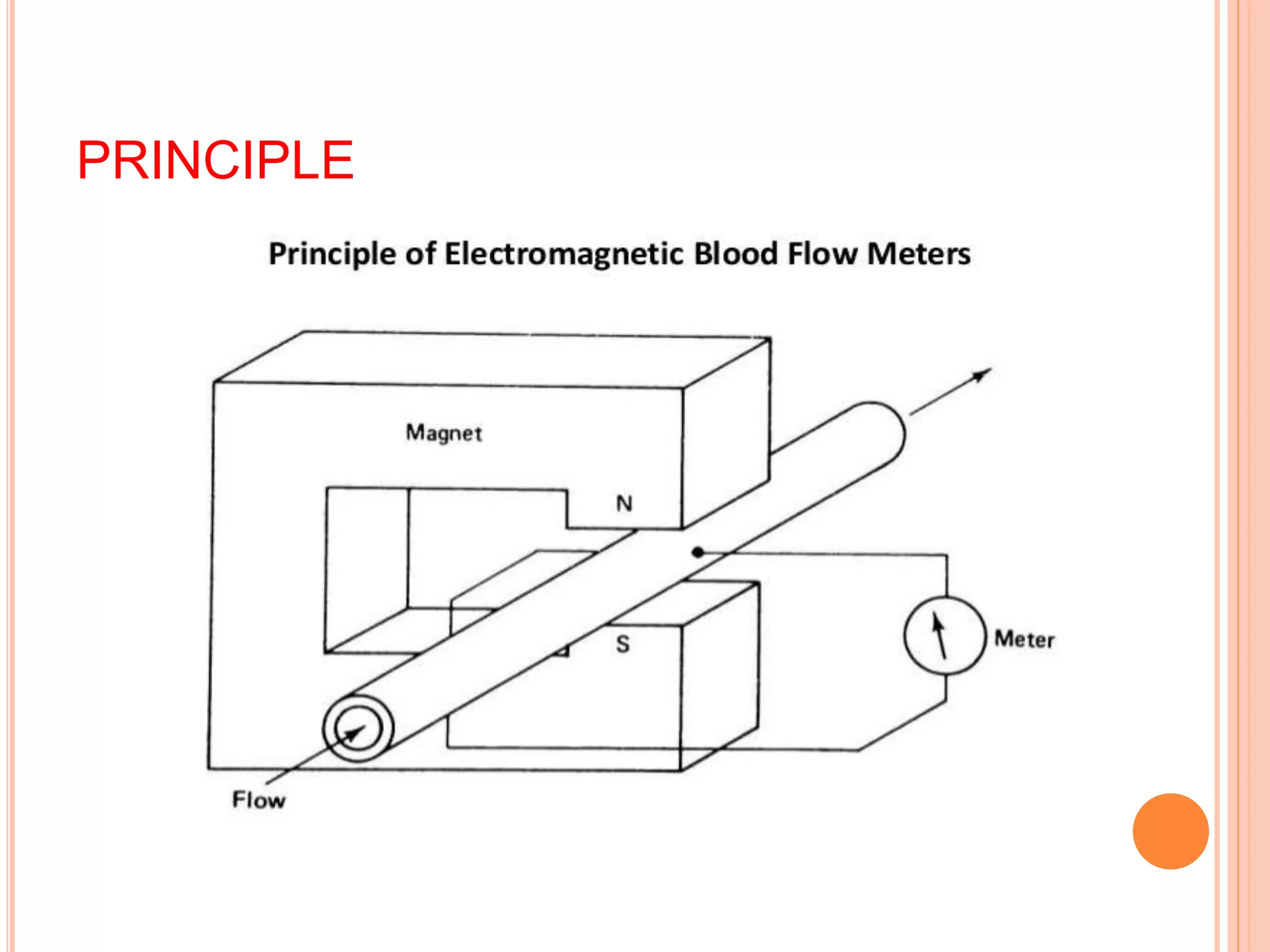
PRINCIPLE
PRINCIPLE
 It uses an oscillator of low frequency (up to 400 Hz)
to drive the electromagnet which is placed in such a
way that the magnetic field is perpendicular to the
direction of blood flow.
 An EMF is induced across the blood vessel.
 In order measure this, a set of electrodes are
placed across the blood vessel mutually
perpendicular to both magnetic field and direction of
blood flow.
PRINCIPLE
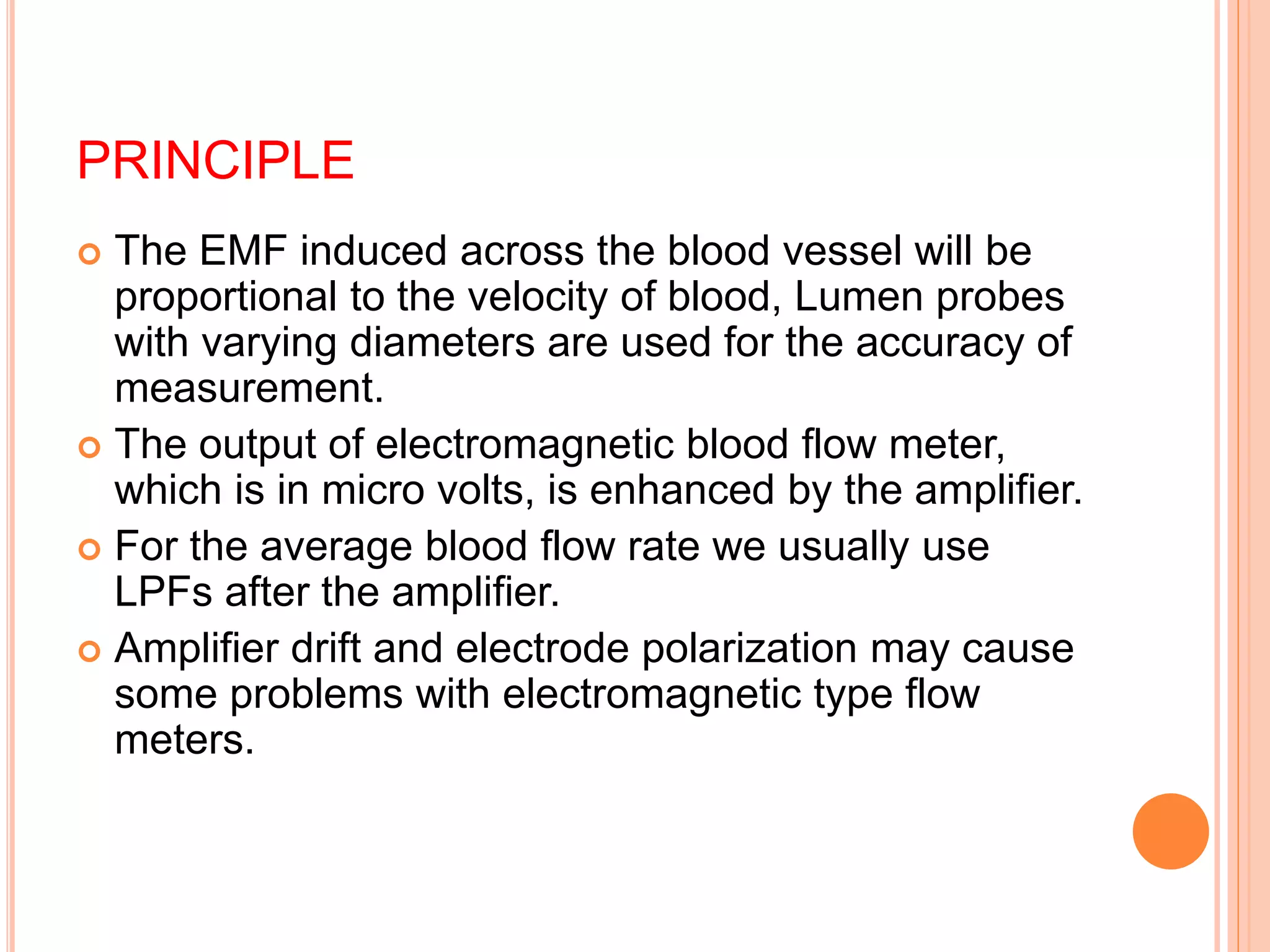
 The EMF induced across the blood vessel will be
proportional to the velocity of blood, Lumen probes
with varying diameters are used for the accuracy of
measurement.
 The output of electromagnetic blood flow meter,
which is in micro volts, is enhanced by the amplifier.
 For the average blood flow rate we usually use
LPFs after the amplifier.
 Amplifier drift and electrode polarization may cause
some problems with electromagnetic type flow
meters.
ADVANTAGES
1. Linear dynamic range
2. Electronics required are relatively simple
3. Almost any flow sensitivity can be measured
4. It has no mechanical limitation for high and low
speed flow
5. The power requirements are reasonable.

Electromagnetic blood flow meter

  • 1.
  • 2.
    INTRODUCTION  Electromagnetic bloodflow meters are based on the principle of electromagnetic induction. According to Fleming's right hand rule, the EMF induced in the conductor under the influence of magnetic field is directly proportional to the velocity of motion of conductor.  Here we consider the blood vessel carrying blood as the conductor.  So here the velocity of motion is simply the blood flow through the blood vessel.
  • 3.
  • 4.
  • 5.
    PRINCIPLE  It usesan oscillator of low frequency (up to 400 Hz) to drive the electromagnet which is placed in such a way that the magnetic field is perpendicular to the direction of blood flow.  An EMF is induced across the blood vessel.  In order measure this, a set of electrodes are placed across the blood vessel mutually perpendicular to both magnetic field and direction of blood flow.
  • 6.
    PRINCIPLE  The EMFinduced across the blood vessel will be proportional to the velocity of blood, Lumen probes with varying diameters are used for the accuracy of measurement.  The output of electromagnetic blood flow meter, which is in micro volts, is enhanced by the amplifier.  For the average blood flow rate we usually use LPFs after the amplifier.  Amplifier drift and electrode polarization may cause some problems with electromagnetic type flow meters.
  • 7.
    ADVANTAGES 1. Linear dynamicrange 2. Electronics required are relatively simple 3. Almost any flow sensitivity can be measured 4. It has no mechanical limitation for high and low speed flow 5. The power requirements are reasonable.