A SEMINAR
ON TRANSDUCER
PRESENTED BY:
SAURABH KUMAR
JHANWAR
CONTENTS
1) WHAT IS TRANSDUCER
2) ELECTRICAL TRANSDUCER
3) CLASSIFICATIONS OF TRANSDUCER
4) SELECTION CRITERIA OF THE TRANSDUCER
5) BASIC CONSTRUCTION OF TRANSDUCER
6) RESISTANCE TEMPERATURE DETECTOR
7) THERMISTORS
8) LVDT
9) STRAIN GAUGE
10) BOURDON TUBE
11) APPLICATION
12) ADVANTAGES
13) DISADVANTAGES
14) CONCLUSION
WHAT IS TRANSDUCER
The transducer is defined as the device which converts the one
form of energy into another form of energy.
Examples:
 Temperature transducers
 Thermocouples
 Resistance-temperature detectors (RTD)
 Thermistors
 Resistive position transducers
 Displacement transducers
 Strain gauge
ELECTRICAL TRANSDUCER
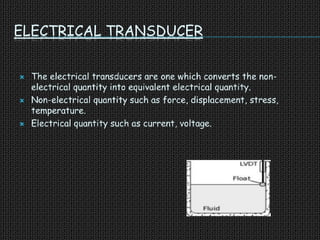
 The electrical transducers are one which converts the non-
electrical quantity into equivalent electrical quantity.
 Non-electrical quantity such as force, displacement, stress,
temperature.
 Electrical quantity such as current, voltage.
CLASSIFICATION OF TRANSDUCERS
 On the basis of transduction form used.
 As primary and secondary transducers.
 As passive and active tranducers.
 As analog and digital transducers.
 As transducers and inverse transducers.
ON THE BASIS OF TRANSDUCTION
FORM USED
 Resistive transducers.
 Capacitive transducers.
 Inductive transducers.
 Voltage and current generating transducers.
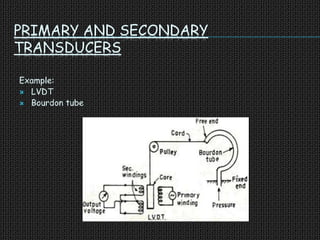
PRIMARY AND SECONDARY
TRANSDUCERS
Example:
 LVDT
 Bourdon tube
PASSIVE AND ACTIVE TRANSDUCERS
 If transducers derive the power require for transduction from an
auxiliary power source, then this kind of transducer are known as
passive transducer.
Example
LVDT
RVDT
 When there is no need for any source then these type of
transducers are active transducers.
Example
Thermocouple
Piezoelectric crystal
ANALOG AND DIGITAL TRANSDUCERS
Analog transducers convert the non-electric (physical quantity) into
an analog output which is a continuous function of time.
Example:
 Strain gauge
 LVDT
 Thermocouple
Whereas digital transducers convert the physical quantity into the
form of pulse.
TRANSDUCERS AND INVERSE
TRANSDUCERS
A transducer can be broadly defined as a device which converts a
non-electrical quantity into an electrical quantity.
While inverse transducers convert a electrical quantity into non
electrical quantity.
Example:
 Analog ammeter
 voltmeter
SLECTION CRITERIA OF THE
TRANSDUCERS
 Operating principle
 Sensitivity
 Operating range
 Accuracy
 Errors
 Environmental capability
 Insensitive to unwanted signal
 stability
BASIC CONSTRUCTION OF TRANSUCERS
It consists of two important parts:
 Sensing or detector element
 Transduction element
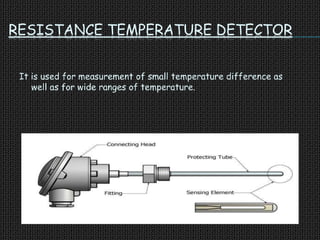
RESISTANCE TEMPERATURE DETECTOR
It is used for measurement of small temperature difference as
well as for wide ranges of temperature.
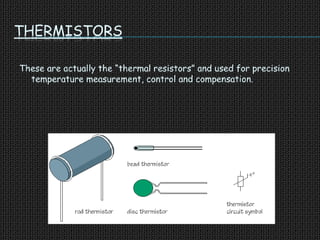
THERMISTORS
These are actually the “thermal resistors” and used for precision
temperature measurement, control and compensation.
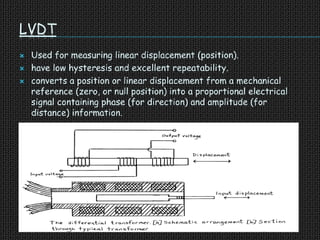
LVDT
 Used for measuring linear displacement (position).
 have low hysteresis and excellent repeatability.
 converts a position or linear displacement from a mechanical
reference (zero, or null position) into a proportional electrical
signal containing phase (for direction) and amplitude (for
distance) information.
STRAIN GAUGE
 It works on Piezoresistive effect.
 These are used for measurement of stress and strain
 If an elastic material is subjected to tension then its resistance
changes.
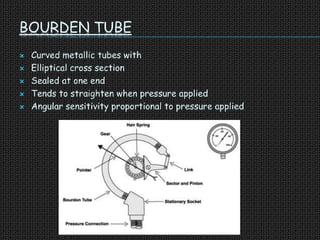
BOURDEN TUBE
 Curved metallic tubes with
 Elliptical cross section
 Sealed at one end
 Tends to straighten when pressure applied
 Angular sensitivity proportional to pressure applied
APPLICATION
 Measurement of Temperature (RTD, Thermocouple)
 Measurement of pressure (Bourdon tubes)
 Measurement of Acceleration (Piezoelectric Crystal)
 Measurement of Flow ( Electromagnetic Flow Meter)
 Measurement of Displacement (LVDT, Capacitance Transducer,
Strain Gauge)
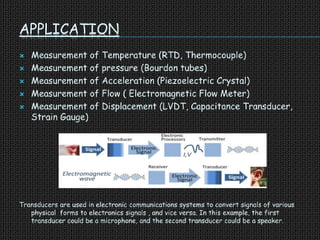
Transducers are used in electronic communications systems to convert signals of various
physical forms to electronics signals , and vice versa. In this example, the first
transducer could be a microphone, and the second transducer could be a speaker.
ADVANTAGES
 Power requirement is very low for controlling the electrical or
electronic system.
 Output can be indicated and recorded remotely from the sensing
element.
 Electrical amplification and attenuation can be easily done.
 An amplifier may be used to amplify the electrical signal according
to requirement.
DISADVANTAGES
 RTD produce mechanical vibrations
 Their cost is high.
 Thermistors are unsuitable for wide temperature.
 Relative large displacement is required for appreciable output for
LVDT.
 Bourdon tube do not provide the precise measurement.
CONCLUSION
 Transducers are used to convert one form energy to another.
 All the transducers are very useful in all the application such as
microphone, speakers etc.
REFERENCES
 en.wikipedia.org/wiki/Transducer
 whatis.techtarget.com › Topics › Computer Science › Electronics
 http://www.slideshare.net/
ANY QUERIES ??

seminar ppt on transducer

  • 1.
    A SEMINAR ON TRANSDUCER PRESENTEDBY: SAURABH KUMAR JHANWAR
  • 2.
    CONTENTS 1) WHAT ISTRANSDUCER 2) ELECTRICAL TRANSDUCER 3) CLASSIFICATIONS OF TRANSDUCER 4) SELECTION CRITERIA OF THE TRANSDUCER 5) BASIC CONSTRUCTION OF TRANSDUCER 6) RESISTANCE TEMPERATURE DETECTOR 7) THERMISTORS 8) LVDT 9) STRAIN GAUGE 10) BOURDON TUBE 11) APPLICATION 12) ADVANTAGES 13) DISADVANTAGES 14) CONCLUSION
  • 3.
    WHAT IS TRANSDUCER Thetransducer is defined as the device which converts the one form of energy into another form of energy. Examples:  Temperature transducers  Thermocouples  Resistance-temperature detectors (RTD)  Thermistors  Resistive position transducers  Displacement transducers  Strain gauge
  • 4.
    ELECTRICAL TRANSDUCER  Theelectrical transducers are one which converts the non- electrical quantity into equivalent electrical quantity.  Non-electrical quantity such as force, displacement, stress, temperature.  Electrical quantity such as current, voltage.
  • 5.
    CLASSIFICATION OF TRANSDUCERS On the basis of transduction form used.  As primary and secondary transducers.  As passive and active tranducers.  As analog and digital transducers.  As transducers and inverse transducers.
  • 6.
    ON THE BASISOF TRANSDUCTION FORM USED  Resistive transducers.  Capacitive transducers.  Inductive transducers.  Voltage and current generating transducers.
  • 7.
  • 8.
    PASSIVE AND ACTIVETRANSDUCERS  If transducers derive the power require for transduction from an auxiliary power source, then this kind of transducer are known as passive transducer. Example LVDT RVDT  When there is no need for any source then these type of transducers are active transducers. Example Thermocouple Piezoelectric crystal
  • 9.
    ANALOG AND DIGITALTRANSDUCERS Analog transducers convert the non-electric (physical quantity) into an analog output which is a continuous function of time. Example:  Strain gauge  LVDT  Thermocouple Whereas digital transducers convert the physical quantity into the form of pulse.
  • 10.
    TRANSDUCERS AND INVERSE TRANSDUCERS Atransducer can be broadly defined as a device which converts a non-electrical quantity into an electrical quantity. While inverse transducers convert a electrical quantity into non electrical quantity. Example:  Analog ammeter  voltmeter
  • 11.
    SLECTION CRITERIA OFTHE TRANSDUCERS  Operating principle  Sensitivity  Operating range  Accuracy  Errors  Environmental capability  Insensitive to unwanted signal  stability
  • 12.
    BASIC CONSTRUCTION OFTRANSUCERS It consists of two important parts:  Sensing or detector element  Transduction element
  • 13.
    RESISTANCE TEMPERATURE DETECTOR Itis used for measurement of small temperature difference as well as for wide ranges of temperature.
  • 14.
    THERMISTORS These are actuallythe “thermal resistors” and used for precision temperature measurement, control and compensation.
  • 15.
    LVDT  Used formeasuring linear displacement (position).  have low hysteresis and excellent repeatability.  converts a position or linear displacement from a mechanical reference (zero, or null position) into a proportional electrical signal containing phase (for direction) and amplitude (for distance) information.
  • 16.
    STRAIN GAUGE  Itworks on Piezoresistive effect.  These are used for measurement of stress and strain  If an elastic material is subjected to tension then its resistance changes.
  • 17.
    BOURDEN TUBE  Curvedmetallic tubes with  Elliptical cross section  Sealed at one end  Tends to straighten when pressure applied  Angular sensitivity proportional to pressure applied
  • 18.
    APPLICATION  Measurement ofTemperature (RTD, Thermocouple)  Measurement of pressure (Bourdon tubes)  Measurement of Acceleration (Piezoelectric Crystal)  Measurement of Flow ( Electromagnetic Flow Meter)  Measurement of Displacement (LVDT, Capacitance Transducer, Strain Gauge) Transducers are used in electronic communications systems to convert signals of various physical forms to electronics signals , and vice versa. In this example, the first transducer could be a microphone, and the second transducer could be a speaker.
  • 19.
    ADVANTAGES  Power requirementis very low for controlling the electrical or electronic system.  Output can be indicated and recorded remotely from the sensing element.  Electrical amplification and attenuation can be easily done.  An amplifier may be used to amplify the electrical signal according to requirement.
  • 20.
    DISADVANTAGES  RTD producemechanical vibrations  Their cost is high.  Thermistors are unsuitable for wide temperature.  Relative large displacement is required for appreciable output for LVDT.  Bourdon tube do not provide the precise measurement.
  • 21.
    CONCLUSION  Transducers areused to convert one form energy to another.  All the transducers are very useful in all the application such as microphone, speakers etc.
  • 22.
    REFERENCES  en.wikipedia.org/wiki/Transducer  whatis.techtarget.com› Topics › Computer Science › Electronics  http://www.slideshare.net/
  • 23.