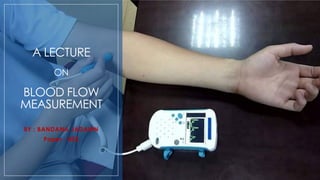
A LECTURE
ON
BLOOD FLOW
MEASUREMENT
BY : BANDANA JADAWN
Paper : 403
BLOOD FLOW
An adequate blood supply is necessary for all organs of the body.
An impaired supply of blood is the cause of various diseases.
The ability to measure blood flow in the vessel that supplies a particular
organ would therefore be of great help in diagnosing such diseases.
Blood flow is a rather elusive variable that cannot be measured easily
Methods used in industry for flow measurements of other liquids, like the
turbine flowmeter and the rotameter, are not very suitable for
the measurement of blood flow because they require cutting the blood
vessel.
TYPES OF
BLOOD
FLOW
METERS
All blood flow meters currently used in clinical
and research applications are based on one
of the following physical principles:
Electromagnetic induction.
Ultrasound transmission
or reflection
Thermal convection.
Radiographic principles.
Indicator (dye or
thermal) dilution
Magnetic Blood
Flow Meters
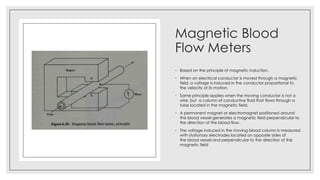
◦ Based on the principle of magnetic induction.
◦ When an electrical conductor is moved through a magnetic
field, a voltage is induced in the conductor proportional to
the velocity of its motion.
◦ Same principle applies when the moving conductor is not a
wire, but a column of conductive fluid that flows through a
tube located in the magnetic field.
◦ A permanent magnet or electromagnet positioned around
the blood vessel generates a magnetic field perpendicular to
the direction of the blood flow.
◦ The voltage induced in the moving blood column is measured
with stationary electrodes located on opposite sides of
the blood vessel and perpendicular to the direction of the
magnetic field
MAGNETIC BLOOD
FLOW PROBE
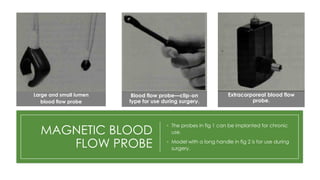
◦ The probes in fig 1 can be implanted for chronic
use.
◦ Model with a long handle in fig 2 is for use during
surgery.
Large and small lumen
blood flow probe
Blood flow probe—clip-on
type for use during surgery.
Extracorporeal blood flow
probe.
MAGNETIC
BLOOD FLOW
PROBE
◦ The slip-on or C type is applied by squeezing an excised
blood vessel together and slipping it through the slot of
the probe.
◦ Contact is provided by two slightly protruding platinum
disks that touch the wall of the blood vessel.
◦ The orifice of the probe must fit tightly around the
vessel.
◦ probes of this type are manufactured in sets, with
diameters increasing in steps of 0.5 or 1 mm from about
2 to 20 mm.
MAGNETIC
BLOOD FLOW
METER
◦ In cannula-type transducer the blood flows through a
plastic cannula around which the magnet is arranged.
◦ The contacts penetrate the walls of the cannula.
◦ In this transducer the blood vessel need to be cut and
its ends slipped over the cannula and secured with a
suture.
◦ Similar transducer is also used to measure the blood
flow in extracorporeal devices, such as dialyzers.
◦ Magnetic blood flow meter measure the mean blood
velocity.
◦ The output voltage of a magnetic blood flow
transducer is very small in few microvolts
MAGNETIC
BLOOD FLOW
METER
Currently magnetic bloodflow meters use electromagnet
driven by alternating currents.
Change of the magnetic field causes the
transducer to act like a transformer and induces error
voltages which often exceed the signal levels
For recovering the signal in the presence of the error
voltage, amplifiers with large dynamic range and phase-
sensitive or gated detectors is used.
To minimize the problem, several different waveforms
have been advocated for the magnet urrent,
WAVEFORMS USED IN MAGNETIC
BLOOD FLOW METERS AND
ERROR SIGNALS INDUCED BY THE
CURRENT
a) sine wave
b) square wave
c) trapezoidal wave
MAGNETIC BLOOD FLOW
METER BLOCK DIAGRAM
Ultrasonic
Blood Flow
Meters
◦ A beam of ultrasonic energy is used to measure the
velocity of flowing blood.
◦ Done in two ways
◦ Transit time ultrasonic flow meter
◦ A pulsed beam is directed through a blood vessel at a
shallow angle and its transit time is then measured.
◦ If blood flows in the direction of the energy transmission, the
transit time is shortened and vice versa
◦ Doppler principle ultrasonic Flow meter
◦ More common ultrasonic flow meters
ULTRASONIC
BLOOD FLOW
METER
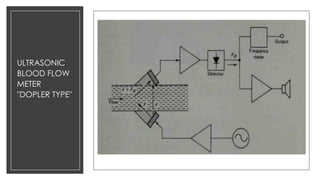
"DOPLER TYPE"
Ultrasonic
blood flow
meter,
Doppler type
◦ An oscillator, operating at a frequency of several Mhtz,
excites a piezoelectric transducer
◦ Transducer is coupled to the wall of an exposed blood
vessel and sends an ultrasonic beam with a frequency F
into the flowing blood.
◦ A small part of the transmitted energy is scattered back is
received by a second transducer arranged opposite the
first one.
◦ Since scattering occurs mainly as a result of the moving
blood cells, the reflected signal has a different frequency
due to the Doppler effect.
◦ Its frequency is either F + Fd) or F - Fd, depending on the
direction of the flow.
◦ The Doppler component Fd is directly proportional to the
velocity of the flowing blood
Ultrasonic
blood flow
meter,
Doppler type
◦ A fraction of the transmitted ultrasonic
energy, reaches the second transducer directly, with
the unchanged frequency.
◦ After amplfication of the composite signal, the Doppler
frequency can be received at the output of a
detector as the difference between the direct and the
scattered signal components.
◦ With blood velocities in the range normally
encountered, the Doppler signal is typically in the low
audio frequency range
◦ Because of the velocity profile of the flowing blood, the
Doppler signal is not a pure sine wave, but has more
the form of narrow-band noise.
THANKYOU

BLOOD FLOW METER.pdf

  • 1.
    A LECTURE ON BLOOD FLOW MEASUREMENT BY: BANDANA JADAWN Paper : 403
  • 2.
    BLOOD FLOW An adequateblood supply is necessary for all organs of the body. An impaired supply of blood is the cause of various diseases. The ability to measure blood flow in the vessel that supplies a particular organ would therefore be of great help in diagnosing such diseases. Blood flow is a rather elusive variable that cannot be measured easily Methods used in industry for flow measurements of other liquids, like the turbine flowmeter and the rotameter, are not very suitable for the measurement of blood flow because they require cutting the blood vessel.
  • 3.
    TYPES OF BLOOD FLOW METERS All bloodflow meters currently used in clinical and research applications are based on one of the following physical principles: Electromagnetic induction. Ultrasound transmission or reflection Thermal convection. Radiographic principles. Indicator (dye or thermal) dilution
  • 4.
    Magnetic Blood Flow Meters ◦Based on the principle of magnetic induction. ◦ When an electrical conductor is moved through a magnetic field, a voltage is induced in the conductor proportional to the velocity of its motion. ◦ Same principle applies when the moving conductor is not a wire, but a column of conductive fluid that flows through a tube located in the magnetic field. ◦ A permanent magnet or electromagnet positioned around the blood vessel generates a magnetic field perpendicular to the direction of the blood flow. ◦ The voltage induced in the moving blood column is measured with stationary electrodes located on opposite sides of the blood vessel and perpendicular to the direction of the magnetic field
  • 5.
    MAGNETIC BLOOD FLOW PROBE ◦The probes in fig 1 can be implanted for chronic use. ◦ Model with a long handle in fig 2 is for use during surgery. Large and small lumen blood flow probe Blood flow probe—clip-on type for use during surgery. Extracorporeal blood flow probe.
  • 6.
    MAGNETIC BLOOD FLOW PROBE ◦ Theslip-on or C type is applied by squeezing an excised blood vessel together and slipping it through the slot of the probe. ◦ Contact is provided by two slightly protruding platinum disks that touch the wall of the blood vessel. ◦ The orifice of the probe must fit tightly around the vessel. ◦ probes of this type are manufactured in sets, with diameters increasing in steps of 0.5 or 1 mm from about 2 to 20 mm.
  • 7.
    MAGNETIC BLOOD FLOW METER ◦ Incannula-type transducer the blood flows through a plastic cannula around which the magnet is arranged. ◦ The contacts penetrate the walls of the cannula. ◦ In this transducer the blood vessel need to be cut and its ends slipped over the cannula and secured with a suture. ◦ Similar transducer is also used to measure the blood flow in extracorporeal devices, such as dialyzers. ◦ Magnetic blood flow meter measure the mean blood velocity. ◦ The output voltage of a magnetic blood flow transducer is very small in few microvolts
  • 8.
    MAGNETIC BLOOD FLOW METER Currently magneticbloodflow meters use electromagnet driven by alternating currents. Change of the magnetic field causes the transducer to act like a transformer and induces error voltages which often exceed the signal levels For recovering the signal in the presence of the error voltage, amplifiers with large dynamic range and phase- sensitive or gated detectors is used. To minimize the problem, several different waveforms have been advocated for the magnet urrent,
  • 9.
    WAVEFORMS USED INMAGNETIC BLOOD FLOW METERS AND ERROR SIGNALS INDUCED BY THE CURRENT a) sine wave b) square wave c) trapezoidal wave
  • 10.
  • 11.
    Ultrasonic Blood Flow Meters ◦ Abeam of ultrasonic energy is used to measure the velocity of flowing blood. ◦ Done in two ways ◦ Transit time ultrasonic flow meter ◦ A pulsed beam is directed through a blood vessel at a shallow angle and its transit time is then measured. ◦ If blood flows in the direction of the energy transmission, the transit time is shortened and vice versa ◦ Doppler principle ultrasonic Flow meter ◦ More common ultrasonic flow meters
  • 12.
  • 13.
    Ultrasonic blood flow meter, Doppler type ◦An oscillator, operating at a frequency of several Mhtz, excites a piezoelectric transducer ◦ Transducer is coupled to the wall of an exposed blood vessel and sends an ultrasonic beam with a frequency F into the flowing blood. ◦ A small part of the transmitted energy is scattered back is received by a second transducer arranged opposite the first one. ◦ Since scattering occurs mainly as a result of the moving blood cells, the reflected signal has a different frequency due to the Doppler effect. ◦ Its frequency is either F + Fd) or F - Fd, depending on the direction of the flow. ◦ The Doppler component Fd is directly proportional to the velocity of the flowing blood
  • 14.
    Ultrasonic blood flow meter, Doppler type ◦A fraction of the transmitted ultrasonic energy, reaches the second transducer directly, with the unchanged frequency. ◦ After amplfication of the composite signal, the Doppler frequency can be received at the output of a detector as the difference between the direct and the scattered signal components. ◦ With blood velocities in the range normally encountered, the Doppler signal is typically in the low audio frequency range ◦ Because of the velocity profile of the flowing blood, the Doppler signal is not a pure sine wave, but has more the form of narrow-band noise.
  • 15.