Powerpoint Presentation 
on 
Classification of 
Transducers
Transducers 
• A Transducer is a device which converts one form of 
energy into another form. 
• Alternatively, a Transducer is defined as a device which 
provides usable output response to a specific input 
measured which may be a physical quantity. 
• A Transducer can also be defined as a device when 
actuated by energy in one system supplies energy in the 
same form or in another form to a second system.
Classification of Transducers 
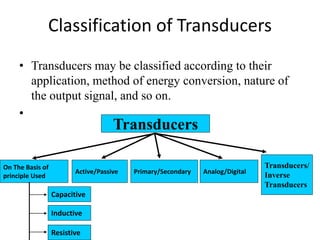
• Transducers may be classified according to their 
application, method of energy conversion, nature of 
the output signal, and so on. 
• 
Transducers 
On The Basis of 
principle Used 
Active/Passive Primary/Secondary Analog/Digital 
Transducers/ 
Inverse 
Transducers 
Capacitive 
Inductive 
Resistive
Active and Passive Transducers 
• Active transducers : 
• These transducers do not need any external source of power for 
their operation. Therefore they are also called as self generating 
type transducers. 
I. The active transducer are self generating devices which operate 
under the energy conversion principle. 
II. As the output of active transducers we get an equivalent 
electrical output signal e.g. temperature or strain to electric 
potential, without any external source of energy being used
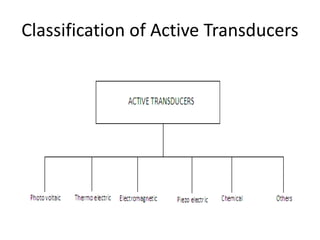
Classification of Active Transducers
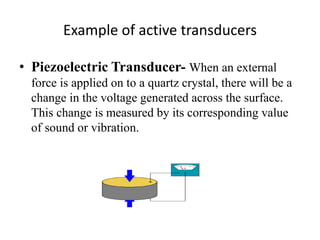
Example of active transducers 
• Piezoelectric Transducer- When an external 
force is applied on to a quartz crystal, there will be a 
change in the voltage generated across the surface. 
This change is measured by its corresponding value 
of sound or vibration.
Passive Transducers 
• These transducers need external source of power for 
their operation. So they are not self generating type 
transducers. 
• A DC power supply or an audio frequency generator is 
used as an external power source. 
• These transducers produce the output signal in the 
form of variation in electrical parameter like resistance, 
capacitance or inductance. 
• Examples – Thermistor, Potentiometer type transducer
Primary and Secondary Transducers 
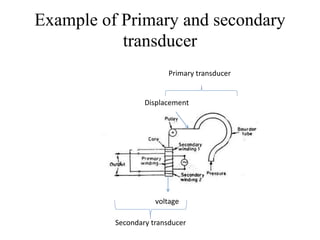
• Some transducers contain the mechanical as well as 
electrical device. The mechanical device converts the 
physical quantity to be measured into a mechanical 
signal. Such mechanical device are called as the 
primary transducers, because they deal with the 
physical quantity to be measured. 
• The electrical device then convert this mechanical 
signal into a corresponding electrical signal. Such 
electrical device are known as secondary transducers.
Example of Primary and secondary 
transducer 
Primary transducer 
Displacement 
voltage 
Secondary transducer
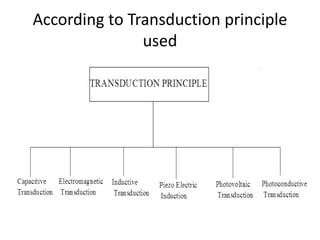
According to Transduction principle 
used
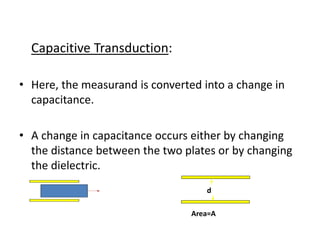
Capacitive Transduction: 
• Here, the measurand is converted into a change in 
capacitance. 
• A change in capacitance occurs either by changing 
the distance between the two plates or by changing 
the dielectric. 
d 
Area=A
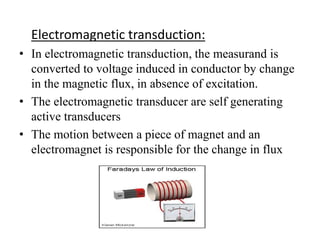
Electromagnetic transduction: 
• In electromagnetic transduction, the measurand is 
converted to voltage induced in conductor by change 
in the magnetic flux, in absence of excitation. 
• The electromagnetic transducer are self generating 
active transducers 
• The motion between a piece of magnet and an 
electromagnet is responsible for the change in flux
Inductance Transduction: 
• In inductive transduction, the measurand is converted 
into a change in the self inductance of a single coil. It 
is achieved by displacing the core of the coil that is 
attached to a mechanical sensing element 
Piezoelectric Transduction: 
• In piezoelectric induction the measurand is converted 
into a change in electrostatic charge q or voltage V 
generated by crystals when it is mechanically 
stressed.
Photovoltaic Transduction: 
• In photovoltaic transduction the measurand is 
converted to voltage generated when the 
junction between dissimilar material is 
illuminated.
Photoconductive Transduction: 
• In photoconductive transduction the 
measurand is converted to change in resistance 
of semiconductor material by the change in 
light incident on the material.
Analog and Digital Transducers 
Analog transducers: 
• These transducers convert the input quantity into an 
analog output which is a continuous function of time. 
• Thus a strain gauge, an L.V.D.T., a thermocouple or a 
thermistor may be called as Analog Transducers as they 
give an output which is a continuous function of time. 
Digital Transducers: 
• These transducers convert the input quantity into an 
electrical output which is in the form of pulses and its 
output is represented by 0 and 1.
Transducer and Inverse Transducer 
Transducer: 
• Transducers convert non electrical quantity to 
electrical quantity. 
Inverse Transducer: 
• Inverse transducers convert electrical quantity 
to a non electrical quantity. A piezoelectric 
crystal acts as an inverse transducer because 
when a voltage is applied across its surfaces, it 
changes its dimensions causing a mechanical 
displacement.
THANK YOU

Classification of transducers

  • 1.
    Powerpoint Presentation on Classification of Transducers
  • 2.
    Transducers • ATransducer is a device which converts one form of energy into another form. • Alternatively, a Transducer is defined as a device which provides usable output response to a specific input measured which may be a physical quantity. • A Transducer can also be defined as a device when actuated by energy in one system supplies energy in the same form or in another form to a second system.
  • 3.
    Classification of Transducers • Transducers may be classified according to their application, method of energy conversion, nature of the output signal, and so on. • Transducers On The Basis of principle Used Active/Passive Primary/Secondary Analog/Digital Transducers/ Inverse Transducers Capacitive Inductive Resistive
  • 4.
    Active and PassiveTransducers • Active transducers : • These transducers do not need any external source of power for their operation. Therefore they are also called as self generating type transducers. I. The active transducer are self generating devices which operate under the energy conversion principle. II. As the output of active transducers we get an equivalent electrical output signal e.g. temperature or strain to electric potential, without any external source of energy being used
  • 5.
  • 6.
    Example of activetransducers • Piezoelectric Transducer- When an external force is applied on to a quartz crystal, there will be a change in the voltage generated across the surface. This change is measured by its corresponding value of sound or vibration.
  • 7.
    Passive Transducers •These transducers need external source of power for their operation. So they are not self generating type transducers. • A DC power supply or an audio frequency generator is used as an external power source. • These transducers produce the output signal in the form of variation in electrical parameter like resistance, capacitance or inductance. • Examples – Thermistor, Potentiometer type transducer
  • 8.
    Primary and SecondaryTransducers • Some transducers contain the mechanical as well as electrical device. The mechanical device converts the physical quantity to be measured into a mechanical signal. Such mechanical device are called as the primary transducers, because they deal with the physical quantity to be measured. • The electrical device then convert this mechanical signal into a corresponding electrical signal. Such electrical device are known as secondary transducers.
  • 9.
    Example of Primaryand secondary transducer Primary transducer Displacement voltage Secondary transducer
  • 10.
  • 11.
    Capacitive Transduction: •Here, the measurand is converted into a change in capacitance. • A change in capacitance occurs either by changing the distance between the two plates or by changing the dielectric. d Area=A
  • 12.
    Electromagnetic transduction: •In electromagnetic transduction, the measurand is converted to voltage induced in conductor by change in the magnetic flux, in absence of excitation. • The electromagnetic transducer are self generating active transducers • The motion between a piece of magnet and an electromagnet is responsible for the change in flux
  • 13.
    Inductance Transduction: •In inductive transduction, the measurand is converted into a change in the self inductance of a single coil. It is achieved by displacing the core of the coil that is attached to a mechanical sensing element Piezoelectric Transduction: • In piezoelectric induction the measurand is converted into a change in electrostatic charge q or voltage V generated by crystals when it is mechanically stressed.
  • 14.
    Photovoltaic Transduction: •In photovoltaic transduction the measurand is converted to voltage generated when the junction between dissimilar material is illuminated.
  • 15.
    Photoconductive Transduction: •In photoconductive transduction the measurand is converted to change in resistance of semiconductor material by the change in light incident on the material.
  • 16.
    Analog and DigitalTransducers Analog transducers: • These transducers convert the input quantity into an analog output which is a continuous function of time. • Thus a strain gauge, an L.V.D.T., a thermocouple or a thermistor may be called as Analog Transducers as they give an output which is a continuous function of time. Digital Transducers: • These transducers convert the input quantity into an electrical output which is in the form of pulses and its output is represented by 0 and 1.
  • 17.
    Transducer and InverseTransducer Transducer: • Transducers convert non electrical quantity to electrical quantity. Inverse Transducer: • Inverse transducers convert electrical quantity to a non electrical quantity. A piezoelectric crystal acts as an inverse transducer because when a voltage is applied across its surfaces, it changes its dimensions causing a mechanical displacement.
  • 18.