IN  THE  NAME  OF THE  MOST  GRACIOUS  THE MOST  MERCIFUL
Presented By:  Rameez Ahmad Mughal BEC-01091032
ElectroMagnetic Flow Meter Topic:
Introduction A  Electromagnetic flow meter  is a volumetric flow meter which does not have any moving parts and is ideal for wastewater applications or any dirty liquid which is  conductive  or water based. 
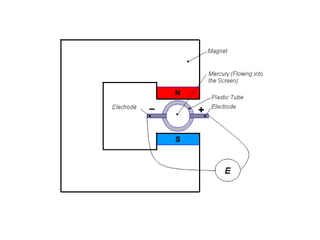
Working Principle The operation of a  Electromagnetic flow meter  or magmeter is based upon  Faraday's Law , which states that: “ The voltage induced across a conductor as it moves at right angles through the magnetic field is proportional to the velocity of that conductor.”
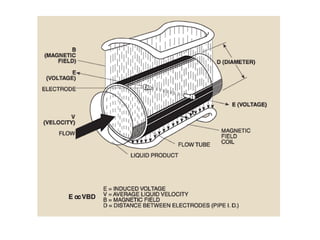
Faraday’s Formula E  is proportional to  V  x  B  x  D where: E  = The voltage generated in a conductor V  = The velocity of the conductor B  = The magnetic field strength D  = The length of the conductor (which in this instance is the distance between the electrodes)
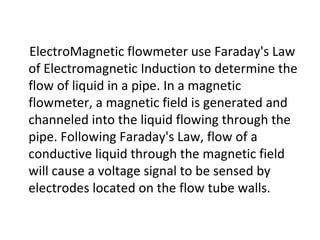
ElectroMagnetic flowmeter use Faraday's Law of Electromagnetic Induction to determine the flow of liquid in a pipe. In a magnetic flowmeter, a magnetic field is generated and channeled into the liquid flowing through the pipe. Following Faraday's Law, flow of a conductive liquid through the magnetic field will cause a voltage signal to be sensed by electrodes located on the flow tube walls.
 
 
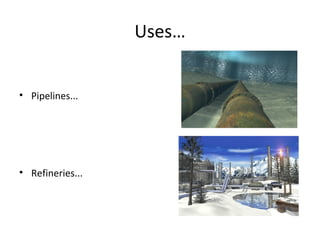
Uses… Pipelines... Refineries...
Advantages & Disadvantage Advantages: Minimum obstruction in the flow path yields minimum pressure drop. It can measure forward as well as reverse flow with equal accuracy. Low maintenance cost because of no moving parts. corrosive or slurry fluid flow. Disadvantage: Requires electrical conductivity of fluid.
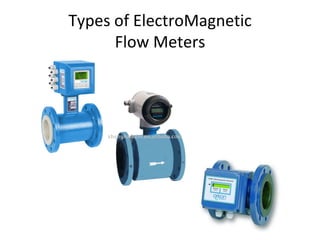
Types of ElectroMagnetic Flow Meters
Questions?

Electromagnetic flow meter

  • 1.
    IN THE NAME OF THE MOST GRACIOUS THE MOST MERCIFUL
  • 2.
    Presented By: Rameez Ahmad Mughal BEC-01091032
  • 3.
  • 4.
    Introduction A  Electromagneticflow meter  is a volumetric flow meter which does not have any moving parts and is ideal for wastewater applications or any dirty liquid which is conductive  or water based. 
  • 5.
    Working Principle Theoperation of a  Electromagnetic flow meter  or magmeter is based upon Faraday's Law , which states that: “ The voltage induced across a conductor as it moves at right angles through the magnetic field is proportional to the velocity of that conductor.”
  • 6.
    Faraday’s Formula E is proportional to  V  x  B  x  D where: E  = The voltage generated in a conductor V  = The velocity of the conductor B  = The magnetic field strength D  = The length of the conductor (which in this instance is the distance between the electrodes)
  • 7.
    ElectroMagnetic flowmeter useFaraday's Law of Electromagnetic Induction to determine the flow of liquid in a pipe. In a magnetic flowmeter, a magnetic field is generated and channeled into the liquid flowing through the pipe. Following Faraday's Law, flow of a conductive liquid through the magnetic field will cause a voltage signal to be sensed by electrodes located on the flow tube walls.
  • 8.
  • 9.
  • 10.
  • 11.
    Advantages & DisadvantageAdvantages: Minimum obstruction in the flow path yields minimum pressure drop. It can measure forward as well as reverse flow with equal accuracy. Low maintenance cost because of no moving parts. corrosive or slurry fluid flow. Disadvantage: Requires electrical conductivity of fluid.
  • 12.
  • 13.