Environment Health && SSaaffeettyy MMaannaaggeemmeenntt IIssssuueess 
&& CChhaalllleennggeess:: SSaaffeettyy MMaannaaggeemmeenntt 
Prof. I.D. MALL 
DePArtMent of CheMICAL engg. 
InDIAn InstItute of teChnoLogy, roorkee 
roorkee- 247667
Process safety, occupational health and 
environmental issues are ever increasing in 
importance in response to heightening public 
concerns, and the resultant tightening of regulations. 
SHE management is a multidisciplinary function and 
every person needs to keep vigil against potential 
cause of fire & accidents and draw lessons from Past 
Incidents. 
Safety Involves 
•Protection of personnel 
•Protection of plant &property 
•Production uninterrupted 
•Legal requirements 
•Welfare of community 
•Good reputation
Surroundings* in which an organization 
operates, including air, water, land, 
natural resources, flora, fauna, humans and 
their interrelation. 
*Surroundings in this context extend from within an organization to the 
global system
Negatively : Absence of illness 
Functionally : Ability to cope with everyday activities 
Positively : Fitness and well-being. 
Survival : Health also implies good prospects for 
continued survival. 
Biological : In any organism, health is a form of 
homeostasis. This is a state of balance, 
with inputs and outputs of energy and 
matter in equilibrium (allowing for 
growth).
Occupational Health 
Occupational health includes 
• Industrial hygiene, 
• Industrial diseases, 
• Industrial work physiology, 
• Industrial accidents, 
• Toxicology in relation to industrial hazards, 
• Occupational rehabilitation, 
• Occupational psychology etc.
 Safety can be defined as prevention of accidents using 
appropriate technologies to identify hazards and to 
eliminate them before an accident occurs 
 Hazard can be referred to as a condition or activity that 
has the potential to cause adverse consequences on 
life, property and the environment. 
 Risk is the probability of the occurrence of an adverse 
consequence of a specified nature and magnitude 
resulting from a potential hazard.
 ISO 14001 
 European Eco-Management and Audit 
Scheme 
 BS 7750 ( UK ) 
 EPA ( USA) 
• OHSAS 18001 
• ILO Guidelines
 Public Perception Of Unsafe And Polluting 
Industry 
 Accidents like Bhopal, Flixborough, Seveso 
 Low Frequency But High Impact 
The health and safety problem in chemical industry can 
be reduced by maintaining safe working conditions, 
preparation and implementation of safe operating 
procedures, study of environment of safety procedure, 
training of employees and periodic medical supervision 
and use of personal protective equipment
• Defined & authorized by top management 
• Appropriate to the nature, scale, Envoi. Impacts 
and OH&S Risks of the activities, products, 
services of the organization. 
• Commitment to comply with legal requirements. 
• Commitment for continual improvement in HSE 
performance . 
• Commitment for prevention of pollution, ill 
health and injury. 
• Available to Interested parties .
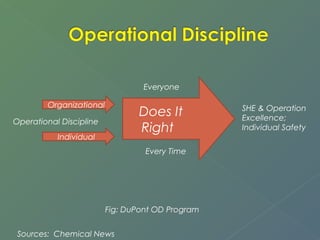
Everyone 
Organizational Does It 
Right 
Operational Discipline 
Individual 
Every Time 
SHE & Operation 
Excellence; 
Individual Safety 
Fig: DuPont OD Program 
Sources: Chemical News
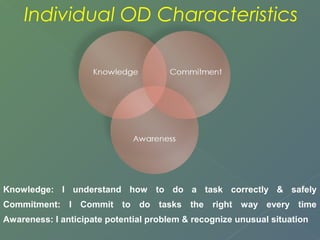
Individual OD Characteristics 
Knowledge: I understand how to do a task correctly & safely 
Commitment: I Commit to do tasks the right way every time 
Awareness: I anticipate potential problem & recognize unusual situation
Twentieth century has brought with it the explosion in 
industrial activities. Industrialization has made human life 
style much easier by making many consumer products. In 
addition industrialization has attracted hazards have 
increased risks and turn accidents. Without adequate 
safety one’s survival is threatened. Safety has made its 
shape in industries from scratch to priorities in the 
changing world. The following are the major requirements 
for development of safety: 
•Legal 
•Economical 
•Social 
To encourage safety in India, 4th March is celebrated as the 
National Safety Day every year.
•To respect humanity 
•To preserve the environment 
•To make the workplace a place of worship 
•To comply with statutory authorities
• Adequate protection against the hazards to which the 
works will be exposed 
• Maximum comfort and minimum weight compatible with 
protective efficiency. 
• No restriction of essential movement. 
• Durability and susceptibility of maintenance on the 
premise’s where it is used. 
• Construction in accordance with the accepted standards 
for performance and material.
Personal protective Equipment may be divided into two broad 
groups: 
•Respiratory protective equipment 
•Non respiratory protective equipment 
Section of equipment to protect different part of the body will 
depend upon the hazardous conditions like injurious 
mechanical contact etc. The former includes those which are 
used for protection of respiratory system or related hazards. 
These provide protection from suffocation due to presence of 
harmful vapors/absence of atmospheric oxygen . The non-respiratory 
PPEs safe guards the other body parts.
Safety tag system is also in existence. The need for this 
system is that any equipment in any kind of job or activity 
other than its normal use needs to be identified ,hence 
tagged. This help minimizing misreading/misconception. This 
tags used for isolation cordoning , restricting entry, etc. 
Tags available are, “ DO NOT OPERATE “ , “DANGER” ,” NO 
ENTRY” , “ROAD BLOCKED” , “BLIND” “ELECTRICALLY 
ISOLATED” . 
In order to maintain an international level of safe work 
environment and to maintain a zero accident level SAFETY 
needs the cooperation of one and all as SAFETY IS 
EVERYBODY’S BUSINESS.
Factor IInnfflluueenncciinngg PPrroocceessss HHaazzaarrdd 
Many complex processes are adopted in manufacturing 
processes, which are not intrinsically safe. Some of the 
factors influencing process hazard are 
• Reaction types (hydrolysis, oxidation, reduction, 
sulphonation, nitration, polymerization, isomerisation, 
alkylation) 
• Reaction parameters(stability, reactivity, heat of 
reaction, pressure, temperature) 
• Physical and chemical properties of substances, their 
toxicity, corrosiveness 
• Quantities of substances used and stored 
• Storage characteristics( pressure, temperature )
Accidents: Accidents can be classified into 
five groups: 
• BLEVE (Boiling Liquid Expanding Vapour Explosion) 
• Release of flammable gases, flash fire, & 
UVCE (Unconfined Vapour Cloud Explosion) 
• Toxic vapour release 
• Pool fires 
• Fragmentation
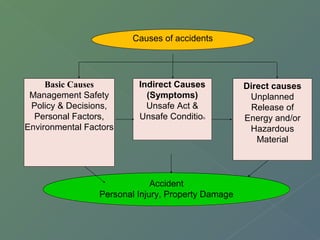
CCaauusseess ooff aacccciiddeennttss 
Indirect Causes 
(Symptoms) 
Unsafe Act & 
Unsafe Condition 
Basic Causes 
Management Safety 
Policy & Decisions, 
Personal Factors, 
Environmental Factors 
Direct causes 
Unplanned 
Release of 
Energy and/or 
Hazardous 
Material 
Accident 
Personal Injury, Property Damage
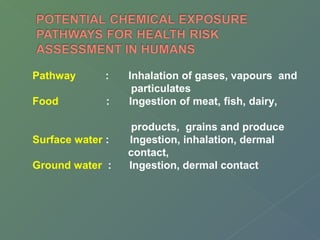
Pathway : Inhalation of gases, vapours and 
particulates 
Food : Ingestion of meat, fish, dairy, 
products, grains and produce 
Surface water : Ingestion, inhalation, dermal 
contact, 
Ground water : Ingestion, dermal contact
Adverse exposure of the chemicals can be acute 
exposure (acute poisoning), chronic exposure (chronic 
poisoning), site of toxic effects of chemicals, local, 
Systemic, cumulative, synergistic or potentiating effect. 
Some of the commonly occupational exposure limits are 
Threshold limit values (TLV), Permissible Exposure limit, 
Maximum allowable concentrations. 
Commonly three types of TLVs are prescribed: TLV-TWA( 
time weighted average), STEL( short term exposure 
limit), TLV-C(ceiling limit) 
[ ISC,2008].
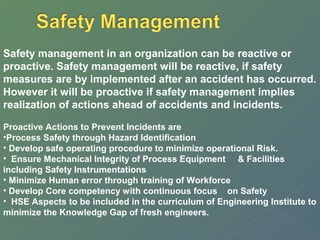
Safety management in an organization can be reactive or 
proactive. Safety management will be reactive, if safety 
measures are by implemented after an accident has occurred. 
However it will be proactive if safety management implies 
realization of actions ahead of accidents and incidents. 
Proactive Actions to Prevent Incidents are 
•Process Safety through Hazard Identification 
• Develop safe operating procedure to minimize operational Risk. 
• Ensure Mechanical Integrity of Process Equipment & Facilities 
including Safety Instrumentations 
• Minimize Human error through training of Workforce 
• Develop Core competency with continuous focus on Safety 
• HSE Aspects to be included in the curriculum of Engineering Institute to 
minimize the Knowledge Gap of fresh engineers.
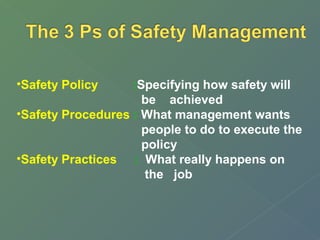
•Safety Policy :Specifying how safety will 
be achieved 
•Safety Procedures : What management wants 
people to do to execute the 
policy 
•Safety Practices : What really happens on 
the job
•Goals and objective of the safety programme 
•Risk analysis and management 
•Industrial process design and operation 
•Mechanical integrity of process equipment 
•Safety regulations, codes and standards 
•Project safety and health review 
•Personnel motivation and training 
•Process and plant modification and change 
•Good work practices 
•Incident investigation and safety audits
IS18001 provides the industry a systematic, structured 
and documented frame work to address OH&S issues 
effectively and in an auditable manner. The element of 
OH&S management systems are as follows: 
•OH&S Policy 
•Planning 
•Implementation and operation 
•Measurement and Evaluation and 
•Management review
Benefits of OH &S Management system 
Reducing the number of personnel injuries through preventive 
and control of work place 
•Reducing the risk of major accident 
•Reducing the material loss caused by accident and in 
production interruption 
•Ensuring the appropriate legislation is addressed 
•Meeting increasing importance of OH &S for public image 
•Serving the possibility for an integrated management system 
including quality, environment and OH &S
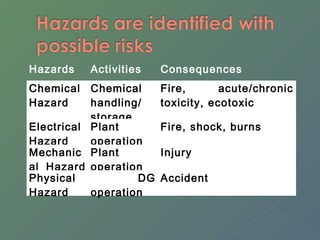
Hazards Activities Consequences 
Chemical 
Hazard 
Chemical 
handling/ 
storage 
Fire, acute/chronic 
toxicity, ecotoxic 
Electrical 
Hazard 
Plant 
operation 
Fire, shock, burns 
Mechanic 
al Hazard 
Plant 
operation 
Injury 
Physical 
Hazard 
DG 
operation 
Accident
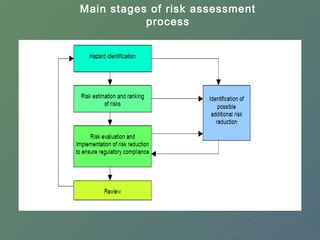
Main stages of risk assessment 
process
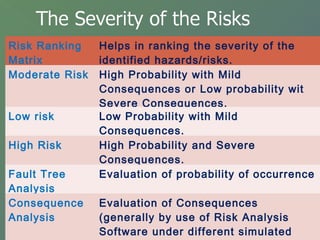
Risk Ranking 
Matrix 
Helps in ranking the severity of the 
identified hazards/risks. 
Moderate Risk High Probability with Mild 
Consequences or Low probability wit 
Severe Consequences. 
Low risk Low Probability with Mild 
Consequences. 
High Risk High Probability and Severe 
Consequences. 
Fault Tree 
Analysis 
Evaluation of probability of occurrence 
Consequence 
Analysis 
Evaluation of Consequences 
(generally by use of Risk Analysis 
Software under different simulated 
situations).
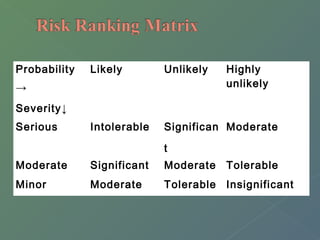
Probability 
→ 
Severity↓ 
Likely Unlikely Highly 
unlikely 
Serious Intolerable Significan 
t 
Moderate 
Moderate Significant Moderate Tolerable 
Minor Moderate Tolerable Insignificant
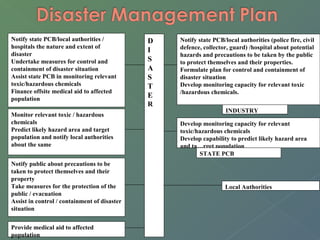
DI 
S 
ASTE 
R 
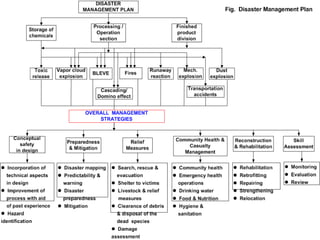
Notify state PCB/local authorities / 
hospitals the nature and extent of 
disaster 
Undertake measures for control and 
containment of disaster situation 
Assist state PCB in monitoring relevant 
toxic/hazardous chemicals 
Finance offsite medical aid to affected 
population 
Monitor relevant toxic / hazardous 
chemicals 
Predict likely hazard area and target 
population and notify local authorities 
about the same 
Notify public about precautions to be 
taken to protect themselves and their 
property 
Take measures for the protection of the 
public / evacuation 
Assist in control / containment of disaster 
situation 
Provide medical aid to affected 
population 
Notify state PCB/local authorities (police fire, civil 
defence, collector, guard) /hospital about potential 
hazards and precautions to be taken by the public 
to protect themselves and their properties. 
Formulate plan for control and containment of 
disaster situation 
Develop monitoring capacity for relevant toxic 
/hazardous chemicals. 
INDUSTRY 
Develop monitoring capacity for relevant 
toxic/hazardous chemicals 
Develop capability to predict likely hazard area 
and ta…rget population 
STATE PCB 
Local Authorities
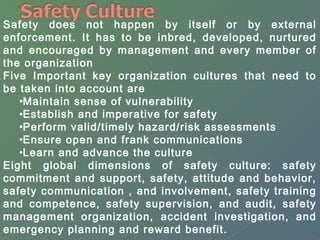
Safety does not happen by itself or by external 
enforcement. It has to be inbred, developed, nurtured 
and encouraged by management and every member of 
the organization 
Five Important key organization cultures that need to 
be taken into account are 
•Maintain sense of vulnerability 
•Establish and imperative for safety 
•Perform valid/timely hazard/risk assessments 
•Ensure open and frank communications 
•Learn and advance the culture 
Eight global dimensions of safety culture: safety 
commitment and support, safety, attitude and behavior, 
safety communication , and involvement, safety training 
and competence, safety supervision, and audit, safety 
management organization, accident investigation, and 
emergency planning and reward benefit.
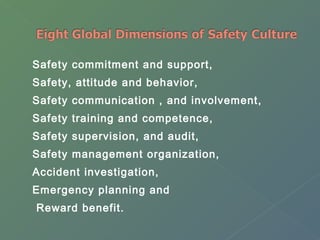
Safety commitment and support, 
Safety, attitude and behavior, 
Safety communication , and involvement, 
Safety training and competence, 
Safety supervision, and audit, 
Safety management organization, 
Accident investigation, 
Emergency planning and 
Reward benefit.
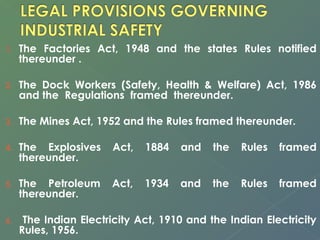
1. The Factories Act, 1948 and the states Rules notified 
thereunder . 
2. The Dock Workers (Safety, Health & Welfare) Act, 1986 
and the Regulations framed thereunder. 
3. The Mines Act, 1952 and the Rules framed thereunder. 
4. The Explosives Act, 1884 and the Rules framed 
thereunder. 
5. The Petroleum Act, 1934 and the Rules framed 
thereunder. 
6. The Indian Electricity Act, 1910 and the Indian Electricity 
Rules, 1956.
 The Indian Boilers Act, 1923 and the Indian Boiler 
Regulations . 
 The Dangerous Machines (Regulation) Act, 1983. 
 The Manufacture, Storage & Import of Hazardous 
Chemical Rules1989 and the Rules framed there 
under 
 Building and Other Construction Workers (Regulation 
of Employment and Conditions of Service) Act, 1996 
and Rules framed there under 
 Beedi and Cigar Workers’ (Conditions of 
Employment) Act, 1966 
 Employers’ Liability Act, 1938 
 Public Liability Insurance Act, 1991 and Rules framed 
there under
“Recognition, evaluation & control of 
those environmental factors or 
stresses arising in or from the 
workplace , which may cause 
sickness, impaired health and well 
being or significant discomfort 
among workers”
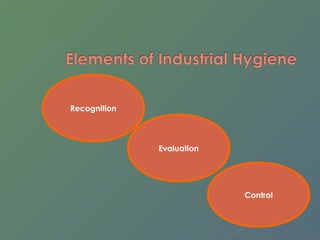
Recognition 
Evaluation 
Control
 Chemical Hazards 
Chemicals are released in the form of dust , fumes, 
gases, vapors etc in the work environment 
 Physical Hazards 
 Noise , 
 Heat , 
 Illumination 
 Vibrations etc
Management of Health, Safety and Environmental issues 
and requirements throughout project execution through 
the issue and maintenance of a project specific Health 
Safety and Environmental (HSE) plan. 
The HSE Plan to address all client requirements, national 
and local legislation. 
HSE plan shall be the principal means by which all HSE 
related issues shall be managed, including risk 
management. 
Components of HSE plan 
Scope and Responsibilities 
Health and Design Safety 
Environment 
Construction
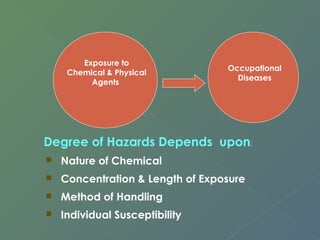
Exposure to 
Chemical & Physical 
Agents 
Occupational 
Diseases 
Degree of Hazards Depends upon: 
 Nature of Chemical 
 Concentration & Length of Exposure 
 Method of Handling 
 Individual Susceptibility
Details of Processes / Operations 
Carried Out 
Chemicals or Substances Used / 
Produced as a Raw Materials, 
Intermediates or By Product etc
Toxicity of Raw Materials, and 
Products etc 
Sources of Air Contaminants 
New Stresses: Change on 
Processesetc. 
Job Activities Review 
Existing Control Measures
 NEGATIVE ASPECTS 
INJURY TO PERSONS 
LOSS to organization 
DAMAGE TO EQUIPMENT & 
PROPERTY 
LITIGATION COSTS 
LOST PRODUCTIVITY
 Safety = freedom from accidents 
 Protection of personnel 
 Protection of plant &property 
 Production uninterrupted 
 Legal requirements 
 Welfare of community 
 Good reputation
With increasing focus on worker safety 
and loss prevention by both government 
and industries themselves safety is no 
longer confined to just hard hats, 
goggles and gloves. 
For complying with the regulations and 
long term benefits an effective and 
optimal safety system is a must and with 
results so far the plant in question seems 
to have got the right balance.
CCoonnttiinnuuee…….... 
 Health, Safety and environmental aspects are 
incorporated into all aspects of pre-FEED, FEED, 
engineering and construction and are given the 
highest priority. 
 All employees contribute towards Health, Safety 
and Environmental (HSE) Policy implementation to 
achieve safe working environment, safety 
designed and constructed plants conducting 
activities to safeguard the environment. 
Target objectives 
 Protection from risk of injury/danger to health 
 Protection from property damage or loss 
 Protection of the environment
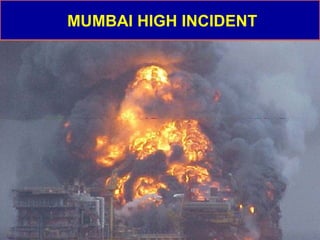
MUMBAI HIGH INCIDENT
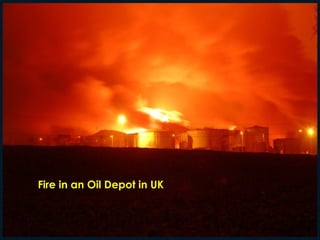
Fire in an Oil Depot in UK
Ehs management issues& challenges safety

Ehs management issues& challenges safety

  • 1.
    Environment Health &&SSaaffeettyy MMaannaaggeemmeenntt IIssssuueess && CChhaalllleennggeess:: SSaaffeettyy MMaannaaggeemmeenntt Prof. I.D. MALL DePArtMent of CheMICAL engg. InDIAn InstItute of teChnoLogy, roorkee roorkee- 247667
  • 2.
    Process safety, occupationalhealth and environmental issues are ever increasing in importance in response to heightening public concerns, and the resultant tightening of regulations. SHE management is a multidisciplinary function and every person needs to keep vigil against potential cause of fire & accidents and draw lessons from Past Incidents. Safety Involves •Protection of personnel •Protection of plant &property •Production uninterrupted •Legal requirements •Welfare of community •Good reputation
  • 3.
    Surroundings* in whichan organization operates, including air, water, land, natural resources, flora, fauna, humans and their interrelation. *Surroundings in this context extend from within an organization to the global system
  • 4.
    Negatively : Absenceof illness Functionally : Ability to cope with everyday activities Positively : Fitness and well-being. Survival : Health also implies good prospects for continued survival. Biological : In any organism, health is a form of homeostasis. This is a state of balance, with inputs and outputs of energy and matter in equilibrium (allowing for growth).
  • 5.
    Occupational Health Occupationalhealth includes • Industrial hygiene, • Industrial diseases, • Industrial work physiology, • Industrial accidents, • Toxicology in relation to industrial hazards, • Occupational rehabilitation, • Occupational psychology etc.
  • 7.
     Safety canbe defined as prevention of accidents using appropriate technologies to identify hazards and to eliminate them before an accident occurs  Hazard can be referred to as a condition or activity that has the potential to cause adverse consequences on life, property and the environment.  Risk is the probability of the occurrence of an adverse consequence of a specified nature and magnitude resulting from a potential hazard.
  • 8.
     ISO 14001  European Eco-Management and Audit Scheme  BS 7750 ( UK )  EPA ( USA) • OHSAS 18001 • ILO Guidelines
  • 9.
     Public PerceptionOf Unsafe And Polluting Industry  Accidents like Bhopal, Flixborough, Seveso  Low Frequency But High Impact The health and safety problem in chemical industry can be reduced by maintaining safe working conditions, preparation and implementation of safe operating procedures, study of environment of safety procedure, training of employees and periodic medical supervision and use of personal protective equipment
  • 10.
    • Defined &authorized by top management • Appropriate to the nature, scale, Envoi. Impacts and OH&S Risks of the activities, products, services of the organization. • Commitment to comply with legal requirements. • Commitment for continual improvement in HSE performance . • Commitment for prevention of pollution, ill health and injury. • Available to Interested parties .
  • 11.
    Everyone Organizational DoesIt Right Operational Discipline Individual Every Time SHE & Operation Excellence; Individual Safety Fig: DuPont OD Program Sources: Chemical News
  • 12.
    Individual OD Characteristics Knowledge: I understand how to do a task correctly & safely Commitment: I Commit to do tasks the right way every time Awareness: I anticipate potential problem & recognize unusual situation
  • 13.
    Twentieth century hasbrought with it the explosion in industrial activities. Industrialization has made human life style much easier by making many consumer products. In addition industrialization has attracted hazards have increased risks and turn accidents. Without adequate safety one’s survival is threatened. Safety has made its shape in industries from scratch to priorities in the changing world. The following are the major requirements for development of safety: •Legal •Economical •Social To encourage safety in India, 4th March is celebrated as the National Safety Day every year.
  • 14.
    •To respect humanity •To preserve the environment •To make the workplace a place of worship •To comply with statutory authorities
  • 15.
    • Adequate protectionagainst the hazards to which the works will be exposed • Maximum comfort and minimum weight compatible with protective efficiency. • No restriction of essential movement. • Durability and susceptibility of maintenance on the premise’s where it is used. • Construction in accordance with the accepted standards for performance and material.
  • 16.
    Personal protective Equipmentmay be divided into two broad groups: •Respiratory protective equipment •Non respiratory protective equipment Section of equipment to protect different part of the body will depend upon the hazardous conditions like injurious mechanical contact etc. The former includes those which are used for protection of respiratory system or related hazards. These provide protection from suffocation due to presence of harmful vapors/absence of atmospheric oxygen . The non-respiratory PPEs safe guards the other body parts.
  • 17.
    Safety tag systemis also in existence. The need for this system is that any equipment in any kind of job or activity other than its normal use needs to be identified ,hence tagged. This help minimizing misreading/misconception. This tags used for isolation cordoning , restricting entry, etc. Tags available are, “ DO NOT OPERATE “ , “DANGER” ,” NO ENTRY” , “ROAD BLOCKED” , “BLIND” “ELECTRICALLY ISOLATED” . In order to maintain an international level of safe work environment and to maintain a zero accident level SAFETY needs the cooperation of one and all as SAFETY IS EVERYBODY’S BUSINESS.
  • 18.
    Factor IInnfflluueenncciinngg PPrroocceessssHHaazzaarrdd Many complex processes are adopted in manufacturing processes, which are not intrinsically safe. Some of the factors influencing process hazard are • Reaction types (hydrolysis, oxidation, reduction, sulphonation, nitration, polymerization, isomerisation, alkylation) • Reaction parameters(stability, reactivity, heat of reaction, pressure, temperature) • Physical and chemical properties of substances, their toxicity, corrosiveness • Quantities of substances used and stored • Storage characteristics( pressure, temperature )
  • 19.
    Accidents: Accidents canbe classified into five groups: • BLEVE (Boiling Liquid Expanding Vapour Explosion) • Release of flammable gases, flash fire, & UVCE (Unconfined Vapour Cloud Explosion) • Toxic vapour release • Pool fires • Fragmentation
  • 20.
    CCaauusseess ooff aacccciiddeennttss Indirect Causes (Symptoms) Unsafe Act & Unsafe Condition Basic Causes Management Safety Policy & Decisions, Personal Factors, Environmental Factors Direct causes Unplanned Release of Energy and/or Hazardous Material Accident Personal Injury, Property Damage
  • 21.
    Pathway : Inhalationof gases, vapours and particulates Food : Ingestion of meat, fish, dairy, products, grains and produce Surface water : Ingestion, inhalation, dermal contact, Ground water : Ingestion, dermal contact
  • 22.
    Adverse exposure ofthe chemicals can be acute exposure (acute poisoning), chronic exposure (chronic poisoning), site of toxic effects of chemicals, local, Systemic, cumulative, synergistic or potentiating effect. Some of the commonly occupational exposure limits are Threshold limit values (TLV), Permissible Exposure limit, Maximum allowable concentrations. Commonly three types of TLVs are prescribed: TLV-TWA( time weighted average), STEL( short term exposure limit), TLV-C(ceiling limit) [ ISC,2008].
  • 23.
    Safety management inan organization can be reactive or proactive. Safety management will be reactive, if safety measures are by implemented after an accident has occurred. However it will be proactive if safety management implies realization of actions ahead of accidents and incidents. Proactive Actions to Prevent Incidents are •Process Safety through Hazard Identification • Develop safe operating procedure to minimize operational Risk. • Ensure Mechanical Integrity of Process Equipment & Facilities including Safety Instrumentations • Minimize Human error through training of Workforce • Develop Core competency with continuous focus on Safety • HSE Aspects to be included in the curriculum of Engineering Institute to minimize the Knowledge Gap of fresh engineers.
  • 24.
    •Safety Policy :Specifyinghow safety will be achieved •Safety Procedures : What management wants people to do to execute the policy •Safety Practices : What really happens on the job
  • 25.
    •Goals and objectiveof the safety programme •Risk analysis and management •Industrial process design and operation •Mechanical integrity of process equipment •Safety regulations, codes and standards •Project safety and health review •Personnel motivation and training •Process and plant modification and change •Good work practices •Incident investigation and safety audits
  • 27.
    IS18001 provides theindustry a systematic, structured and documented frame work to address OH&S issues effectively and in an auditable manner. The element of OH&S management systems are as follows: •OH&S Policy •Planning •Implementation and operation •Measurement and Evaluation and •Management review
  • 28.
    Benefits of OH&S Management system Reducing the number of personnel injuries through preventive and control of work place •Reducing the risk of major accident •Reducing the material loss caused by accident and in production interruption •Ensuring the appropriate legislation is addressed •Meeting increasing importance of OH &S for public image •Serving the possibility for an integrated management system including quality, environment and OH &S
  • 29.
    Hazards Activities Consequences Chemical Hazard Chemical handling/ storage Fire, acute/chronic toxicity, ecotoxic Electrical Hazard Plant operation Fire, shock, burns Mechanic al Hazard Plant operation Injury Physical Hazard DG operation Accident
  • 30.
    Main stages ofrisk assessment process
  • 31.
    Risk Ranking Matrix Helps in ranking the severity of the identified hazards/risks. Moderate Risk High Probability with Mild Consequences or Low probability wit Severe Consequences. Low risk Low Probability with Mild Consequences. High Risk High Probability and Severe Consequences. Fault Tree Analysis Evaluation of probability of occurrence Consequence Analysis Evaluation of Consequences (generally by use of Risk Analysis Software under different simulated situations).
  • 32.
    Probability → Severity↓ Likely Unlikely Highly unlikely Serious Intolerable Significan t Moderate Moderate Significant Moderate Tolerable Minor Moderate Tolerable Insignificant
  • 33.
    DI S ASTE R Notify state PCB/local authorities / hospitals the nature and extent of disaster Undertake measures for control and containment of disaster situation Assist state PCB in monitoring relevant toxic/hazardous chemicals Finance offsite medical aid to affected population Monitor relevant toxic / hazardous chemicals Predict likely hazard area and target population and notify local authorities about the same Notify public about precautions to be taken to protect themselves and their property Take measures for the protection of the public / evacuation Assist in control / containment of disaster situation Provide medical aid to affected population Notify state PCB/local authorities (police fire, civil defence, collector, guard) /hospital about potential hazards and precautions to be taken by the public to protect themselves and their properties. Formulate plan for control and containment of disaster situation Develop monitoring capacity for relevant toxic /hazardous chemicals. INDUSTRY Develop monitoring capacity for relevant toxic/hazardous chemicals Develop capability to predict likely hazard area and ta…rget population STATE PCB Local Authorities
  • 34.
    Safety does nothappen by itself or by external enforcement. It has to be inbred, developed, nurtured and encouraged by management and every member of the organization Five Important key organization cultures that need to be taken into account are •Maintain sense of vulnerability •Establish and imperative for safety •Perform valid/timely hazard/risk assessments •Ensure open and frank communications •Learn and advance the culture Eight global dimensions of safety culture: safety commitment and support, safety, attitude and behavior, safety communication , and involvement, safety training and competence, safety supervision, and audit, safety management organization, accident investigation, and emergency planning and reward benefit.
  • 35.
    Safety commitment andsupport, Safety, attitude and behavior, Safety communication , and involvement, Safety training and competence, Safety supervision, and audit, Safety management organization, Accident investigation, Emergency planning and Reward benefit.
  • 36.
    1. The FactoriesAct, 1948 and the states Rules notified thereunder . 2. The Dock Workers (Safety, Health & Welfare) Act, 1986 and the Regulations framed thereunder. 3. The Mines Act, 1952 and the Rules framed thereunder. 4. The Explosives Act, 1884 and the Rules framed thereunder. 5. The Petroleum Act, 1934 and the Rules framed thereunder. 6. The Indian Electricity Act, 1910 and the Indian Electricity Rules, 1956.
  • 37.
     The IndianBoilers Act, 1923 and the Indian Boiler Regulations .  The Dangerous Machines (Regulation) Act, 1983.  The Manufacture, Storage & Import of Hazardous Chemical Rules1989 and the Rules framed there under  Building and Other Construction Workers (Regulation of Employment and Conditions of Service) Act, 1996 and Rules framed there under  Beedi and Cigar Workers’ (Conditions of Employment) Act, 1966  Employers’ Liability Act, 1938  Public Liability Insurance Act, 1991 and Rules framed there under
  • 38.
    “Recognition, evaluation &control of those environmental factors or stresses arising in or from the workplace , which may cause sickness, impaired health and well being or significant discomfort among workers”
  • 39.
  • 40.
     Chemical Hazards Chemicals are released in the form of dust , fumes, gases, vapors etc in the work environment  Physical Hazards  Noise ,  Heat ,  Illumination  Vibrations etc
  • 41.
    Management of Health,Safety and Environmental issues and requirements throughout project execution through the issue and maintenance of a project specific Health Safety and Environmental (HSE) plan. The HSE Plan to address all client requirements, national and local legislation. HSE plan shall be the principal means by which all HSE related issues shall be managed, including risk management. Components of HSE plan Scope and Responsibilities Health and Design Safety Environment Construction
  • 42.
    Exposure to Chemical& Physical Agents Occupational Diseases Degree of Hazards Depends upon:  Nature of Chemical  Concentration & Length of Exposure  Method of Handling  Individual Susceptibility
  • 43.
    Details of Processes/ Operations Carried Out Chemicals or Substances Used / Produced as a Raw Materials, Intermediates or By Product etc
  • 44.
    Toxicity of RawMaterials, and Products etc Sources of Air Contaminants New Stresses: Change on Processesetc. Job Activities Review Existing Control Measures
  • 45.
     NEGATIVE ASPECTS INJURY TO PERSONS LOSS to organization DAMAGE TO EQUIPMENT & PROPERTY LITIGATION COSTS LOST PRODUCTIVITY
  • 46.
     Safety =freedom from accidents  Protection of personnel  Protection of plant &property  Production uninterrupted  Legal requirements  Welfare of community  Good reputation
  • 47.
    With increasing focuson worker safety and loss prevention by both government and industries themselves safety is no longer confined to just hard hats, goggles and gloves. For complying with the regulations and long term benefits an effective and optimal safety system is a must and with results so far the plant in question seems to have got the right balance.
  • 48.
    CCoonnttiinnuuee……....  Health,Safety and environmental aspects are incorporated into all aspects of pre-FEED, FEED, engineering and construction and are given the highest priority.  All employees contribute towards Health, Safety and Environmental (HSE) Policy implementation to achieve safe working environment, safety designed and constructed plants conducting activities to safeguard the environment. Target objectives  Protection from risk of injury/danger to health  Protection from property damage or loss  Protection of the environment
  • 49.
  • 50.
    Fire in anOil Depot in UK