Introduction to Occupational
Safety II
Introduction toIntroduction to
Occupational Safety IIOccupational Safety II
Rona Tan (Grad IOSH)
The Nature and Scope of health
and Safety
• The Multi-Disciplinary Nature of Health
and Safety,
Chemistry and physic
Biological sciences
Engineering
Psychology
Sociology
The Law
Obstacles to Good
Standards of Health & Safety
• Complexity
- The cause of a problem
- Process & Technology
- Requirements & Regulations
• Competing & Conflicting Demands
- Productivity & Cost
- External Customer Oriented
- Competing
• Behavioural Issues
- Unsafe Act
- Ignorance, Carelessness or Incompetence
- Work Culture
Health and Safety Foundations
Why ?
Humane – harm to people
Economical Impact- expensive
Legal – compliance to legal requirement
Reputation – societal expectation
Meanings and Distinctions
• Health , Safety , Welfare and Environmental
Protection
►Health relates to the physical condition of both body
and mind of all people at the workplace,
►Safety relates to the conditions at the workplace and
applies to the pursuit of a state where the risk of harm
has been eliminated or reduced to an acceptable level
►Welfare relates to the general well-being of workers at
the workplaces,
►Environmental protection can be seen as comprising
two types
Health & Safety Foundation
– Types :-
• The workplace environment, which relates to the
general conditions in the immediate area of the
workplace itself-
• The external environment, which relates to
pollution of , damage to, the air , land , water and
living creatures outside of the workplace, insofar
as they may be affected by workplace activities,
Accidents and other Events
Definitions in relations to health and safety.
☻Incident: an event –include accident and near miss.
☻Accident: undesired event
☻Near-miss: could have resulted injury but did not
☻Occupational accident
☻Occupational diseases
Basically accidents are caused by two factors:
• 1) Unsafe Behavior/Act
• 2) Unsafe Condition
90% Behavior
30,000 Hazards
At Risk Acts/Conditions
10% Conditions
Reactive Safety
Management
Proactive BBS
Accident Prevention
Approach
1 Fatality
30
Majors
300
Recordable
3000
Near Miss
Statistics based on
200 companies
Definitions
• Hazards
A Hazard is an article, substance or
situation that has the potential to
cause harm or damage.
Definitions
• Risk:
A risk is the likelihood of harm occurring.
The degree of risk is based both on the
likelihood and severity of outcome (type of
injury, number involved..)
Example
Hazard Position of Cable
Magnitude of Risk
(Likelihood x Severity)
Tripping over cable
And falling
Fastened to wall Zero
Trailing around edge
of room
Low
Trailing across the
floor
Medium
Trailing across head
of stairway
High
Identification of hazards and the assessment of associated risks has
become the cornerstone of modern health and safety law
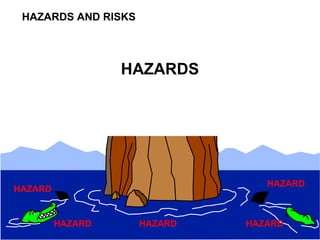
HAZARDS
HAZARDHAZARD
HAZARD
HAZARD
HAZARD
HAZARDS AND RISKS
HAZARDHAZARD
HAZARD
HAZARD
HAZARD
Risk emerges
when
TARGET is
introduce or
expose to the
HAZARD
HAZARDHAZARD
HAZARD
HAZARD
HAZARD
Risk level is
dependent upon the
number of
hazards and
time/length of
exposure
Types of Hazards
physical
Biological
Chemical
Psychosocial
Ergonomic
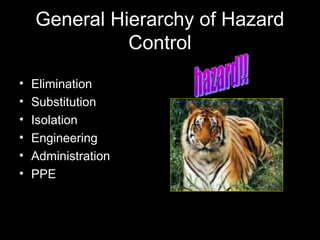
General Hierarchy of Hazard
Control
• Elimination
• Substitution
• Isolation
• Engineering
• Administration
• PPE
The Moral, Legal and Economic
Reasons For Health and Safety
• Legislation Requirement-Minimum
• Vicarious Liability-defense Negligence
• Moral Obligations- Take cares of
neighbours
• Fines for non-compliance
• Economical impact- accidents and ill
health very expensive-direct and indirect
costs,
Size of the problem
ILO statistics shows the scale of the problem:-
There are 270 million occupational accident and 160
million occupational diseases each year,
2 million people die every year from occupational
accidents and occupational diseases,
4% of the world’s GDP (gross domestic product) is lost
each year through the cost of injury, death, absence ,
etc
Around 355,000 on-the job fatalities each year-half from
agriculture – others construction and fishing industries
Costs of Accidents and Ill-Health
• Direct costs
• Indirect costs
• Iceberg Theory
• Insurance , Costs and Liabilities
Safe Systems of Work
• It is not sufficient to stop at the provision of safe
premises and plant and equipment. Employer
must provide safe procedures in the used of
equipment:-
• The system of work should be reasonably safe in all
circumstances, procedures must cover all foreseeable
possibilities
• Workers must be fully aware of and competent in carrying
out the safe system of work (properly trained, instructed, and
given information necessary is made available)
• There is a need to review , planning and control in ensuring
that working methods are safe,
Training and Supervision and
Competency of Staff
• It is also become the duty of employer to ensure , that
staff are equipped with the knowledge, experience, skills
and training necessary to carry out their work in a safe
manner,
– This starts with recruitment, appointment and selection of
personnel has all the necessary abilities to do the job safely
(Competent)
– All staff need to be provided with the specific knowledge
required to operate safely in the particular workplace,
machinery ,plant according to recognized safe system of work ,
through training, instruction, information is a major responsibility
of employer.
• Employers should take reasonable
practical steps to ensure that:-
– Staff follows all the correct procedures
– And are actually operating safely,
– Around 60% of workplace accidents are the
result of human actions and are preventable,
– Adequate supervision , can reinforce
adherence to procedures.
Training and Supervision and
Competency of Staff
To provide and maintain workplaces, machinery
and equipment, and use work methods, which
are as safe and without risk to health as is
reasonably practicable;
To give necessary instructions and training,
taking account to the functions and capacities of
different categories of workers;
The Employer’s Basic
responsibilities
General Duties of
Employee/Workers
 To take care of his own safety and the safety of
others,
 Comply with established safe systems of work
and rules,
 To use protective equipment provided while
carrying out the work requiring them,
 To report to supervisors, unsafe condition, tools,
that equipment are in good repair
 To report all accidents, for lesson learnt
Consequences of Non-Compliance
• Breach of health and safety legislation –
criminal offence
• Civil liability may also arise – compensation
resulted from negligence,
• Negligence – is probably the most important
in terms of the number of cases and the
amount of damages which may be awarded
for serious injury
Negligence
• Breach of the legal duty to exercise
reasonable care towards others-resulting
causing harm to someone to whom you
owed a duty of care as result of something
you did OR failed to do. (foreseeable
harm)
• In health and safety terms, the same
applies to employers, who are under a
duty of care towards their workers and
others
Role of Enforcing Authorities and other
External Agencies
• Government makes laws and courts
decides on guilt and pass sentence on
those who are guilty – in between the two
various agencies who can enforce laws,
investigate, provide advice and so on.
Typical Agencies might includes:-
Enforcement Agencies
Fire Authorities
Insurance Companies
The Role of International Standards
and Conventions
• Countries has their own specific laws, developed
over the years to tackle their own specific issues .
E,g OSHA 514 for Malaysia (1981 draft – 1994 Feb
24.implemented with out grace period.)
• The prime mover in the area of International
Standards in Health and Safety is the United
Nations (UN) specifically- ILO – a large number of
countries are members of ILO.
Sources Of Information
(Internal and External)
• External data sources includes:-
• Internal data source includes:-
 Exercise ( List down source of information
available to consult on Health and Safety )
ACTION FOR
IMPROVEMENT
ACTION FOR
IMPROVEMENT
POLICYPOLICY
ORGANISINGORGANISING
PLANNING AND
IMPLEMENTATION
PLANNING AND
IMPLEMENTATION
EVALUATIONEVALUATION
AUDITAUDIT
FEEDBACKCONTINUALIMPROVEMENT
Health and Safety Management Model
HEALTH & SAFETY MANAGEMENT MODEL
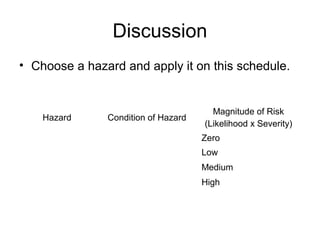
Discussion
• Choose a hazard and apply it on this schedule.
Hazard Condition of Hazard
Magnitude of Risk
(Likelihood x Severity)
Zero
Low
Medium
High
DISCUSSION
• Discuss the ways in which employers
might motivate their employees to comply
with health and safety procedures

Introduction.137697294749987.OS

  • 1.
    Introduction to Occupational SafetyII Introduction toIntroduction to Occupational Safety IIOccupational Safety II Rona Tan (Grad IOSH)
  • 2.
    The Nature andScope of health and Safety • The Multi-Disciplinary Nature of Health and Safety, Chemistry and physic Biological sciences Engineering Psychology Sociology The Law
  • 3.
    Obstacles to Good Standardsof Health & Safety • Complexity - The cause of a problem - Process & Technology - Requirements & Regulations • Competing & Conflicting Demands - Productivity & Cost - External Customer Oriented - Competing • Behavioural Issues - Unsafe Act - Ignorance, Carelessness or Incompetence - Work Culture
  • 4.
    Health and SafetyFoundations Why ? Humane – harm to people Economical Impact- expensive Legal – compliance to legal requirement Reputation – societal expectation
  • 5.
    Meanings and Distinctions •Health , Safety , Welfare and Environmental Protection ►Health relates to the physical condition of both body and mind of all people at the workplace, ►Safety relates to the conditions at the workplace and applies to the pursuit of a state where the risk of harm has been eliminated or reduced to an acceptable level ►Welfare relates to the general well-being of workers at the workplaces, ►Environmental protection can be seen as comprising two types
  • 6.
    Health & SafetyFoundation – Types :- • The workplace environment, which relates to the general conditions in the immediate area of the workplace itself- • The external environment, which relates to pollution of , damage to, the air , land , water and living creatures outside of the workplace, insofar as they may be affected by workplace activities,
  • 7.
    Accidents and otherEvents Definitions in relations to health and safety. ☻Incident: an event –include accident and near miss. ☻Accident: undesired event ☻Near-miss: could have resulted injury but did not ☻Occupational accident ☻Occupational diseases Basically accidents are caused by two factors: • 1) Unsafe Behavior/Act • 2) Unsafe Condition
  • 8.
    90% Behavior 30,000 Hazards AtRisk Acts/Conditions 10% Conditions Reactive Safety Management Proactive BBS Accident Prevention Approach 1 Fatality 30 Majors 300 Recordable 3000 Near Miss Statistics based on 200 companies
  • 9.
    Definitions • Hazards A Hazardis an article, substance or situation that has the potential to cause harm or damage.
  • 10.
    Definitions • Risk: A riskis the likelihood of harm occurring. The degree of risk is based both on the likelihood and severity of outcome (type of injury, number involved..)
  • 11.
    Example Hazard Position ofCable Magnitude of Risk (Likelihood x Severity) Tripping over cable And falling Fastened to wall Zero Trailing around edge of room Low Trailing across the floor Medium Trailing across head of stairway High Identification of hazards and the assessment of associated risks has become the cornerstone of modern health and safety law
  • 12.
  • 13.
  • 14.
    HAZARDHAZARD HAZARD HAZARD HAZARD Risk level is dependentupon the number of hazards and time/length of exposure
  • 15.
  • 16.
    General Hierarchy ofHazard Control • Elimination • Substitution • Isolation • Engineering • Administration • PPE
  • 17.
    The Moral, Legaland Economic Reasons For Health and Safety • Legislation Requirement-Minimum • Vicarious Liability-defense Negligence • Moral Obligations- Take cares of neighbours • Fines for non-compliance • Economical impact- accidents and ill health very expensive-direct and indirect costs,
  • 18.
    Size of theproblem ILO statistics shows the scale of the problem:- There are 270 million occupational accident and 160 million occupational diseases each year, 2 million people die every year from occupational accidents and occupational diseases, 4% of the world’s GDP (gross domestic product) is lost each year through the cost of injury, death, absence , etc Around 355,000 on-the job fatalities each year-half from agriculture – others construction and fishing industries
  • 19.
    Costs of Accidentsand Ill-Health • Direct costs • Indirect costs • Iceberg Theory • Insurance , Costs and Liabilities
  • 20.
    Safe Systems ofWork • It is not sufficient to stop at the provision of safe premises and plant and equipment. Employer must provide safe procedures in the used of equipment:- • The system of work should be reasonably safe in all circumstances, procedures must cover all foreseeable possibilities • Workers must be fully aware of and competent in carrying out the safe system of work (properly trained, instructed, and given information necessary is made available) • There is a need to review , planning and control in ensuring that working methods are safe,
  • 21.
    Training and Supervisionand Competency of Staff • It is also become the duty of employer to ensure , that staff are equipped with the knowledge, experience, skills and training necessary to carry out their work in a safe manner, – This starts with recruitment, appointment and selection of personnel has all the necessary abilities to do the job safely (Competent) – All staff need to be provided with the specific knowledge required to operate safely in the particular workplace, machinery ,plant according to recognized safe system of work , through training, instruction, information is a major responsibility of employer.
  • 22.
    • Employers shouldtake reasonable practical steps to ensure that:- – Staff follows all the correct procedures – And are actually operating safely, – Around 60% of workplace accidents are the result of human actions and are preventable, – Adequate supervision , can reinforce adherence to procedures. Training and Supervision and Competency of Staff
  • 23.
    To provide andmaintain workplaces, machinery and equipment, and use work methods, which are as safe and without risk to health as is reasonably practicable; To give necessary instructions and training, taking account to the functions and capacities of different categories of workers; The Employer’s Basic responsibilities
  • 24.
    General Duties of Employee/Workers To take care of his own safety and the safety of others,  Comply with established safe systems of work and rules,  To use protective equipment provided while carrying out the work requiring them,  To report to supervisors, unsafe condition, tools, that equipment are in good repair  To report all accidents, for lesson learnt
  • 25.
    Consequences of Non-Compliance •Breach of health and safety legislation – criminal offence • Civil liability may also arise – compensation resulted from negligence, • Negligence – is probably the most important in terms of the number of cases and the amount of damages which may be awarded for serious injury
  • 26.
    Negligence • Breach ofthe legal duty to exercise reasonable care towards others-resulting causing harm to someone to whom you owed a duty of care as result of something you did OR failed to do. (foreseeable harm) • In health and safety terms, the same applies to employers, who are under a duty of care towards their workers and others
  • 27.
    Role of EnforcingAuthorities and other External Agencies • Government makes laws and courts decides on guilt and pass sentence on those who are guilty – in between the two various agencies who can enforce laws, investigate, provide advice and so on. Typical Agencies might includes:- Enforcement Agencies Fire Authorities Insurance Companies
  • 28.
    The Role ofInternational Standards and Conventions • Countries has their own specific laws, developed over the years to tackle their own specific issues . E,g OSHA 514 for Malaysia (1981 draft – 1994 Feb 24.implemented with out grace period.) • The prime mover in the area of International Standards in Health and Safety is the United Nations (UN) specifically- ILO – a large number of countries are members of ILO.
  • 29.
    Sources Of Information (Internaland External) • External data sources includes:- • Internal data source includes:-  Exercise ( List down source of information available to consult on Health and Safety )
  • 30.
    ACTION FOR IMPROVEMENT ACTION FOR IMPROVEMENT POLICYPOLICY ORGANISINGORGANISING PLANNINGAND IMPLEMENTATION PLANNING AND IMPLEMENTATION EVALUATIONEVALUATION AUDITAUDIT FEEDBACKCONTINUALIMPROVEMENT Health and Safety Management Model HEALTH & SAFETY MANAGEMENT MODEL
  • 33.
    Discussion • Choose ahazard and apply it on this schedule. Hazard Condition of Hazard Magnitude of Risk (Likelihood x Severity) Zero Low Medium High
  • 34.
    DISCUSSION • Discuss theways in which employers might motivate their employees to comply with health and safety procedures

Editor's Notes

  • #4 Obstacles to Good Standards of health and Safety Complexity of the Problem The cause-and-effect relationship Work processes and activities Extent of the problem Competing and Conflicting Demands Organization Regarded as a non-productive costs It may be seen as conflicting with the need to increase production or to cut costs, Employer takes little responsibilities for the protection of his workers, health and safety ,resulting serious workplace accidents, injuries , diseases Behavioural Issues Conflicts between individual or group goals and the requirements of health and safety Individual characteristics and suitability for the job, The satisfaction of need through achievements at work,
  • #5 P.E.A.R. People environment asset people