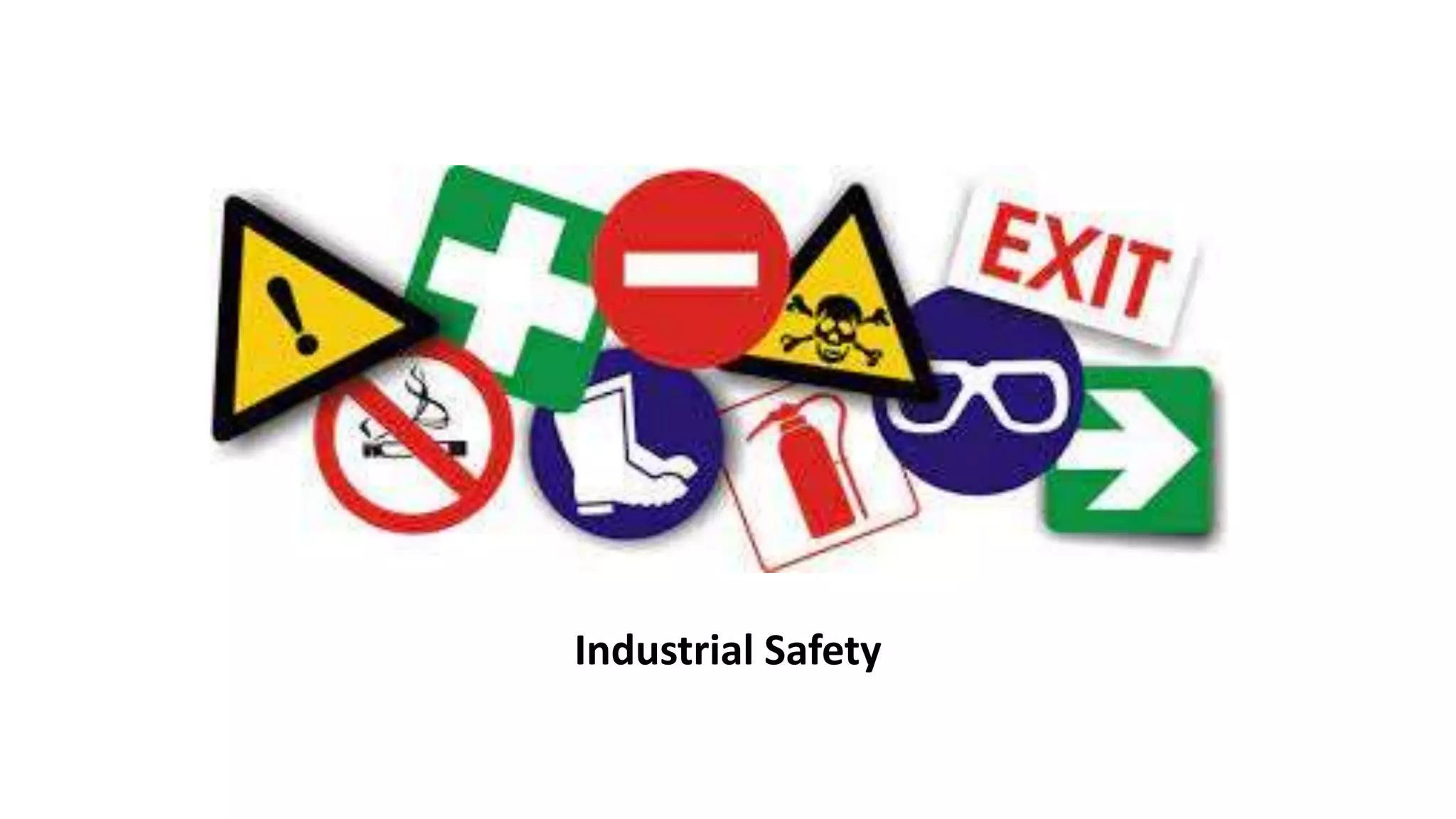
Industrial Safety
Industrial Safety
• Safety - the condition of being protected from or unlikely to cause
danger, risk, or injury
• Industrial safety is primarily a management activity which is
concerned with
• Eliminating hazards from the industries or industrial units.
• Reducing
• Controlling
Objectives of Industrial Safety
• To check all the possible chances of accidents
• To eliminate accidents causing work stoppage and
• production loss
• To prevent accidents in industry by reducing hazard
• To reduce cost related to accident
• Better morale of industrial employees
• To educate
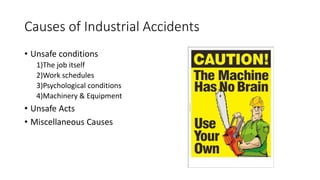
Causes of Industrial Accidents
• Unsafe conditions
1)The job itself
2)Work schedules
3)Psychological conditions
4)Machinery & Equipment
• Unsafe Acts
• Miscellaneous Causes
Industrial Accidents
Sudden & unexpected occurrence”
Types:
Depending upon severity, durability and degree of injury
• Major Injury
• Minor Injury
• External Injury
• Hazard is a potential source of harm or adverse health effect on a
person or persons
• Risk is the chance or probability that a person will be harmed or
experience an adverse health effect if exposed to a hazard.
Hazards can be identified by:
• Observation - use your senses of sight, hearing, smell and touch -
combined with knowledge and experience.
• Material Safety Data Sheets (MSDSs) - obtain them from
manufacturers and suppliers. Read them carefully to identify possible
harm from hazardous substances and precautions that need to be
taken.
• Hazard and risk surveys - conduct hazard spotting surveys of main
work areas. Talk to others about their safety concerns.
• Record analysis - keep records of identified hazards, near misses, injuries
and workers' compensation claims to help identify possible trends.
• Discussion groups - are useful for identifying hazards and recommending
solutions.
• Safety audits - consider creating a safety committee to investigate safety
and help prepare a management plan.
• Information - keep informed of hazards in the industry through the latest
available information.
• Consumer information - carefully read and follow consumer guidelines on
equipment and substances.
• Regulations and best practices
How to assess the risks in your workplace
• Identify the hazards
• Decide who might be harmed and how
• Evaluate the risks and decide on precautions
• Record your significant findings
• Review your assessment and update if necessary
Control Technique
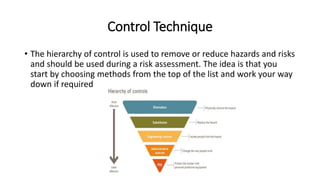
• The hierarchy of control is used to remove or reduce hazards and risks
and should be used during a risk assessment. The idea is that you
start by choosing methods from the top of the list and work your way
down if required
Industrial Hygiene
• Occupational hygiene is the anticipation, recognition, evaluation,
control, and confirmation of protection from hazards at work that
may result in injury, illness, or affect the well being of workers.
• Industrial hygienists help develop and set occupational safety and
health regulations by evaluating the employees' exposure to
workplace hazards. They then outline what steps are required to
control those hazards.
• Health and safety hazards cover a wide-range of physical, chemical
and biological stressors which may cause sickness, impaired health or
significant discomfort among workers or citizens of your community.
• There are numerous hazards that can exist between employees who
work with chemicals, pathogens and contaminants. Setting practice
controls ensure that the environmental and physical hazards are best
taken care of in a developed and mandated setting.
Some types of hazards, as categorized
• Environmental
Air contaminants are classified by OSHA in their IH guidelines as either
particulate or gas and vapor contaminants. OSHA states that the most
common particulate contaminants are:
• Dusts
• Fumes
• Mist
• Aerosols
• Fibers
• Gases
• Vapors
• Chemical
OSHA considers chemical hazards as vapors exerted by inhalation,
absorption, ingestion or are airborne. The degree of worker risk varies
with exposure to any substance and depends on the nature and
potency of the toxic effects and magnitude of exposure.
• Biological
Bacteria, fungi, viruses and other living organisms are considered
biological hazards. OSHA states that such organisms can cause acute
and chronic infections either directly or through breaks in the skin.
• Physical
OSHA refers to excessive levels of ionizing and non-ionizing
electromagnetic radiation, noise, vibration, illumination and
temperature as physical hazards. Danger from radiation increases with
the amount of exposure time.
• Ergonomic
The science of ergonomic studies as reported by OSHA evaluates a full
range of tasks including and not limited to—holding, lifting, pushing,
walking and reaching.
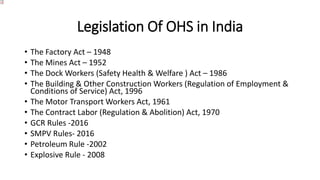
Legislation Of OHS in India
• The Factory Act – 1948
• The Mines Act – 1952
• The Dock Workers (Safety Health & Welfare ) Act – 1986
• The Building & Other Construction Workers (Regulation of Employment &
Conditions of Service) Act, 1996
• The Motor Transport Workers Act, 1961
• The Contract Labor (Regulation & Abolition) Act, 1970
• GCR Rules -2016
• SMPV Rules- 2016
• Petroleum Rule -2002
• Explosive Rule - 2008

Industrial safety

  • 1.
  • 2.
    Industrial Safety • Safety- the condition of being protected from or unlikely to cause danger, risk, or injury • Industrial safety is primarily a management activity which is concerned with • Eliminating hazards from the industries or industrial units. • Reducing • Controlling
  • 4.
    Objectives of IndustrialSafety • To check all the possible chances of accidents • To eliminate accidents causing work stoppage and • production loss • To prevent accidents in industry by reducing hazard • To reduce cost related to accident • Better morale of industrial employees • To educate
  • 5.
    Causes of IndustrialAccidents • Unsafe conditions 1)The job itself 2)Work schedules 3)Psychological conditions 4)Machinery & Equipment • Unsafe Acts • Miscellaneous Causes
  • 6.
    Industrial Accidents Sudden &unexpected occurrence” Types: Depending upon severity, durability and degree of injury • Major Injury • Minor Injury • External Injury
  • 7.
    • Hazard isa potential source of harm or adverse health effect on a person or persons • Risk is the chance or probability that a person will be harmed or experience an adverse health effect if exposed to a hazard.
  • 8.
    Hazards can beidentified by: • Observation - use your senses of sight, hearing, smell and touch - combined with knowledge and experience. • Material Safety Data Sheets (MSDSs) - obtain them from manufacturers and suppliers. Read them carefully to identify possible harm from hazardous substances and precautions that need to be taken. • Hazard and risk surveys - conduct hazard spotting surveys of main work areas. Talk to others about their safety concerns.
  • 9.
    • Record analysis- keep records of identified hazards, near misses, injuries and workers' compensation claims to help identify possible trends. • Discussion groups - are useful for identifying hazards and recommending solutions. • Safety audits - consider creating a safety committee to investigate safety and help prepare a management plan. • Information - keep informed of hazards in the industry through the latest available information. • Consumer information - carefully read and follow consumer guidelines on equipment and substances. • Regulations and best practices
  • 10.
    How to assessthe risks in your workplace • Identify the hazards • Decide who might be harmed and how • Evaluate the risks and decide on precautions • Record your significant findings • Review your assessment and update if necessary
  • 11.
    Control Technique • Thehierarchy of control is used to remove or reduce hazards and risks and should be used during a risk assessment. The idea is that you start by choosing methods from the top of the list and work your way down if required
  • 12.
    Industrial Hygiene • Occupationalhygiene is the anticipation, recognition, evaluation, control, and confirmation of protection from hazards at work that may result in injury, illness, or affect the well being of workers. • Industrial hygienists help develop and set occupational safety and health regulations by evaluating the employees' exposure to workplace hazards. They then outline what steps are required to control those hazards.
  • 13.
    • Health andsafety hazards cover a wide-range of physical, chemical and biological stressors which may cause sickness, impaired health or significant discomfort among workers or citizens of your community. • There are numerous hazards that can exist between employees who work with chemicals, pathogens and contaminants. Setting practice controls ensure that the environmental and physical hazards are best taken care of in a developed and mandated setting.
  • 14.
    Some types ofhazards, as categorized • Environmental Air contaminants are classified by OSHA in their IH guidelines as either particulate or gas and vapor contaminants. OSHA states that the most common particulate contaminants are: • Dusts • Fumes • Mist • Aerosols • Fibers • Gases • Vapors
  • 15.
    • Chemical OSHA considerschemical hazards as vapors exerted by inhalation, absorption, ingestion or are airborne. The degree of worker risk varies with exposure to any substance and depends on the nature and potency of the toxic effects and magnitude of exposure. • Biological Bacteria, fungi, viruses and other living organisms are considered biological hazards. OSHA states that such organisms can cause acute and chronic infections either directly or through breaks in the skin.
  • 16.
    • Physical OSHA refersto excessive levels of ionizing and non-ionizing electromagnetic radiation, noise, vibration, illumination and temperature as physical hazards. Danger from radiation increases with the amount of exposure time. • Ergonomic The science of ergonomic studies as reported by OSHA evaluates a full range of tasks including and not limited to—holding, lifting, pushing, walking and reaching.
  • 17.
    Legislation Of OHSin India • The Factory Act – 1948 • The Mines Act – 1952 • The Dock Workers (Safety Health & Welfare ) Act – 1986 • The Building & Other Construction Workers (Regulation of Employment & Conditions of Service) Act, 1996 • The Motor Transport Workers Act, 1961 • The Contract Labor (Regulation & Abolition) Act, 1970 • GCR Rules -2016 • SMPV Rules- 2016 • Petroleum Rule -2002 • Explosive Rule - 2008