TechnoSysCon
Shree Nathji Heights, Plot No.- 72, C.D.C. Purnanagar, Chinchwad, Pune. PIN - 411019
Tele - +91 20 2749 0009, Mobile – 09423005866, info@technosyscon.com
www.technosyscon.com
Hazard Identification,
Risk Assessment and
Determining Controls
Slide 2TechnoSysCon . . . . . . preferred partner for sustainable systems
 Purpose
 What is Hazard and Risk ?
 Definitions
 Understanding Requirements - OHSAS
 Rating system –HIRA
 HIRA & DC
 Group Task
 Presentation by each Group
 Discussions
Topics
Slide 3TechnoSysCon . . . . . . preferred partner for sustainable systems
Purpose
To provide a systematic and objective approach to assessing hazards
and their associated risks that will provide an objective measure
of an identified hazard as well as determine a method to control
the risk.
It is one of the important requirement under the
Occupational Health and Safety Management
System – OHSAS 18001 for the organization to
prevent injury, ill-health and to provide a safe
workplaces to their employees and other related
person
Slide 4TechnoSysCon . . . . . . preferred partner for sustainable systems
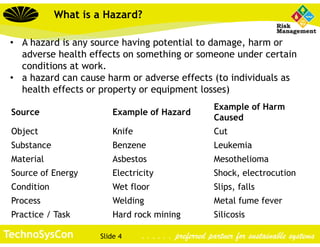
What is a Hazard?
• A hazard is any source having potential to damage, harm or
adverse health effects on something or someone under certain
conditions at work.
• a hazard can cause harm or adverse effects (to individuals as
health effects or property or equipment losses)
Source Example of Hazard
Example of Harm
Caused
Object Knife Cut
Substance Benzene Leukemia
Material Asbestos Mesothelioma
Source of Energy Electricity Shock, electrocution
Condition Wet floor Slips, falls
Process Welding Metal fume fever
Practice / Task Hard rock mining Silicosis
Slide 5TechnoSysCon . . . . . . preferred partner for sustainable systems
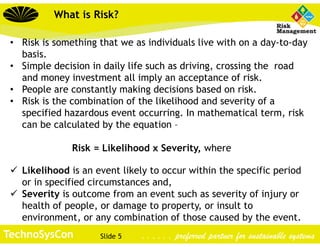
What is Risk?
• Risk is something that we as individuals live with on a day-to-day
basis.
• Simple decision in daily life such as driving, crossing the road
and money investment all imply an acceptance of risk.
• People are constantly making decisions based on risk.
• Risk is the combination of the likelihood and severity of a
specified hazardous event occurring. In mathematical term, risk
can be calculated by the equation –
Risk = Likelihood x Severity, where
 Likelihood is an event likely to occur within the specific period
or in specified circumstances and,
 Severity is outcome from an event such as severity of injury or
health of people, or damage to property, or insult to
environment, or any combination of those caused by the event.
Slide 8TechnoSysCon . . . . . . preferred partner for sustainable systems
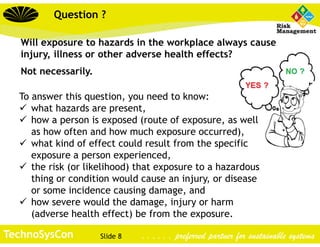
Question ?
Will exposure to hazards in the workplace always cause
injury, illness or other adverse health effects?
Not necessarily.
To answer this question, you need to know:
 what hazards are present,
 how a person is exposed (route of exposure, as well
as how often and how much exposure occurred),
 what kind of effect could result from the specific
exposure a person experienced,
 the risk (or likelihood) that exposure to a hazardous
thing or condition would cause an injury, or disease
or some incidence causing damage, and
 how severe would the damage, injury or harm
(adverse health effect) be from the exposure.
Slide 13TechnoSysCon . . . . . . preferred partner for sustainable systems
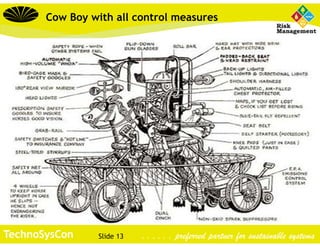
Cow Boy with all control measures
Slide 14TechnoSysCon . . . . . . preferred partner for sustainable systems
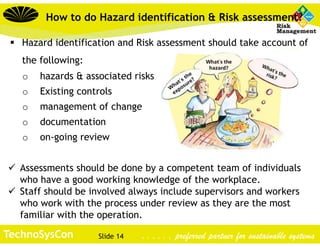
How to do Hazard identification & Risk assessment?
 Hazard identification and Risk assessment should take account of
the following:
o hazards & associated risks
o Existing controls
o management of change
o documentation
o on-going review
 Assessments should be done by a competent team of individuals
who have a good working knowledge of the workplace.
 Staff should be involved always include supervisors and workers
who work with the process under review as they are the most
familiar with the operation.
Slide 15TechnoSysCon . . . . . . preferred partner for sustainable systems
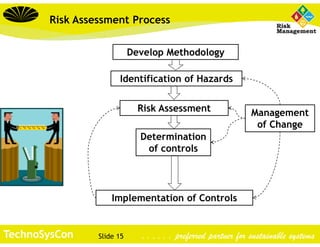
Develop Methodology
Identification of Hazards
Risk Assessment
Determination
of controls
Implementation of Controls
Management
of Change
Risk Assessment Process
Slide 22TechnoSysCon . . . . . . preferred partner for sustainable systems
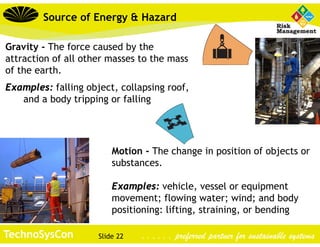
Gravity - The force caused by the
attraction of all other masses to the mass
of the earth.
Examples: falling object, collapsing roof,
and a body tripping or falling
Source of Energy & Hazard
Motion - The change in position of objects or
substances.
Examples: vehicle, vessel or equipment
movement; flowing water; wind; and body
positioning: lifting, straining, or bending
Slide 48TechnoSysCon . . . . . . preferred partner for sustainable systems
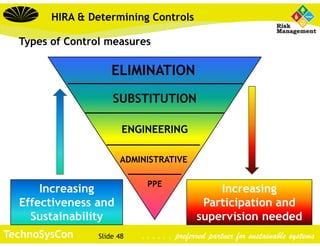
ELIMINATION
SUBSTITUTION
ENGINEERING
ADMINISTRATIVE
PPE
Increasing
Participation and
supervision needed
Increasing
Effectiveness and
Sustainability
HIRA & Determining Controls
Types of Control measures
Slide 63TechnoSysCon . . . . . . preferred partner for sustainable systems
 Core team shall divide themselves in different groups / teams
 Identify the responsible areas for HIRA
 Respective teams must visit the identified areas
• List down the sources of hazards & activities in that areas
• List down the List down the hazardous tasks in that area
• List down the people having access to that area
• Observe behavior of the people working in that area
• Note down hazardous situation and acts
• List down the probable hazardous outcome based on your
observation
 Use the HIRA matrix format to note your observations
 Define existing controls to mitigate impacts
 Rate “Severity” & “Likelihood”, define controls for high risk
 Review periodically HIRA matrices (Cross Functional)
Simple step for effective Hazard identification
. . . preferred partner for sustainable systems
Thank You
2nd Floor, Shree Nathji Heights, Plot No 72,  C.D.C. 
Purnanagar, Chinchwad, Pune ‐ 411 019 MH, INDIA 
+91 20 27490009 
+91 94 23005866| www.TechnoSysCon.com
info@TechnoSysCon.com
||
||
We believe in lasting relationships and
looking forward to be your partner

OHSAS Hazard identification & Risk assessment

  • 1.
    TechnoSysCon Shree Nathji Heights,Plot No.- 72, C.D.C. Purnanagar, Chinchwad, Pune. PIN - 411019 Tele - +91 20 2749 0009, Mobile – 09423005866, info@technosyscon.com www.technosyscon.com Hazard Identification, Risk Assessment and Determining Controls
  • 2.
    Slide 2TechnoSysCon .. . . . . preferred partner for sustainable systems  Purpose  What is Hazard and Risk ?  Definitions  Understanding Requirements - OHSAS  Rating system –HIRA  HIRA & DC  Group Task  Presentation by each Group  Discussions Topics
  • 3.
    Slide 3TechnoSysCon .. . . . . preferred partner for sustainable systems Purpose To provide a systematic and objective approach to assessing hazards and their associated risks that will provide an objective measure of an identified hazard as well as determine a method to control the risk. It is one of the important requirement under the Occupational Health and Safety Management System – OHSAS 18001 for the organization to prevent injury, ill-health and to provide a safe workplaces to their employees and other related person
  • 4.
    Slide 4TechnoSysCon .. . . . . preferred partner for sustainable systems What is a Hazard? • A hazard is any source having potential to damage, harm or adverse health effects on something or someone under certain conditions at work. • a hazard can cause harm or adverse effects (to individuals as health effects or property or equipment losses) Source Example of Hazard Example of Harm Caused Object Knife Cut Substance Benzene Leukemia Material Asbestos Mesothelioma Source of Energy Electricity Shock, electrocution Condition Wet floor Slips, falls Process Welding Metal fume fever Practice / Task Hard rock mining Silicosis
  • 5.
    Slide 5TechnoSysCon .. . . . . preferred partner for sustainable systems What is Risk? • Risk is something that we as individuals live with on a day-to-day basis. • Simple decision in daily life such as driving, crossing the road and money investment all imply an acceptance of risk. • People are constantly making decisions based on risk. • Risk is the combination of the likelihood and severity of a specified hazardous event occurring. In mathematical term, risk can be calculated by the equation – Risk = Likelihood x Severity, where  Likelihood is an event likely to occur within the specific period or in specified circumstances and,  Severity is outcome from an event such as severity of injury or health of people, or damage to property, or insult to environment, or any combination of those caused by the event.
  • 6.
    Slide 8TechnoSysCon .. . . . . preferred partner for sustainable systems Question ? Will exposure to hazards in the workplace always cause injury, illness or other adverse health effects? Not necessarily. To answer this question, you need to know:  what hazards are present,  how a person is exposed (route of exposure, as well as how often and how much exposure occurred),  what kind of effect could result from the specific exposure a person experienced,  the risk (or likelihood) that exposure to a hazardous thing or condition would cause an injury, or disease or some incidence causing damage, and  how severe would the damage, injury or harm (adverse health effect) be from the exposure.
  • 7.
    Slide 13TechnoSysCon .. . . . . preferred partner for sustainable systems Cow Boy with all control measures
  • 8.
    Slide 14TechnoSysCon .. . . . . preferred partner for sustainable systems How to do Hazard identification & Risk assessment?  Hazard identification and Risk assessment should take account of the following: o hazards & associated risks o Existing controls o management of change o documentation o on-going review  Assessments should be done by a competent team of individuals who have a good working knowledge of the workplace.  Staff should be involved always include supervisors and workers who work with the process under review as they are the most familiar with the operation.
  • 9.
    Slide 15TechnoSysCon .. . . . . preferred partner for sustainable systems Develop Methodology Identification of Hazards Risk Assessment Determination of controls Implementation of Controls Management of Change Risk Assessment Process
  • 10.
    Slide 22TechnoSysCon .. . . . . preferred partner for sustainable systems Gravity - The force caused by the attraction of all other masses to the mass of the earth. Examples: falling object, collapsing roof, and a body tripping or falling Source of Energy & Hazard Motion - The change in position of objects or substances. Examples: vehicle, vessel or equipment movement; flowing water; wind; and body positioning: lifting, straining, or bending
  • 11.
    Slide 48TechnoSysCon .. . . . . preferred partner for sustainable systems ELIMINATION SUBSTITUTION ENGINEERING ADMINISTRATIVE PPE Increasing Participation and supervision needed Increasing Effectiveness and Sustainability HIRA & Determining Controls Types of Control measures
  • 12.
    Slide 63TechnoSysCon .. . . . . preferred partner for sustainable systems  Core team shall divide themselves in different groups / teams  Identify the responsible areas for HIRA  Respective teams must visit the identified areas • List down the sources of hazards & activities in that areas • List down the List down the hazardous tasks in that area • List down the people having access to that area • Observe behavior of the people working in that area • Note down hazardous situation and acts • List down the probable hazardous outcome based on your observation  Use the HIRA matrix format to note your observations  Define existing controls to mitigate impacts  Rate “Severity” & “Likelihood”, define controls for high risk  Review periodically HIRA matrices (Cross Functional) Simple step for effective Hazard identification
  • 13.
    . . .preferred partner for sustainable systems Thank You 2nd Floor, Shree Nathji Heights, Plot No 72,  C.D.C.  Purnanagar, Chinchwad, Pune ‐ 411 019 MH, INDIA  +91 20 27490009  +91 94 23005866| www.TechnoSysCon.com info@TechnoSysCon.com || || We believe in lasting relationships and looking forward to be your partner