Hazard Identification and Risk
Assessment (HIRA)
Course Objectives
2
You will be able to:
• Recognize and identify hazards
• Conduct risk assessments
• Manage risks
WHAT ARE HAZARDS?
3
Introduction To and Definition of Hazards
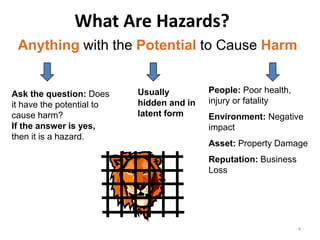
Ask the question: Does
it have the potential to
cause harm?
If the answer is yes,
then it is a hazard.
What Are Hazards?
4
Anything with the Potential to Cause Harm
Usually
hidden and in
latent form
People: Poor health,
injury or fatality
Environment: Negative
impact
Asset: Property Damage
Reputation: Business
Loss
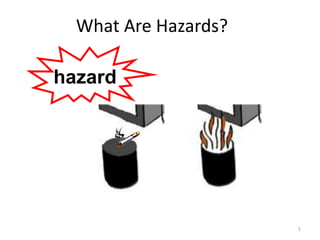
What Are Hazards?
5
hazard
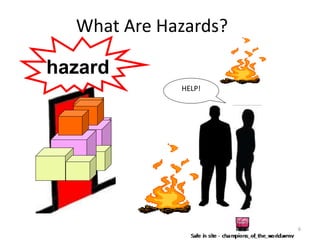
What Are Hazards?
6
HELP!
hazard
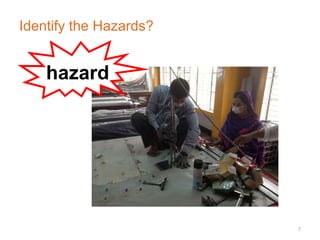
Identify the Hazards?
7
hazard
HAZARD TYPES AND SOURCES
8
An Overview
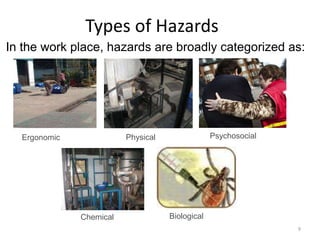
Types of Hazards
9
In the work place, hazards are broadly categorized as:
Ergonomic Physical
Chemical Biological
Psychosocial
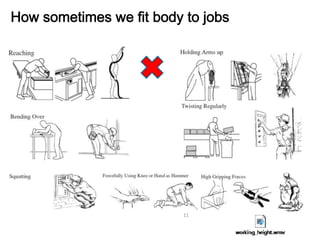
Ergonomic Hazards
10
Definition: Hazards that occur when work, body
position or working conditions or environment
put strain on one’s body
Ergonomic hazards include
Posture
Workstation
Work Environment
11
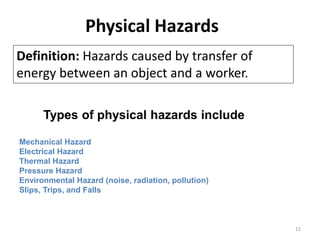
Physical Hazards
12
Definition: Hazards caused by transfer of
energy between an object and a worker.
Types of physical hazards include
Mechanical Hazard
Electrical Hazard
Thermal Hazard
Pressure Hazard
Environmental Hazard (noise, radiation, pollution)
Slips, Trips, and Falls
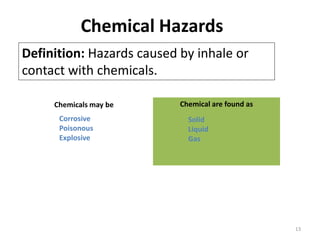
Chemical Hazards
13
Definition: Hazards caused by inhale or
contact with chemicals.
Chemicals may be
Corrosive
Poisonous
Explosive
Chemical are found as
Solid
Liquid
Gas
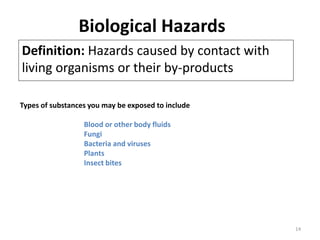
Biological Hazards
14
Definition: Hazards caused by contact with
living organisms or their by-products
Types of substances you may be exposed to include
Blood or other body fluids
Fungi
Bacteria and viruses
Plants
Insect bites
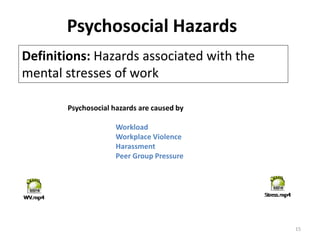
Psychosocial Hazards
15
Definitions: Hazards associated with the
mental stresses of work
Psychosocial hazards are caused by
Workload
Workplace Violence
Harassment
Peer Group Pressure
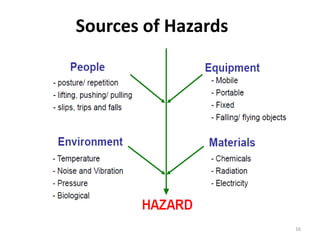
Sources of Hazards
16
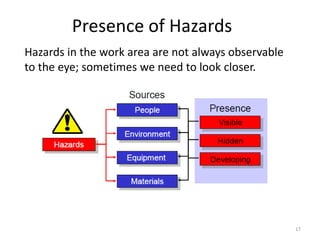
Presence of Hazards
17
Hazards in the work area are not always observable
to the eye; sometimes we need to look closer.
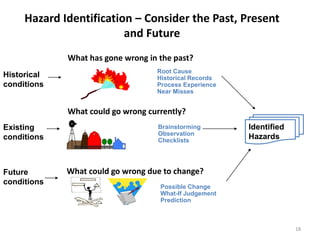
Hazard Identification – Consider the Past, Present
and Future
18
Identified
Hazards
Identified
Hazards
Historical
conditions
What has gone wrong in the past?
Root Cause
Historical Records
Process Experience
Near Misses
What could go wrong currently?
Brainstorming
Observation
Checklists
Existing
conditions
Future
conditions
What could go wrong due to change?
Possible Change
What-If Judgement
Prediction
Hazard Identification (HAZID)
19
Hazard identification requires:
• Being team-based
• Being proactive when searching for hazards
• Assessing all hazards
• Also assessing current control system
RISK ASSESSMENT
20
Overview and Definitions
What Is Risk?
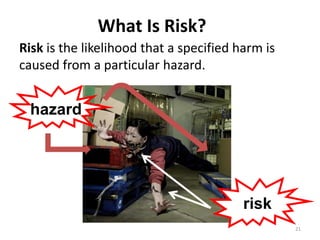
21
Risk is the likelihood that a specified harm is
caused from a particular hazard.
hazard
risk
What Is Risk?
22
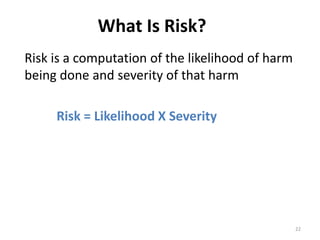
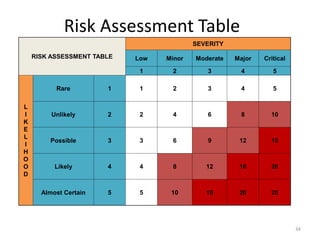
Risk is a computation of the likelihood of harm
being done and severity of that harm
Risk = Likelihood X Severity
What Is Risk Assessment?
23
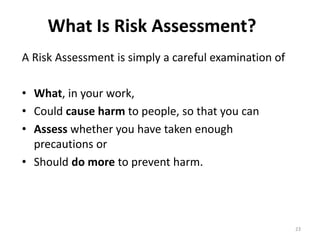
A Risk Assessment is simply a careful examination of
• What, in your work,
• Could cause harm to people, so that you can
• Assess whether you have taken enough
precautions or
• Should do more to prevent harm.
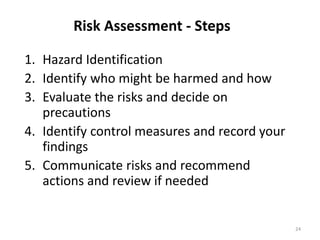
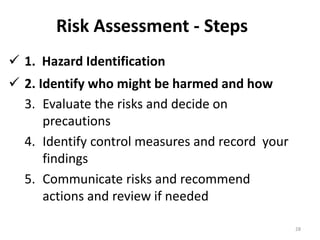
Risk Assessment - Steps
24
1. Hazard Identification
2. Identify who might be harmed and how
3. Evaluate the risks and decide on
precautions
4. Identify control measures and record your
findings
5. Communicate risks and recommend
actions and review if needed
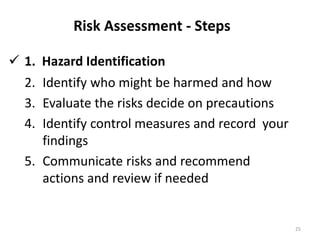
Risk Assessment - Steps
25
2. Identify who might be harmed and how
3. Evaluate the risks decide on precautions
4. Identify control measures and record your
findings
5. Communicate risks and recommend
actions and review if needed
 1. Hazard Identification
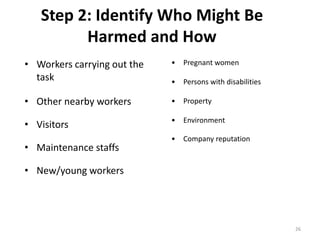
Step 2: Identify Who Might Be
Harmed and How
26
• Workers carrying out the
task
• Other nearby workers
• Visitors
• Maintenance staffs
• New/young workers
• Pregnant women
• Persons with disabilities
• Property
• Environment
• Company reputation
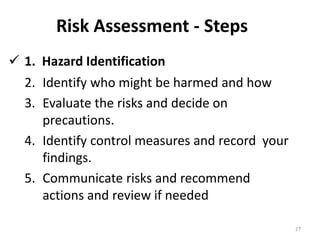
Risk Assessment - Steps
27
2. Identify who might be harmed and how
3. Evaluate the risks and decide on
precautions.
4. Identify control measures and record your
findings.
5. Communicate risks and recommend
actions and review if needed
 1. Hazard Identification
Risk Assessment - Steps
28
3. Evaluate the risks and decide on
precautions
4. Identify control measures and record your
findings
5. Communicate risks and recommend
actions and review if needed
 1. Hazard Identification
 2. Identify who might be harmed and how
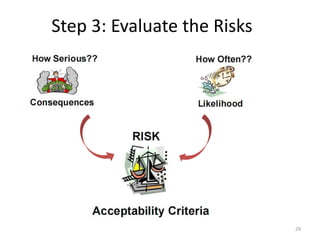
Step 3: Evaluate the Risks
29
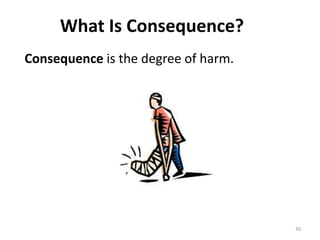
What Is Consequence?
30
Consequence is the degree of harm.
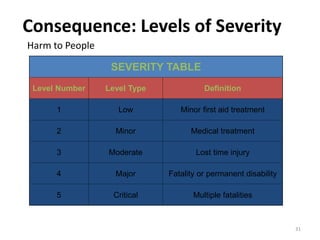
Consequence: Levels of Severity
31
SEVERITY TABLE
Level Number Level Type Definition
1 Low Minor first aid treatment
2 Minor Medical treatment
3 Moderate Lost time injury
4 Major Fatality or permanent disability
5 Critical Multiple fatalities
Harm to People
What Is Likelihood?
32
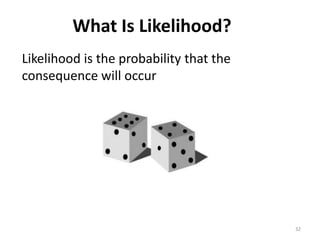
Likelihood is the probability that the
consequence will occur
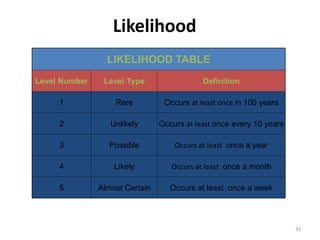
Likelihood
33
LIKELIHOOD TABLE
Level Number Level Type Definition
1 Rare Occurs at least once in 100 years
2 Unlikely Occurs at least once every 10 years
3 Possible Occurs at least once a year
4 Likely Occurs at least once a month
5 Almost Certain Occurs at least once a week
Risk Assessment Table
34
RISK ASSESSMENT TABLE
SEVERITY
Low Minor Moderate Major Critical
1 2 3 4 5
L
I
K
E
L
I
H
O
O
D
Rare 1 1 2 3 4 5
Unlikely 2 2 4 6 8 10
Possible 3 3 6 9 12 15
Likely 4 4 8 12 16 20
Almost Certain 5 5 10 15 20 25
What We’ve Learned So Far: Review
35
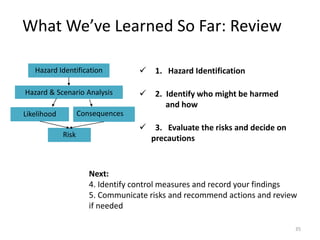
Hazard Identification
Hazard & Scenario Analysis
Likelihood Consequences
Risk
 1. Hazard Identification
 2. Identify who might be harmed
dddand how
 3. Evaluate the risks and decide on
precautions
Next:
4. Identify control measures and record your findings
5. Communicate risks and recommend actions and review
if needed
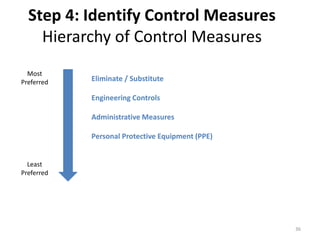
Step 4: Identify Control Measures
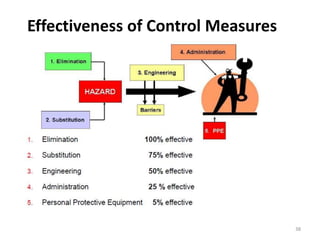
Hierarchy of Control Measures
36
Least
Preferred
Most
Preferred Eliminate / Substitute
Engineering Controls
Administrative Measures
Personal Protective Equipment (PPE)
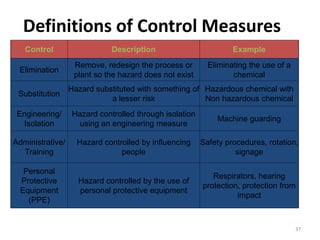
Definitions of Control Measures
37
Control Description Example
Elimination
Remove, redesign the process or
plant so the hazard does not exist
Eliminating the use of a
chemical
Substitution
Hazard substituted with something of
a lesser risk
Hazardous chemical with
Non hazardous chemical
Engineering/
Isolation
Hazard controlled through isolation
using an engineering measure
Machine guarding
Administrative/
Training
Hazard controlled by influencing
people
Safety procedures, rotation,
signage
Personal
Protective
Equipment
(PPE)
Hazard controlled by the use of
personal protective equipment
Respirators, hearing
protection, protection from
impact
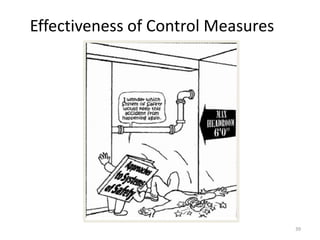
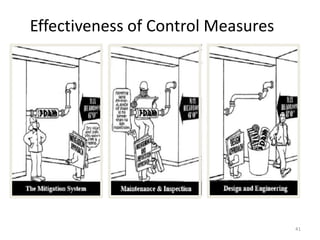
Effectiveness of Control Measures
38
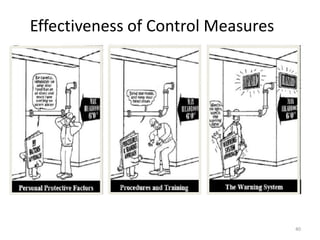
Effectiveness of Control Measures
39
Effectiveness of Control Measures
40
Effectiveness of Control Measures
41
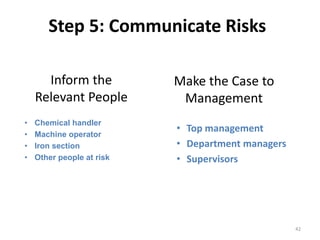
Step 5: Communicate Risks
Make the Case to
Management
• Top management
• Department managers
• Supervisors
42
Inform the
Relevant People
• Chemical handler
• Machine operator
• Iron section
• Other people at risk
Inform the Relevant People
43
• Chemical handlers, machine operators, etc are at the front line of
risk and must be informed
• All high risk operation operators must be well trained in high risk
operation procedure
• Show them the hazard
• How it can be harmful
• How to manage hazard
• All operators should be trained in Safe Working Procedure
• Regular refresher trainings
44
• Show them the findings.
• Ask them whether they agree with control measures.
• Remind them of the effectiveness of control measures
• Reach an agreement on control measures to be taken
• Carefully negotiate implementation plan and timeline
Meeting with Department Manager
Review Risk Assessment
• Building Modification
• New equipment
• Changes to
– furniture,
– hazardous substances,
– work activities and
– storage of goods
• Incident
45
1. Form the RA Team
46
Select five participants to form the RA team
• Suitable skills and experience
• Multi-disciplinary
• Equal participation
Creating Value of RA
2. Train, Plan, and Conduct Risk
Assessment
47
• Train the team
• On hazard identification and Risk Assessment
• On how to record findings
• Plan the Risk Assessment at your factory
• Identify areas of factory to be assessed
• Assign areas for each team
• Set the timeline for Risk Assessment
• Communicate it to all supervisors and Department
managers.
Creating Value of RA
THANK YOU
48

HIRA training

  • 1.
    Hazard Identification andRisk Assessment (HIRA)
  • 2.
    Course Objectives 2 You willbe able to: • Recognize and identify hazards • Conduct risk assessments • Manage risks
  • 3.
    WHAT ARE HAZARDS? 3 IntroductionTo and Definition of Hazards
  • 4.
    Ask the question:Does it have the potential to cause harm? If the answer is yes, then it is a hazard. What Are Hazards? 4 Anything with the Potential to Cause Harm Usually hidden and in latent form People: Poor health, injury or fatality Environment: Negative impact Asset: Property Damage Reputation: Business Loss
  • 5.
  • 6.
  • 7.
  • 8.
    HAZARD TYPES ANDSOURCES 8 An Overview
  • 9.
    Types of Hazards 9 Inthe work place, hazards are broadly categorized as: Ergonomic Physical Chemical Biological Psychosocial
  • 10.
    Ergonomic Hazards 10 Definition: Hazardsthat occur when work, body position or working conditions or environment put strain on one’s body Ergonomic hazards include Posture Workstation Work Environment
  • 11.
  • 12.
    Physical Hazards 12 Definition: Hazardscaused by transfer of energy between an object and a worker. Types of physical hazards include Mechanical Hazard Electrical Hazard Thermal Hazard Pressure Hazard Environmental Hazard (noise, radiation, pollution) Slips, Trips, and Falls
  • 13.
    Chemical Hazards 13 Definition: Hazardscaused by inhale or contact with chemicals. Chemicals may be Corrosive Poisonous Explosive Chemical are found as Solid Liquid Gas
  • 14.
    Biological Hazards 14 Definition: Hazardscaused by contact with living organisms or their by-products Types of substances you may be exposed to include Blood or other body fluids Fungi Bacteria and viruses Plants Insect bites
  • 15.
    Psychosocial Hazards 15 Definitions: Hazardsassociated with the mental stresses of work Psychosocial hazards are caused by Workload Workplace Violence Harassment Peer Group Pressure
  • 16.
  • 17.
    Presence of Hazards 17 Hazardsin the work area are not always observable to the eye; sometimes we need to look closer.
  • 18.
    Hazard Identification –Consider the Past, Present and Future 18 Identified Hazards Identified Hazards Historical conditions What has gone wrong in the past? Root Cause Historical Records Process Experience Near Misses What could go wrong currently? Brainstorming Observation Checklists Existing conditions Future conditions What could go wrong due to change? Possible Change What-If Judgement Prediction
  • 19.
    Hazard Identification (HAZID) 19 Hazardidentification requires: • Being team-based • Being proactive when searching for hazards • Assessing all hazards • Also assessing current control system
  • 20.
  • 21.
    What Is Risk? 21 Riskis the likelihood that a specified harm is caused from a particular hazard. hazard risk
  • 22.
    What Is Risk? 22 Riskis a computation of the likelihood of harm being done and severity of that harm Risk = Likelihood X Severity
  • 23.
    What Is RiskAssessment? 23 A Risk Assessment is simply a careful examination of • What, in your work, • Could cause harm to people, so that you can • Assess whether you have taken enough precautions or • Should do more to prevent harm.
  • 24.
    Risk Assessment -Steps 24 1. Hazard Identification 2. Identify who might be harmed and how 3. Evaluate the risks and decide on precautions 4. Identify control measures and record your findings 5. Communicate risks and recommend actions and review if needed
  • 25.
    Risk Assessment -Steps 25 2. Identify who might be harmed and how 3. Evaluate the risks decide on precautions 4. Identify control measures and record your findings 5. Communicate risks and recommend actions and review if needed  1. Hazard Identification
  • 26.
    Step 2: IdentifyWho Might Be Harmed and How 26 • Workers carrying out the task • Other nearby workers • Visitors • Maintenance staffs • New/young workers • Pregnant women • Persons with disabilities • Property • Environment • Company reputation
  • 27.
    Risk Assessment -Steps 27 2. Identify who might be harmed and how 3. Evaluate the risks and decide on precautions. 4. Identify control measures and record your findings. 5. Communicate risks and recommend actions and review if needed  1. Hazard Identification
  • 28.
    Risk Assessment -Steps 28 3. Evaluate the risks and decide on precautions 4. Identify control measures and record your findings 5. Communicate risks and recommend actions and review if needed  1. Hazard Identification  2. Identify who might be harmed and how
  • 29.
    Step 3: Evaluatethe Risks 29
  • 30.
  • 31.
    Consequence: Levels ofSeverity 31 SEVERITY TABLE Level Number Level Type Definition 1 Low Minor first aid treatment 2 Minor Medical treatment 3 Moderate Lost time injury 4 Major Fatality or permanent disability 5 Critical Multiple fatalities Harm to People
  • 32.
    What Is Likelihood? 32 Likelihoodis the probability that the consequence will occur
  • 33.
    Likelihood 33 LIKELIHOOD TABLE Level NumberLevel Type Definition 1 Rare Occurs at least once in 100 years 2 Unlikely Occurs at least once every 10 years 3 Possible Occurs at least once a year 4 Likely Occurs at least once a month 5 Almost Certain Occurs at least once a week
  • 34.
    Risk Assessment Table 34 RISKASSESSMENT TABLE SEVERITY Low Minor Moderate Major Critical 1 2 3 4 5 L I K E L I H O O D Rare 1 1 2 3 4 5 Unlikely 2 2 4 6 8 10 Possible 3 3 6 9 12 15 Likely 4 4 8 12 16 20 Almost Certain 5 5 10 15 20 25
  • 35.
    What We’ve LearnedSo Far: Review 35 Hazard Identification Hazard & Scenario Analysis Likelihood Consequences Risk  1. Hazard Identification  2. Identify who might be harmed dddand how  3. Evaluate the risks and decide on precautions Next: 4. Identify control measures and record your findings 5. Communicate risks and recommend actions and review if needed
  • 36.
    Step 4: IdentifyControl Measures Hierarchy of Control Measures 36 Least Preferred Most Preferred Eliminate / Substitute Engineering Controls Administrative Measures Personal Protective Equipment (PPE)
  • 37.
    Definitions of ControlMeasures 37 Control Description Example Elimination Remove, redesign the process or plant so the hazard does not exist Eliminating the use of a chemical Substitution Hazard substituted with something of a lesser risk Hazardous chemical with Non hazardous chemical Engineering/ Isolation Hazard controlled through isolation using an engineering measure Machine guarding Administrative/ Training Hazard controlled by influencing people Safety procedures, rotation, signage Personal Protective Equipment (PPE) Hazard controlled by the use of personal protective equipment Respirators, hearing protection, protection from impact
  • 38.
  • 39.
  • 40.
  • 41.
  • 42.
    Step 5: CommunicateRisks Make the Case to Management • Top management • Department managers • Supervisors 42 Inform the Relevant People • Chemical handler • Machine operator • Iron section • Other people at risk
  • 43.
    Inform the RelevantPeople 43 • Chemical handlers, machine operators, etc are at the front line of risk and must be informed • All high risk operation operators must be well trained in high risk operation procedure • Show them the hazard • How it can be harmful • How to manage hazard • All operators should be trained in Safe Working Procedure • Regular refresher trainings
  • 44.
    44 • Show themthe findings. • Ask them whether they agree with control measures. • Remind them of the effectiveness of control measures • Reach an agreement on control measures to be taken • Carefully negotiate implementation plan and timeline Meeting with Department Manager
  • 45.
    Review Risk Assessment •Building Modification • New equipment • Changes to – furniture, – hazardous substances, – work activities and – storage of goods • Incident 45
  • 46.
    1. Form theRA Team 46 Select five participants to form the RA team • Suitable skills and experience • Multi-disciplinary • Equal participation Creating Value of RA
  • 47.
    2. Train, Plan,and Conduct Risk Assessment 47 • Train the team • On hazard identification and Risk Assessment • On how to record findings • Plan the Risk Assessment at your factory • Identify areas of factory to be assessed • Assign areas for each team • Set the timeline for Risk Assessment • Communicate it to all supervisors and Department managers. Creating Value of RA
  • 48.