HSE GENERAL
Ciel Consulting
www.cielgr.com
YOU ARE WELCOME!
Aims and Objectives
• The aims and objectives of this course is
to provide competence training in health,
safety and environment through
identification of hazards and control
measures.
Introduction to Health Safety
and Environment (HSE)
Definitions
• Health: Is a state of total well being of a person not merely the
absence of disease.
• Safety: Is the state of been free from danger or harm
• Environment: the environment is our surroundings which includes
air, land and water.
• PARE. Personnel, Assets, Reputation and Environment
• ALARP: As Low As Reasonably Practicable. This is a term used to
reduce Hazards to the barest minimum.
• Hazard: Is any thing or activity that can cause harm or damage to
PARE
Definitions
• Incident: Is an unplanned event which may
or may not lead to harm or damage.
• Accident: is unplanned event which leads
to harm or damage.
• Near-miss: is unplanned event which did
not lead to harm or damage.
• Unsafe Act and Unsafe Condition: an
unsafe act is any action or omission which
does not regard safety rules.e.g making
phone call while driving.
Duties of a Safety Officer
1. To protect PARE
2. To train personnel on HSE matters
3. To ALARP hazards or eliminate hazards
4. To advice management on HSE matters
5. To carry out Pep talk and Toolbox
meetings
6. To carry out monthly HSE meetings
Duties of a Safety Officer (cont.)
• To conduct drills .e.g. fire drills
• To ensure equipments and work
environment are safe
• To determine the necessary personal
protective equipment (PPE) to be used by
workers
• To represent the company on HSE
matters
SAFETY CERTIFICATION
NOW MANDATORY IN
MANY ORGANIZATION!
Task 1
• Question: Why is Safety important?
• Time: 7min
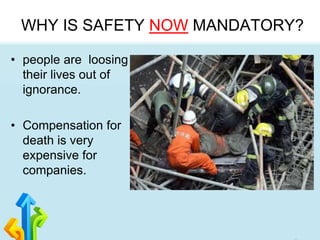
WHY IS SAFETY NOW MANDATORY?
• people are loosing
their lives out of
ignorance.
• Compensation for
death is very
expensive for
companies.
WHY IS SAFETY NOW MANDATORY?
• Organizations
don’t want to
Loose man hours.
Shell looses
N30million every
15 mins work is
shutdown.
WHY IS SAFETY NOW MANDATORY?
• Machines are
usually damaged
by non safety
educated persons
every now and
then.
• Companies spend
heavily on repairs
WHY IS SAFETY NOW MANDATORY?
• A safety ignorant
person can even
set a company
ablaze.
• Company stands
to lose
everything.
WHY IS SAFETY NOW MANDATORY?
• Government fines
and penalties.
• Government can
even shutdown the
company.
Task 2.0
WHY ARE YOU IN THIS TRAINING!
• To learn ways and
methods to keep yourself
safe anywhere any time.
• To learn methods to fight
any unforeseen situations
when it occurs.
YOU ARE HERE:
• To prove to employers that you are ready and
suitable to work within any job condition and
keep yourself safe.
• To give yourself an edge and also increase your
stands in the competitive labor market.
YOU ARE STUDYING THIS COURSE:
• Because you intend to take HSE as a
career.
• Hungry to grow in HSE and to get ready
for the next level in HSE.
• To qualify as a leader.
You are studying this course?
Task 3.0
• What does the letter H.S.E means to you?
Time: 5min
• H = Health
• S = Safety
• E = Environment
WHAT IS HSE?
The HSE acronym stands for
Health and safety at work
• keeping people healthy
and safe at work
• everyone has a
responsibility
Activity 4.0
- write a short definition for each of
the terms presented
Time: 10mins
Definitions
• health
– when you feel well and have no illness or injury
• safety
– when you are protected from harm
• workplace
– anywhere you do your job (inside or outside)
Hazard
• something that can cause harm
• in every workplace – e.g.
fire, electricity, sharp tools,
chemicals, noise, uneven floors
WHEN YOU SAY YOU
ARE HSE COMPETENT
OR CERTIFIED, IT
MEANS
You can:
1. Identify hazards
2. Assess the risks
3. Establish control measures to
prevent incidents
4. Establish Recovery measures to mitigate
the consequences in the event of an
accident.
Task 5.0
• What are some hazards in your
workplace?
Time: 7min
What are some hazards in the work?
• Chemicals
• Radiation
• Fire
• Electrical
• Biological
• Physical
• Slips and trips
• Falling hazard
• Ergonomics
• Thermal
• Noise etc…
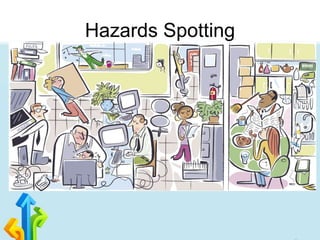
Hazards Spotting
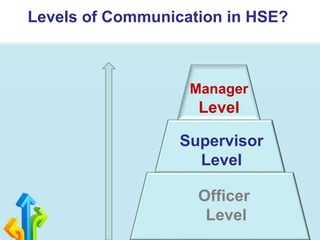
Levels of Communication in HSE?
Officer
Level
Supervisor
Level
Manager
Level
• HSE Officers report to a HSE supervisor.
• HSE Supervisor reports to a HSE
manager.
• HSE manager reports to the management
Levels of Communication in HSE?
INTRODUCTION TO
SAFETY SIGNS
• Safety signs are means of communicating
important information that can be
understood by all races, by literate and
illiterate people, by all age groups and by
all people, locally or globally.
• Safety signs are vital in all our workplaces
to ensure the safety of our workers.
SAFETY SIGNS
Intrinsic features:
• a) round shape;
• (b) black pictogram on white background,
red edging and diagonal line
TYPE OF SAFETY SIGNS
THE PROHIBITION SIGNS
TYPE OF SAFETY SIGNS
THE PROHIBITION SIGNS
No access for unauthorized persons No access for industrial vehicles
TYPE OF SAFETY SIGNS
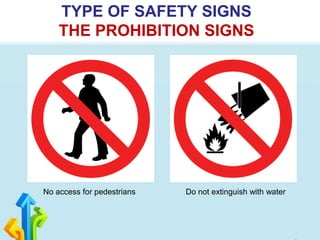
THE PROHIBITION SIGNS
Do not extinguish with waterNo access for pedestrians
TYPE OF SAFETY SIGNS
THE PROHIBITION SIGNS
Naked flames forbiddenNo smoking
Intrinsic features:
TYPE OF SAFETY SIGNS
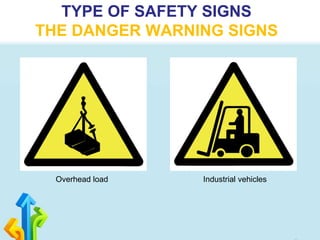
THE DANGER WARNING SIGNS
(a)triangular shape
(b) black pictogram on a yellow background
with black edging
TYPE OF SAFETY SIGNS
THE DANGER WARNING SIGNS
General danger Danger: Electricity
TYPE OF SAFETY SIGNS
THE DANGER WARNING SIGNS
Industrial vehiclesOverhead load
L[LKJ
TYPE OF SAFETY SIGNS
THE DANGER WARNING SIGNS
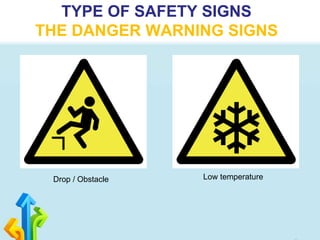
Low temperatureDrop / Obstacle
Intrinsic features:
TYPE OF SAFETY SIGNS
MANDATORY SIGNS
(a) round shape
(b) white pictogram on a blue background
TYPE OF SAFETY SIGNS
MANDATORY SIGNS
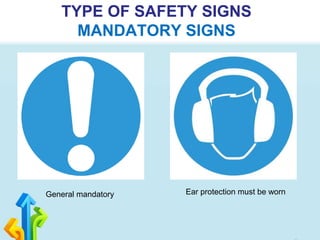
General mandatory Ear protection must be worn
TYPE OF SAFETY SIGNS
MANDATORY SIGNS
Safety overalls must be wornSafety boots must be worn
Task 6.0
• Why do you think you need to wear face
protection?
• Why is it important to wear safety helmet?
• What is Emergency Exit?
• What is Safety Shower?
• Time: 10mins.
TYPE OF SAFETY SIGNS
MANDATORY SIGNS
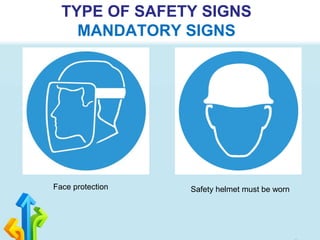
Safety helmet must be wornFace protection
Intrinsic features:
TYPE OF SAFETY SIGNS
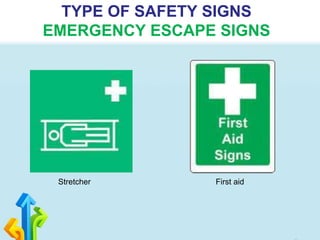
EMERGENCY ESCAPE SIGNS
(a) rectangular or square shape
(b) white pictogram on a green background
TYPE OF SAFETY SIGNS
EMERGENCY ESCAPE SIGNS
Emergency Exit Safety Shower
TYPE OF SAFETY SIGNS
EMERGENCY ESCAPE SIGNS
Stretcher First aid
Intrinsic features:
TYPE OF SAFETY SIGNS
Firefighting Signs
(a) rectangular or square shape
(b) white pictogram on a red background
TYPE OF SAFETY SIGNS
Firefighting Signs
Fire Ladder Fire Extinguisher
TYPE OF SAFETY SIGNS
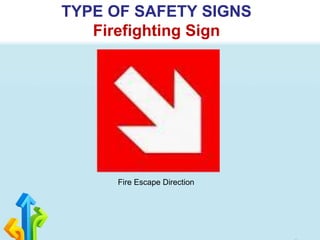
Firefighting Sign
Fire Escape Direction
SAFETY LEGISLATION AND RULES
SAFETY LEGISLATION
(a) GOVERNMENTAL: Safety legislations
consist of Law enacted by the government
to regulate industrial activities so as to
safeguard lives of people, properties and
the environment.
(b) COMPANY: Written laws prepared by the
employers to ensure the safety of persons
at work and also to save the environment.
SAFETY LEGISLATION
(a) A safety officer needs to understand and
have this laid down laws on his or her
finger tips so as to efficiently fit in as a
mediator between the company and
governmental agencies .
(b) It is the safety officer that enforces the
laws laid down by the management.
SAFETY LEGISLATION
- The factories act 1990
- Health and Safety at Work Act (HASAWA)
1974
- The minerals oils (safety) regulation 1997
revised
- Petroleum (Drilling and production)
regulation 1969
- Petroleum refining regulation 1967
(transport and storage of petroleum
products)
SAFETY LEGISLATION
- Electricity regulation
- The explosive regulation
- And many others in the book.
RESPONSIBLITIES OF EMPLOYERS
AS REGARDS TO LEGISLATIONS
- Employers should make sure all Factories
(Plant) are registered according to the
standard of the federal Government before
commencing operation.
- Employers must provide personal
protective equipments (PPEs) as
recommended by the authorities.
- Provision of sanitary facilities,
- Adequate ventilation,
- Lightings
- Portable water showers
- First Aid Facilities.
- Provide training for personnel
And many other you can find in the book
RESPONSIBLITIES OF EMPLOYERS AS
REGARDS TO LEGISLATIONS (C0NT.)
RESPONSIBLITIES OF EMPLOYEES
AS REGARDS TO LEGISLATIONS
- NOTE: It shall be the responsibility of
everyone employed by the company to
keep regulations and laws stipulated to
help the company keep the federation
laws.
- ACTIVITIES LIKE:
- good house-keeping
- Avoiding acts likely to render safety
devices inefective, in the plant or factory.
RESPONSIBLITIES OF EMPLOYEES
AS REGARDS TO LEGISLATIONS
- Prohibited from sleeping , drinking while on
duty or reporting for duty under the
influence of alcohol.
- NOT to Tamper, repair or operate any
equipment that he or she is not qualified
and certified to.
- Report unsafe acts and unsafe conditions
to the supervisor
ENFORCEMENT
Task 7.0
• How is Health and Safety law Enforced?
Time: 5mins.
ENFORCEMENT
(A) These are measures put in place by different
federal government arms to make sure
regulations put in place are been obeyed by
companies .
(B) There are also measures put in place by
companies to make sure employees obey laws
set aside.
ENFORCEMENT
(A 1) One of the ways by which government
enforce laws is that defaulting companies
pay heavy fines.
(A 2) Another way is that the defaulting
company is temporally shutdown.
ENFORCEMENT
(B 1) One of the ways by which companies
enforce laws can be reduction of salary
(B 2) quarries or suspension as the case
maybe.
PENALTIES FOR NON-COMPLIANCE
Task 8.0
• List at least 3 penalties you think
should be given for non-compliance
Time: 15mins.
PENALTIES FOR NON-COMPLIANCE
Penalties are for serious
offenders or defaulters:
PENALTIES FOR NON-COMPLIANCE
For companies, penalties for non-compliance might be:
- Sentence to imprisonment as the case maybe.
- Or other tailored serious punishment proposed
by the company safety department / the
management.
HAZARDS
HAZARD
- Hazard in a practical term is
any condition or activity that if
left uncontrolled can result in
an injury, illness or death.
TYPES OF HAZARD
CHEMICAL HAZARD
CHEMICAL HAZARD
- These are basically the kinds of threats gotten
from chemical substances.
CHEMICAL HAZARD
- METHOD OF EXPOSURE : INHALATION
(through the nose),
Through inhalation: people, out of ignorance,
inhale poisonous chemicals such as:
- Carbon monoxide (CO)
- smoke from generator,
- car and many other sources
- Hydrogen Sulfide (H2S), Sulfur Dioxide, Ozone,
Phosgene, Nitrogen Dioxide, Ammonia. etc
CHEMICAL HAZARD
- METHOD OF EXPOSURE : SKIN CONTACT
(Absorption)
- Dangerous chemicals burn and rupture the skin
when they come in contact with it.
- Example: exposure to high Amount of Acid.
CHEMICAL HAZARD
- METHOD OF EXPOSURE: ABSORPTION
Skin absorption is a route by which substances
can enter the body through the skin.
Also harmful substances pass through this
medium into the body system.
CHEMICAL HAZARD
- METHOD OF EXPOSURES: INGESTION
(through the mouth)
Poisonous chemicals enter body through the
mouth into the digestive system, from
contaminated food or water and or any other
means. This can be prevented by not eating or
drinking when handling chemicals.
CHEMICAL HAZARD
- METHOD OF EXPOSURE: INJECTION
Harmful chemical can enter into our body or
blood stream through a mechanical medium.
E.g. through cuts from broken glass or sharp
objects.
Note: This could also be deliberate in the case of
hard drugs. However victims are usually not
abreast of the full chemical composition of the
substance entering their body.
CHEMICAL HAZARD
- GENERAL CHEMICAL HAZARD KNOWLEDGE
SYMPTOMS:
Depending on the type of exposure, symptoms can be :
- Abdominal pain
- Breathing difficulty
- Dizziness
- Headache
- Pain where contact is made with the skin
- Weakness
- Unconsciousness
CHEMICAL HAZARD
CONTROL TO CHEMICAL HAZARD
- Label all chemicals.
- Do not eat or drink while handling chemicals.
- Workers must follow the standard operating
procedure (sop) when handling chemicals.
- Use PPE e.g Gloves, coveralls, etc
- Workers must work under supervision
- Wash off immediately if the chemical comes in
contact with skin.
- Follow the safety data sheet (manual) of
chemicals
CHEMICAL HAZARD
- GENERAL CHEMICAL HAZARD KNOWLEDGE
PROTECTION Cont:
- Avoid prolonged (even low-level) exposure to chemicals.
- Avoid mixing different products that contain toxic chemicals such
as ammonia and bleach. The mixture can give off hazardous
fumes.
- Buy potentially poisonous substance in safety containers, and buy
only as much as needed.
- Many household products are made of toxic chemicals. It is
important to read and follow label instructions, including any
precautions.
CHEMICAL HAZARD
- GENERAL CHEMICAL HAZARD KNOWLEDGE
PROTECTION:
- Never store household products in food or drink containers. Leave
them in their original containers with the labels intact.
- Store chemicals safely immediately after use.
- Use paints, petroleum products, ammonia, bleach, and other
products that give off fumes only in a well-ventilated area.
CHEMICAL HAZARD
- GENERAL CHEMICAL HAZARD KNOWLEDGE
FIRST AID:
- Make sure the cause of the burn Is removed
- Flush the chemical off the skin using cool running water
- Treat the person from shock
- Apply wet compresses to release
- Wrap the burned area with a dry sterile cloth
- Protect the burned area from pressure and friction
- Unconsciousness
BIOLOGICAL HAZARDS
BIOLOGICAL HAZARDS
- These refer to biological substances that pose
a threat to the health of humans.
- Biological hazards are hazards associated with
living disease causing organisms (i.e
pathogens)
BIOLOGICAL HAZARDS
- METHOD OF EXPOSURES : Bloodborne Pathogens:
- A pathogen is something that spreads disease
- Bloodborne are diseases that goes through the blood.
Examples are:
- Hepatitis B virus (HBV)
- Hepatitis C
- human immunodeficiency virus (HIV)
- And others
BIOLOGICAL HAZARDS
METHOD OF EXPOSURES : Bloodborne Pathogens:
NOTE: objects contaminated with the blood of an infected
person will be contagious. Avoid any contact with
equipments.
- Do not handle blood with your bare hands always use
disposable gloves, and apron in severe instance.
BIOLOGICAL HAZARDS
METHOD OF EXPOSURES : Building Related illness:
building-related illness (BRI) refers to recognized diseases,
often infections, eg Legionnaires' disease, caused by being
in a sick building.
BIOLOGICAL HAZARDS
METHOD OF EXPOSURES : Building Related illness:
Buildings become “sick” mostly when :
- There is a Poor ventilation.
- Poisonous Air conditioning.
- Low humidity.
BIOLOGICAL HAZARDS
METHOD OF EXPOSURES : Plant and insect Poison
• many plants and their fruits are poisonous and should not
be eaten.
• Many insects like snakes, spiders, scorpions, ticks and
others transmit deadly poisons
• also, certain aquatic creatures like jelly fish, sea anemones
also transmit poisons.
Sea Anemones & Jelly fish
PHYSICAL HAZARD
Task 9.0
• What could have lead
to the accident and
how could it have
been prevented?
• Can you list recovery
measures to mitigate
the consequences of
this accident?
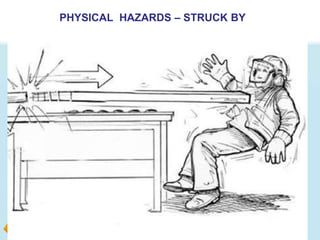
PHYSICAL HAZARDS
- Physical Hazard are those substances or
conditions which threaten your physical safety.
- THEY ARE:
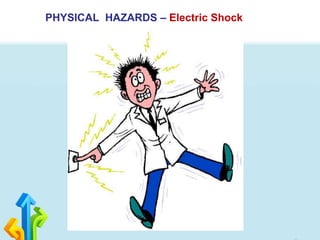
- Electrical shocks
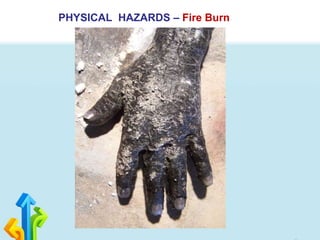
- Fire / Explosions
- Noise
- Thermal
- Caught in /on between pinch points
- Slips and falls
- Struck by flying objects
PHYSICAL HAZARDS – Electric Shock
PHYSICAL HAZARDS – Fire Burn
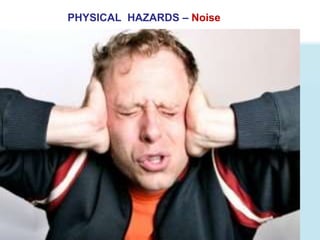
PHYSICAL HAZARDS – Noise
Noise-induced hearing loss is an irreversible condition that can have a
terrible impact on a person’s life.
If you are exposed to loud noise continually over a period of time, the nerve
receptors in your inner ear may eventually die, and once damage occurs it
cannot be repaired.
Hearing loss can also result from exposure to sudden loud noises, such as
explosions, gun shots or heavy hammering. These types of noises are
commonly referred to as ‘impact’ noises and, if loud enough, can cause
immediate, permanent damage.
Permanent hearing loss may also be accompanied by tinnitus or ringing in
the ears.
PHYSICAL HAZARDS – Thermal
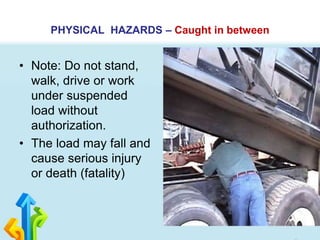
PHYSICAL HAZARDS – Caught in between
• Note: Do not stand,
walk, drive or work
under suspended
load without
authorization.
• The load may fall and
cause serious injury
or death (fatality)
Task 10.0
• Mention some of the causes of Slip and
Fall.
Time: 5mins
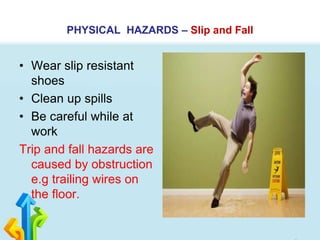
PHYSICAL HAZARDS – Slip and Fall
• Wear slip resistant
shoes
• Clean up spills
• Be careful while at
work
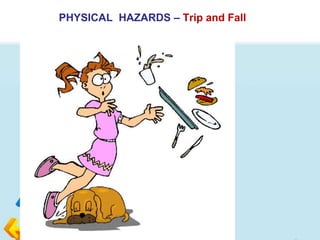
Trip and fall hazards are
caused by obstruction
e.g trailing wires on
the floor.
PHYSICAL HAZARDS – Trip and Fall
PHYSICAL HAZARDS – STRUCK BY
ERGONOMIC HAZARDS
- Ergonomics is the study of the relationship
between the worker, and the work environment
- refer to workplace conditions that pose the risk
of injury to the musculoskeletal system of the
worker.
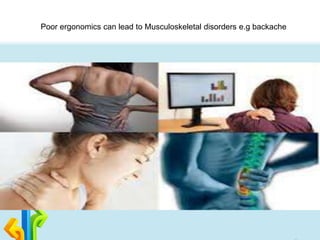
Poor ergonomics can lead to Musculoskeletal disorders e.g backache
Task 11.0
• What are some of the Personal Protective
Equipment (PPE) you know of?
Time: 5mins.
PERSONAL PROTECTIVE
EQUIPMENT (PPE)
PERSONAL PROTECTIVE
EQUIPMENT
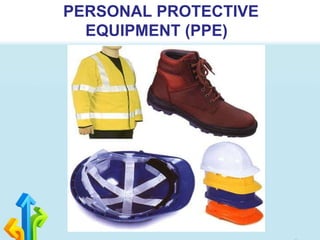
- Personal protective equipment (PPE)
are equipments that will protect the
users against health, safety and
environmental risks.
Things to consider
• What are the hazards in the job?
• What type of PPE is required?
• How to use and maintain the PPE?
• How to store the PPE?
BREATHING PPEs
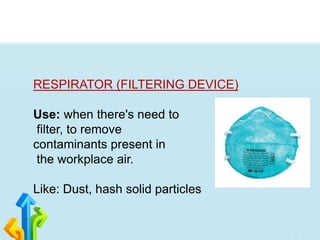
RESPIRATOR (FILTERING DEVICE)
Use: when there's need to
filter, to remove
contaminants present in
the workplace air.
Like: Dust, hash solid particles
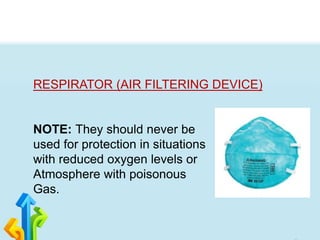
RESPIRATOR (AIR FILTERING DEVICE)
NOTE: They should never be
used for protection in situations
with reduced oxygen levels or
Atmosphere with poisonous
Gas.
PERSONAL PROTECTIVE
EQUIPMENT
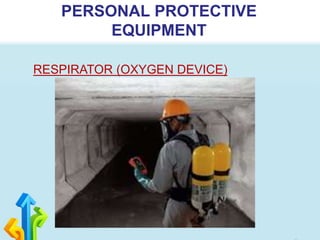
RESPIRATOR (OXYGEN DEVICE)
Use: when there's not enough
Oxygen in the atmosphere.
Like: in a confined space
where there is dangerous
vapor/fumes.
PERSONAL PROTECTIVE
EQUIPMENT
RESPIRATOR (OXYGEN DEVICE)
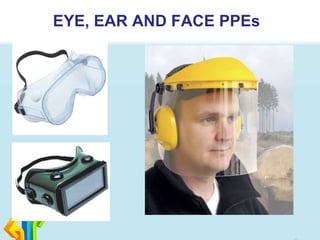
EYE, EAR AND FACE PPEs
PERSONAL PROTECTIVE
EQUIPMENT
EYE PPE
Type: Safety spectacle
goggles
- Safety spectacle is used to
protect against flying objects
- Goggles are further used to
protect against dangerous
lights.
PERSONAL PROTECTIVE
EQUIPMENT
EYE / FACE PPE
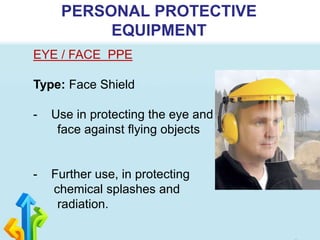
Type: Face Shield
- Use in protecting the eye and
face against flying objects
- Further use, in protecting
chemical splashes and
radiation.
HEAD PPEs
PERSONAL PROTECTIVE
EQUIPMENT
HEAD PPE
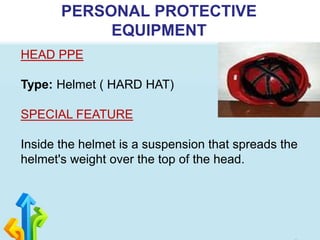
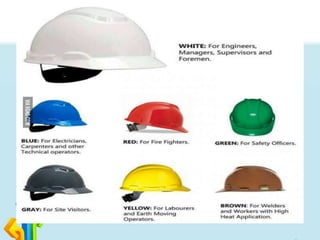
Type: Helmet ( HARD HAT)
A hard hat is a type of helmet predominantly used
in workplace environments, such as construction
sites, to protect the head from injury by falling
objects, impact with other objects, debris, bad
weather and electric shock.
PERSONAL PROTECTIVE
EQUIPMENT
HEAD PPE
Type: Helmet ( HARD HAT)
SPECIAL FEATURE
Inside the helmet is a suspension that spreads the
helmet's weight over the top of the head.
PERSONAL PROTECTIVE
EQUIPMENT
HEAD PPE
Type: Helmet ( BUMP CAP)
A bump cap is a lightweight kind of hard hat with
simplified suspension or padding. It is used where
there is a possibility of scraping or bumping one's
head on equipment or structure projections, but is
not strong enough to absorb large impacts, such as
from a tool dropped several stories.
.
PERSONAL PROTECTIVE
EQUIPMENT
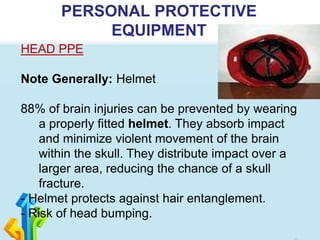
HEAD PPE
Note Generally: Helmet
88% of brain injuries can be prevented by wearing
a properly fitted helmet. They absorb impact
and minimize violent movement of the brain
within the skull. They distribute impact over a
larger area, reducing the chance of a skull
fracture.
- Helmet protects against hair entanglement.
- Risk of head bumping.
BODY PPE’S
PERSONAL PROTECTIVE
EQUIPMENT
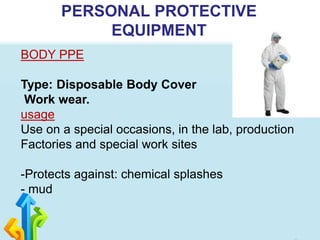
BODY PPE
Type: Disposable Body Cover
Work wear.
usage
Use on a special occasions, in the lab, production
Factories and special work sites
-Protects against: chemical splashes
- mud
PERSONAL PROTECTIVE
EQUIPMENT
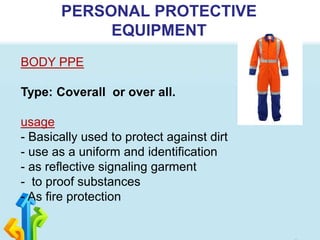
BODY PPE
Type: Coverall or over all.
usage
- Basically used to protect against dirt
- use as a uniform and identification
- as reflective signaling garment
- to proof substances
- As fire protection
PERSONAL PROTECTIVE
EQUIPMENT
TYPES of COVER ALL
Fire proof cover all
Cover all with reflection
General
HAND / HAND AND ARM
PERSONAL PROTECTIVE
EQUIPMENT
HANDS AND ARMS
Type: armlet, glove, gauntlets, Mitts,
Use to protect against
- abrasion
- temperature extremes
- cuts and punctures
-Impacts, chemicals
- skin infection disease or contamination
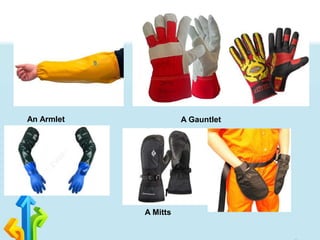
An Armlet A Gauntlet
A Mitts
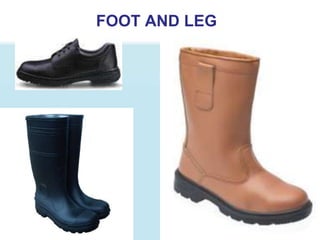
FOOT AND LEG
PERSONAL PROTECTIVE
EQUIPMENT
FOOT AND LEG
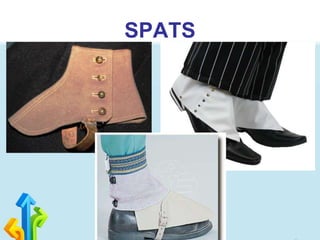
Type: GAITER, LEGGINGS, SPATS
Use to protect against
- Wet electrostatic build-up
- slipping
- cuts and punctures
-Falling objects
- metal and chemical splash , abrasion
GAITERS
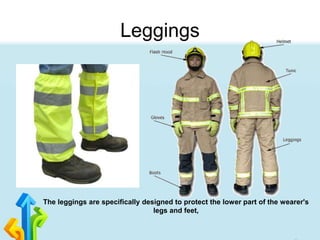
Leggings
The leggings are specifically designed to protect the lower part of the wearer's
legs and feet,
SPATS
SAFETY HARNESS
PERSONAL PROTECTIVE
EQUIPMENT
NOTE! NOTE!
PERSONAL PROTECTIVE
EQUIPMENT
FOR SAFETY OFFICERS:
The personal protective equipment (PPE) should
be:
- Properly assessed before use to make sure it is
fit for purpose.
- It should be maintained and stored properly
- Provided with instructions on how to use it
safely and how to use it correctly.
PERSONAL PROTECTIVE
EQUIPMENT
FOR SAFETY OFFICERS:
Mandatory, even management should know
- when PPE is necessary
- Why they must wear PPEs
- Proper care, maintenance, useful life and
disposal.
JOB HAZARD ANALYSIS
(JHA)
JOB HAZARD ANALYSIS
(JHA)
JHA is a technique that focuses on job tasks as a
way of identifying hazards before the incidents /
accident occurs.
- It focuses on the relationship between the
works, the task, the tools and the work
environment.
- It helps safety officers identify potential hazards
and give them clues on how to eliminate it or
reduce it to the acceptable risk level.
JOB HAZARD ANALYSIS
(JHA)
TYPICAL JHA QUESTIONS ARE:
- What can go wrong?
- What are the consequences?
- How could it arise?
- What are other seemingly contributing factors?
- How likely is it that the hazard will occur?
JOB HAZARD ANALYSIS
(JHA)
A CORRECT JHA TELLS:
- Where it can happen (Environment)
- Who or what it can happen to (exposure)
- What can precipitates the hazard
- The outcome that would occur should it happen
- And any other contributing factor
JOB HAZARD ANALYSIS
(JHA)
JHA demonstrates that all the credible hazards
inherent in the job have been identified and
measures to put them under control is on
ground already.
REMEMBER:
RESEARCH > IDENTIFY > ASSESS > CONTROL
/ RECOVER
- Job in which one simple human error could
lead to a severe accident or injuries.
- Complex jobs that should require written
instruction.
- Job where accident frequently occurs
- Jobs which many workers are not familiar
with
JOB HAZARD ANALYSIS
(JHA)
WHAT JOB NEEDS JHA MORE?
- Identify the scope and JHA objectives.
- Breakdown task into basic steps.
- For each step identify the hazards and its
threats
- Define control and recovery measures
- Record results
JOB HAZARD ANALYSIS
(JHA)
STEPS TO DO A JHA?
To identify potential hazard study the job
systematically and answer these questions:
- Can the tools, machines or equipment
present any hazard?
- Can the work suffer slip, trip or fall?
- Is there a danger from falling objects?
JOB HAZARD ANALYSIS
(JHA)
IDENTIFYING A POTENTIAL HAZARD
- Can weather condition affect safety?
- Is harmful radiations a possibility?
- Can contact be made with toxic, hot or
caustic substances?
- Is lighting poor?
- Can damage to equipment occur?
JOB HAZARD ANALYSIS
(JHA)
IDENTIFYING A POTENTIAL HAZARD
- Eliminate / substitution
- Isolation
- Lockout and Tagout
- Enclosure guards
- Education/training
- Procedures
- Work design and schedules
JOB HAZARD ANALYSIS
(JHA)
CONTROLS / RECOVERY MEASURE
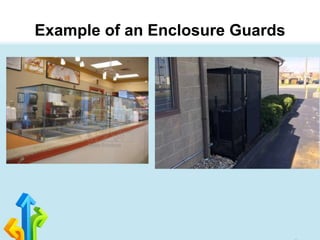
Example of an Enclosure Guards
Question
• Now what is Job Hazard
Analysis?
154
ACCIDENT
REPORTING
155
Accident Reporting
Fatality
Doctor ?
Phone Number
Address ?
City Hospital ?
Office Notification
Cell Phone
Ambulance ?
112 ?
Blood loss Broken Bones
Accident Report
Witness Statement
Boo-Boo
Response
156
ACCIDENT REPORTING PROCEDURE
A. LIFE THREATENING SITUATION
1. Get to the nearest emergency room for proper medical attention.
2. Notify the main office as soon as possible
B. NON-LIFE THREATENING
1. Notify your supervisor
2. Call and make arrangements with the company doctor.
3. Assist your supervisor with details to fill out the “First Report of Injury”
4. All accidents must be reported and investigated. It is YOUR
responsibility to report all accidents or incidents (near misses) without
regard to severity.
157
FIRST AID PROCEDURES
EMERGENCY PHONE NUMBERS
Safety Coordinator:
Poison Control:
First Aid:
Fire Department:
Ambulance:
Police:
Medical Clinic:
Clinic Address:
158
Emergency Medical Treatment
If you sustain a severe injury requiring emergency treatment:
Call for help and seek assistance from a co-worker.
Use the emergency telephone numbers and instructions posted next to the
telephone in your work area to request assistance and transportation to
the local hospital emergency room/clinic etc.
Provide details for the completion of the accident investigation report.
159
Non-Emergency Medical
Treatment
For non-emergency work-related injuries requiring professional medical
assistance, management must first authorize treatment
If you sustain an injury requiring treatment other than, first aid:
Inform your supervisor.
Proceed to the posted medical facility. Your supervisor will assist
with transportation, if necessary.
Provide details for the completion of the accident investigation
report.
160
Minor First-Aid Treatment
If you sustain an injury or are involved in an accident requiring minor first aid treatment:
Inform your supervisor.
Administer first aid treatment to the injury or wound.
If a first aid kit is used, indicate usage on the accident investigation
report.
Access to a first aid kit is not intended to be a substitute for medical
attention.
Provide details for the completion of the accident investigation report.
161
As a general rule, all accidents, no matter how minor, should be reported
immediately and investigated as soon as possible.
Employees must be made aware of their responsibility, to report the incident
as soon as possible after it occurs. They must also be aware that when/if
they report an incident, the incident will be discussed with them, as to
When-Where-Who-What-Why-How. They will be expected to cooperate with
the investigation, as the goal is to develop the root cause of the incident and
abate it so it does not occur again.
REMEMBER: Failure to comply with a company policy, such as the
requirement to report ANY/All accidents/incidents equals violating company
policy. That could result in disciplinary actions up to and including
termination. Since companies are different, check your company policies to
be sure!
In numerous businesses, when there is an incident, there is also a drug test
as part of policy. Employees should know this and expect this as a routine
occurrence.
Reporting of Accidents/Incidents
162
ACCIDENT INVESTIGATION
Task 12.0
• Mention some accidents you have seen in
your workplace?
Time: 5mins
164
ACCIDENTS don’t just happen…
“THEY ARE CAUSED!!!”
166
ACCIDENTS ARE CAUSED BY:
• Unsafe Acts
• Unsafe Conditions
167
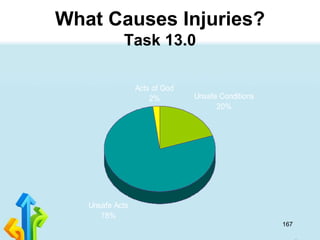
What Causes Injuries?
Task 13.0
Unsafe Conditions
20%
Acts of God
2%
Unsafe Acts
78%
168
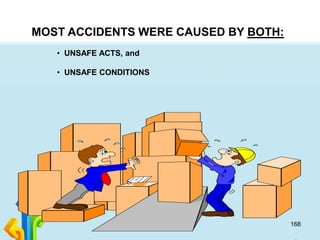
MOST ACCIDENTS WERE CAUSED BY BOTH:
• UNSAFE ACTS, and
• UNSAFE CONDITIONS
169
UNSAFE CONDITION (Hazard):
Is a physical condition or circumstance that
permits, or is likely to cause an accident.
170
UNSAFE ACT (Work Practice):
Is any violation of (or departure from) an accepted
normal, or correct, procedure or practice.
Task 14.0
• Why should we investigate an accident?
Time: 5mins.
172
Accident: An unplanned, undesired event, not necessarily resulting in
injury,but damaging to property and/.or interrupting the activity in process.
Incident: An undesired event that may cause personal harm or other
damage. (OSHA specifies incidents of a certain severity be recorded.)
With proper hazard identification and evaluation, management
commitment and support, preventive and corrective procedures,
monitoring, evaluation and training, unwanted events can be
prevented.
ACCIDENT INVESTIGATION
173
ACCIDENT INVESTIGATION
The ultimate purpose of investigations is to prevent future incidents.
•Investigations must produce factual information leading to corrective
actions that prevent or reduce the number of incidents.
•Investigations must be FACT FINDING not FAULT FINDING
174
ACCIDENT INVESTIGATION
The investigation concentrates on the fact surrounding the incident. After
the incident is fully investigated, responsibility will be fixed where
personal fault has caused the injury.
No person should be excused from the
consequences of their actions.
Disciplinary actions must not be from the investigating individual or
committee, but from management, for violating company
policies/procedures.
175
ACCIDENT INVESTIGATION
As a rule of thumb, use the “5-W” principle!
Simply ask “Why” five (5) times.
1. Why did you slip and Fall in the hall by the water cooler ? <answer> Because the
floor was wet.
2. Why was the floor wet? <answer> Because there was water on it.
3. Why was their water on the floor? <answer>I don’t know. It was coming out from
underneath the water cooler.
4. Why was water coming out from under the water cooler?
<answer> I don’t know. Let’s look. There is a hole in the
drain pipe.
5. Why is there a hole in the drain pipe? <answer>It appears as if it rusted out.
Was this an UNSAFE ACTIVITY or UNSAFE CONDITION?
176
ACCIDENT INVESTIGATION
It was an Unsafe Condition, caused by an Unsafe Activity.
The rusted pipe was caused by lack of preventative maintenance,
which was an unsafe activity. If there is “blame” where does it lie?
Was there a preventative maintenance program?, Who was in
charge of it. Why was it not checked? Should this be subject to
disciplinary actions?
177
ACCIDENTS
• Injuries
• Illnesses
• Property Damage
• Near-Misses
178
ACCIDENTS
An undesired event that could
involve:
Workers
Materials
Tools
Equipment
Environment
179
What is a properly performed
accident investigation?
* Does not seek to blame or find fault
* Finds underlying causes
* Gathers factual information
* Develops corrective action
180
Five Steps to Incident
Investigation
* Manage the Incident Site* Collect Information
* Analyze the Facts * Recommend Corrective
Action
* Corrective Action Follow-up
181
MANAGE THE ACCIDENT SITE
1. Assist the Injured Employee(s)
2. Eliminate or Control the Risk of Further
Injury
3. Preserve the Accident Scene
a. shut down equipment
b. barricade the site
182
COLLECT INFORMATION
1. Who, What, When, Where, Why, and How
2. Physical Evidence
3. Witness Statements
4. Documentation
183
PHYSICAL EVIDENCE
1. Photographs
2. Physical Conditions of Equipment and the
Environment
3. Sketch of Site
4. Records
5. Witness Statements
184
WITNESS STATEMENTS
1. Explain the Purpose of the Investigation
2. Listen Attentively
3. Ask Open Ended Questions
4. Safely Reenact the Incident
5. Get Signed Witness Statements
6. Solicit Recommendations
185
DOCUMENTATION
1. Training Records
2. Maintenance Records
3. Job Descriptions
4. Job Safety Requirements
186
Recommend Corrective Action
Follow-up
1. Identify corrective actions
2. Assign responsibility
3. Establish deadline for actions and follow-
up
4. Obtain management approval
5. Communicate results
Often times people do not give accurate
information to the safety officer due to:
- Fear of discipline
- Concern about the safety record
- Fear of medical treatment
- Poor understanding of the importance of
accident investigation.
ACCIDENT INVESTIGATION
SET BACK OF AI
Task 15.0
• What is First Aid?
Time: 5mins
FIRST AID
DEFINITION
• First aid is the skilled emergency
treatment given to an injured or sick
person before the arrival of a
doctor/medical personnel or before taking
the victim to the hospital, using available
materials at the scene.
AIMS & OBJECTIVES OF FIRST AID
1. To save or preserve life
2. To prevent illness or injury becoming
worse.
3. To promote recovery by relieving pain as
far as possible
4. To provide reassurance and comfort to
the casualty
Qualities of a first aider
• Observant
• Carefulness
• Resourceful
• Tactful
• Sympathetic
• Persevering
• explicit
General rules for first aiders
• Stay calm
• Use your common sense
• Do not attempt to do too much if you are
unsure of what to do
• Reassure victim all the time
• Do not move victim unless absolutely
necessary
• Do not leave the victim unattended to until
the doctor takes charge
• Do not give him anything to eat or drink
Emergency action principles
1. Survey the scene
2. Do a primary survey of the victim
3. Phone the emergency medical service
(EMS) or look for help
4. Do a secondary survey of the victim when
appropriate
Assess the situation
Immediately observe the scene and take in
much information as possible using the
“DRS-ABCD” Principle
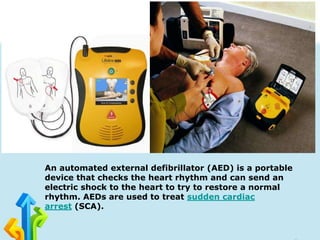
An automated external defibrillator (AED) is a portable
device that checks the heart rhythm and can send an
electric shock to the heart to try to restore a normal
rhythm. AEDs are used to treat sudden cardiac
arrest (SCA).
First Aid Treatment
1. remove or treat any cause of
unconsciousness.
2. Ensure the airway is clear.
3. Examine him and treat any serious
injuries
4. Place victim in a recovery position unless
when injuries do not permit eg spinal inj.
5. Keep him protected from cold
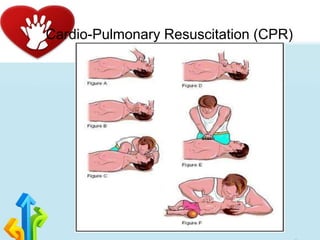
Cardio-Pulmonary Resuscitation (CPR)
“3Bs” of First Aid
1. Breathing
2. Bleeding, and
3. Bones
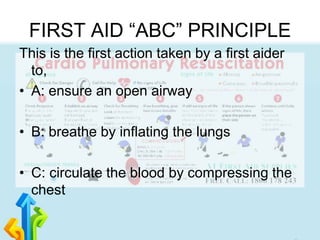
FIRST AID “ABC” PRINCIPLE
This is the first action taken by a first aider
to,
• A: ensure an open airway
• B: breathe by inflating the lungs
• C: circulate the blood by compressing the
chest
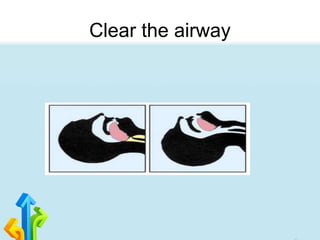
Clear the airway
Conditions that often require first aid
Bone fracture
Choking
Burns
Cardiac arrest
Drowning or asphyxiation
Electric shock
Battle field
Poisoning
Seizures
Bone dislocation
Cuts
Cramps in muscles
Childbirth
Toothache
Insect or animal bite
Wounds and bleeding
TYPES OF POLLUTION
• Air pollution
• Water pollution
• Land/soil pollution
Sources of pollution
• Oil/chemical spill/leakage
• Sewage discharge into water bodies
• Indiscriminate discharge of waste into
water
• Bush burning
• Release of combustion gases into the
atmosphere
Effect of Environmental Pollution
• Health problems
• Ozone layer depletion
• Global warming
• Flooding and erosion
• Deforestation
• Reduced soil fertility, etc
Waste control
• Waste control or management is the
deliberate effort at putting away waste
without re-contaminating the environment
Definition:
Waste is any material resulting from any
activity which has no immediate economic
benefit and must be disposed of.
Waste management hierarchy
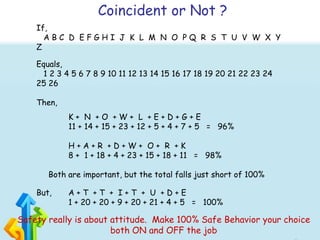
Coincident or Not ?
If,
A B C D E F G H I J K L M N O P Q R S T U V W X Y
Z
Equals,
1 2 3 4 5 6 7 8 9 10 11 12 13 14 15 16 17 18 19 20 21 22 23 24
25 26
Then,
K + N + O + W + L + E + D + G + E
11 + 14 + 15 + 23 + 12 + 5 + 4 + 7 + 5 = 96%
H + A + R + D + W + O + R + K
8 + 1 + 18 + 4 + 23 + 15 + 18 + 11 = 98%
Both are important, but the total falls just short of 100%
But, A + T + T + I + T + U + D + E
1 + 20 + 20 + 9 + 20 + 21 + 4 + 5 = 100%
Safety really is about attitude. Make 100% Safe Behavior your choice
both ON and OFF the job
General HSE Training (Level 1 & 2)

General HSE Training (Level 1 & 2)

  • 1.
  • 2.
    Aims and Objectives •The aims and objectives of this course is to provide competence training in health, safety and environment through identification of hazards and control measures.
  • 3.
    Introduction to HealthSafety and Environment (HSE) Definitions • Health: Is a state of total well being of a person not merely the absence of disease. • Safety: Is the state of been free from danger or harm • Environment: the environment is our surroundings which includes air, land and water. • PARE. Personnel, Assets, Reputation and Environment • ALARP: As Low As Reasonably Practicable. This is a term used to reduce Hazards to the barest minimum. • Hazard: Is any thing or activity that can cause harm or damage to PARE
  • 4.
    Definitions • Incident: Isan unplanned event which may or may not lead to harm or damage. • Accident: is unplanned event which leads to harm or damage. • Near-miss: is unplanned event which did not lead to harm or damage. • Unsafe Act and Unsafe Condition: an unsafe act is any action or omission which does not regard safety rules.e.g making phone call while driving.
  • 5.
    Duties of aSafety Officer 1. To protect PARE 2. To train personnel on HSE matters 3. To ALARP hazards or eliminate hazards 4. To advice management on HSE matters 5. To carry out Pep talk and Toolbox meetings 6. To carry out monthly HSE meetings
  • 6.
    Duties of aSafety Officer (cont.) • To conduct drills .e.g. fire drills • To ensure equipments and work environment are safe • To determine the necessary personal protective equipment (PPE) to be used by workers • To represent the company on HSE matters
  • 7.
  • 8.
    Task 1 • Question:Why is Safety important? • Time: 7min
  • 9.
    WHY IS SAFETYNOW MANDATORY? • people are loosing their lives out of ignorance. • Compensation for death is very expensive for companies.
  • 10.
    WHY IS SAFETYNOW MANDATORY? • Organizations don’t want to Loose man hours. Shell looses N30million every 15 mins work is shutdown.
  • 11.
    WHY IS SAFETYNOW MANDATORY? • Machines are usually damaged by non safety educated persons every now and then. • Companies spend heavily on repairs
  • 12.
    WHY IS SAFETYNOW MANDATORY? • A safety ignorant person can even set a company ablaze. • Company stands to lose everything.
  • 13.
    WHY IS SAFETYNOW MANDATORY? • Government fines and penalties. • Government can even shutdown the company.
  • 14.
    Task 2.0 WHY AREYOU IN THIS TRAINING!
  • 15.
    • To learnways and methods to keep yourself safe anywhere any time. • To learn methods to fight any unforeseen situations when it occurs. YOU ARE HERE:
  • 16.
    • To proveto employers that you are ready and suitable to work within any job condition and keep yourself safe. • To give yourself an edge and also increase your stands in the competitive labor market. YOU ARE STUDYING THIS COURSE:
  • 17.
    • Because youintend to take HSE as a career. • Hungry to grow in HSE and to get ready for the next level in HSE. • To qualify as a leader. You are studying this course?
  • 18.
    Task 3.0 • Whatdoes the letter H.S.E means to you? Time: 5min
  • 19.
    • H =Health • S = Safety • E = Environment WHAT IS HSE? The HSE acronym stands for
  • 20.
    Health and safetyat work • keeping people healthy and safe at work • everyone has a responsibility
  • 21.
    Activity 4.0 - writea short definition for each of the terms presented Time: 10mins
  • 22.
    Definitions • health – whenyou feel well and have no illness or injury • safety – when you are protected from harm • workplace – anywhere you do your job (inside or outside)
  • 23.
    Hazard • something thatcan cause harm • in every workplace – e.g. fire, electricity, sharp tools, chemicals, noise, uneven floors
  • 24.
    WHEN YOU SAYYOU ARE HSE COMPETENT OR CERTIFIED, IT MEANS
  • 25.
    You can: 1. Identifyhazards 2. Assess the risks 3. Establish control measures to prevent incidents 4. Establish Recovery measures to mitigate the consequences in the event of an accident.
  • 26.
    Task 5.0 • Whatare some hazards in your workplace? Time: 7min
  • 27.
    What are somehazards in the work? • Chemicals • Radiation • Fire • Electrical • Biological • Physical • Slips and trips • Falling hazard • Ergonomics • Thermal • Noise etc…
  • 28.
  • 29.
    Levels of Communicationin HSE? Officer Level Supervisor Level Manager Level
  • 30.
    • HSE Officersreport to a HSE supervisor. • HSE Supervisor reports to a HSE manager. • HSE manager reports to the management Levels of Communication in HSE?
  • 31.
  • 32.
    • Safety signsare means of communicating important information that can be understood by all races, by literate and illiterate people, by all age groups and by all people, locally or globally. • Safety signs are vital in all our workplaces to ensure the safety of our workers. SAFETY SIGNS
  • 33.
    Intrinsic features: • a)round shape; • (b) black pictogram on white background, red edging and diagonal line TYPE OF SAFETY SIGNS THE PROHIBITION SIGNS
  • 34.
    TYPE OF SAFETYSIGNS THE PROHIBITION SIGNS No access for unauthorized persons No access for industrial vehicles
  • 35.
    TYPE OF SAFETYSIGNS THE PROHIBITION SIGNS Do not extinguish with waterNo access for pedestrians
  • 36.
    TYPE OF SAFETYSIGNS THE PROHIBITION SIGNS Naked flames forbiddenNo smoking
  • 37.
    Intrinsic features: TYPE OFSAFETY SIGNS THE DANGER WARNING SIGNS (a)triangular shape (b) black pictogram on a yellow background with black edging
  • 38.
    TYPE OF SAFETYSIGNS THE DANGER WARNING SIGNS General danger Danger: Electricity
  • 39.
    TYPE OF SAFETYSIGNS THE DANGER WARNING SIGNS Industrial vehiclesOverhead load
  • 40.
    L[LKJ TYPE OF SAFETYSIGNS THE DANGER WARNING SIGNS Low temperatureDrop / Obstacle
  • 41.
    Intrinsic features: TYPE OFSAFETY SIGNS MANDATORY SIGNS (a) round shape (b) white pictogram on a blue background
  • 42.
    TYPE OF SAFETYSIGNS MANDATORY SIGNS General mandatory Ear protection must be worn
  • 43.
    TYPE OF SAFETYSIGNS MANDATORY SIGNS Safety overalls must be wornSafety boots must be worn
  • 44.
    Task 6.0 • Whydo you think you need to wear face protection? • Why is it important to wear safety helmet? • What is Emergency Exit? • What is Safety Shower? • Time: 10mins.
  • 45.
    TYPE OF SAFETYSIGNS MANDATORY SIGNS Safety helmet must be wornFace protection
  • 46.
    Intrinsic features: TYPE OFSAFETY SIGNS EMERGENCY ESCAPE SIGNS (a) rectangular or square shape (b) white pictogram on a green background
  • 47.
    TYPE OF SAFETYSIGNS EMERGENCY ESCAPE SIGNS Emergency Exit Safety Shower
  • 48.
    TYPE OF SAFETYSIGNS EMERGENCY ESCAPE SIGNS Stretcher First aid
  • 49.
    Intrinsic features: TYPE OFSAFETY SIGNS Firefighting Signs (a) rectangular or square shape (b) white pictogram on a red background
  • 50.
    TYPE OF SAFETYSIGNS Firefighting Signs Fire Ladder Fire Extinguisher
  • 51.
    TYPE OF SAFETYSIGNS Firefighting Sign Fire Escape Direction
  • 52.
  • 53.
    SAFETY LEGISLATION (a) GOVERNMENTAL:Safety legislations consist of Law enacted by the government to regulate industrial activities so as to safeguard lives of people, properties and the environment. (b) COMPANY: Written laws prepared by the employers to ensure the safety of persons at work and also to save the environment.
  • 54.
    SAFETY LEGISLATION (a) Asafety officer needs to understand and have this laid down laws on his or her finger tips so as to efficiently fit in as a mediator between the company and governmental agencies . (b) It is the safety officer that enforces the laws laid down by the management.
  • 55.
    SAFETY LEGISLATION - Thefactories act 1990 - Health and Safety at Work Act (HASAWA) 1974 - The minerals oils (safety) regulation 1997 revised - Petroleum (Drilling and production) regulation 1969 - Petroleum refining regulation 1967 (transport and storage of petroleum products)
  • 56.
    SAFETY LEGISLATION - Electricityregulation - The explosive regulation - And many others in the book.
  • 57.
    RESPONSIBLITIES OF EMPLOYERS ASREGARDS TO LEGISLATIONS - Employers should make sure all Factories (Plant) are registered according to the standard of the federal Government before commencing operation. - Employers must provide personal protective equipments (PPEs) as recommended by the authorities.
  • 58.
    - Provision ofsanitary facilities, - Adequate ventilation, - Lightings - Portable water showers - First Aid Facilities. - Provide training for personnel And many other you can find in the book RESPONSIBLITIES OF EMPLOYERS AS REGARDS TO LEGISLATIONS (C0NT.)
  • 59.
    RESPONSIBLITIES OF EMPLOYEES ASREGARDS TO LEGISLATIONS - NOTE: It shall be the responsibility of everyone employed by the company to keep regulations and laws stipulated to help the company keep the federation laws. - ACTIVITIES LIKE: - good house-keeping - Avoiding acts likely to render safety devices inefective, in the plant or factory.
  • 60.
    RESPONSIBLITIES OF EMPLOYEES ASREGARDS TO LEGISLATIONS - Prohibited from sleeping , drinking while on duty or reporting for duty under the influence of alcohol. - NOT to Tamper, repair or operate any equipment that he or she is not qualified and certified to. - Report unsafe acts and unsafe conditions to the supervisor
  • 61.
  • 62.
    Task 7.0 • Howis Health and Safety law Enforced? Time: 5mins.
  • 63.
    ENFORCEMENT (A) These aremeasures put in place by different federal government arms to make sure regulations put in place are been obeyed by companies . (B) There are also measures put in place by companies to make sure employees obey laws set aside.
  • 64.
    ENFORCEMENT (A 1) Oneof the ways by which government enforce laws is that defaulting companies pay heavy fines. (A 2) Another way is that the defaulting company is temporally shutdown.
  • 65.
    ENFORCEMENT (B 1) Oneof the ways by which companies enforce laws can be reduction of salary (B 2) quarries or suspension as the case maybe.
  • 66.
  • 67.
    Task 8.0 • Listat least 3 penalties you think should be given for non-compliance Time: 15mins.
  • 68.
    PENALTIES FOR NON-COMPLIANCE Penaltiesare for serious offenders or defaulters:
  • 69.
    PENALTIES FOR NON-COMPLIANCE Forcompanies, penalties for non-compliance might be: - Sentence to imprisonment as the case maybe. - Or other tailored serious punishment proposed by the company safety department / the management.
  • 70.
  • 71.
    HAZARD - Hazard ina practical term is any condition or activity that if left uncontrolled can result in an injury, illness or death.
  • 72.
  • 73.
  • 74.
    CHEMICAL HAZARD - Theseare basically the kinds of threats gotten from chemical substances.
  • 75.
    CHEMICAL HAZARD - METHODOF EXPOSURE : INHALATION (through the nose), Through inhalation: people, out of ignorance, inhale poisonous chemicals such as: - Carbon monoxide (CO) - smoke from generator, - car and many other sources - Hydrogen Sulfide (H2S), Sulfur Dioxide, Ozone, Phosgene, Nitrogen Dioxide, Ammonia. etc
  • 76.
    CHEMICAL HAZARD - METHODOF EXPOSURE : SKIN CONTACT (Absorption) - Dangerous chemicals burn and rupture the skin when they come in contact with it. - Example: exposure to high Amount of Acid.
  • 77.
    CHEMICAL HAZARD - METHODOF EXPOSURE: ABSORPTION Skin absorption is a route by which substances can enter the body through the skin. Also harmful substances pass through this medium into the body system.
  • 78.
    CHEMICAL HAZARD - METHODOF EXPOSURES: INGESTION (through the mouth) Poisonous chemicals enter body through the mouth into the digestive system, from contaminated food or water and or any other means. This can be prevented by not eating or drinking when handling chemicals.
  • 79.
    CHEMICAL HAZARD - METHODOF EXPOSURE: INJECTION Harmful chemical can enter into our body or blood stream through a mechanical medium. E.g. through cuts from broken glass or sharp objects. Note: This could also be deliberate in the case of hard drugs. However victims are usually not abreast of the full chemical composition of the substance entering their body.
  • 80.
    CHEMICAL HAZARD - GENERALCHEMICAL HAZARD KNOWLEDGE SYMPTOMS: Depending on the type of exposure, symptoms can be : - Abdominal pain - Breathing difficulty - Dizziness - Headache - Pain where contact is made with the skin - Weakness - Unconsciousness
  • 81.
    CHEMICAL HAZARD CONTROL TOCHEMICAL HAZARD - Label all chemicals. - Do not eat or drink while handling chemicals. - Workers must follow the standard operating procedure (sop) when handling chemicals. - Use PPE e.g Gloves, coveralls, etc - Workers must work under supervision - Wash off immediately if the chemical comes in contact with skin. - Follow the safety data sheet (manual) of chemicals
  • 82.
    CHEMICAL HAZARD - GENERALCHEMICAL HAZARD KNOWLEDGE PROTECTION Cont: - Avoid prolonged (even low-level) exposure to chemicals. - Avoid mixing different products that contain toxic chemicals such as ammonia and bleach. The mixture can give off hazardous fumes. - Buy potentially poisonous substance in safety containers, and buy only as much as needed. - Many household products are made of toxic chemicals. It is important to read and follow label instructions, including any precautions.
  • 83.
    CHEMICAL HAZARD - GENERALCHEMICAL HAZARD KNOWLEDGE PROTECTION: - Never store household products in food or drink containers. Leave them in their original containers with the labels intact. - Store chemicals safely immediately after use. - Use paints, petroleum products, ammonia, bleach, and other products that give off fumes only in a well-ventilated area.
  • 84.
    CHEMICAL HAZARD - GENERALCHEMICAL HAZARD KNOWLEDGE FIRST AID: - Make sure the cause of the burn Is removed - Flush the chemical off the skin using cool running water - Treat the person from shock - Apply wet compresses to release - Wrap the burned area with a dry sterile cloth - Protect the burned area from pressure and friction - Unconsciousness
  • 85.
  • 86.
    BIOLOGICAL HAZARDS - Theserefer to biological substances that pose a threat to the health of humans. - Biological hazards are hazards associated with living disease causing organisms (i.e pathogens)
  • 87.
    BIOLOGICAL HAZARDS - METHODOF EXPOSURES : Bloodborne Pathogens: - A pathogen is something that spreads disease - Bloodborne are diseases that goes through the blood. Examples are: - Hepatitis B virus (HBV) - Hepatitis C - human immunodeficiency virus (HIV) - And others
  • 88.
    BIOLOGICAL HAZARDS METHOD OFEXPOSURES : Bloodborne Pathogens: NOTE: objects contaminated with the blood of an infected person will be contagious. Avoid any contact with equipments. - Do not handle blood with your bare hands always use disposable gloves, and apron in severe instance.
  • 89.
    BIOLOGICAL HAZARDS METHOD OFEXPOSURES : Building Related illness: building-related illness (BRI) refers to recognized diseases, often infections, eg Legionnaires' disease, caused by being in a sick building.
  • 90.
    BIOLOGICAL HAZARDS METHOD OFEXPOSURES : Building Related illness: Buildings become “sick” mostly when : - There is a Poor ventilation. - Poisonous Air conditioning. - Low humidity.
  • 91.
    BIOLOGICAL HAZARDS METHOD OFEXPOSURES : Plant and insect Poison • many plants and their fruits are poisonous and should not be eaten. • Many insects like snakes, spiders, scorpions, ticks and others transmit deadly poisons • also, certain aquatic creatures like jelly fish, sea anemones also transmit poisons.
  • 92.
    Sea Anemones &Jelly fish
  • 93.
    PHYSICAL HAZARD Task 9.0 •What could have lead to the accident and how could it have been prevented? • Can you list recovery measures to mitigate the consequences of this accident?
  • 94.
    PHYSICAL HAZARDS - PhysicalHazard are those substances or conditions which threaten your physical safety. - THEY ARE: - Electrical shocks - Fire / Explosions - Noise - Thermal - Caught in /on between pinch points - Slips and falls - Struck by flying objects
  • 95.
    PHYSICAL HAZARDS –Electric Shock
  • 96.
  • 97.
  • 98.
    PHYSICAL HAZARDS –Noise Noise-induced hearing loss is an irreversible condition that can have a terrible impact on a person’s life. If you are exposed to loud noise continually over a period of time, the nerve receptors in your inner ear may eventually die, and once damage occurs it cannot be repaired. Hearing loss can also result from exposure to sudden loud noises, such as explosions, gun shots or heavy hammering. These types of noises are commonly referred to as ‘impact’ noises and, if loud enough, can cause immediate, permanent damage. Permanent hearing loss may also be accompanied by tinnitus or ringing in the ears.
  • 99.
  • 100.
    PHYSICAL HAZARDS –Caught in between • Note: Do not stand, walk, drive or work under suspended load without authorization. • The load may fall and cause serious injury or death (fatality)
  • 101.
    Task 10.0 • Mentionsome of the causes of Slip and Fall. Time: 5mins
  • 102.
    PHYSICAL HAZARDS –Slip and Fall • Wear slip resistant shoes • Clean up spills • Be careful while at work Trip and fall hazards are caused by obstruction e.g trailing wires on the floor.
  • 103.
    PHYSICAL HAZARDS –Trip and Fall
  • 105.
  • 106.
    ERGONOMIC HAZARDS - Ergonomicsis the study of the relationship between the worker, and the work environment - refer to workplace conditions that pose the risk of injury to the musculoskeletal system of the worker.
  • 107.
    Poor ergonomics canlead to Musculoskeletal disorders e.g backache
  • 108.
    Task 11.0 • Whatare some of the Personal Protective Equipment (PPE) you know of? Time: 5mins.
  • 109.
  • 110.
    PERSONAL PROTECTIVE EQUIPMENT - Personalprotective equipment (PPE) are equipments that will protect the users against health, safety and environmental risks.
  • 111.
    Things to consider •What are the hazards in the job? • What type of PPE is required? • How to use and maintain the PPE? • How to store the PPE?
  • 112.
  • 113.
    RESPIRATOR (FILTERING DEVICE) Use:when there's need to filter, to remove contaminants present in the workplace air. Like: Dust, hash solid particles
  • 114.
    RESPIRATOR (AIR FILTERINGDEVICE) NOTE: They should never be used for protection in situations with reduced oxygen levels or Atmosphere with poisonous Gas.
  • 115.
    PERSONAL PROTECTIVE EQUIPMENT RESPIRATOR (OXYGENDEVICE) Use: when there's not enough Oxygen in the atmosphere. Like: in a confined space where there is dangerous vapor/fumes.
  • 116.
  • 117.
    EYE, EAR ANDFACE PPEs
  • 118.
    PERSONAL PROTECTIVE EQUIPMENT EYE PPE Type:Safety spectacle goggles - Safety spectacle is used to protect against flying objects - Goggles are further used to protect against dangerous lights.
  • 119.
    PERSONAL PROTECTIVE EQUIPMENT EYE /FACE PPE Type: Face Shield - Use in protecting the eye and face against flying objects - Further use, in protecting chemical splashes and radiation.
  • 120.
  • 121.
    PERSONAL PROTECTIVE EQUIPMENT HEAD PPE Type:Helmet ( HARD HAT) A hard hat is a type of helmet predominantly used in workplace environments, such as construction sites, to protect the head from injury by falling objects, impact with other objects, debris, bad weather and electric shock.
  • 122.
    PERSONAL PROTECTIVE EQUIPMENT HEAD PPE Type:Helmet ( HARD HAT) SPECIAL FEATURE Inside the helmet is a suspension that spreads the helmet's weight over the top of the head.
  • 123.
    PERSONAL PROTECTIVE EQUIPMENT HEAD PPE Type:Helmet ( BUMP CAP) A bump cap is a lightweight kind of hard hat with simplified suspension or padding. It is used where there is a possibility of scraping or bumping one's head on equipment or structure projections, but is not strong enough to absorb large impacts, such as from a tool dropped several stories. .
  • 124.
    PERSONAL PROTECTIVE EQUIPMENT HEAD PPE NoteGenerally: Helmet 88% of brain injuries can be prevented by wearing a properly fitted helmet. They absorb impact and minimize violent movement of the brain within the skull. They distribute impact over a larger area, reducing the chance of a skull fracture. - Helmet protects against hair entanglement. - Risk of head bumping.
  • 126.
  • 127.
    PERSONAL PROTECTIVE EQUIPMENT BODY PPE Type:Disposable Body Cover Work wear. usage Use on a special occasions, in the lab, production Factories and special work sites -Protects against: chemical splashes - mud
  • 128.
    PERSONAL PROTECTIVE EQUIPMENT BODY PPE Type:Coverall or over all. usage - Basically used to protect against dirt - use as a uniform and identification - as reflective signaling garment - to proof substances - As fire protection
  • 129.
    PERSONAL PROTECTIVE EQUIPMENT TYPES ofCOVER ALL Fire proof cover all Cover all with reflection General
  • 130.
    HAND / HANDAND ARM
  • 131.
    PERSONAL PROTECTIVE EQUIPMENT HANDS ANDARMS Type: armlet, glove, gauntlets, Mitts, Use to protect against - abrasion - temperature extremes - cuts and punctures -Impacts, chemicals - skin infection disease or contamination
  • 132.
    An Armlet AGauntlet A Mitts
  • 133.
  • 134.
    PERSONAL PROTECTIVE EQUIPMENT FOOT ANDLEG Type: GAITER, LEGGINGS, SPATS Use to protect against - Wet electrostatic build-up - slipping - cuts and punctures -Falling objects - metal and chemical splash , abrasion
  • 135.
  • 136.
    Leggings The leggings arespecifically designed to protect the lower part of the wearer's legs and feet,
  • 137.
  • 138.
  • 139.
  • 140.
    PERSONAL PROTECTIVE EQUIPMENT FOR SAFETYOFFICERS: The personal protective equipment (PPE) should be: - Properly assessed before use to make sure it is fit for purpose. - It should be maintained and stored properly - Provided with instructions on how to use it safely and how to use it correctly.
  • 141.
    PERSONAL PROTECTIVE EQUIPMENT FOR SAFETYOFFICERS: Mandatory, even management should know - when PPE is necessary - Why they must wear PPEs - Proper care, maintenance, useful life and disposal.
  • 142.
  • 143.
    JOB HAZARD ANALYSIS (JHA) JHAis a technique that focuses on job tasks as a way of identifying hazards before the incidents / accident occurs. - It focuses on the relationship between the works, the task, the tools and the work environment. - It helps safety officers identify potential hazards and give them clues on how to eliminate it or reduce it to the acceptable risk level.
  • 144.
    JOB HAZARD ANALYSIS (JHA) TYPICALJHA QUESTIONS ARE: - What can go wrong? - What are the consequences? - How could it arise? - What are other seemingly contributing factors? - How likely is it that the hazard will occur?
  • 145.
    JOB HAZARD ANALYSIS (JHA) ACORRECT JHA TELLS: - Where it can happen (Environment) - Who or what it can happen to (exposure) - What can precipitates the hazard - The outcome that would occur should it happen - And any other contributing factor
  • 146.
    JOB HAZARD ANALYSIS (JHA) JHAdemonstrates that all the credible hazards inherent in the job have been identified and measures to put them under control is on ground already. REMEMBER: RESEARCH > IDENTIFY > ASSESS > CONTROL / RECOVER
  • 147.
    - Job inwhich one simple human error could lead to a severe accident or injuries. - Complex jobs that should require written instruction. - Job where accident frequently occurs - Jobs which many workers are not familiar with JOB HAZARD ANALYSIS (JHA) WHAT JOB NEEDS JHA MORE?
  • 148.
    - Identify thescope and JHA objectives. - Breakdown task into basic steps. - For each step identify the hazards and its threats - Define control and recovery measures - Record results JOB HAZARD ANALYSIS (JHA) STEPS TO DO A JHA?
  • 149.
    To identify potentialhazard study the job systematically and answer these questions: - Can the tools, machines or equipment present any hazard? - Can the work suffer slip, trip or fall? - Is there a danger from falling objects? JOB HAZARD ANALYSIS (JHA) IDENTIFYING A POTENTIAL HAZARD
  • 150.
    - Can weathercondition affect safety? - Is harmful radiations a possibility? - Can contact be made with toxic, hot or caustic substances? - Is lighting poor? - Can damage to equipment occur? JOB HAZARD ANALYSIS (JHA) IDENTIFYING A POTENTIAL HAZARD
  • 151.
    - Eliminate /substitution - Isolation - Lockout and Tagout - Enclosure guards - Education/training - Procedures - Work design and schedules JOB HAZARD ANALYSIS (JHA) CONTROLS / RECOVERY MEASURE
  • 152.
    Example of anEnclosure Guards
  • 153.
    Question • Now whatis Job Hazard Analysis?
  • 154.
  • 155.
    155 Accident Reporting Fatality Doctor ? PhoneNumber Address ? City Hospital ? Office Notification Cell Phone Ambulance ? 112 ? Blood loss Broken Bones Accident Report Witness Statement Boo-Boo Response
  • 156.
    156 ACCIDENT REPORTING PROCEDURE A.LIFE THREATENING SITUATION 1. Get to the nearest emergency room for proper medical attention. 2. Notify the main office as soon as possible B. NON-LIFE THREATENING 1. Notify your supervisor 2. Call and make arrangements with the company doctor. 3. Assist your supervisor with details to fill out the “First Report of Injury” 4. All accidents must be reported and investigated. It is YOUR responsibility to report all accidents or incidents (near misses) without regard to severity.
  • 157.
    157 FIRST AID PROCEDURES EMERGENCYPHONE NUMBERS Safety Coordinator: Poison Control: First Aid: Fire Department: Ambulance: Police: Medical Clinic: Clinic Address:
  • 158.
    158 Emergency Medical Treatment Ifyou sustain a severe injury requiring emergency treatment: Call for help and seek assistance from a co-worker. Use the emergency telephone numbers and instructions posted next to the telephone in your work area to request assistance and transportation to the local hospital emergency room/clinic etc. Provide details for the completion of the accident investigation report.
  • 159.
    159 Non-Emergency Medical Treatment For non-emergencywork-related injuries requiring professional medical assistance, management must first authorize treatment If you sustain an injury requiring treatment other than, first aid: Inform your supervisor. Proceed to the posted medical facility. Your supervisor will assist with transportation, if necessary. Provide details for the completion of the accident investigation report.
  • 160.
    160 Minor First-Aid Treatment Ifyou sustain an injury or are involved in an accident requiring minor first aid treatment: Inform your supervisor. Administer first aid treatment to the injury or wound. If a first aid kit is used, indicate usage on the accident investigation report. Access to a first aid kit is not intended to be a substitute for medical attention. Provide details for the completion of the accident investigation report.
  • 161.
    161 As a generalrule, all accidents, no matter how minor, should be reported immediately and investigated as soon as possible. Employees must be made aware of their responsibility, to report the incident as soon as possible after it occurs. They must also be aware that when/if they report an incident, the incident will be discussed with them, as to When-Where-Who-What-Why-How. They will be expected to cooperate with the investigation, as the goal is to develop the root cause of the incident and abate it so it does not occur again. REMEMBER: Failure to comply with a company policy, such as the requirement to report ANY/All accidents/incidents equals violating company policy. That could result in disciplinary actions up to and including termination. Since companies are different, check your company policies to be sure! In numerous businesses, when there is an incident, there is also a drug test as part of policy. Employees should know this and expect this as a routine occurrence. Reporting of Accidents/Incidents
  • 162.
  • 163.
    Task 12.0 • Mentionsome accidents you have seen in your workplace? Time: 5mins
  • 164.
    164 ACCIDENTS don’t justhappen… “THEY ARE CAUSED!!!”
  • 166.
    166 ACCIDENTS ARE CAUSEDBY: • Unsafe Acts • Unsafe Conditions
  • 167.
    167 What Causes Injuries? Task13.0 Unsafe Conditions 20% Acts of God 2% Unsafe Acts 78%
  • 168.
    168 MOST ACCIDENTS WERECAUSED BY BOTH: • UNSAFE ACTS, and • UNSAFE CONDITIONS
  • 169.
    169 UNSAFE CONDITION (Hazard): Isa physical condition or circumstance that permits, or is likely to cause an accident.
  • 170.
    170 UNSAFE ACT (WorkPractice): Is any violation of (or departure from) an accepted normal, or correct, procedure or practice.
  • 171.
    Task 14.0 • Whyshould we investigate an accident? Time: 5mins.
  • 172.
    172 Accident: An unplanned,undesired event, not necessarily resulting in injury,but damaging to property and/.or interrupting the activity in process. Incident: An undesired event that may cause personal harm or other damage. (OSHA specifies incidents of a certain severity be recorded.) With proper hazard identification and evaluation, management commitment and support, preventive and corrective procedures, monitoring, evaluation and training, unwanted events can be prevented. ACCIDENT INVESTIGATION
  • 173.
    173 ACCIDENT INVESTIGATION The ultimatepurpose of investigations is to prevent future incidents. •Investigations must produce factual information leading to corrective actions that prevent or reduce the number of incidents. •Investigations must be FACT FINDING not FAULT FINDING
  • 174.
    174 ACCIDENT INVESTIGATION The investigationconcentrates on the fact surrounding the incident. After the incident is fully investigated, responsibility will be fixed where personal fault has caused the injury. No person should be excused from the consequences of their actions. Disciplinary actions must not be from the investigating individual or committee, but from management, for violating company policies/procedures.
  • 175.
    175 ACCIDENT INVESTIGATION As arule of thumb, use the “5-W” principle! Simply ask “Why” five (5) times. 1. Why did you slip and Fall in the hall by the water cooler ? <answer> Because the floor was wet. 2. Why was the floor wet? <answer> Because there was water on it. 3. Why was their water on the floor? <answer>I don’t know. It was coming out from underneath the water cooler. 4. Why was water coming out from under the water cooler? <answer> I don’t know. Let’s look. There is a hole in the drain pipe. 5. Why is there a hole in the drain pipe? <answer>It appears as if it rusted out. Was this an UNSAFE ACTIVITY or UNSAFE CONDITION?
  • 176.
    176 ACCIDENT INVESTIGATION It wasan Unsafe Condition, caused by an Unsafe Activity. The rusted pipe was caused by lack of preventative maintenance, which was an unsafe activity. If there is “blame” where does it lie? Was there a preventative maintenance program?, Who was in charge of it. Why was it not checked? Should this be subject to disciplinary actions?
  • 177.
    177 ACCIDENTS • Injuries • Illnesses •Property Damage • Near-Misses
  • 178.
    178 ACCIDENTS An undesired eventthat could involve: Workers Materials Tools Equipment Environment
  • 179.
    179 What is aproperly performed accident investigation? * Does not seek to blame or find fault * Finds underlying causes * Gathers factual information * Develops corrective action
  • 180.
    180 Five Steps toIncident Investigation * Manage the Incident Site* Collect Information * Analyze the Facts * Recommend Corrective Action * Corrective Action Follow-up
  • 181.
    181 MANAGE THE ACCIDENTSITE 1. Assist the Injured Employee(s) 2. Eliminate or Control the Risk of Further Injury 3. Preserve the Accident Scene a. shut down equipment b. barricade the site
  • 182.
    182 COLLECT INFORMATION 1. Who,What, When, Where, Why, and How 2. Physical Evidence 3. Witness Statements 4. Documentation
  • 183.
    183 PHYSICAL EVIDENCE 1. Photographs 2.Physical Conditions of Equipment and the Environment 3. Sketch of Site 4. Records 5. Witness Statements
  • 184.
    184 WITNESS STATEMENTS 1. Explainthe Purpose of the Investigation 2. Listen Attentively 3. Ask Open Ended Questions 4. Safely Reenact the Incident 5. Get Signed Witness Statements 6. Solicit Recommendations
  • 185.
    185 DOCUMENTATION 1. Training Records 2.Maintenance Records 3. Job Descriptions 4. Job Safety Requirements
  • 186.
    186 Recommend Corrective Action Follow-up 1.Identify corrective actions 2. Assign responsibility 3. Establish deadline for actions and follow- up 4. Obtain management approval 5. Communicate results
  • 187.
    Often times peopledo not give accurate information to the safety officer due to: - Fear of discipline - Concern about the safety record - Fear of medical treatment - Poor understanding of the importance of accident investigation. ACCIDENT INVESTIGATION SET BACK OF AI
  • 188.
    Task 15.0 • Whatis First Aid? Time: 5mins
  • 189.
  • 190.
    DEFINITION • First aidis the skilled emergency treatment given to an injured or sick person before the arrival of a doctor/medical personnel or before taking the victim to the hospital, using available materials at the scene.
  • 191.
    AIMS & OBJECTIVESOF FIRST AID 1. To save or preserve life 2. To prevent illness or injury becoming worse. 3. To promote recovery by relieving pain as far as possible 4. To provide reassurance and comfort to the casualty
  • 192.
    Qualities of afirst aider • Observant • Carefulness • Resourceful • Tactful • Sympathetic • Persevering • explicit
  • 193.
    General rules forfirst aiders • Stay calm • Use your common sense • Do not attempt to do too much if you are unsure of what to do • Reassure victim all the time • Do not move victim unless absolutely necessary • Do not leave the victim unattended to until the doctor takes charge • Do not give him anything to eat or drink
  • 194.
    Emergency action principles 1.Survey the scene 2. Do a primary survey of the victim 3. Phone the emergency medical service (EMS) or look for help 4. Do a secondary survey of the victim when appropriate
  • 195.
    Assess the situation Immediatelyobserve the scene and take in much information as possible using the “DRS-ABCD” Principle
  • 197.
    An automated externaldefibrillator (AED) is a portable device that checks the heart rhythm and can send an electric shock to the heart to try to restore a normal rhythm. AEDs are used to treat sudden cardiac arrest (SCA).
  • 198.
    First Aid Treatment 1.remove or treat any cause of unconsciousness. 2. Ensure the airway is clear. 3. Examine him and treat any serious injuries 4. Place victim in a recovery position unless when injuries do not permit eg spinal inj. 5. Keep him protected from cold
  • 200.
  • 201.
    “3Bs” of FirstAid 1. Breathing 2. Bleeding, and 3. Bones
  • 202.
    FIRST AID “ABC”PRINCIPLE This is the first action taken by a first aider to, • A: ensure an open airway • B: breathe by inflating the lungs • C: circulate the blood by compressing the chest
  • 203.
  • 204.
    Conditions that oftenrequire first aid Bone fracture Choking Burns Cardiac arrest Drowning or asphyxiation Electric shock Battle field Poisoning Seizures Bone dislocation Cuts Cramps in muscles Childbirth Toothache Insect or animal bite Wounds and bleeding
  • 205.
    TYPES OF POLLUTION •Air pollution • Water pollution • Land/soil pollution
  • 206.
    Sources of pollution •Oil/chemical spill/leakage • Sewage discharge into water bodies • Indiscriminate discharge of waste into water • Bush burning • Release of combustion gases into the atmosphere
  • 207.
    Effect of EnvironmentalPollution • Health problems • Ozone layer depletion • Global warming • Flooding and erosion • Deforestation • Reduced soil fertility, etc
  • 208.
    Waste control • Wastecontrol or management is the deliberate effort at putting away waste without re-contaminating the environment Definition: Waste is any material resulting from any activity which has no immediate economic benefit and must be disposed of.
  • 209.
  • 210.
    Coincident or Not? If, A B C D E F G H I J K L M N O P Q R S T U V W X Y Z Equals, 1 2 3 4 5 6 7 8 9 10 11 12 13 14 15 16 17 18 19 20 21 22 23 24 25 26 Then, K + N + O + W + L + E + D + G + E 11 + 14 + 15 + 23 + 12 + 5 + 4 + 7 + 5 = 96% H + A + R + D + W + O + R + K 8 + 1 + 18 + 4 + 23 + 15 + 18 + 11 = 98% Both are important, but the total falls just short of 100% But, A + T + T + I + T + U + D + E 1 + 20 + 20 + 9 + 20 + 21 + 4 + 5 = 100% Safety really is about attitude. Make 100% Safe Behavior your choice both ON and OFF the job