Safety Engineering
CE1400
ENVIRONMENT AND SAFETY ENGINEERING
Lecture 16
Dr. Soukat Das
Assistant Professor
Department of Civil Engineering
National Institute of Technology Rourkela
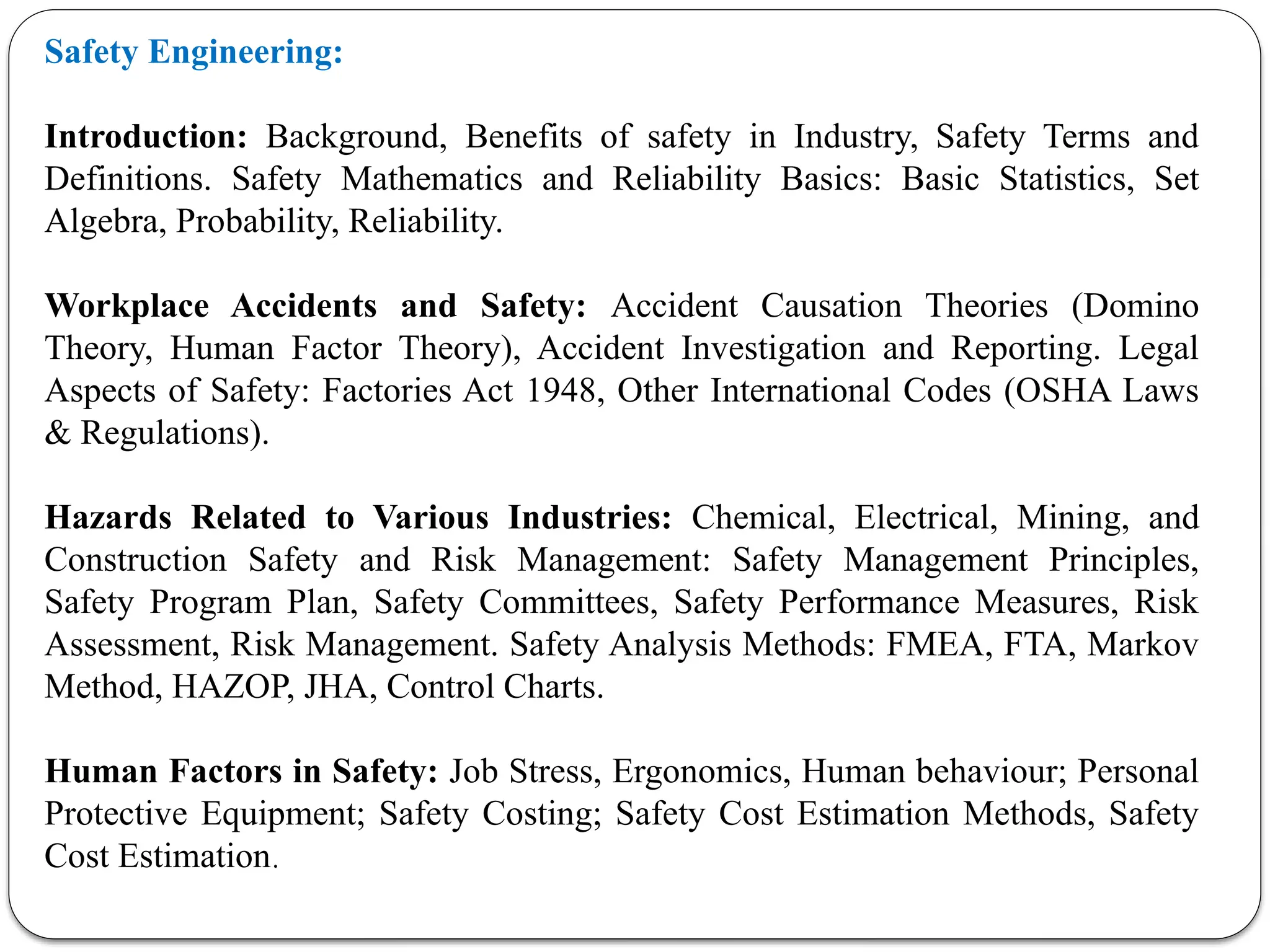
Safety Engineering:
Introduction: Background, Benefits of safety in Industry, Safety Terms and
Definitions. Safety Mathematics and Reliability Basics: Basic Statistics, Set
Algebra, Probability, Reliability.
Workplace Accidents and Safety: Accident Causation Theories (Domino
Theory, Human Factor Theory), Accident Investigation and Reporting. Legal
Aspects of Safety: Factories Act 1948, Other International Codes (OSHA Laws
& Regulations).
Hazards Related to Various Industries: Chemical, Electrical, Mining, and
Construction Safety and Risk Management: Safety Management Principles,
Safety Program Plan, Safety Committees, Safety Performance Measures, Risk
Assessment, Risk Management. Safety Analysis Methods: FMEA, FTA, Markov
Method, HAZOP, JHA, Control Charts.
Human Factors in Safety: Job Stress, Ergonomics, Human behaviour; Personal
Protective Equipment; Safety Costing; Safety Cost Estimation Methods, Safety
Cost Estimation.
Safety is the state of being "safe" (from French sauf),
the condition of being protected from harm or other
non-desirable outcomes.
Safety can also refer to
the control of recognized hazards in order to achieve an
acceptable level of risk.
Safety has been replaced by “loss prevention”.
Safety
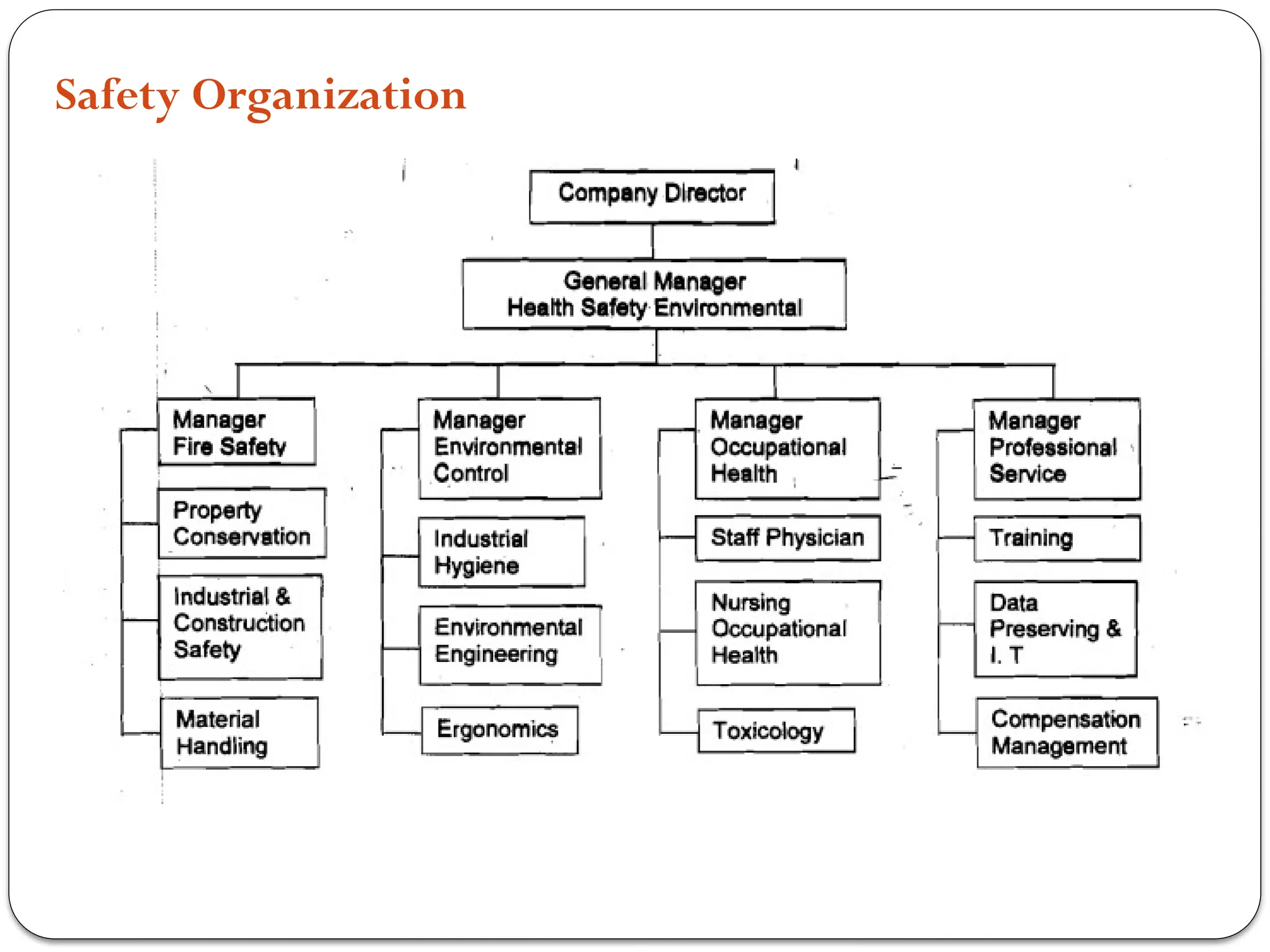
Safety Organization
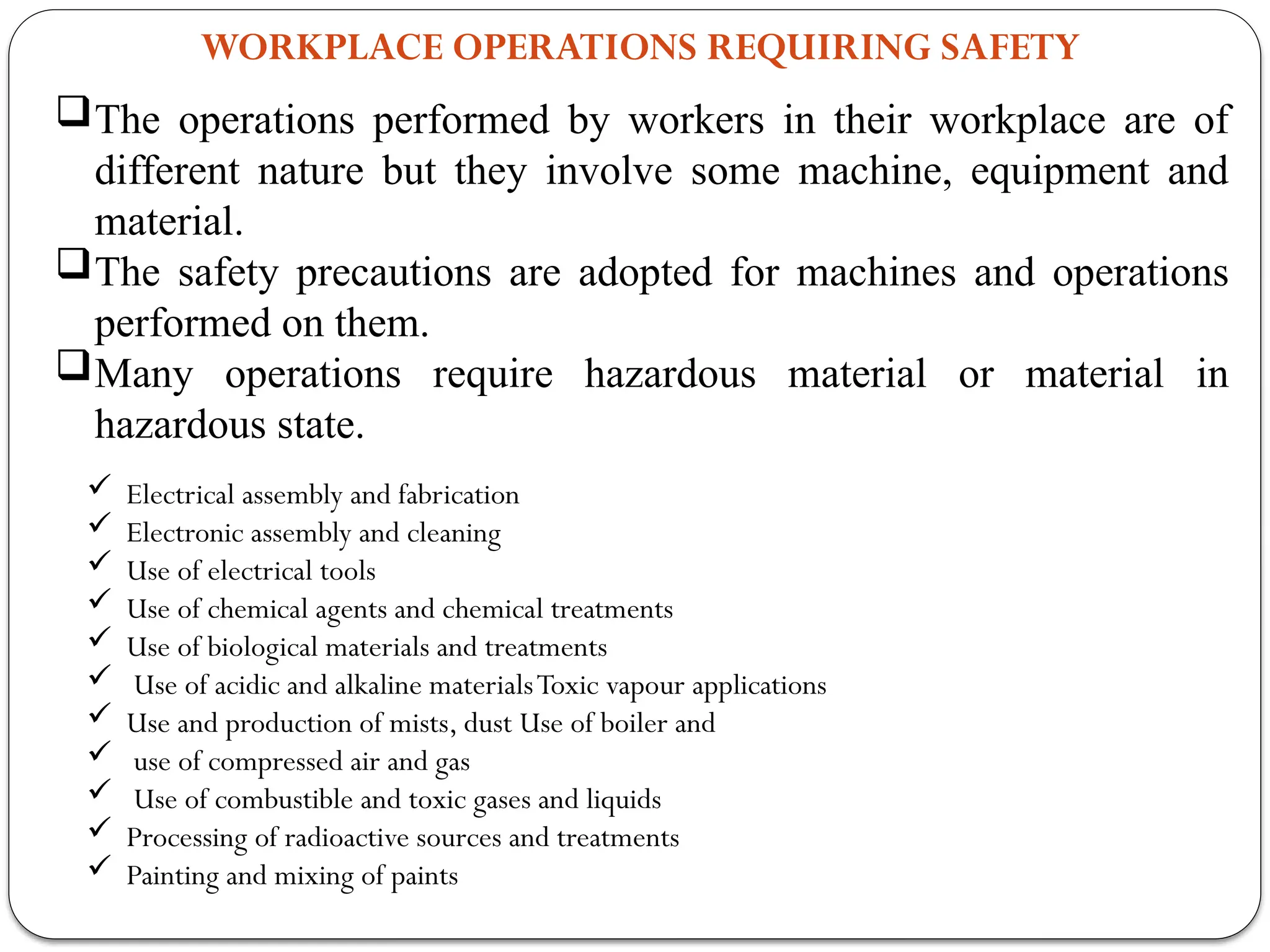
WORKPLACE OPERATIONS REQUIRING SAFETY
The operations performed by workers in their workplace are of
different nature but they involve some machine, equipment and
material.
The safety precautions are adopted for machines and operations
performed on them.
Many operations require hazardous material or material in
hazardous state.
 Electrical assembly and fabrication
 Electronic assembly and cleaning
 Use of electrical tools
 Use of chemical agents and chemical treatments
 Use of biological materials and treatments
 Use of acidic and alkaline materialsToxic vapour applications
 Use and production of mists, dust Use of boiler and
 use of compressed air and gas
 Use of combustible and toxic gases and liquids
 Processing of radioactive sources and treatments
 Painting and mixing of paints
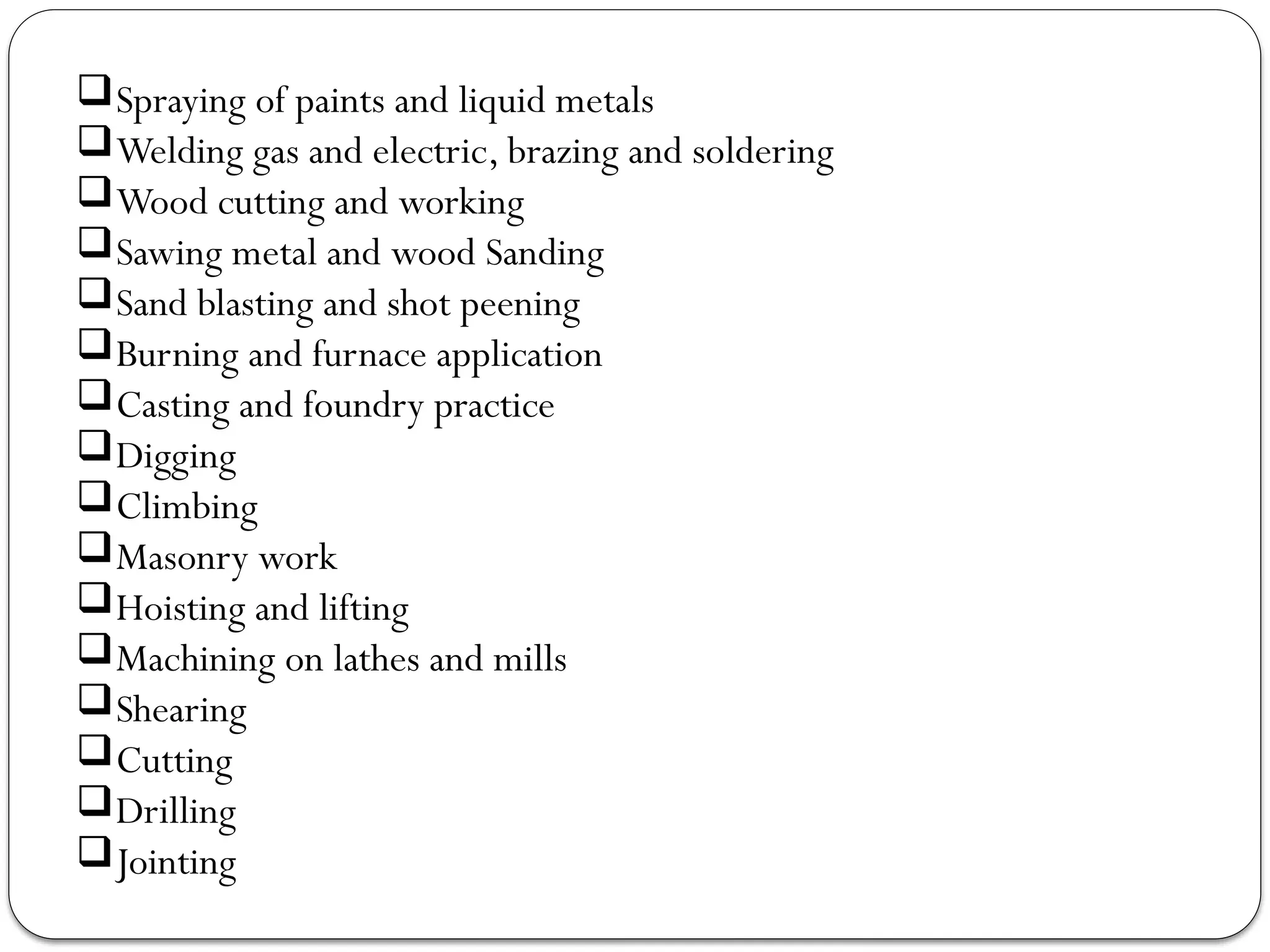
Spraying of paints and liquid metals
Welding gas and electric, brazing and soldering
Wood cutting and working
Sawing metal and wood Sanding
Sand blasting and shot peening
Burning and furnace application
Casting and foundry practice
Digging
Climbing
Masonry work
Hoisting and lifting
Machining on lathes and mills
Shearing
Cutting
Drilling
Jointing
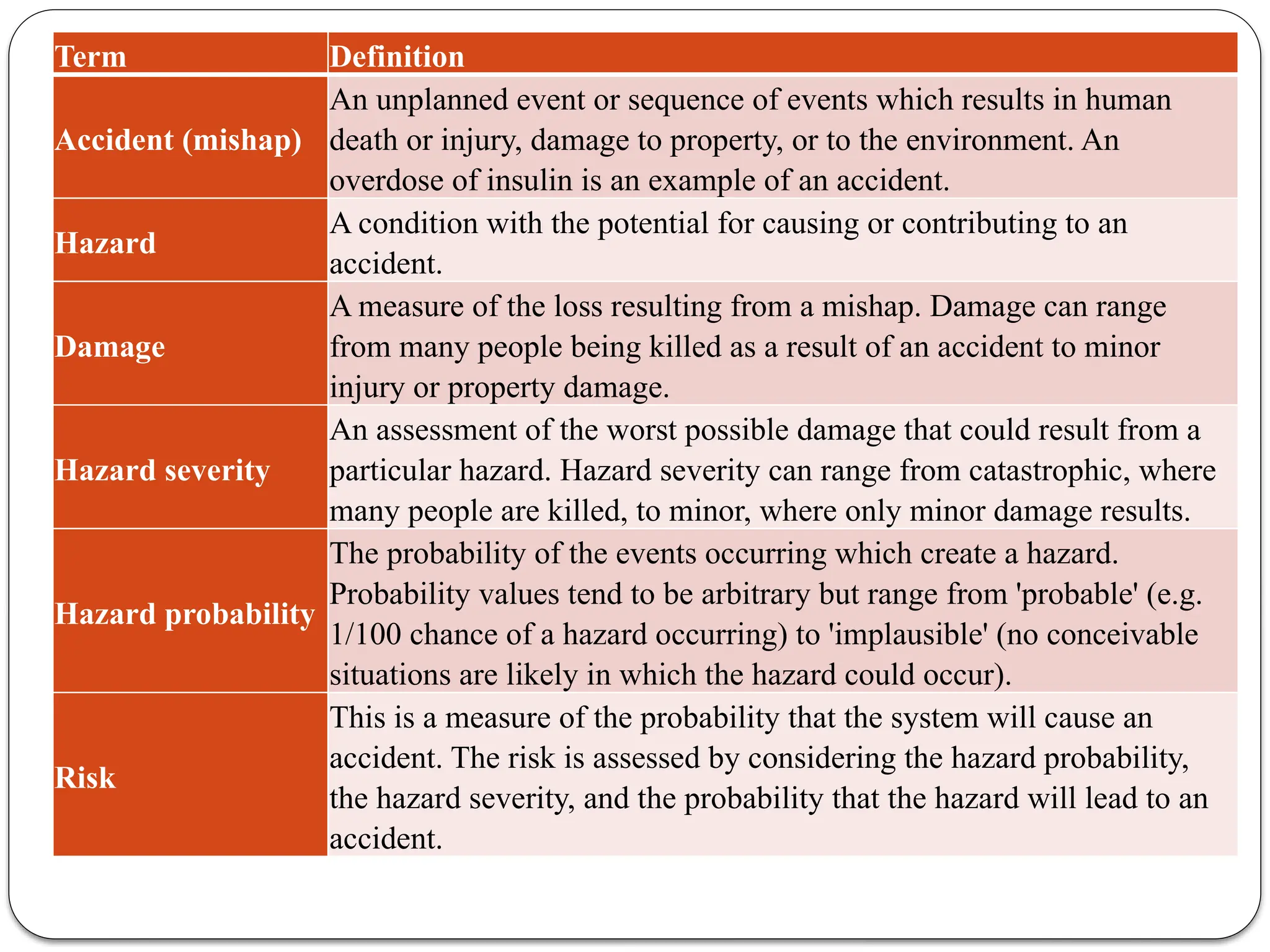
Term Definition
Accident (mishap)
An unplanned event or sequence of events which results in human
death or injury, damage to property, or to the environment. An
overdose of insulin is an example of an accident.
Hazard
A condition with the potential for causing or contributing to an
accident.
Damage
A measure of the loss resulting from a mishap. Damage can range
from many people being killed as a result of an accident to minor
injury or property damage.
Hazard severity
An assessment of the worst possible damage that could result from a
particular hazard. Hazard severity can range from catastrophic, where
many people are killed, to minor, where only minor damage results.
Hazard probability
The probability of the events occurring which create a hazard.
Probability values tend to be arbitrary but range from 'probable' (e.g.
1/100 chance of a hazard occurring) to 'implausible' (no conceivable
situations are likely in which the hazard could occur).
Risk
This is a measure of the probability that the system will cause an
accident. The risk is assessed by considering the hazard probability,
the hazard severity, and the probability that the hazard will lead to an
accident.
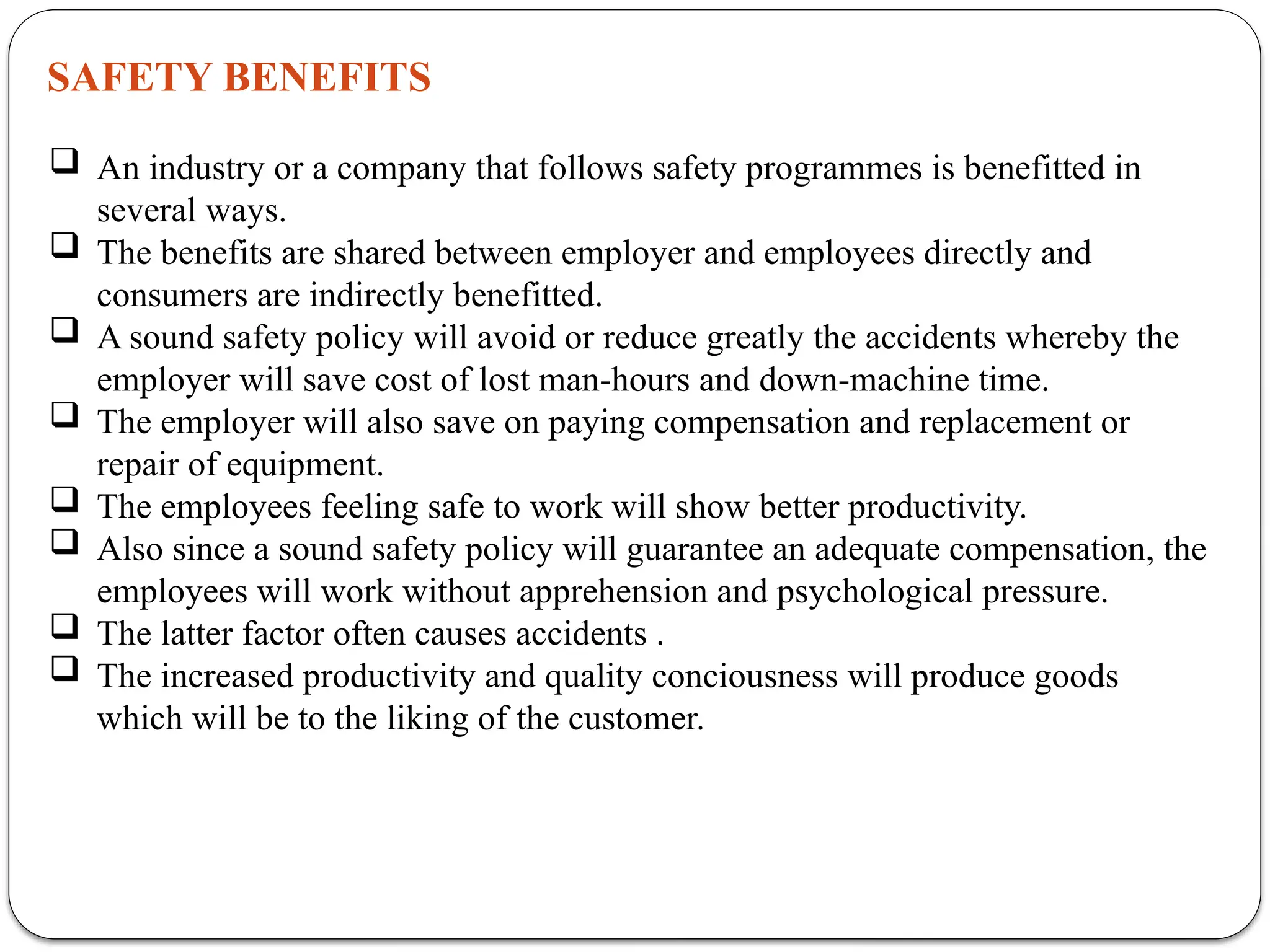
SAFETY BENEFITS
 An industry or a company that follows safety programmes is benefitted in
several ways.
 The benefits are shared between employer and employees directly and
consumers are indirectly benefitted.
 A sound safety policy will avoid or reduce greatly the accidents whereby the
employer will save cost of lost man-hours and down-machine time.
 The employer will also save on paying compensation and replacement or
repair of equipment.
 The employees feeling safe to work will show better productivity.
 Also since a sound safety policy will guarantee an adequate compensation, the
employees will work without apprehension and psychological pressure.
 The latter factor often causes accidents .
 The increased productivity and quality conciousness will produce goods
which will be to the liking of the customer.
 Safety, hazard, and risk are frequently used terms in chemical
process safety.
 Safety or loss prevention: the prevention of accidents through
the use of appropriate technologies to identify the hazards of a
chemical plant and eliminate them before an accident occurs.
 Hazard: a chemical or physical condition that has the potential
to cause damage to people, property, or the environment.
 Risk: a measure of human injury, environmental damage, or
economic loss in terms of both the incident likelihood and the
magnitude of the loss or injury
Safety, hazard, and risk
HAZARD
 A hazard is a situation that poses a level of threat to life, health, property, or
environment.
 These hazards are also very dangerous for human and animal life.
 A hazardous situation that has come to pass is called an incident.
 Hazard and possibility interact together to create risk.
 Identification of hazard risks is the first step in performing a risk assessment.
Hazards are sometimes classified into three mode.
 Dormant—The situation environment is currently affected. For instance, a
hillside may be unstable, with the potential for a landslide, but there is nothing
below or on the hillside that could be affected.
 Armed—People, property, or environment are in potential harm's way.
 Active—A harmful incident involving the hazard has actually occurred. Often
this is referred to not as an "active hazard" but as an accident, emergency,
incident, or disaster.
Hazard-Risk-Accident
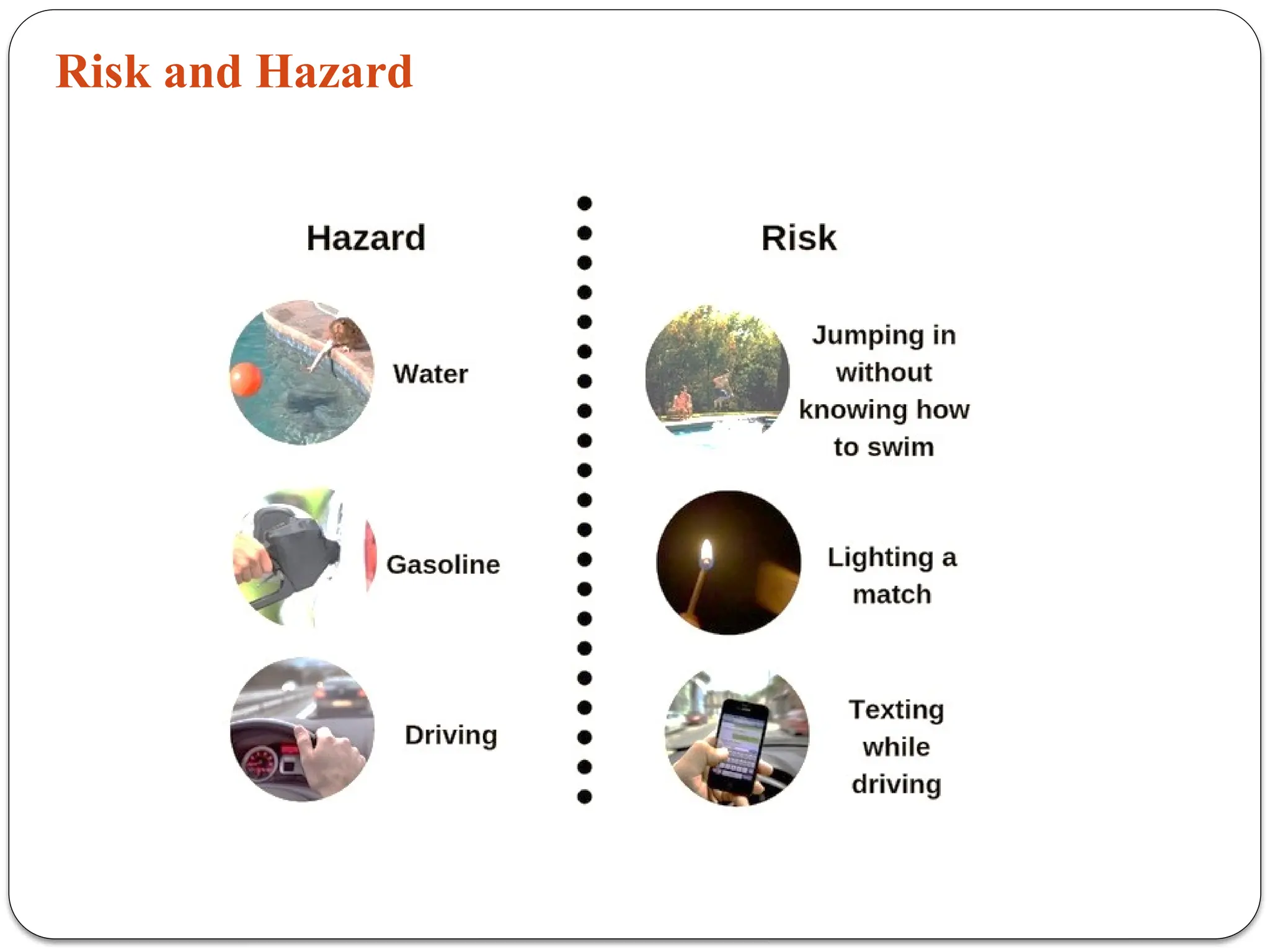
Hazard: Hazard is anything, situation or condition which has the
potential to cause harm to people, equipment and environment.
Risk: Risk is the probability/likelihood that an incident will
occur and the severity of the outcome. Risk is graded into low,
medium and high.
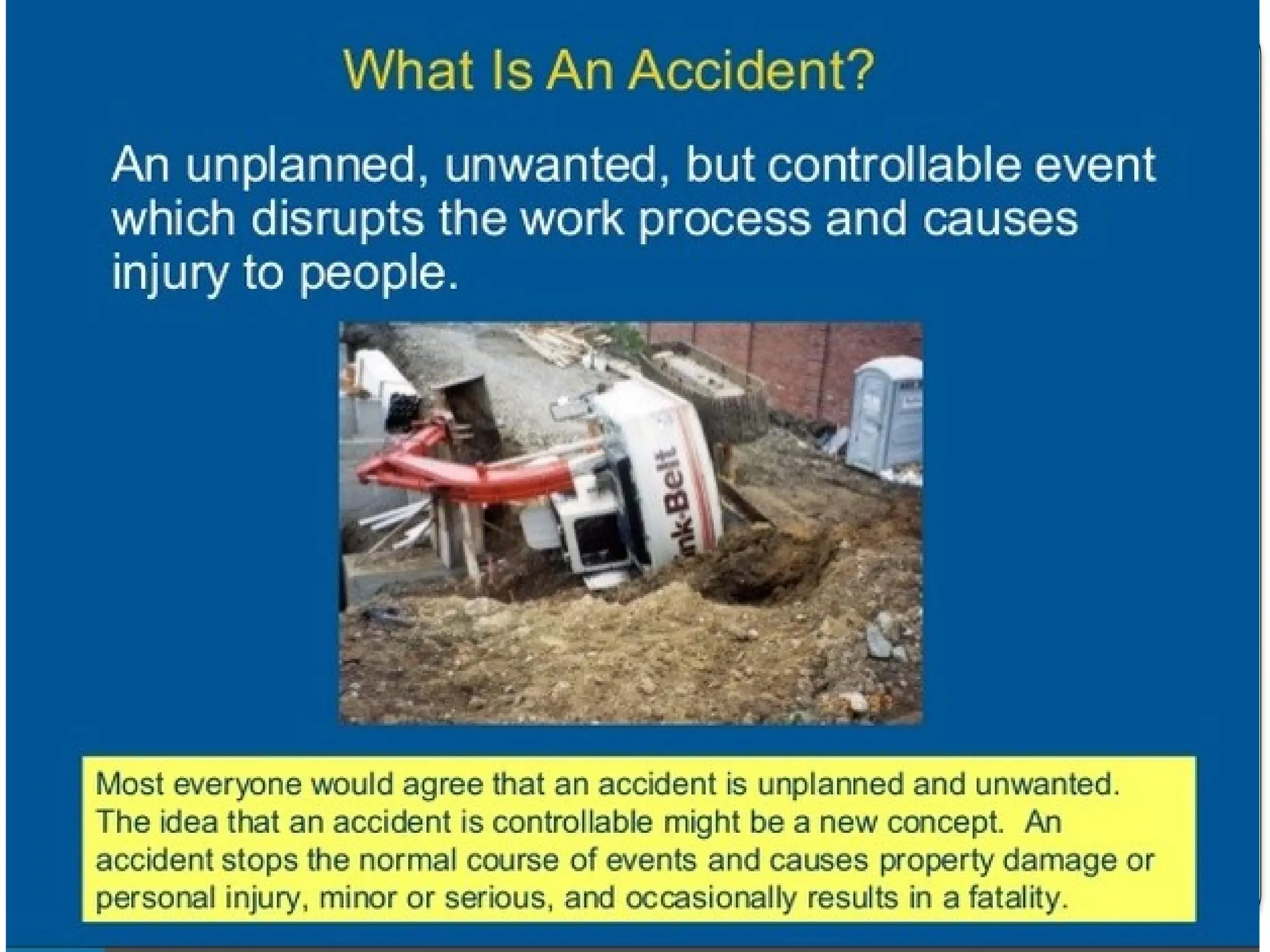
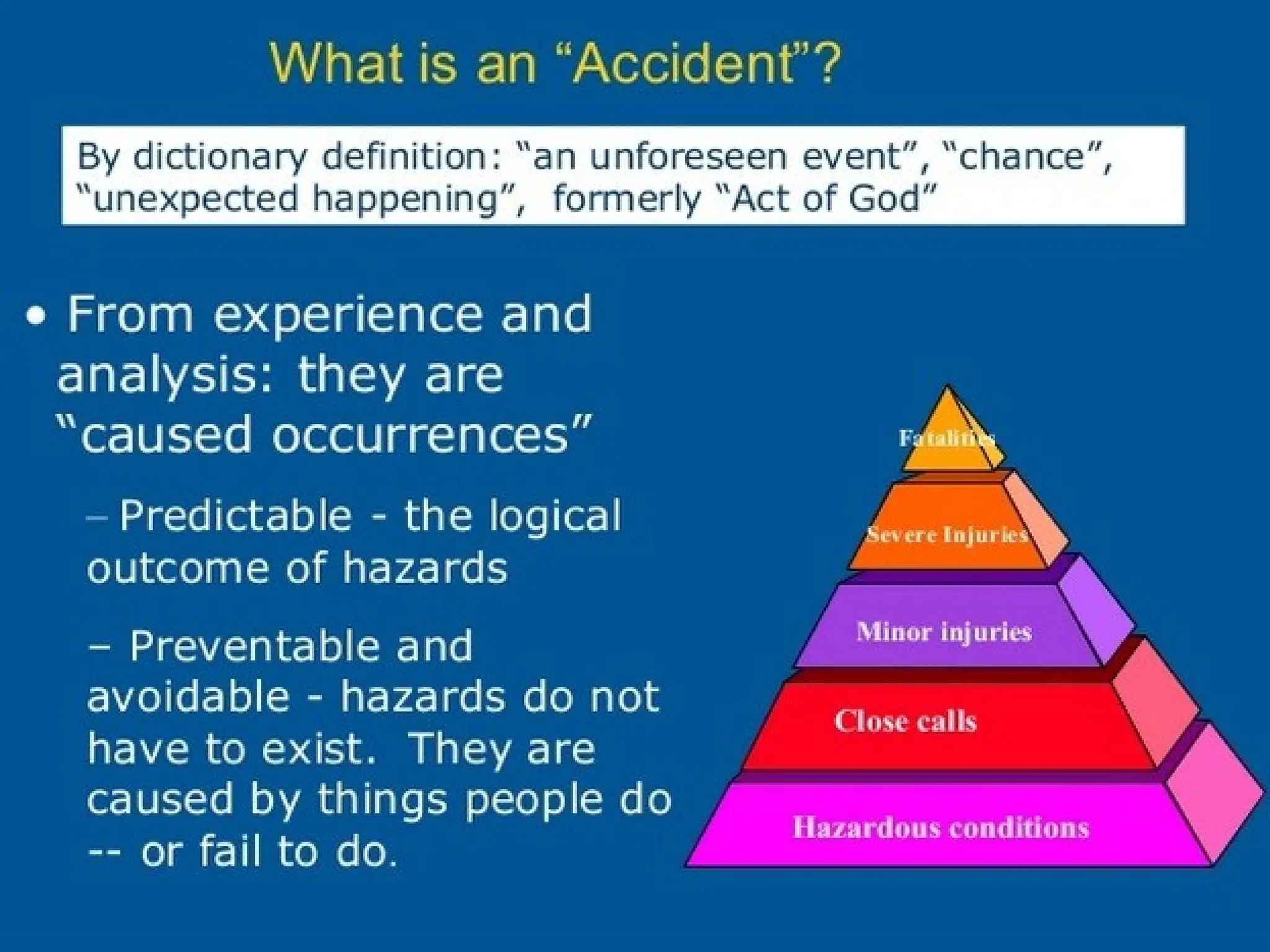
Accident: Accident is an unexpected and unwanted occurrence
which could result to injury to persons, damage to equipment,
materials or environment.
Risk and Hazard
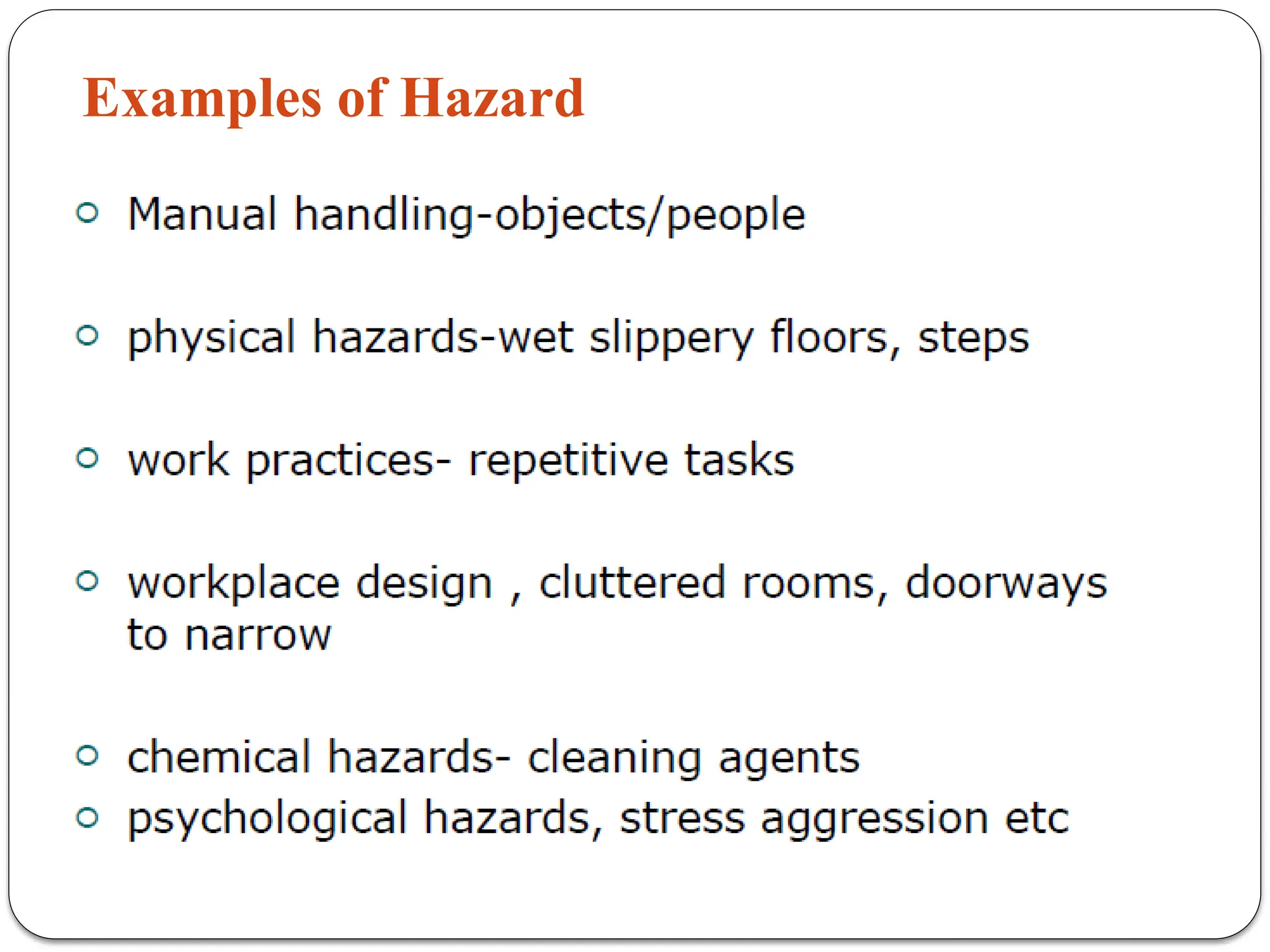
Examples of Hazard
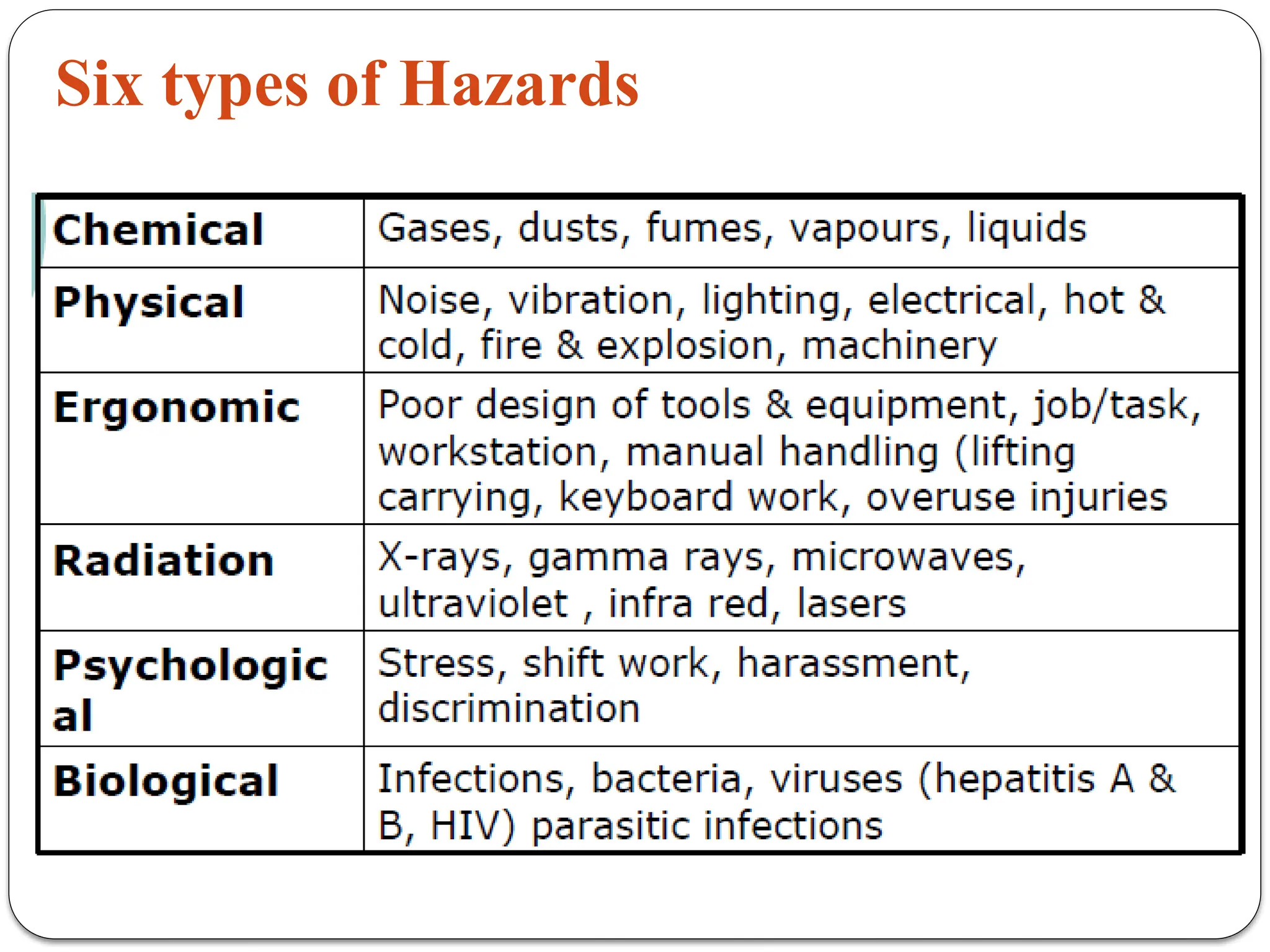
Six types of Hazards
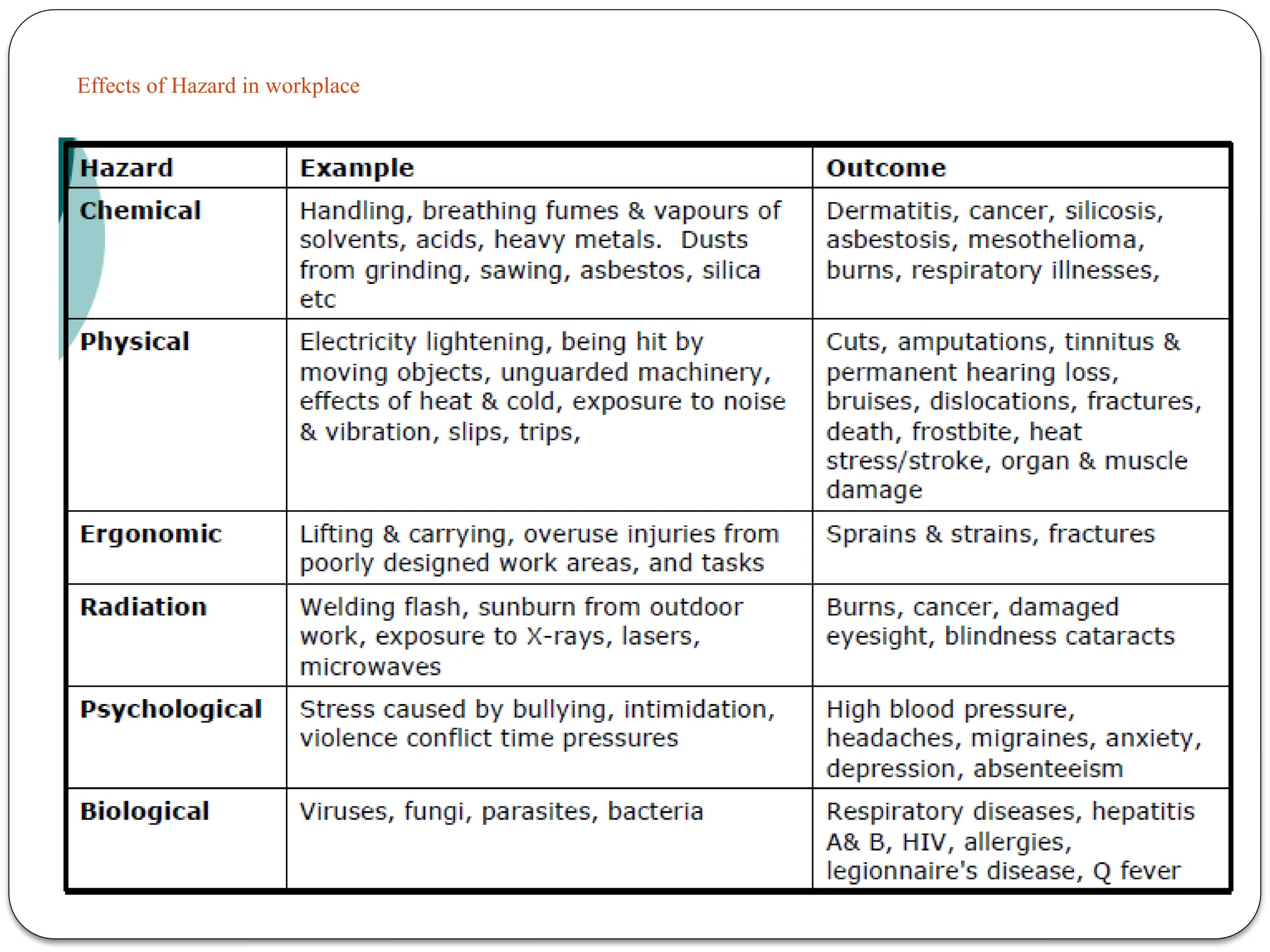
Effects of Hazard in workplace
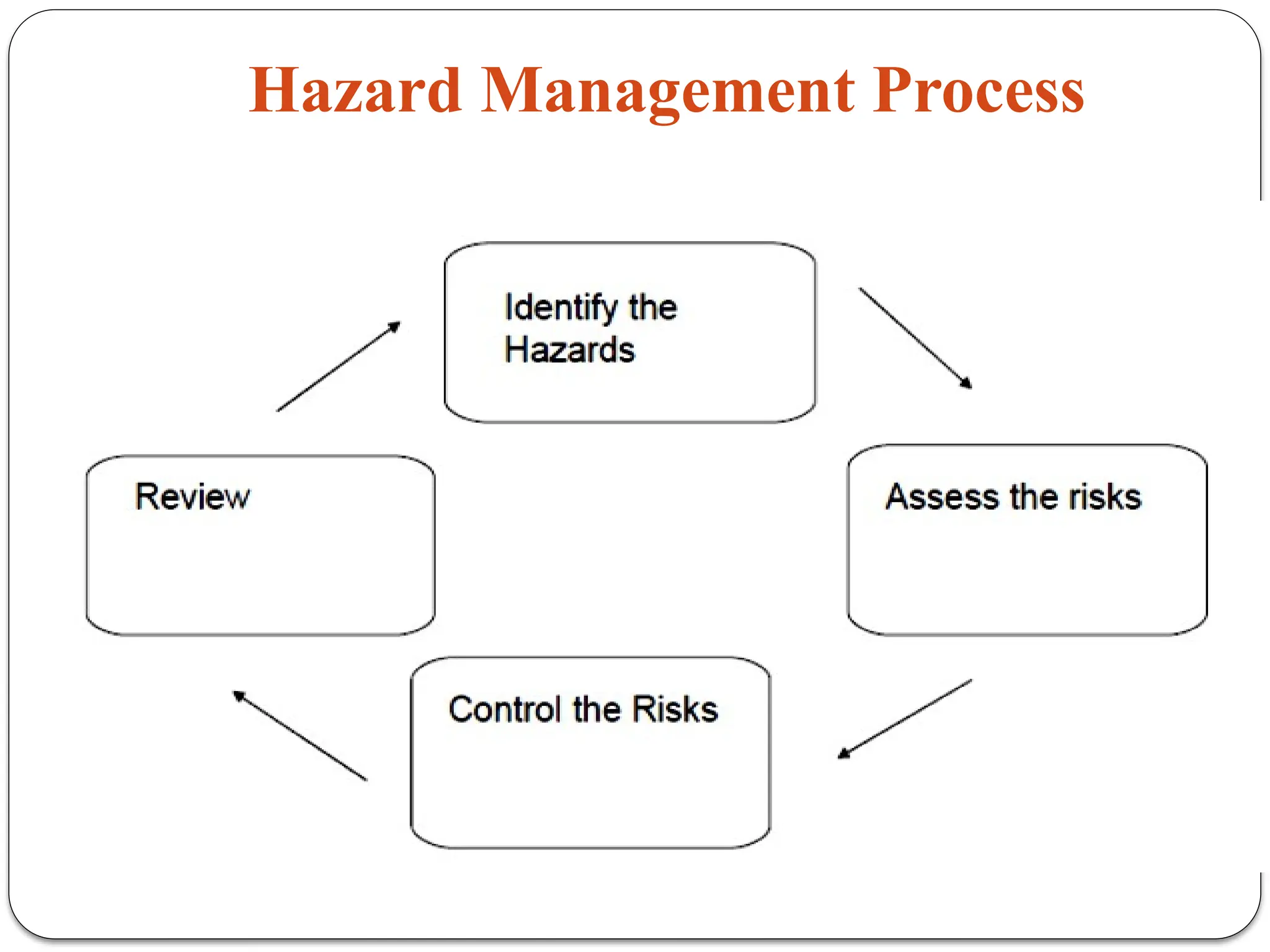
Hazard Management Process
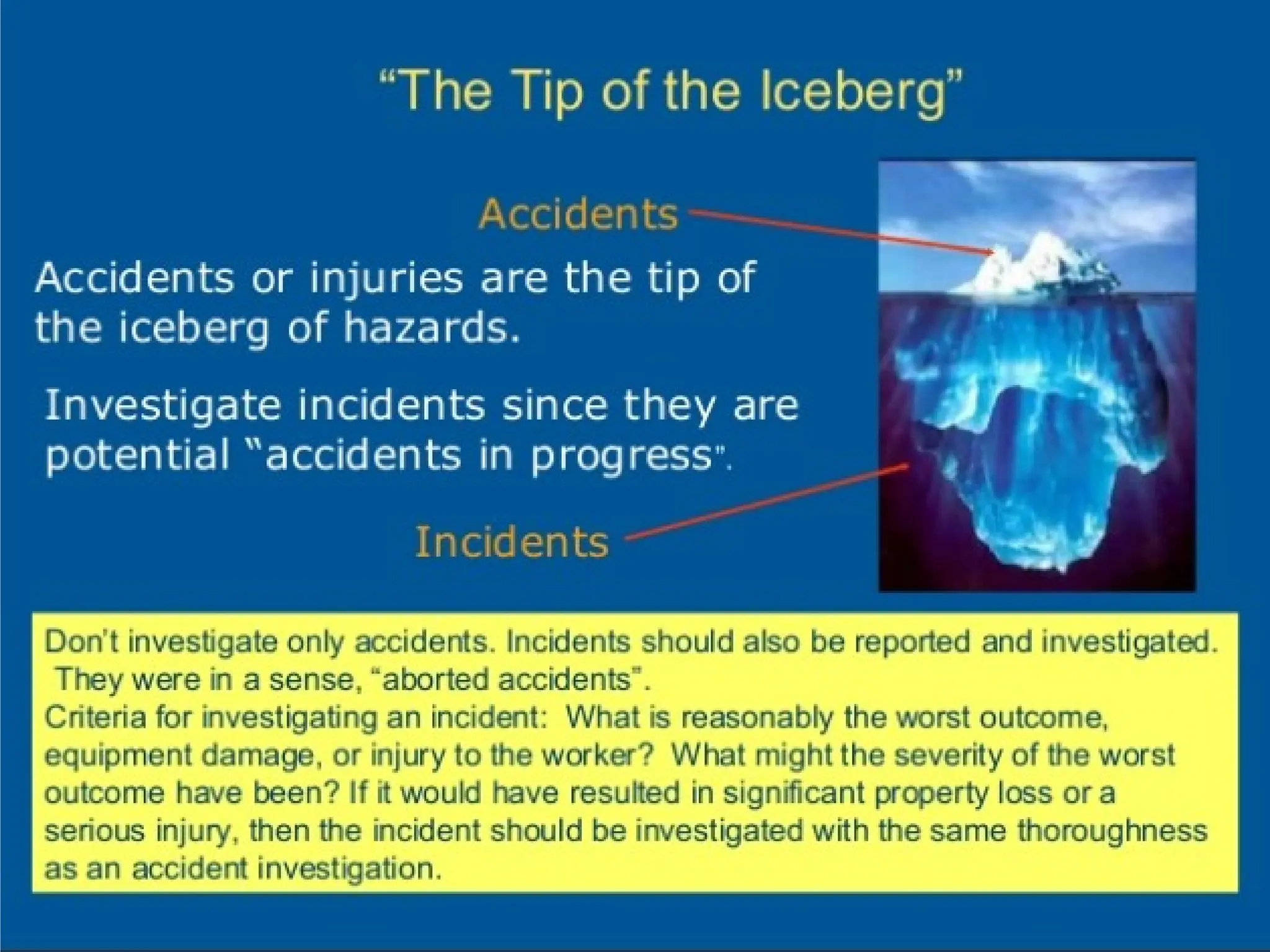
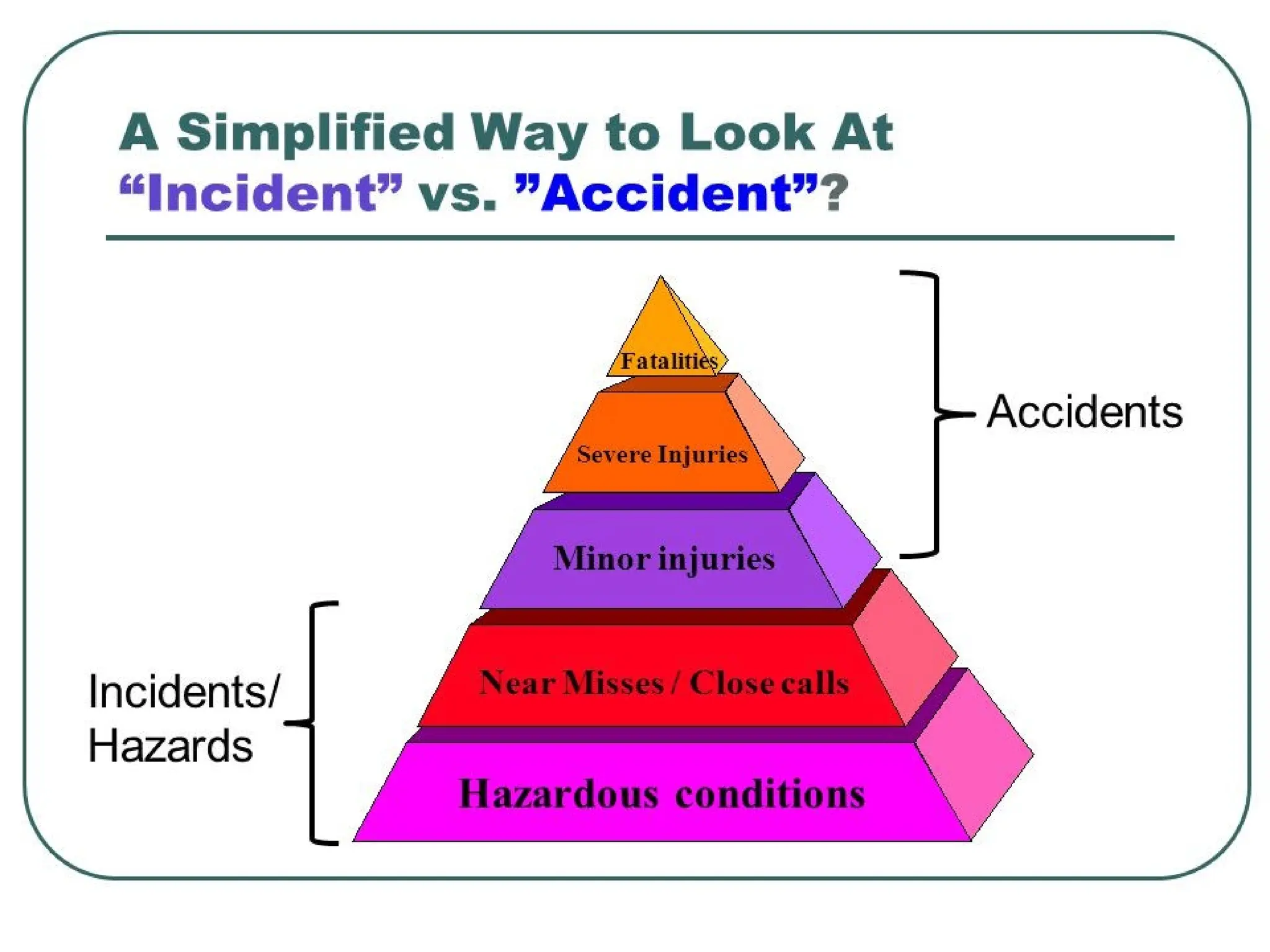
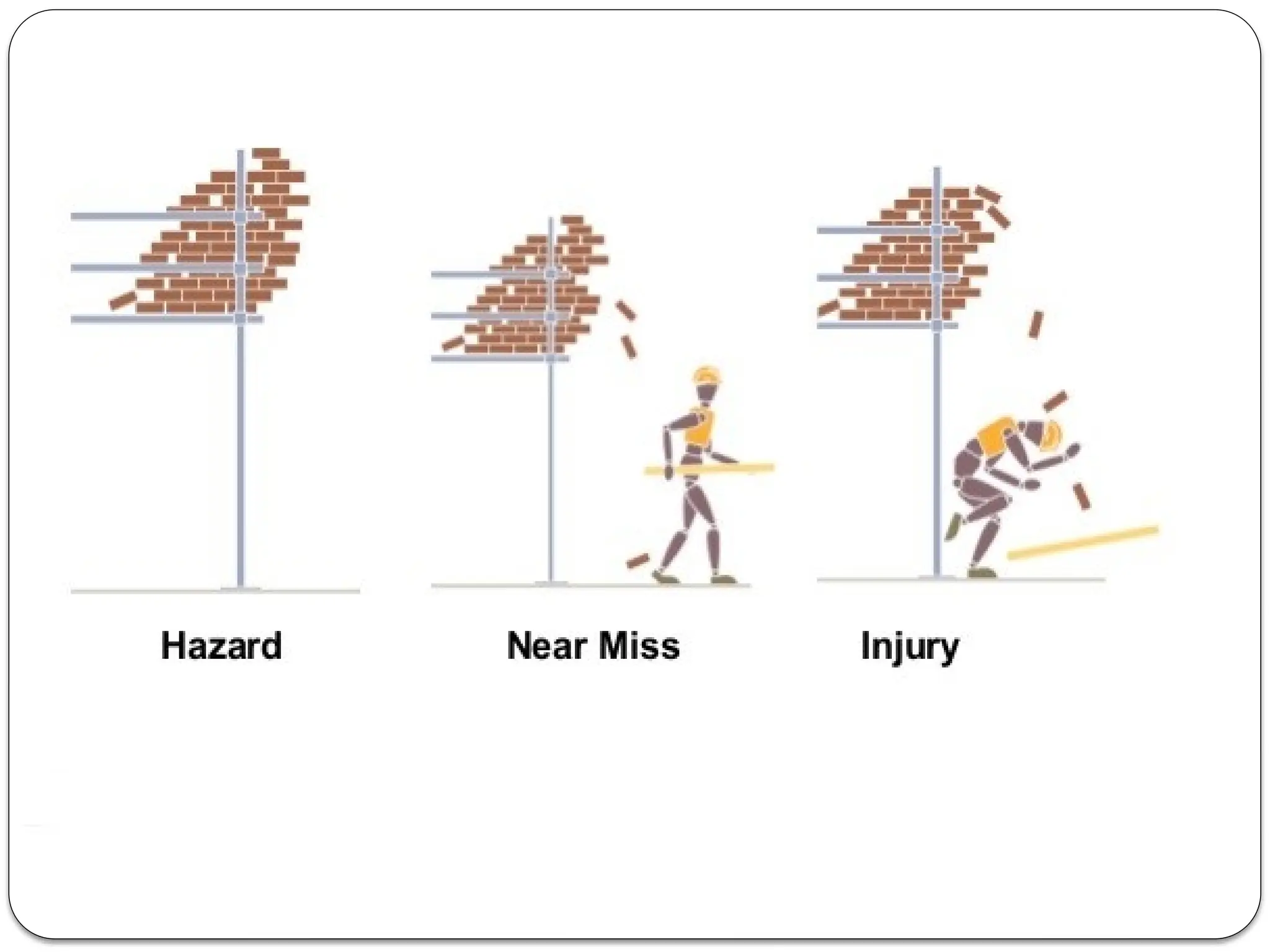
Incidents and Accidents
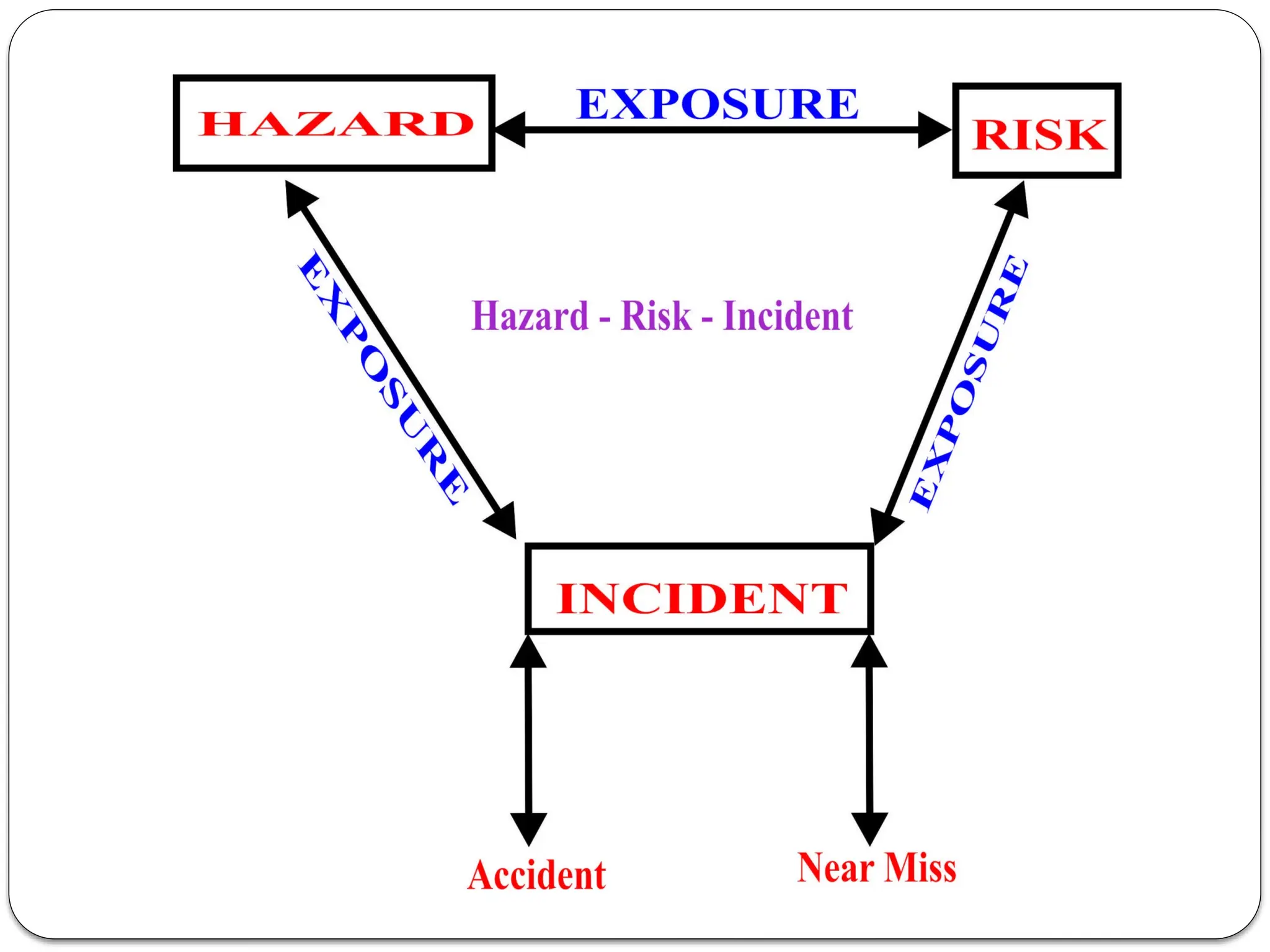
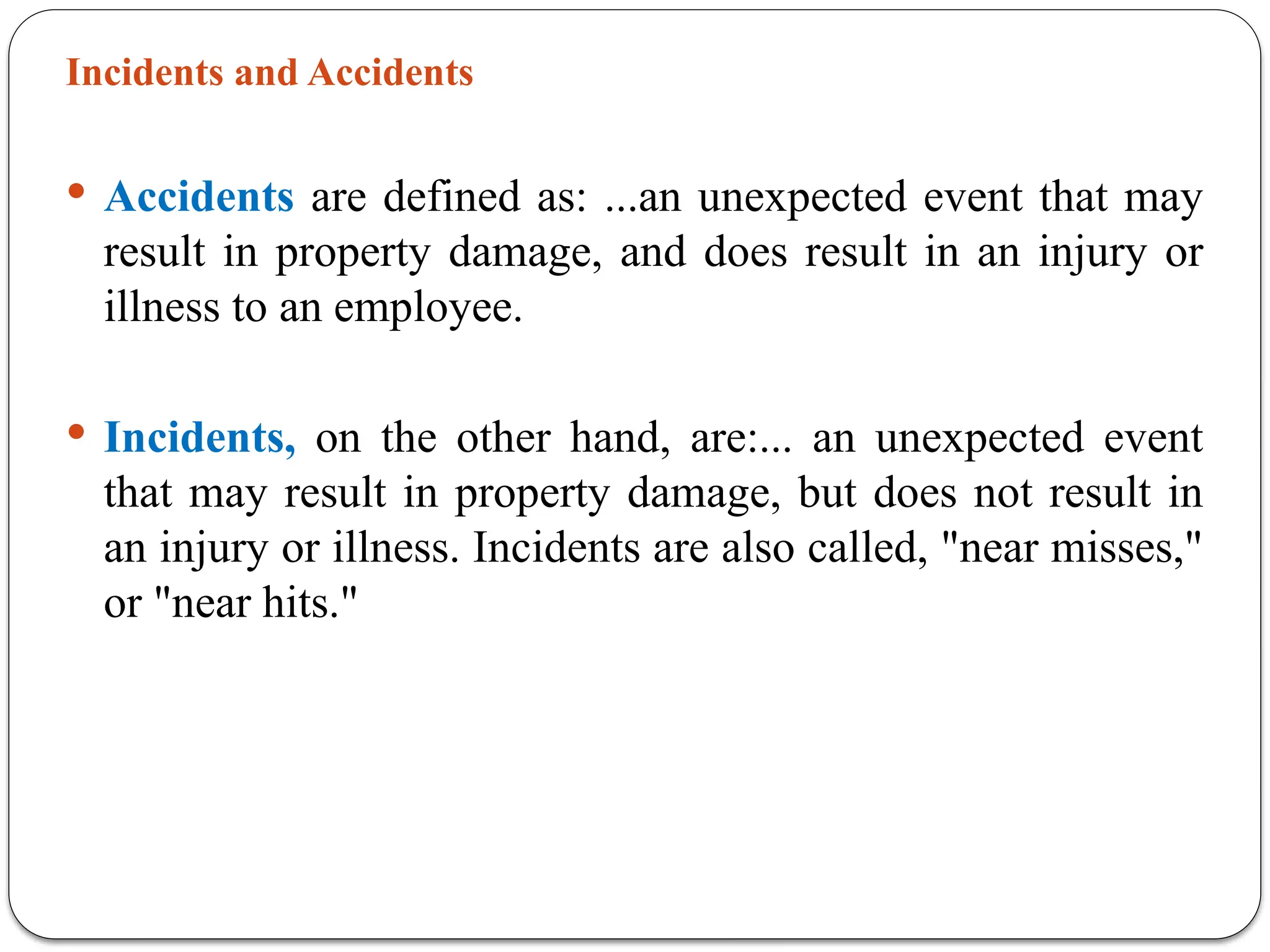
 Accidents are defined as: ...an unexpected event that may
result in property damage, and does result in an injury or
illness to an employee.
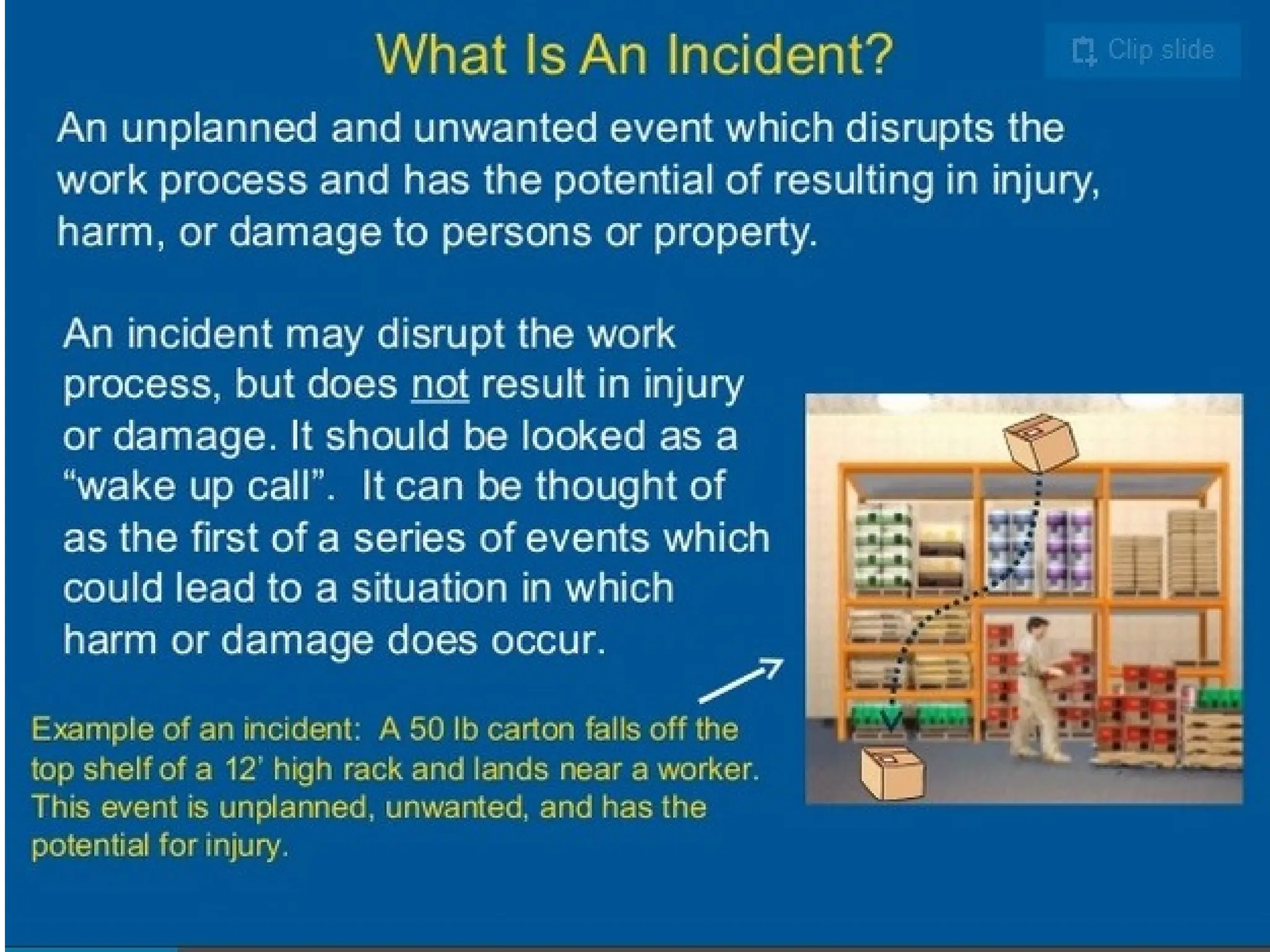
 Incidents, on the other hand, are:... an unexpected event
that may result in property damage, but does not result in
an injury or illness. Incidents are also called, "near misses,"
or "near hits."
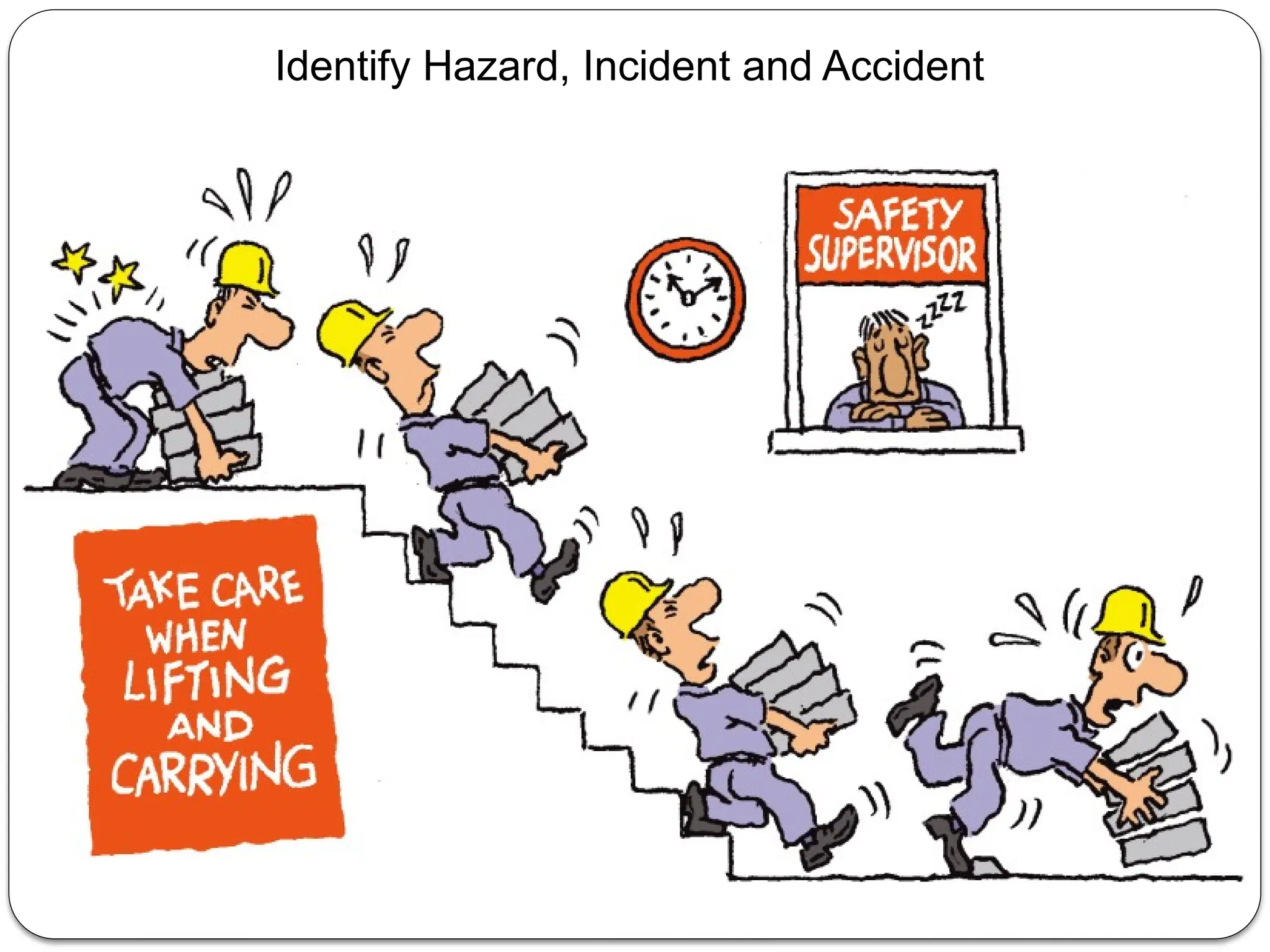
Identify Hazard, Incident and Accident
Examples- Incidents but not Accidents
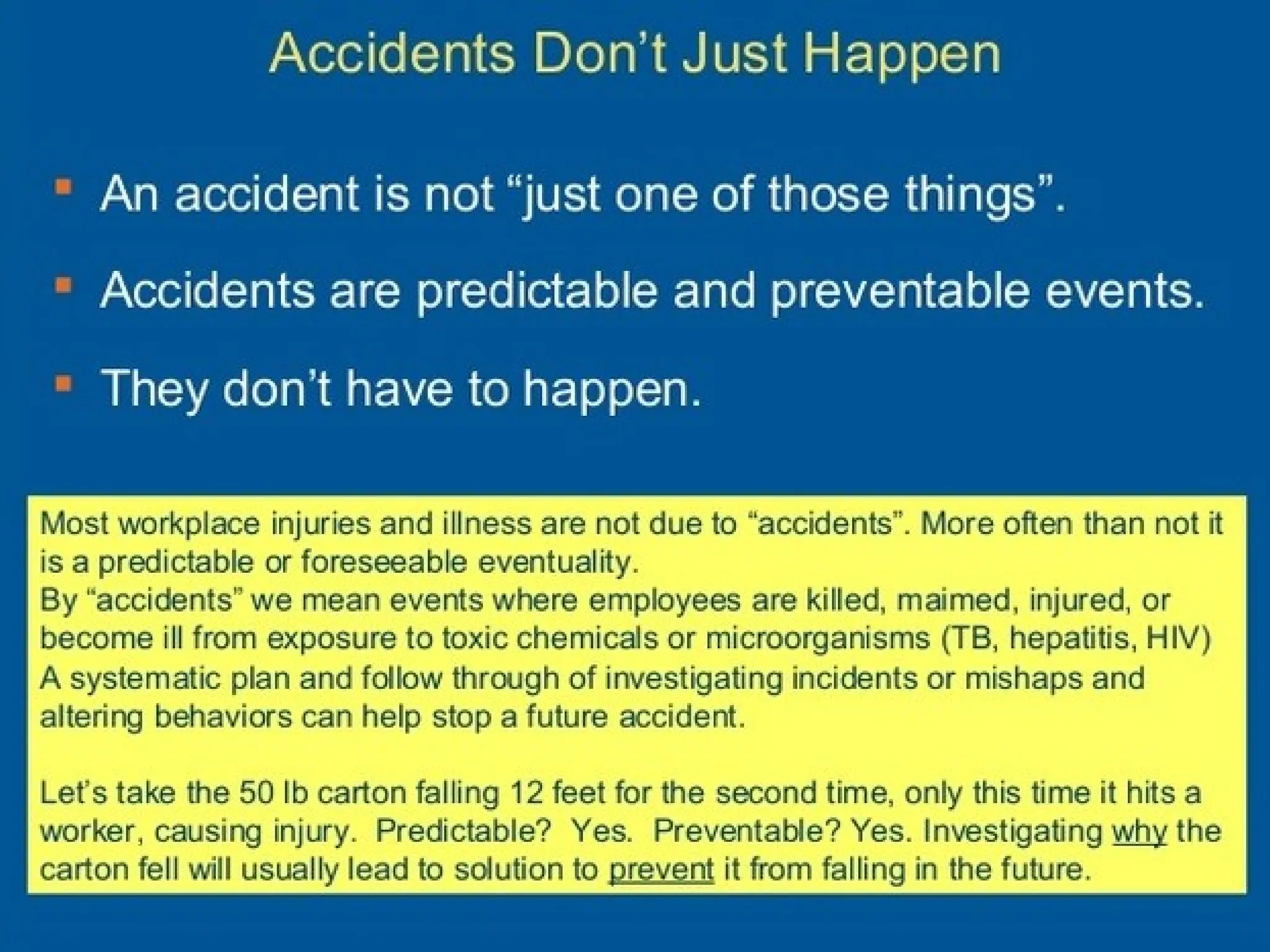
1. Incident: a 50 kg carton falls off the top shelf of a 12 ft
high rack and lands near the worker. The event is
unplanned, unwanted, and has the potential to cause
damage to the floor or injury to the worker.
2. Let’s say you bump into another car but it leaves no
damage whatsoever. That is not an accident. This is an
incident.
3. If three people were arrested after fighting in a bar, that
is an incident (but not an accident – because the fight
was not by chance; they intended to fight).
Examples- Accidents are also incidents
1. If a drunk driver runs his car into a group of people, that is
an accident (he did not intend to do it; it was caused by
alcohol and chance).
2. It could also be described as an incident (“The incident
occurred on Main Street at around 2:30 AM”).
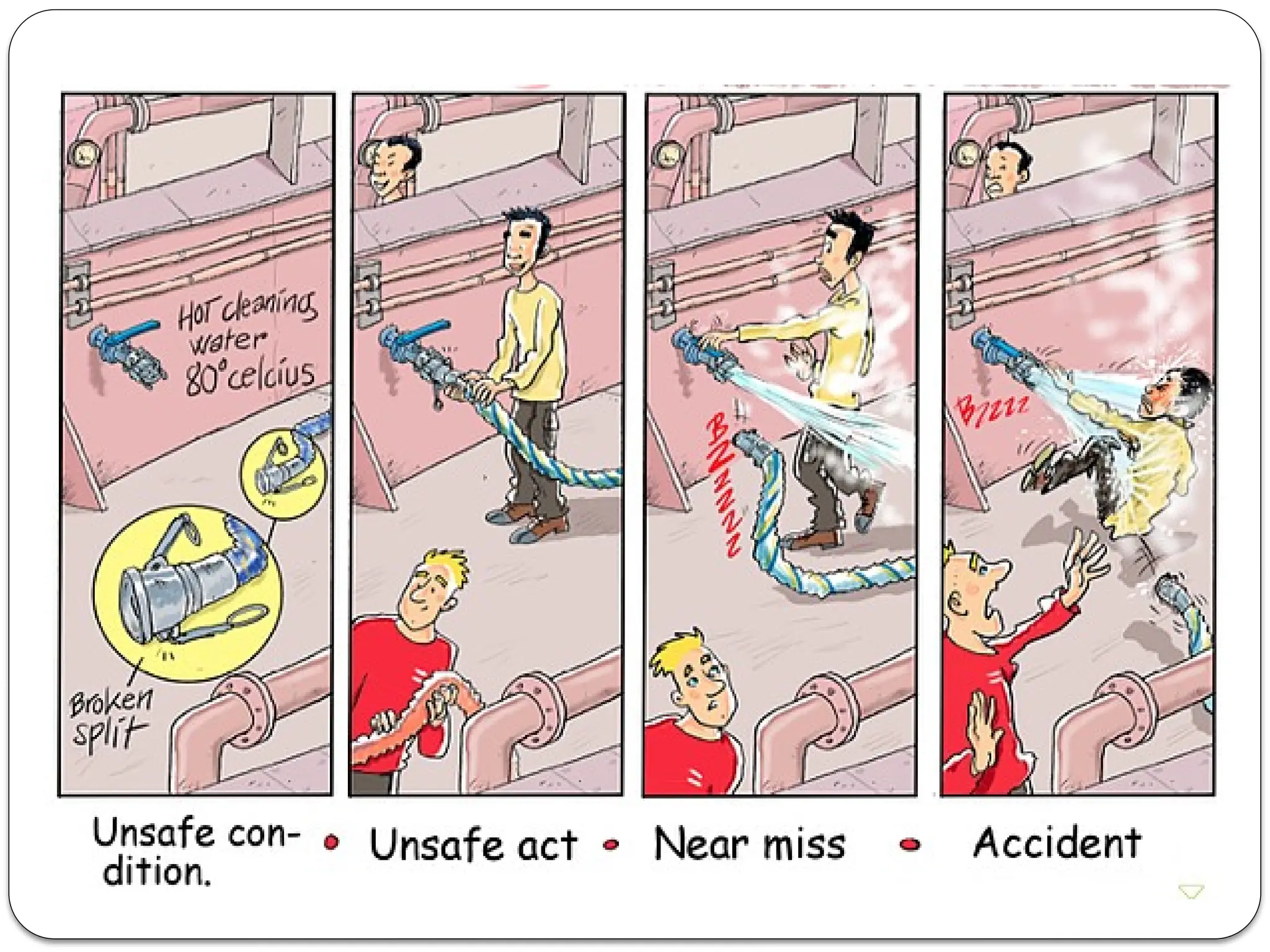
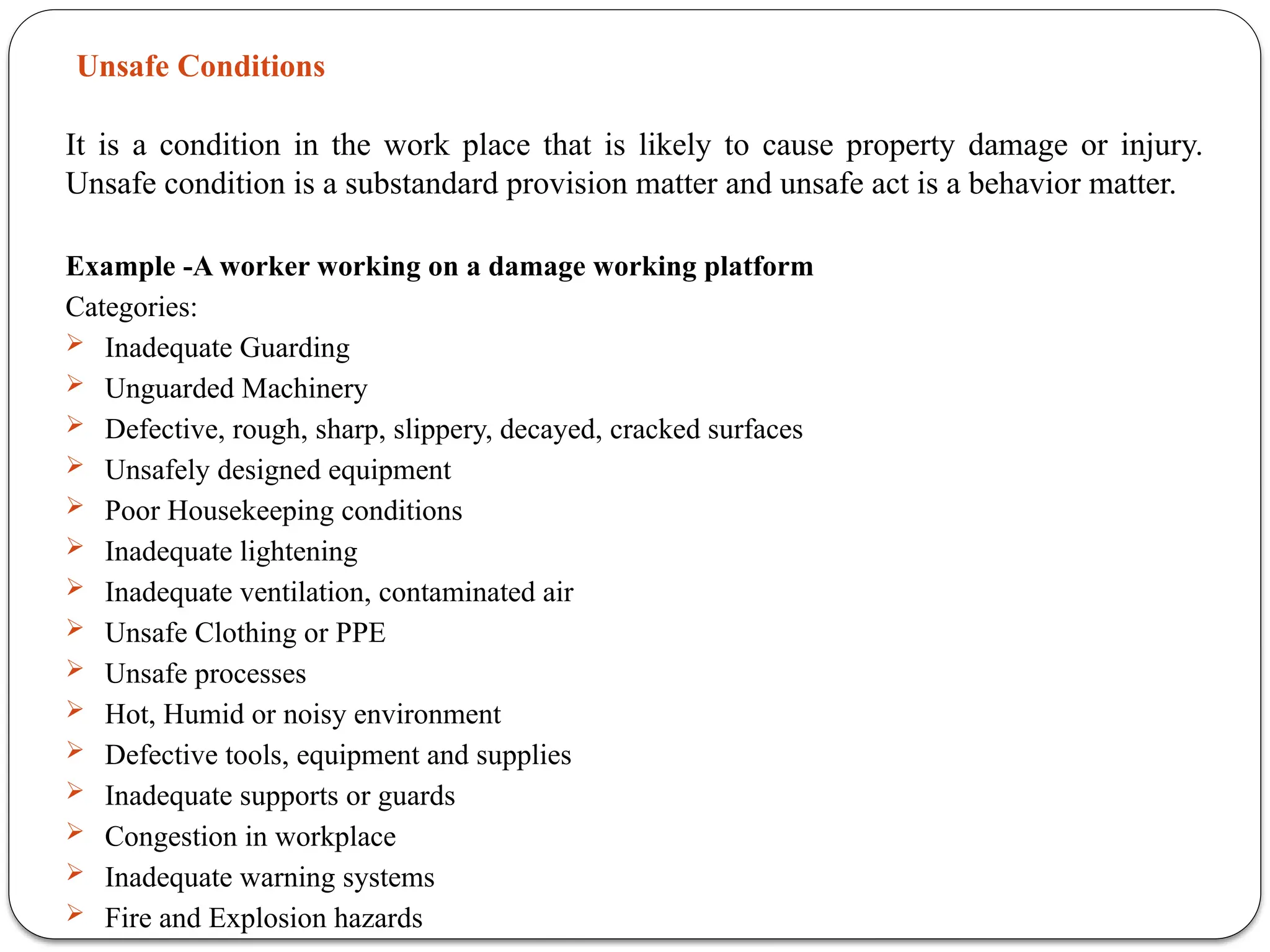
Unsafe Conditions
It is a condition in the work place that is likely to cause property damage or injury.
Unsafe condition is a substandard provision matter and unsafe act is a behavior matter.
Example -A worker working on a damage working platform
Categories:
 Inadequate Guarding
 Unguarded Machinery
 Defective, rough, sharp, slippery, decayed, cracked surfaces
 Unsafely designed equipment
 Poor Housekeeping conditions
 Inadequate lightening
 Inadequate ventilation, contaminated air
 Unsafe Clothing or PPE
 Unsafe processes
 Hot, Humid or noisy environment
 Defective tools, equipment and supplies
 Inadequate supports or guards
 Congestion in workplace
 Inadequate warning systems
 Fire and Explosion hazards
Unsafe Acts
 It is something that someone does that results in or could result in an accident
 It can be active or passive.
Example -A worker deliberately remove machine guard
Categories:
o Operating Without Clearance, Qualification or authorization
o Operating at unsafe speed
o Failure to warn (sign, signals, tags etc.)
o Bypass or removal of safety devices
o Using unsafe equipment or using it unsafely
o Unsafe methods (loading, carrying, mixing)
o Adopting unsafe position or posture
o Working on moving or dangerous equipment
o Horseplay (distracting, teasing, starling)
Safety achievement strategies
 Hazard avoidance
 The system is designed so that some classes of hazard simply cannot arise.
 Hazard detection and removal
 The system is designed so that hazards are detected and removed before they
result in an accident.
 Damage limitation
 The system includes protection features that minimize the damage that may
result from an accident.
 Accidents in complex systems rarely have a single cause as these systems
are designed to be resilient to a single point of failure.
 Almost all accidents are a result of combinations of malfunctions rather than
single failures.
 It is probably the case that anticipating all problem combinations, especially,
in software controlled systems is impossible so achieving complete safety is
impossible.
 However, accidents are inevitable.
Accident and Loss Statistics
 Accident and loss statistics are important measures of the effectiveness of
safety programs.
 These statistics are valuable for determining whether a process is safe or
whether a safety procedure is working effectively.
 Many statistical methods are available to characterize accident and loss
performance.
 These statistics must be used carefully. Like most statistics they are only
averages and do not reflect the potential for single episodes involving
substantial losses.
 Unfortunately, no single method is capable of measuring all required aspects.
 The three systems considered here are
• OSHA incidence rate,
• Fatal accident rate (FAR), and
• Fatality rate, or deaths per person per year
All three methods report the number of accidents and/or fatalities for a fixed
number of workers during a specified period.
OSHA stands for the Occupational Safety and Health Administration of the
United States
Thank you

Lecture-16-Safety Engineering.pptxJOIOPIHPON;NPIH[I[OINN

  • 1.
    Safety Engineering CE1400 ENVIRONMENT ANDSAFETY ENGINEERING Lecture 16 Dr. Soukat Das Assistant Professor Department of Civil Engineering National Institute of Technology Rourkela
  • 2.
    Safety Engineering: Introduction: Background,Benefits of safety in Industry, Safety Terms and Definitions. Safety Mathematics and Reliability Basics: Basic Statistics, Set Algebra, Probability, Reliability. Workplace Accidents and Safety: Accident Causation Theories (Domino Theory, Human Factor Theory), Accident Investigation and Reporting. Legal Aspects of Safety: Factories Act 1948, Other International Codes (OSHA Laws & Regulations). Hazards Related to Various Industries: Chemical, Electrical, Mining, and Construction Safety and Risk Management: Safety Management Principles, Safety Program Plan, Safety Committees, Safety Performance Measures, Risk Assessment, Risk Management. Safety Analysis Methods: FMEA, FTA, Markov Method, HAZOP, JHA, Control Charts. Human Factors in Safety: Job Stress, Ergonomics, Human behaviour; Personal Protective Equipment; Safety Costing; Safety Cost Estimation Methods, Safety Cost Estimation.
  • 3.
    Safety is thestate of being "safe" (from French sauf), the condition of being protected from harm or other non-desirable outcomes. Safety can also refer to the control of recognized hazards in order to achieve an acceptable level of risk. Safety has been replaced by “loss prevention”. Safety
  • 4.
  • 5.
    WORKPLACE OPERATIONS REQUIRINGSAFETY The operations performed by workers in their workplace are of different nature but they involve some machine, equipment and material. The safety precautions are adopted for machines and operations performed on them. Many operations require hazardous material or material in hazardous state.  Electrical assembly and fabrication  Electronic assembly and cleaning  Use of electrical tools  Use of chemical agents and chemical treatments  Use of biological materials and treatments  Use of acidic and alkaline materialsToxic vapour applications  Use and production of mists, dust Use of boiler and  use of compressed air and gas  Use of combustible and toxic gases and liquids  Processing of radioactive sources and treatments  Painting and mixing of paints
  • 6.
    Spraying of paintsand liquid metals Welding gas and electric, brazing and soldering Wood cutting and working Sawing metal and wood Sanding Sand blasting and shot peening Burning and furnace application Casting and foundry practice Digging Climbing Masonry work Hoisting and lifting Machining on lathes and mills Shearing Cutting Drilling Jointing
  • 7.
    Term Definition Accident (mishap) Anunplanned event or sequence of events which results in human death or injury, damage to property, or to the environment. An overdose of insulin is an example of an accident. Hazard A condition with the potential for causing or contributing to an accident. Damage A measure of the loss resulting from a mishap. Damage can range from many people being killed as a result of an accident to minor injury or property damage. Hazard severity An assessment of the worst possible damage that could result from a particular hazard. Hazard severity can range from catastrophic, where many people are killed, to minor, where only minor damage results. Hazard probability The probability of the events occurring which create a hazard. Probability values tend to be arbitrary but range from 'probable' (e.g. 1/100 chance of a hazard occurring) to 'implausible' (no conceivable situations are likely in which the hazard could occur). Risk This is a measure of the probability that the system will cause an accident. The risk is assessed by considering the hazard probability, the hazard severity, and the probability that the hazard will lead to an accident.
  • 8.
    SAFETY BENEFITS  Anindustry or a company that follows safety programmes is benefitted in several ways.  The benefits are shared between employer and employees directly and consumers are indirectly benefitted.  A sound safety policy will avoid or reduce greatly the accidents whereby the employer will save cost of lost man-hours and down-machine time.  The employer will also save on paying compensation and replacement or repair of equipment.  The employees feeling safe to work will show better productivity.  Also since a sound safety policy will guarantee an adequate compensation, the employees will work without apprehension and psychological pressure.  The latter factor often causes accidents .  The increased productivity and quality conciousness will produce goods which will be to the liking of the customer.
  • 9.
     Safety, hazard,and risk are frequently used terms in chemical process safety.  Safety or loss prevention: the prevention of accidents through the use of appropriate technologies to identify the hazards of a chemical plant and eliminate them before an accident occurs.  Hazard: a chemical or physical condition that has the potential to cause damage to people, property, or the environment.  Risk: a measure of human injury, environmental damage, or economic loss in terms of both the incident likelihood and the magnitude of the loss or injury Safety, hazard, and risk
  • 10.
    HAZARD  A hazardis a situation that poses a level of threat to life, health, property, or environment.  These hazards are also very dangerous for human and animal life.  A hazardous situation that has come to pass is called an incident.  Hazard and possibility interact together to create risk.  Identification of hazard risks is the first step in performing a risk assessment. Hazards are sometimes classified into three mode.  Dormant—The situation environment is currently affected. For instance, a hillside may be unstable, with the potential for a landslide, but there is nothing below or on the hillside that could be affected.  Armed—People, property, or environment are in potential harm's way.  Active—A harmful incident involving the hazard has actually occurred. Often this is referred to not as an "active hazard" but as an accident, emergency, incident, or disaster.
  • 11.
    Hazard-Risk-Accident Hazard: Hazard isanything, situation or condition which has the potential to cause harm to people, equipment and environment. Risk: Risk is the probability/likelihood that an incident will occur and the severity of the outcome. Risk is graded into low, medium and high. Accident: Accident is an unexpected and unwanted occurrence which could result to injury to persons, damage to equipment, materials or environment.
  • 13.
  • 14.
  • 15.
    Six types ofHazards
  • 16.
    Effects of Hazardin workplace
  • 17.
  • 23.
    Incidents and Accidents Accidents are defined as: ...an unexpected event that may result in property damage, and does result in an injury or illness to an employee.  Incidents, on the other hand, are:... an unexpected event that may result in property damage, but does not result in an injury or illness. Incidents are also called, "near misses," or "near hits."
  • 26.
  • 27.
    Examples- Incidents butnot Accidents 1. Incident: a 50 kg carton falls off the top shelf of a 12 ft high rack and lands near the worker. The event is unplanned, unwanted, and has the potential to cause damage to the floor or injury to the worker. 2. Let’s say you bump into another car but it leaves no damage whatsoever. That is not an accident. This is an incident. 3. If three people were arrested after fighting in a bar, that is an incident (but not an accident – because the fight was not by chance; they intended to fight).
  • 28.
    Examples- Accidents arealso incidents 1. If a drunk driver runs his car into a group of people, that is an accident (he did not intend to do it; it was caused by alcohol and chance). 2. It could also be described as an incident (“The incident occurred on Main Street at around 2:30 AM”).
  • 32.
    Unsafe Conditions It isa condition in the work place that is likely to cause property damage or injury. Unsafe condition is a substandard provision matter and unsafe act is a behavior matter. Example -A worker working on a damage working platform Categories:  Inadequate Guarding  Unguarded Machinery  Defective, rough, sharp, slippery, decayed, cracked surfaces  Unsafely designed equipment  Poor Housekeeping conditions  Inadequate lightening  Inadequate ventilation, contaminated air  Unsafe Clothing or PPE  Unsafe processes  Hot, Humid or noisy environment  Defective tools, equipment and supplies  Inadequate supports or guards  Congestion in workplace  Inadequate warning systems  Fire and Explosion hazards
  • 33.
    Unsafe Acts  Itis something that someone does that results in or could result in an accident  It can be active or passive. Example -A worker deliberately remove machine guard Categories: o Operating Without Clearance, Qualification or authorization o Operating at unsafe speed o Failure to warn (sign, signals, tags etc.) o Bypass or removal of safety devices o Using unsafe equipment or using it unsafely o Unsafe methods (loading, carrying, mixing) o Adopting unsafe position or posture o Working on moving or dangerous equipment o Horseplay (distracting, teasing, starling)
  • 34.
    Safety achievement strategies Hazard avoidance  The system is designed so that some classes of hazard simply cannot arise.  Hazard detection and removal  The system is designed so that hazards are detected and removed before they result in an accident.  Damage limitation  The system includes protection features that minimize the damage that may result from an accident.  Accidents in complex systems rarely have a single cause as these systems are designed to be resilient to a single point of failure.  Almost all accidents are a result of combinations of malfunctions rather than single failures.  It is probably the case that anticipating all problem combinations, especially, in software controlled systems is impossible so achieving complete safety is impossible.  However, accidents are inevitable.
  • 35.
    Accident and LossStatistics  Accident and loss statistics are important measures of the effectiveness of safety programs.  These statistics are valuable for determining whether a process is safe or whether a safety procedure is working effectively.  Many statistical methods are available to characterize accident and loss performance.  These statistics must be used carefully. Like most statistics they are only averages and do not reflect the potential for single episodes involving substantial losses.  Unfortunately, no single method is capable of measuring all required aspects.  The three systems considered here are • OSHA incidence rate, • Fatal accident rate (FAR), and • Fatality rate, or deaths per person per year All three methods report the number of accidents and/or fatalities for a fixed number of workers during a specified period. OSHA stands for the Occupational Safety and Health Administration of the United States
  • 36.