1 | s o c i a l g r o u p s 
Assignment 
Submitted by 
Nitheesh .t.g 
Social science 
Fmtc mylapure
2 | s o c i a l g r o u p s 
Index 
Sl.no 
content 
Page .no 
1 
INTRODUCTION 
3 
2 
NEED AND 
SIGNIFICANCE 
4-6 
3 
OBJECTIVES 
6-7 
4 
ANALYZIS AND 
INTERPRETATION 
7-12
5 
3 | s o c i a l g r o u p s 
ÇONCLUSION 
13 
6 
REFERENCES 
14 
INTRODUCTION 
A social group consists of two or 
more people who interact with one another and who recognize themselves as a 
distinct social unit. The definition is simple enough, but it has significant 
implications. Frequent interaction leads people to share values and beliefs. This 
similarity and the interaction cause them to identify with one another. 
Identification and attachment, in turn, stimulate more frequent and intense 
interaction. Each group maintains solidarity with all to other groups and other 
types of social systems. 
Groups are among the most stable 
and enduring of social units. They are important both to their members and to the 
society at large. Through encouraging regular and predictable behavior, groups 
form the foundation upon which society rests. Thus, a family, a village, a political
party a trade union is all social groups. These, it should be noted are different 
from social classes, status groups or crowds, which not only lack structure but 
whose members are less aware or even unaware of the existence of the group. 
These have been called quasi-groups or groupings. Nevertheless, the distinction 
between social groups and quasi-groups is fluid and variable since quasi-groups 
very often give rise to social groups, as for example, social classes give rise to 
political parties. 
4 | s o c i a l g r o u p s 
NEED AND SIGNIFICANCE 
Usually defined as a number of people who identify and interact with 
one another. This is a very broad definition, as it includes groups of all 
sizes, fromdyads to whole societies. While an aggregate comprises 
merely a number of individuals, a group in sociology exhibits 
cohesiveness to a larger degree. Aspects that members in the group 
may share include: interests, values, ethnic/linguistic 
background, roles and kinship. One way of determining if a collection of 
people can be considered a group is if individuals who belong to that 
collection use the self-referent pronoun "we;" using "we" to refer to a 
collection of people often implies that the collection thinks of itself as a 
group. Examples of groups include: families, companies, circles of 
friends, clubs, local chapters of fraternities and sororities, and local 
religious congregations. 
A law enforcement official is a social category, not a group. However, 
law enforcement officials who all work in the same station and 
regularly meet to plan their day and work together would be 
considered part of a group.
Collections of people that do not use the self-referent pronoun "we" 
but share certain characteristics (e.g., roles, social functions, etc.) are 
different from groups in that they usually do not regularly interact with 
each other nor share similar interests or values. Such collections are 
referred to as categories of people rather than groups; examples 
include: police, soldiers, millionaires, women, etc. 
Individuals form groups for a variety of reasons. There are some rather 
obvious ones, like reproduction, protection, trade, protest, and food 
production. But social categorization of people into groups and 
categories also facilitates behavior and action.[1] An example may help 
explain this idea: 
Suppose you are driving somewhere in a car when you notice red 
lights flashing in your rearview mirror. Because you have been 
socialized into society, you know that the red lights mean you 
should pull over, so you do. After waiting for a minute or two, an 
individual in a uniform walks toward your car door. You roll down 
your window and the individual asks you for your "license and 
registration." 
Because groups and categories help facilitate social behavior, you 
know who this individual is: a member of a law enforcement 
category like the police or highway patrol. In all likelihood, you do 
not have to question this individual as to why they are driving a 
special car with lights on it, why they are wearing a uniform, why 
they are carrying a gun, or why they pulled you over (you may ask 
why they pulled you over, but doing so often increases the likelihood 
they'll give you a ticket). In short, because you recognize that the 
individual driving the car belongs to a specific social category (or 
group), you can enter this interaction with a body of knowledge that 
will help guide your behavior. You do not have to learn how to 
interact in that situation every single time you encounter it. 
5 | s o c i a l g r o u p s
In fact, sociologists have long recognized the people experience 
much of social life by attempting to frame situations in terms they 
can understand.[2] Specifically, people approach each situation by 
consciously or unconsciously asking "What is going on here," and 
seeking to coordinate their activities to the "definition of the 
situation" they decide upon. To accomplish this, people scan 
situations for information "given" (e.g., the things people do to 
signify who they are and what groups they belong to intentionally) 
and "given off" (e.g., the things people do that inadvertently signify 
who they are and the groups they belong to) by other people in the 
situation. Based on this information, people then act in ways they 
have been socialized to believe is appropriate for the situation. In 
the case above, for example, you (as the driver) would note the 
information given (e.g., the special car, the lights, and the uniform 
worn) to ascertain what was happening and who the other driver 
was, and then you could note the information given off (e.g., the 
apparent mood of the police officer based upon her or his body 
language, verbal language, and mannerisms) to predict (accurately 
or otherwise) what was about to happen to you. In so doing, you 
would be using the knowledge of groups at your disposal to manage 
the situation. Such interpretive work combined with social 
categorizations to smooth a wide variety of interactional and 
interpretive experiences. 
AIMS AND OBJECTIVES 
Identification carries two meanings. Part of who we are is made up of 
our group memberships. That is, sometimes we think of ourselves as 
6 | s o c i a l g r o u p s
"us" vs. "them" or "we" vs. "they", and at other times we think of 
ourselves as "I" vs. "he or she" or "me" vs. "him or her". In other words, 
sometimes we think of ourselves as group members and at other times 
we think of ourselves as unique individuals. This varies situationally, so 
that we can be more or less a group member, depending upon the 
circumstances. What is crucial for our purposes is that thinking of 
yourself as a group member and thinking of yourself as a unique 
individual are both parts of your self-concept. The first is referred to as 
social identity, the latter is referred to as personal identity. In social 
identity theory, group membership is not something foreign which is 
tacked onto the person, it is a real, true and vital part of the person. 
Our groups make up part of who we are. 
7 | s o c i a l g r o u p s 
The other 
meaning implied by the concept of identity is the idea that we are, in 
some sense, the same, or identical to other people. This should not be 
misinterpreted, when we say that we are the same, we mean that for 
some purposes we treat members of our groups as being similar to 
ourselves in some relevant way. To take the most extreme example, in 
some violent conflict such as a war, the members of the opposite group 
- the outgroup - are treated as identical and completely different to the 
those people in your group - theingroup - which is made up of distinct 
individuals. Thinking about individuals in one's outgroup in such a
fashion allows the individual to believe that the enemy is deserving of 
death by dehumanizing them (more on this below). Treating people this 
way allows us to justify otherwise unjustifiable behavior 
8 | s o c i a l g r o u p s 
ANALYSIS AND INTERPRETATION 
A social network is a 
social structure between actors, either individuals or organizations. It 
indicates the ways in which they are connected through various social 
familiarities ranging from casual acquaintance to close familial bonds. 
The study of social networks is called both social network 
analysis and social network theory. Research in a number of academic 
fields has demonstrated that social networks operate on many levels, 
from families up to the level of nations, and play a critical role in 
determining the way problems are solved, organizations are run, and 
the degree to which individuals succeed in achieving their goals.
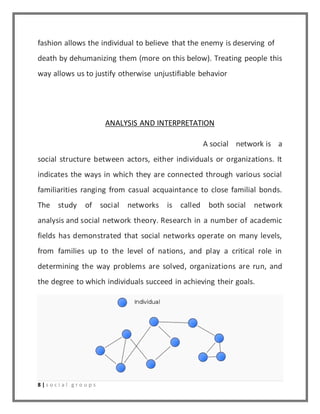
An example of a social network diagram 
Social network theory views social relationships in terms 
of nodes and ties. Nodes are the individual actors within the networks, 
and ties are the relationships between the actors. There can be many 
kinds of ties between the nodes. In its most simple form, a social 
network is a map of all of the relevant ties between the nodes being 
studied. The network can also be used to determine the social capital of 
individual actors. These concepts are often displayed in a social 
network diagram, where nodes are the points and ties are the lines. 
The shape of the social network helps determine a network's 
usefulness to its individuals. Smaller, tighter networks can be less useful 
to their members than networks with lots of loose connections (weak 
ties) to individuals outside the main network. More "open" networks, 
with many weak ties and social connections, are more likely to 
introduce new ideas and opportunities to their members than closed 
networks with many redundant ties. In other words, a group of friends 
who only do things with each other already share the same knowledge 
and opportunities. A group of individuals with connections to other 
social worlds is likely to have access to a wider range of information. It 
is better for individual success to have connections to a variety of 
networks rather than many connections within a single network. 
9 | s o c i a l g r o u p s
Similarly, individuals can exercise influence or act as brokers within 
their social networks by bridging two networks that are not directly 
linked (called filling social holes). 
The power of social network theory stems from its difference from 
traditional sociological studies, which assume that it is the attributes of 
individual actors - whether they are friendly or unfriendly, smart or 
dumb, etc. - that matter. Social network theory produces an alternate 
view, where the attributes of individuals are less important than their 
relationships and ties with other actors within the network. This 
approach has turned out to be useful for explaining many real-world 
phenomena, but leaves less room for individual agency, the ability for 
individuals to influence their success, so much of it rests within the 
structure of their network. For instance, social networks have been 
used to examine how companies interact with each other, 
characterizing the many informal connections that link executives 
together, as well as associations and connections between individual 
employees at different companies. These networks provide ways for 
companies to gather information, deter competition, and 
even collude in setting prices or policies. Power within organizations 
has also been found to be tied to social networks. Powerful people in 
organizations often derive their power from their degree of 
connectedness within the organization (i.e., the degree to which an 
10 | s o c i a l g r o u p s
individual within a network is at the center of many relationships) 
rather than from job title or statuses. Social networks also play a key 
role in hiring, in business success for firms, and in job performance. 
The so-called rule of 150 states that the size of a genuine social 
network is limited to about 150 members (sometimes called 
the Dunbar Number). The rule arises from cross-cultural studies 
in sociology and especially anthropology of the maximum size of 
a village (in modern parlance an ecovillage). It is theorized 
in evolutionary psychology that the number may be some kind of limit 
of average human ability to recognize members and track emotional 
facts about all members of a group. However, it may be due 
to economicsand the need to track "free riders", as larger groups tend 
to be easier for cheats and liars to prosper in. 
The "six degrees of separation" model. 
The small world phenomenon is the hypothesis that the chain of social 
acquaintances required to connect one arbitrary person to another 
arbitrary person anywhere in the world is generally short. The concept 
11 | s o c i a l g r o u p s
gave rise to the famous phrase six degrees of separation after 
a 1967small world experiment by psychologist Stanley Milgram which 
found that two random US citizens were connected by an average of six 
acquaintances. Current internet experiments continue to explore this 
phenomenon, including the Ohio State Electronic Small World 
Projectand Columbia's Small World Project. As of 2005, these 
experiments confirm that about five to seven degrees of separation are 
sufficient for connecting any two people through the internet. 
Sociologists are interested in social networks because of their influence 
on and importance for the individual. Social networks are the basic 
tools used by individuals to meet other people, to recreate, and to find 
social support.[32] Recent research suggests that the social networks of 
Americans are shrinking and more and more people have no close 
confidants or people with whom they can share their most intimate 
thoughts.[33] In 1985, the mean network size of individuals in the U.S. 
was 2.94 people. Networks declined by almost an entire confidant by 
2004, to 2.08 people. Almost half, 46.3% of Americans, say they have 
only one or no confidants with whom they can discuss important 
matters. The most frequently occurring response to the question of 
how many confidants one has was zero in 2004. The decline in 
confidants has been most notable among non-kin networks, putting 
greater emphasis on kin and spouses as social confidants. Most social 
12 | s o c i a l g r o u p s
confidants are similar in demographic characteristics to the person 
doing the sharing.[33] The implications of these findings are potentially 
disturbing for American society as people have smaller social 
support networks, which are important for both social but also health 
reasons.[32] 
13 | s o c i a l g r o u p s 
Conclusion 
The term group, or social group, 
has been used to refer to very divergent kinds of aggregations of 
people. Indeed, the term has been used so broadly as to threaten its 
fruitfulness as a focal concept. For one thing, the word group has 
sometimes been used to designate the members of a social category 
based on possession of a common attribute, even when the members 
have no meaningful degree of interrelation. Thus, it has been used to
refer to such collections as persons of a particular age, all persons 
having similar incomes or occupations, and all persons with similar 
reading habits. These are what might be called statistical groups, as 
distinct from actual groups, the latter being characterized by 
interrelatedness of the members. 
Virtually all efforts to classify social groups result in a certain degree of 
artificiality. Because of these and other problems of definition and 
classification, sociologists have attempted to distinguish between 
various kinds of social aggregates, some to be considered groups and 
others to be identified by other terms—audiences, publics, and the like; 
there is, however, no generally accepted classification at this time. 
14 | s o c i a l g r o u p s 
REFERENCES 
1. ohn J. Macionis, Linda M. Gerber, "Sociology", Seventh Canadian 
Edition, Pearson Canada. Missing or empty |title= (help) 
2. Jump up^ Hare, A. P. (1962). Handbook of small group research. 
New York: Macmillan Publishers.
3. Jump up^ Sherif, Muzafer and Sherif, Carolyn W., An Outline of 
Social Psychology rev.ed. Harper & Brothers: New York pp. 143– 
180. 
4. Jump up^ Simon, Herbert A. Administrative Behavior 3rd ed. Free 
Press 1976 p.123-153 
15 | s o c i a l g r o u p s
16 | s o c i a l g r o u p s
17 | s o c i a l g r o u p s
18 | s o c i a l g r o u p s
19 | s o c i a l g r o u p s
20 | s o c i a l g r o u p s

Nitheesh

  • 1.
    1 | so c i a l g r o u p s Assignment Submitted by Nitheesh .t.g Social science Fmtc mylapure
  • 2.
    2 | so c i a l g r o u p s Index Sl.no content Page .no 1 INTRODUCTION 3 2 NEED AND SIGNIFICANCE 4-6 3 OBJECTIVES 6-7 4 ANALYZIS AND INTERPRETATION 7-12
  • 3.
    5 3 |s o c i a l g r o u p s ÇONCLUSION 13 6 REFERENCES 14 INTRODUCTION A social group consists of two or more people who interact with one another and who recognize themselves as a distinct social unit. The definition is simple enough, but it has significant implications. Frequent interaction leads people to share values and beliefs. This similarity and the interaction cause them to identify with one another. Identification and attachment, in turn, stimulate more frequent and intense interaction. Each group maintains solidarity with all to other groups and other types of social systems. Groups are among the most stable and enduring of social units. They are important both to their members and to the society at large. Through encouraging regular and predictable behavior, groups form the foundation upon which society rests. Thus, a family, a village, a political
  • 4.
    party a tradeunion is all social groups. These, it should be noted are different from social classes, status groups or crowds, which not only lack structure but whose members are less aware or even unaware of the existence of the group. These have been called quasi-groups or groupings. Nevertheless, the distinction between social groups and quasi-groups is fluid and variable since quasi-groups very often give rise to social groups, as for example, social classes give rise to political parties. 4 | s o c i a l g r o u p s NEED AND SIGNIFICANCE Usually defined as a number of people who identify and interact with one another. This is a very broad definition, as it includes groups of all sizes, fromdyads to whole societies. While an aggregate comprises merely a number of individuals, a group in sociology exhibits cohesiveness to a larger degree. Aspects that members in the group may share include: interests, values, ethnic/linguistic background, roles and kinship. One way of determining if a collection of people can be considered a group is if individuals who belong to that collection use the self-referent pronoun "we;" using "we" to refer to a collection of people often implies that the collection thinks of itself as a group. Examples of groups include: families, companies, circles of friends, clubs, local chapters of fraternities and sororities, and local religious congregations. A law enforcement official is a social category, not a group. However, law enforcement officials who all work in the same station and regularly meet to plan their day and work together would be considered part of a group.
  • 5.
    Collections of peoplethat do not use the self-referent pronoun "we" but share certain characteristics (e.g., roles, social functions, etc.) are different from groups in that they usually do not regularly interact with each other nor share similar interests or values. Such collections are referred to as categories of people rather than groups; examples include: police, soldiers, millionaires, women, etc. Individuals form groups for a variety of reasons. There are some rather obvious ones, like reproduction, protection, trade, protest, and food production. But social categorization of people into groups and categories also facilitates behavior and action.[1] An example may help explain this idea: Suppose you are driving somewhere in a car when you notice red lights flashing in your rearview mirror. Because you have been socialized into society, you know that the red lights mean you should pull over, so you do. After waiting for a minute or two, an individual in a uniform walks toward your car door. You roll down your window and the individual asks you for your "license and registration." Because groups and categories help facilitate social behavior, you know who this individual is: a member of a law enforcement category like the police or highway patrol. In all likelihood, you do not have to question this individual as to why they are driving a special car with lights on it, why they are wearing a uniform, why they are carrying a gun, or why they pulled you over (you may ask why they pulled you over, but doing so often increases the likelihood they'll give you a ticket). In short, because you recognize that the individual driving the car belongs to a specific social category (or group), you can enter this interaction with a body of knowledge that will help guide your behavior. You do not have to learn how to interact in that situation every single time you encounter it. 5 | s o c i a l g r o u p s
  • 6.
    In fact, sociologistshave long recognized the people experience much of social life by attempting to frame situations in terms they can understand.[2] Specifically, people approach each situation by consciously or unconsciously asking "What is going on here," and seeking to coordinate their activities to the "definition of the situation" they decide upon. To accomplish this, people scan situations for information "given" (e.g., the things people do to signify who they are and what groups they belong to intentionally) and "given off" (e.g., the things people do that inadvertently signify who they are and the groups they belong to) by other people in the situation. Based on this information, people then act in ways they have been socialized to believe is appropriate for the situation. In the case above, for example, you (as the driver) would note the information given (e.g., the special car, the lights, and the uniform worn) to ascertain what was happening and who the other driver was, and then you could note the information given off (e.g., the apparent mood of the police officer based upon her or his body language, verbal language, and mannerisms) to predict (accurately or otherwise) what was about to happen to you. In so doing, you would be using the knowledge of groups at your disposal to manage the situation. Such interpretive work combined with social categorizations to smooth a wide variety of interactional and interpretive experiences. AIMS AND OBJECTIVES Identification carries two meanings. Part of who we are is made up of our group memberships. That is, sometimes we think of ourselves as 6 | s o c i a l g r o u p s
  • 7.
    "us" vs. "them"or "we" vs. "they", and at other times we think of ourselves as "I" vs. "he or she" or "me" vs. "him or her". In other words, sometimes we think of ourselves as group members and at other times we think of ourselves as unique individuals. This varies situationally, so that we can be more or less a group member, depending upon the circumstances. What is crucial for our purposes is that thinking of yourself as a group member and thinking of yourself as a unique individual are both parts of your self-concept. The first is referred to as social identity, the latter is referred to as personal identity. In social identity theory, group membership is not something foreign which is tacked onto the person, it is a real, true and vital part of the person. Our groups make up part of who we are. 7 | s o c i a l g r o u p s The other meaning implied by the concept of identity is the idea that we are, in some sense, the same, or identical to other people. This should not be misinterpreted, when we say that we are the same, we mean that for some purposes we treat members of our groups as being similar to ourselves in some relevant way. To take the most extreme example, in some violent conflict such as a war, the members of the opposite group - the outgroup - are treated as identical and completely different to the those people in your group - theingroup - which is made up of distinct individuals. Thinking about individuals in one's outgroup in such a
  • 8.
    fashion allows theindividual to believe that the enemy is deserving of death by dehumanizing them (more on this below). Treating people this way allows us to justify otherwise unjustifiable behavior 8 | s o c i a l g r o u p s ANALYSIS AND INTERPRETATION A social network is a social structure between actors, either individuals or organizations. It indicates the ways in which they are connected through various social familiarities ranging from casual acquaintance to close familial bonds. The study of social networks is called both social network analysis and social network theory. Research in a number of academic fields has demonstrated that social networks operate on many levels, from families up to the level of nations, and play a critical role in determining the way problems are solved, organizations are run, and the degree to which individuals succeed in achieving their goals.
  • 9.
    An example ofa social network diagram Social network theory views social relationships in terms of nodes and ties. Nodes are the individual actors within the networks, and ties are the relationships between the actors. There can be many kinds of ties between the nodes. In its most simple form, a social network is a map of all of the relevant ties between the nodes being studied. The network can also be used to determine the social capital of individual actors. These concepts are often displayed in a social network diagram, where nodes are the points and ties are the lines. The shape of the social network helps determine a network's usefulness to its individuals. Smaller, tighter networks can be less useful to their members than networks with lots of loose connections (weak ties) to individuals outside the main network. More "open" networks, with many weak ties and social connections, are more likely to introduce new ideas and opportunities to their members than closed networks with many redundant ties. In other words, a group of friends who only do things with each other already share the same knowledge and opportunities. A group of individuals with connections to other social worlds is likely to have access to a wider range of information. It is better for individual success to have connections to a variety of networks rather than many connections within a single network. 9 | s o c i a l g r o u p s
  • 10.
    Similarly, individuals canexercise influence or act as brokers within their social networks by bridging two networks that are not directly linked (called filling social holes). The power of social network theory stems from its difference from traditional sociological studies, which assume that it is the attributes of individual actors - whether they are friendly or unfriendly, smart or dumb, etc. - that matter. Social network theory produces an alternate view, where the attributes of individuals are less important than their relationships and ties with other actors within the network. This approach has turned out to be useful for explaining many real-world phenomena, but leaves less room for individual agency, the ability for individuals to influence their success, so much of it rests within the structure of their network. For instance, social networks have been used to examine how companies interact with each other, characterizing the many informal connections that link executives together, as well as associations and connections between individual employees at different companies. These networks provide ways for companies to gather information, deter competition, and even collude in setting prices or policies. Power within organizations has also been found to be tied to social networks. Powerful people in organizations often derive their power from their degree of connectedness within the organization (i.e., the degree to which an 10 | s o c i a l g r o u p s
  • 11.
    individual within anetwork is at the center of many relationships) rather than from job title or statuses. Social networks also play a key role in hiring, in business success for firms, and in job performance. The so-called rule of 150 states that the size of a genuine social network is limited to about 150 members (sometimes called the Dunbar Number). The rule arises from cross-cultural studies in sociology and especially anthropology of the maximum size of a village (in modern parlance an ecovillage). It is theorized in evolutionary psychology that the number may be some kind of limit of average human ability to recognize members and track emotional facts about all members of a group. However, it may be due to economicsand the need to track "free riders", as larger groups tend to be easier for cheats and liars to prosper in. The "six degrees of separation" model. The small world phenomenon is the hypothesis that the chain of social acquaintances required to connect one arbitrary person to another arbitrary person anywhere in the world is generally short. The concept 11 | s o c i a l g r o u p s
  • 12.
    gave rise tothe famous phrase six degrees of separation after a 1967small world experiment by psychologist Stanley Milgram which found that two random US citizens were connected by an average of six acquaintances. Current internet experiments continue to explore this phenomenon, including the Ohio State Electronic Small World Projectand Columbia's Small World Project. As of 2005, these experiments confirm that about five to seven degrees of separation are sufficient for connecting any two people through the internet. Sociologists are interested in social networks because of their influence on and importance for the individual. Social networks are the basic tools used by individuals to meet other people, to recreate, and to find social support.[32] Recent research suggests that the social networks of Americans are shrinking and more and more people have no close confidants or people with whom they can share their most intimate thoughts.[33] In 1985, the mean network size of individuals in the U.S. was 2.94 people. Networks declined by almost an entire confidant by 2004, to 2.08 people. Almost half, 46.3% of Americans, say they have only one or no confidants with whom they can discuss important matters. The most frequently occurring response to the question of how many confidants one has was zero in 2004. The decline in confidants has been most notable among non-kin networks, putting greater emphasis on kin and spouses as social confidants. Most social 12 | s o c i a l g r o u p s
  • 13.
    confidants are similarin demographic characteristics to the person doing the sharing.[33] The implications of these findings are potentially disturbing for American society as people have smaller social support networks, which are important for both social but also health reasons.[32] 13 | s o c i a l g r o u p s Conclusion The term group, or social group, has been used to refer to very divergent kinds of aggregations of people. Indeed, the term has been used so broadly as to threaten its fruitfulness as a focal concept. For one thing, the word group has sometimes been used to designate the members of a social category based on possession of a common attribute, even when the members have no meaningful degree of interrelation. Thus, it has been used to
  • 14.
    refer to suchcollections as persons of a particular age, all persons having similar incomes or occupations, and all persons with similar reading habits. These are what might be called statistical groups, as distinct from actual groups, the latter being characterized by interrelatedness of the members. Virtually all efforts to classify social groups result in a certain degree of artificiality. Because of these and other problems of definition and classification, sociologists have attempted to distinguish between various kinds of social aggregates, some to be considered groups and others to be identified by other terms—audiences, publics, and the like; there is, however, no generally accepted classification at this time. 14 | s o c i a l g r o u p s REFERENCES 1. ohn J. Macionis, Linda M. Gerber, "Sociology", Seventh Canadian Edition, Pearson Canada. Missing or empty |title= (help) 2. Jump up^ Hare, A. P. (1962). Handbook of small group research. New York: Macmillan Publishers.
  • 15.
    3. Jump up^Sherif, Muzafer and Sherif, Carolyn W., An Outline of Social Psychology rev.ed. Harper & Brothers: New York pp. 143– 180. 4. Jump up^ Simon, Herbert A. Administrative Behavior 3rd ed. Free Press 1976 p.123-153 15 | s o c i a l g r o u p s
  • 16.
    16 | so c i a l g r o u p s
  • 17.
    17 | so c i a l g r o u p s
  • 18.
    18 | so c i a l g r o u p s
  • 19.
    19 | so c i a l g r o u p s
  • 20.
    20 | so c i a l g r o u p s