Barnstable County Water Utilities Association Safe Chemical Handling and  Initial Spill Response June 16, 2011 David P. Horowitz, P.E., CSP Tighe & Bond, Inc. 413.572.3211 [email_address] @dphorowitz on Twitter & YouTube
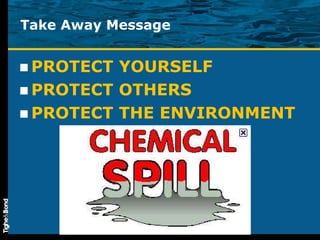
Take Away Message PROTECT YOURSELF PROTECT OTHERS PROTECT THE ENVIRONMENT
Introduction / Objectives Specific water treatment plant chemical hazards Means of hazard recognition Normal handling Spill / release situations Evaluate Risk Protect Yourself Use of personal protective equipment Safe distance / places of refuge Protect Others Protect the Environment
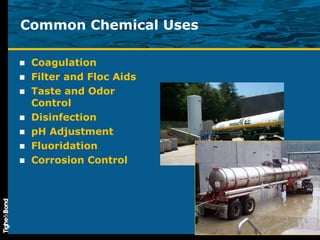
Common Chemical Uses Coagulation Filter and Floc Aids Taste and Odor Control Disinfection pH Adjustment Fluoridation Corrosion Control
Select only the closest or the best answer What does MSDS stand for? Massachusetts Safety Data System Material Safety Data Sheet Material Safety Database System Mine Safety Data System
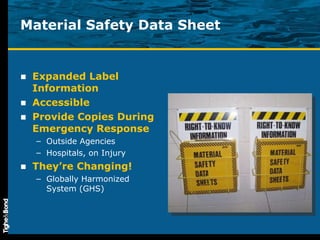
Material Safety Data Sheet Expanded Label Information Accessible Provide Copies During Emergency Response Outside Agencies Hospitals, on Injury They’re Changing! Globally Harmonized System (GHS)
MSDS - Key Sections Appearance and Odor State of Material (Gas, Liquid, Solid) Warning Properties Physical Characteristics Specific Gravity Vapor Density Fire and Explosion Flashpoint Flammable Limits Extinguishing Media
MSDS - Key Sections Reactivity Data Incompatibles Health Hazard Data Health Effects (Acute / Chronic) Emergency and First-aid Decontamination Ingestion Medical Information
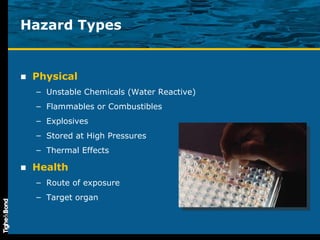
Hazard Types Physical Unstable Chemicals (Water Reactive) Flammables or Combustibles Explosives Stored at High Pressures Thermal Effects Health Route of exposure Target organ
Globally Harmonized Systems The Big Purple Book
WHAT? A rule has been  proposed by OSHA  to align the Hazard Communication Standard  29 CFR 1910.1200  with provisions of the United Nations Globally Harmonized System of Classification and Labeling of Chemicals.
Published in the Sept. 30, 2009 Federal Register Phase-in period for the proposed rule will be  3 years after the final rule is published Phase-in for the implementation of training and education programs expected within  2 years of the final rule being published WHEN?
ANTICIPATED IMPLEMENTATION Quote from acting Assistant Secretary of Labor for OSHA Jordan Barab “ Although no date has been established for the publication of the final rule, Jordan said, “We think we have a pretty good proposal, so we’re hoping to move it along with all due speed ….” Anticipated for early 2010 May publish in August 2011
WHY? “ The proposal to align the hazard communication standard with the GHS will  improve the consistency and effectiveness of hazard communications  reduce chemical-related injuries, illnesses and fatalities
WHO? Number of workers affected by the proposed HCS:  Over 40 million workers Affected Industries: Over 5 million workplaces
INTERNATIONAL PARTICIPATION Countries that have already implemented the system include: Japan Korea New Zealand  Taiwan Countries/regions that have incorporated UN GHS into their local regulations include: European Union (EU) China Singapore Thailand
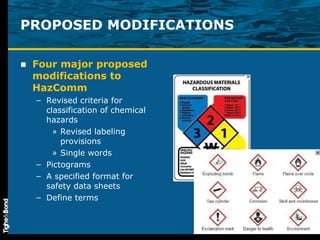
PROPOSED MODIFICATIONS Four major proposed modifications to HazComm Revised criteria for classification of chemical hazards Revised labeling provisions Single words Pictograms A specified format for safety data sheets Define terms
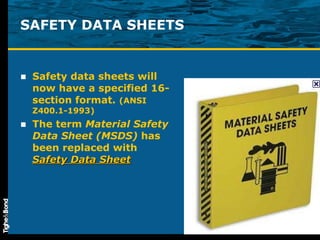
SAFETY DATA SHEETS Safety data sheets will now have a specified 16-section format.  (ANSI Z400.1-1993) The term  Material Safety Data Sheet (MSDS)  has been replaced with  Safety Data Sheet
It’s Movie Time!
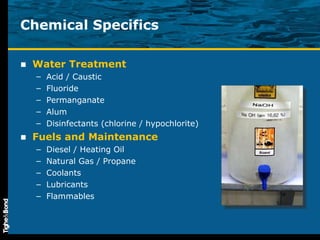
Chemical Specifics Water Treatment Acid / Caustic Fluoride Permanganate Alum Disinfectants (chlorine / hypochlorite) Fuels and Maintenance Diesel / Heating Oil Natural Gas / Propane Coolants Lubricants Flammables
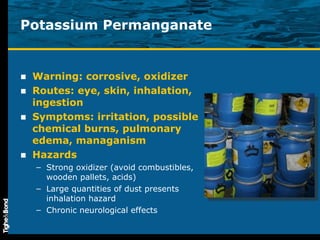
Potassium Permanganate Warning: corrosive, oxidizer Routes: eye, skin, inhalation, ingestion Symptoms: irritation, possible chemical burns, pulmonary edema, managanism Hazards Strong oxidizer (avoid combustibles, wooden pallets, acids) Large quantities of dust presents inhalation hazard Chronic neurological effects
Aluminum Sulfate Warning: irritant Routes: eye, skin, inhalation, ingestion Symptoms: irritation, shortness of breath, vomiting, diarrhea Hazards: Avoid ingestion Hydrolyzes in water forming sulfuric acid
What is the main safety hazard of polyelectrolytes (polymers used in water treatment)? Explosive Slippery Corrosive Toxic Select only the closest or the best answer
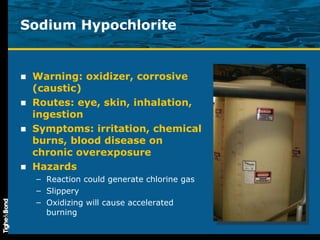
Sodium Hypochlorite Warning: oxidizer, corrosive (caustic) Routes: eye, skin, inhalation, ingestion Symptoms: irritation, chemical burns, blood disease on chronic overexposure Hazards Reaction could generate chlorine gas Slippery Oxidizing will cause accelerated burning
Chlorine Gas / Liquid Corrosive / toxic by inhalation Vapors condense to form hydrochloric acid Toxic at relatively low airborne concentration Can cause pulmonary edema Cryogenic as a liquid Reactives Ammonia and fuel gas Explosive compounds Strong odor, good warning properties
What does OSHA say about a chlorine spill? http://www.osha.gov/SLTC/healthguidelines/chlorine/recognition.html In the event of a spill or leak involving chlorine, persons not wearing protective equipment and fully-encapsulating, vapor-protective clothing should be restricted from contaminated areas until cleanup has been completed. The following steps should be undertaken following a spill or leak: Notify safety personnel.  Remove all sources of heat and ignition.  Keep all combustibles (wood, paper, oil, etc.) away from the leak.  Ventilate potentially explosive atmospheres.
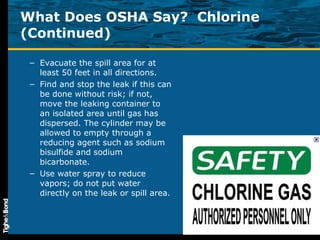
What Does OSHA Say?  Chlorine (Continued) Evacuate the spill area for at least 50 feet in all directions.  Find and stop the leak if this can be done without risk; if not, move the leaking container to an isolated area until gas has dispersed. The cylinder may be allowed to empty through a reducing agent such as sodium bisulfide and sodium bicarbonate. Use water spray to reduce vapors; do not put water directly on the leak or spill area.
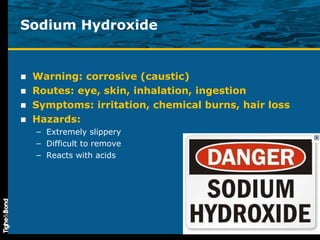
Sodium Hydroxide Warning: corrosive (caustic) Routes: eye, skin, inhalation, ingestion Symptoms: irritation, chemical burns, hair loss Hazards:  Extremely slippery Difficult to remove Reacts with acids
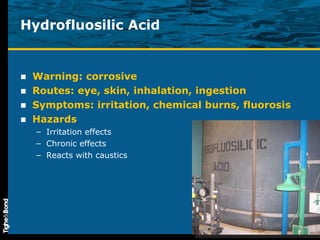
Hydrofluosilic Acid Warning: corrosive Routes: eye, skin, inhalation, ingestion Symptoms: irritation, chemical burns, fluorosis Hazards Irritation effects Chronic effects Reacts with caustics
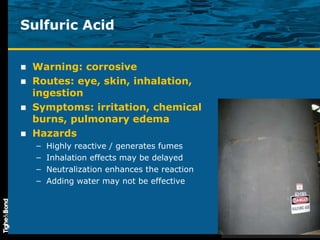
Sulfuric Acid Warning: corrosive Routes: eye, skin, inhalation, ingestion Symptoms: irritation, chemical burns, pulmonary edema Hazards Highly reactive / generates fumes Inhalation effects may be delayed Neutralization enhances the reaction Adding water may not be effective
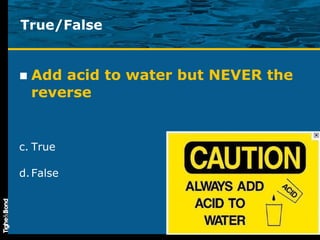
True/False Add acid to water but NEVER the reverse True False
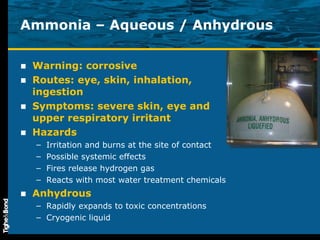
Ammonia – Aqueous / Anhydrous Warning: corrosive Routes: eye, skin, inhalation, ingestion Symptoms: severe skin, eye and upper respiratory irritant  Hazards Irritation and burns at the site of contact Possible systemic effects Fires release hydrogen gas Reacts with most water treatment chemicals Anhydrous Rapidly expands to toxic concentrations Cryogenic liquid
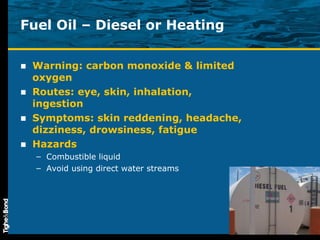
Fuel Oil – Diesel or Heating Warning: carbon monoxide & limited oxygen Routes: eye, skin, inhalation, ingestion Symptoms: skin reddening, headache, dizziness, drowsiness, fatigue  Hazards Combustible liquid Avoid using direct water streams
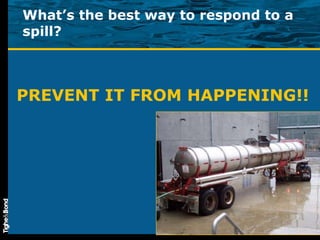
What’s the best way to respond to a spill? PREVENT IT FROM HAPPENING!!
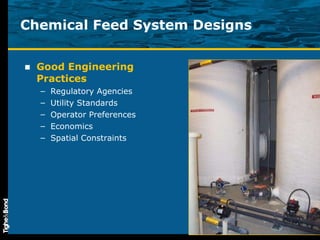
Chemical Feed System Designs Good Engineering Practices Regulatory Agencies Utility Standards Operator Preferences Economics Spatial Constraints
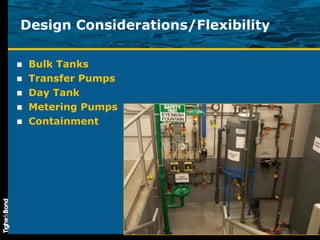
Design Considerations/Flexibility Bulk Tanks Transfer Pumps Day Tank Metering Pumps Containment
Chemical Compatibility ALWAYS check wetted material for compatibility Effect Ratings None – excellent Minor – good Moderate – fair Severe – not recommended Resistance Charts
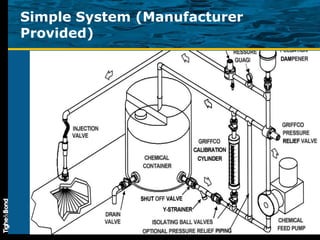
Simple System (Manufacturer Provided)
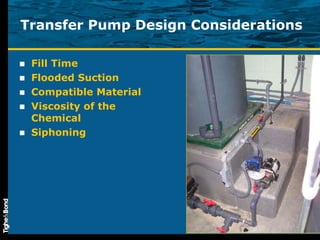
Transfer Pump Design Considerations Fill Time Flooded Suction Compatible Material Viscosity of the Chemical Siphoning
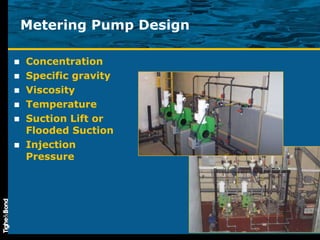
Metering Pump Design Concentration Specific gravity Viscosity Temperature Suction Lift or Flooded Suction Injection Pressure
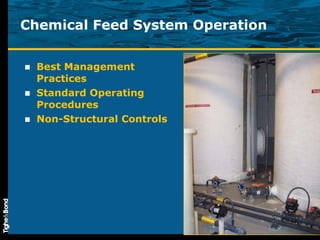
Chemical Feed System Operation Best Management Practices Standard Operating Procedures Non-Structural Controls
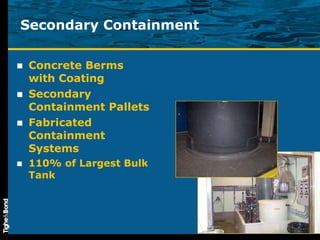
Secondary Containment Concrete Berms with Coating Secondary Containment Pallets Fabricated Containment Systems 110% of Largest Bulk Tank
 
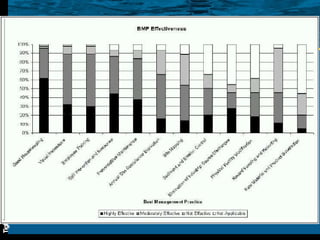
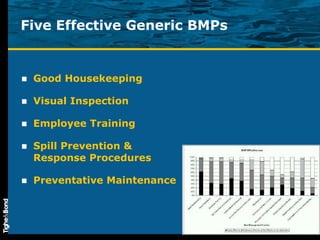
Five Effective Generic BMPs  Good Housekeeping Visual Inspection Employee Training Spill Prevention & Response Procedures Preventative Maintenance
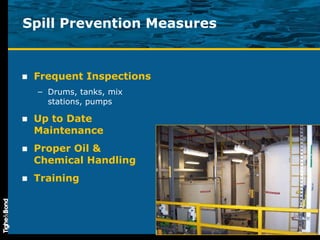
Spill Prevention Measures Frequent Inspections Drums, tanks, mix stations, pumps Up to Date Maintenance  Proper Oil & Chemical Handling Training
 
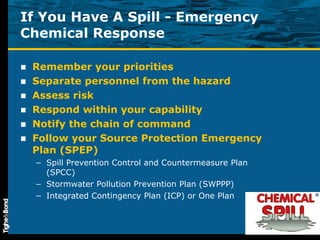
If You Have A Spill - Emergency Chemical Response Remember your priorities Separate personnel from the hazard Assess risk Respond within your capability Notify the chain of command Follow your Source Protection Emergency Plan (SPEP) Spill Prevention Control and Countermeasure Plan (SPCC) Stormwater Pollution Prevention Plan (SWPPP) Integrated Contingency Plan (ICP) or One Plan
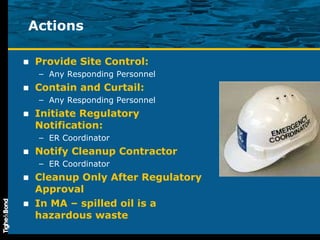
Actions Provide Site Control:  Any Responding Personnel Contain and Curtail:  Any Responding Personnel Initiate Regulatory Notification:  ER Coordinator Notify Cleanup Contractor ER Coordinator  Cleanup Only After Regulatory Approval In MA – spilled oil is a hazardous waste
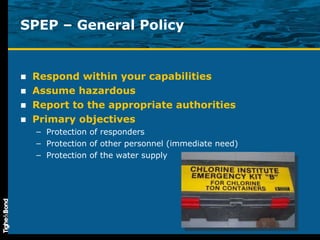
SPEP – General Policy Respond within your capabilities Assume hazardous Report to the appropriate authorities Primary objectives Protection of responders Protection of other personnel (immediate need) Protection of the water supply
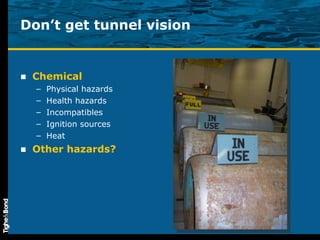
Don’t get tunnel vision Chemical Physical hazards Health hazards Incompatibles Ignition sources Heat Other hazards?
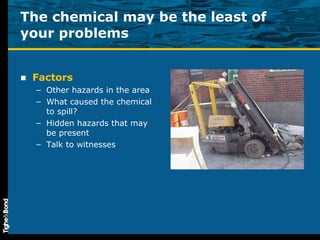
The chemical may be the least of your problems Factors Other hazards in the area What caused the chemical to spill? Hidden hazards that may be present Talk to witnesses
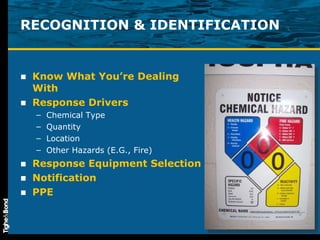
RECOGNITION & IDENTIFICATION Know What You’re Dealing With Response Drivers Chemical Type Quantity Location Other Hazards (E.G., Fire) Response Equipment Selection Notification PPE
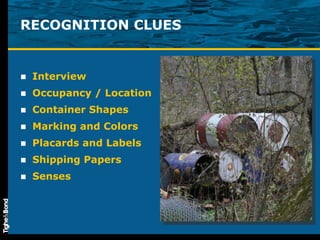
RECOGNITION CLUES Interview Occupancy / Location Container Shapes Marking and Colors Placards and Labels Shipping Papers Senses
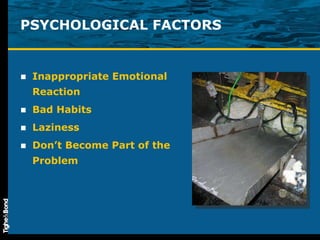
PSYCHOLOGICAL FACTORS Inappropriate Emotional Reaction Bad Habits Laziness Don’t Become Part of the Problem


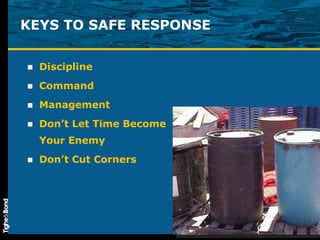
KEYS TO SAFE RESPONSE Discipline Command Management Don’t Let Time Become Your Enemy Don’t Cut Corners
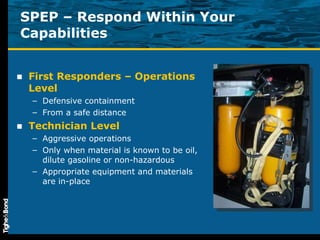
SPEP – Respond Within Your Capabilities First Responders – Operations Level Defensive containment From a safe distance Technician Level Aggressive operations Only when material is known to be oil, dilute gasoline or non-hazardous Appropriate equipment and materials are in-place
SPEP – Response Procedure ER Coordinator ensures incident is properly reported Local organizations Fire Department DPW ConComm DEP DPH Communications coordinator to place internal organizations on standby Responders Supervisors Quality control
SPEP – Actions At The Scene ER Coordinator Directs responders Liaison to incident commander Maintains records at the scene Response Based on threat to water supply
SPEP – Response To Threats To The Water Supply Actions Inform appropriate internal organizations Mobilize resources to the scene Initiate containment activities to protect the water supply In concert with incident command
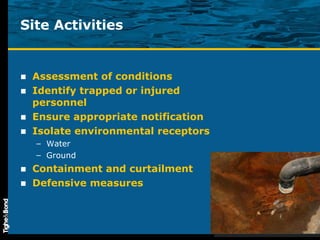
Site Activities Assessment of conditions Identify trapped or injured personnel Ensure appropriate notification Isolate environmental receptors Water Ground Containment and curtailment Defensive measures
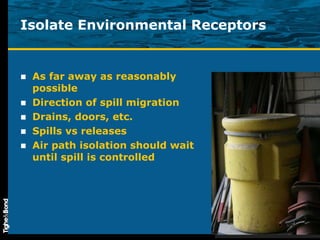
Isolate Environmental Receptors As far away as reasonably possible Direction of spill migration Drains, doors, etc. Spills vs releases Air path isolation should wait until spill is controlled
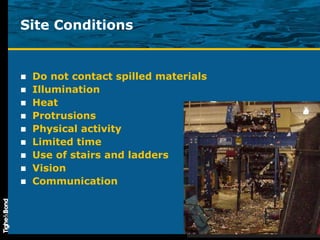
Site Conditions Do not contact spilled materials Illumination Heat Protrusions Physical activity Limited time Use of stairs and ladders Vision Communication
Spill Reporting Massachusetts Contingency Plan (MCP) 310 CMR 40.0000 Bureau of Waste Site Cleanup Massachusetts Oil and Hazardous Material List 310 CMR 40.1600 CAS # Reportable Quantities (RQs) Sudden release – 2 hours
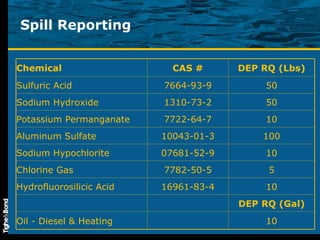
Spill Reporting Chemical CAS # DEP RQ (Lbs) Sulfuric Acid 7664-93-9 50 Sodium Hydroxide 1310-73-2 50 Potassium Permanganate 7722-64-7 10 Aluminum Sulfate 10043-01-3 100 Sodium Hypochlorite 07681-52-9 10 Chlorine Gas 7782-50-5 5 Hydrofluorosilicic Acid 16961-83-4 10     DEP RQ (Gal) Oil - Diesel & Heating   10
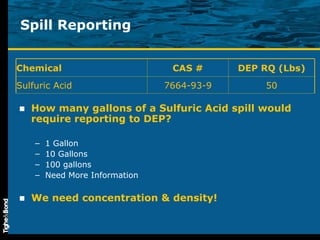
Spill Reporting How many gallons of a Sulfuric Acid spill would require reporting to DEP?  1 Gallon 10 Gallons 100 gallons Need More Information We need concentration & density! Chemical CAS # DEP RQ (Lbs) Sulfuric Acid 7664-93-9 50
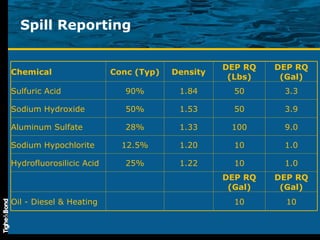
Spill Reporting Chemical Conc (Typ) Density DEP RQ (Lbs) DEP RQ (Gal) Sulfuric Acid 90% 1.84 50 3.3 Sodium Hydroxide 50% 1.53 50 3.9 Aluminum Sulfate 28% 1.33 100 9.0 Sodium Hypochlorite 12.5% 1.20 10 1.0 Hydrofluorosilicic Acid 25% 1.22 10 1.0       DEP RQ (Gal) DEP RQ (Gal) Oil - Diesel & Heating     10 10
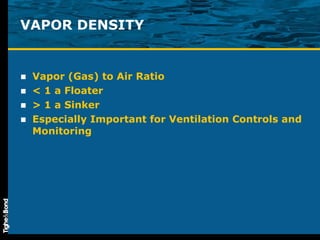
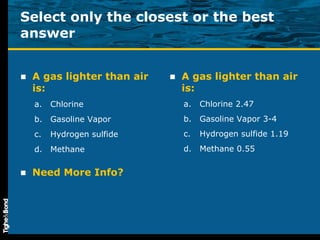
VAPOR DENSITY Vapor (Gas) to Air Ratio < 1 a Floater > 1 a Sinker Especially Important for Ventilation Controls and Monitoring
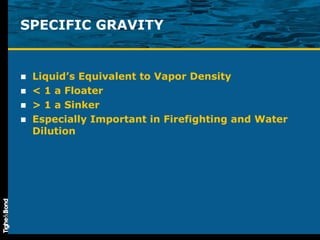
SPECIFIC GRAVITY Liquid’s Equivalent to Vapor Density < 1 a Floater > 1 a Sinker Especially Important in Firefighting and Water Dilution
Select only the closest or the best answer A gas lighter than air is: Chlorine Gasoline Vapor Hydrogen sulfide Methane A gas lighter than air is: Chlorine 2.47 Gasoline Vapor 3-4 Hydrogen sulfide 1.19 Methane 0.55 Need More Info?
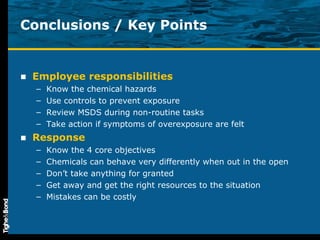
Conclusions / Key Points Employee responsibilities Know the chemical hazards Use controls to prevent exposure Review MSDS during non-routine tasks Take action if symptoms of overexposure are felt Response Know the 4 core objectives Chemicals can behave very differently when out in the open Don’t take anything for granted Get away and get the right resources to the situation Mistakes can be costly
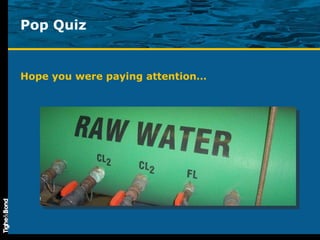
Pop Quiz Hope you were paying attention…
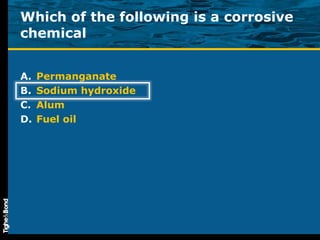
Which of the following is a corrosive chemical Permanganate Sodium hydroxide Alum Fuel oil
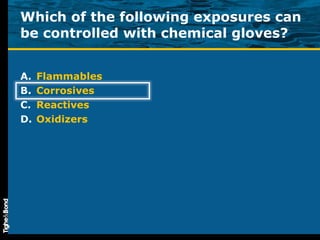
Which of the following exposures can be controlled with chemical gloves? Flammables Corrosives Reactives Oxidizers
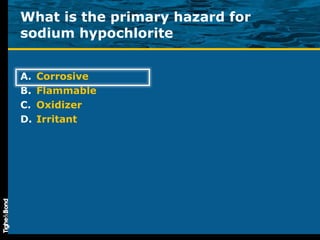
What is the primary hazard for sodium hypochlorite Corrosive Flammable Oxidizer Irritant
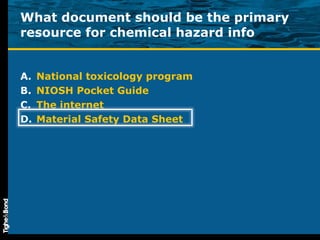
What document should be the primary resource for chemical hazard info National toxicology program NIOSH Pocket Guide The internet Material Safety Data Sheet
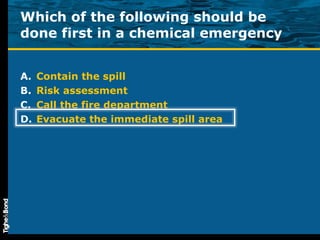
Which of the following should be done first in a chemical emergency Contain the spill Risk assessment Call the fire department Evacuate the immediate spill area
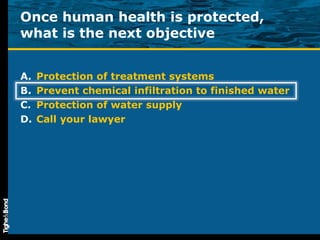
Once human health is protected, what is the next objective Protection of treatment systems Prevent chemical infiltration to finished water Protection of water supply Call your lawyer
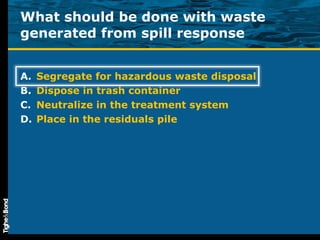
What should be done with waste generated from spill response Segregate for hazardous waste disposal Dispose in trash container Neutralize in the treatment system Place in the residuals pile
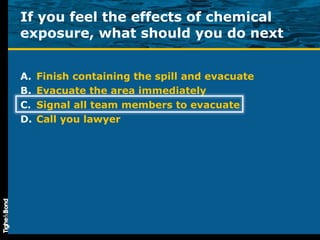
If you feel the effects of chemical exposure, what should you do next Finish containing the spill and evacuate Evacuate the area immediately Signal all team members to evacuate Call you lawyer
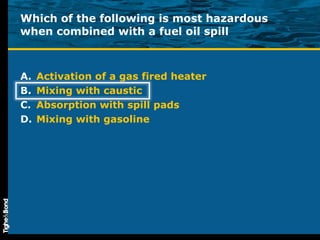
Which of the following is most hazardous when combined with a fuel oil spill Activation of a gas fired heater Mixing with caustic Absorption with spill pads Mixing with gasoline
Questions / Thanks David P. Horowitz, P.E., CSP Tighe & Bond, Inc. 413.572.3211 [email_address]

Safe Chemical Handling & Initial Spill Response

  • 1.
    Barnstable County WaterUtilities Association Safe Chemical Handling and Initial Spill Response June 16, 2011 David P. Horowitz, P.E., CSP Tighe & Bond, Inc. 413.572.3211 [email_address] @dphorowitz on Twitter & YouTube
  • 2.
    Take Away MessagePROTECT YOURSELF PROTECT OTHERS PROTECT THE ENVIRONMENT
  • 3.
    Introduction / ObjectivesSpecific water treatment plant chemical hazards Means of hazard recognition Normal handling Spill / release situations Evaluate Risk Protect Yourself Use of personal protective equipment Safe distance / places of refuge Protect Others Protect the Environment
  • 4.
    Common Chemical UsesCoagulation Filter and Floc Aids Taste and Odor Control Disinfection pH Adjustment Fluoridation Corrosion Control
  • 5.
    Select only theclosest or the best answer What does MSDS stand for? Massachusetts Safety Data System Material Safety Data Sheet Material Safety Database System Mine Safety Data System
  • 6.
    Material Safety DataSheet Expanded Label Information Accessible Provide Copies During Emergency Response Outside Agencies Hospitals, on Injury They’re Changing! Globally Harmonized System (GHS)
  • 7.
    MSDS - KeySections Appearance and Odor State of Material (Gas, Liquid, Solid) Warning Properties Physical Characteristics Specific Gravity Vapor Density Fire and Explosion Flashpoint Flammable Limits Extinguishing Media
  • 8.
    MSDS - KeySections Reactivity Data Incompatibles Health Hazard Data Health Effects (Acute / Chronic) Emergency and First-aid Decontamination Ingestion Medical Information
  • 9.
    Hazard Types PhysicalUnstable Chemicals (Water Reactive) Flammables or Combustibles Explosives Stored at High Pressures Thermal Effects Health Route of exposure Target organ
  • 10.
    Globally Harmonized SystemsThe Big Purple Book
  • 11.
    WHAT? A rulehas been proposed by OSHA to align the Hazard Communication Standard 29 CFR 1910.1200 with provisions of the United Nations Globally Harmonized System of Classification and Labeling of Chemicals.
  • 12.
    Published in theSept. 30, 2009 Federal Register Phase-in period for the proposed rule will be 3 years after the final rule is published Phase-in for the implementation of training and education programs expected within 2 years of the final rule being published WHEN?
  • 13.
    ANTICIPATED IMPLEMENTATION Quotefrom acting Assistant Secretary of Labor for OSHA Jordan Barab “ Although no date has been established for the publication of the final rule, Jordan said, “We think we have a pretty good proposal, so we’re hoping to move it along with all due speed ….” Anticipated for early 2010 May publish in August 2011
  • 14.
    WHY? “ Theproposal to align the hazard communication standard with the GHS will improve the consistency and effectiveness of hazard communications reduce chemical-related injuries, illnesses and fatalities
  • 15.
    WHO? Number ofworkers affected by the proposed HCS: Over 40 million workers Affected Industries: Over 5 million workplaces
  • 16.
    INTERNATIONAL PARTICIPATION Countriesthat have already implemented the system include: Japan Korea New Zealand Taiwan Countries/regions that have incorporated UN GHS into their local regulations include: European Union (EU) China Singapore Thailand
  • 17.
    PROPOSED MODIFICATIONS Fourmajor proposed modifications to HazComm Revised criteria for classification of chemical hazards Revised labeling provisions Single words Pictograms A specified format for safety data sheets Define terms
  • 18.
    SAFETY DATA SHEETSSafety data sheets will now have a specified 16-section format. (ANSI Z400.1-1993) The term Material Safety Data Sheet (MSDS) has been replaced with Safety Data Sheet
  • 19.
  • 20.
    Chemical Specifics WaterTreatment Acid / Caustic Fluoride Permanganate Alum Disinfectants (chlorine / hypochlorite) Fuels and Maintenance Diesel / Heating Oil Natural Gas / Propane Coolants Lubricants Flammables
  • 21.
    Potassium Permanganate Warning:corrosive, oxidizer Routes: eye, skin, inhalation, ingestion Symptoms: irritation, possible chemical burns, pulmonary edema, managanism Hazards Strong oxidizer (avoid combustibles, wooden pallets, acids) Large quantities of dust presents inhalation hazard Chronic neurological effects
  • 22.
    Aluminum Sulfate Warning:irritant Routes: eye, skin, inhalation, ingestion Symptoms: irritation, shortness of breath, vomiting, diarrhea Hazards: Avoid ingestion Hydrolyzes in water forming sulfuric acid
  • 23.
    What is themain safety hazard of polyelectrolytes (polymers used in water treatment)? Explosive Slippery Corrosive Toxic Select only the closest or the best answer
  • 24.
    Sodium Hypochlorite Warning:oxidizer, corrosive (caustic) Routes: eye, skin, inhalation, ingestion Symptoms: irritation, chemical burns, blood disease on chronic overexposure Hazards Reaction could generate chlorine gas Slippery Oxidizing will cause accelerated burning
  • 25.
    Chlorine Gas /Liquid Corrosive / toxic by inhalation Vapors condense to form hydrochloric acid Toxic at relatively low airborne concentration Can cause pulmonary edema Cryogenic as a liquid Reactives Ammonia and fuel gas Explosive compounds Strong odor, good warning properties
  • 26.
    What does OSHAsay about a chlorine spill? http://www.osha.gov/SLTC/healthguidelines/chlorine/recognition.html In the event of a spill or leak involving chlorine, persons not wearing protective equipment and fully-encapsulating, vapor-protective clothing should be restricted from contaminated areas until cleanup has been completed. The following steps should be undertaken following a spill or leak: Notify safety personnel. Remove all sources of heat and ignition. Keep all combustibles (wood, paper, oil, etc.) away from the leak. Ventilate potentially explosive atmospheres.
  • 27.
    What Does OSHASay? Chlorine (Continued) Evacuate the spill area for at least 50 feet in all directions. Find and stop the leak if this can be done without risk; if not, move the leaking container to an isolated area until gas has dispersed. The cylinder may be allowed to empty through a reducing agent such as sodium bisulfide and sodium bicarbonate. Use water spray to reduce vapors; do not put water directly on the leak or spill area.
  • 28.
    Sodium Hydroxide Warning:corrosive (caustic) Routes: eye, skin, inhalation, ingestion Symptoms: irritation, chemical burns, hair loss Hazards: Extremely slippery Difficult to remove Reacts with acids
  • 29.
    Hydrofluosilic Acid Warning:corrosive Routes: eye, skin, inhalation, ingestion Symptoms: irritation, chemical burns, fluorosis Hazards Irritation effects Chronic effects Reacts with caustics
  • 30.
    Sulfuric Acid Warning:corrosive Routes: eye, skin, inhalation, ingestion Symptoms: irritation, chemical burns, pulmonary edema Hazards Highly reactive / generates fumes Inhalation effects may be delayed Neutralization enhances the reaction Adding water may not be effective
  • 31.
    True/False Add acidto water but NEVER the reverse True False
  • 32.
    Ammonia – Aqueous/ Anhydrous Warning: corrosive Routes: eye, skin, inhalation, ingestion Symptoms: severe skin, eye and upper respiratory irritant Hazards Irritation and burns at the site of contact Possible systemic effects Fires release hydrogen gas Reacts with most water treatment chemicals Anhydrous Rapidly expands to toxic concentrations Cryogenic liquid
  • 33.
    Fuel Oil –Diesel or Heating Warning: carbon monoxide & limited oxygen Routes: eye, skin, inhalation, ingestion Symptoms: skin reddening, headache, dizziness, drowsiness, fatigue Hazards Combustible liquid Avoid using direct water streams
  • 34.
    What’s the bestway to respond to a spill? PREVENT IT FROM HAPPENING!!
  • 35.
    Chemical Feed SystemDesigns Good Engineering Practices Regulatory Agencies Utility Standards Operator Preferences Economics Spatial Constraints
  • 36.
    Design Considerations/Flexibility BulkTanks Transfer Pumps Day Tank Metering Pumps Containment
  • 37.
    Chemical Compatibility ALWAYScheck wetted material for compatibility Effect Ratings None – excellent Minor – good Moderate – fair Severe – not recommended Resistance Charts
  • 38.
  • 39.
    Transfer Pump DesignConsiderations Fill Time Flooded Suction Compatible Material Viscosity of the Chemical Siphoning
  • 40.
    Metering Pump DesignConcentration Specific gravity Viscosity Temperature Suction Lift or Flooded Suction Injection Pressure
  • 41.
    Chemical Feed SystemOperation Best Management Practices Standard Operating Procedures Non-Structural Controls
  • 42.
    Secondary Containment ConcreteBerms with Coating Secondary Containment Pallets Fabricated Containment Systems 110% of Largest Bulk Tank
  • 43.
  • 44.
    Five Effective GenericBMPs Good Housekeeping Visual Inspection Employee Training Spill Prevention & Response Procedures Preventative Maintenance
  • 45.
    Spill Prevention MeasuresFrequent Inspections Drums, tanks, mix stations, pumps Up to Date Maintenance Proper Oil & Chemical Handling Training
  • 46.
  • 47.
    If You HaveA Spill - Emergency Chemical Response Remember your priorities Separate personnel from the hazard Assess risk Respond within your capability Notify the chain of command Follow your Source Protection Emergency Plan (SPEP) Spill Prevention Control and Countermeasure Plan (SPCC) Stormwater Pollution Prevention Plan (SWPPP) Integrated Contingency Plan (ICP) or One Plan
  • 48.
    Actions Provide SiteControl: Any Responding Personnel Contain and Curtail: Any Responding Personnel Initiate Regulatory Notification: ER Coordinator Notify Cleanup Contractor ER Coordinator Cleanup Only After Regulatory Approval In MA – spilled oil is a hazardous waste
  • 49.
    SPEP – GeneralPolicy Respond within your capabilities Assume hazardous Report to the appropriate authorities Primary objectives Protection of responders Protection of other personnel (immediate need) Protection of the water supply
  • 50.
    Don’t get tunnelvision Chemical Physical hazards Health hazards Incompatibles Ignition sources Heat Other hazards?
  • 51.
    The chemical maybe the least of your problems Factors Other hazards in the area What caused the chemical to spill? Hidden hazards that may be present Talk to witnesses
  • 52.
    RECOGNITION & IDENTIFICATIONKnow What You’re Dealing With Response Drivers Chemical Type Quantity Location Other Hazards (E.G., Fire) Response Equipment Selection Notification PPE
  • 53.
    RECOGNITION CLUES InterviewOccupancy / Location Container Shapes Marking and Colors Placards and Labels Shipping Papers Senses
  • 54.
    PSYCHOLOGICAL FACTORS InappropriateEmotional Reaction Bad Habits Laziness Don’t Become Part of the Problem
  • 55.
  • 56.
  • 57.
  • 58.
    KEYS TO SAFERESPONSE Discipline Command Management Don’t Let Time Become Your Enemy Don’t Cut Corners
  • 59.
    SPEP – RespondWithin Your Capabilities First Responders – Operations Level Defensive containment From a safe distance Technician Level Aggressive operations Only when material is known to be oil, dilute gasoline or non-hazardous Appropriate equipment and materials are in-place
  • 60.
    SPEP – ResponseProcedure ER Coordinator ensures incident is properly reported Local organizations Fire Department DPW ConComm DEP DPH Communications coordinator to place internal organizations on standby Responders Supervisors Quality control
  • 61.
    SPEP – ActionsAt The Scene ER Coordinator Directs responders Liaison to incident commander Maintains records at the scene Response Based on threat to water supply
  • 62.
    SPEP – ResponseTo Threats To The Water Supply Actions Inform appropriate internal organizations Mobilize resources to the scene Initiate containment activities to protect the water supply In concert with incident command
  • 63.
    Site Activities Assessmentof conditions Identify trapped or injured personnel Ensure appropriate notification Isolate environmental receptors Water Ground Containment and curtailment Defensive measures
  • 64.
    Isolate Environmental ReceptorsAs far away as reasonably possible Direction of spill migration Drains, doors, etc. Spills vs releases Air path isolation should wait until spill is controlled
  • 65.
    Site Conditions Donot contact spilled materials Illumination Heat Protrusions Physical activity Limited time Use of stairs and ladders Vision Communication
  • 66.
    Spill Reporting MassachusettsContingency Plan (MCP) 310 CMR 40.0000 Bureau of Waste Site Cleanup Massachusetts Oil and Hazardous Material List 310 CMR 40.1600 CAS # Reportable Quantities (RQs) Sudden release – 2 hours
  • 67.
    Spill Reporting ChemicalCAS # DEP RQ (Lbs) Sulfuric Acid 7664-93-9 50 Sodium Hydroxide 1310-73-2 50 Potassium Permanganate 7722-64-7 10 Aluminum Sulfate 10043-01-3 100 Sodium Hypochlorite 07681-52-9 10 Chlorine Gas 7782-50-5 5 Hydrofluorosilicic Acid 16961-83-4 10     DEP RQ (Gal) Oil - Diesel & Heating   10
  • 68.
    Spill Reporting Howmany gallons of a Sulfuric Acid spill would require reporting to DEP? 1 Gallon 10 Gallons 100 gallons Need More Information We need concentration & density! Chemical CAS # DEP RQ (Lbs) Sulfuric Acid 7664-93-9 50
  • 69.
    Spill Reporting ChemicalConc (Typ) Density DEP RQ (Lbs) DEP RQ (Gal) Sulfuric Acid 90% 1.84 50 3.3 Sodium Hydroxide 50% 1.53 50 3.9 Aluminum Sulfate 28% 1.33 100 9.0 Sodium Hypochlorite 12.5% 1.20 10 1.0 Hydrofluorosilicic Acid 25% 1.22 10 1.0       DEP RQ (Gal) DEP RQ (Gal) Oil - Diesel & Heating     10 10
  • 70.
    VAPOR DENSITY Vapor(Gas) to Air Ratio < 1 a Floater > 1 a Sinker Especially Important for Ventilation Controls and Monitoring
  • 71.
    SPECIFIC GRAVITY Liquid’sEquivalent to Vapor Density < 1 a Floater > 1 a Sinker Especially Important in Firefighting and Water Dilution
  • 72.
    Select only theclosest or the best answer A gas lighter than air is: Chlorine Gasoline Vapor Hydrogen sulfide Methane A gas lighter than air is: Chlorine 2.47 Gasoline Vapor 3-4 Hydrogen sulfide 1.19 Methane 0.55 Need More Info?
  • 73.
    Conclusions / KeyPoints Employee responsibilities Know the chemical hazards Use controls to prevent exposure Review MSDS during non-routine tasks Take action if symptoms of overexposure are felt Response Know the 4 core objectives Chemicals can behave very differently when out in the open Don’t take anything for granted Get away and get the right resources to the situation Mistakes can be costly
  • 74.
    Pop Quiz Hopeyou were paying attention…
  • 75.
    Which of thefollowing is a corrosive chemical Permanganate Sodium hydroxide Alum Fuel oil
  • 76.
    Which of thefollowing exposures can be controlled with chemical gloves? Flammables Corrosives Reactives Oxidizers
  • 77.
    What is theprimary hazard for sodium hypochlorite Corrosive Flammable Oxidizer Irritant
  • 78.
    What document shouldbe the primary resource for chemical hazard info National toxicology program NIOSH Pocket Guide The internet Material Safety Data Sheet
  • 79.
    Which of thefollowing should be done first in a chemical emergency Contain the spill Risk assessment Call the fire department Evacuate the immediate spill area
  • 80.
    Once human healthis protected, what is the next objective Protection of treatment systems Prevent chemical infiltration to finished water Protection of water supply Call your lawyer
  • 81.
    What should bedone with waste generated from spill response Segregate for hazardous waste disposal Dispose in trash container Neutralize in the treatment system Place in the residuals pile
  • 82.
    If you feelthe effects of chemical exposure, what should you do next Finish containing the spill and evacuate Evacuate the area immediately Signal all team members to evacuate Call you lawyer
  • 83.
    Which of thefollowing is most hazardous when combined with a fuel oil spill Activation of a gas fired heater Mixing with caustic Absorption with spill pads Mixing with gasoline
  • 84.
    Questions / ThanksDavid P. Horowitz, P.E., CSP Tighe & Bond, Inc. 413.572.3211 [email_address]