This document outlines an occupational health and safety management system based on OHSAS 18001. It discusses the benefits of implementing such a system, including reducing risks, accidents, and financial losses. It then describes the key elements of OHSAS 18001, including performing hazard assessments, establishing objectives and procedures, implementing operational controls, and conducting audits and management reviews to ensure continual improvement of health and safety practices. Responsibilities are defined for managers, supervisors, safety representatives, and employees to maintain safe operations.
Occupational Health andSafety
Management System
OHSAS 18001:2007 YOUR IMPLEMENTATION GUIDE
Presented By:
Dr. Madhu Aman Sharma
Principal Consultant & Lead Auditor
2.
Presented By:
Dr. MadhuAman Sharma
Principal Consultant & Lead Auditor
What is a Management System?
Drivers for implementing a Health and Safety
Management System
What is OHSAS 18001
Implementation of OHSAS 18001
Q & A
3.
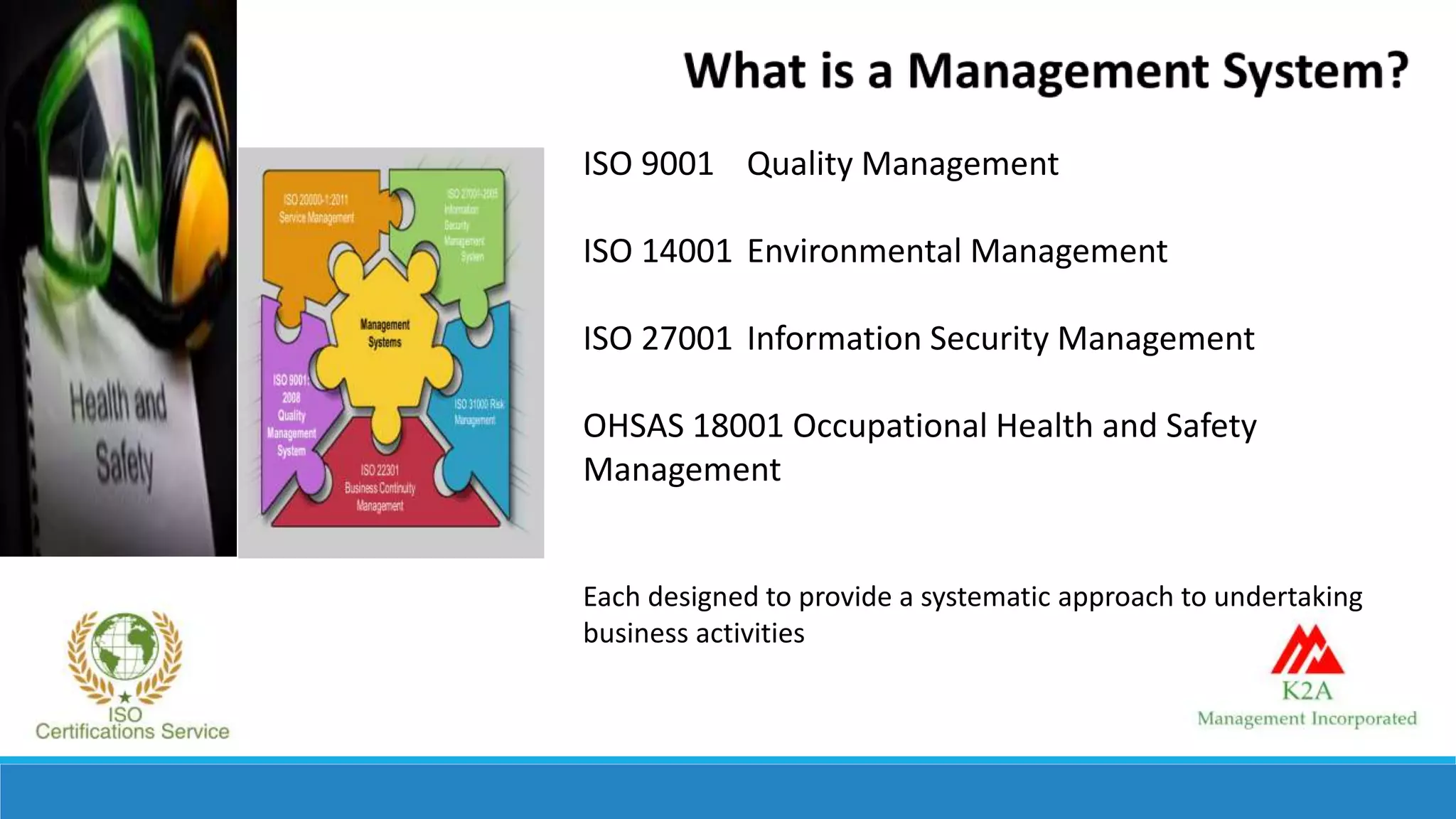
ISO 9001 QualityManagement
ISO 14001 Environmental Management
ISO 27001 Information Security Management
OHSAS 18001 Occupational Health and Safety
Management
Each designed to provide a systematic approach to undertaking
business activities
4.
• Management systemsare designed to be compatible, allowing
organisation to implement any or all that fit their business needs as either
stand alone or integrated systems.
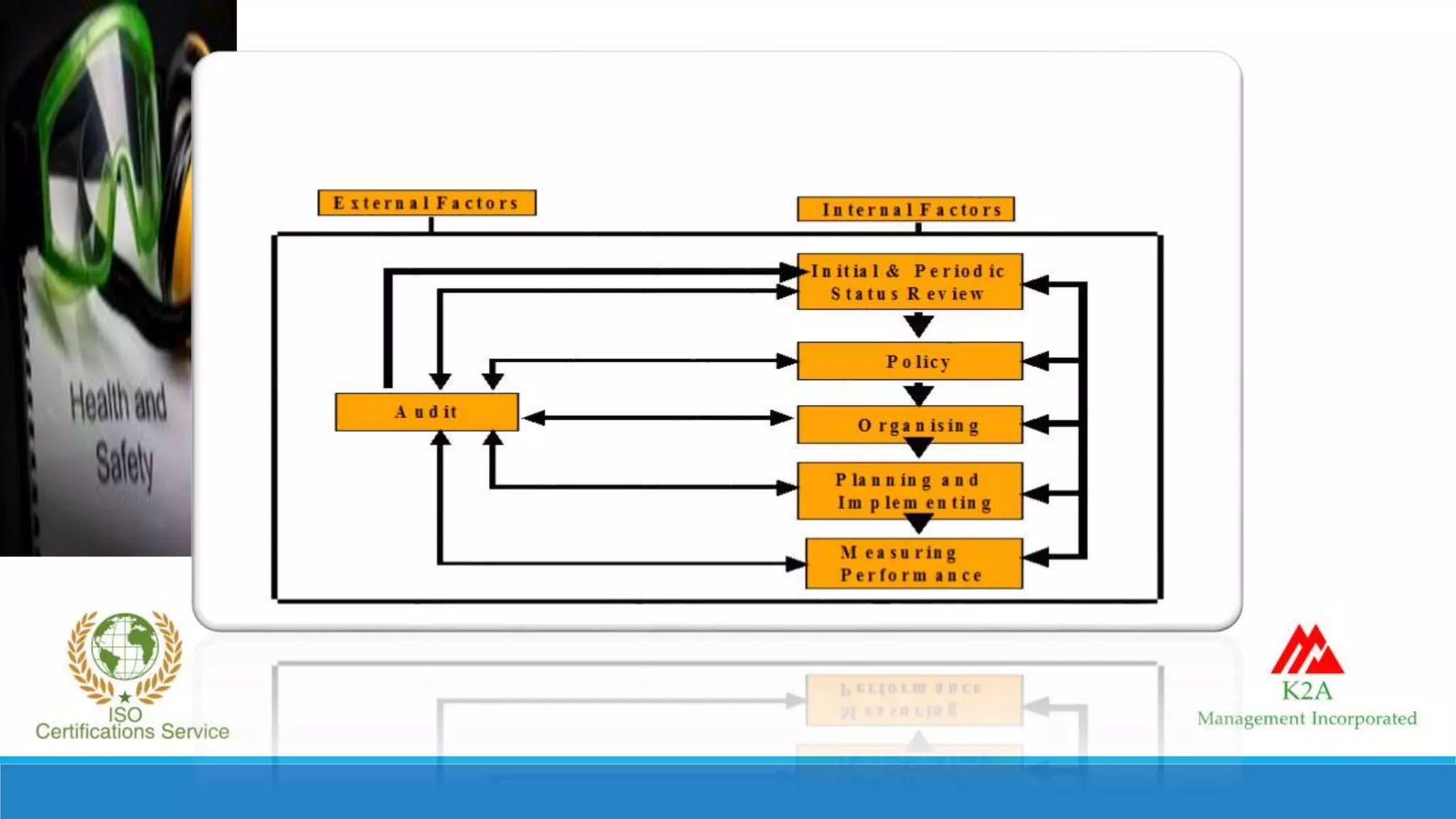
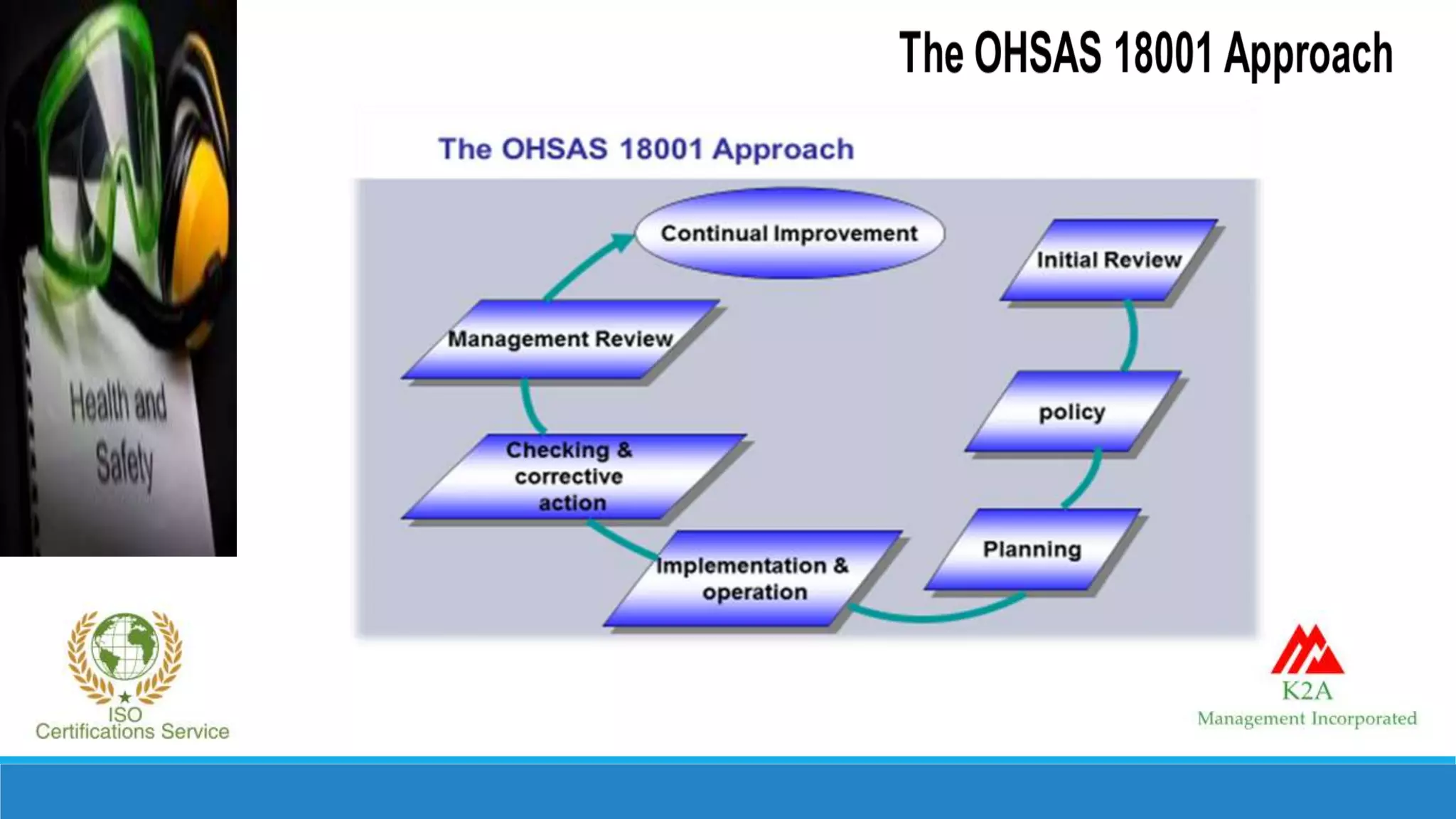
• Based on the Deming model - Plan – Do – Check – Act
• Comprising of five main elements
• Policy
• Planning
• Implementation and Operation
• Checking and Corrective Action
• Management Review
• And demonstrating a commitment to continual improvement
5.
• External auditsensure that operational controls are maintained
• Reduced risk of accidents and financial losses
• Use of the ‘Certification Body registered symbol’
• Maintain legal compliance
• Drive continual improvement
• 235 peoplekilled in the U.K. last year in work
related incidents
• 0.81 deaths per 100,000 workers
• 2.2 m people suffered from work related illness
• Employees working in SMEs are twice has likely to be seriously injured
or killed
9.
• 39 milliondays lost per annum
• 30 million days lost due to work related illness
• 9 million due lost due to injury
• Cost to business £25 billion per annum
• Uninsured costs typically 10 x more than insurance costs
10.
Company Law Review
•Private companies >£500million t/o
• PLCs > £50million t/o
• Fair and true Financial and Operating Report
• Information on risks and strategies
11.
• Evidence ofmanagement of risk
• Reduction in liability
• All factors that effect insurance premiums
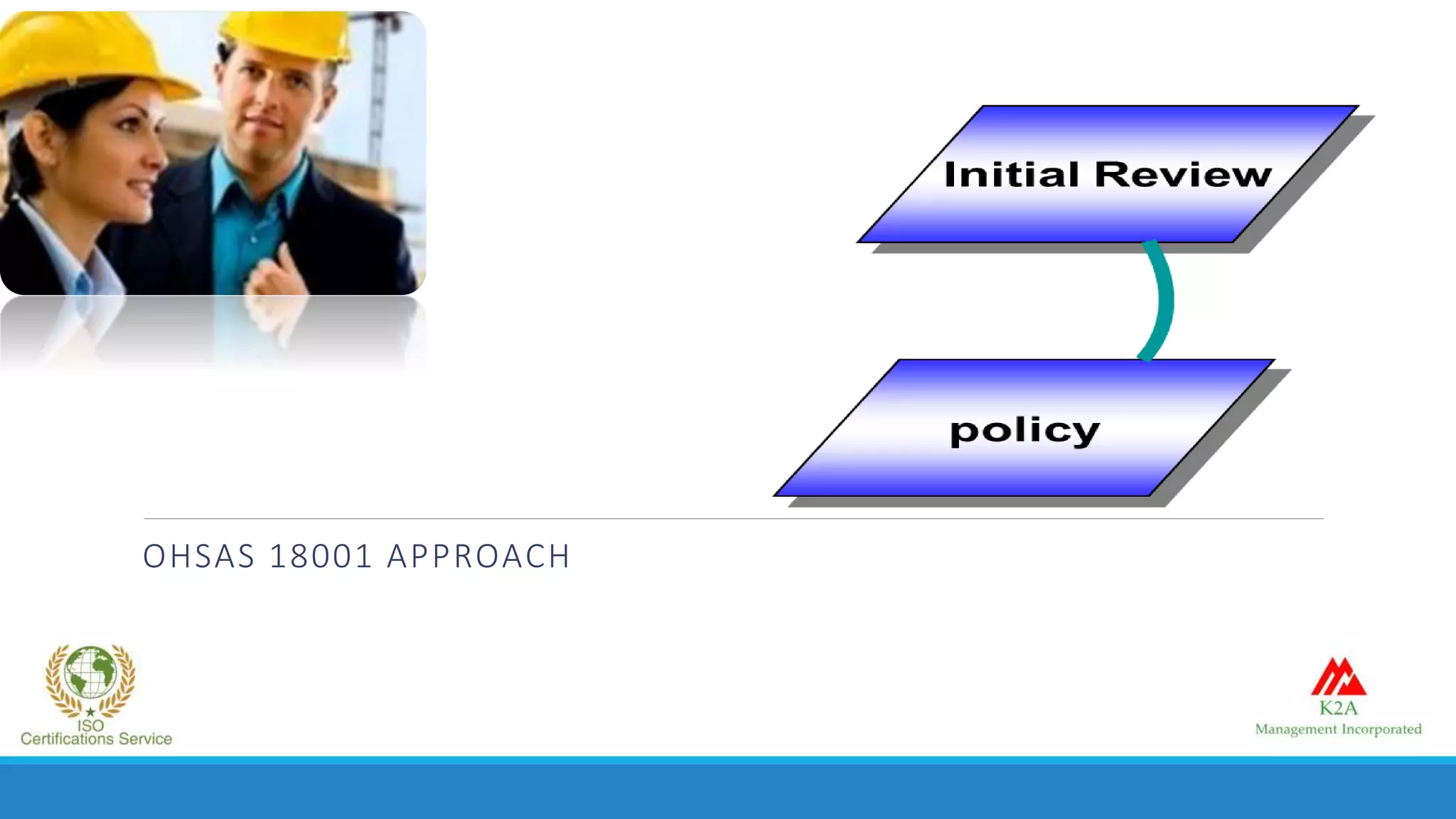
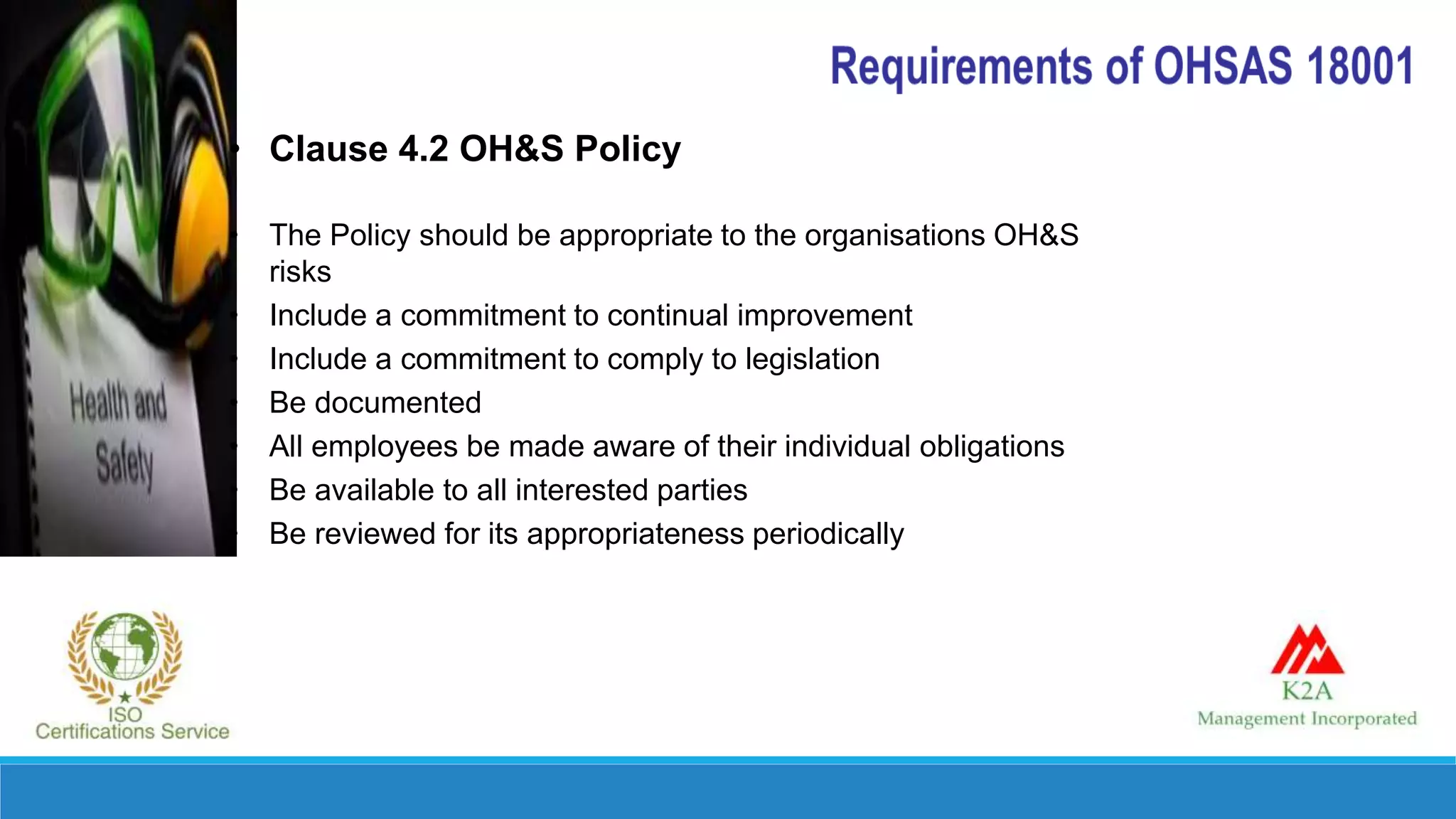
• Clause 4.2OH&S Policy
• The Policy should be appropriate to the organisations OH&S
risks
• Include a commitment to continual improvement
• Include a commitment to comply to legislation
• Be documented
• All employees be made aware of their individual obligations
• Be available to all interested parties
• Be reviewed for its appropriateness periodically
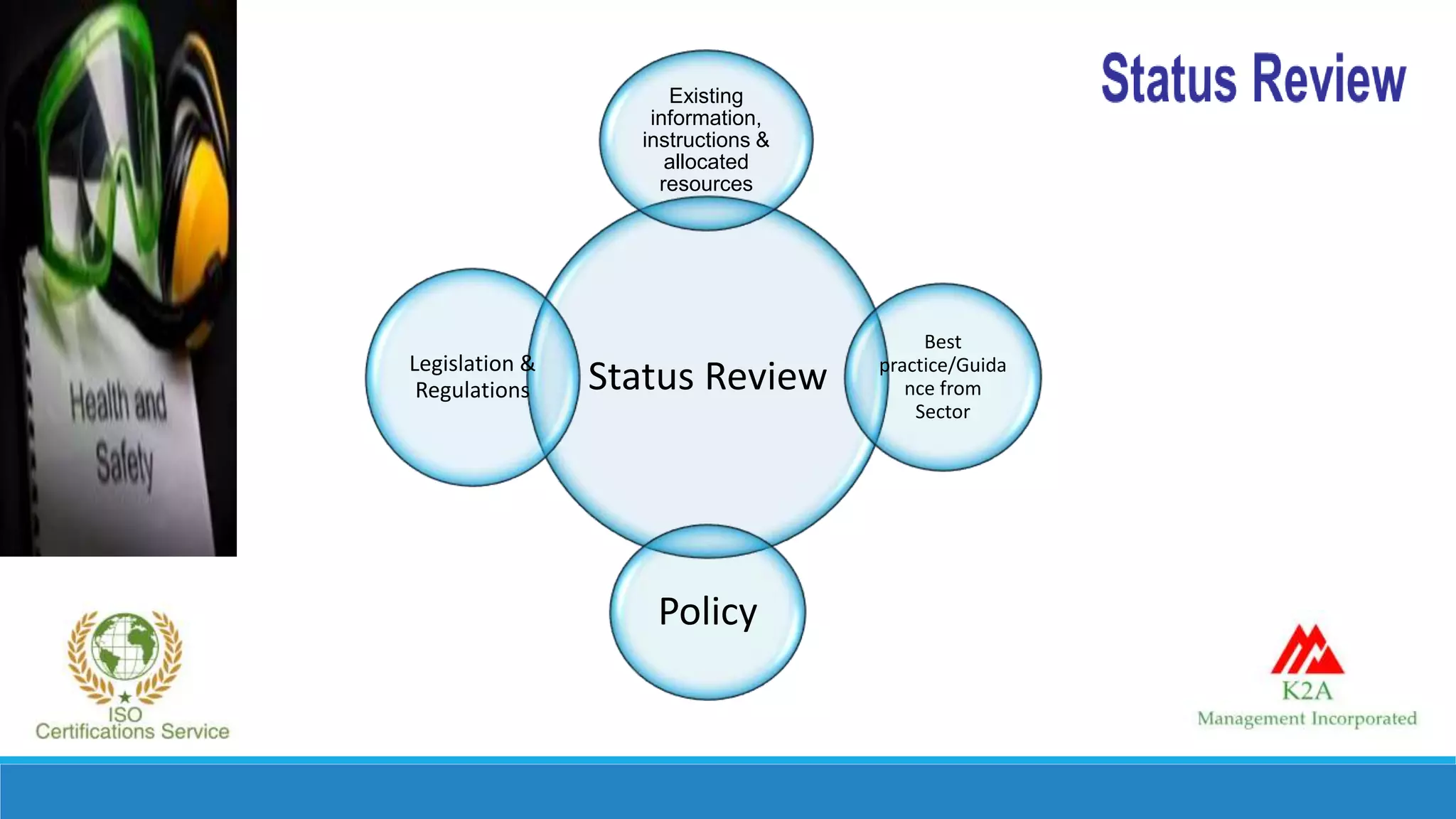
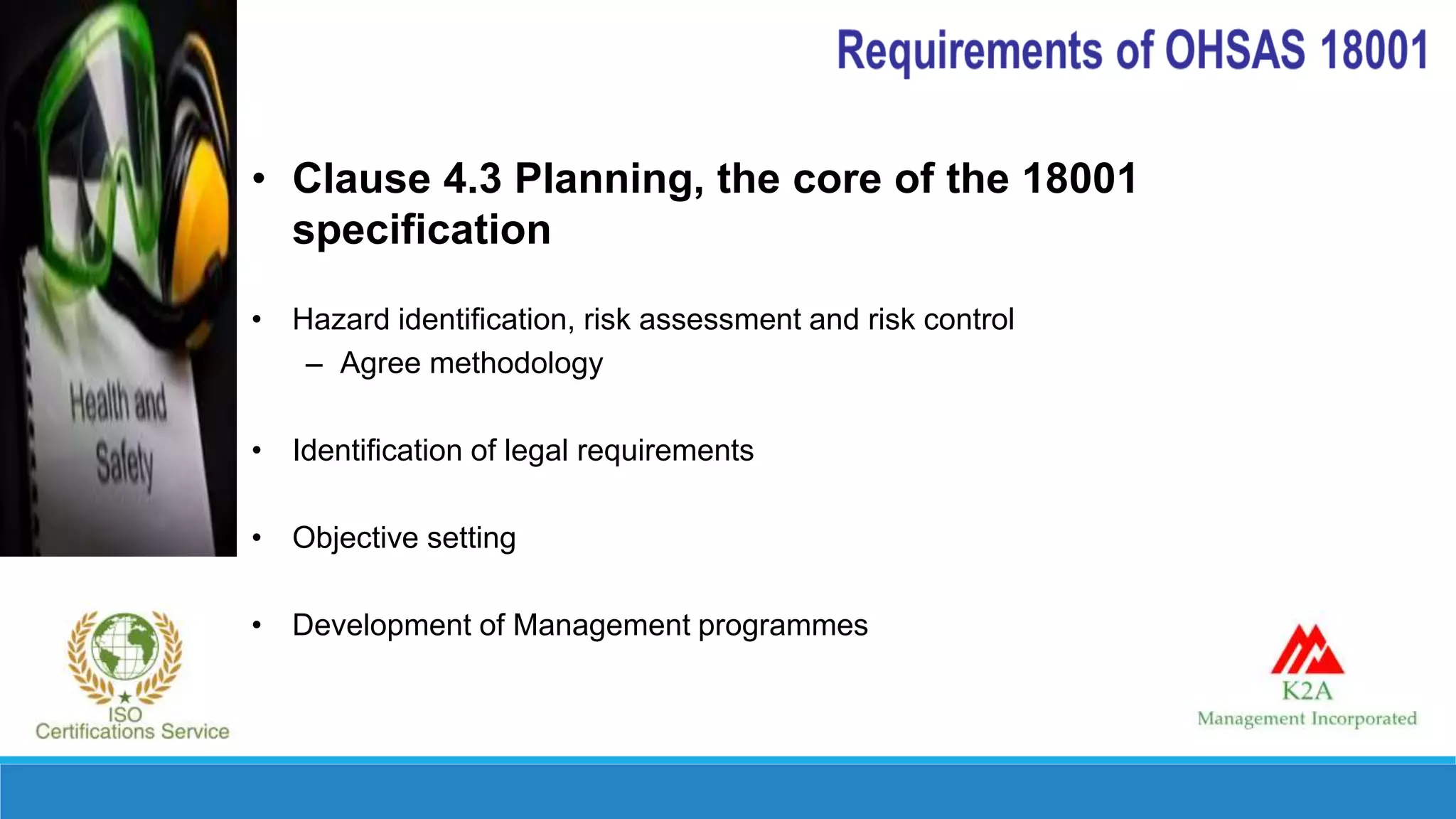
• Clause 4.3Planning, the core of the 18001
specification
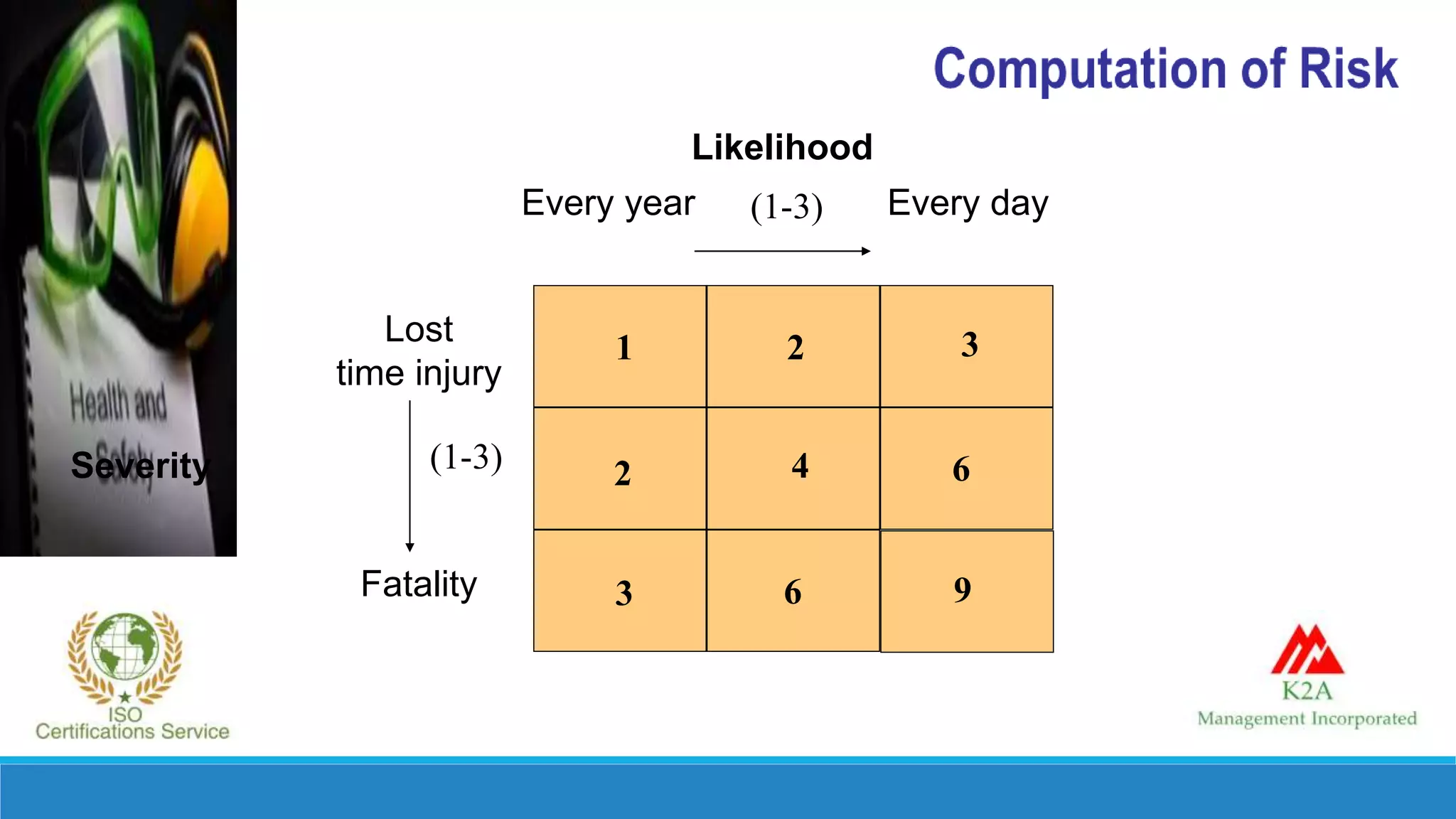
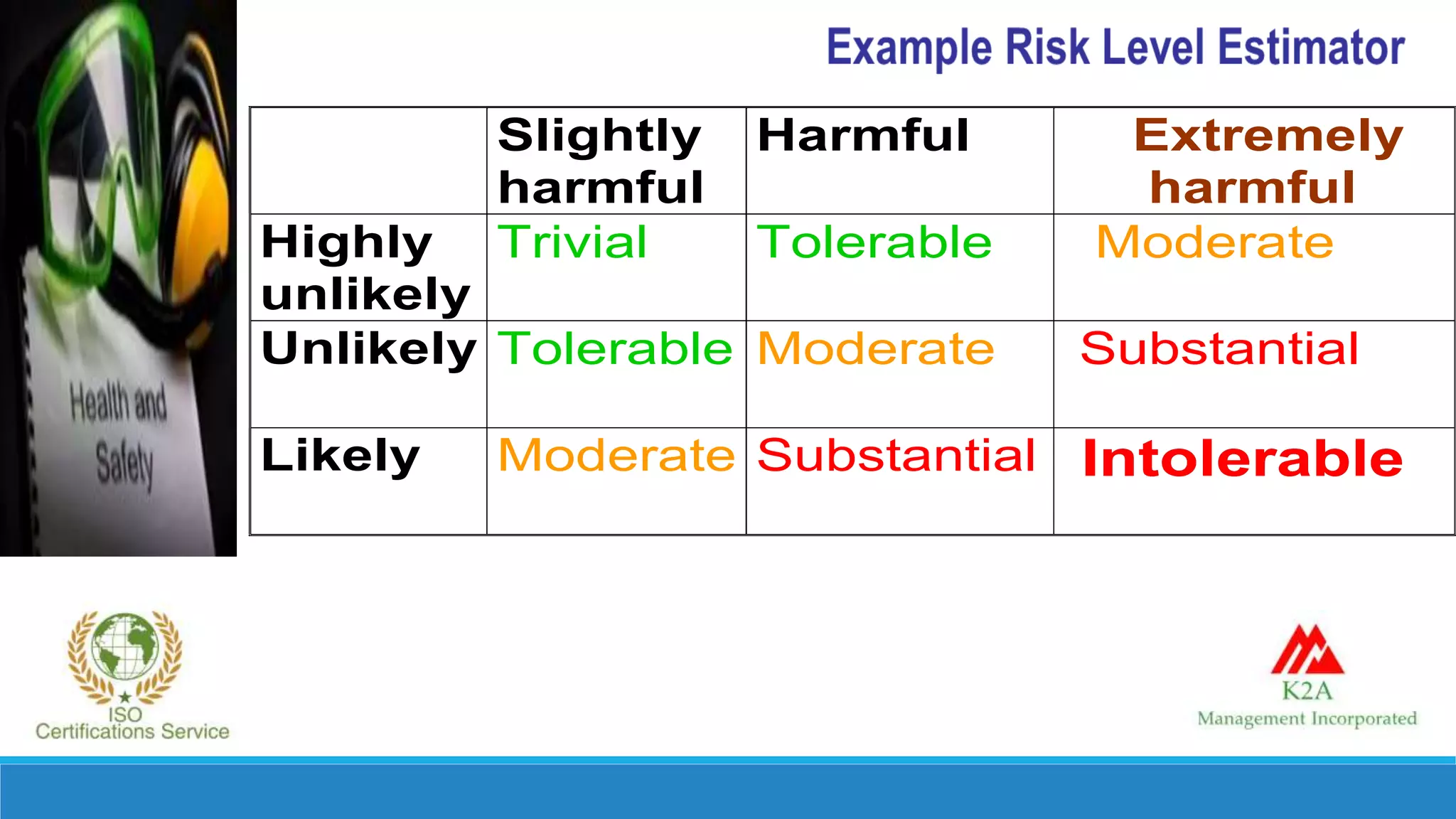
• Hazard identification, risk assessment and risk control
– Agree methodology
• Identification of legal requirements
• Objective setting
• Development of Management programmes
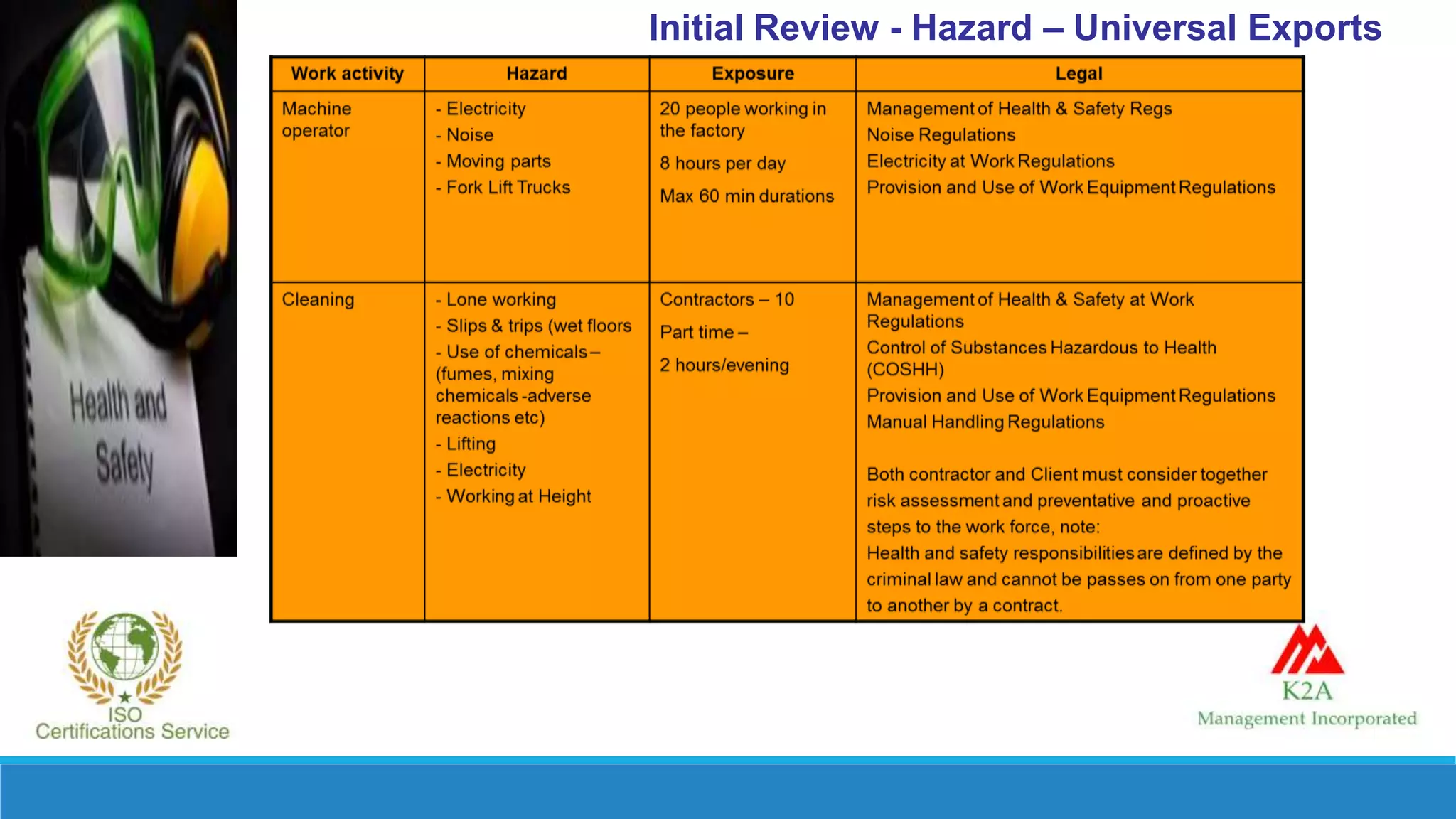
Work activity HazardExposure Legal Control
measures
risk priority
Machine
operation
- Electricity
- Noise
- Moving parts
- Fork Lift
Trucks
20 people working in
the factory
8 hours per day
Max 60 min
durations
Management
Regs
Noise Regs
Electrical Regs
Welfare Regs
- Hearing
protection
available
- Guards (fixed)
- Maintenance
- PAT Testing
- Trained
operators
Tolerable Priority 3
(low)
27.
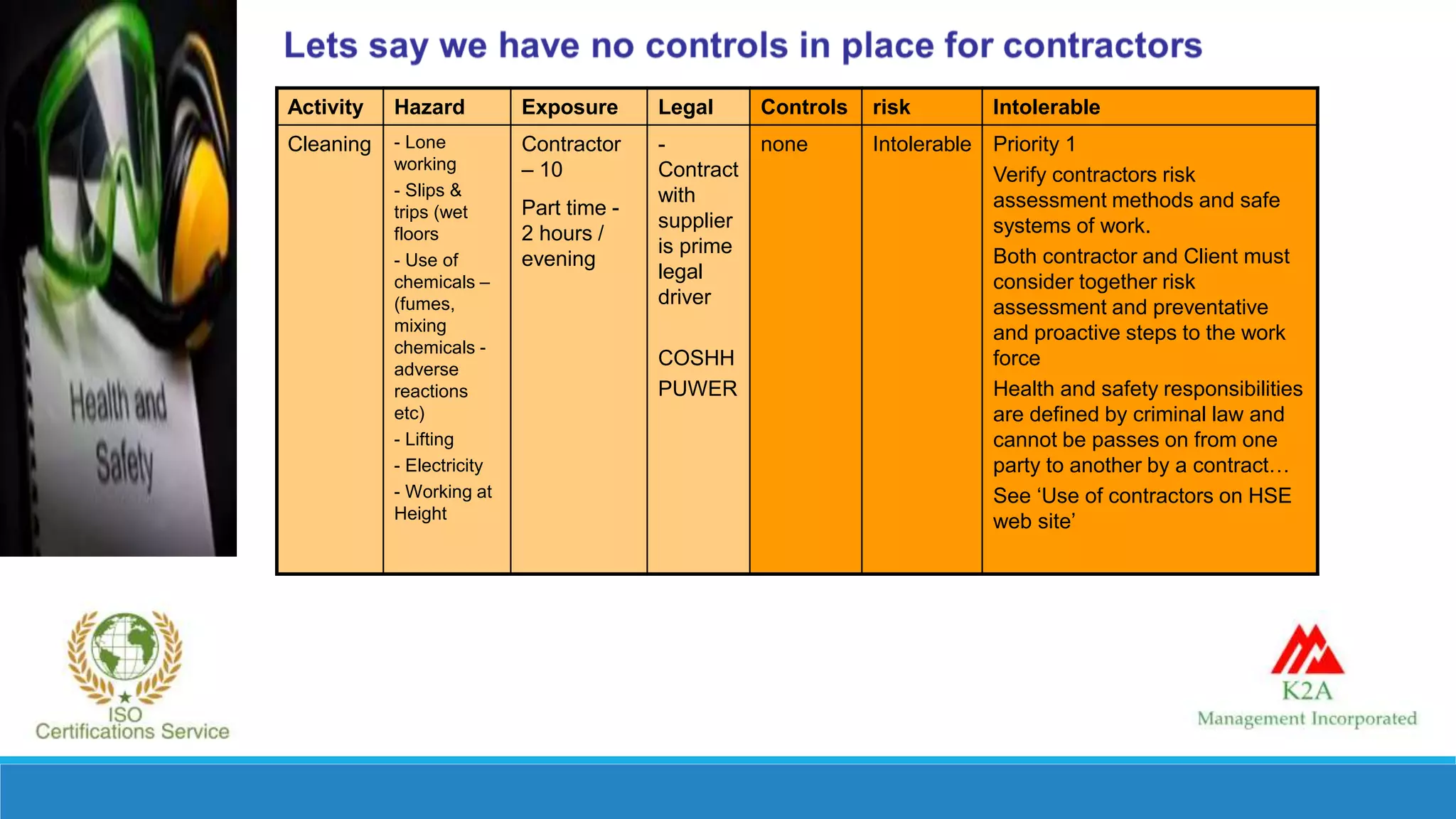
Activity Hazard ExposureLegal Controls risk Intolerable
Cleaning - Lone
working
- Slips &
trips (wet
floors
- Use of
chemicals –
(fumes,
mixing
chemicals -
adverse
reactions
etc)
- Lifting
- Electricity
- Working at
Height
Contractor
– 10
Part time -
2 hours /
evening
-
Contract
with
supplier
is prime
legal
driver
COSHH
PUWER
none Intolerable Priority 1
Verify contractors risk
assessment methods and safe
systems of work.
Both contractor and Client must
consider together risk
assessment and preventative
and proactive steps to the work
force
Health and safety responsibilities
are defined by criminal law and
cannot be passes on from one
party to another by a contract…
See ‘Use of contractors on HSE
web site’
28.
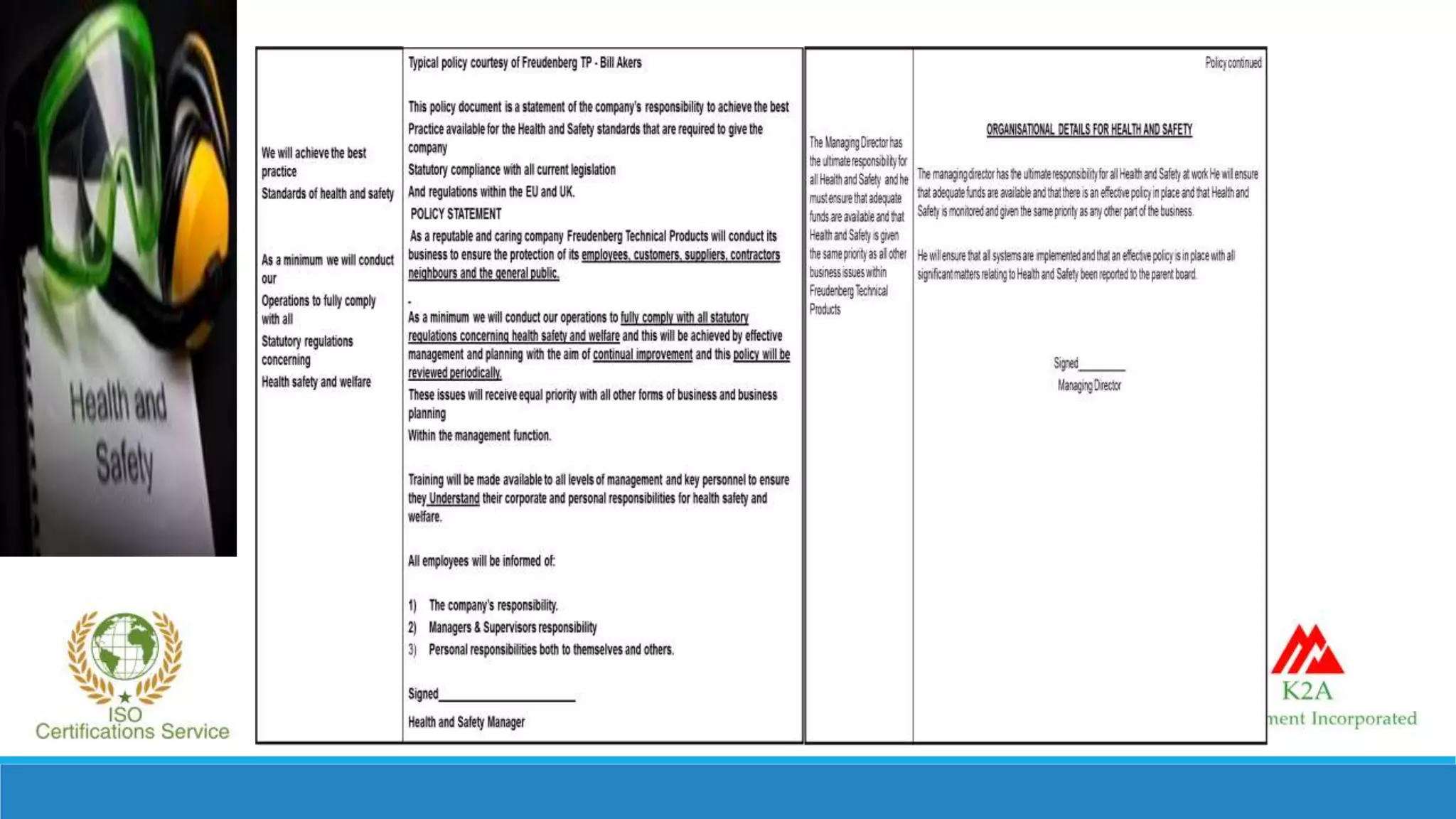
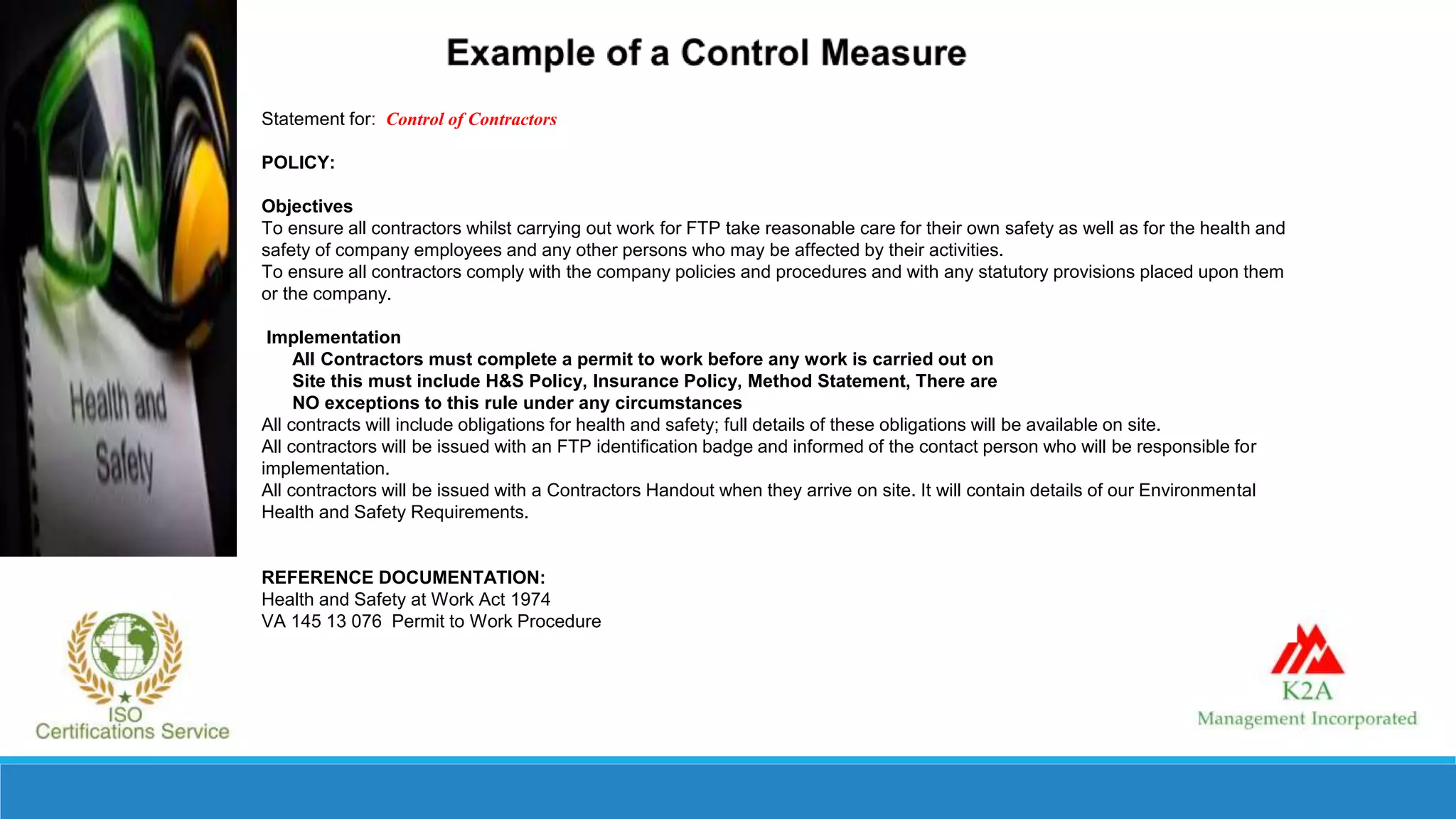
Statement for: Controlof Contractors
POLICY:
Objectives
To ensure all contractors whilst carrying out work for FTP take reasonable care for their own safety as well as for the health and
safety of company employees and any other persons who may be affected by their activities.
To ensure all contractors comply with the company policies and procedures and with any statutory provisions placed upon them
or the company.
Implementation
All Contractors must complete a permit to work before any work is carried out on
Site this must include H&S Policy, Insurance Policy, Method Statement, There are
NO exceptions to this rule under any circumstances
All contracts will include obligations for health and safety; full details of these obligations will be available on site.
All contractors will be issued with an FTP identification badge and informed of the contact person who will be responsible for
implementation.
All contractors will be issued with a Contractors Handout when they arrive on site. It will contain details of our Environmental
Health and Safety Requirements.
REFERENCE DOCUMENTATION:
Health and Safety at Work Act 1974
VA 145 13 076 Permit to Work Procedure
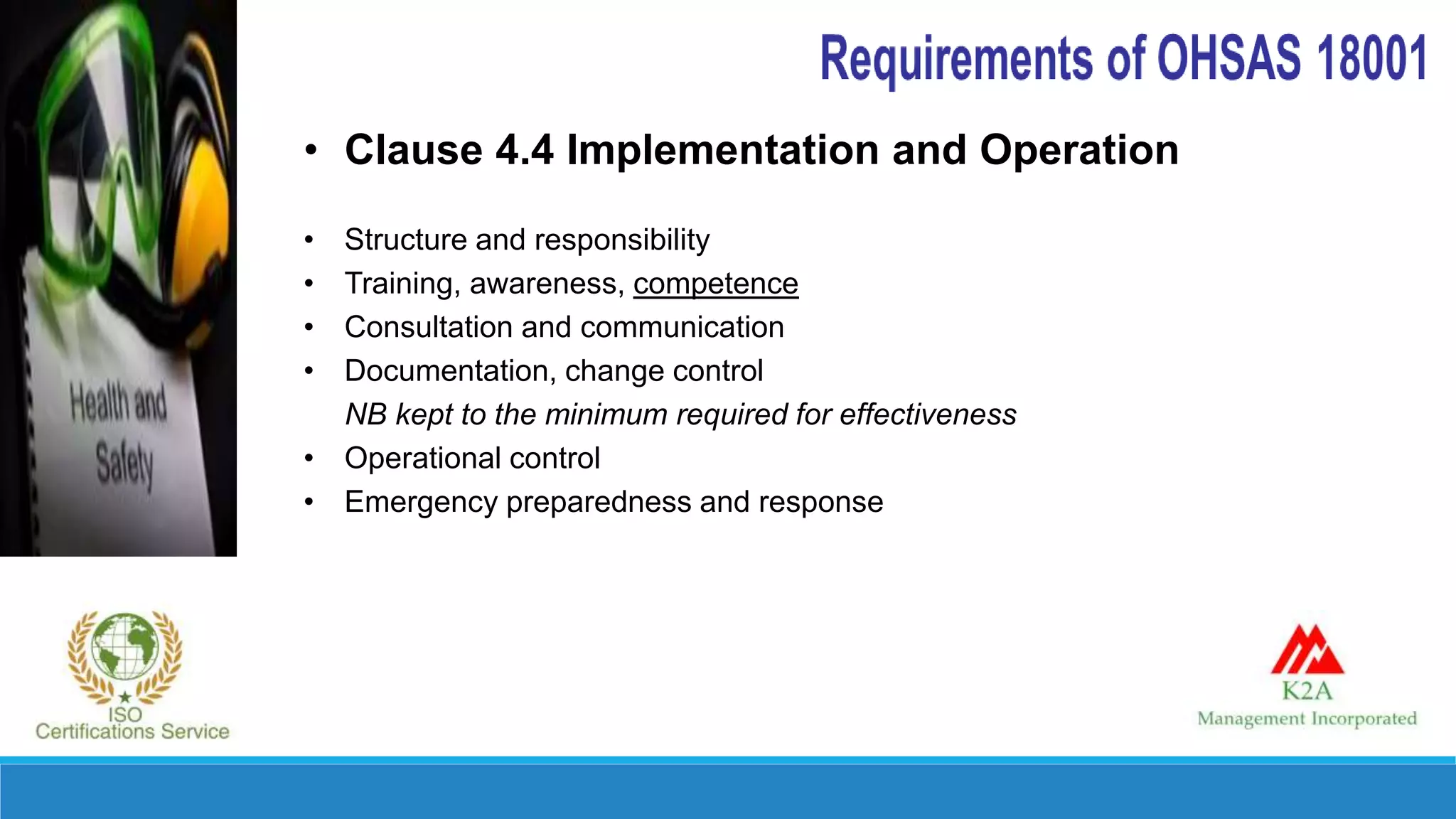
• Clause 4.4Implementation and Operation
• Structure and responsibility
• Training, awareness, competence
• Consultation and communication
• Documentation, change control
NB kept to the minimum required for effectiveness
• Operational control
• Emergency preparedness and response
31.
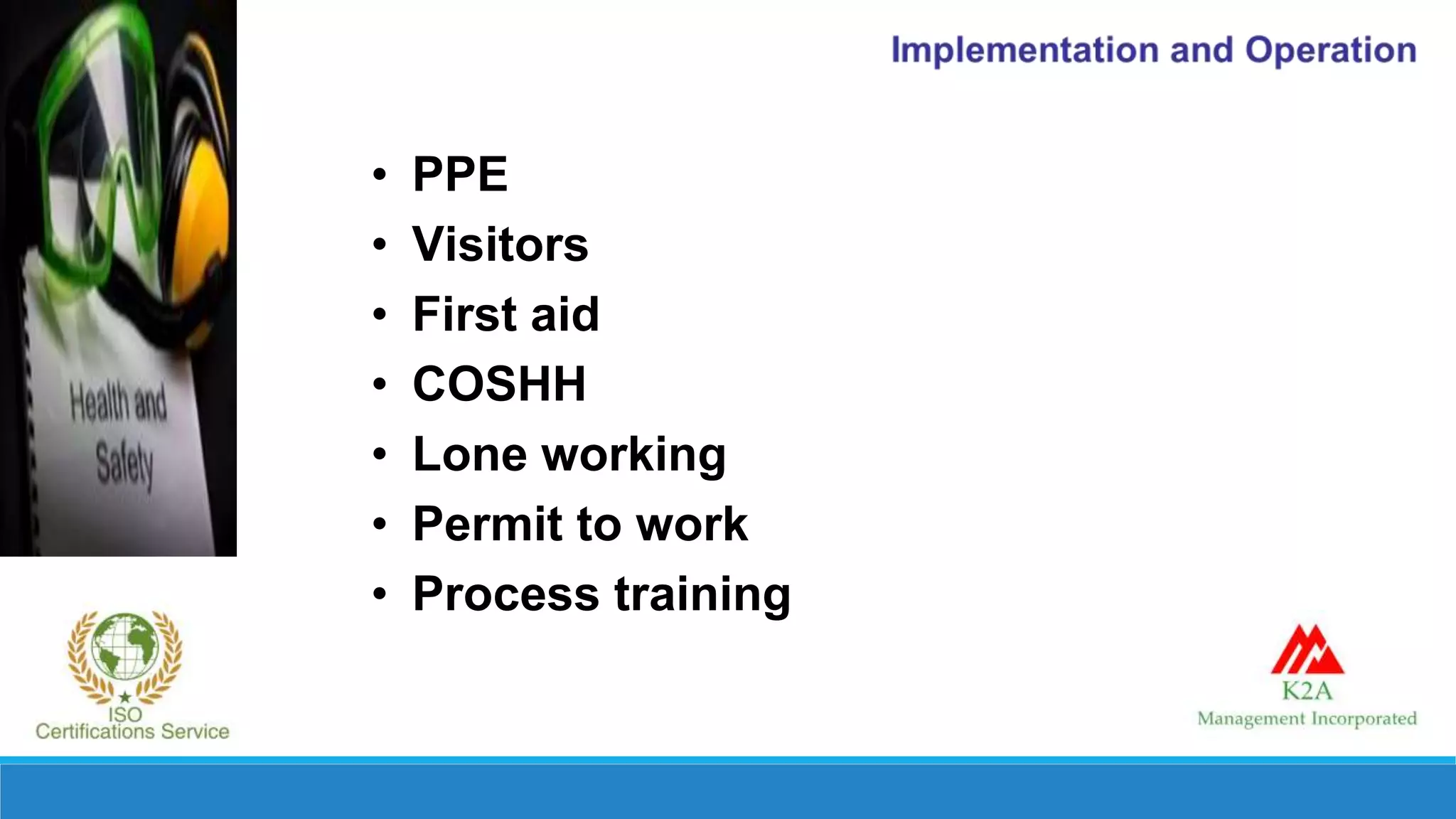
• PPE
• Visitors
•First aid
• COSHH
• Lone working
• Permit to work
• Process training
32.
MANAGERS
Each manager isresponsible for the day-to-day safety of his work area and all employees under
his control.
To this end he will ensure that all employees fully understand the company Health and Safety
Policy and that all company directives and procedures are fully complied with.
The manager will ensure that his department has documented procedures for all Health and
Safety and auditing standards..
a) The provision and maintenance of safe plant and equipment and all safe systems of work.
b) The provision for safe storage handling and transportation of articles and substances.
c) The provision of information instruction training and supervision.
d) The provision of safe access and egress
e) The provision of a safe working environment
f) The provision of good welfare facilities.
g) The provision of First Aid and Occupational Health facilities
h) Ensure any new machinery either purchased or delivered complies with all existing Health
and Safety legislation
i) Prior to going into production.
To assist in achieving these standards a full time Safety Manger will provide advice and
resources to each of the business managers.
Risk Assessments will be carried out on a 18 Month cycle except when the risk becomes
intolerable or when a change in production is to be carried out Managers must ensure that the
Safety Department is aware of all changes taking place that include any form or movement of
machinery.
Trained personnel must only carry out risk Assessments.
33.
Supervisors and TeamLeaders
On a day-to-day basis the Supervisor or Team Leader have control of health safety and welfare within their
respective areas.
They must be familiar with the company’s Safety Policy and actively support the company on any Safety
matters this will include attendance at monthly Safety meetings and the support of any Safety training that
may be taking place.
Their specific responsibilities will include
1) Ensuring that all machinery and equipment is safe and maintained as appropriate.
2) Report all accidents near misses and dangerous occurrences and ensure that the required
investigations are carried out
3) Ensure that all employees under their control carryout their duties in a safe way at all times while at
work.
4) Maintain a good standard of housekeeping at all times
5) Make recommendations to their business manager on matters regarding Health Safety and Welfare.
34.
Safety Representatives.
Freudenberg TechnicalProducts fully supports employee representation on health safety and welfare
matters.
The company views Safety Representatives as playing a key role in consultations with the employer and
considers the Safety Representative to be one of the main links of any Health and Safety Committee.
In addition to this The Safety Representative shall promote Health and Safety to all employees and will have
the following functions
1) They will investigate complaints by an employee that relate to that employee’s Health Safety and
Welfare.
2) They will make representations to the employer on matters regarding Health Safety and Welfare.
3) They will make representations to the employer on general matters that may have Health and Safety
Concerns.
4) Carryout inspections of the workplace and document in accordance with company procedures.
5) Represent all employees in consultation with officers and inspectors of the Health and Safety Executive
or any other enforcing authority.
6) Receive any instructions or information from officers or inspectors affecting the employee’s health
safety and welfare.
Safety Representatives should receive training to give them the skill and knowledge that will allow them to
fulfil their obligations.
Safety Representatives names should be included in any Inductions given to new employees.
35.
Employees. All employeeshave a Legal Duty while at work TO:
1) Take responsibility for their own and that of others Health and Safety and except responsibility for all of there acts or omissions whilst in
the place of work.
Co-Operate with their employer at all times enabling the employer to comply with all duties and requirements that may be placed upon them.
3) Report to the Supervisor or Manager any faults in plant machinery and equipment or indeed any dangerous situation.
4) Not interfere with or misuse anything that belongs to the company that is in the best interests of Health and Safety
5) Comply with all Health and Safety Instructions given to them by any person in authority.
Reporting of Faults and Dangerous Situations.
Every employee has a legal duty to report to there Team Leader or Supervisor any faults to any plant or equipment.
If the response they receive is not satisfactory then they should contact the Health and Safety Department.
36.
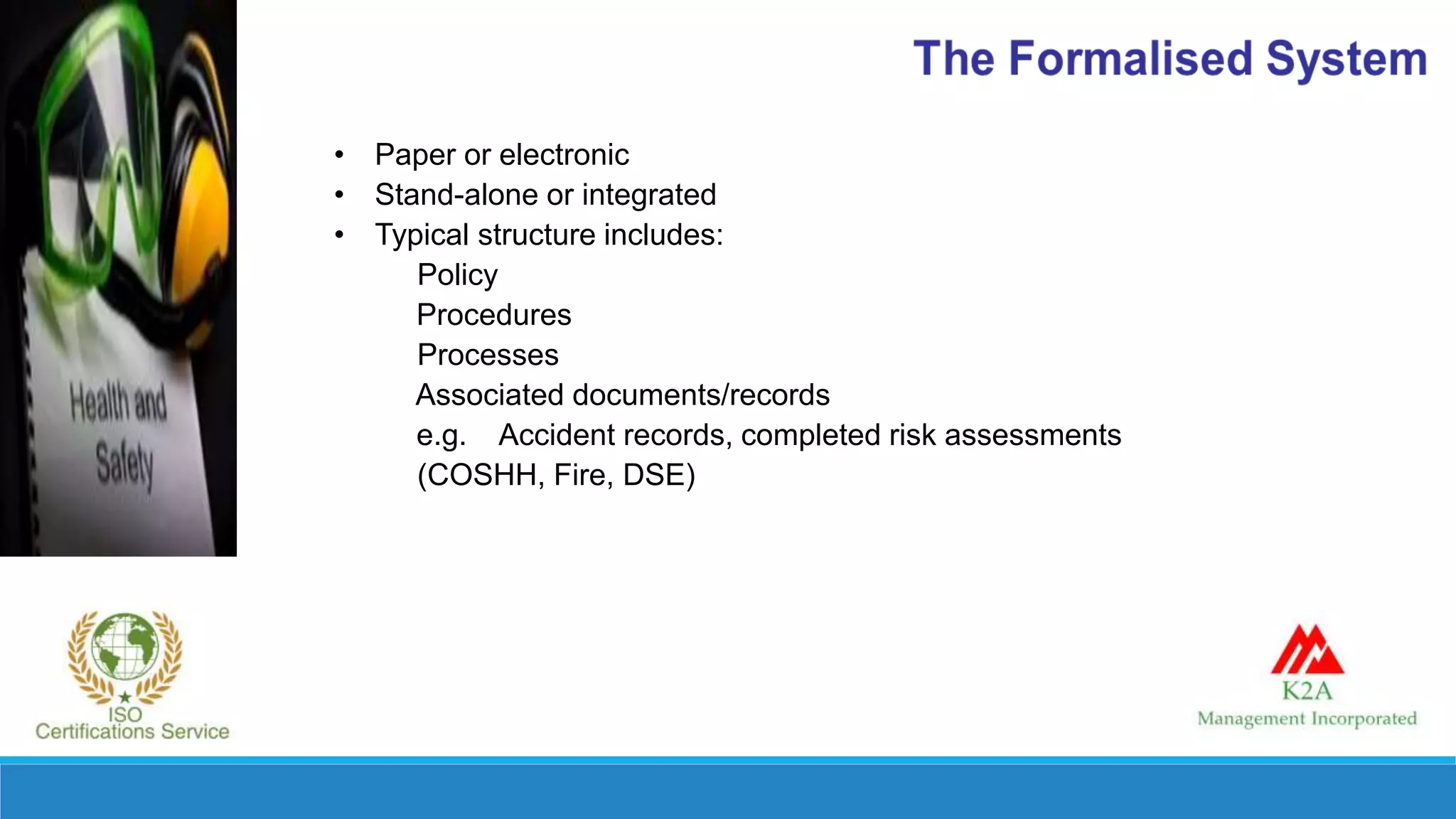
• Paper orelectronic
• Stand-alone or integrated
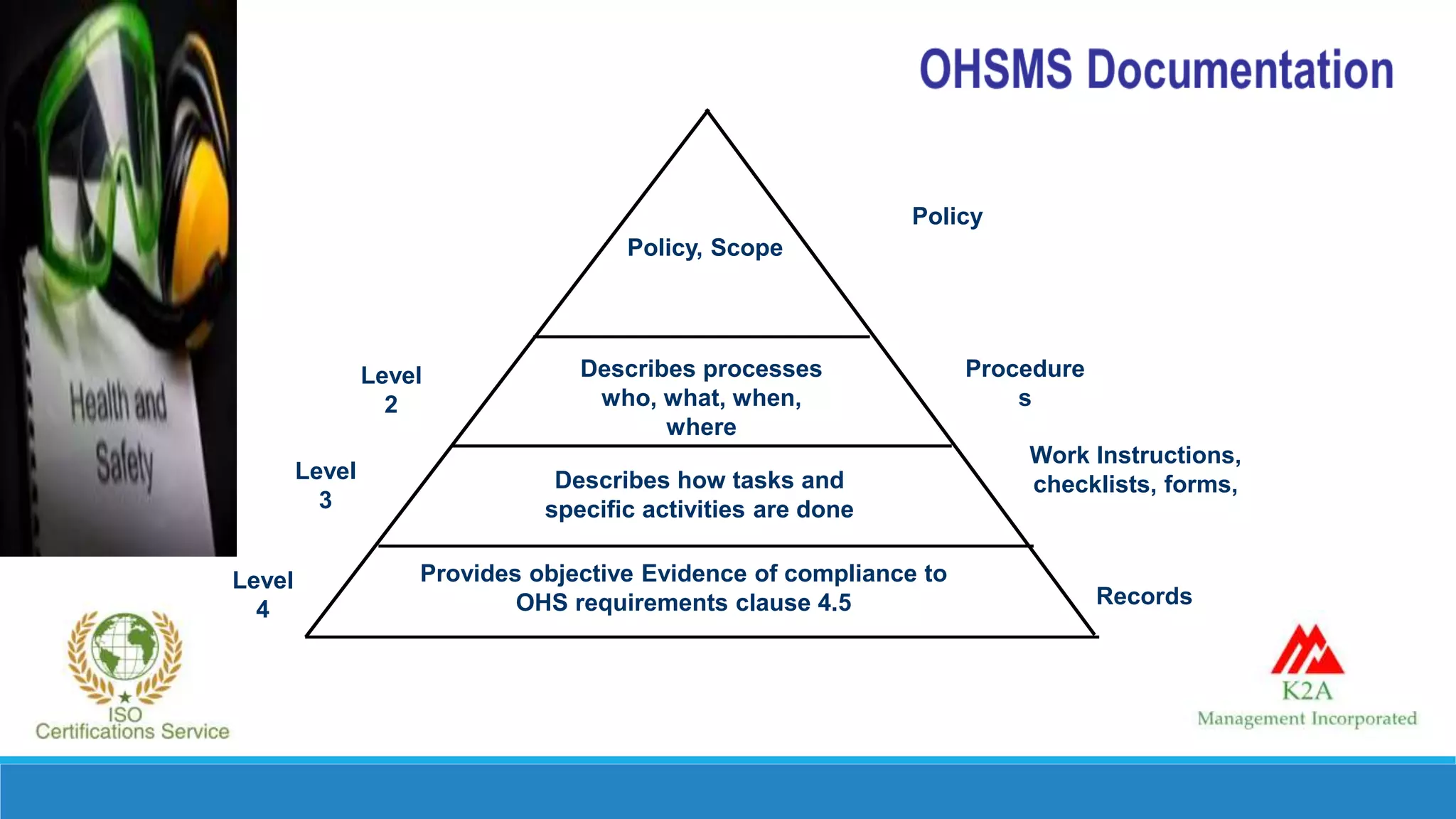
• Typical structure includes:
Policy
Procedures
Processes
Associated documents/records
e.g. Accident records, completed risk assessments
(COSHH, Fire, DSE)
• Clause 4.5Checking and corrective action
• Performance measuring and monitoring
• Accident, incident, non-conformance and corrective and preventive actions
• Records and records management
• Audits
40.
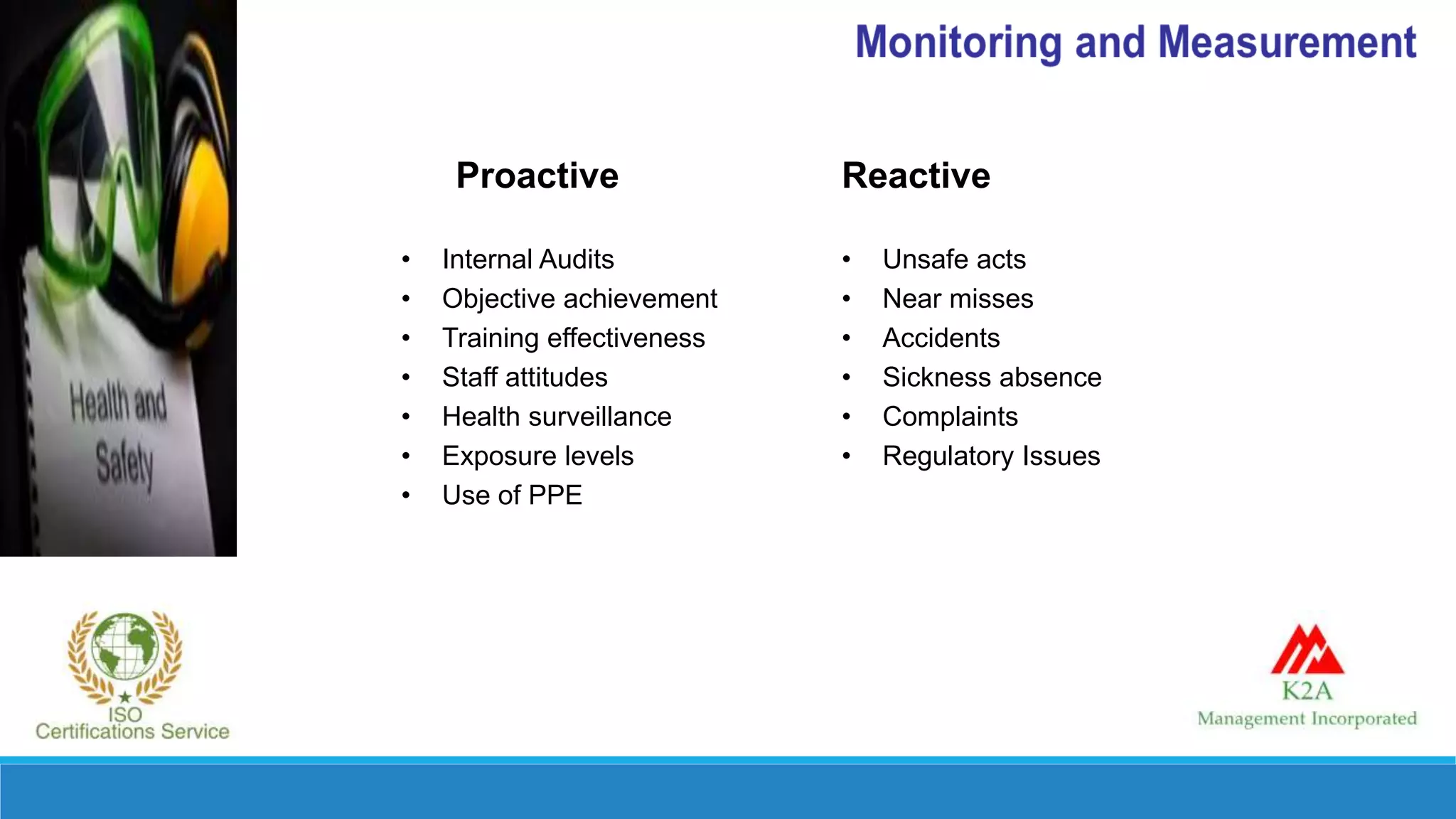
Proactive
• Internal Audits
•Objective achievement
• Training effectiveness
• Staff attitudes
• Health surveillance
• Exposure levels
• Use of PPE
Reactive
• Unsafe acts
• Near misses
• Accidents
• Sickness absence
• Complaints
• Regulatory Issues
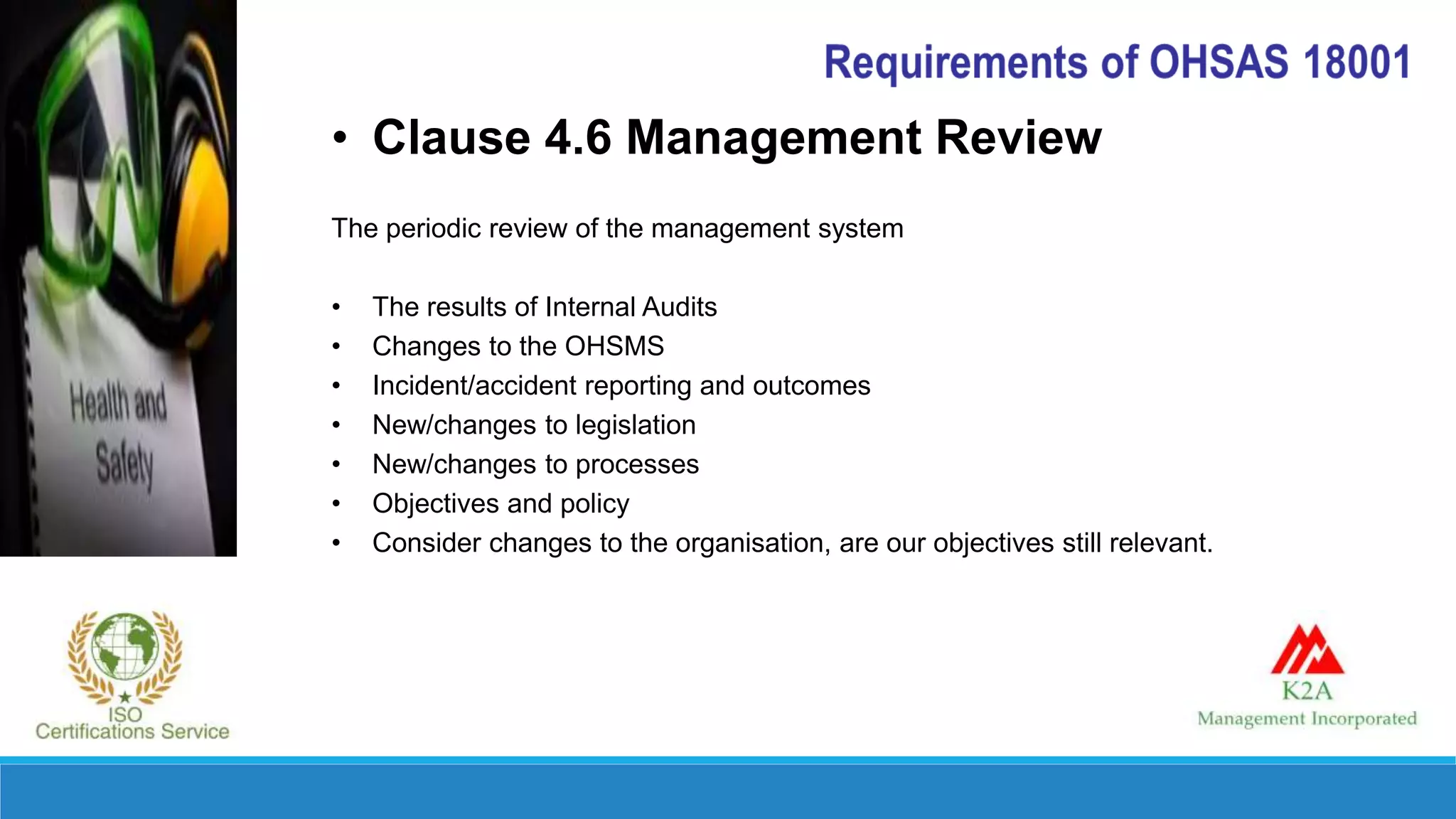
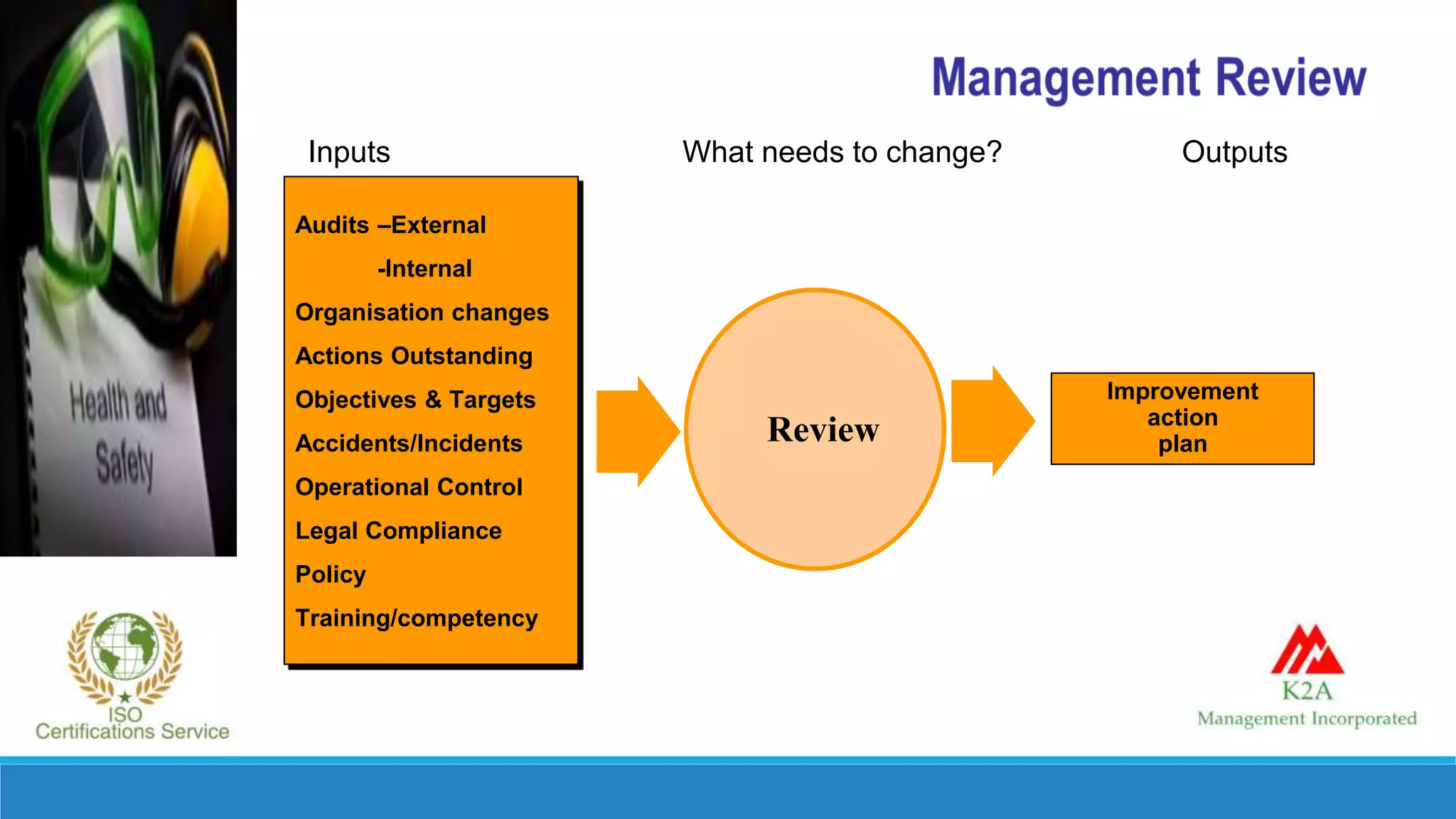
• Clause 4.6Management Review
The periodic review of the management system
• The results of Internal Audits
• Changes to the OHSMS
• Incident/accident reporting and outcomes
• New/changes to legislation
• New/changes to processes
• Objectives and policy
• Consider changes to the organisation, are our objectives still relevant.