Amit Pandit
M. Pharmacy II sem
Neucleophile
 As electron pair donors, nucleophiles must
either contain an electron pair that is easily
available because it is nonbonding or they
must contain a bonding electron pair that
can be donated from the bond involved and
thus be made available to the reaction
partner.
 From this it follows that nucleophiles are
usually anions or neutral species but not
cations.
Good and Poor Nucleophiles
 Within a group of nucleophiles that
attack at the electrophile with the same
atom, the nucleophilicity decreases with
decreasing basicity of the nucleophile
 Nucleophilicity is a measure of how
readily a compound (a nucleophile) is
able to attack an electron-deficient atom.
Nucleophilicity of O nucleophiles
with different basicities.
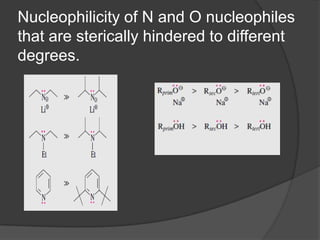
Nucleophilicity of N and O nucleophiles
that are sterically hindered to different
degrees.
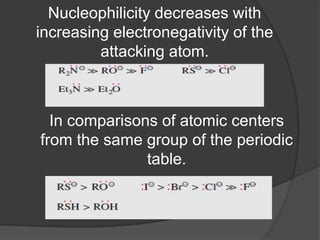
Nucleophilicity decreases with
increasing electronegativity of the
attacking atom.
In comparisons of atomic centers
from the same group of the periodic
table.
The nucleophilicity of a given nucleophilic center is
increased by attached heteroatoms that possess
free electron pairs (-effect)
Nucleophilic Aliphatic
substitution
To ensure that reaction occurs in homogeneous solution, solvents are
chosen that dissolve both the alkyl halide and the ionic salt. The alkyl
halide substrates are soluble in organic solvents, but the salts often are
not. Inorganic salts are soluble in water, but alkyl halides are not. Mixed
solvents such as ethanol–water mixtures that can dissolve enough of
both the substrate and the nucleophile to give fairly concentrated
solutions are frequently used. Many salts, as well as most alkyl halides,
possess significant solubility in dimethyl sulfoxide (DMSO), which makes
this a good medium for carrying out nucleophilic substitution reactions.
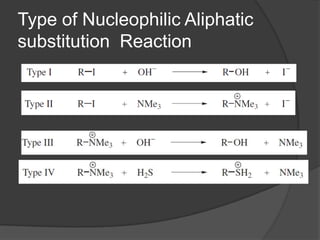
Type of Nucleophilic Aliphatic
substitution Reaction
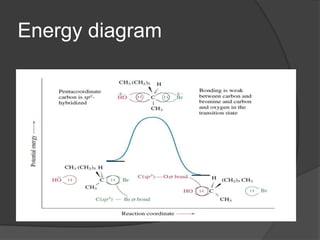
The SN2 Mechanism
 a single step process
 Involves no intermediates
 Involves only one transition state, which is of
low polarity
 Follows second order (bimolecular) kinetics.
That is, rate=k[substrate][nucleophile]
 backside attack
Energy diagram
Factors Affecting SN2
Reactions
 The Leaving Group
 The Nucleophile
 The Effect of the Solvent
 Steric Effects
Factors Affecting SN2
Reactions :The Leaving
Group
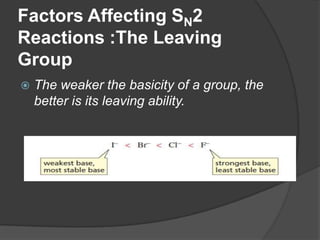
 The weaker the basicity of a group, the
better is its leaving ability.
Factors Affecting SN2
Reactions : The Nucleophile
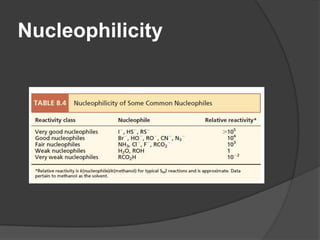
 the stronger bases are the better
nucleophiles
Nucleophilicity
The Effect of the Solvent
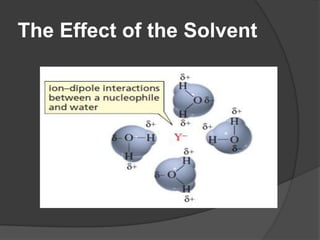
 In a protic solvent, is the smallest atom the poorest
nucleophile even though it is the strongest base.
 Protic solvents are hydrogen bond donors.
 The interaction between the ion and the dipole of the
protic solvent is called an ion–dipole interaction.
 Because the solvent shields the nucleophile, at least
one of the ion–dipole interactions must be broken
before the nucleophile can participate in a SN2
reaction.
 Weak bases interact weakly with protic
solvents, whereas strong bases interact more
strongly because they are better at sharing their
electrons.
The Effect of the Solvent
STERIC EFFECTS IN SN2
REACTIONS
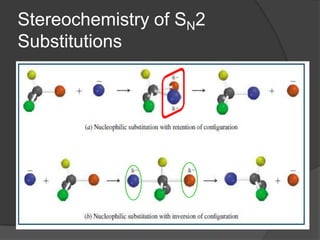
Stereochemistry of SN2
Substitutions
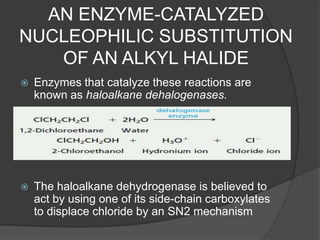
AN ENZYME-CATALYZED
NUCLEOPHILIC SUBSTITUTION
OF AN ALKYL HALIDE
 Enzymes that catalyze these reactions are
known as haloalkane dehalogenases.
 The haloalkane dehydrogenase is believed to
act by using one of its side-chain carboxylates
to displace chloride by an SN2 mechanism
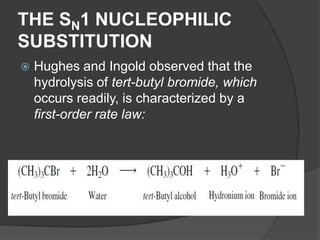
THE SN1 NUCLEOPHILIC
SUBSTITUTION
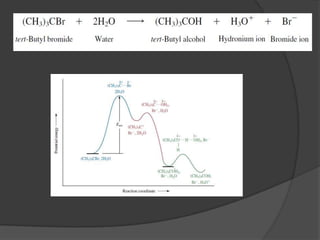
 Hughes and Ingold observed that the
hydrolysis of tert-butyl bromide, which
occurs readily, is characterized by a
first-order rate law:
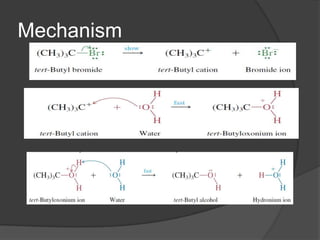
Mechanism
Experimental Evidence
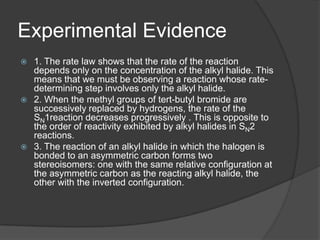
 1. The rate law shows that the rate of the reaction
depends only on the concentration of the alkyl halide. This
means that we must be observing a reaction whose rate-
determining step involves only the alkyl halide.
 2. When the methyl groups of tert-butyl bromide are
successively replaced by hydrogens, the rate of the
SN1reaction decreases progressively . This is opposite to
the order of reactivity exhibited by alkyl halides in SN2
reactions.
 3. The reaction of an alkyl halide in which the halogen is
bonded to an asymmetric carbon forms two
stereoisomers: one with the same relative configuration at
the asymmetric carbon as the reacting alkyl halide, the
other with the inverted configuration.
Reactivity
Factors Affecting SN1 Reactions
 The Leaving Group
 The Solvent
 Carbocation Rearrangements
The Leaving Group
 two factors affect the rate of an reaction:
 the ease with which the leaving group
dissociates from the carbon
 the stability of the carbocation that is formed.
 The weaker the base, the less tightly it is
bonded to the carbon and the easier it is to
break the carbon–halogen bond.
 As a result, an alkyl iodide is the most
reactive and an alkyl fluoride is the least
reactive of the alkyl halides
The Solvent
 The major effect of the solvent is on the rate of
nucleophilic substitution, not on what the
products are.
 The higher the dielectric constant of solvent
(polar) , the better the medium is able to
support separated positively and negatively
charged species.
 The rate of solvolysis of tert-butyl chloride
increases dramatically as the dielectric
constant of the solvent increases.
 Aprotic solvents, lack OH groups and do not
solvate anions very strongly, leaving them
much more able to express their nucleophilic
character.
Carbocation Rearrangements
Stabilization of Carbocation
STEREOCHEMISTRY OF SN1
REACTIONS
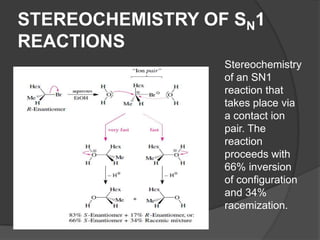
Stereochemistry
of an SN1
reaction that
takes place via
a contact ion
pair. The
reaction
proceeds with
66% inversion
of configuration
and 34%
racemization.
SN1 and SN2
SN1 and SN2
SN1 and SN2
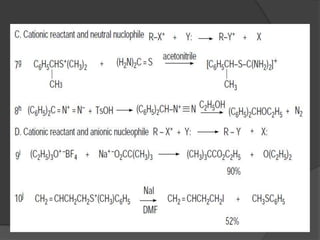
Representative Nucleophilic
Substitution Reactions
Reference
 Advanced Organic Chemistry Reaction
Mechanisms Elsevier, 2002
 ORGANIC CHEMISTRY Francis A.
Carey University of Virginia
 MARCH’S ADVANCED ORGANIC
CHEMISTRY
REACTIONS, MECHANISMS, AND
STRUCTURE, SIXTH EDITION Michael
B. Smith, Jerry March
 ORGANIC CHEMISTRY , PAULA
YURKANIS BRUICE, 4th edition

Substitution Reaction

  • 1.
  • 2.
    Neucleophile  As electronpair donors, nucleophiles must either contain an electron pair that is easily available because it is nonbonding or they must contain a bonding electron pair that can be donated from the bond involved and thus be made available to the reaction partner.  From this it follows that nucleophiles are usually anions or neutral species but not cations.
  • 3.
    Good and PoorNucleophiles  Within a group of nucleophiles that attack at the electrophile with the same atom, the nucleophilicity decreases with decreasing basicity of the nucleophile  Nucleophilicity is a measure of how readily a compound (a nucleophile) is able to attack an electron-deficient atom.
  • 4.
    Nucleophilicity of Onucleophiles with different basicities.
  • 5.
    Nucleophilicity of Nand O nucleophiles that are sterically hindered to different degrees.
  • 6.
    Nucleophilicity decreases with increasingelectronegativity of the attacking atom. In comparisons of atomic centers from the same group of the periodic table.
  • 7.
    The nucleophilicity ofa given nucleophilic center is increased by attached heteroatoms that possess free electron pairs (-effect)
  • 8.
    Nucleophilic Aliphatic substitution To ensurethat reaction occurs in homogeneous solution, solvents are chosen that dissolve both the alkyl halide and the ionic salt. The alkyl halide substrates are soluble in organic solvents, but the salts often are not. Inorganic salts are soluble in water, but alkyl halides are not. Mixed solvents such as ethanol–water mixtures that can dissolve enough of both the substrate and the nucleophile to give fairly concentrated solutions are frequently used. Many salts, as well as most alkyl halides, possess significant solubility in dimethyl sulfoxide (DMSO), which makes this a good medium for carrying out nucleophilic substitution reactions.
  • 9.
    Type of NucleophilicAliphatic substitution Reaction
  • 10.
    The SN2 Mechanism a single step process  Involves no intermediates  Involves only one transition state, which is of low polarity  Follows second order (bimolecular) kinetics. That is, rate=k[substrate][nucleophile]  backside attack
  • 11.
  • 12.
    Factors Affecting SN2 Reactions The Leaving Group  The Nucleophile  The Effect of the Solvent  Steric Effects
  • 13.
    Factors Affecting SN2 Reactions:The Leaving Group  The weaker the basicity of a group, the better is its leaving ability.
  • 14.
    Factors Affecting SN2 Reactions: The Nucleophile  the stronger bases are the better nucleophiles
  • 15.
  • 16.
    The Effect ofthe Solvent  In a protic solvent, is the smallest atom the poorest nucleophile even though it is the strongest base.  Protic solvents are hydrogen bond donors.  The interaction between the ion and the dipole of the protic solvent is called an ion–dipole interaction.  Because the solvent shields the nucleophile, at least one of the ion–dipole interactions must be broken before the nucleophile can participate in a SN2 reaction.  Weak bases interact weakly with protic solvents, whereas strong bases interact more strongly because they are better at sharing their electrons.
  • 17.
    The Effect ofthe Solvent
  • 18.
    STERIC EFFECTS INSN2 REACTIONS
  • 19.
  • 20.
    AN ENZYME-CATALYZED NUCLEOPHILIC SUBSTITUTION OFAN ALKYL HALIDE  Enzymes that catalyze these reactions are known as haloalkane dehalogenases.  The haloalkane dehydrogenase is believed to act by using one of its side-chain carboxylates to displace chloride by an SN2 mechanism
  • 22.
    THE SN1 NUCLEOPHILIC SUBSTITUTION Hughes and Ingold observed that the hydrolysis of tert-butyl bromide, which occurs readily, is characterized by a first-order rate law:
  • 23.
  • 25.
    Experimental Evidence  1.The rate law shows that the rate of the reaction depends only on the concentration of the alkyl halide. This means that we must be observing a reaction whose rate- determining step involves only the alkyl halide.  2. When the methyl groups of tert-butyl bromide are successively replaced by hydrogens, the rate of the SN1reaction decreases progressively . This is opposite to the order of reactivity exhibited by alkyl halides in SN2 reactions.  3. The reaction of an alkyl halide in which the halogen is bonded to an asymmetric carbon forms two stereoisomers: one with the same relative configuration at the asymmetric carbon as the reacting alkyl halide, the other with the inverted configuration.
  • 26.
  • 27.
    Factors Affecting SN1Reactions  The Leaving Group  The Solvent  Carbocation Rearrangements
  • 28.
    The Leaving Group two factors affect the rate of an reaction:  the ease with which the leaving group dissociates from the carbon  the stability of the carbocation that is formed.  The weaker the base, the less tightly it is bonded to the carbon and the easier it is to break the carbon–halogen bond.  As a result, an alkyl iodide is the most reactive and an alkyl fluoride is the least reactive of the alkyl halides
  • 29.
    The Solvent  Themajor effect of the solvent is on the rate of nucleophilic substitution, not on what the products are.  The higher the dielectric constant of solvent (polar) , the better the medium is able to support separated positively and negatively charged species.  The rate of solvolysis of tert-butyl chloride increases dramatically as the dielectric constant of the solvent increases.  Aprotic solvents, lack OH groups and do not solvate anions very strongly, leaving them much more able to express their nucleophilic character.
  • 30.
  • 32.
  • 33.
    STEREOCHEMISTRY OF SN1 REACTIONS Stereochemistry ofan SN1 reaction that takes place via a contact ion pair. The reaction proceeds with 66% inversion of configuration and 34% racemization.
  • 34.
  • 35.
  • 36.
  • 37.
  • 40.
    Reference  Advanced OrganicChemistry Reaction Mechanisms Elsevier, 2002  ORGANIC CHEMISTRY Francis A. Carey University of Virginia  MARCH’S ADVANCED ORGANIC CHEMISTRY REACTIONS, MECHANISMS, AND STRUCTURE, SIXTH EDITION Michael B. Smith, Jerry March  ORGANIC CHEMISTRY , PAULA YURKANIS BRUICE, 4th edition