Ecology and Environment By Geonyzl L. Alviola
Line up of  topics -  Earth  - Ecosystem - The Abiotic and  Biotic Factors - Types of Ecosystem - Biological  Cycles in the Ecosystem
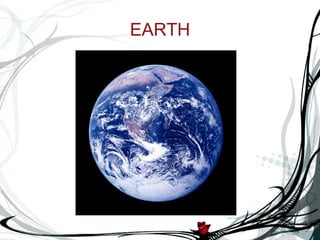
EARTH
4 Spheres of Earth (Derived from the Greek word)‏ 1.Atmosphere (air “atmo”)‏ 2. Hydrosphere (water “hydro”)‏ 3. Lithosphere (stone “litho”)‏ 4. Biosphere (life “bio”)‏
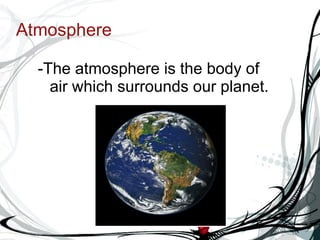
Atmosphere -The atmosphere is the body of air which surrounds our planet.
 
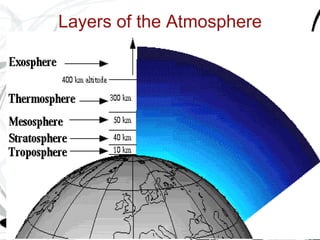
Layers of the Atmosphere
This is the layer of the atmosphere closest to the Earth's surface,  - extending up to about 10-15 km above the Earth's surface.  - It contains 75% of the atmosphere's mass. -Temperature and pressure drops as you go higher up the troposphere. TROPOSPHERE
Stratosphere - It extends from about 15 to 50 km above the Earth's surface. The Ozone Layer:  The stratosphere contains a thin layer of ozone which absorbs most of the harmful ultraviolet radiation from the Sun.
MESOSPHERE - Directly above the stratosphere - extending from 50 to 80 km above the Earth's surface,  - the mesosphere is a cold layer  - thick enough to slow down meteors hurtling into the atmosphere, where they burn up, leaving fiery trails  in the night sky.
THERMOSPHERE The thermosphere extends from 80 km above the Earth's surface to outer space. The temperature is hot
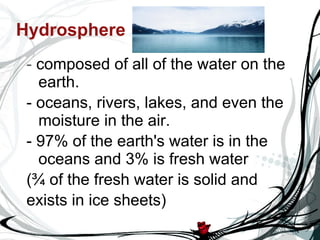
Hydrosphere -  composed of all of the water on the earth.  - oceans, rivers, lakes, and even the moisture in the air.  - 97% of the earth's water is in the oceans and 3% is fresh water  (¾ of the fresh water is solid and  exists in ice sheets)
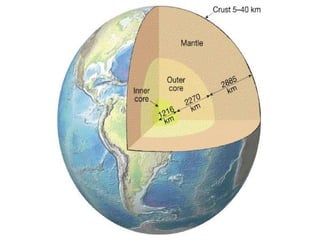
Lithosphere The lithosphere is the solid, rocky crust covering entire planet.  This crust is inorganic and is composed of minerals.
 
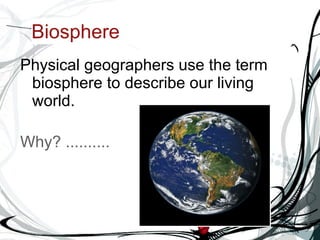
Biosphere Physical geographers use the term biosphere to describe our living world. Why? ..........
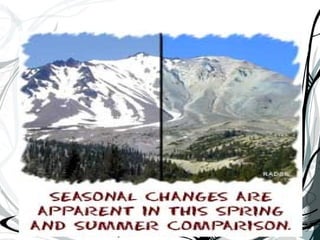
Big, Small, and the Smallest Factors -  There are large factors such as the distance between the  Earth and the Sun. Seasons and seasonal climate  changes are direct results of the tilt of the Earth towards or away from the Sun.
 
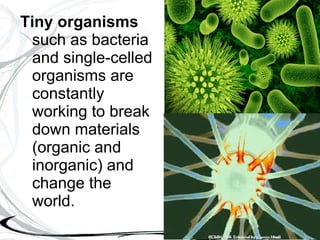
Tiny organisms   such as bacteria and single-celled organisms are constantly working to break down materials (organic and inorganic) and change the world.
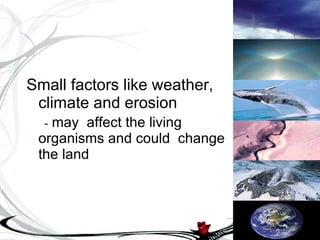
Small factors like weather, climate and erosion -  may  affect the living organisms and could  change the land
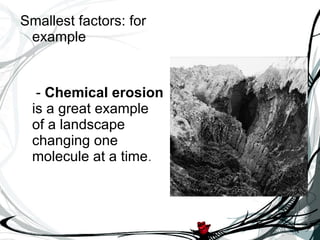
Smallest factors: for example -  Chemical erosion  is a great example of a landscape changing one molecule at a time .
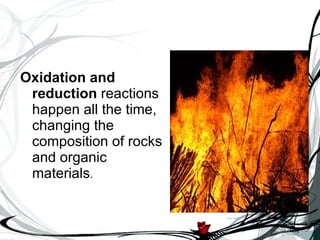
Oxidation and reduction  reactions happen all the time, changing the composition of rocks and organic materials .
 
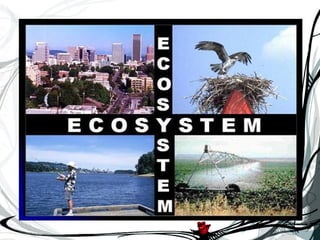
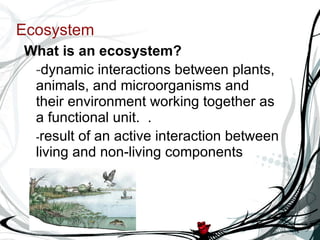
Ecosystem What is an ecosystem? - dynamic interactions between plants, animals, and microorganisms and their environment working together as a functional unit.    .  - result of an active interaction between living and non-living components
Components of Ecosystem Abiotic These include the non -living, physcio-chemical factors such as air, water, soil and the basic elements and compounds of the environment.
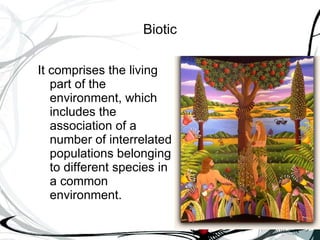
Biotic It comprises the living part of the environment, which includes the association of a number of interrelated populations belonging to different species in a common environment.
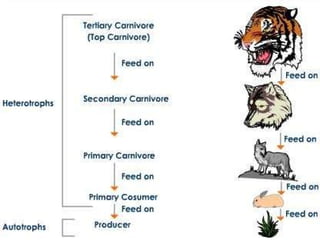
Biotic: Three Kinds •   Autotrophs  (auto - self, trophos feeder)   - are also called producers, convertors or transducers.  •  Heterotrophs  (heteros - other; trophs –feeder) are called consumers, which are generally animals feeding on other organisms.   •  Saprotrophs  (Gr: sapros - rotten;trophos - feeder)  - are also called decomposers or reducers. .
 
Abiotic: Three Categories Climatic factors  -  which include the climatic regime and physical factors of the environment like light, humidity, atmospheric temperature, wind, etc.
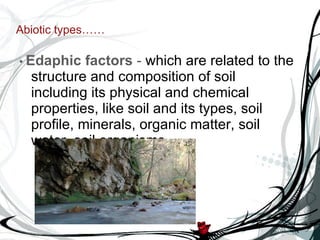
Abiotic types…… •  Edaphic factors  -  which are related to the structure and composition of soil including its physical and chemical properties, like soil and its types, soil profile, minerals, organic matter, soil water, soil organisms.
Abiotic type….. Chemical substances  -  like water, carbon, sulphur, nitrogen, phosphorus and so on. Organic substances like proteins, lipids, carbohydrates, humid substances
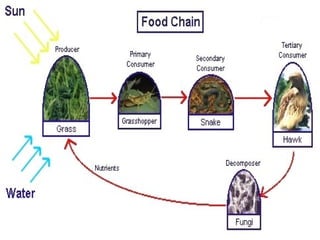
Food Chain A  food chain  shows how each living thing gets its food. For example, a simple food chain links the trees & shrubs, the giraffes (that eat trees & shrubs), and the lions (that eat the giraffes).  Each link in this chain is food for the next link. A food chain always starts with plant life and ends with an animal.
 
Food web Most food chains have no more than four or five links. There cannot be too many links in a single food chain because the animals at the end of the chain would not get enough food (and hence energy) to stay alive. Most animals are part of more than one food chain and eat more than one kind of food in order to meet their food and energy requirements. These interconnected food chains form a  food web .
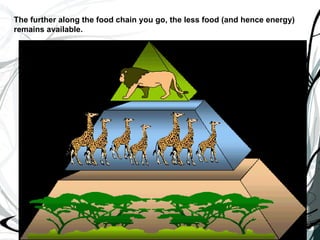
The further along the food chain you go, the less food (and hence energy) remains available.
Biological Interactions: “Symbiosis” Symbiosis  is a  close ecological relationship between the individuals  of two (or more) different species.  .
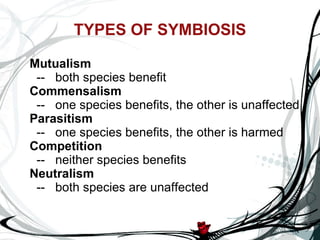
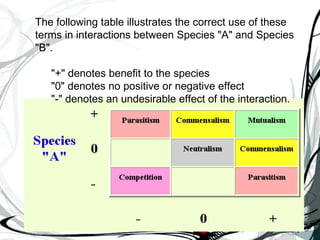
TYPES OF SYMBIOSIS Mutualism    --   both species benefit Commensalism    --   one species benefits, the other is unaffected Parasitism    --   one species benefits, the other is harmed Competition    --   neither species benefits Neutralism    --   both species are unaffected
Function of Ecosystem Regulate change and stability Disturbance regulation Provide Life Support Functions 4.  Capability return to its current equilibrium state following a disturbance
The following table illustrates the correct use of these terms in interactions between Species "A" and Species "B".  "+" denotes benefit to the species  "0" denotes no positive or negative effect  "-" denotes an undesirable effect of the interaction.
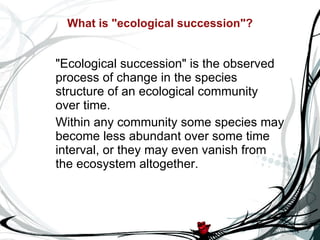
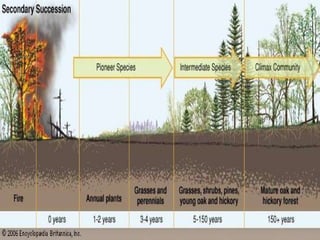
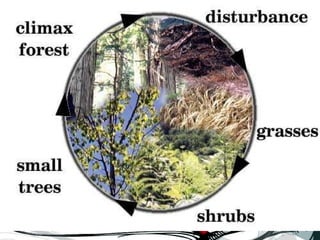
What is "ecological succession"? "Ecological succession" is the observed process of change in the species structure of an ecological community over time.  Within any community some species may become less abundant over some time interval, or they may even vanish from the ecosystem altogether.
 
 
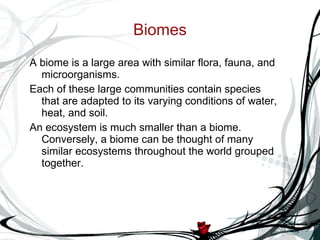
Biomes A biome is a large area with similar flora, fauna, and microorganisms.   Each of these large communities contain species that are adapted to its varying conditions of water, heat, and soil.   An ecosystem is much smaller than a biome.  Conversely, a biome can be thought of many similar ecosystems throughout the world grouped together.
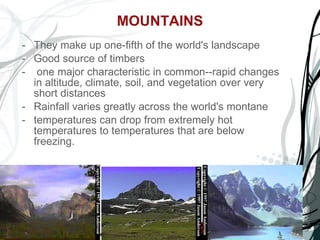
MOUNTAINS They make up one-fifth of the world's landscape Good source of timbers one major characteristic in common--rapid changes in altitude, climate, soil, and vegetation over very short distances  Rainfall varies greatly across the world's montane  temperatures can drop from extremely hot temperatures to temperatures that are below freezing.
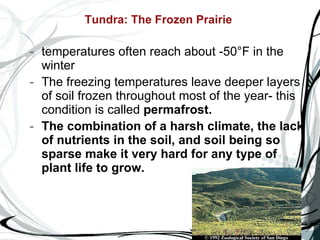
Tundra: The Frozen Prairie   temperatures often reach about -50°F in the winter  The freezing temperatures leave deeper layers of soil frozen throughout most of the year- this condition is called  permafrost.   The combination of a harsh climate, the lack of nutrients in the soil, and soil being so sparse make it very hard for any type of plant life to grow.
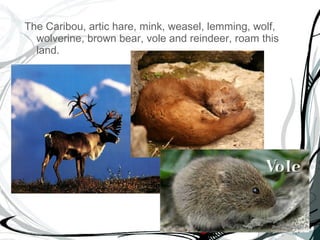
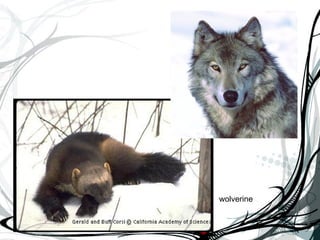
The Caribou, artic hare, mink, weasel, lemming, wolf, wolverine, brown bear, vole and reindeer, roam this land.
wolverine
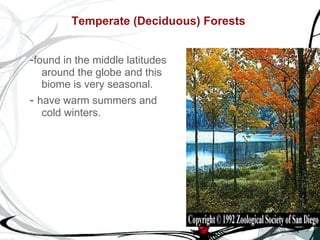
Temperate (Deciduous) Forests   - found in the middle latitudes around the globe and this biome is very seasonal.  -  have warm summers and cold winters.
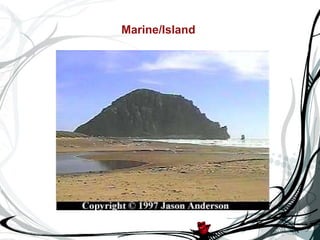
Marine/Island
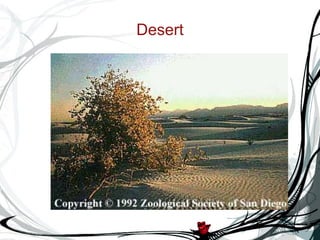
Desert
desert lie between 20 degrees to 30 degrees north and south latitude.  It is here that equatorial air falls down toward the Earth's surface  rainfall is rare because rain usually occurs when air begins to rise, not fall.
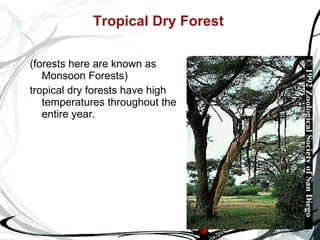
Tropical Dry Forest   (forests here are known as Monsoon Forests)  tropical dry forests have high temperatures throughout the entire year.
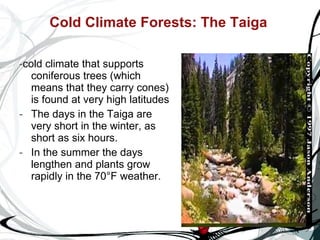
Cold Climate Forests: The Taiga   - cold climate that supports coniferous trees (which means that they carry cones) is found at very high latitudes  The days in the Taiga are very short in the winter, as short as six hours.  In the summer the days lengthen and plants grow rapidly in the 70°F weather.
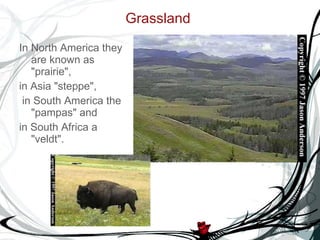
Grassland  In North America they are known as "prairie",  in Asia "steppe", in South America the "pampas" and  in South Africa a "veldt".
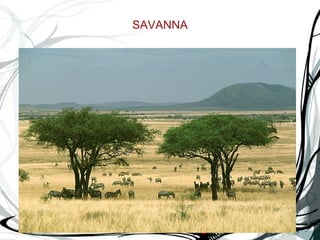
SAVANNA
- Savannahs are tropical grasslands for they are located at tropical latitudes, - much drier than many tropical forests. - Rainfall  is about 20 to 60 inches a year, with long periods of drought to follow. - dominant plant life are grasses and small plants. - Trees are sparse
 
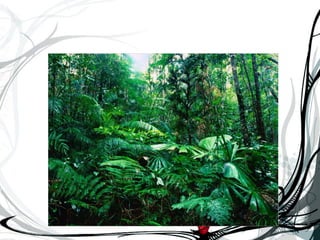
this type of forest can be defined as a forest in the tropics receiving 4-8 meters of rain each year.  All tropical rainforests are found along the equator where the temperatures and the humidity is always high, with the days being equal to the nights.
Within a four mile square area of a tropical rainforest, you would find:  Over 750 species of trees  1500 different kinds of flowering plants  125 species of mammals  400 species of birds  100 reptiles  60 amphibians  countless insects  150 species of butterflies
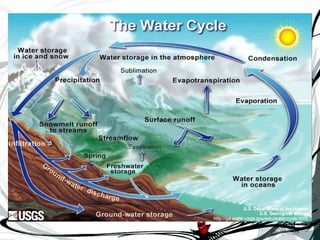
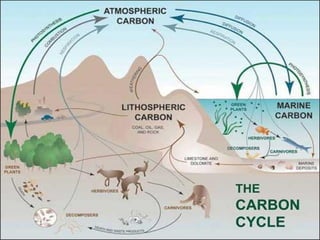
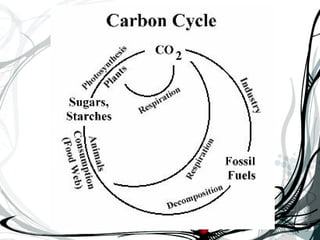
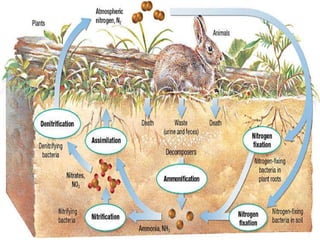
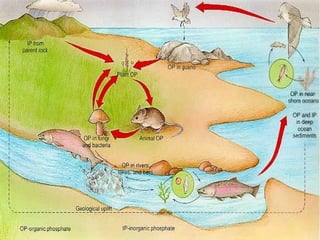
Biogeochemical Cycle A pathway by which a chemical element  or molecule moves through both  biotic and abiotic compartments  of Earth. •   The cycle of element


Thank you

Ecosystem

  • 1.
    Ecology and EnvironmentBy Geonyzl L. Alviola
  • 2.
    Line up of topics - Earth - Ecosystem - The Abiotic and Biotic Factors - Types of Ecosystem - Biological Cycles in the Ecosystem
  • 3.
  • 4.
    4 Spheres ofEarth (Derived from the Greek word)‏ 1.Atmosphere (air “atmo”)‏ 2. Hydrosphere (water “hydro”)‏ 3. Lithosphere (stone “litho”)‏ 4. Biosphere (life “bio”)‏
  • 5.
    Atmosphere -The atmosphereis the body of air which surrounds our planet.
  • 6.
  • 7.
    Layers of theAtmosphere
  • 8.
    This is thelayer of the atmosphere closest to the Earth's surface, - extending up to about 10-15 km above the Earth's surface. - It contains 75% of the atmosphere's mass. -Temperature and pressure drops as you go higher up the troposphere. TROPOSPHERE
  • 9.
    Stratosphere - Itextends from about 15 to 50 km above the Earth's surface. The Ozone Layer: The stratosphere contains a thin layer of ozone which absorbs most of the harmful ultraviolet radiation from the Sun.
  • 10.
    MESOSPHERE - Directlyabove the stratosphere - extending from 50 to 80 km above the Earth's surface, - the mesosphere is a cold layer - thick enough to slow down meteors hurtling into the atmosphere, where they burn up, leaving fiery trails in the night sky.
  • 11.
    THERMOSPHERE The thermosphereextends from 80 km above the Earth's surface to outer space. The temperature is hot
  • 12.
    Hydrosphere - composed of all of the water on the earth. - oceans, rivers, lakes, and even the moisture in the air. - 97% of the earth's water is in the oceans and 3% is fresh water (¾ of the fresh water is solid and exists in ice sheets)
  • 13.
    Lithosphere The lithosphereis the solid, rocky crust covering entire planet. This crust is inorganic and is composed of minerals.
  • 14.
  • 15.
    Biosphere Physical geographersuse the term biosphere to describe our living world. Why? ..........
  • 16.
    Big, Small, andthe Smallest Factors - There are large factors such as the distance between the Earth and the Sun. Seasons and seasonal climate changes are direct results of the tilt of the Earth towards or away from the Sun.
  • 17.
  • 18.
    Tiny organisms such as bacteria and single-celled organisms are constantly working to break down materials (organic and inorganic) and change the world.
  • 19.
    Small factors likeweather, climate and erosion - may affect the living organisms and could change the land
  • 20.
    Smallest factors: forexample - Chemical erosion is a great example of a landscape changing one molecule at a time .
  • 21.
    Oxidation and reduction reactions happen all the time, changing the composition of rocks and organic materials .
  • 22.
  • 23.
    Ecosystem What isan ecosystem? - dynamic interactions between plants, animals, and microorganisms and their environment working together as a functional unit.  . - result of an active interaction between living and non-living components
  • 24.
    Components of EcosystemAbiotic These include the non -living, physcio-chemical factors such as air, water, soil and the basic elements and compounds of the environment.
  • 25.
    Biotic It comprisesthe living part of the environment, which includes the association of a number of interrelated populations belonging to different species in a common environment.
  • 26.
    Biotic: Three Kinds• Autotrophs (auto - self, trophos feeder) - are also called producers, convertors or transducers. • Heterotrophs (heteros - other; trophs –feeder) are called consumers, which are generally animals feeding on other organisms. • Saprotrophs (Gr: sapros - rotten;trophos - feeder) - are also called decomposers or reducers. .
  • 27.
  • 28.
    Abiotic: Three CategoriesClimatic factors - which include the climatic regime and physical factors of the environment like light, humidity, atmospheric temperature, wind, etc.
  • 29.
    Abiotic types…… • Edaphic factors - which are related to the structure and composition of soil including its physical and chemical properties, like soil and its types, soil profile, minerals, organic matter, soil water, soil organisms.
  • 30.
    Abiotic type….. Chemicalsubstances - like water, carbon, sulphur, nitrogen, phosphorus and so on. Organic substances like proteins, lipids, carbohydrates, humid substances
  • 31.
    Food Chain A food chain shows how each living thing gets its food. For example, a simple food chain links the trees & shrubs, the giraffes (that eat trees & shrubs), and the lions (that eat the giraffes). Each link in this chain is food for the next link. A food chain always starts with plant life and ends with an animal.
  • 32.
  • 33.
    Food web Mostfood chains have no more than four or five links. There cannot be too many links in a single food chain because the animals at the end of the chain would not get enough food (and hence energy) to stay alive. Most animals are part of more than one food chain and eat more than one kind of food in order to meet their food and energy requirements. These interconnected food chains form a food web .
  • 34.
    The further alongthe food chain you go, the less food (and hence energy) remains available.
  • 35.
    Biological Interactions: “Symbiosis”Symbiosis is a close ecological relationship between the individuals of two (or more) different species.  .
  • 36.
    TYPES OF SYMBIOSISMutualism   --   both species benefit Commensalism   --   one species benefits, the other is unaffected Parasitism   --   one species benefits, the other is harmed Competition   --   neither species benefits Neutralism   --   both species are unaffected
  • 37.
    Function of EcosystemRegulate change and stability Disturbance regulation Provide Life Support Functions 4. Capability return to its current equilibrium state following a disturbance
  • 38.
    The following tableillustrates the correct use of these terms in interactions between Species "A" and Species "B". "+" denotes benefit to the species "0" denotes no positive or negative effect "-" denotes an undesirable effect of the interaction.
  • 39.
    What is "ecologicalsuccession"? "Ecological succession" is the observed process of change in the species structure of an ecological community over time. Within any community some species may become less abundant over some time interval, or they may even vanish from the ecosystem altogether.
  • 40.
  • 41.
  • 42.
    Biomes A biomeis a large area with similar flora, fauna, and microorganisms.  Each of these large communities contain species that are adapted to its varying conditions of water, heat, and soil.  An ecosystem is much smaller than a biome.  Conversely, a biome can be thought of many similar ecosystems throughout the world grouped together.
  • 43.
    MOUNTAINS They makeup one-fifth of the world's landscape Good source of timbers one major characteristic in common--rapid changes in altitude, climate, soil, and vegetation over very short distances Rainfall varies greatly across the world's montane temperatures can drop from extremely hot temperatures to temperatures that are below freezing.
  • 44.
    Tundra: The Frozen Prairie temperatures often reach about -50°F in the winter The freezing temperatures leave deeper layers of soil frozen throughout most of the year- this condition is called permafrost. The combination of a harsh climate, the lack of nutrients in the soil, and soil being so sparse make it very hard for any type of plant life to grow.
  • 45.
    The Caribou, artichare, mink, weasel, lemming, wolf, wolverine, brown bear, vole and reindeer, roam this land.
  • 46.
  • 47.
    Temperate (Deciduous) Forests - found in the middle latitudes around the globe and this biome is very seasonal. - have warm summers and cold winters.
  • 48.
  • 49.
  • 50.
    desert lie between20 degrees to 30 degrees north and south latitude. It is here that equatorial air falls down toward the Earth's surface rainfall is rare because rain usually occurs when air begins to rise, not fall.
  • 51.
    Tropical Dry Forest (forests here are known as Monsoon Forests) tropical dry forests have high temperatures throughout the entire year.
  • 52.
    Cold Climate Forests:The Taiga - cold climate that supports coniferous trees (which means that they carry cones) is found at very high latitudes The days in the Taiga are very short in the winter, as short as six hours. In the summer the days lengthen and plants grow rapidly in the 70°F weather.
  • 53.
    Grassland InNorth America they are known as "prairie", in Asia "steppe", in South America the "pampas" and in South Africa a "veldt".
  • 54.
  • 55.
    - Savannahs aretropical grasslands for they are located at tropical latitudes, - much drier than many tropical forests. - Rainfall is about 20 to 60 inches a year, with long periods of drought to follow. - dominant plant life are grasses and small plants. - Trees are sparse
  • 56.
  • 57.
    this type offorest can be defined as a forest in the tropics receiving 4-8 meters of rain each year. All tropical rainforests are found along the equator where the temperatures and the humidity is always high, with the days being equal to the nights.
  • 58.
    Within a fourmile square area of a tropical rainforest, you would find: Over 750 species of trees 1500 different kinds of flowering plants 125 species of mammals 400 species of birds 100 reptiles 60 amphibians countless insects 150 species of butterflies
  • 59.
    Biogeochemical Cycle Apathway by which a chemical element or molecule moves through both biotic and abiotic compartments of Earth. • The cycle of element
  • 60.
  • 61.
  • 62.
  • 63.
  • 64.
  • 65.