14.2 The Gas Laws >
1 Copyright © Pearson Education, Inc., or its affiliates. All Rights Reserved.
GOOD DAY
GRADE 10
14.2 The Gas Laws >
2 Copyright © Pearson Education, Inc., or its affiliates. All Rights Reserved.
How are the pressure
and temperature of a gas
related?
Gay-Lussac’s Law
14.2 The Gas Laws >
3 Copyright © Pearson Education, Inc., or its affiliates. All Rights Reserved.
14.2 The Gas Laws >
4 Copyright © Pearson Education, Inc., or its affiliates. All Rights Reserved.
Gay-Lussac’s Law
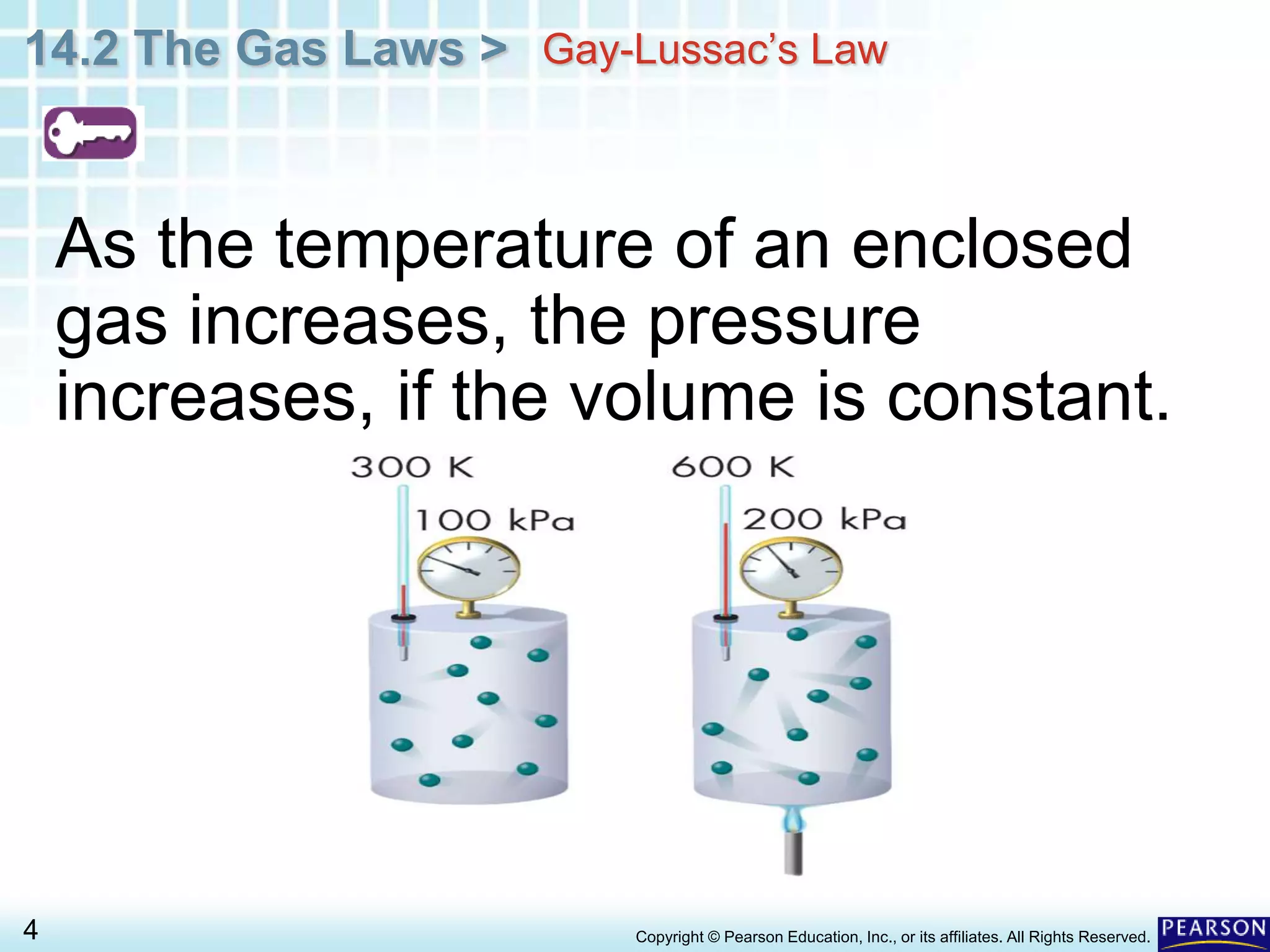
As the temperature of an enclosed
gas increases, the pressure
increases, if the volume is constant.
14.2 The Gas Laws >
5 Copyright © Pearson Education, Inc., or its affiliates. All Rights Reserved.
14.2 The Gas Laws >
6 Copyright © Pearson Education, Inc., or its affiliates. All Rights Reserved.
14.2 The Gas Laws >
7 Copyright © Pearson Education, Inc., or its affiliates. All Rights Reserved.
Gay-Lussac’s Law
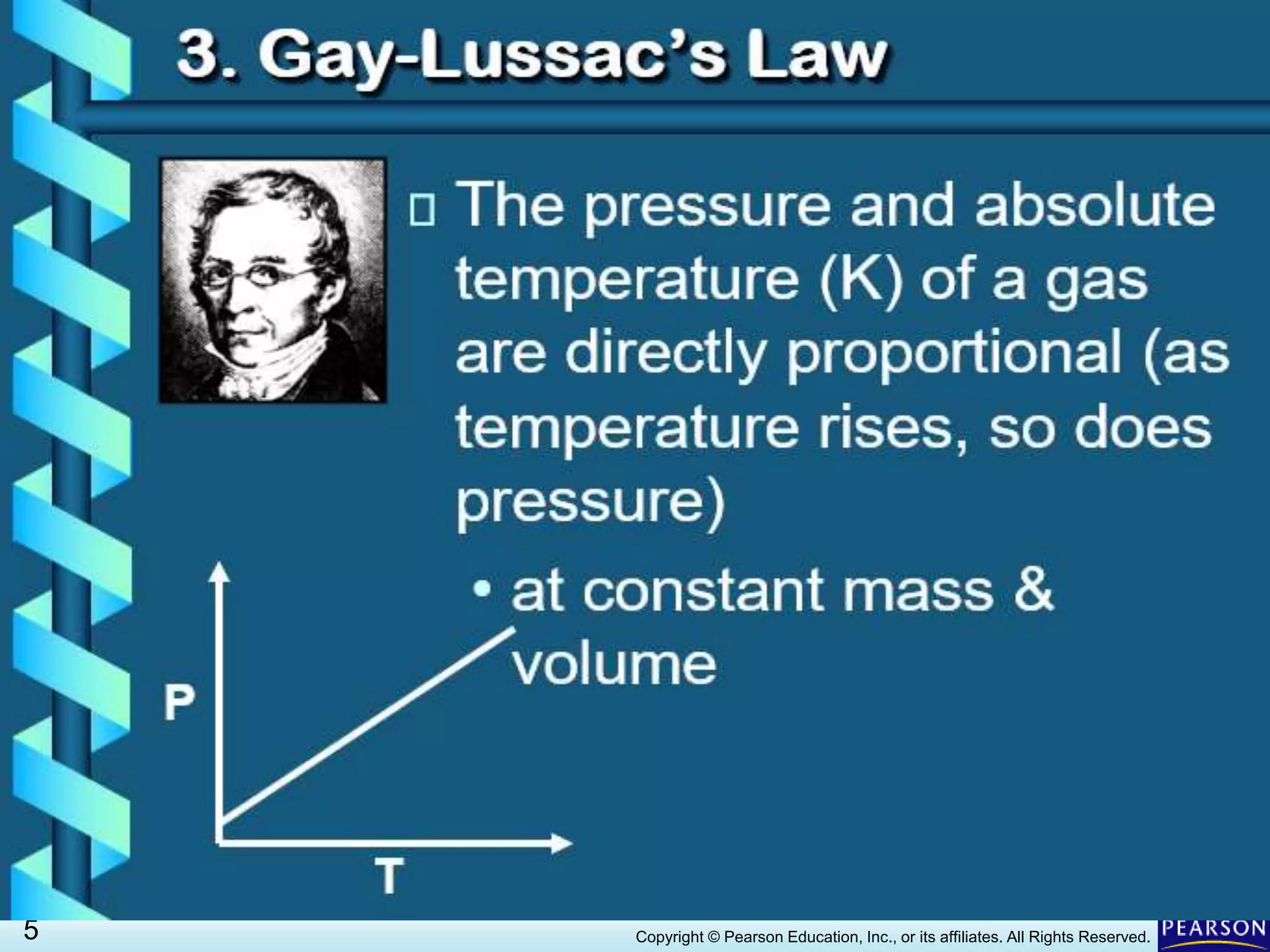
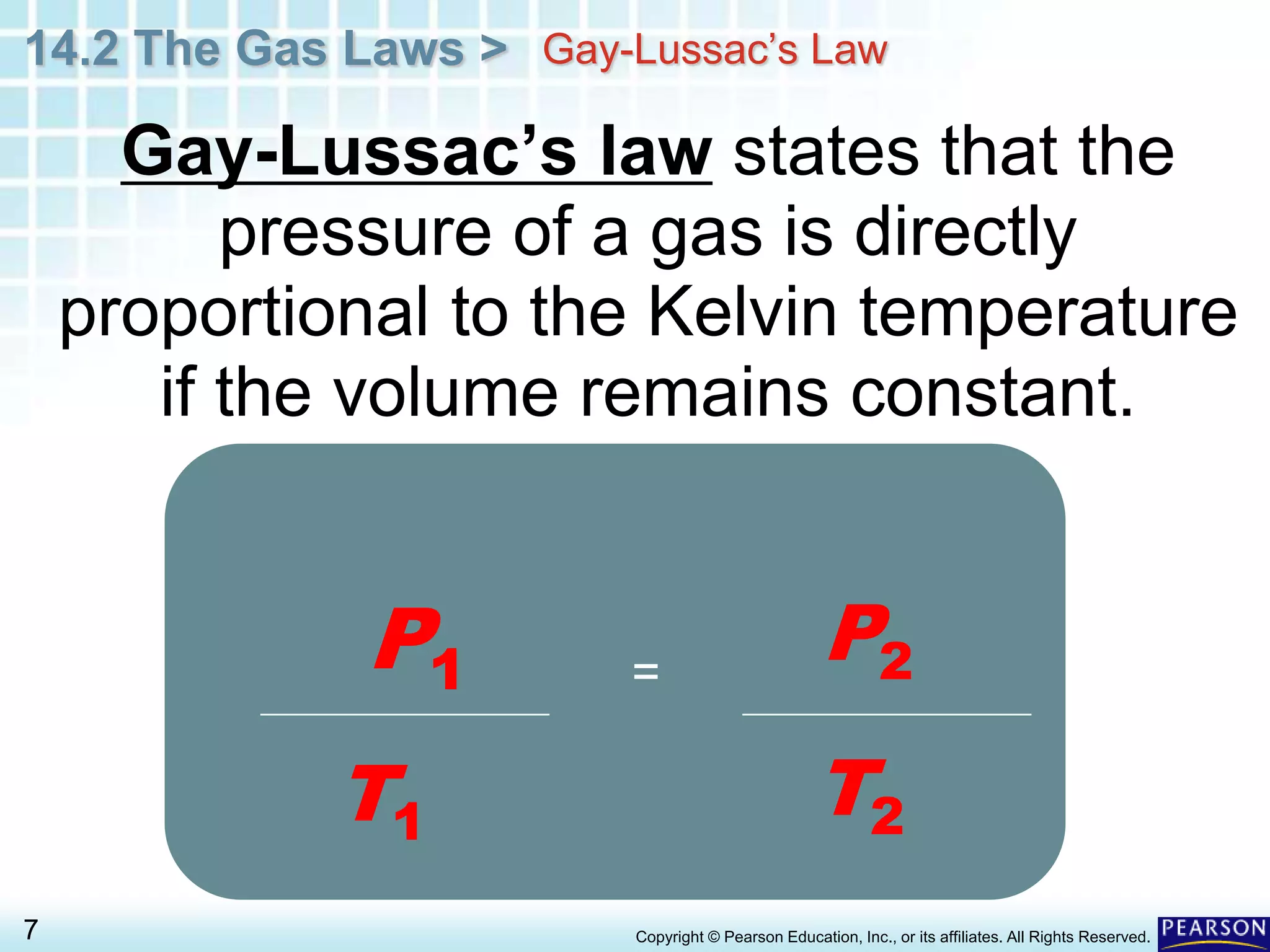
Gay-Lussac’s law states that the
pressure of a gas is directly
proportional to the Kelvin temperature
if the volume remains constant.
P1
P2
T1 T2
=
14.2 The Gas Laws >
8 Copyright © Pearson Education, Inc., or its affiliates. All Rights Reserved.
Sample Problem 14.3
Using Gay-Lussac’s Law
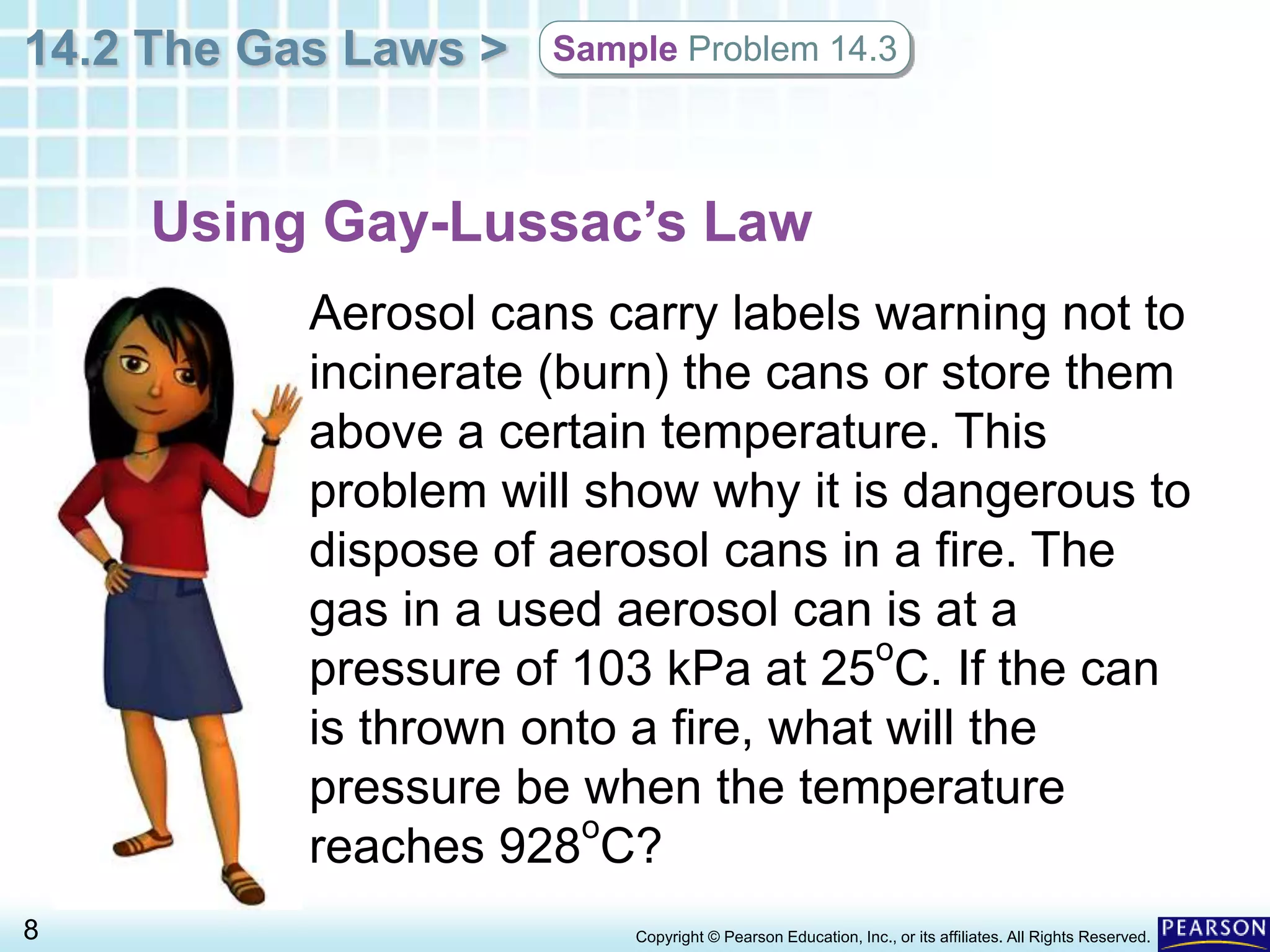
Aerosol cans carry labels warning not to
incinerate (burn) the cans or store them
above a certain temperature. This
problem will show why it is dangerous to
dispose of aerosol cans in a fire. The
gas in a used aerosol can is at a
pressure of 103 kPa at 25
o
C. If the can
is thrown onto a fire, what will the
pressure be when the temperature
reaches 928
o
C?
14.2 The Gas Laws >
9 Copyright © Pearson Education, Inc., or its affiliates. All Rights Reserved.
Sample Problem 14.3
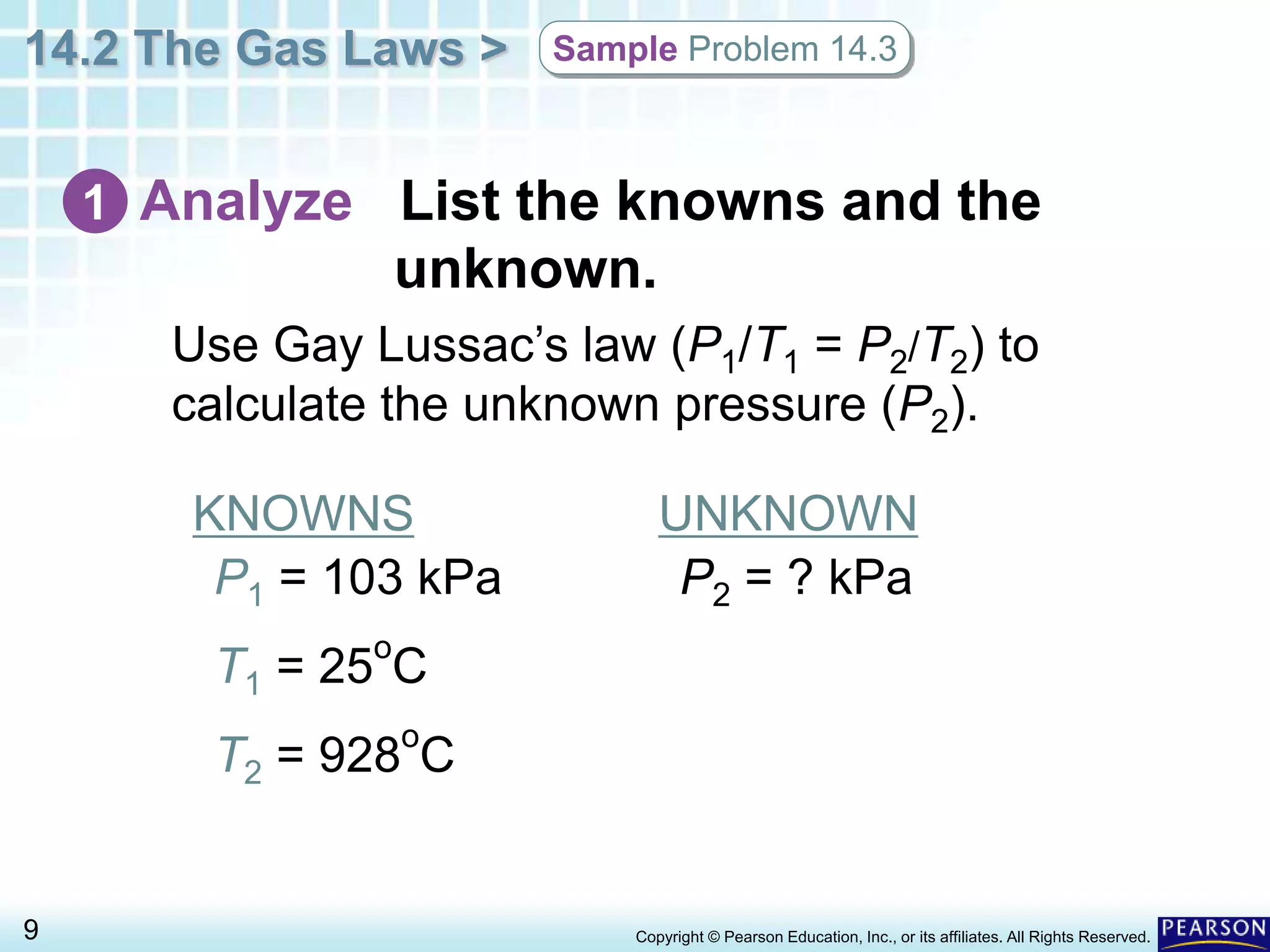
Use Gay Lussac’s law (P1/T1 = P2/T2) to
calculate the unknown pressure (P2).
KNOWNS
P1 = 103 kPa
T1 = 25
o
C
T2 = 928
o
C
UNKNOWN
P2 = ? kPa
Analyze List the knowns and the
unknown.
1
14.2 The Gas Laws >
10 Copyright © Pearson Education, Inc., or its affiliates. All Rights Reserved.
Sample Problem 14.3
Remember, because this problem
involves temperatures and a gas law,
the temperatures must be expressed in
kelvins.
Calculate Solve for the unknown.
2
T1 = 25o
C + 273 = 298 K
T2 = 928o
C + 273 = 1201 K
14.2 The Gas Laws >
11 Copyright © Pearson Education, Inc., or its affiliates. All Rights Reserved.
Sample Problem 14.3
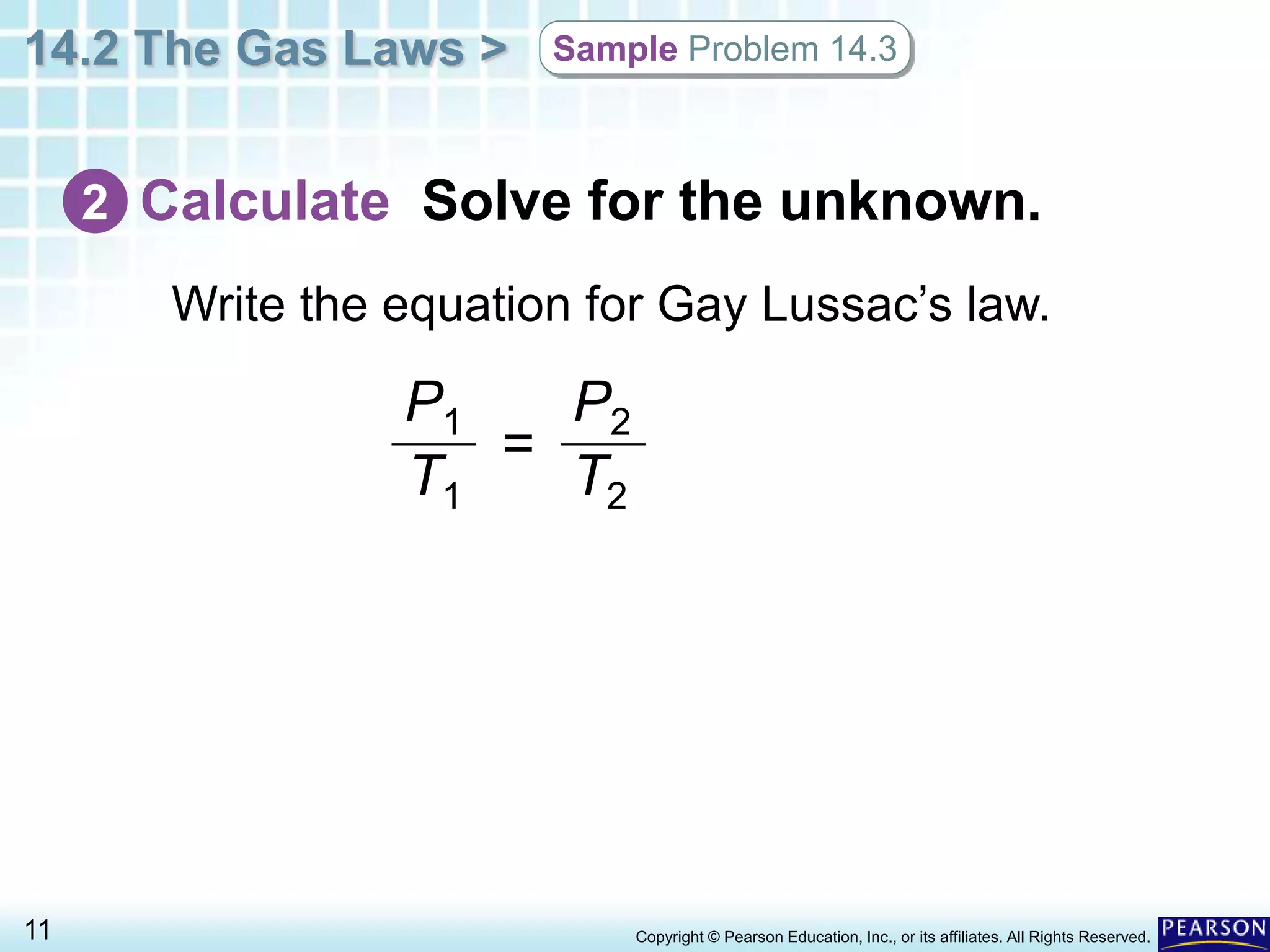
Write the equation for Gay Lussac’s law.
Calculate Solve for the unknown.
2
P1 P2
=
T1 T2
14.2 The Gas Laws >
12 Copyright © Pearson Education, Inc., or its affiliates. All Rights Reserved.
Sample Problem 14.3
Rearrange the equation to isolate P2.
Calculate Solve for the unknown.
2
P2 =
T1
P1  T2
Isolate P2 by multiplying
both sides by T2:
P1
T2
P2
T1
T2 T2
=
 
P1 P2
=
T1 T2
14.2 The Gas Laws >
13 Copyright © Pearson Education, Inc., or its affiliates. All Rights Reserved.
Sample Problem 14.3
Substitute the known values for P1, T2,
and T1 into the equation and solve.
Calculate Solve for the unknown.
2
P2 =
298 K
103 kPa  1201 K
P2 = 415 kPa
P2 = 4.15  102 kPa
14.2 The Gas Laws >
14 Copyright © Pearson Education, Inc., or its affiliates. All Rights Reserved.
Sample Problem 14.3
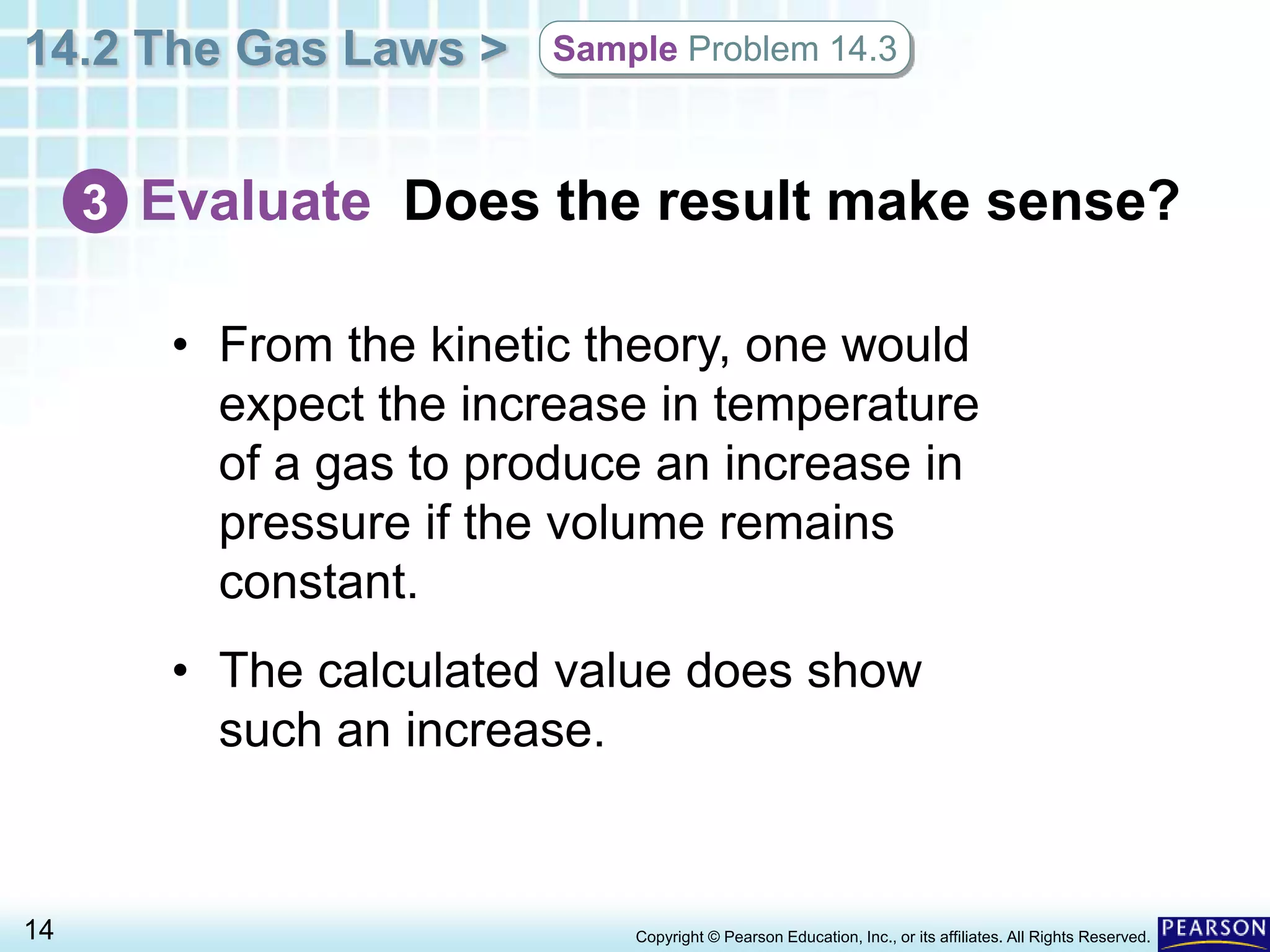
• From the kinetic theory, one would
expect the increase in temperature
of a gas to produce an increase in
pressure if the volume remains
constant.
• The calculated value does show
such an increase.
Evaluate Does the result make sense?
3
14.2 The Gas Laws >
15 Copyright © Pearson Education, Inc., or its affiliates. All Rights Reserved.
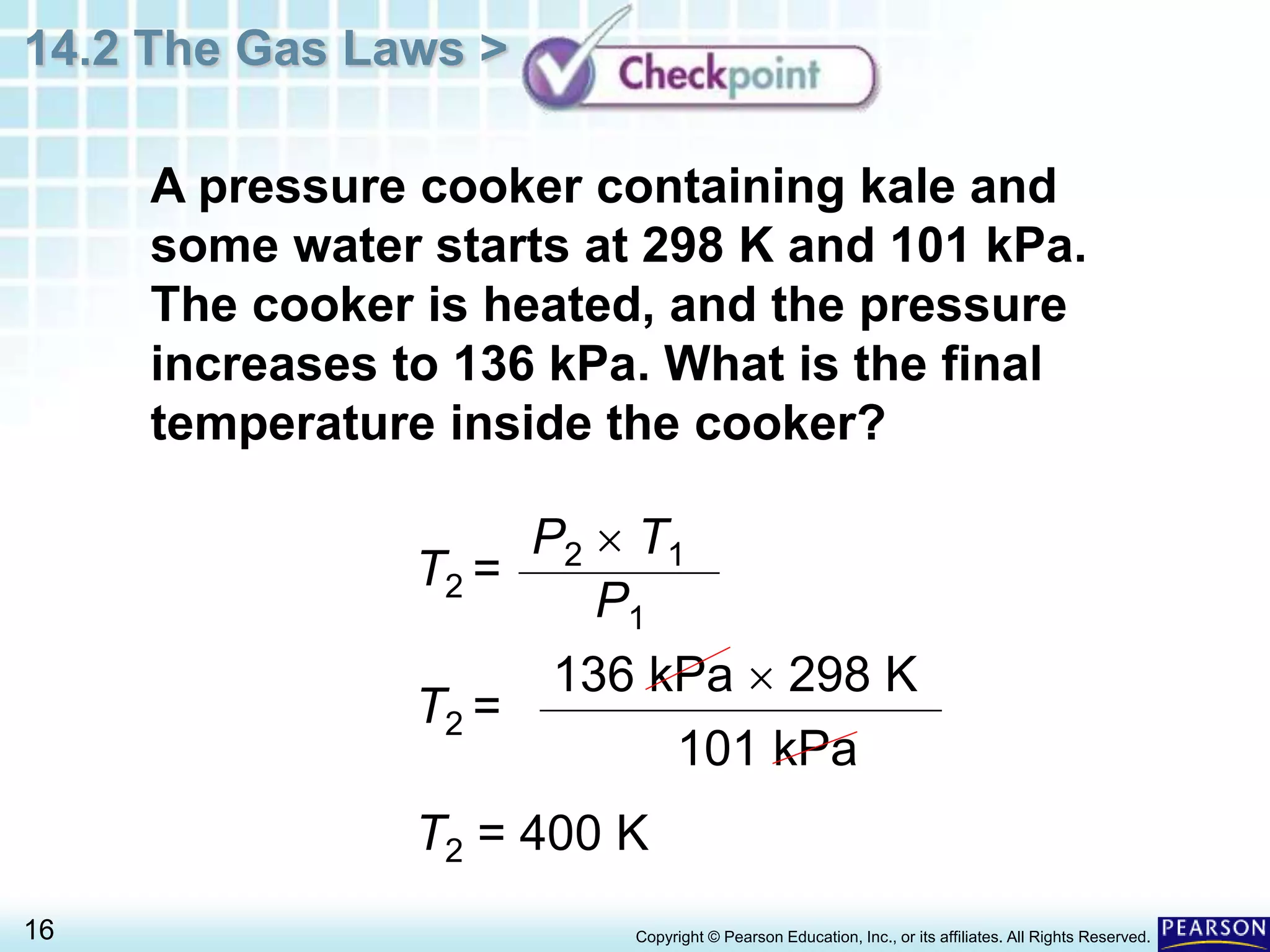
A pressure cooker containing kale and
some water starts at 298 K and 101 kPa.
The cooker is heated, and the pressure
increases to 136 kPa. What is the final
temperature inside the cooker?
14.2 The Gas Laws >
16 Copyright © Pearson Education, Inc., or its affiliates. All Rights Reserved.
T2 =
P1
P2  T1
T2 =
101 kPa
136 kPa  298 K
T2 = 400 K
A pressure cooker containing kale and
some water starts at 298 K and 101 kPa.
The cooker is heated, and the pressure
increases to 136 kPa. What is the final
temperature inside the cooker?
14.2 The Gas Laws >
17 Copyright © Pearson Education, Inc., or its affiliates. All Rights Reserved.
Gay-Lussac’s Law
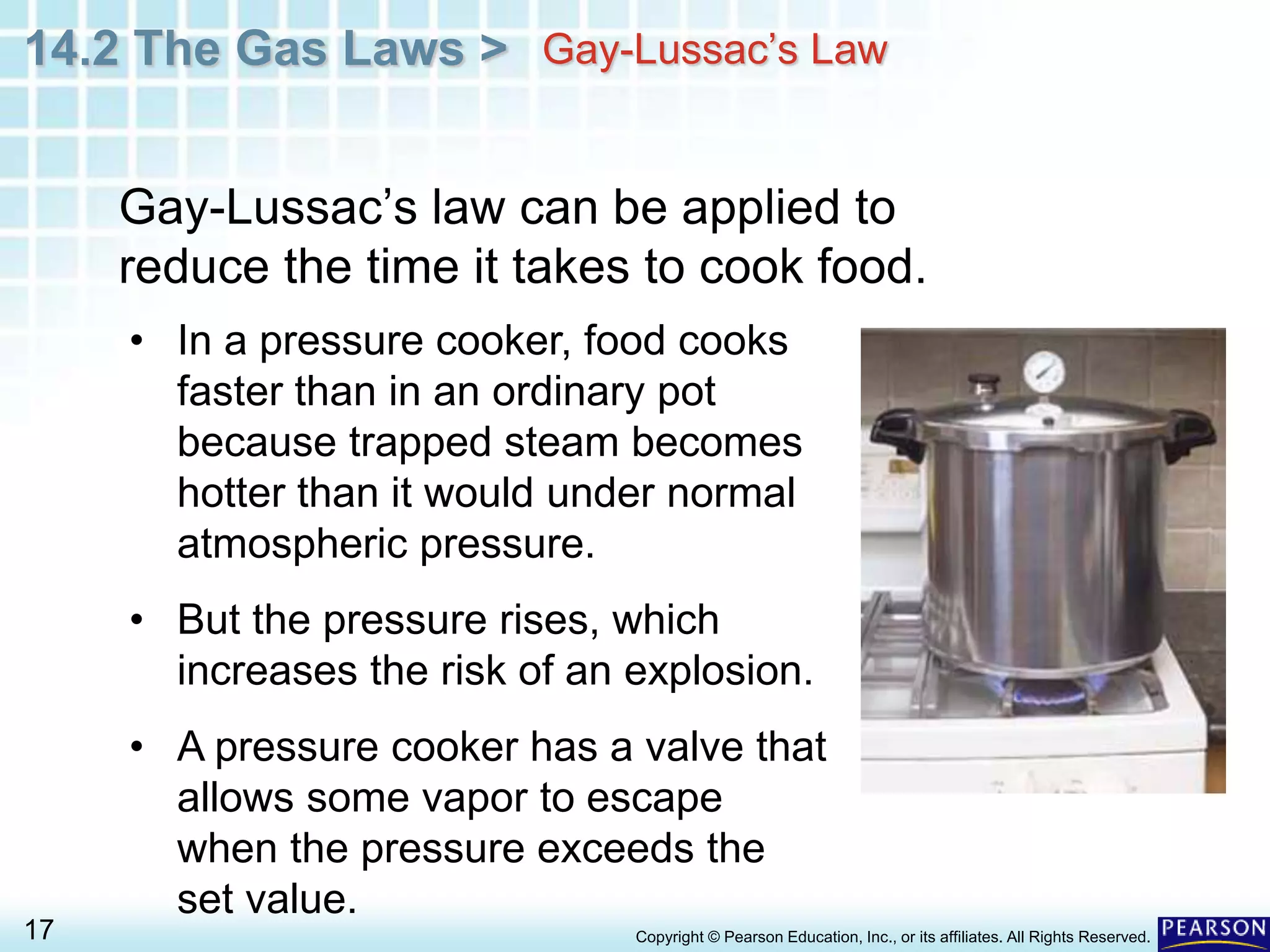
Gay-Lussac’s law can be applied to
reduce the time it takes to cook food.
• In a pressure cooker, food cooks
faster than in an ordinary pot
because trapped steam becomes
hotter than it would under normal
atmospheric pressure.
• But the pressure rises, which
increases the risk of an explosion.
• A pressure cooker has a valve that
allows some vapor to escape
when the pressure exceeds the
set value.
14.2 The Gas Laws >
18 Copyright © Pearson Education, Inc., or its affiliates. All Rights Reserved.
THANK YOU
FOR
LISTENING!!!

GAY-LUSSACS-PPT.ppt

  • 1.
    14.2 The GasLaws > 1 Copyright © Pearson Education, Inc., or its affiliates. All Rights Reserved. GOOD DAY GRADE 10
  • 2.
    14.2 The GasLaws > 2 Copyright © Pearson Education, Inc., or its affiliates. All Rights Reserved. How are the pressure and temperature of a gas related? Gay-Lussac’s Law
  • 3.
    14.2 The GasLaws > 3 Copyright © Pearson Education, Inc., or its affiliates. All Rights Reserved.
  • 4.
    14.2 The GasLaws > 4 Copyright © Pearson Education, Inc., or its affiliates. All Rights Reserved. Gay-Lussac’s Law As the temperature of an enclosed gas increases, the pressure increases, if the volume is constant.
  • 5.
    14.2 The GasLaws > 5 Copyright © Pearson Education, Inc., or its affiliates. All Rights Reserved.
  • 6.
    14.2 The GasLaws > 6 Copyright © Pearson Education, Inc., or its affiliates. All Rights Reserved.
  • 7.
    14.2 The GasLaws > 7 Copyright © Pearson Education, Inc., or its affiliates. All Rights Reserved. Gay-Lussac’s Law Gay-Lussac’s law states that the pressure of a gas is directly proportional to the Kelvin temperature if the volume remains constant. P1 P2 T1 T2 =
  • 8.
    14.2 The GasLaws > 8 Copyright © Pearson Education, Inc., or its affiliates. All Rights Reserved. Sample Problem 14.3 Using Gay-Lussac’s Law Aerosol cans carry labels warning not to incinerate (burn) the cans or store them above a certain temperature. This problem will show why it is dangerous to dispose of aerosol cans in a fire. The gas in a used aerosol can is at a pressure of 103 kPa at 25 o C. If the can is thrown onto a fire, what will the pressure be when the temperature reaches 928 o C?
  • 9.
    14.2 The GasLaws > 9 Copyright © Pearson Education, Inc., or its affiliates. All Rights Reserved. Sample Problem 14.3 Use Gay Lussac’s law (P1/T1 = P2/T2) to calculate the unknown pressure (P2). KNOWNS P1 = 103 kPa T1 = 25 o C T2 = 928 o C UNKNOWN P2 = ? kPa Analyze List the knowns and the unknown. 1
  • 10.
    14.2 The GasLaws > 10 Copyright © Pearson Education, Inc., or its affiliates. All Rights Reserved. Sample Problem 14.3 Remember, because this problem involves temperatures and a gas law, the temperatures must be expressed in kelvins. Calculate Solve for the unknown. 2 T1 = 25o C + 273 = 298 K T2 = 928o C + 273 = 1201 K
  • 11.
    14.2 The GasLaws > 11 Copyright © Pearson Education, Inc., or its affiliates. All Rights Reserved. Sample Problem 14.3 Write the equation for Gay Lussac’s law. Calculate Solve for the unknown. 2 P1 P2 = T1 T2
  • 12.
    14.2 The GasLaws > 12 Copyright © Pearson Education, Inc., or its affiliates. All Rights Reserved. Sample Problem 14.3 Rearrange the equation to isolate P2. Calculate Solve for the unknown. 2 P2 = T1 P1  T2 Isolate P2 by multiplying both sides by T2: P1 T2 P2 T1 T2 T2 =   P1 P2 = T1 T2
  • 13.
    14.2 The GasLaws > 13 Copyright © Pearson Education, Inc., or its affiliates. All Rights Reserved. Sample Problem 14.3 Substitute the known values for P1, T2, and T1 into the equation and solve. Calculate Solve for the unknown. 2 P2 = 298 K 103 kPa  1201 K P2 = 415 kPa P2 = 4.15  102 kPa
  • 14.
    14.2 The GasLaws > 14 Copyright © Pearson Education, Inc., or its affiliates. All Rights Reserved. Sample Problem 14.3 • From the kinetic theory, one would expect the increase in temperature of a gas to produce an increase in pressure if the volume remains constant. • The calculated value does show such an increase. Evaluate Does the result make sense? 3
  • 15.
    14.2 The GasLaws > 15 Copyright © Pearson Education, Inc., or its affiliates. All Rights Reserved. A pressure cooker containing kale and some water starts at 298 K and 101 kPa. The cooker is heated, and the pressure increases to 136 kPa. What is the final temperature inside the cooker?
  • 16.
    14.2 The GasLaws > 16 Copyright © Pearson Education, Inc., or its affiliates. All Rights Reserved. T2 = P1 P2  T1 T2 = 101 kPa 136 kPa  298 K T2 = 400 K A pressure cooker containing kale and some water starts at 298 K and 101 kPa. The cooker is heated, and the pressure increases to 136 kPa. What is the final temperature inside the cooker?
  • 17.
    14.2 The GasLaws > 17 Copyright © Pearson Education, Inc., or its affiliates. All Rights Reserved. Gay-Lussac’s Law Gay-Lussac’s law can be applied to reduce the time it takes to cook food. • In a pressure cooker, food cooks faster than in an ordinary pot because trapped steam becomes hotter than it would under normal atmospheric pressure. • But the pressure rises, which increases the risk of an explosion. • A pressure cooker has a valve that allows some vapor to escape when the pressure exceeds the set value.
  • 18.
    14.2 The GasLaws > 18 Copyright © Pearson Education, Inc., or its affiliates. All Rights Reserved. THANK YOU FOR LISTENING!!!