ECG INTERPRETATION
Dr Saleh Ahmed
MD Phase A, Cardiology
NICVD, Dhaka
CONDUCTIVE SYSTEM
There are 5 specialized tissues called conductive
system of the heart. These are:
• SA node.
• AV node.
• Bundle of His.
• Right bundle branch (RBB) and left bundle branch
(LBB).
• Purkinje fibers.
Bundle of his
Purkinje fibers
ELECTROCARDIOGRAM
• It is the graphical representation of electrical
potentials produced when the electric current
passes through the heart.
• Electrical activity is the basic characteristic of
heart and is the stimulus for cardiac
contraction
P wave Atrial depolarization.
PR interval
The time taken for the cardiac
impulse to spread over the atrium
and through AV node and His-
Purkinje system
QRS Complex Ventricular depolarization.
T wave Ventricular repolarization.
Waves of ECG
P wave
Height ≤2.5mm
Width ≤2.5mm
Q wave
Depth <2mm
Width <1mm
R wave
aVL <13mm
aVF <20mm
V5,V6 <25mm
QRS complex Width <3mm
T wave
Standard lead ≤5mm
Chest lead ≤10mm
Intervals of ECG
PR interval 0.12 to 0.20 sec (3- 5mm)
QT interval 0.35 to 0.43 seconds
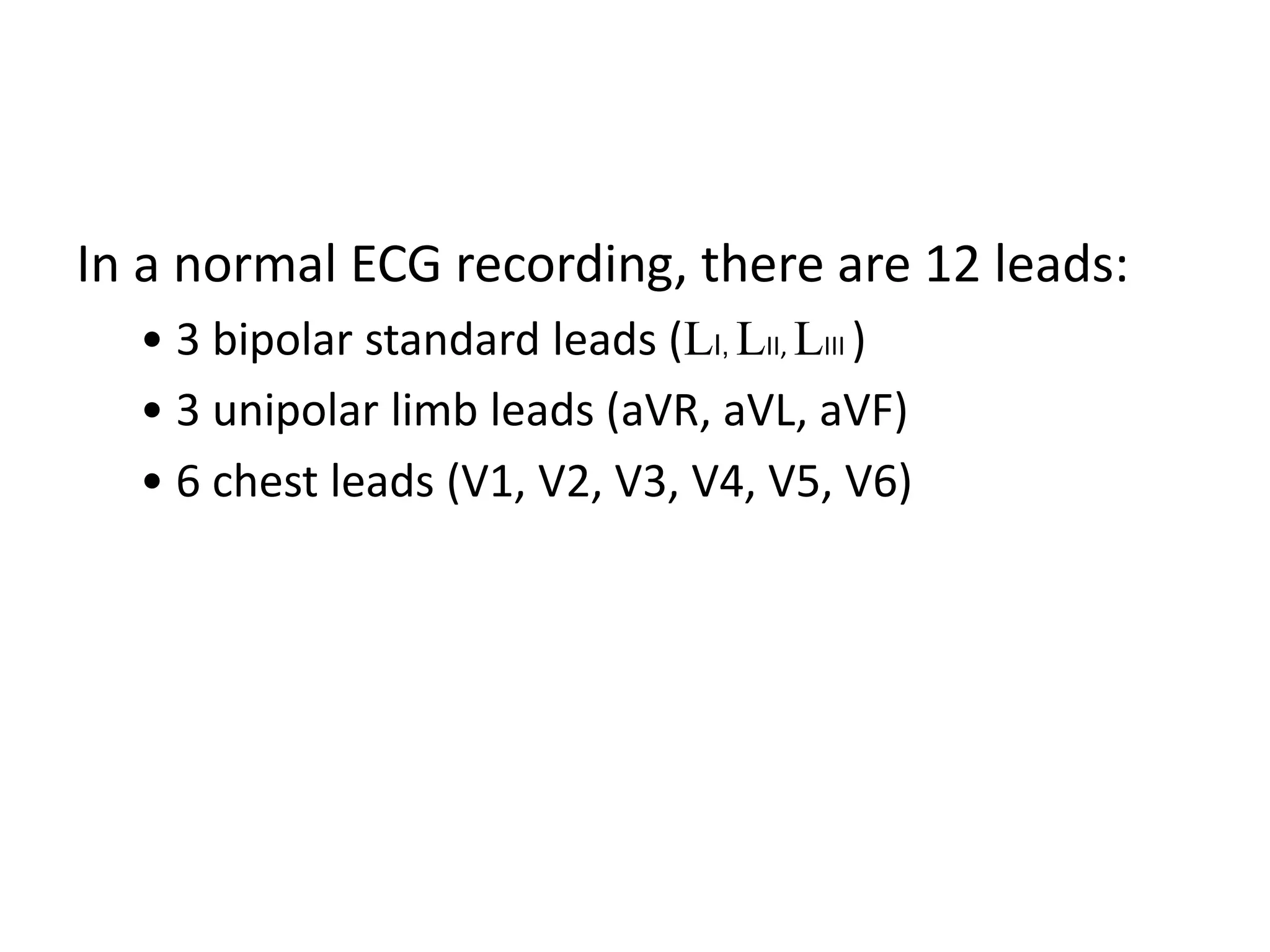
In a normal ECG recording, there are 12 leads:
• 3 bipolar standard leads (LI, LII, LIII )
• 3 unipolar limb leads (aVR, aVL, aVF)
• 6 chest leads (V1, V2, V3, V4, V5, V6)
VIEW OF THE HEART IN ALL LEADS
V1 and V2 Right ventricle
V3 and V4 Interventricular septum
V5 and V6 Left ventricle
V1 to V6 Anterior aspect of heart
LI, aVL, V1 to V6
Extensive anterior aspect of
heart or anterolateral
LI, aVL, V5 and V6 Lateral
LI and aVL High lateral
LII, LIII and aVF Inferior aspect of heart
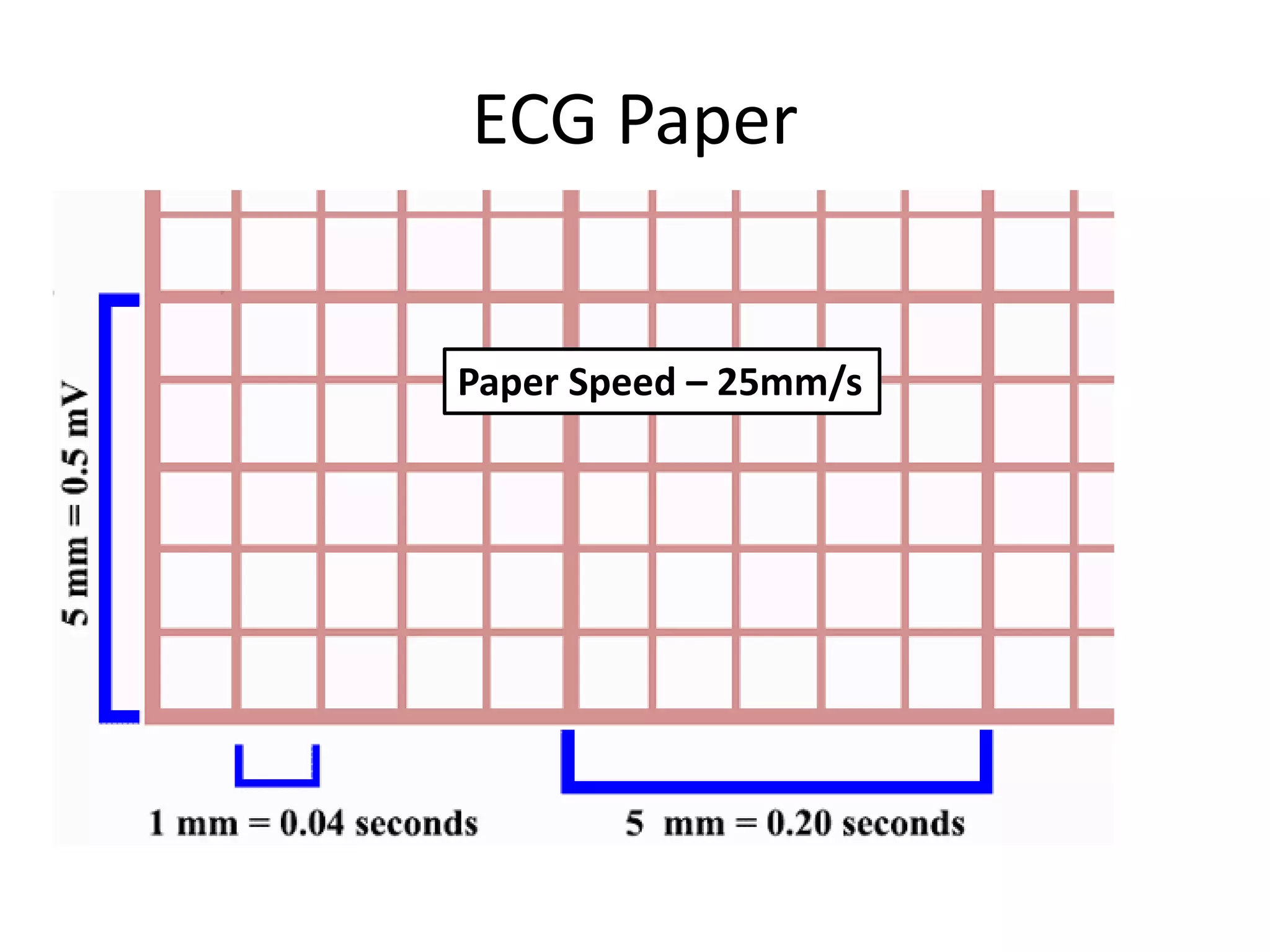
ECG Paper
Paper Speed – 25mm/s
SYSTEMATIC APPROACH IN ECG
INTERPRETATION
•Rate—what is the rate ?
• Rhythm—regular or irregular, regularly followed by
occasional irregular.
• Characters of individual waves (P, PR, Q, R, QRS, ST, T,
U).
• Specific pathological changes.
Heart Rate
 When the cardiac rhythm is regular:
• If large square is calculated
• If small square is calculated:
 When the rhythm is irregular:
1. Count the number of R in 30 large squares
2. Then simply multiply this by 10
RHYTHM OF HEART
• If the RR interval is equal, it is called regular rhythm.
• If the RR interval is irregular, then it is called irregular
rhythm
Causes of Irregular Rhythm
1. Physiological: Sinus arrhythmia.
2. Pathological:
• Atrial fibrillation.
• Atrial flutter.
• Ectopic beat.
• SA block or sinus arrest.
• Atrial tachycardia with block.
• Second degree heart block.
• Ventricular fibrillation.
CARDIAC AXIS
• Normal axis is between –30° to +90°
Tall R in both LI andLII Axis is normal
Tall R in LI and deep S in LII Left axis deviation
Tall R in LII and deep S in LI Right axis deviation
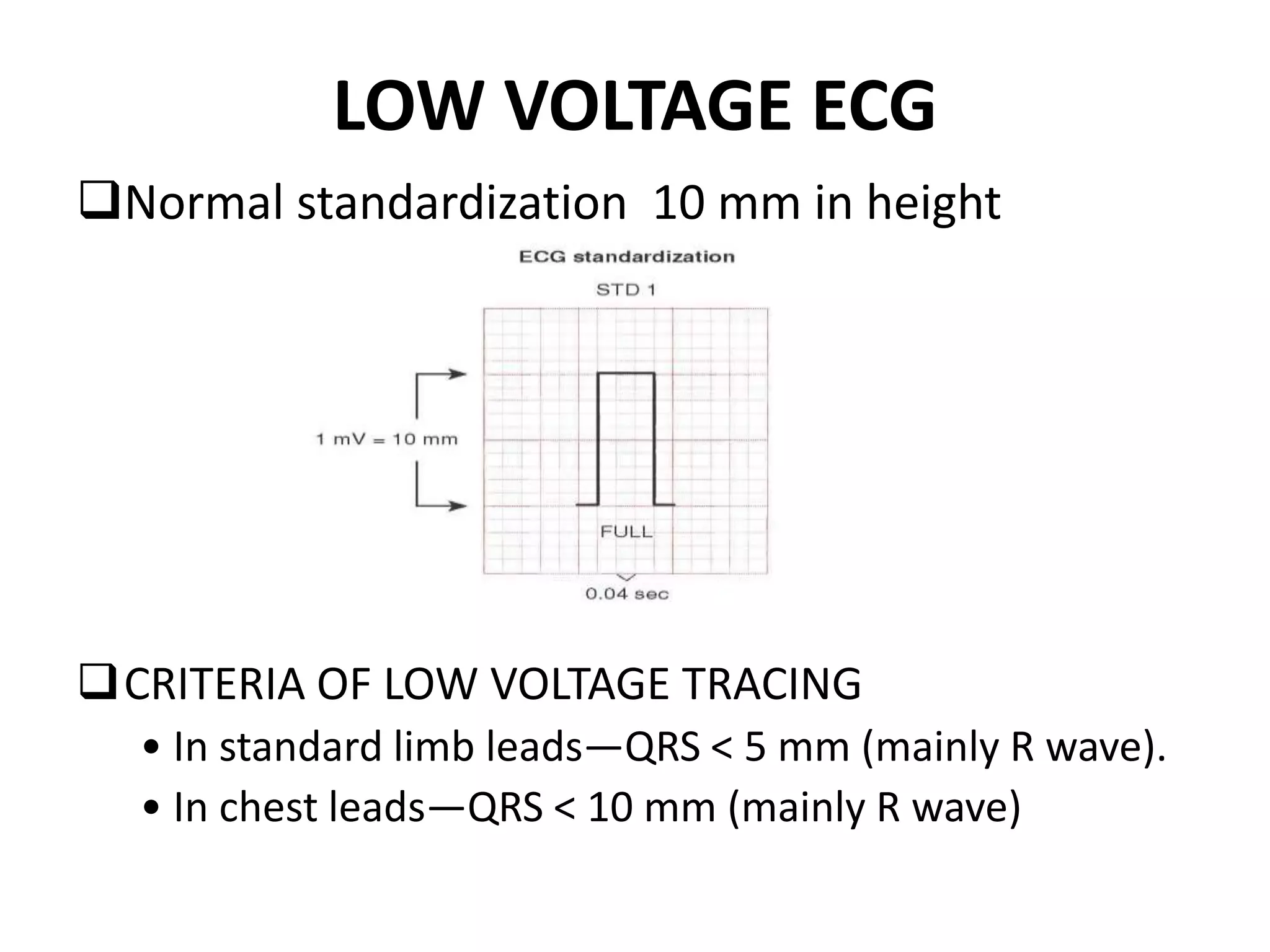
LOW VOLTAGE ECG
Normal standardization 10 mm in height
CRITERIA OF LOW VOLTAGE TRACING
• In standard limb leads—QRS < 5 mm (mainly R wave).
• In chest leads—QRS < 10 mm (mainly R wave)
CAUSES OF LOW VOLTAGE ECG TRACING
• Incorrect standardization (i.e. if < 10 mm).
• Obesity.
• Emphysema
• Pericardial effusion.
• Chronic constrictive pericarditis.
• Myxedema.
• Hypothermia.
ECG Changes in Different
Diseases
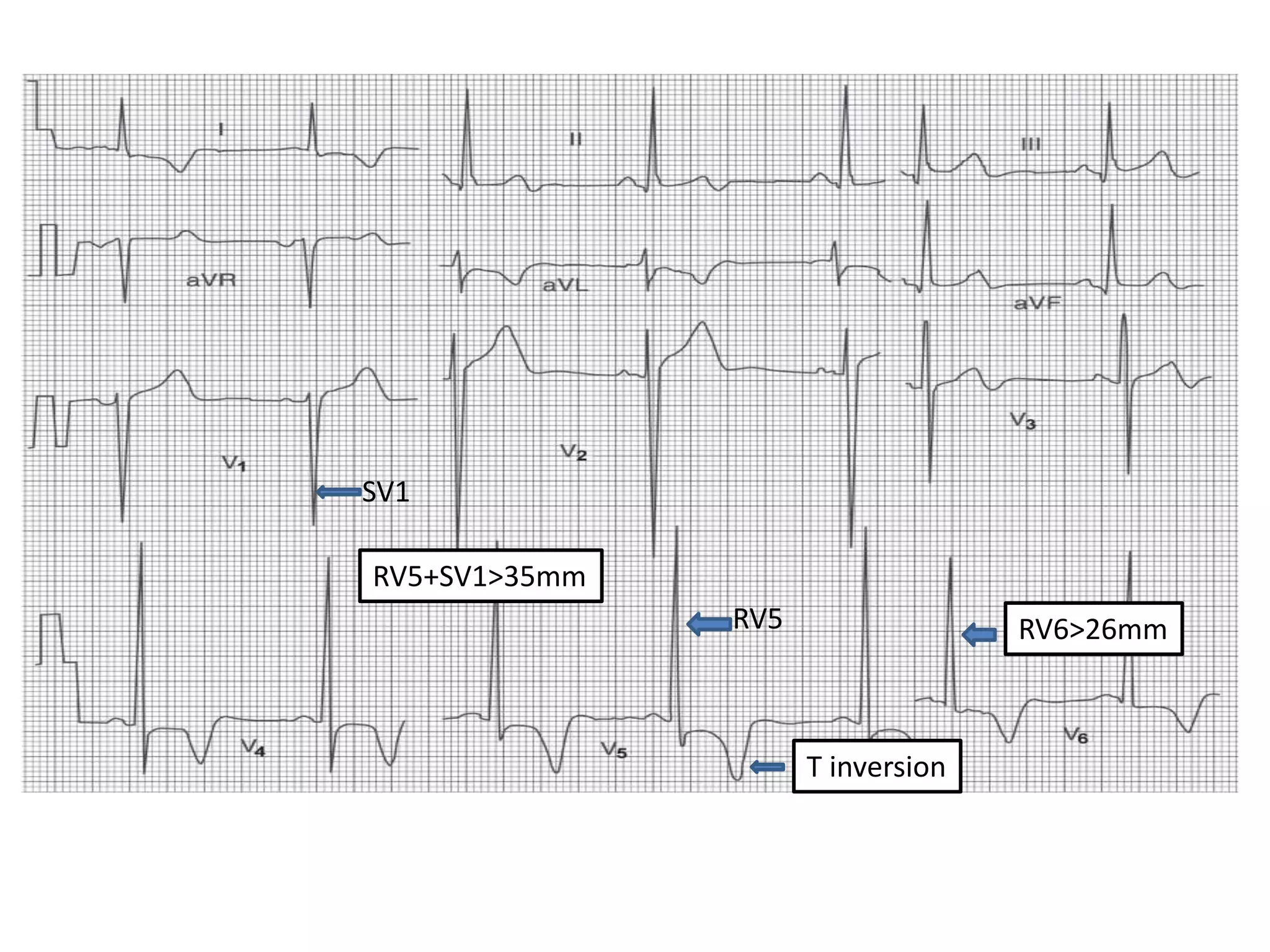
LEFT VENTRICULAR HYPERTROPHY
• S in V1 + R in V6 or V5 > 35 mm
• R in V5 or V6 > 26 mm
• R in aVL > 11 mm
• R in aVF > 20 mm
• Left axis deviation
S in V2 + R in V5 > 35 mm
RV5
SV1
RV5+SV1>35mm
RV6>26mm
T inversion
RIGHT VENTRICULAR HYPERTROPHY
• Tall R wave in V1 > 7 mm
• Right axis deviation
RV1>7mm
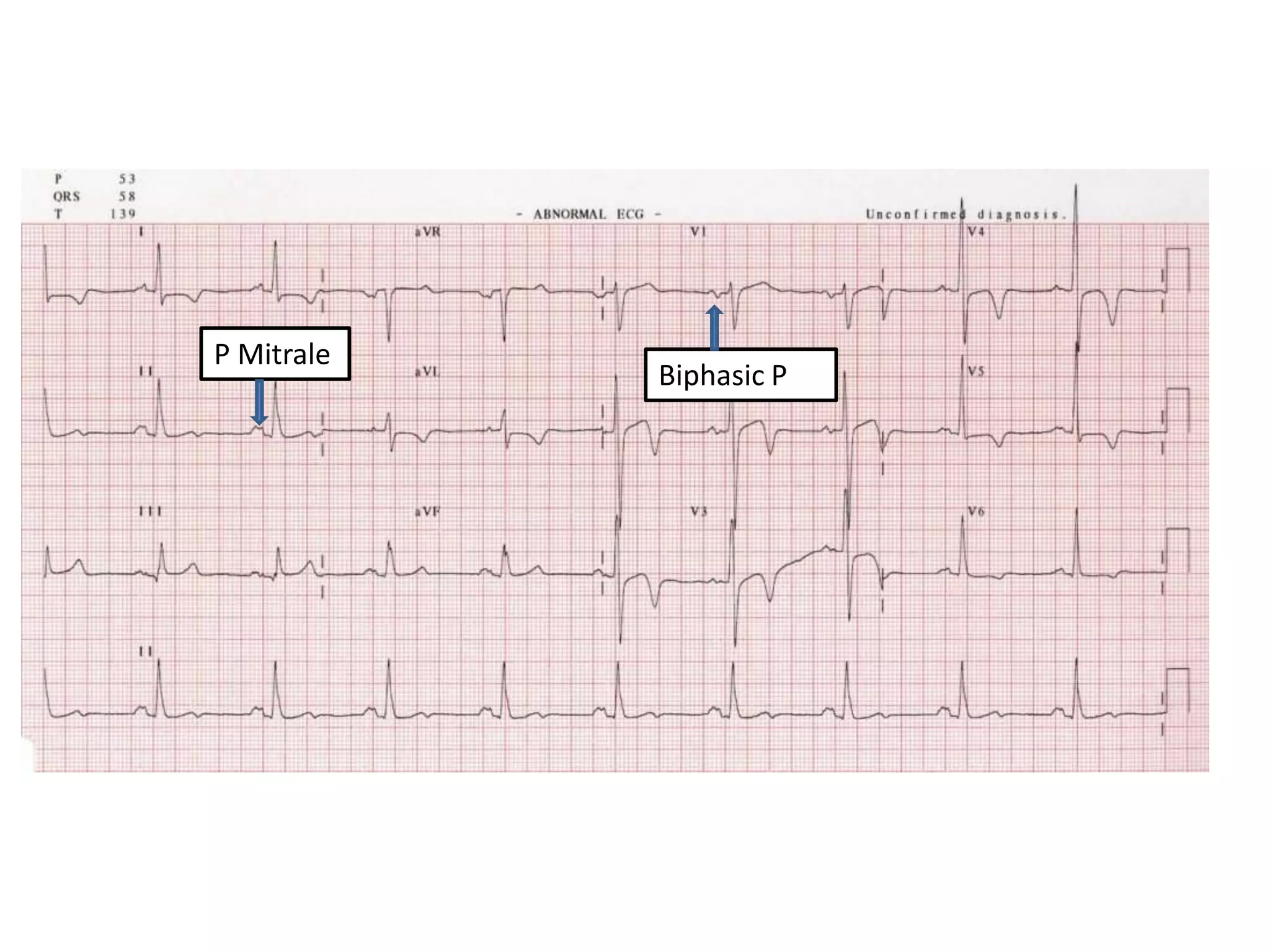
LEFT ATRIAL HYPERTROPHY
• P > 2.5 small squares
• P may be notched or bifid (like M), called P
mitrale
• P in V1-Biphasic
P Mitrale
Biphasic P
RIGHT ATRIAL HYPERTROPHY
• P > 2.5 mm (P pulmonale)
• P in V1 Biphasic
P Pulmonale
ATRIAL FIBRILLATION
• P wave Absent
• P may be replaced by fibrillary f wave
• Rhythm: Irregularly irregular
Rhythm irregularly irregular
Fibrillatory wave
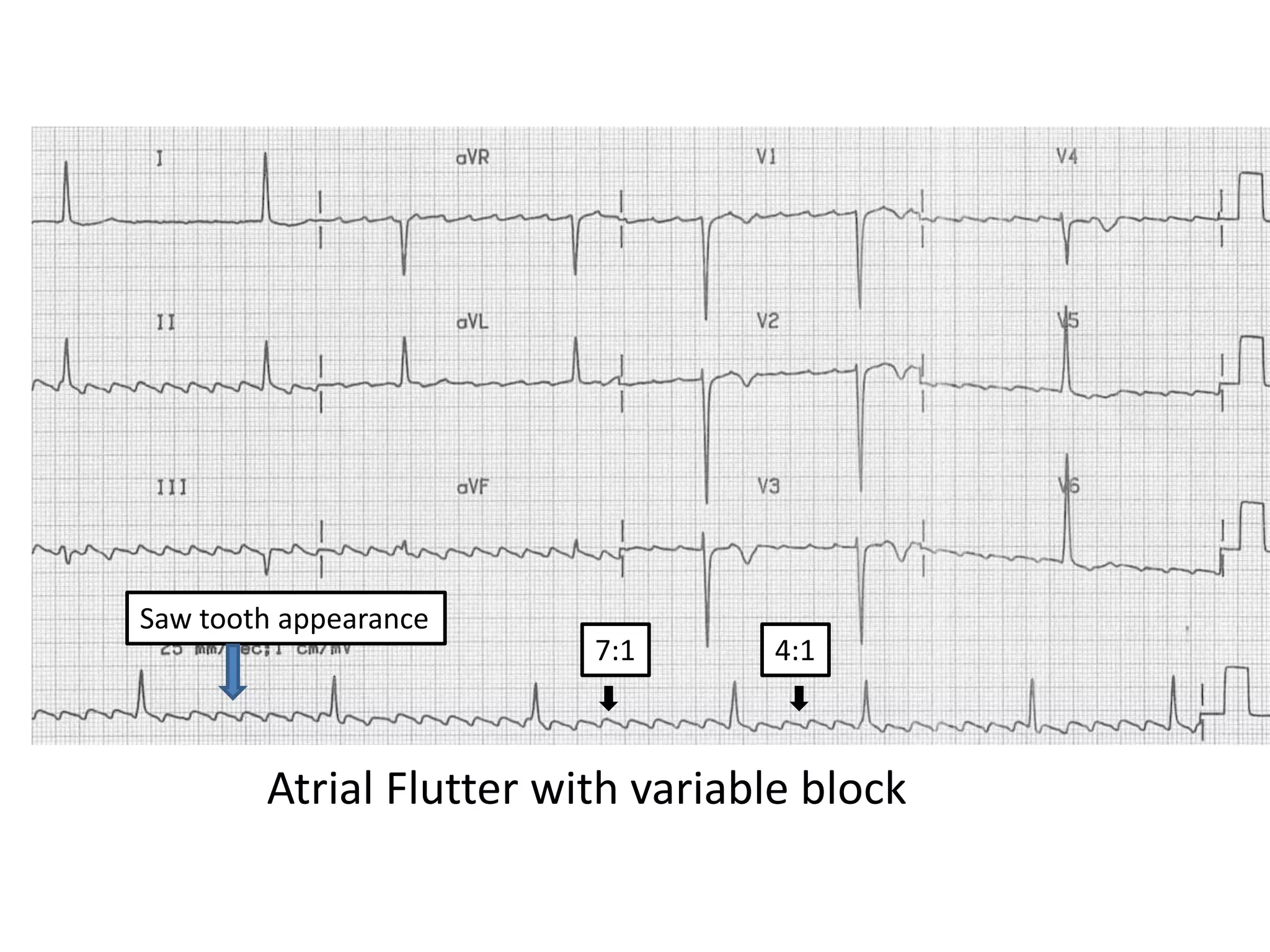
ATRIAL FLUTTER
• P is saw toothed appearance (flutter or F
wave)
• RR regular or irregular when there is variable
block
P saw toothed appearance
R-R regular
• A
Saw tooth appearance
7:1 4:1
Atrial Flutter with variable block
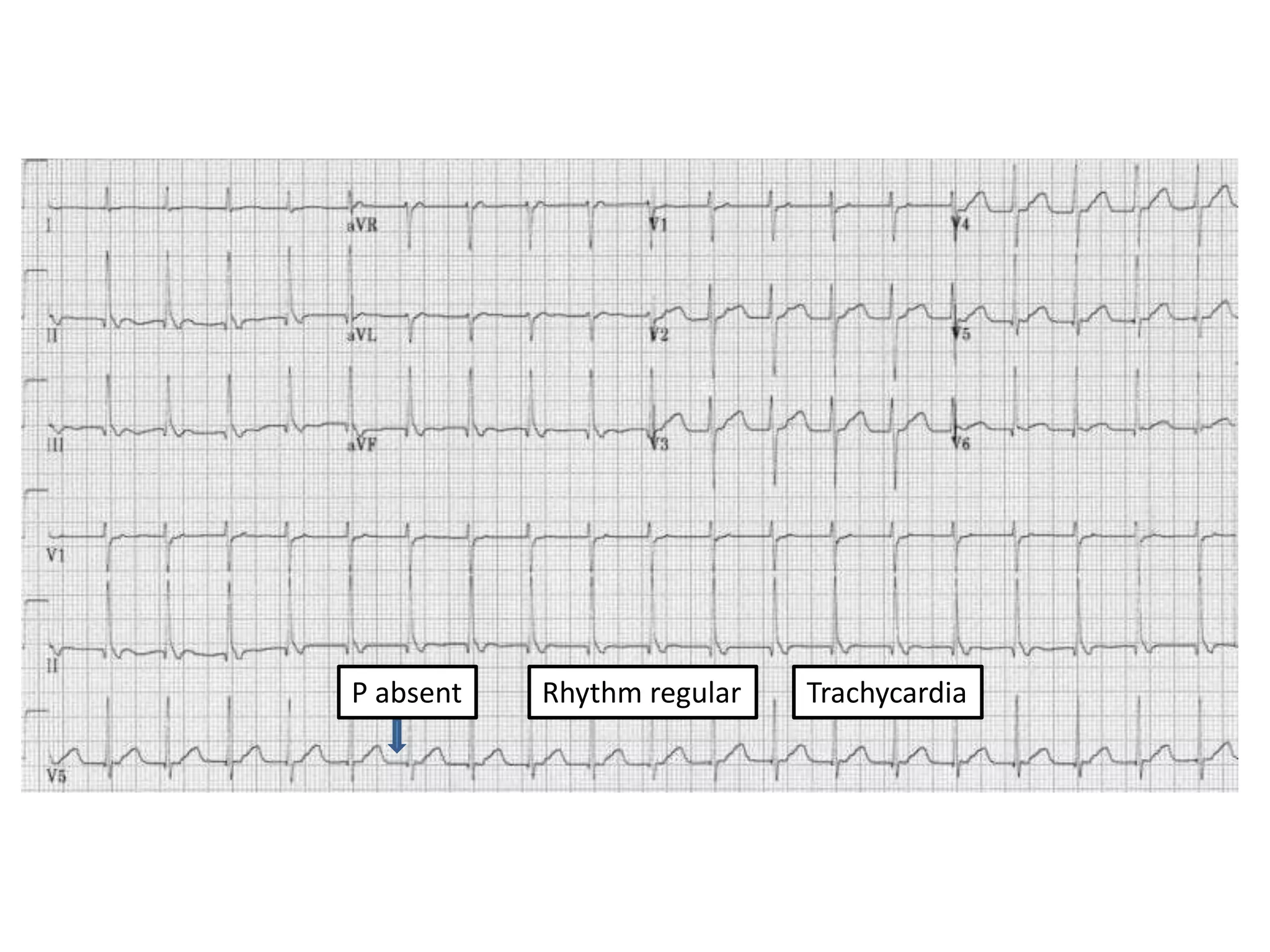
SUPRAVENTRICULAR TACHYCARDIA
• P—absent.
• QRS—narrow.
• Rhythm—regular.
• Trachycardia
P absent Rhythm regular Trachycardia
VENTRICULAR ECTOPIC
• P—absent.
• QRS—wide > 0.12 second (3 small squares).
• T—opposite to major deflection.
P absent
Wide QRS
T opposite to major deflation
• Bigeminy — every other beat is a ventricular ectopic
• Trigeminy — every third beat is a ventricular ectopic
VENTRICULAR TACHYCARDIA
• P wave—absent
• QRS—broad , abnormal or bizarre pattern
• Rate > 100 beats /minute
Broad bizzare QRS complex
Absent P wave
Heart rate >100b/min
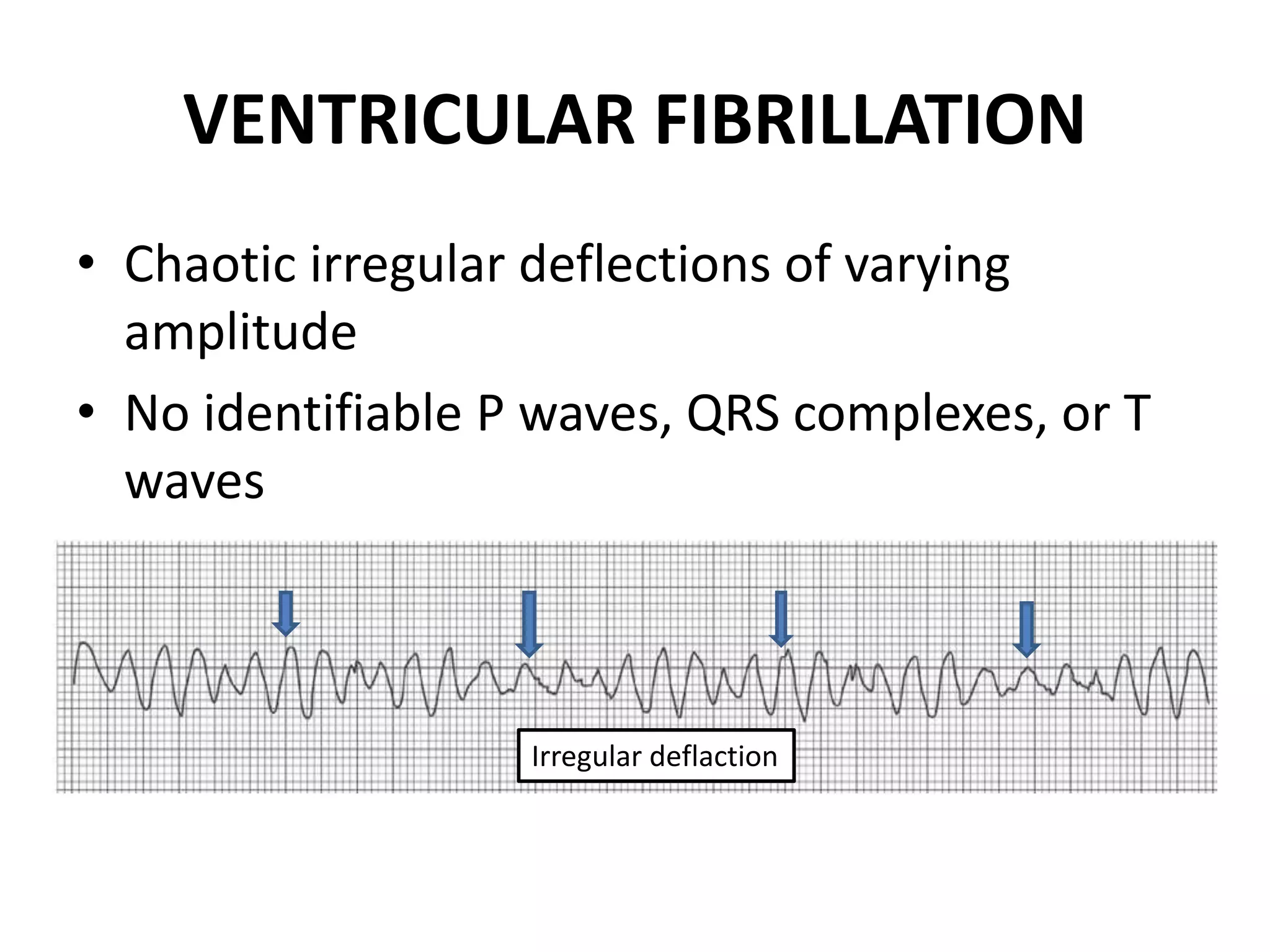
VENTRICULAR FIBRILLATION
• Chaotic irregular deflections of varying
amplitude
• No identifiable P waves, QRS complexes, or T
waves
Irregular deflaction
FIRST DEGREE AV BLOCK
• PR interval—prolonged > 0.22 second
SECOND DEGREE AV BLOCK
• Second degree AV block may be of 2 types:
• Mobitz type I (Wenckebach’s phenomenon).
• Mobitz type II.
MOBITZ TYPE I
• Progressive lengthening of PR interval
followed by absent QRS complex
Drop Beat
PR interval lengthening
MOBITZ TYPE II
• Some P waves are not followed by QRS
complexes
• PR interval is constant
Drop beat
PR constant
COMPLETE HEART BLOCK
• PP interval—constant
• RR interval- constant
• No relationship between P wave and QRS
complex
P P P P P PR R R
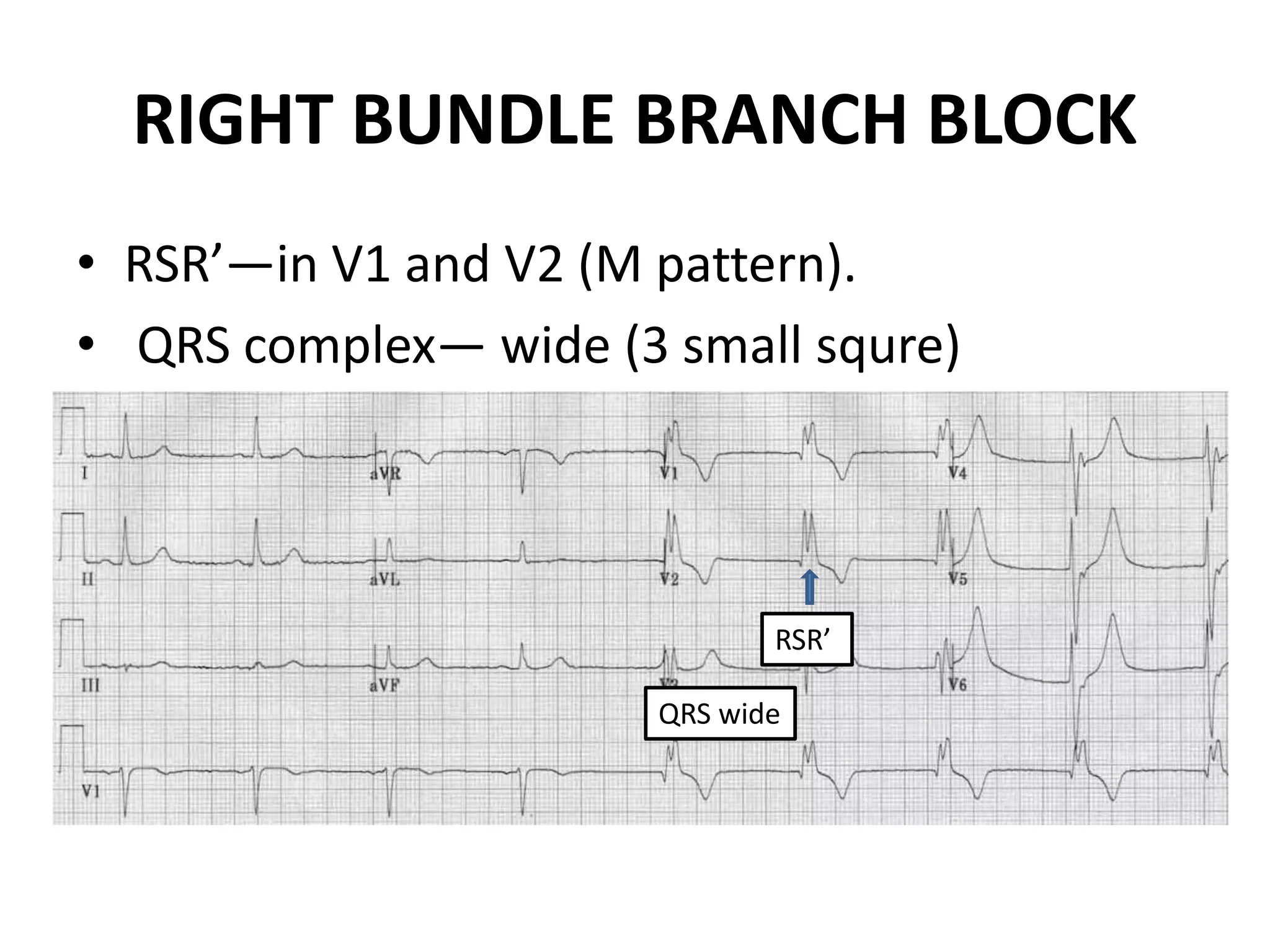
RIGHT BUNDLE BRANCH BLOCK
• RSR’—in V1 and V2 (M pattern).
• QRS complex— wide (3 small squre)
RSR’
QRS wide
LEFT BUNDLE BRANCH BLOCK
• RSR’—in V5 and V6, also in LI and aVL (M pattern).
• QRS—wide (3 small squares)
RSR’
QRS wide
MYOCARDIAL INFARCTION
Criteria for acute myocardial infarction:
Rise of Troponin I with at least one of the
following:
1. Symptoms of myocardial ischaemia
2. New ischaemic ECG changes
3. Development of pathological Q waves
4. Imaging evidence of new loss of viable myocardium
or new regional wall motion abnormality
5. Identification of a coronary thrombus by
angiography or autopsy
(Fourth universal definition of myocardial infarction (2018),ESC)
ECG Criteria of Acute MI
• ST elevation (with upward convexity).
• Pathological Q wave.
• T inversion
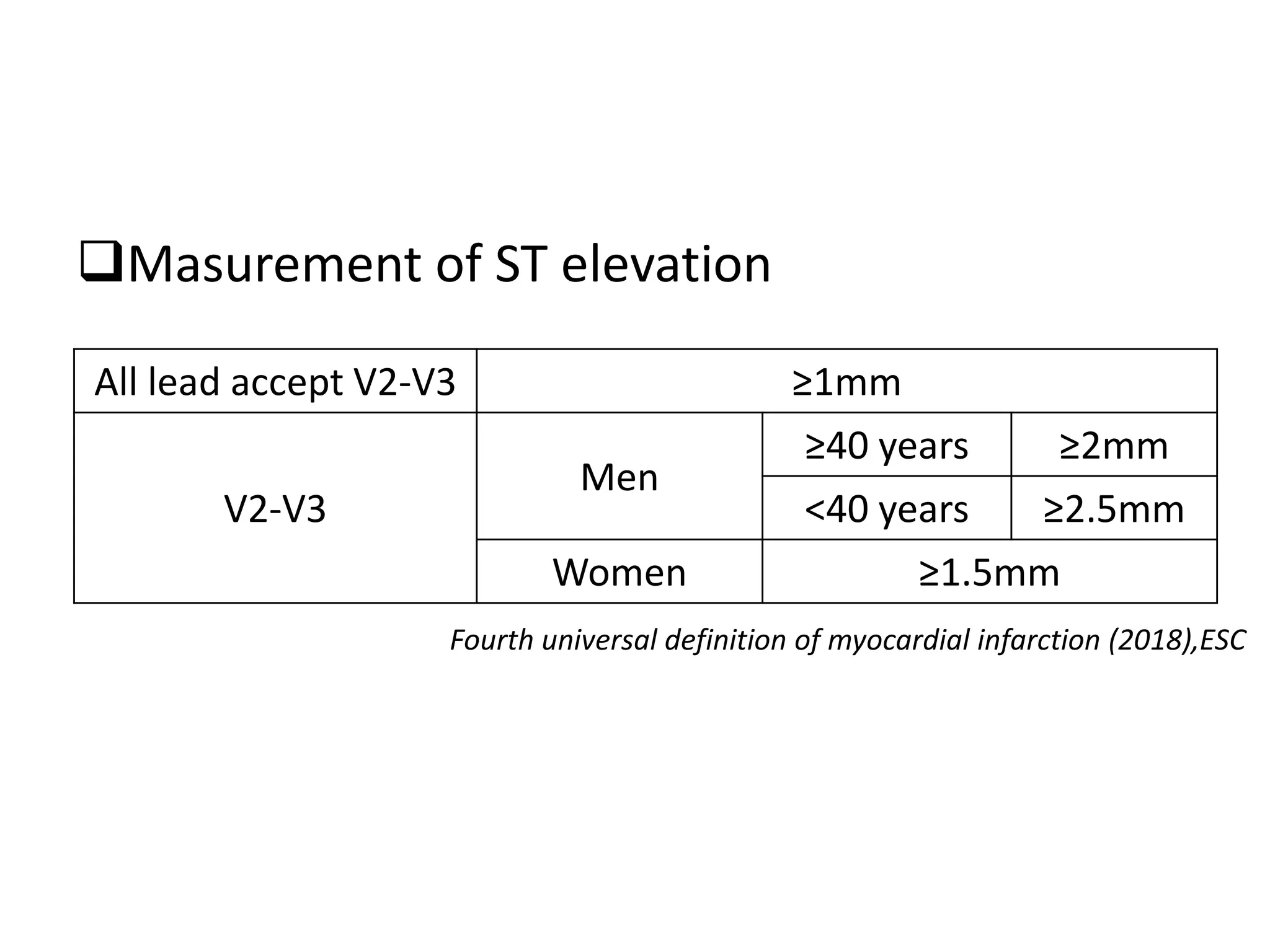
Masurement of ST elevation
All lead accept V2-V3 ≥1mm
V2-V3
Men
≥40 years ≥2mm
<40 years ≥2.5mm
Women ≥1.5mm
Fourth universal definition of myocardial infarction (2018),ESC
Sites of Myocardial Infarction is
Detected in Different Leads
Anteroseptal MI V1 to V3 or V4
Anterior MI V1 to V6.
Extensive anterior MI L1, aVL, V1 to V6.
Lateral MI L1, aVL, V5, V6
High lateral L1 and aVL
Inferior MI L2, L3 and aVF
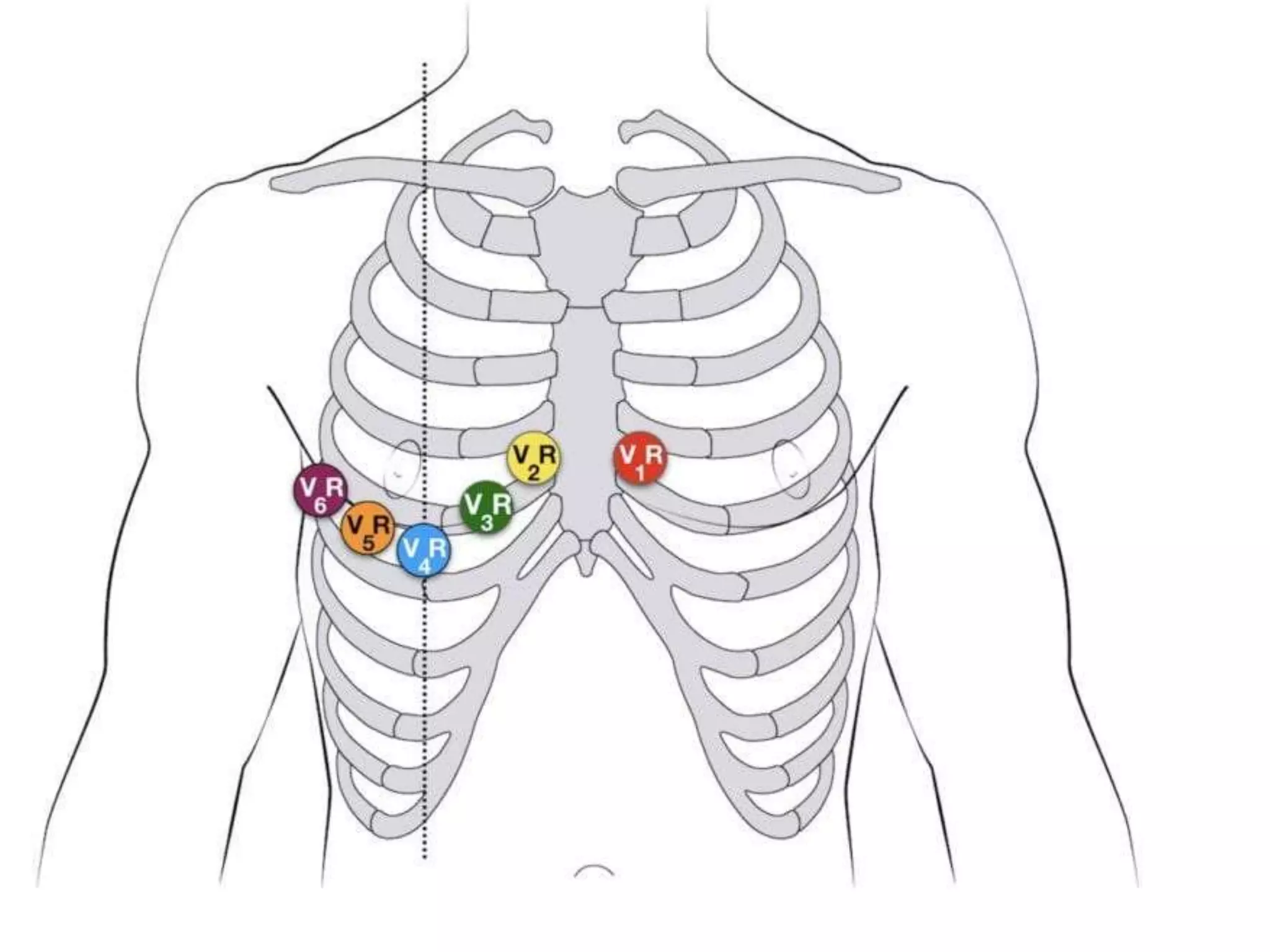
Right ventricular infarction V3R to V6R
Posterior (true) MI V1 and V2
Artery involve in MI
Inferior MI
Anterior MI
Lateral MI
RCA
LCX
LAD
ST elevation
Anterioseptal MI
ST elevation
Extensive Anterior MI
ST elevation
High lateral MI
• I
ST elevation
Inferior MI
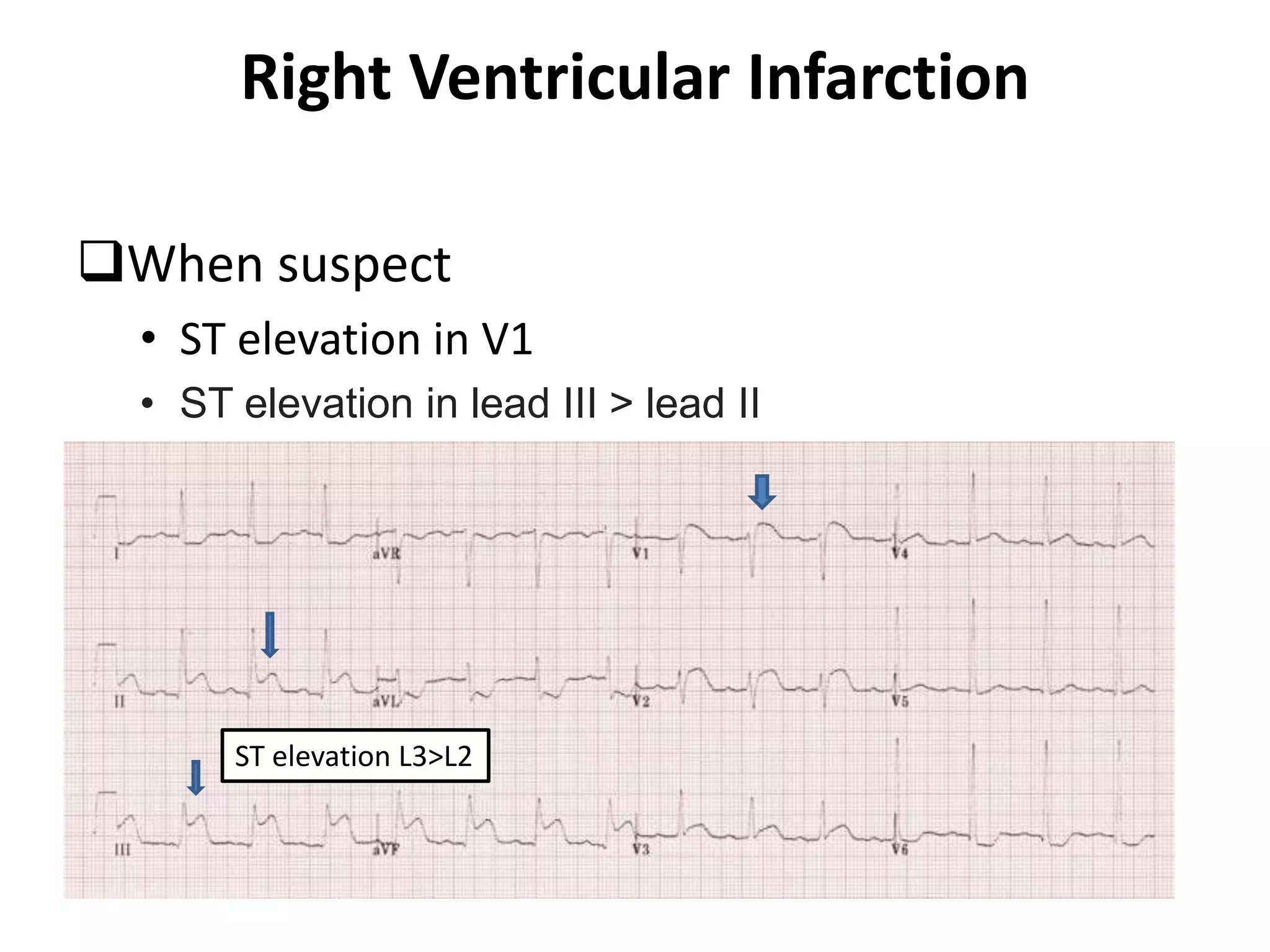
Right Ventricular Infarction
When suspect
• ST elevation in V1
• ST elevation in lead III > lead II
ST elevation L3>L2
ST elevation
Right Ventricular Infarct
Posterior Myocardial Infarction
• Posterior MI is suggested by the following
changes in V1-3:
• Tall, broad R waves (>30ms)
• Horizontal ST depression
• Upright T waves
Horizontal ST depressionTall R
Upright T
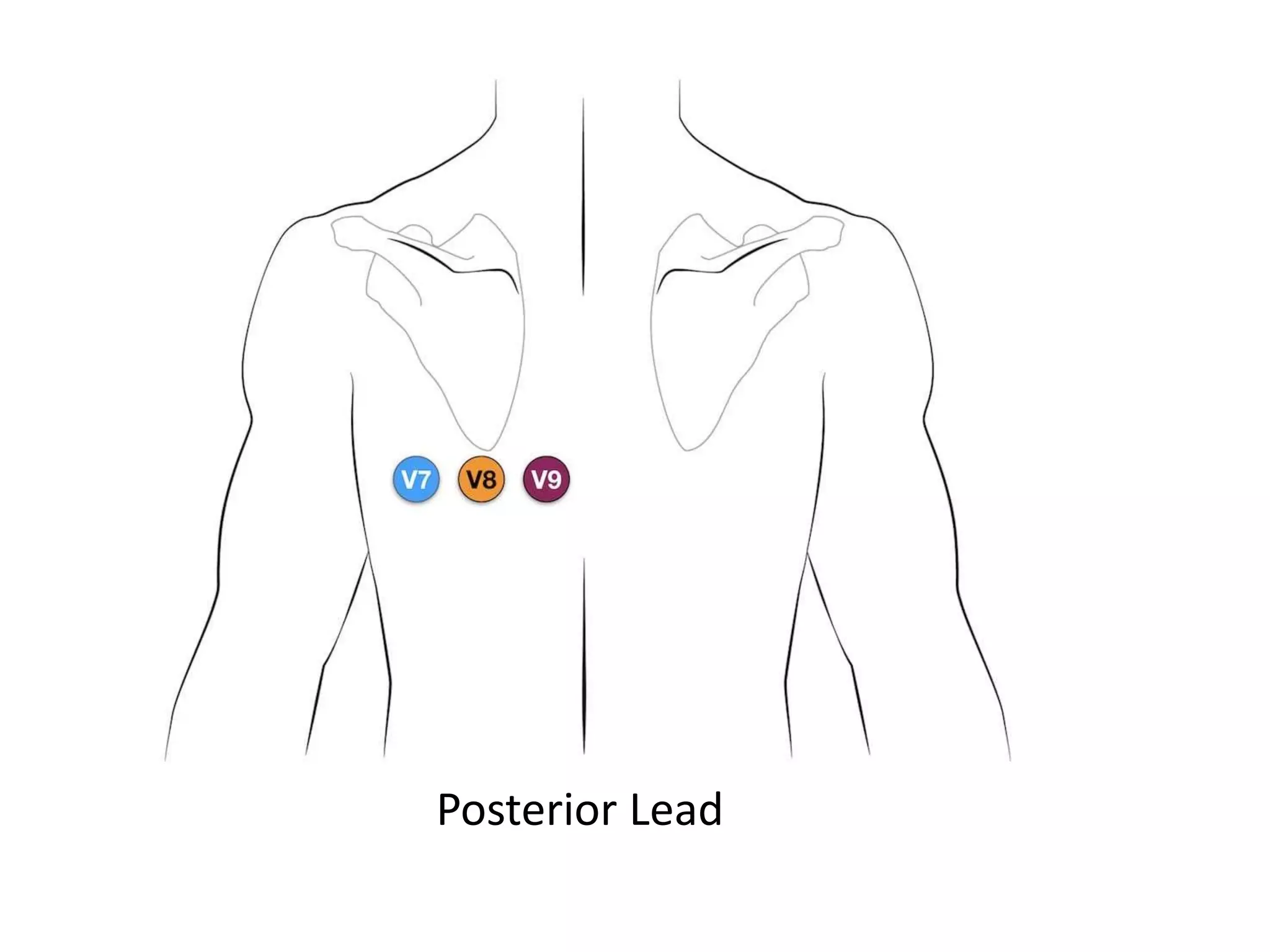
Posterior Lead
• ST elevation in V7-V9 >0.5 mm diagnostic for
Posterior MI
Old Myocardial Infarction
• Pathological Q wave.
• ST—in baseline.
• T—normal or inverted
Pathological Q wave
Acute Pericarditis
• Widespread ST elevation with upward
concavity (chair shaped or saddle shaped)
• PR depression
ST
PR
ST Elevation
PR depression
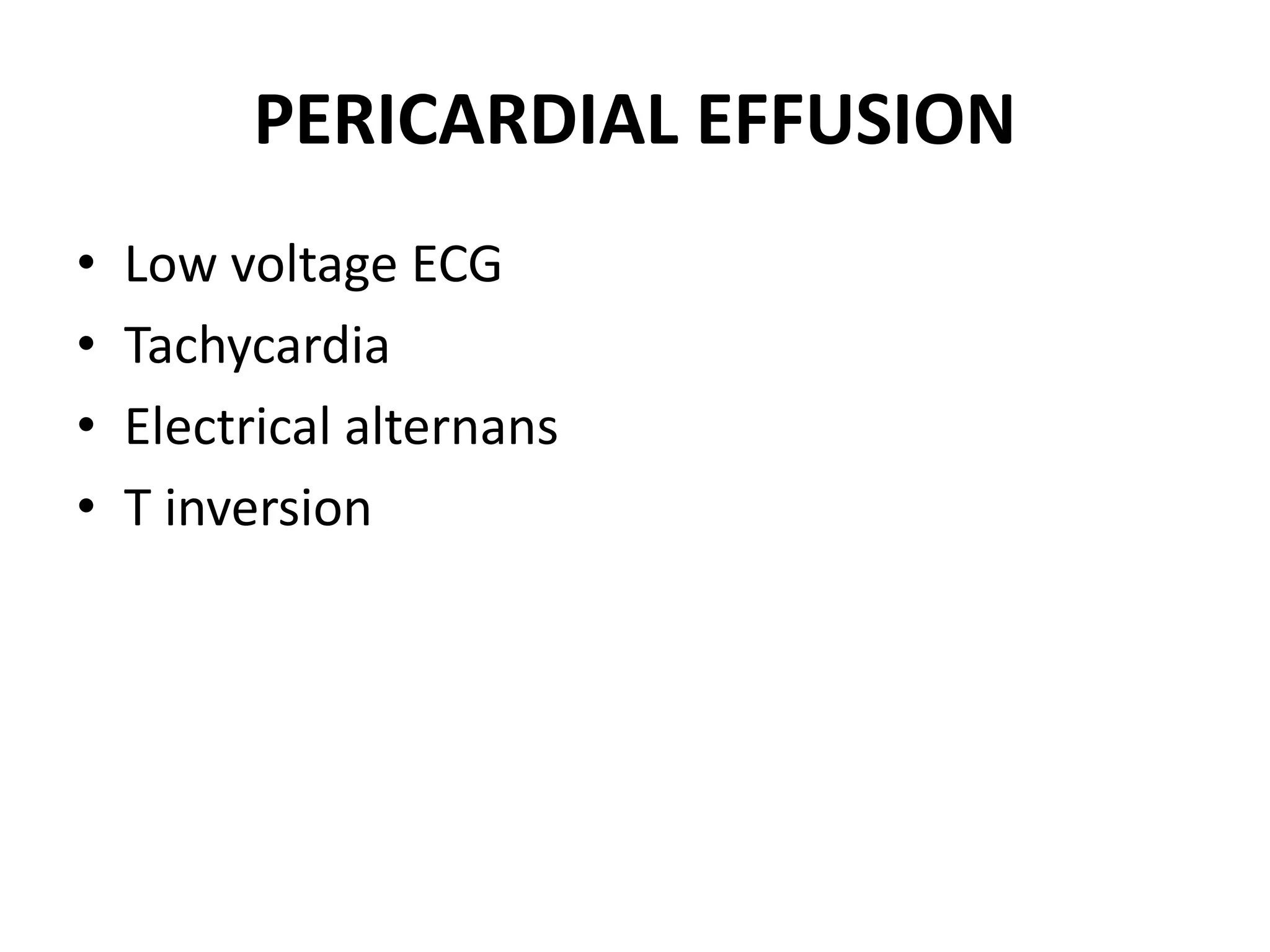
PERICARDIAL EFFUSION
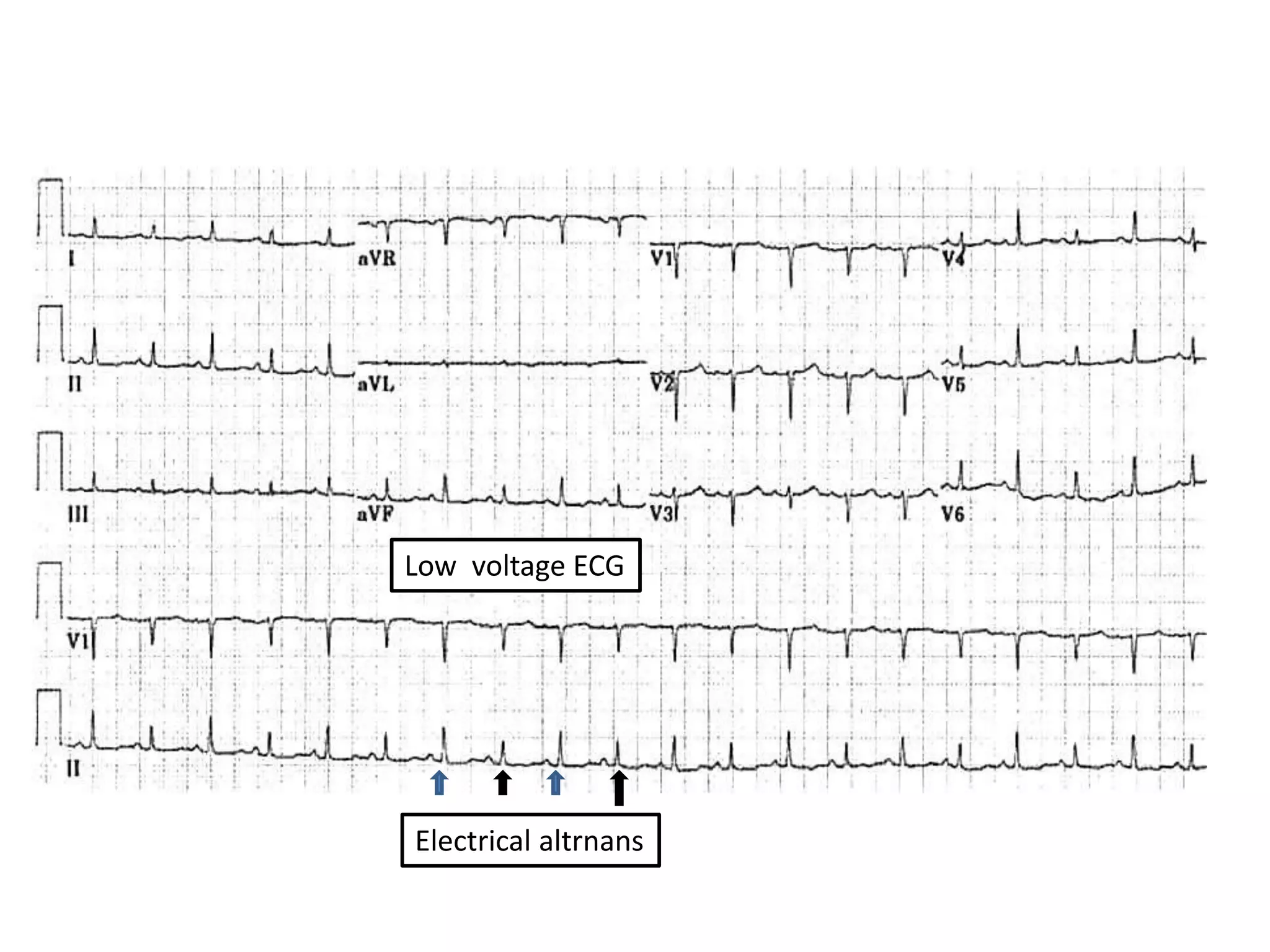
• Low voltage ECG
• Tachycardia
• Electrical alternans
• T inversion
Electrical altrnans
Low voltage ECG
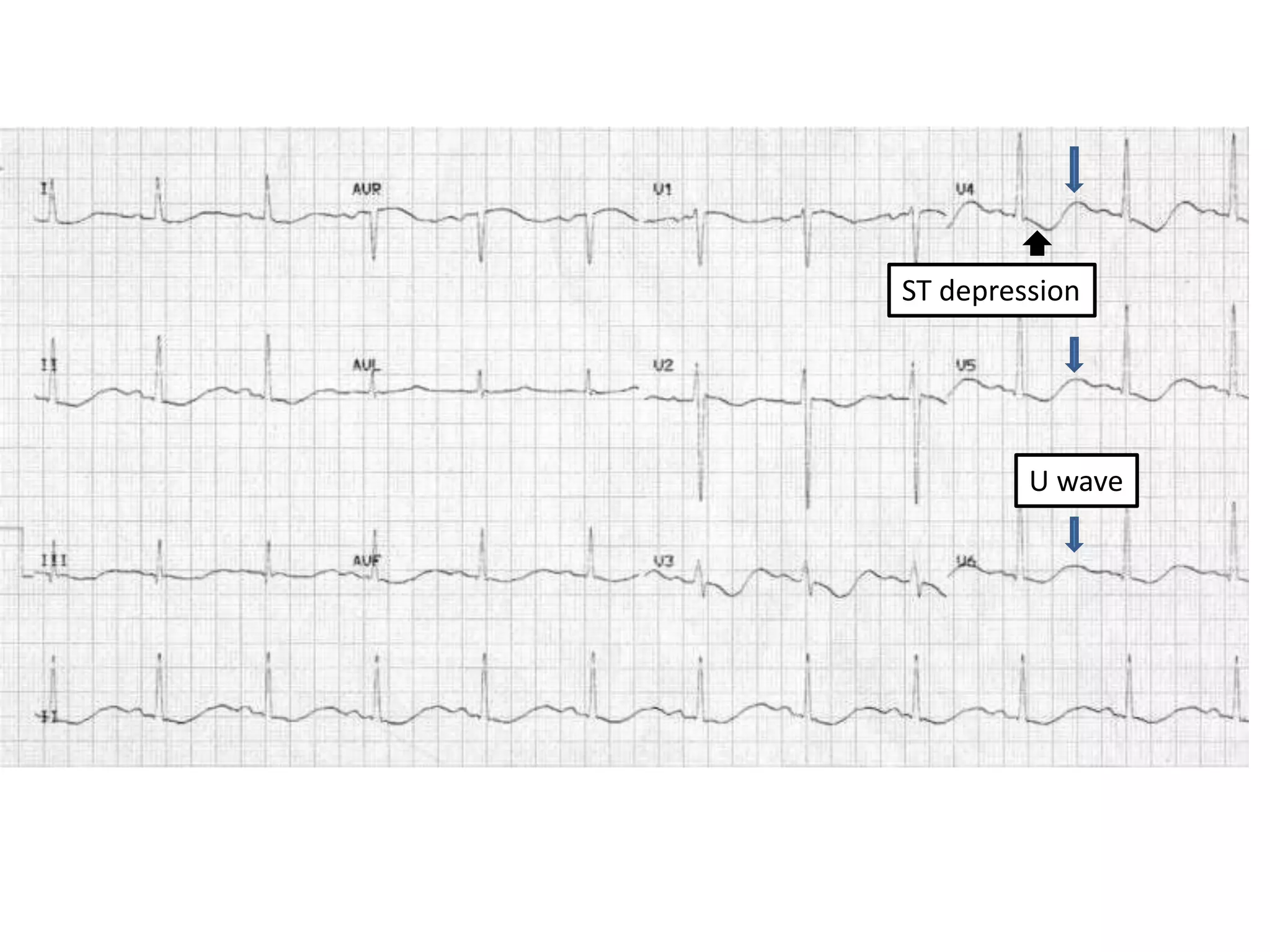
HYPOKALEMIA
• Prolonged PR interval
• U—prominent in chest leads .
• ST depression
• T is small or inverted
U
T
U wave
ST depression
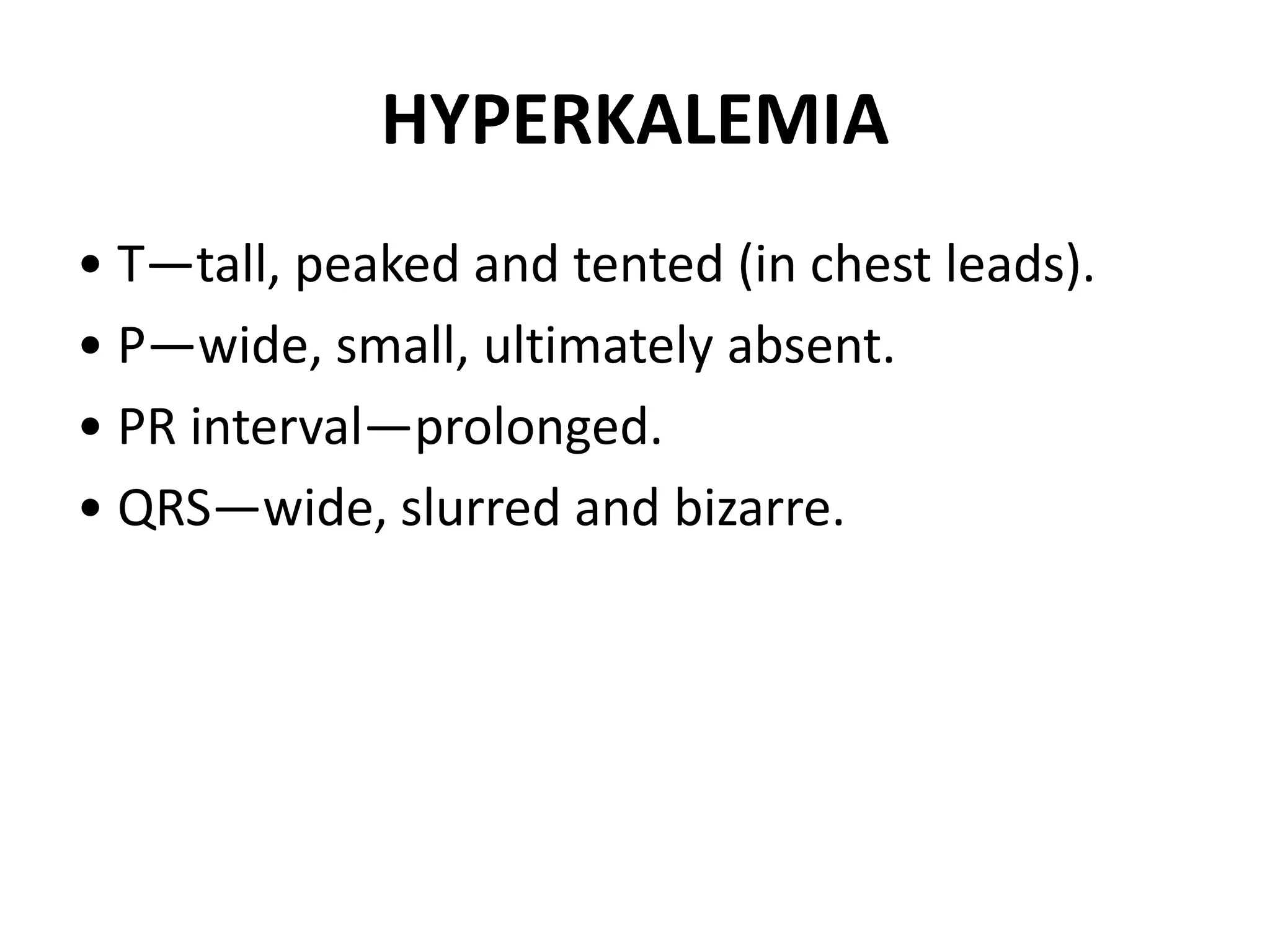
HYPERKALEMIA
• T—tall, peaked and tented (in chest leads).
• P—wide, small, ultimately absent.
• PR interval—prolonged.
• QRS—wide, slurred and bizarre.
Tall peaked T
Broad bizzare QRS
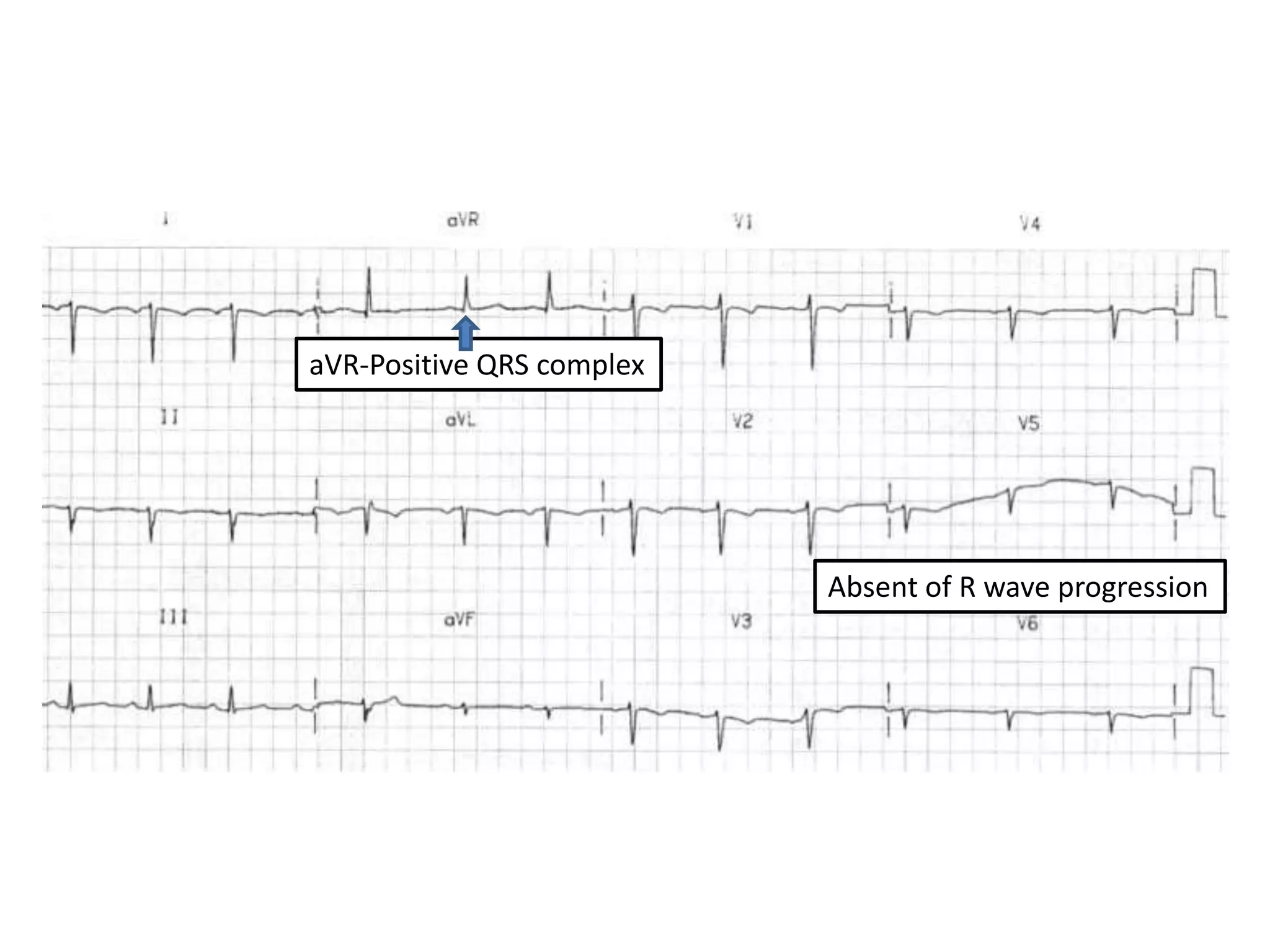
DEXTROCARDIA
• Right axis deviation
• Positive QRS complexes in aVR
• Absent R-wave progression in the chest leads
,dominant S waves throughout
aVR-Positive QRS complex
Absent of R wave progression
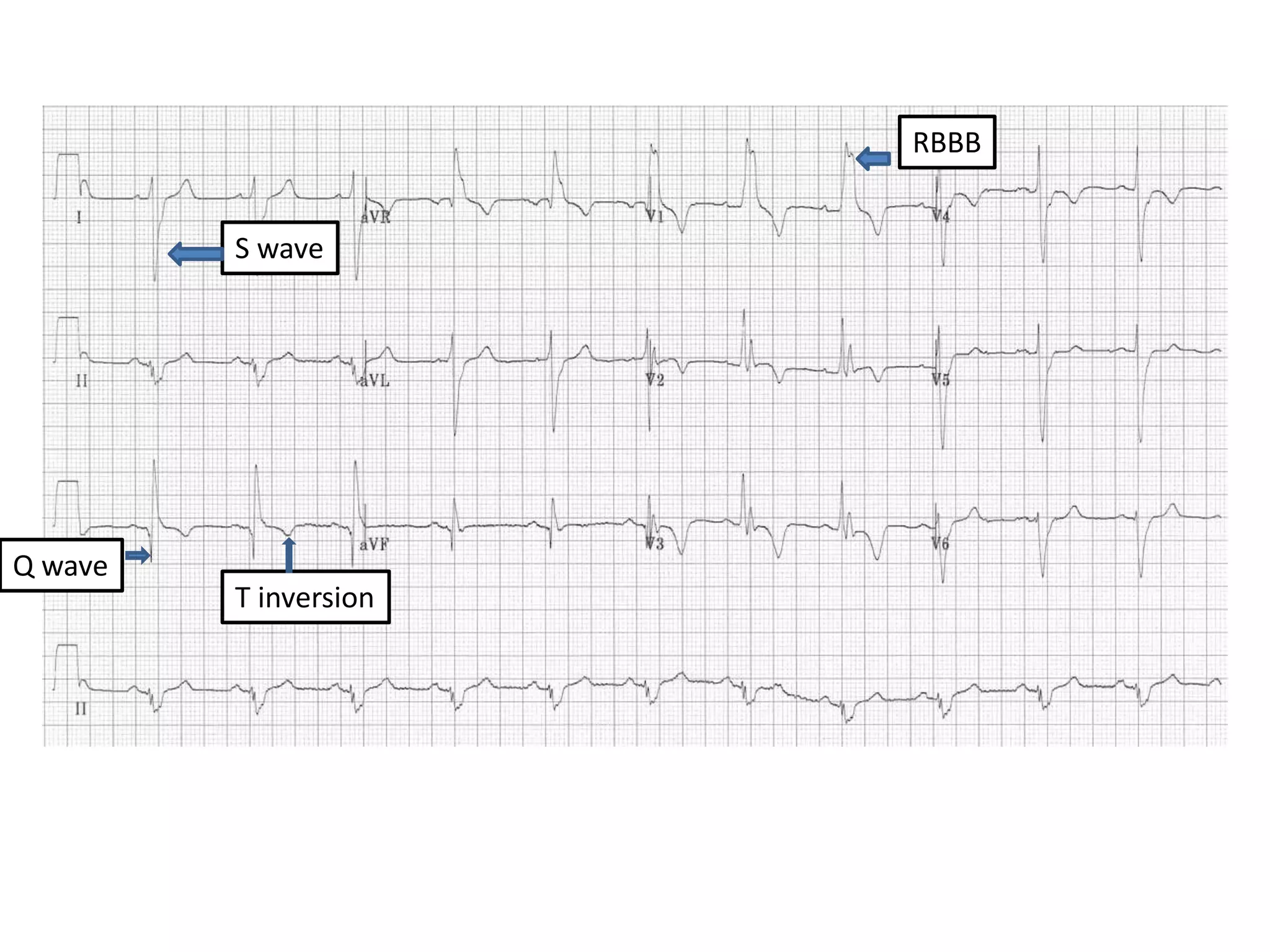
PULMONARY EMBOLISM
• Sinus tachycardia
• RBBB
• Right axis deviation
• S in LI, Q and T inversion in LIII (SI, QIII, TIII
pattern)
• ST depression and T wave inversion in right
precordial leads (V1 and V2)
S wave
Q wave
T inversion
RBBB
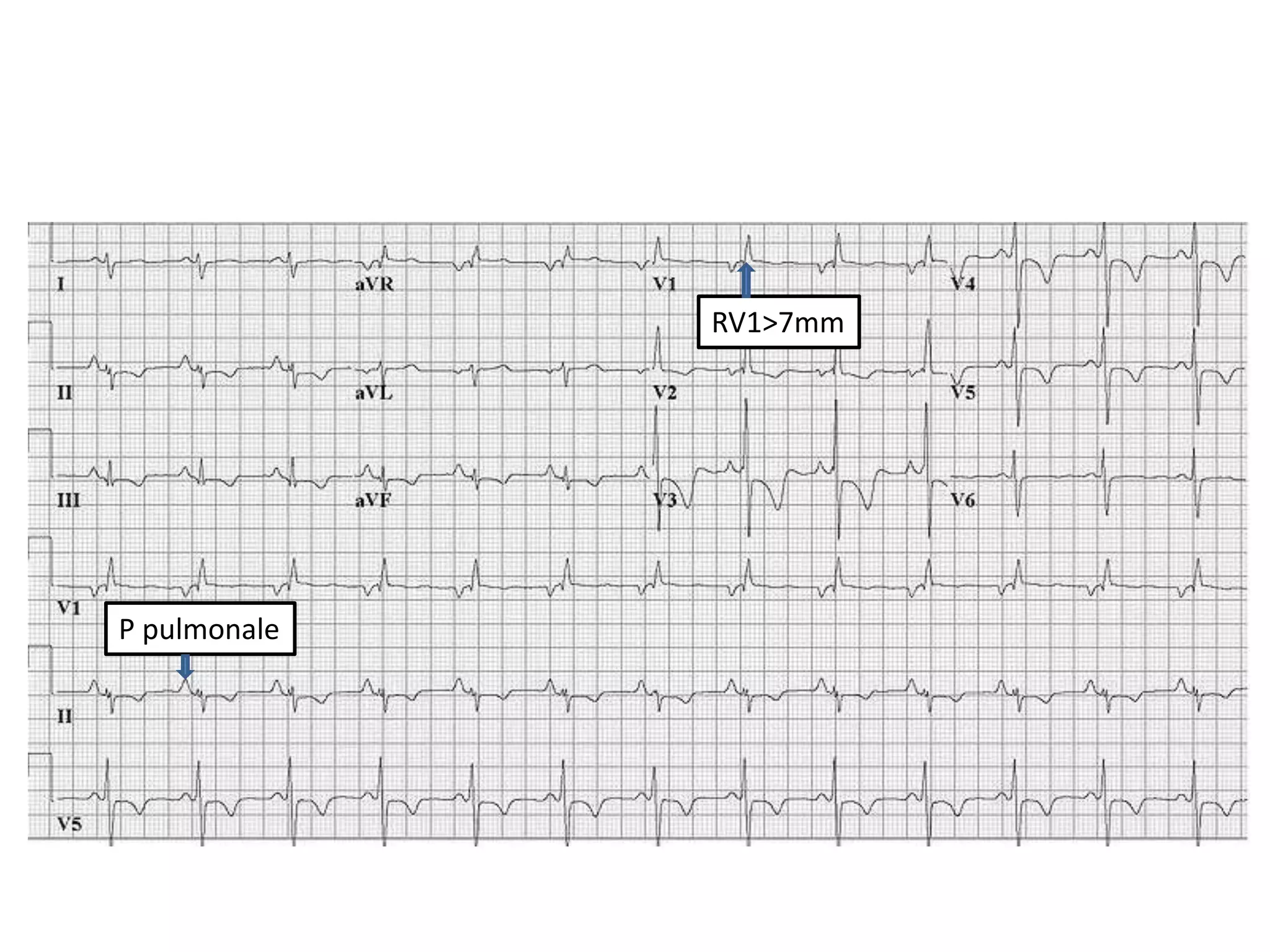
Pulmonary Hypertension
• P pulmonale
• RV1>7mm
• Right axis deviation
• RBBB
P pulmonale
RV1>7mm
ECG Interpretation

ECG Interpretation