Basics of Electrocardiography Dr.K.Subramanyam 23-3-2009
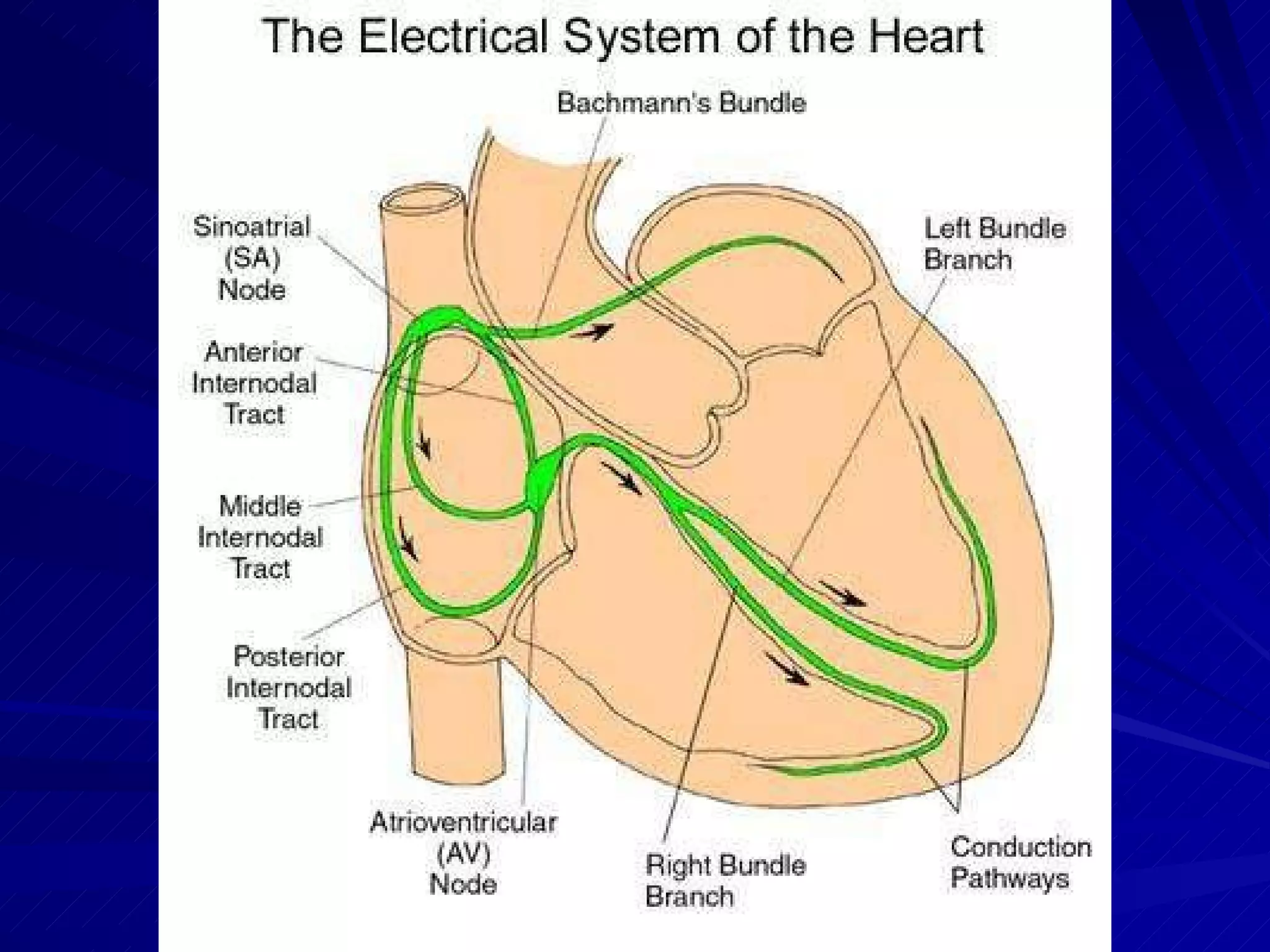
Outline Review of the conduction system ECG leads and recording  ECG waveforms and intervals Normal ECG and its variants Interpretation and reporting of an ECG
 
What is an ECG? An ECG is the recording (gram)  of the electrical activity(electro)  generated by the cells of the  heart(cardio)  that reaches the body  surface.
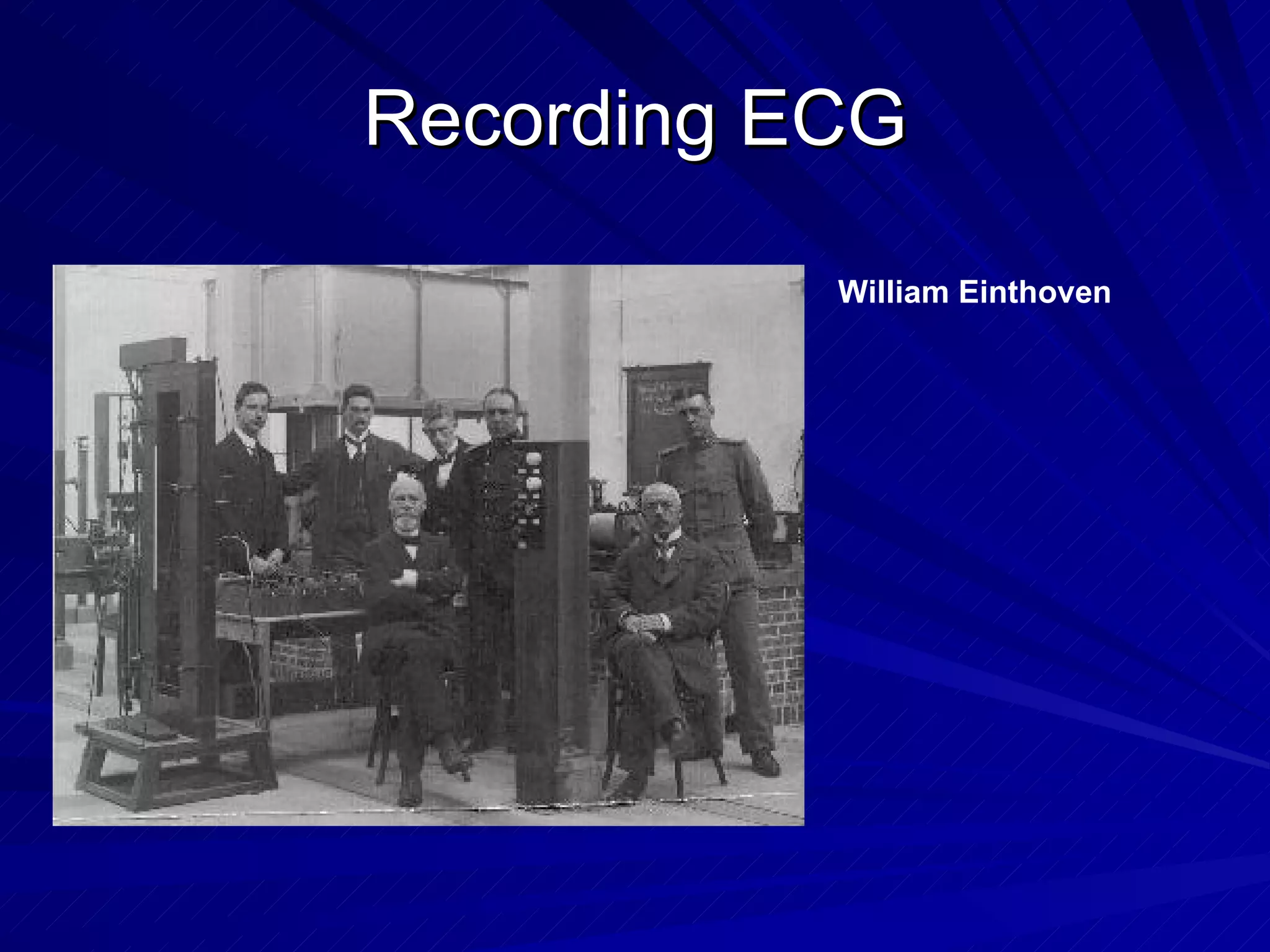
Recording ECG William Einthoven
Useful in diagnosis of… Cardiac Arrhythmias Myocardial ischemia and infarction Pericarditis Chamber hypertrophy Electrolyte disturbances Drug effects and toxicity
Recording an ECG
Basics ECG graphs: 1 mm squares 5 mm squares  Paper Speed: 25 mm/sec standard Voltage Calibration:  10 mm/mV standard
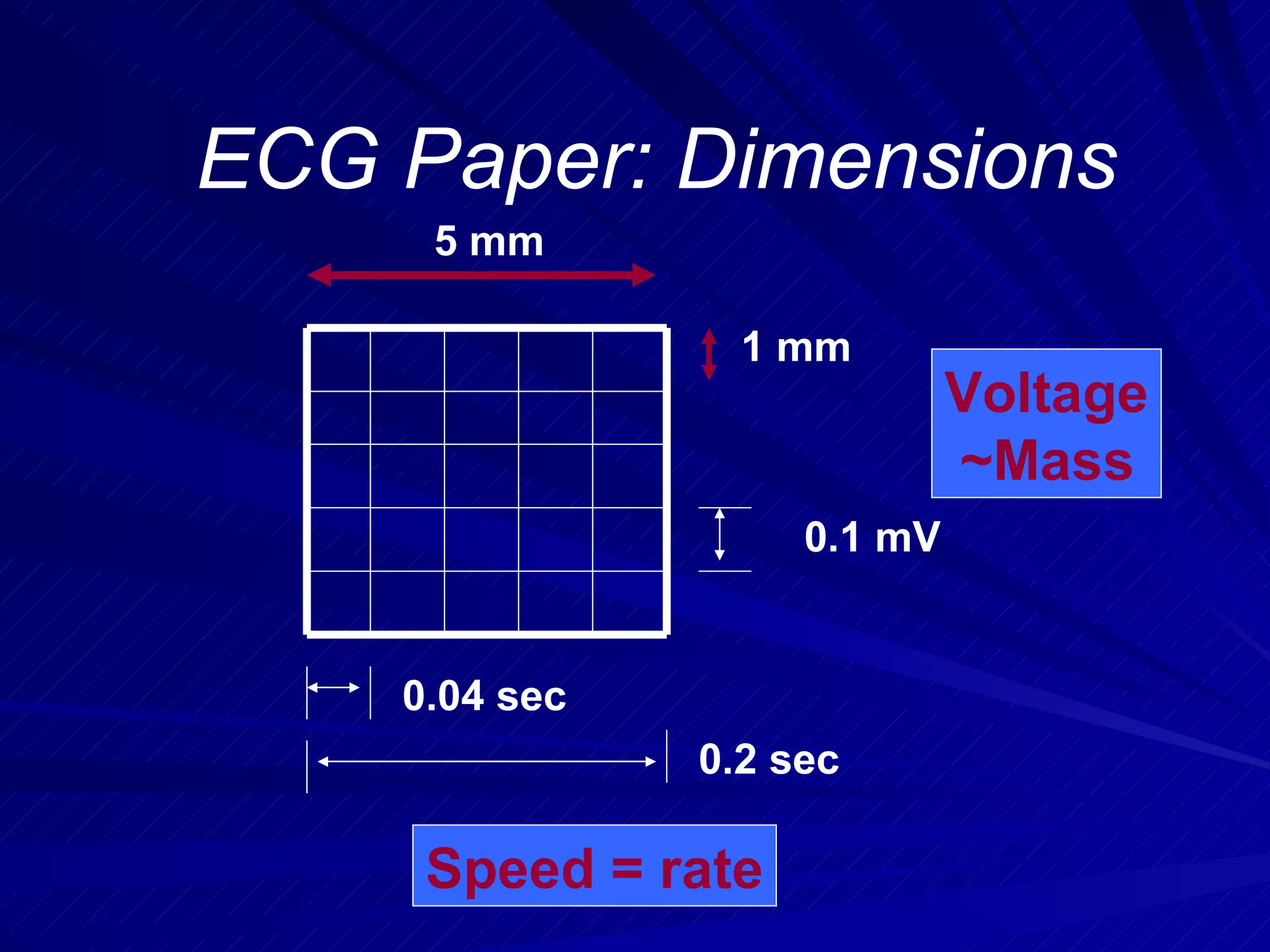
ECG Paper: Dimensions 5 mm 1 mm 0.1 mV 0.04 sec 0.2 sec Speed = rate Voltage ~Mass
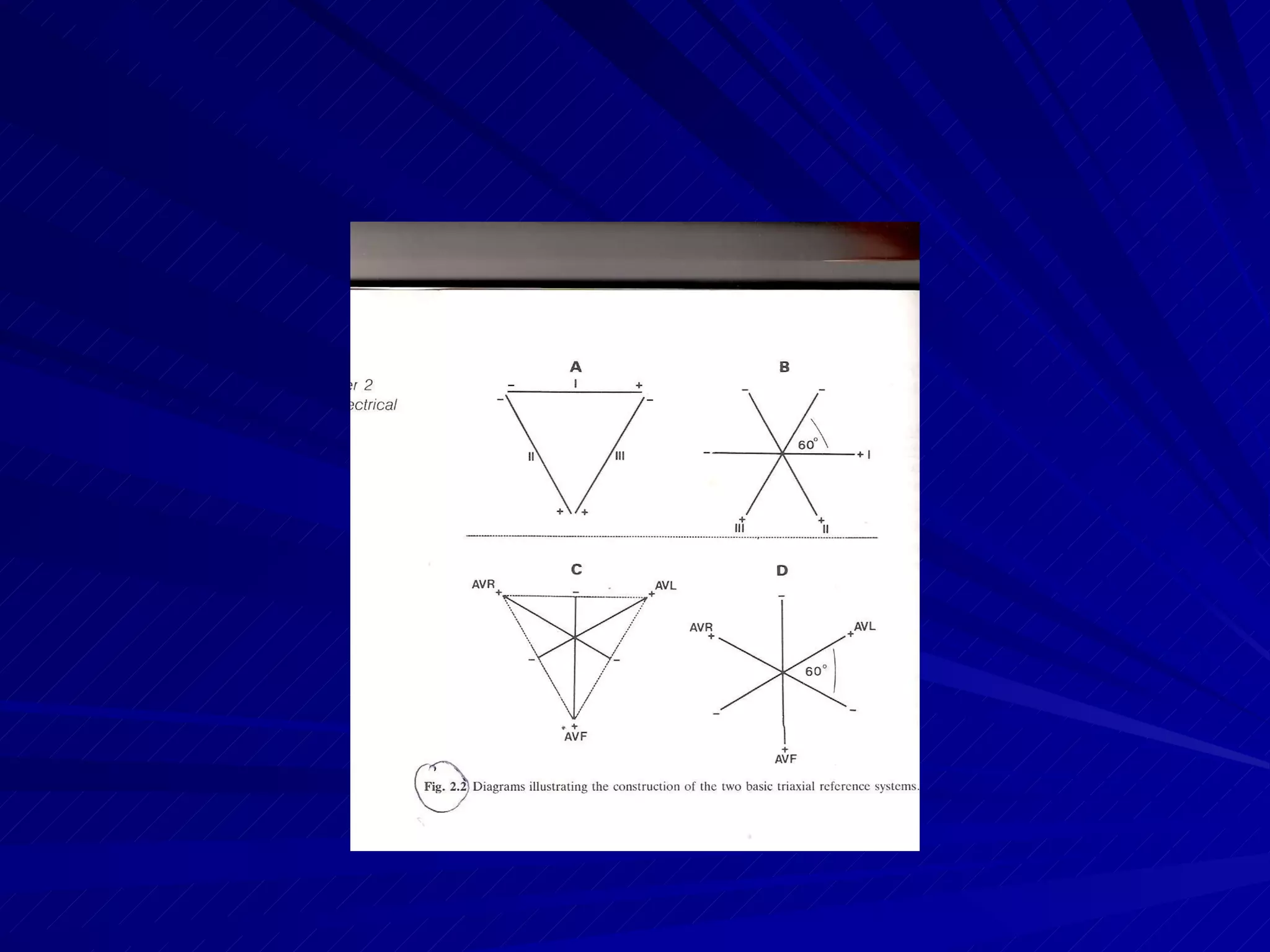
ECG Leads Leads are electrodes which measure the difference in electrical potential between either: 1. Two different points on the body (bipolar leads) 2. One point on the body and a virtual reference point with zero electrical potential, located in the center of the heart (unipolar leads)
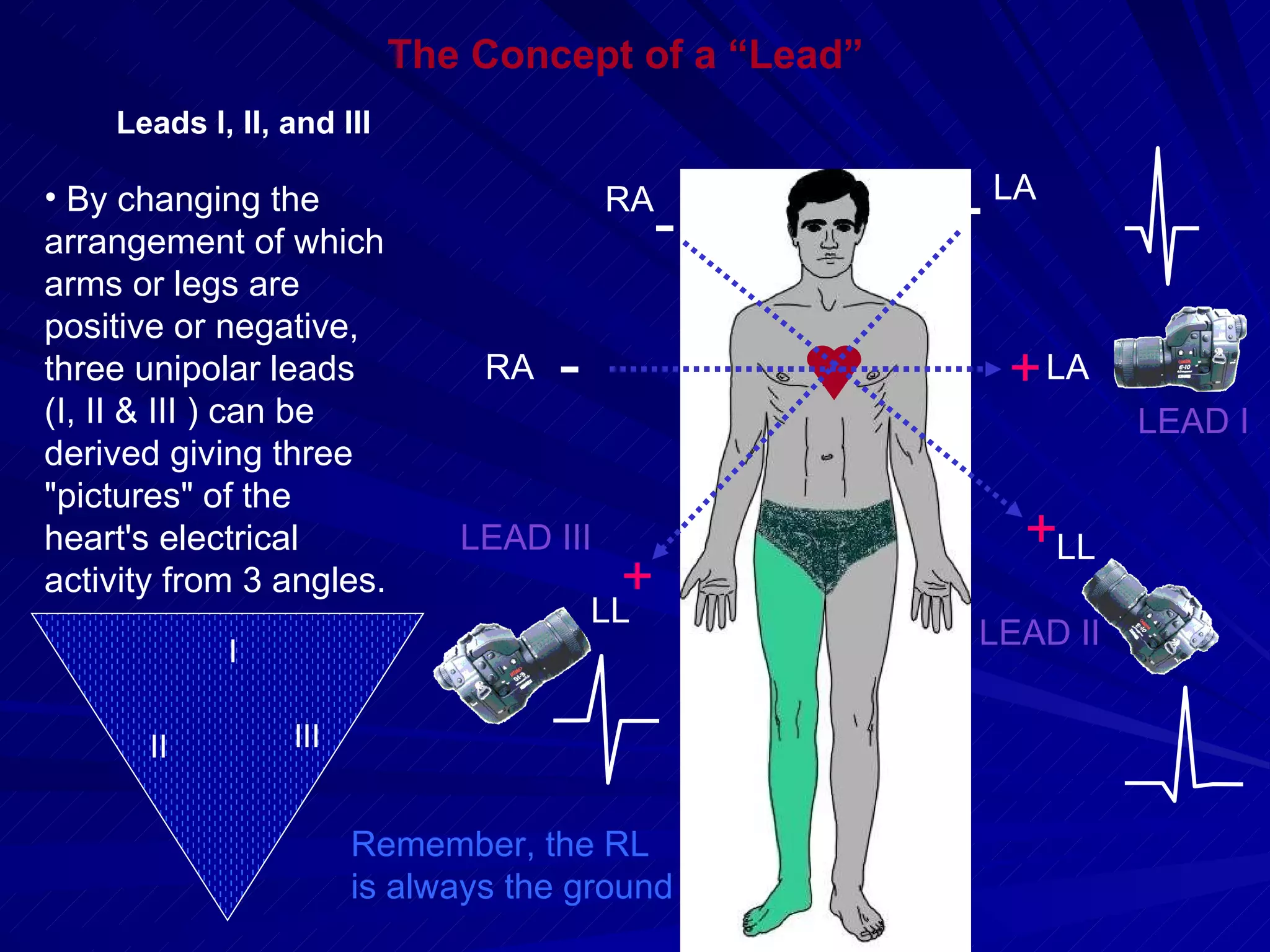
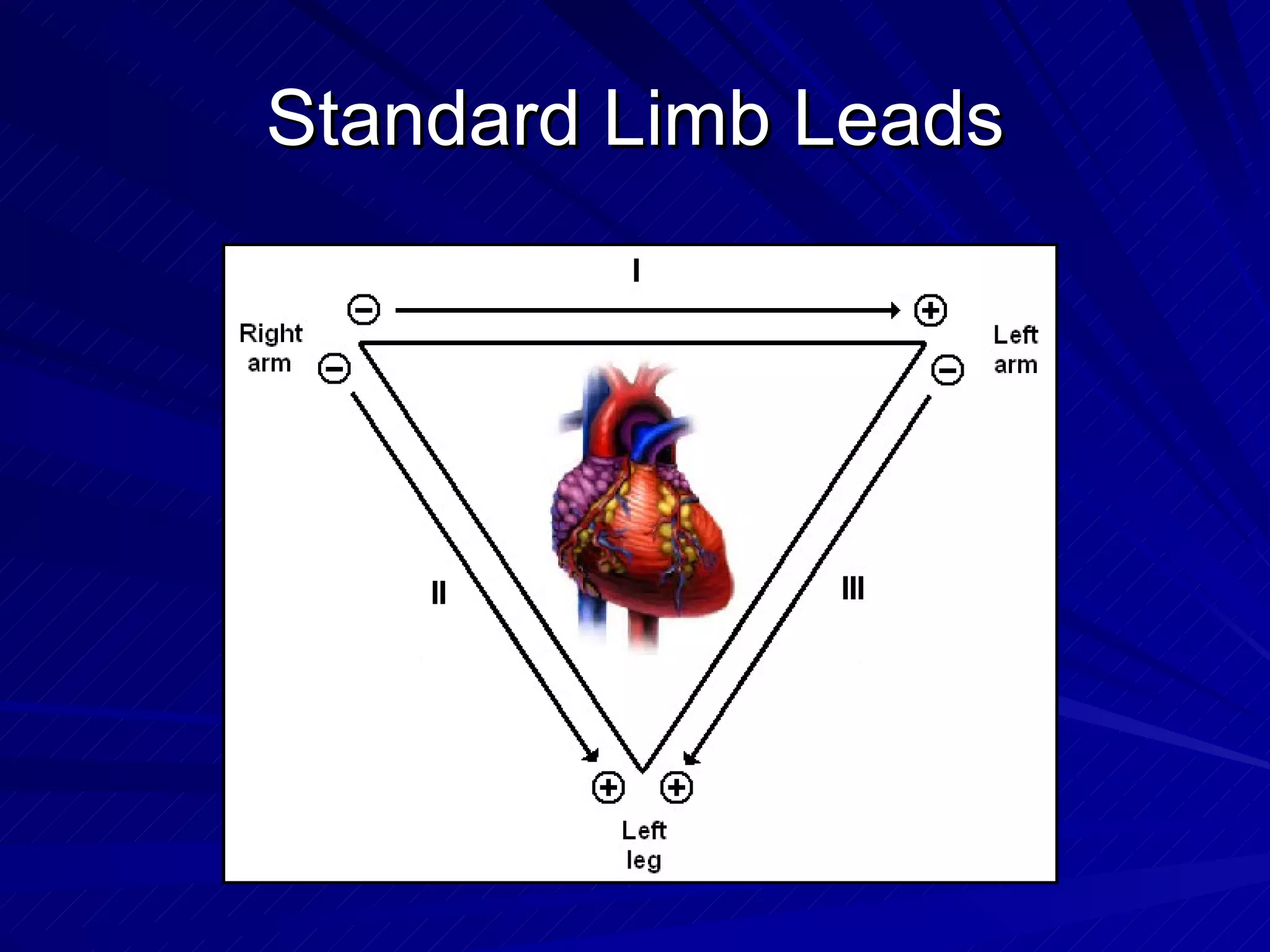
+ - RA RA LL + + - - LA LL LA LEAD II LEAD I LEAD III Remember, the RL is always the ground By changing the arrangement of which arms or legs are positive or negative, three unipolar leads (I, II & III ) can be derived giving three "pictures" of the heart's electrical activity from 3 angles. The Concept of a “Lead” Leads I, II, and III I II III
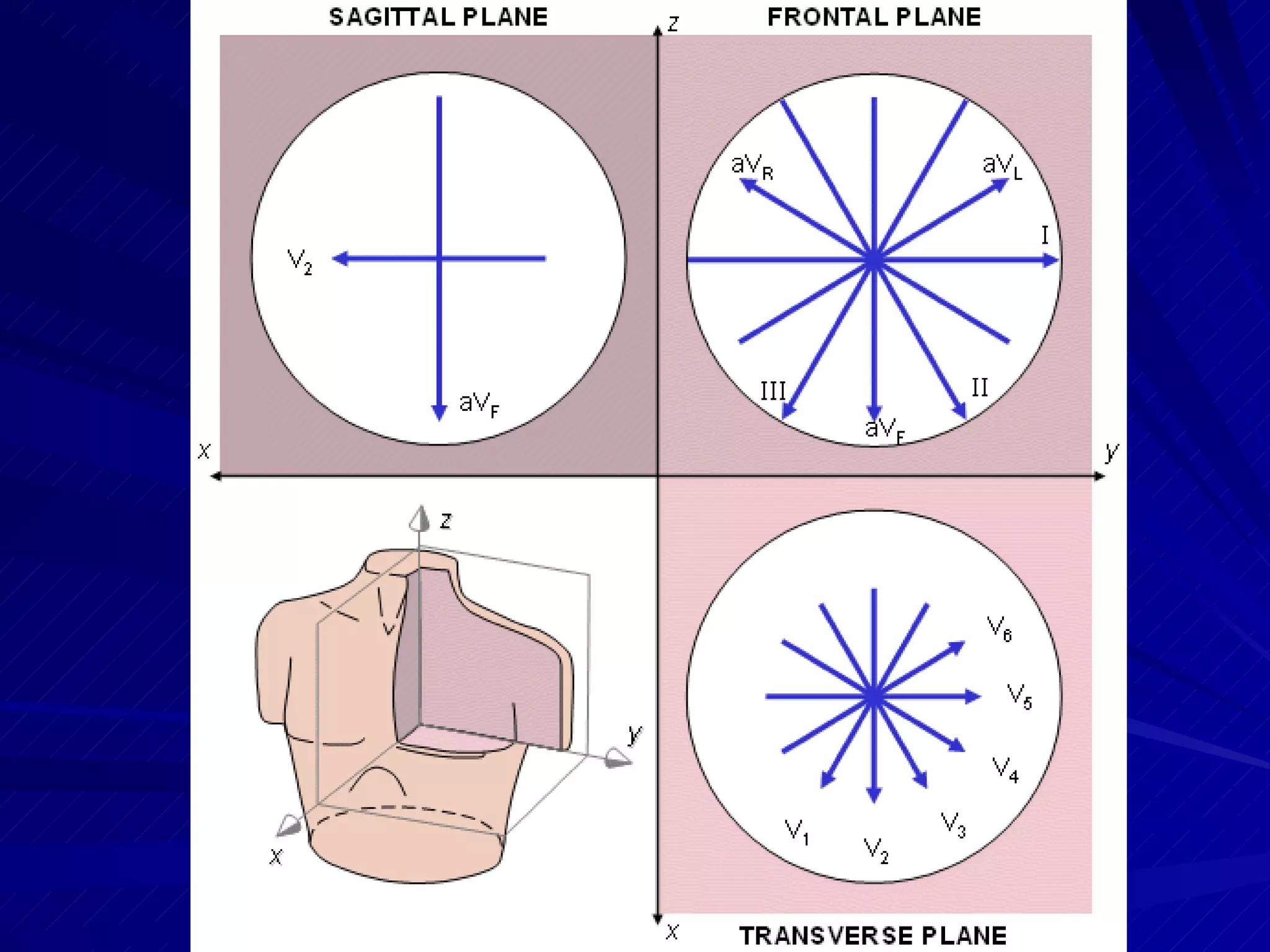
ECG Leads The standard ECG has 12 leads: 3 Standard Limb Leads 3 Augmented Limb Leads 6 Precordial Leads The axis of a particular lead represents the viewpoint from which it looks at the heart.
ECG LEADS Gold Berger :aV frontal leads Wilson & co-workwers :chest leads
Standard Limb Leads
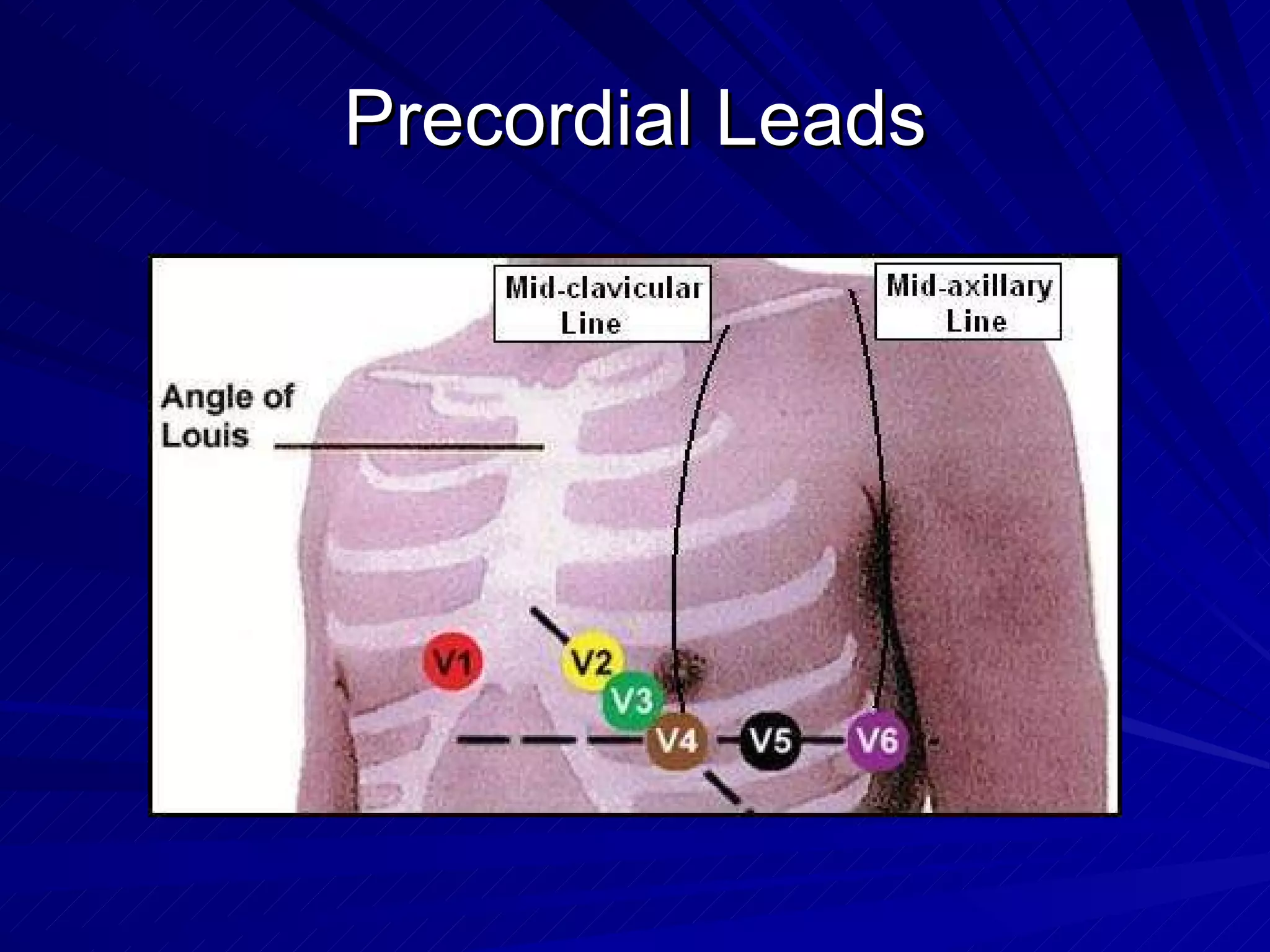
Precordial Leads
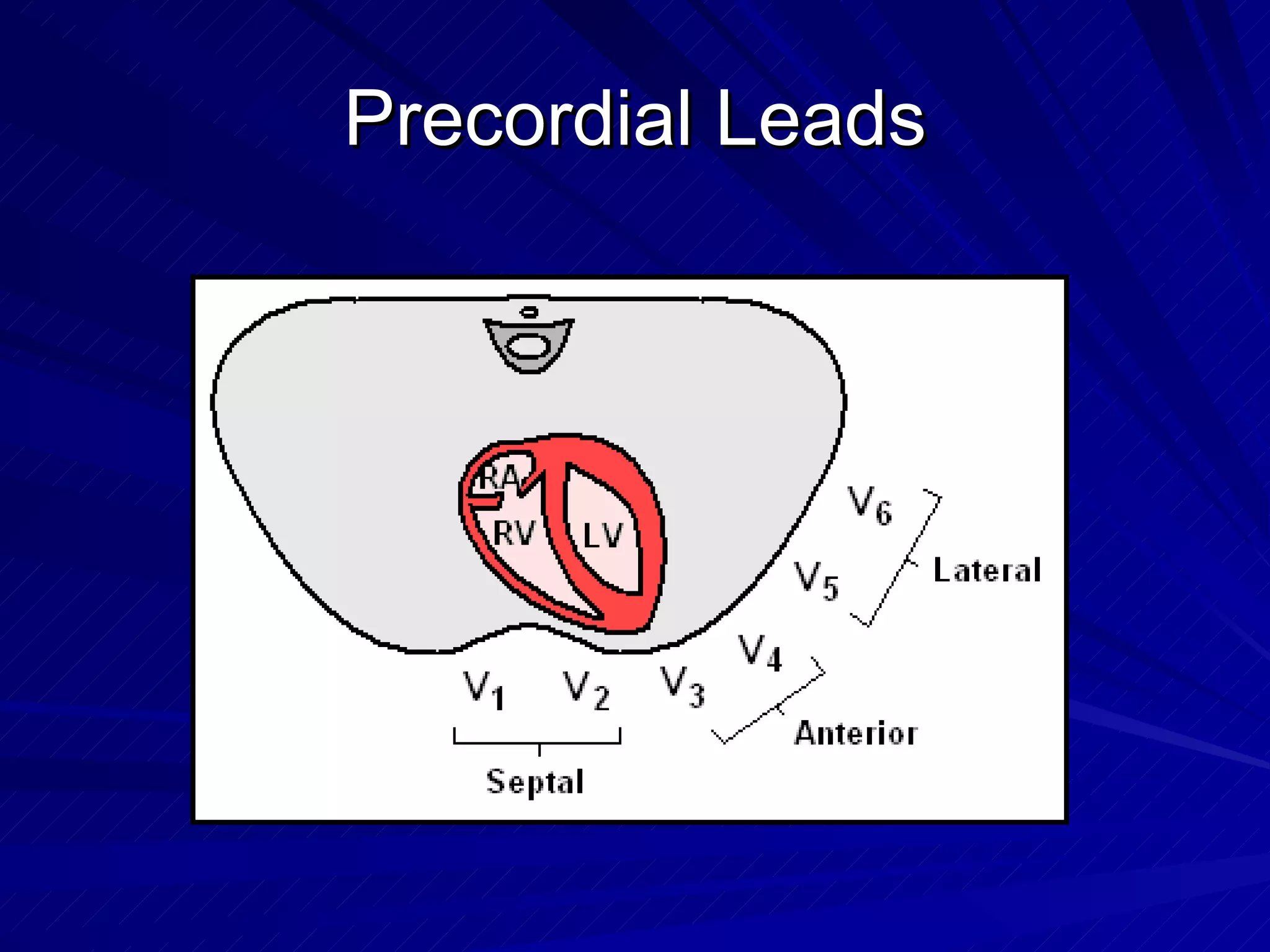
Precordial Leads
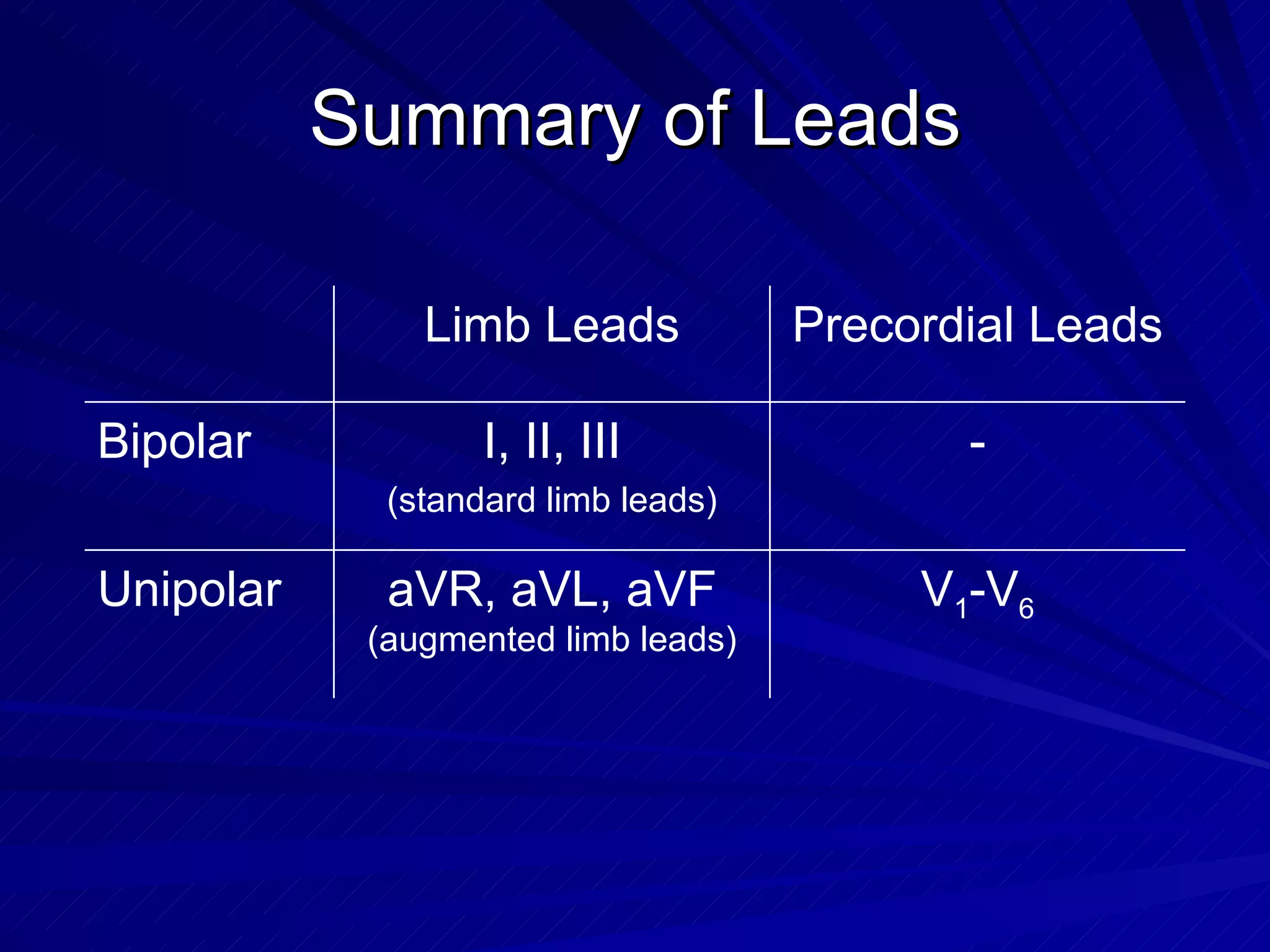
Summary of Leads V 1 -V 6 aVR, aVL, aVF  (augmented limb leads) Unipolar - I, II, III (standard limb leads) Bipolar Precordial Leads Limb Leads
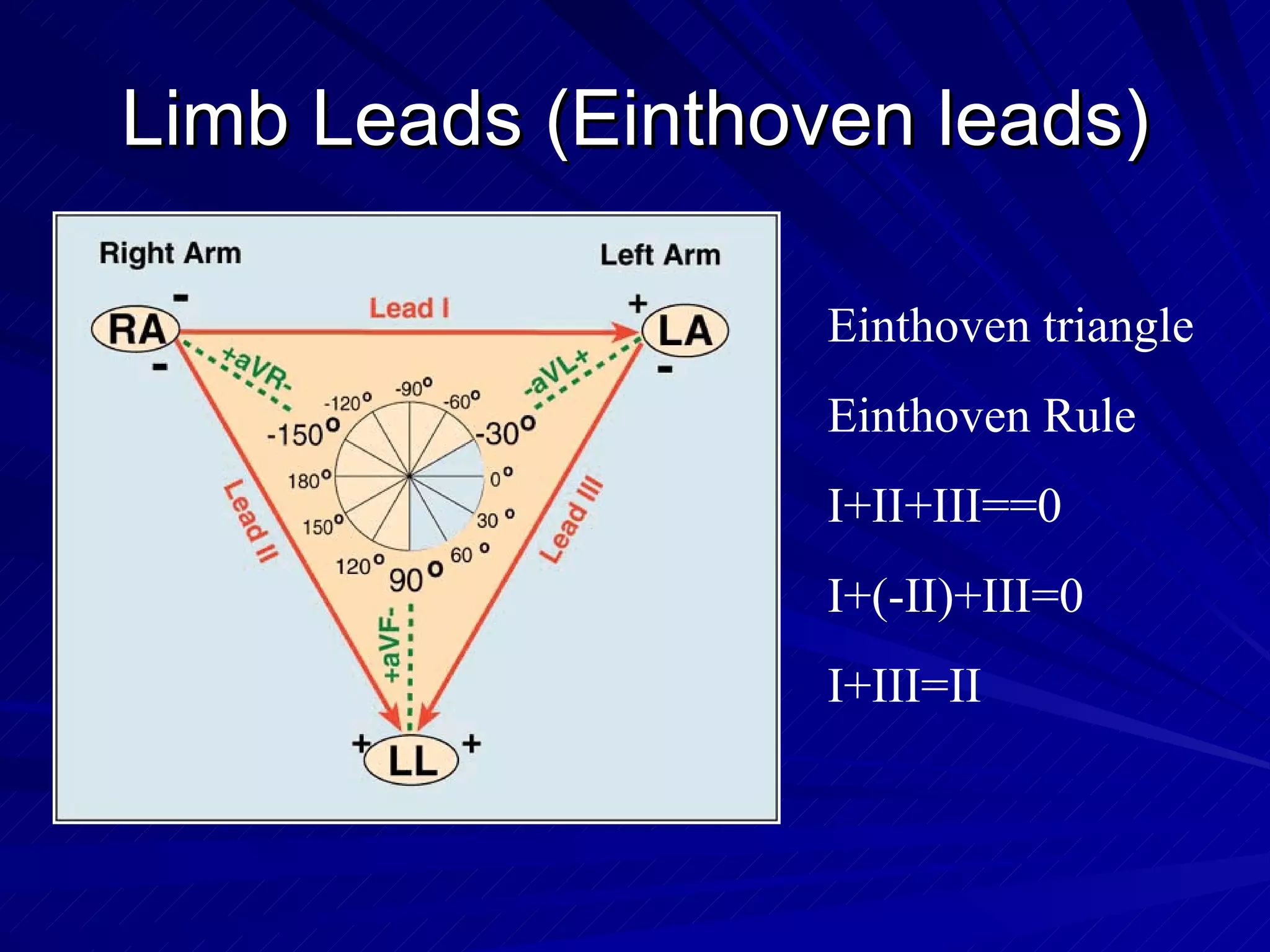
Limb Leads (Einthoven leads) Einthoven triangle Einthoven Rule I+II+III==0 I+(-II)+III=0 I+III=II
 
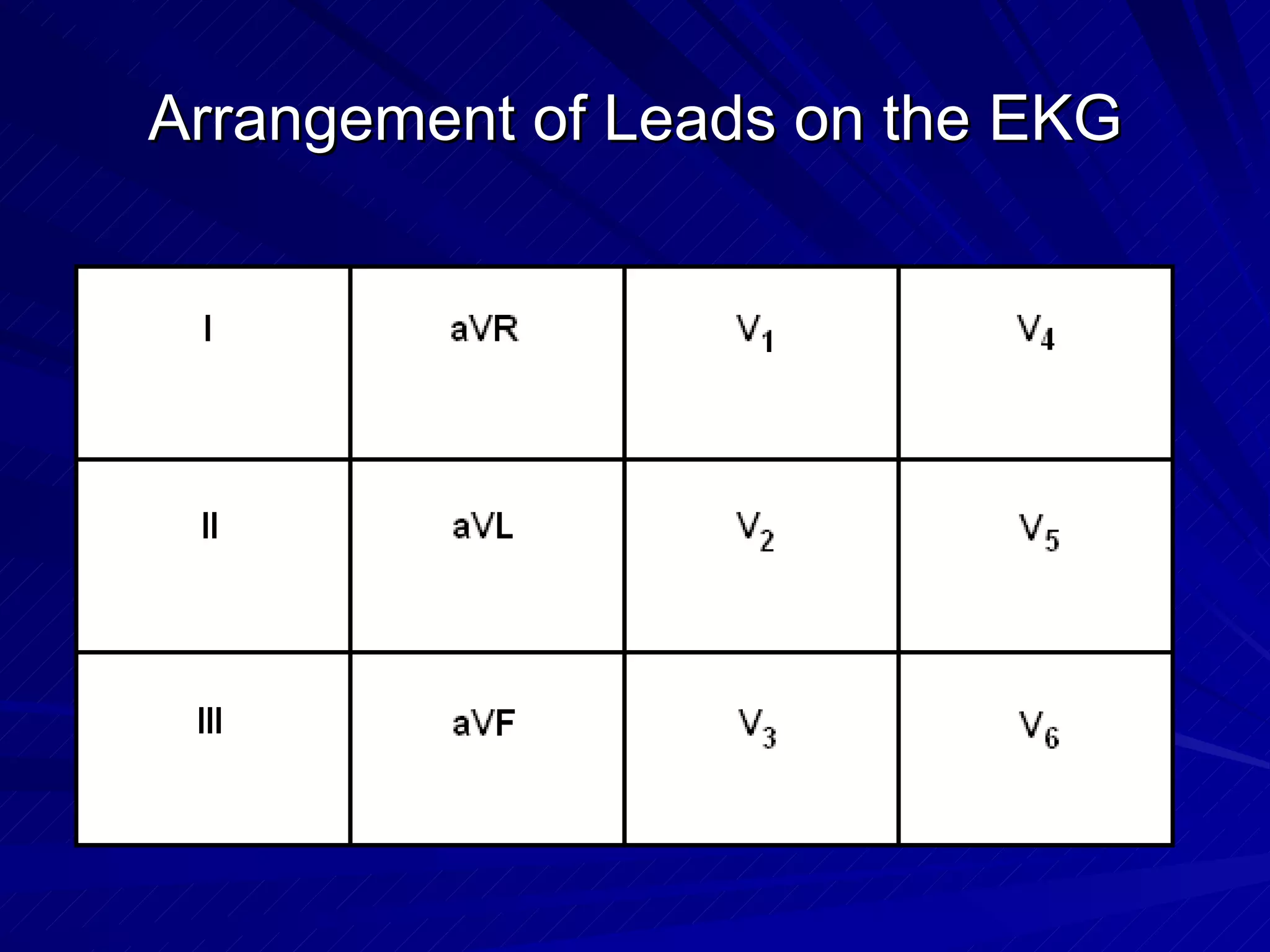
Arrangement of Leads on the EKG
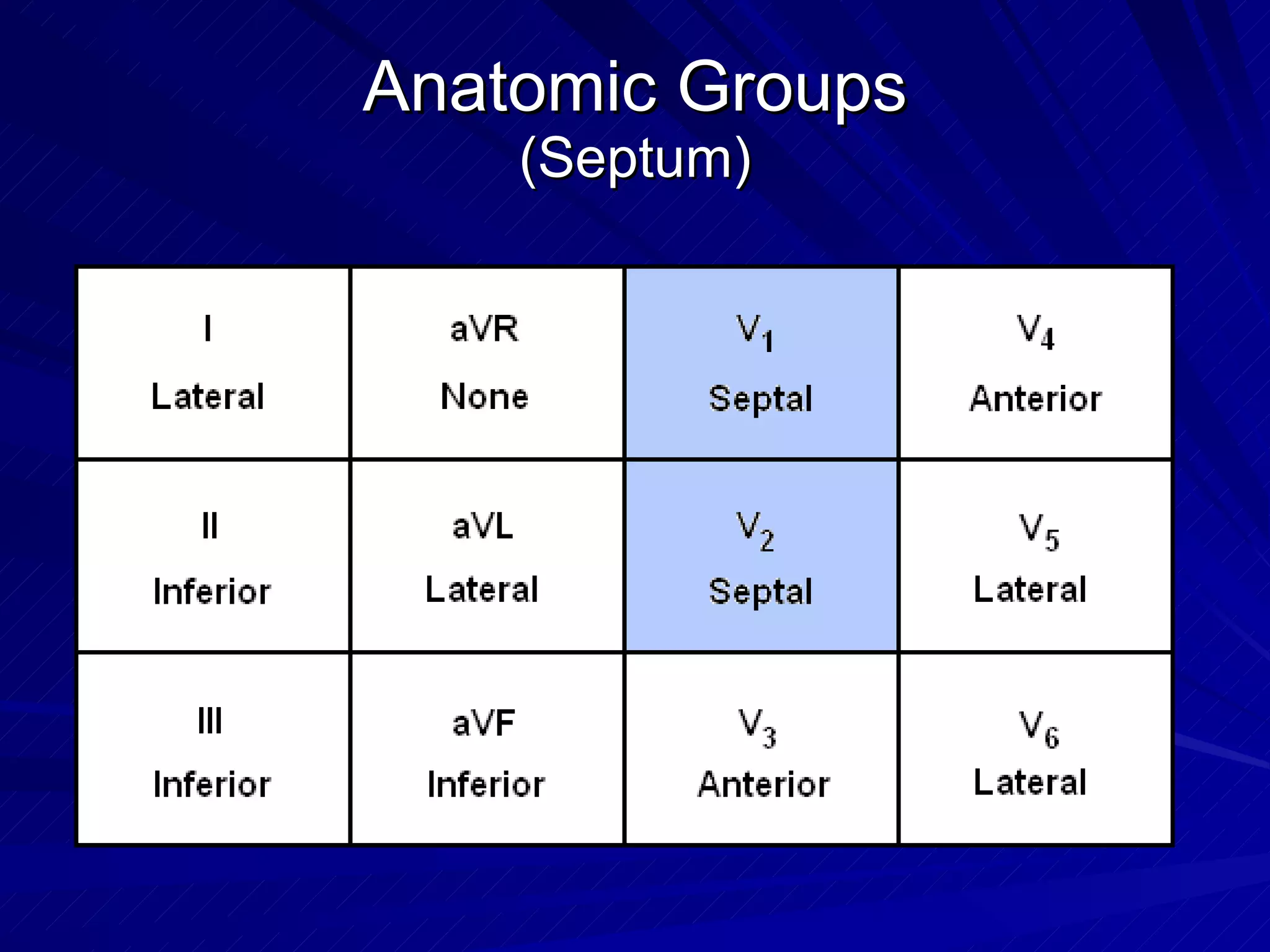
Anatomic Groups (Septum)
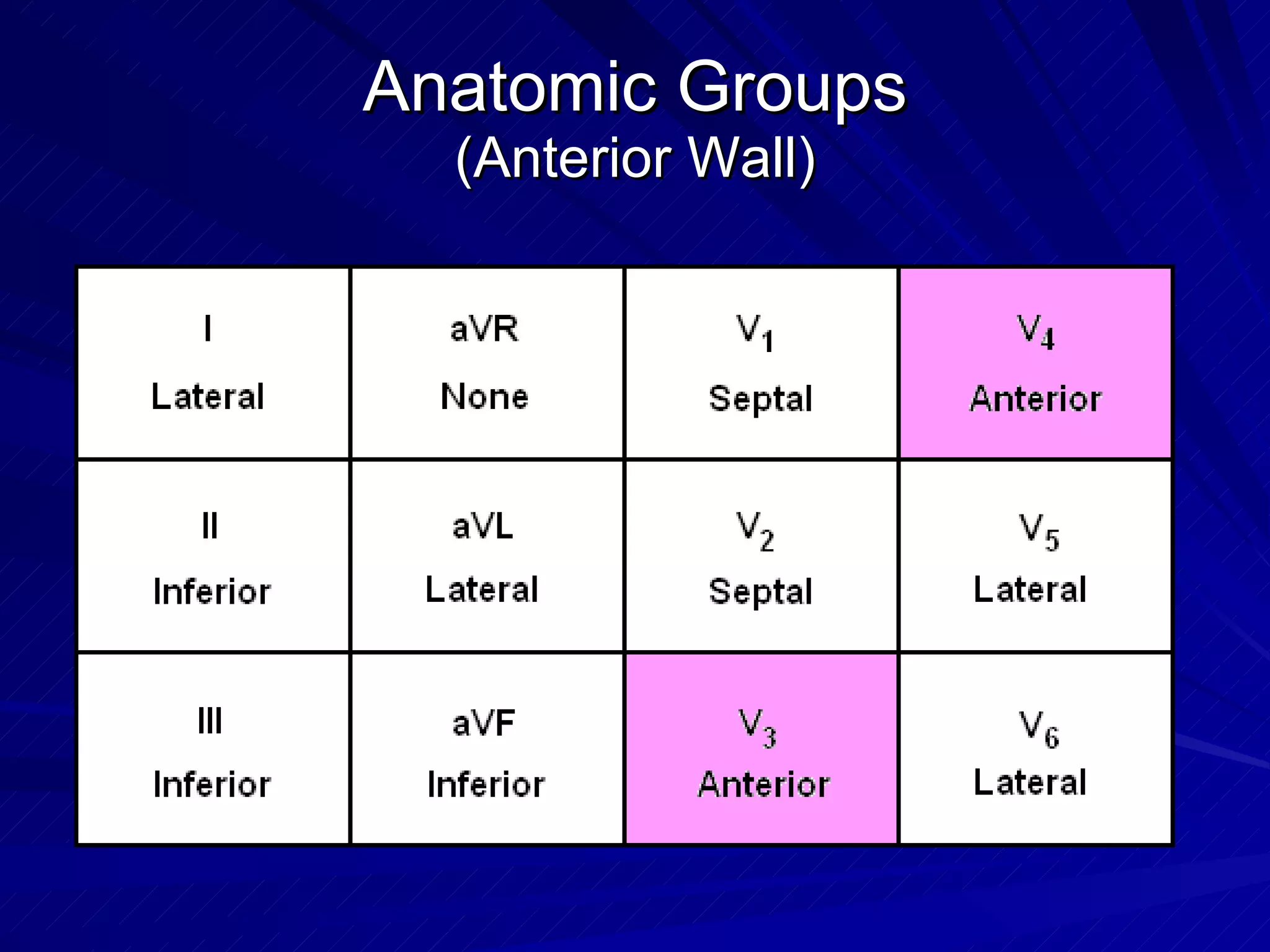
Anatomic Groups (Anterior Wall)
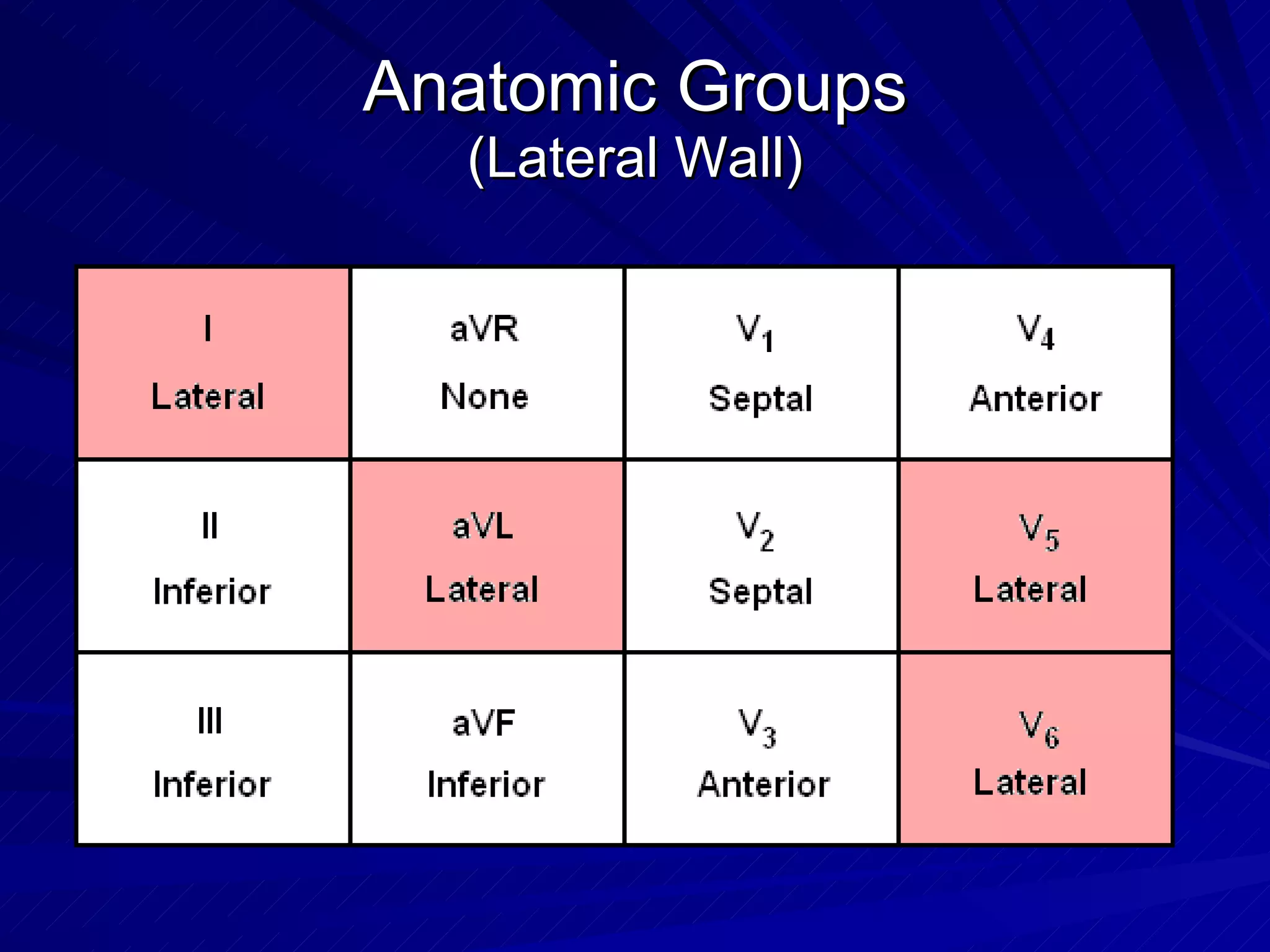
Anatomic Groups (Lateral Wall)
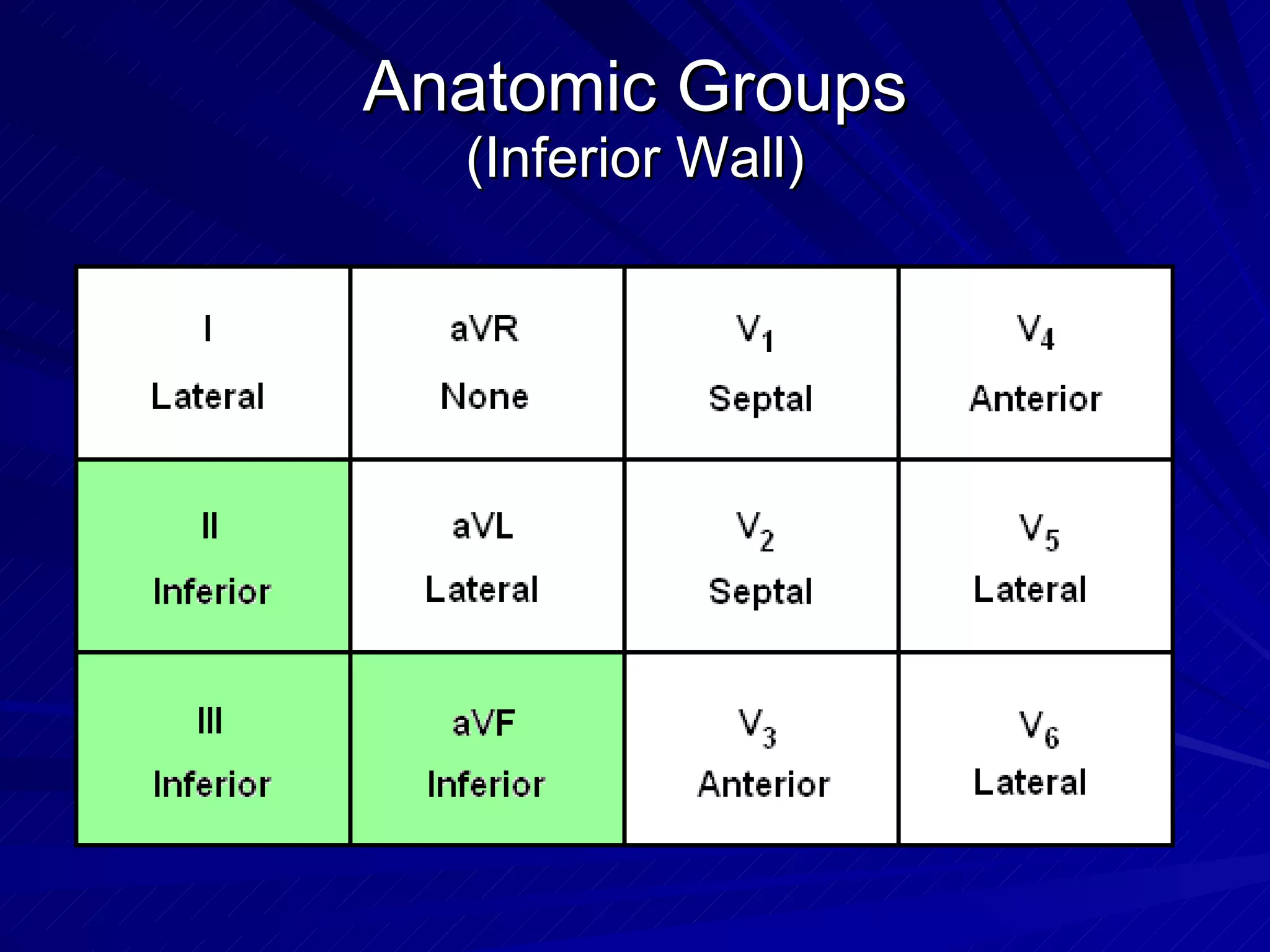
Anatomic Groups (Inferior Wall)
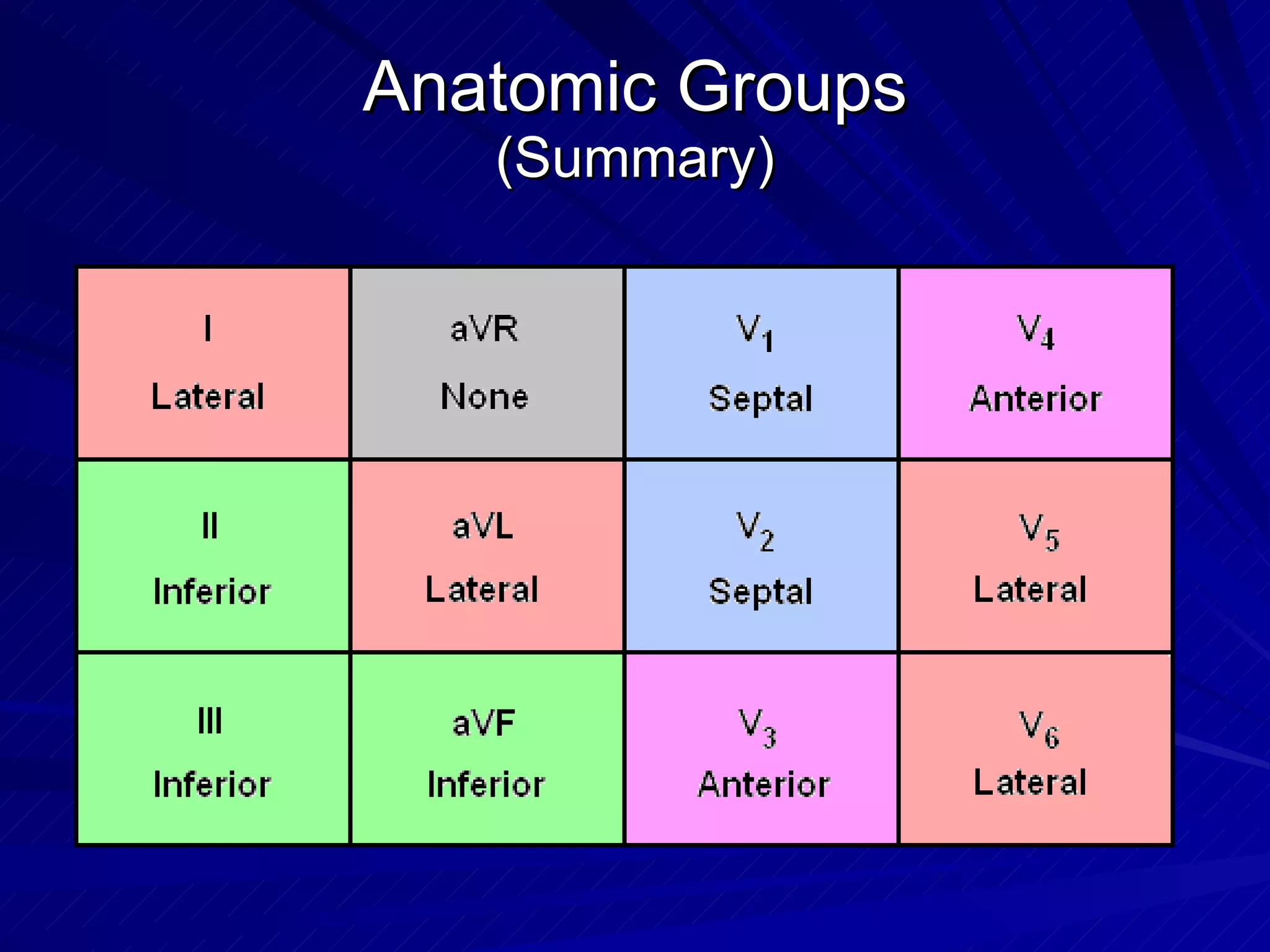
Anatomic Groups (Summary)
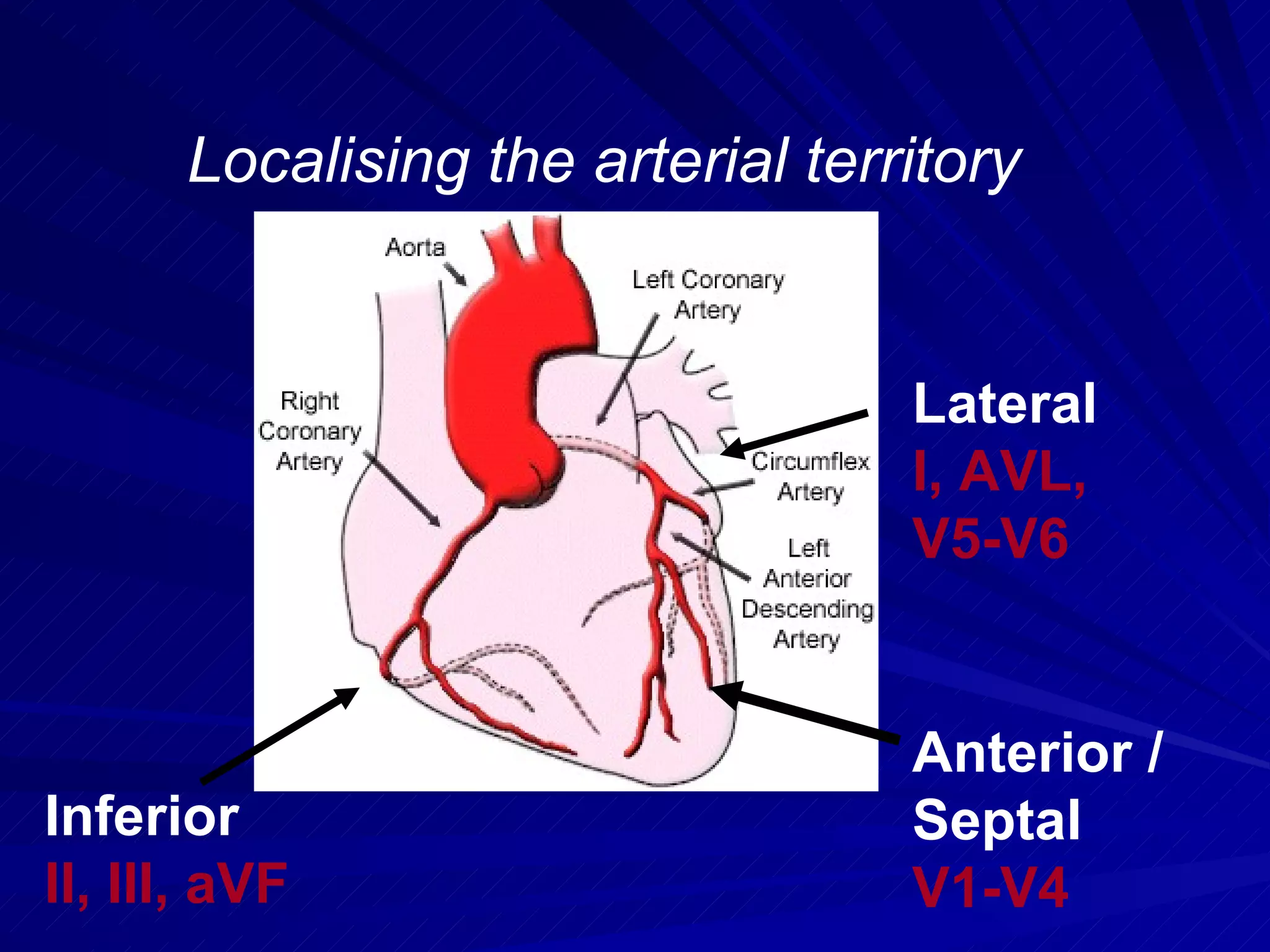
Localising the arterial territory Inferior II, III, aVF Lateral I, AVL,  V5-V6 Anterior /  Septal V1-V4
Standard sites unavailable Patient pathology Amputation or burns  or bandages   should be placed as closely as possible to the standard sites
Specific cardiac abnormalities Situs inversus dextrocardia   right & left arm electrodes should be reversed pre-cordial leads should be recorded from V1R(V2) to V6 RVH & RV infarction:V3R & V4R
Continuous monitoring Bed side:  Holter monitoring: TMT:  Mason Likar system
Other practical points Electrodes should be selected for maximum adhesiveness and minimum discomfort,electrical noise,and skin-electrode impedance Effective contact between electrode and skin is essential. ECG :calibration
ECG :paper speed Electrical artifacts:external or internal external can be minimized by straightening the lead wires internal can be due to muscle tremors,shivering ,hiccoughs . Supine position
Interpretation of an ECG
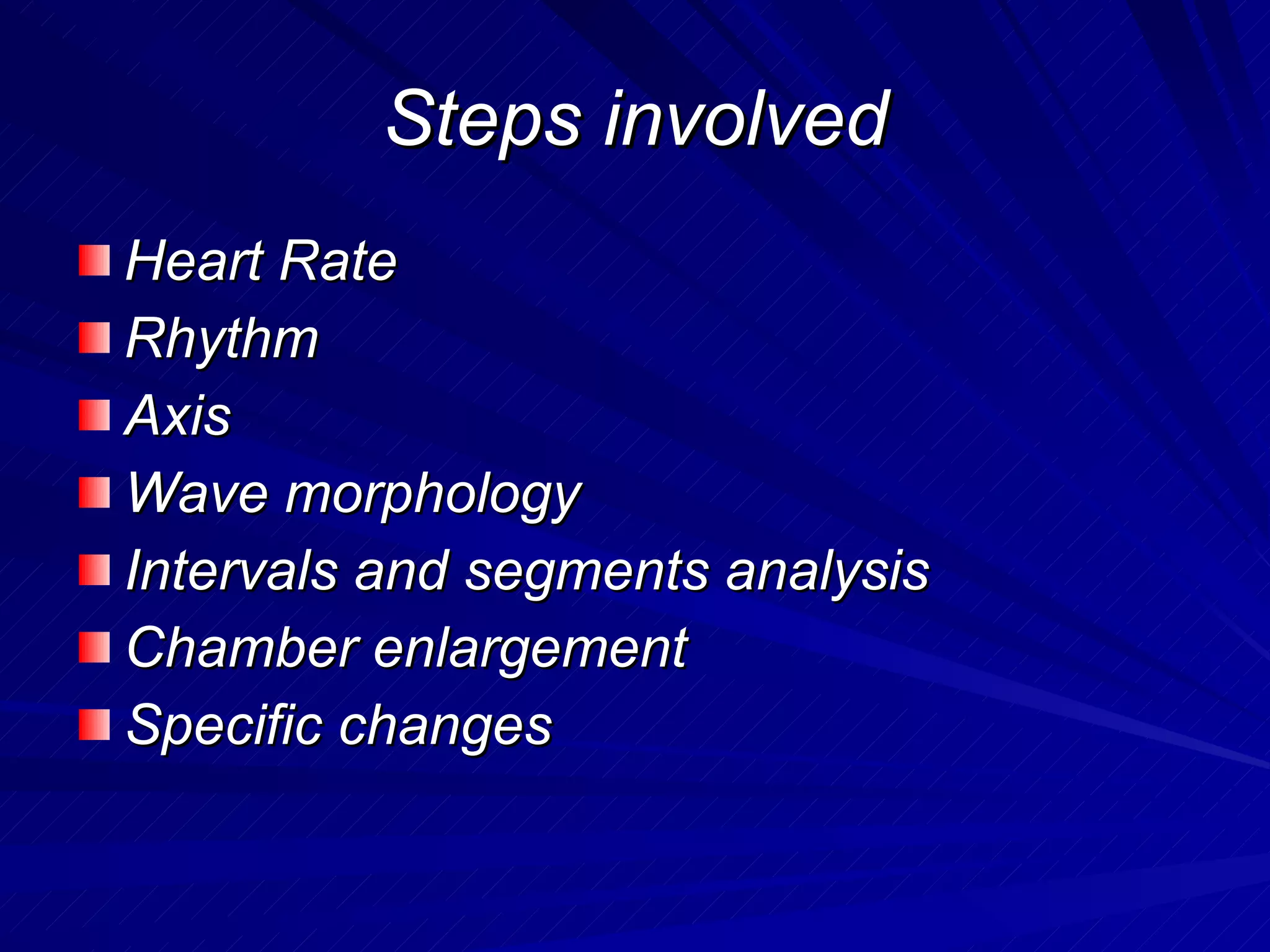
Steps involved Heart Rate Rhythm Axis Wave morphology Intervals and segments analysis Chamber enlargement Specific changes
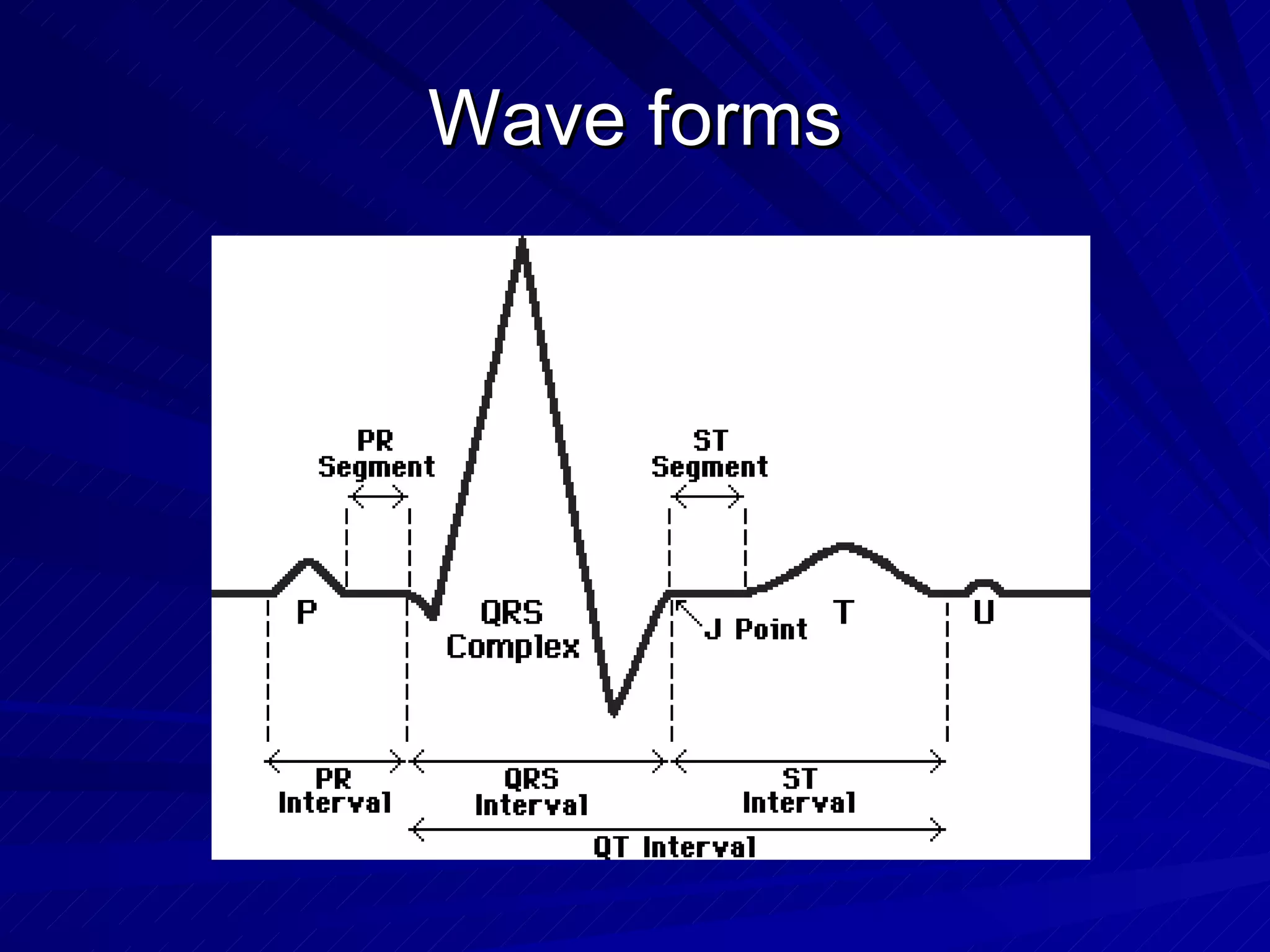
Wave forms
Determining the Heart Rate Rule of 300 10 Second Rule
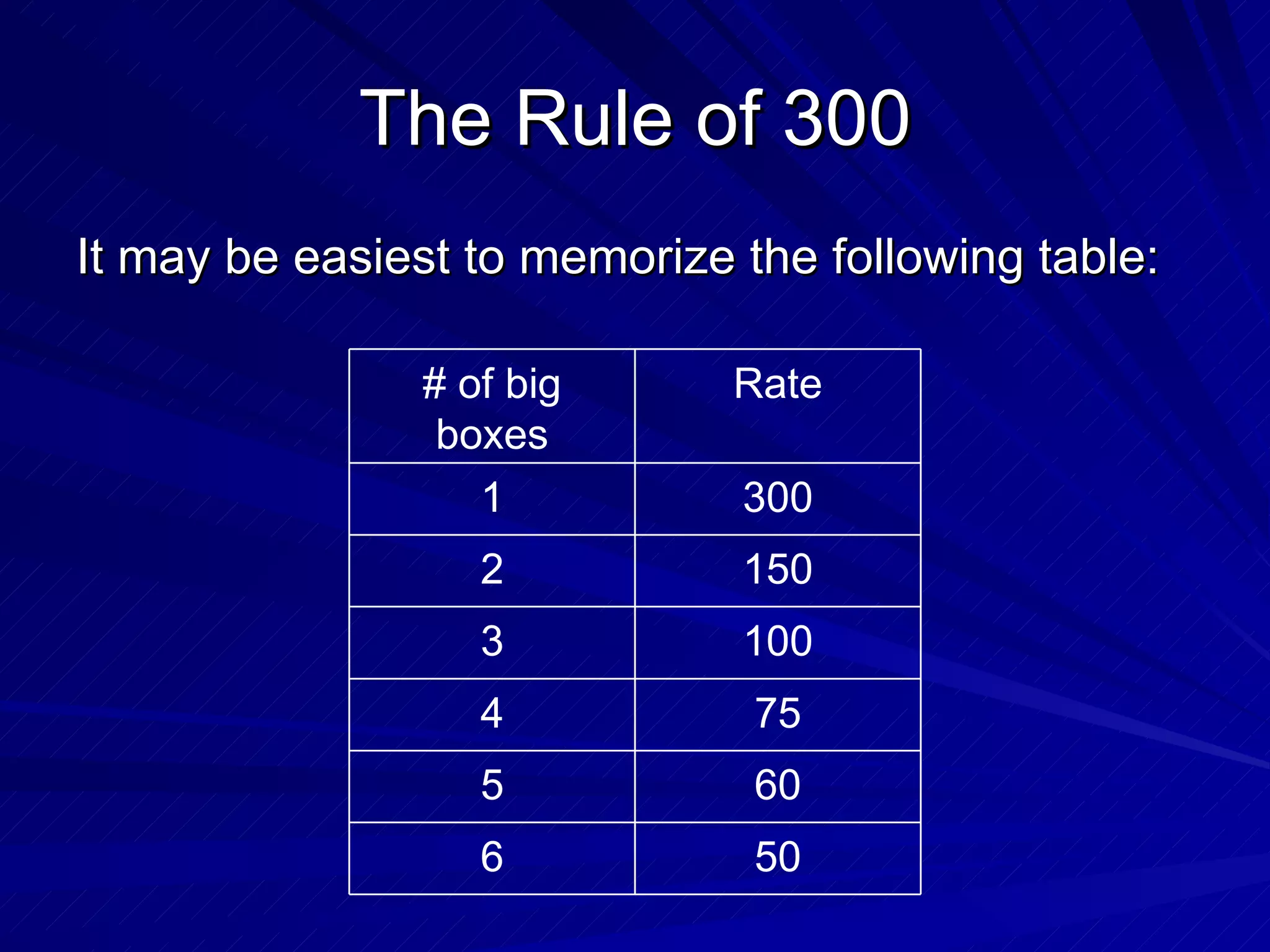
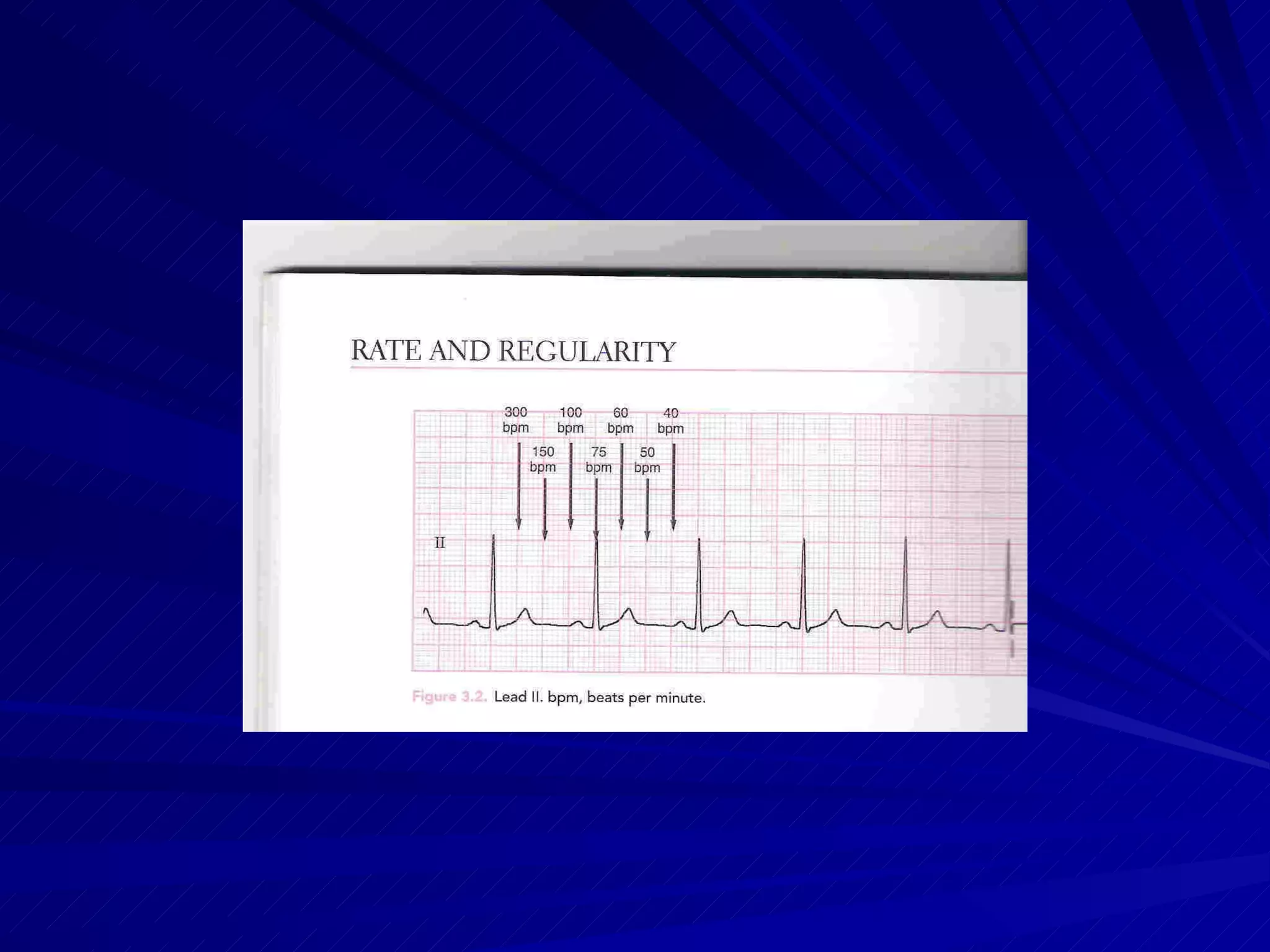
Rule of 300 Take the number of “big boxes” between neighboring QRS complexes, and divide this into 300.  The result will be approximately equal to the rate Although fast, this method only works for regular rhythms.
The Rule of 300 It may be easiest to memorize the following table: 50 6 60 5 75 4 100 3 150 2 300 1 Rate # of big boxes
 
10 Second Rule As most ECGs record 10 seconds of rhythm per page, one can simply count the number of beats present on the ECG and multiply by 6 to get the number of beats per 60 seconds. This method works well for irregular rhythms.
QRS axis Dr.K.Subramanyam 9-4-2009
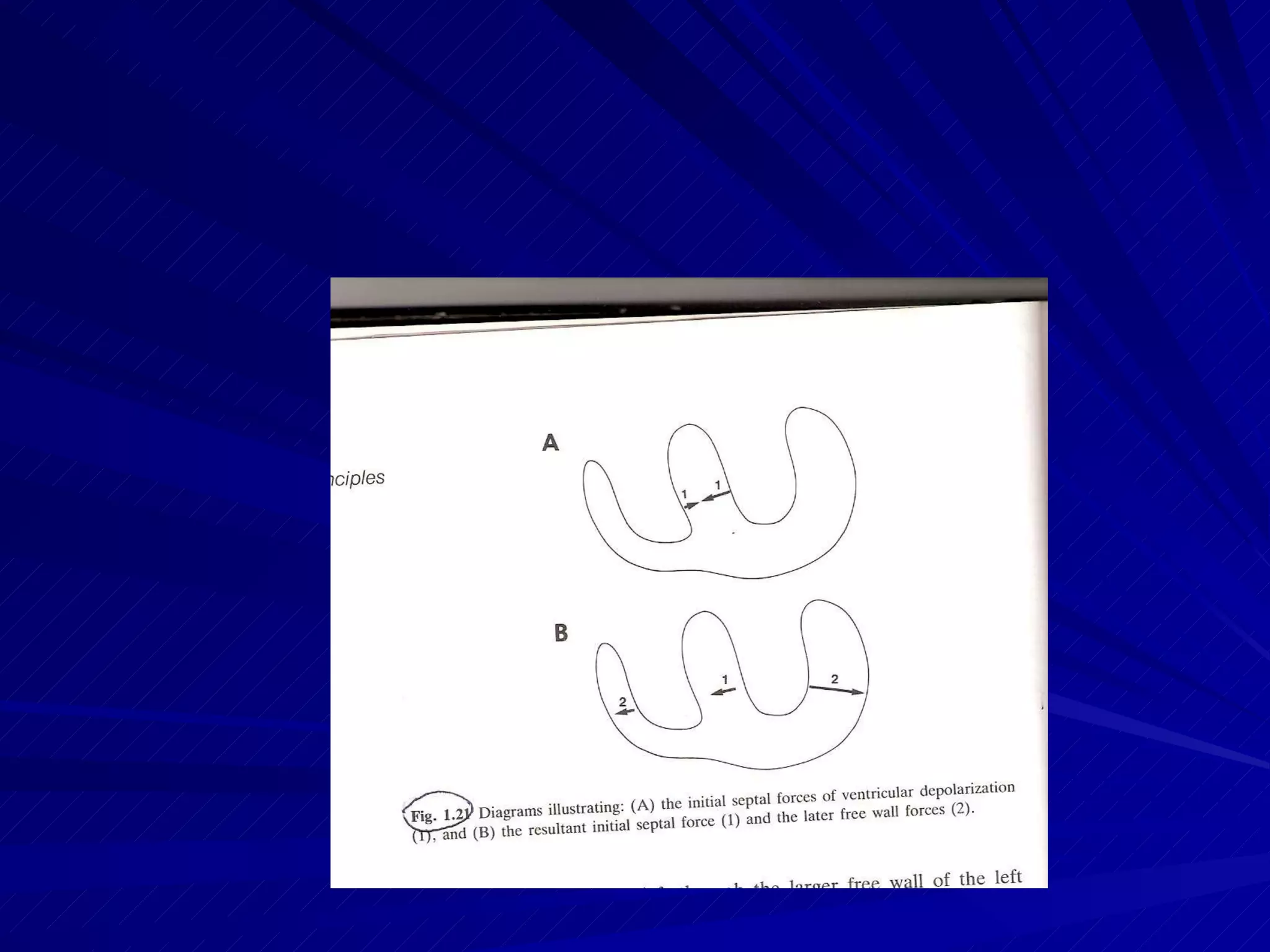
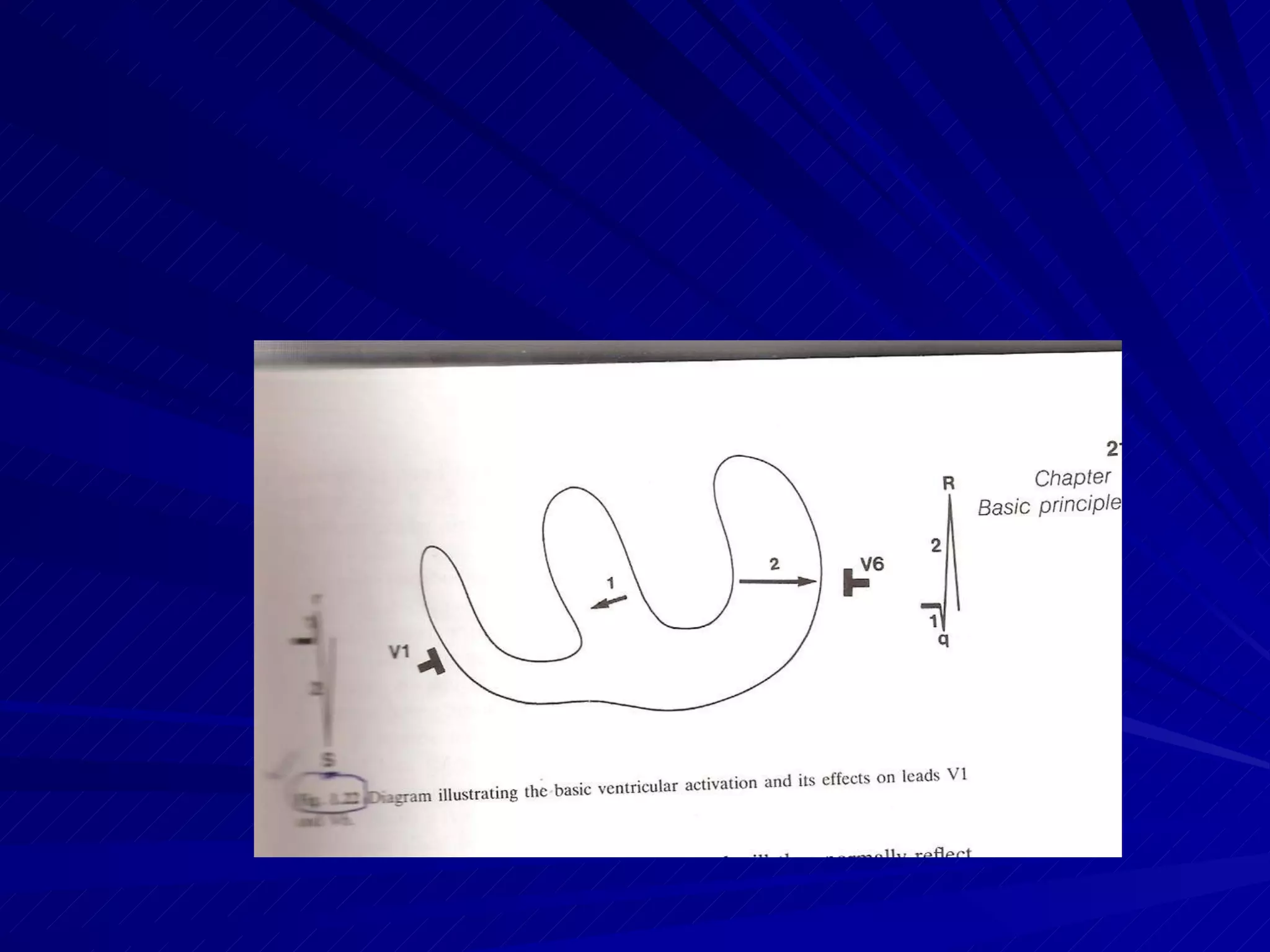
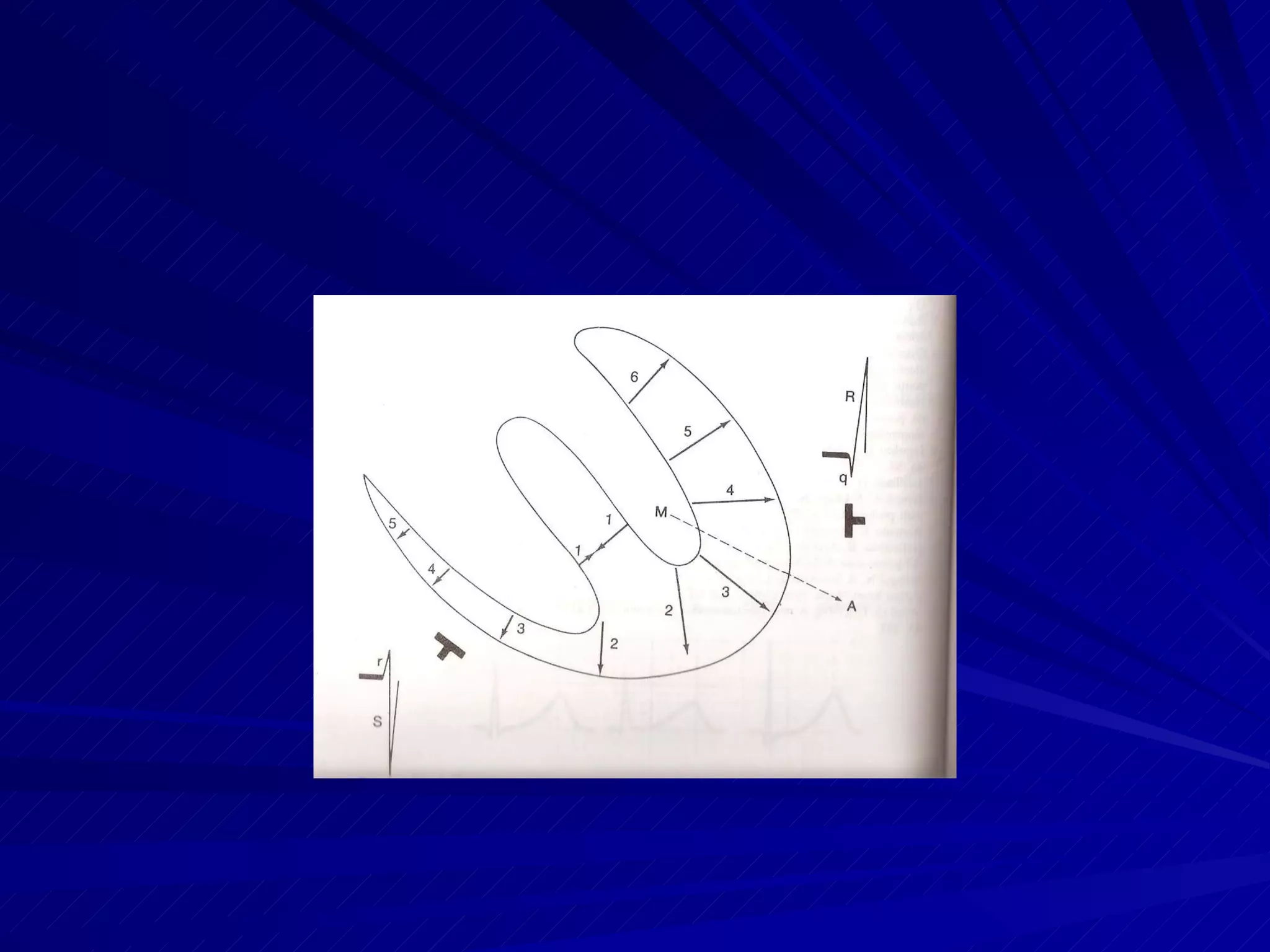
Genesis of QRS Initially there is a small vector from left to right through the IVS ,followed by a larger vector from right to left through the free wall of the LV
 
 
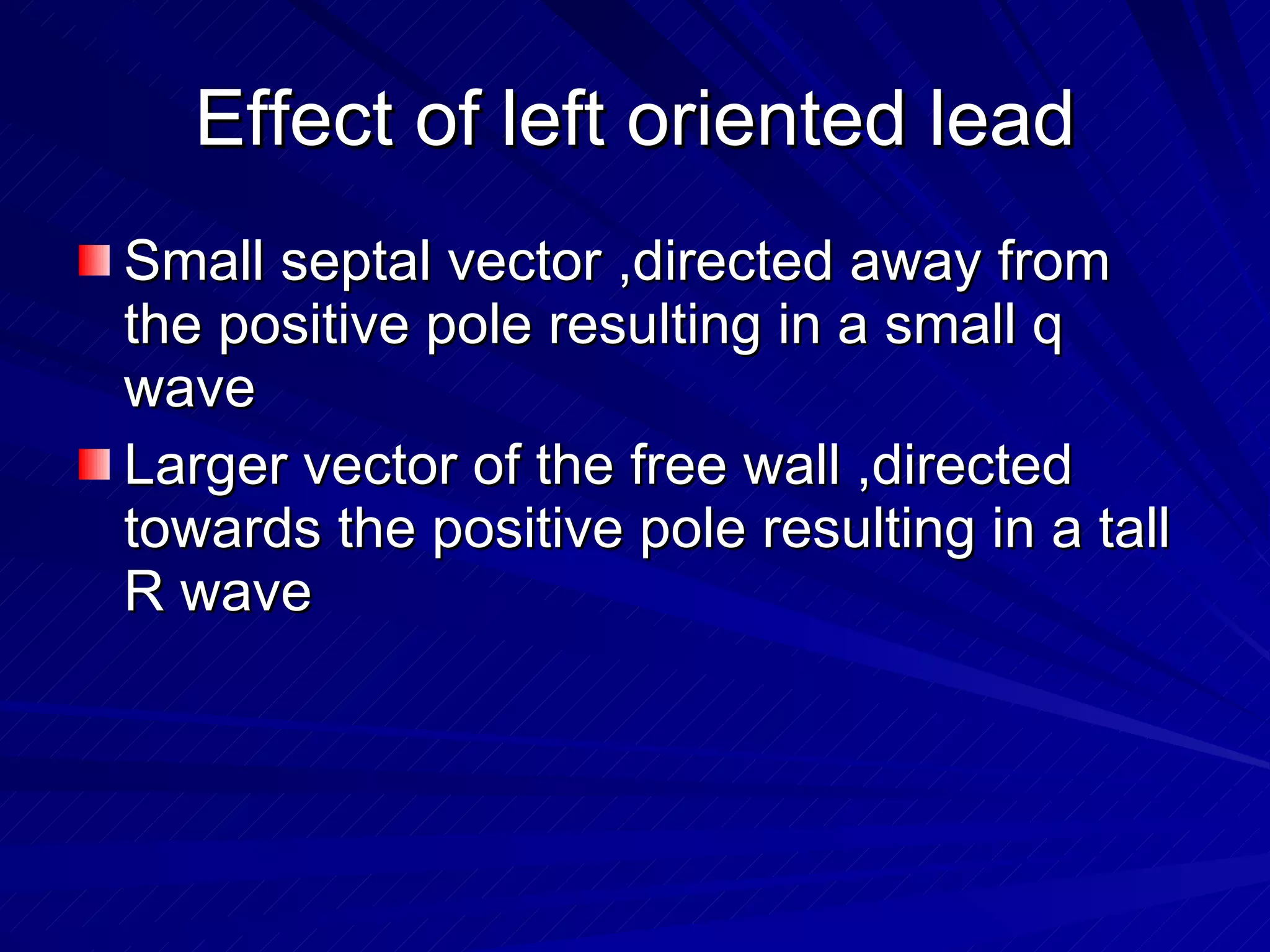
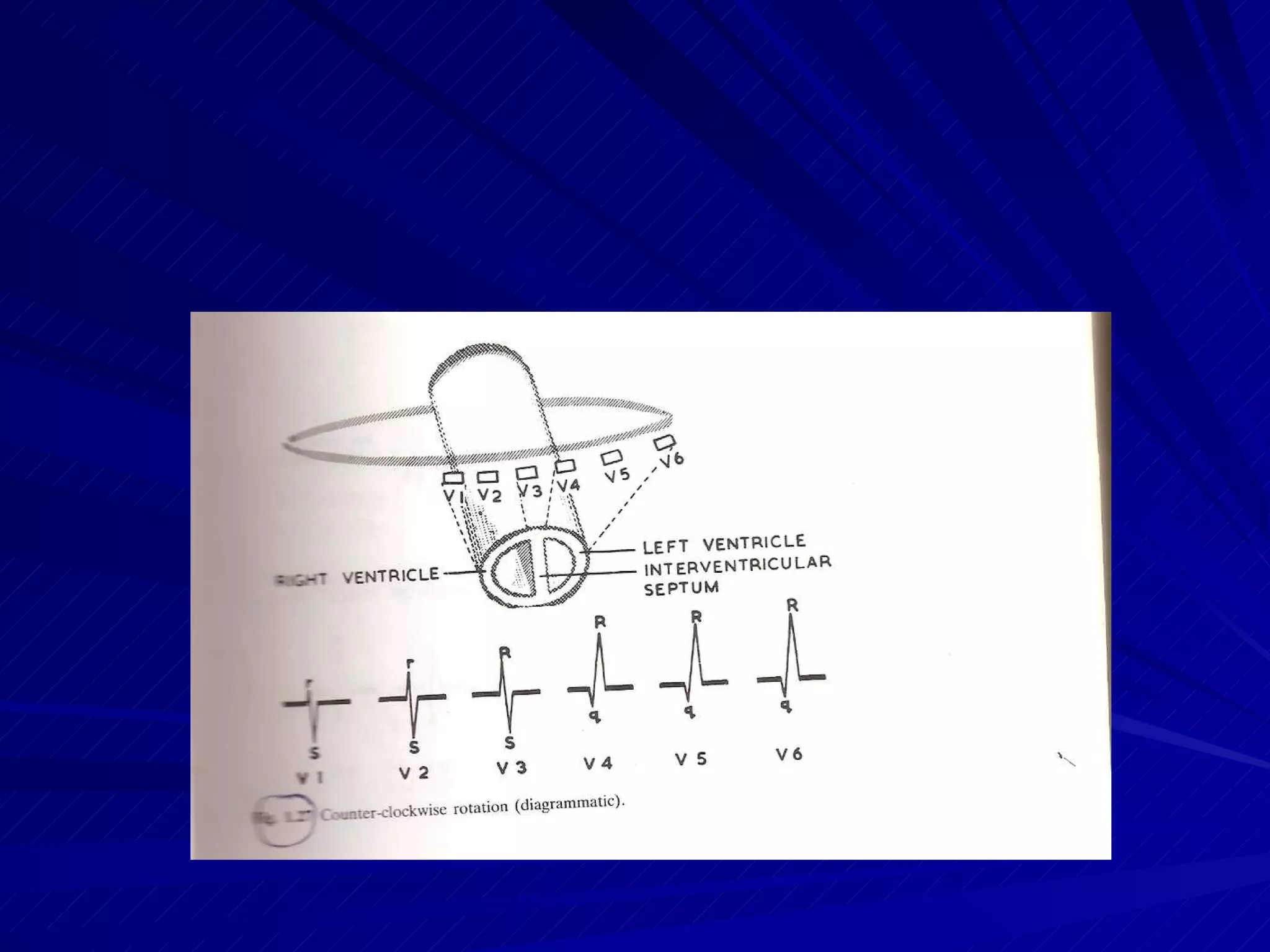
Effect of left oriented lead Small septal vector ,directed away from the positive pole resulting in a small q wave Larger vector of the free wall ,directed towards the positive pole resulting in a tall R wave
 
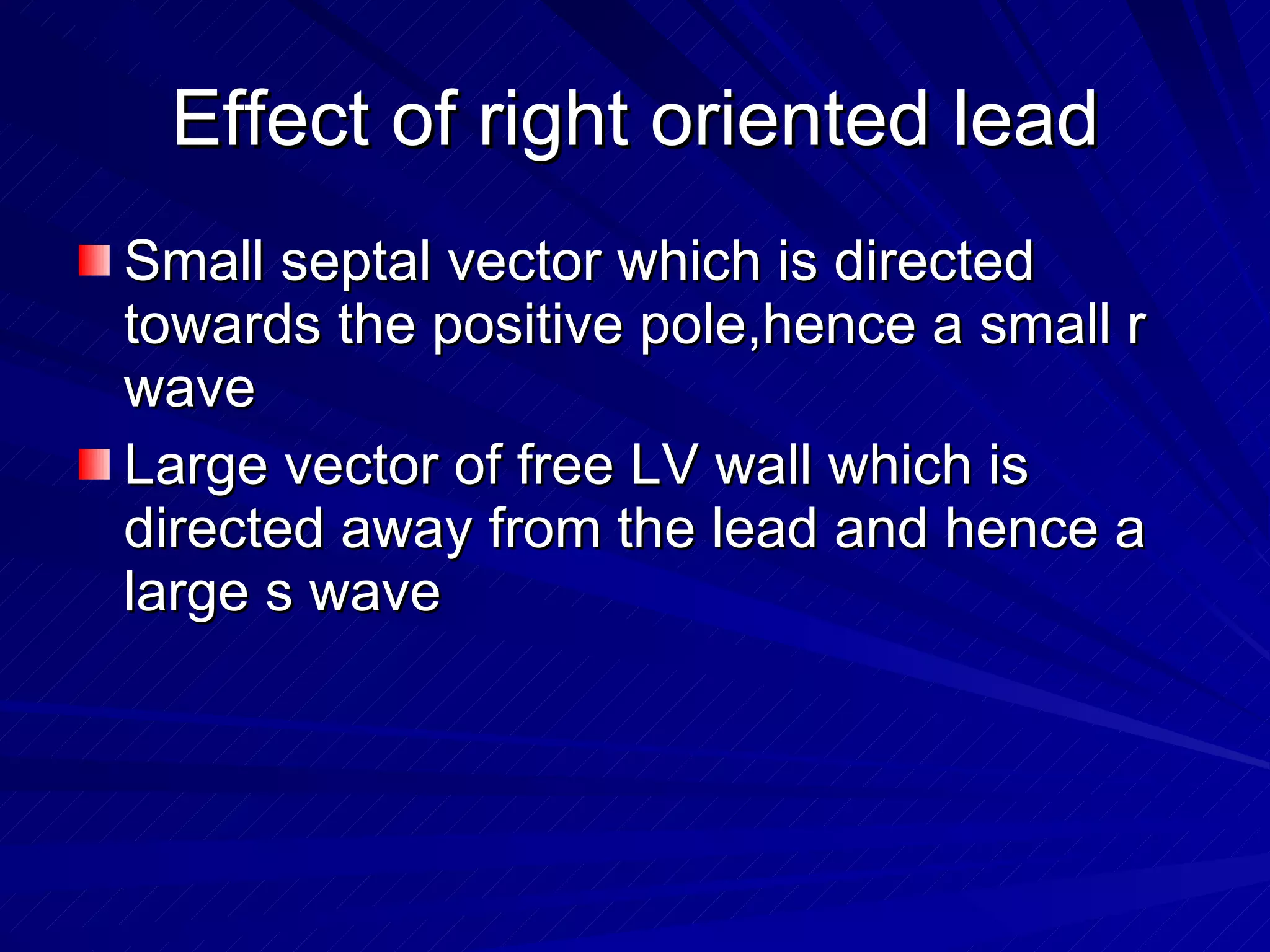
Effect of right oriented lead Small septal vector which is directed towards the positive pole,hence a small r wave Large vector of free LV wall which is directed away from the lead and hence a large s wave
Transition zone Transition from rS to qR pattern which is usually seen in V3 /V4
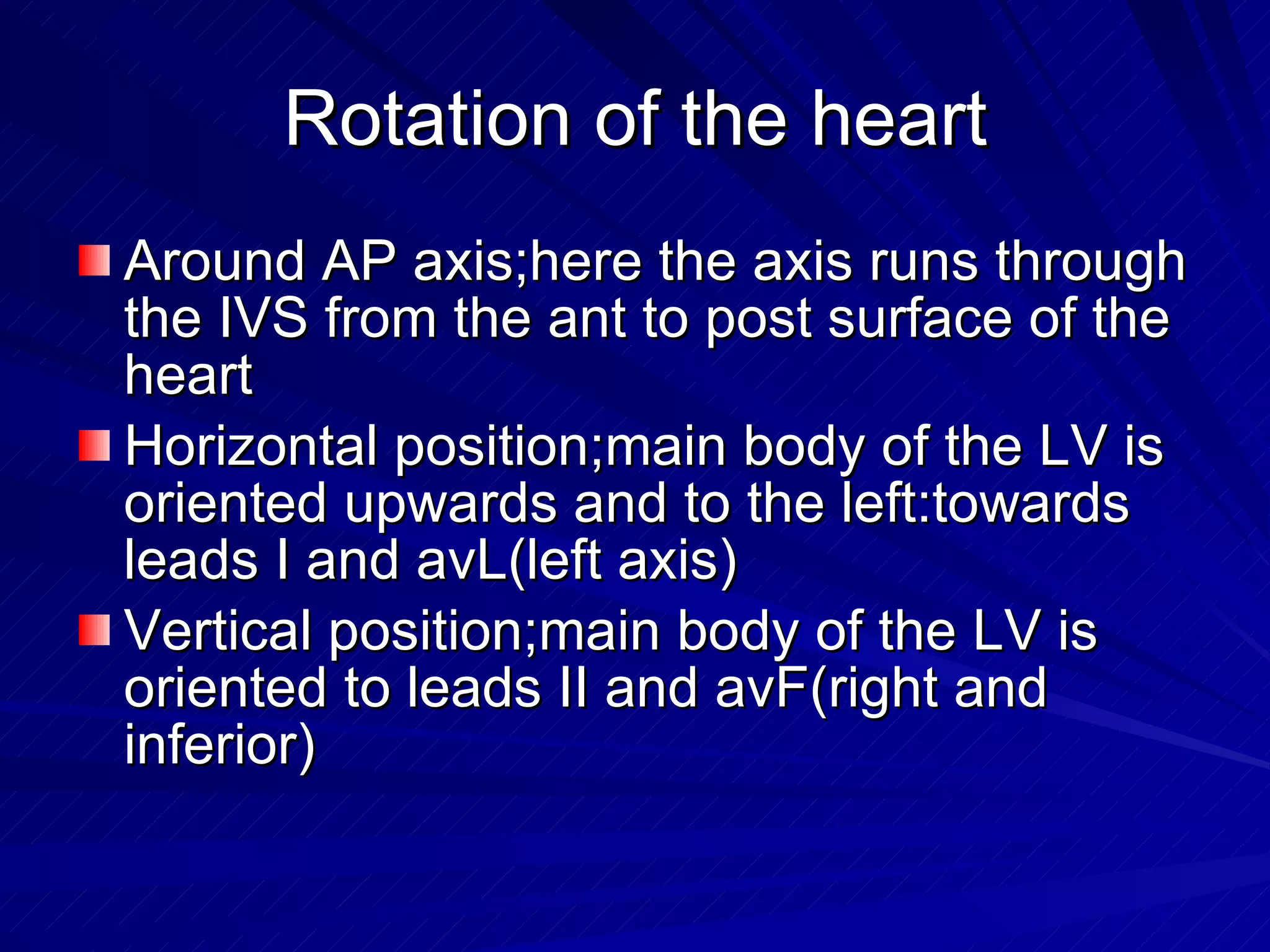
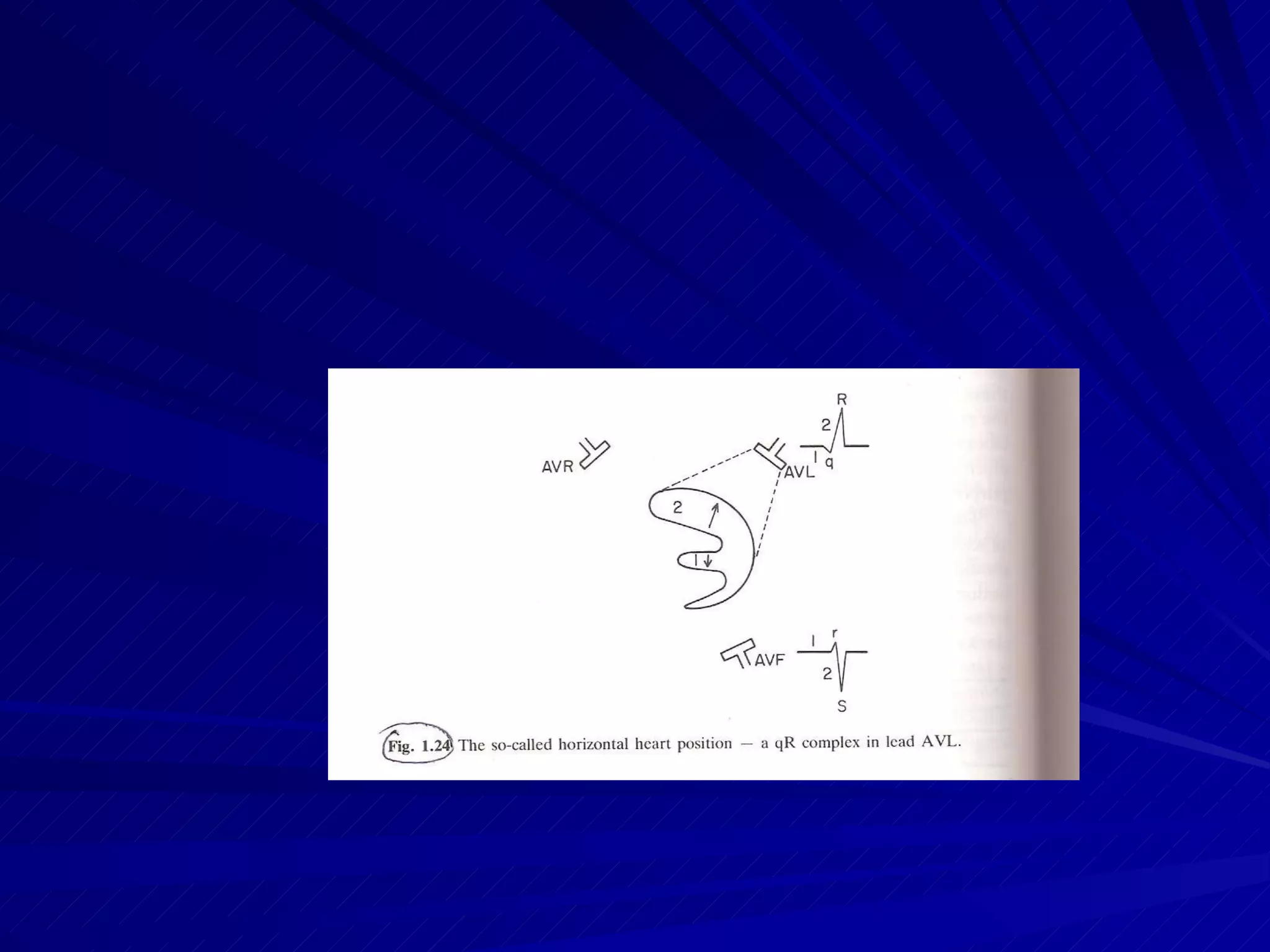
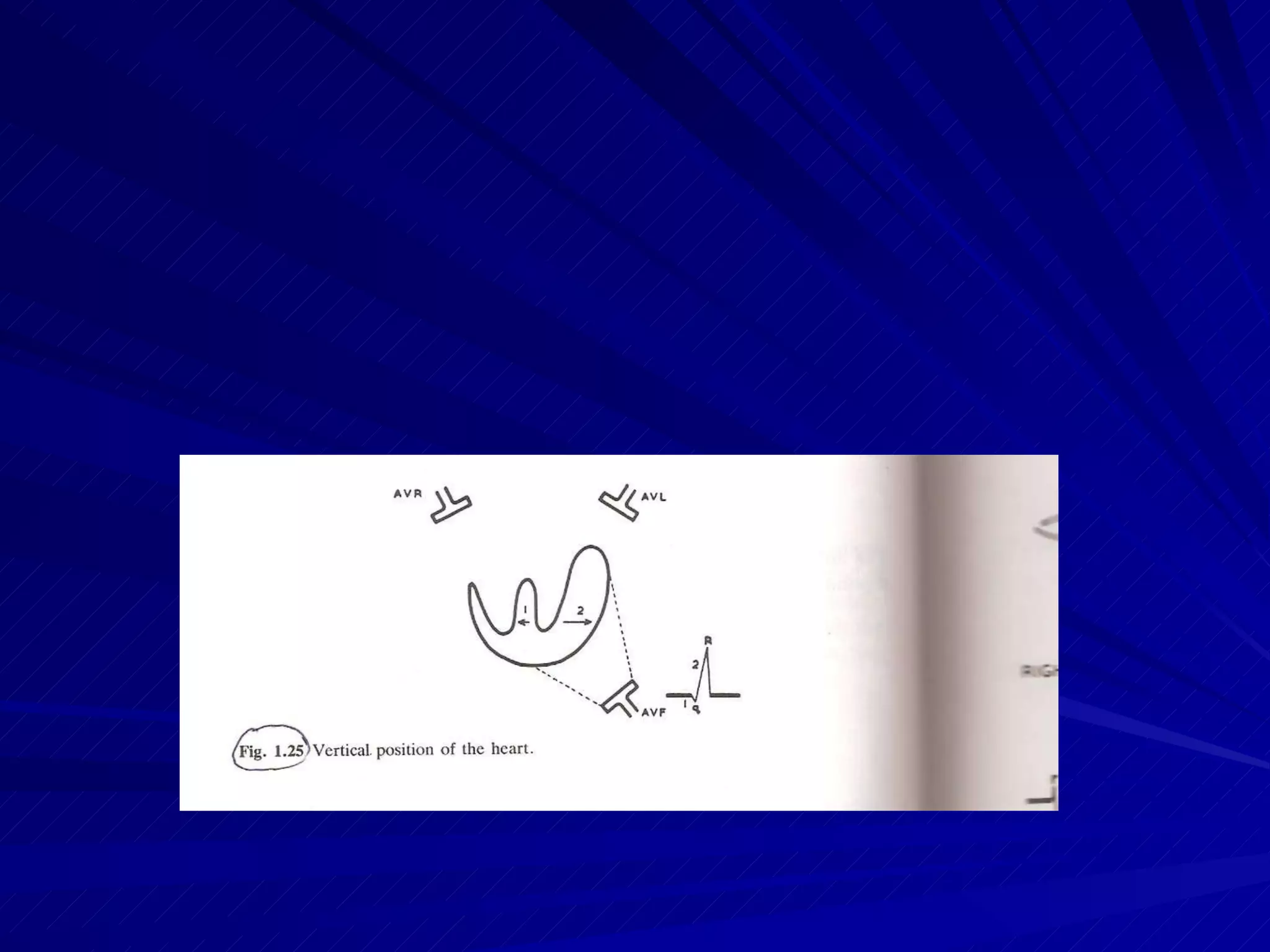
Rotation of the heart Around AP axis;here the axis runs through the IVS from the ant to post surface of the heart Horizontal position;main body of the LV is oriented upwards and to the left:towards leads I and avL(left axis) Vertical position;main body of the LV is oriented to leads II and avF(right and inferior)
 
 
Around oblique axis;the axis runs through the IVS from apex to base Anatomical rotation    clock-wise and counter  clock wise rotation
Counter clock-wise    more anterior position of LV Results in transition zone shifting to left
 
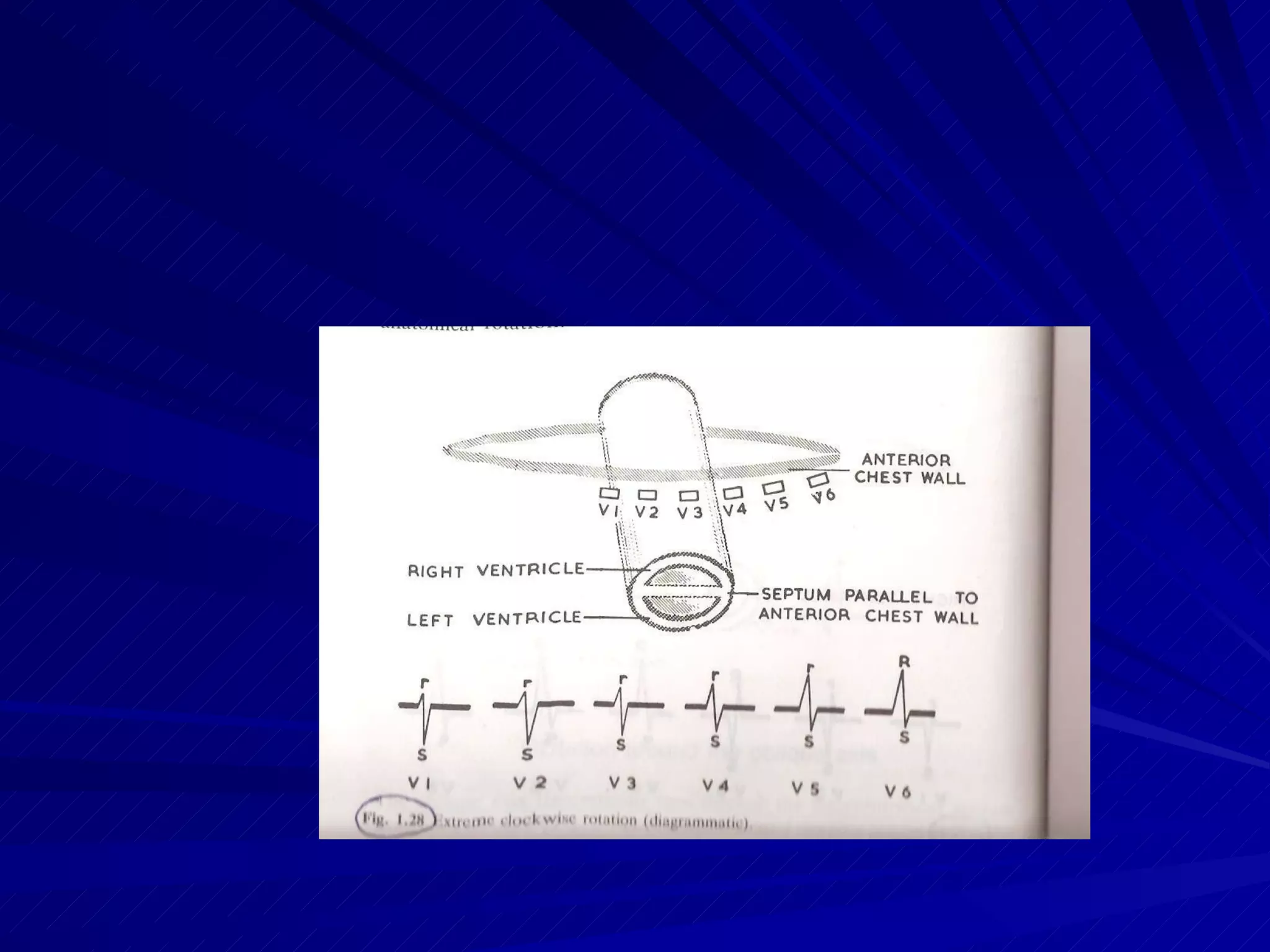
Clock wise rotation;here th RV assumes a more anterior position so that the IVS lay parallel to the chest wall There is a shift of the transition zone to the right
 
 
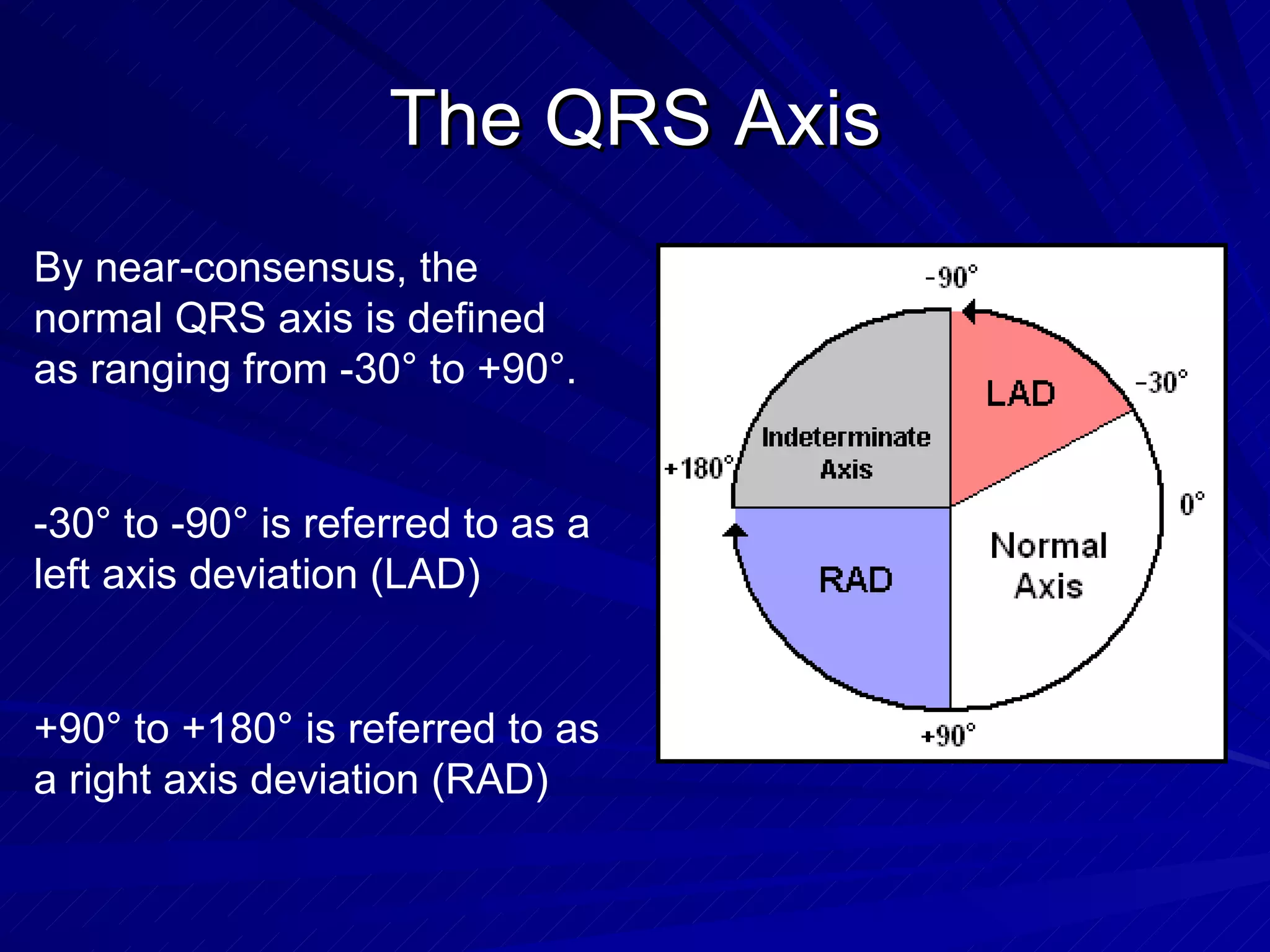
The QRS Axis The QRS axis represents the net overall direction of the heart’s electrical activity. Abnormalities of axis can hint at: Ventricular enlargement Conduction blocks (i.e. hemiblocks)
 
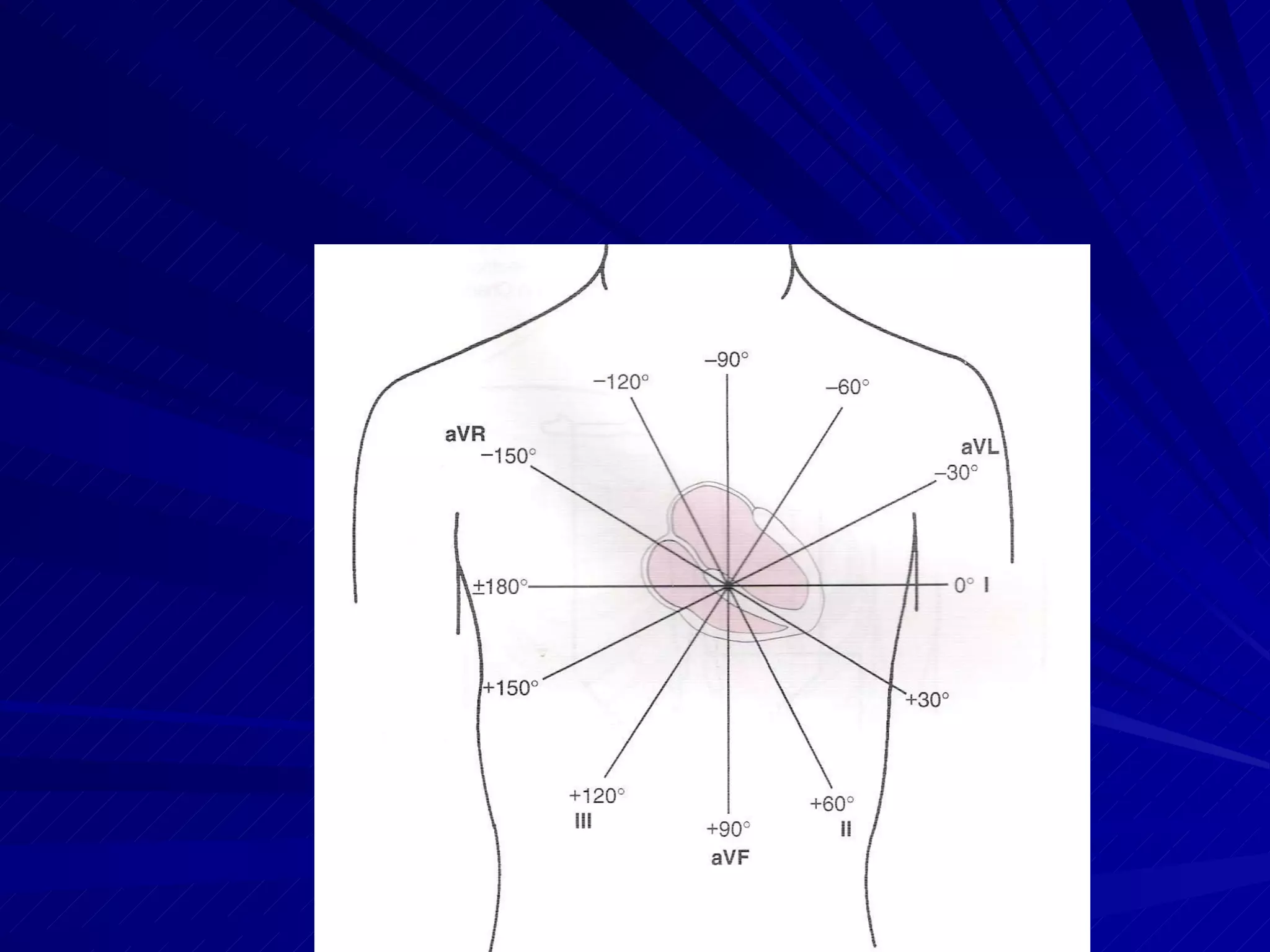
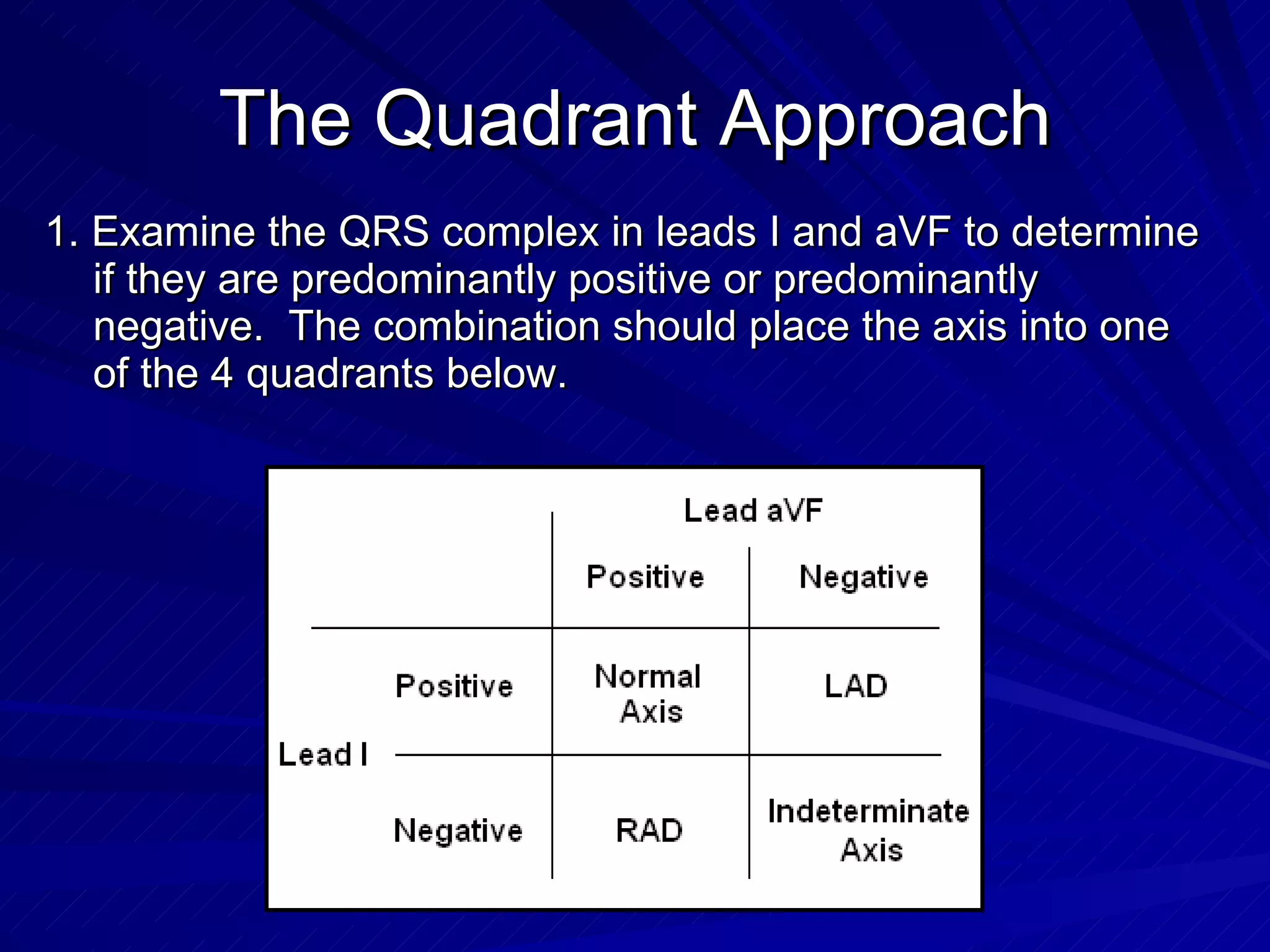
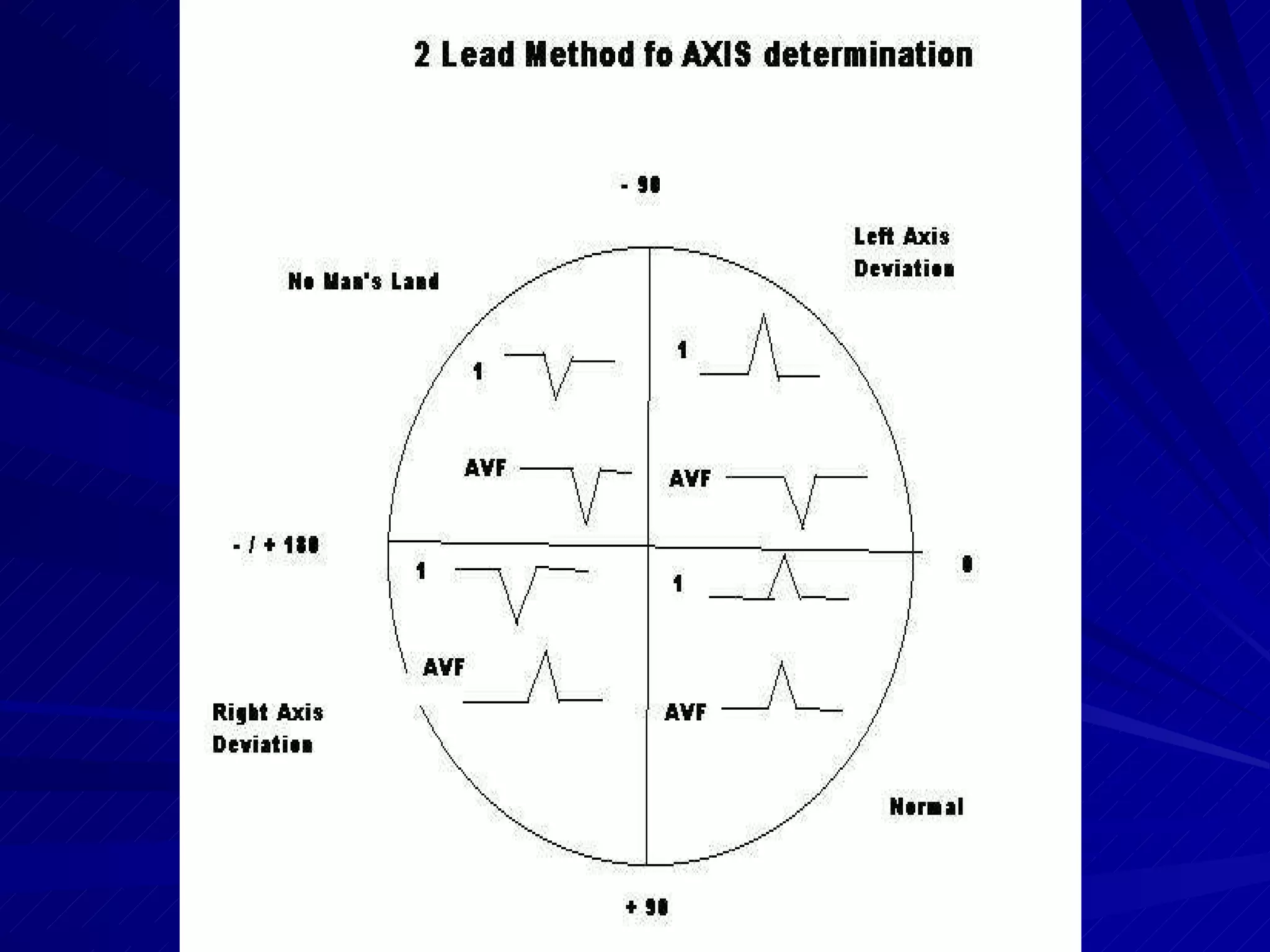
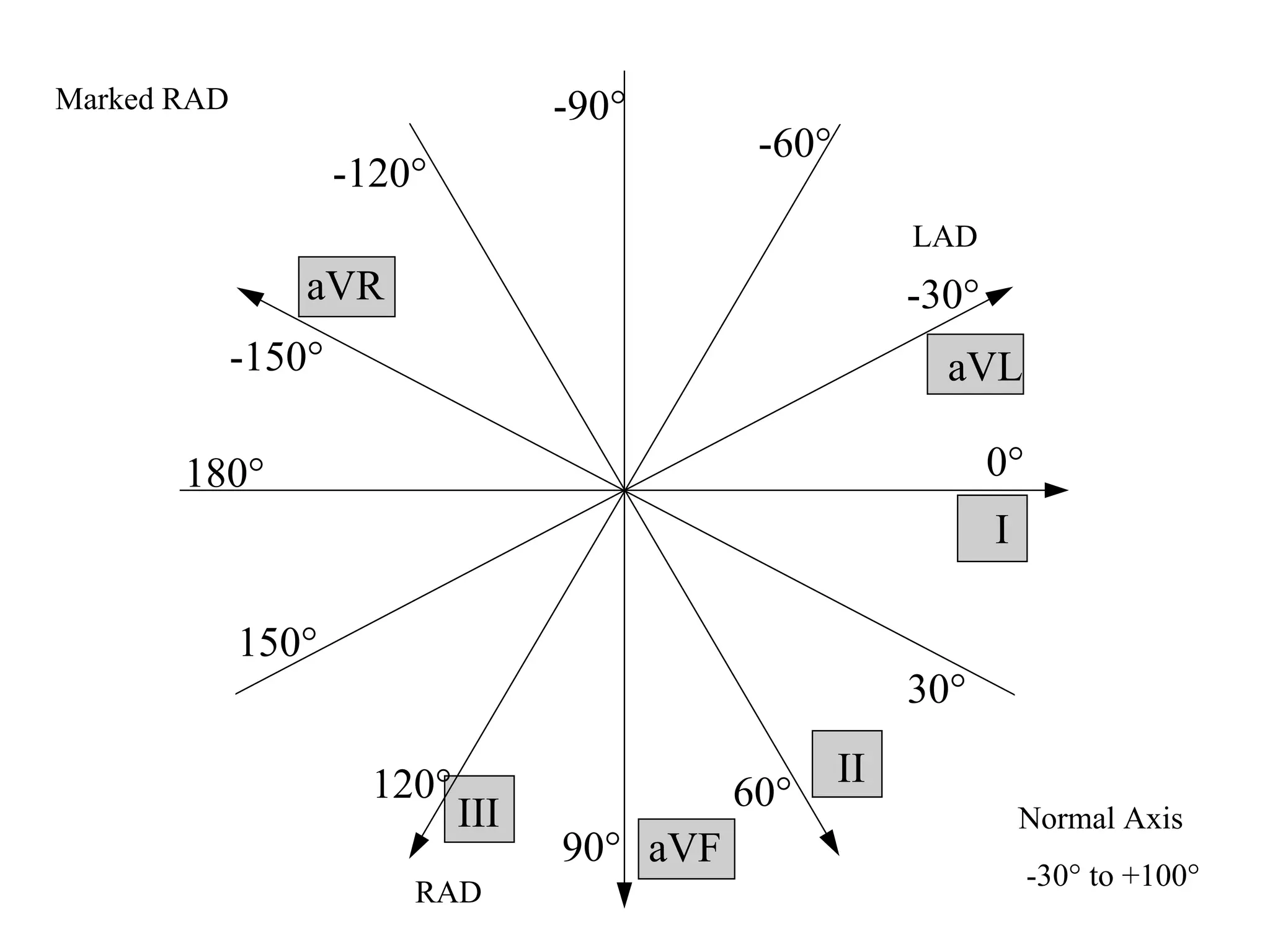
The QRS Axis By near-consensus, the normal QRS axis is defined as ranging from -30 °  to +90 ° . -30 °  to -90 °  is referred to as a left axis deviation (LAD) +90 °  to +180 °  is referred to as a right axis deviation (RAD)
 
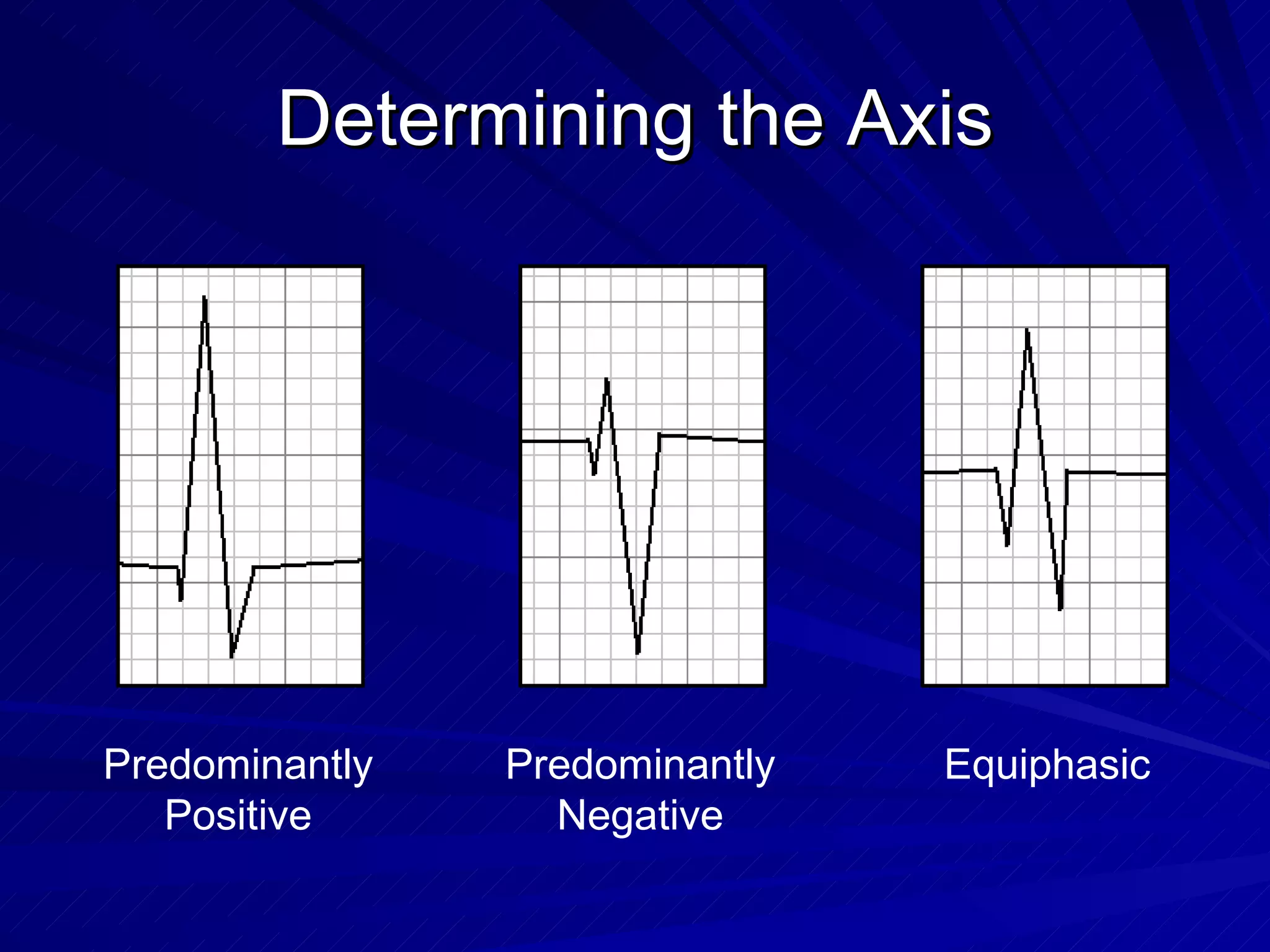
Determining the Axis The Quadrant Approach The Equiphasic Approach
Determining the Axis Predominantly Positive Predominantly Negative Equiphasic
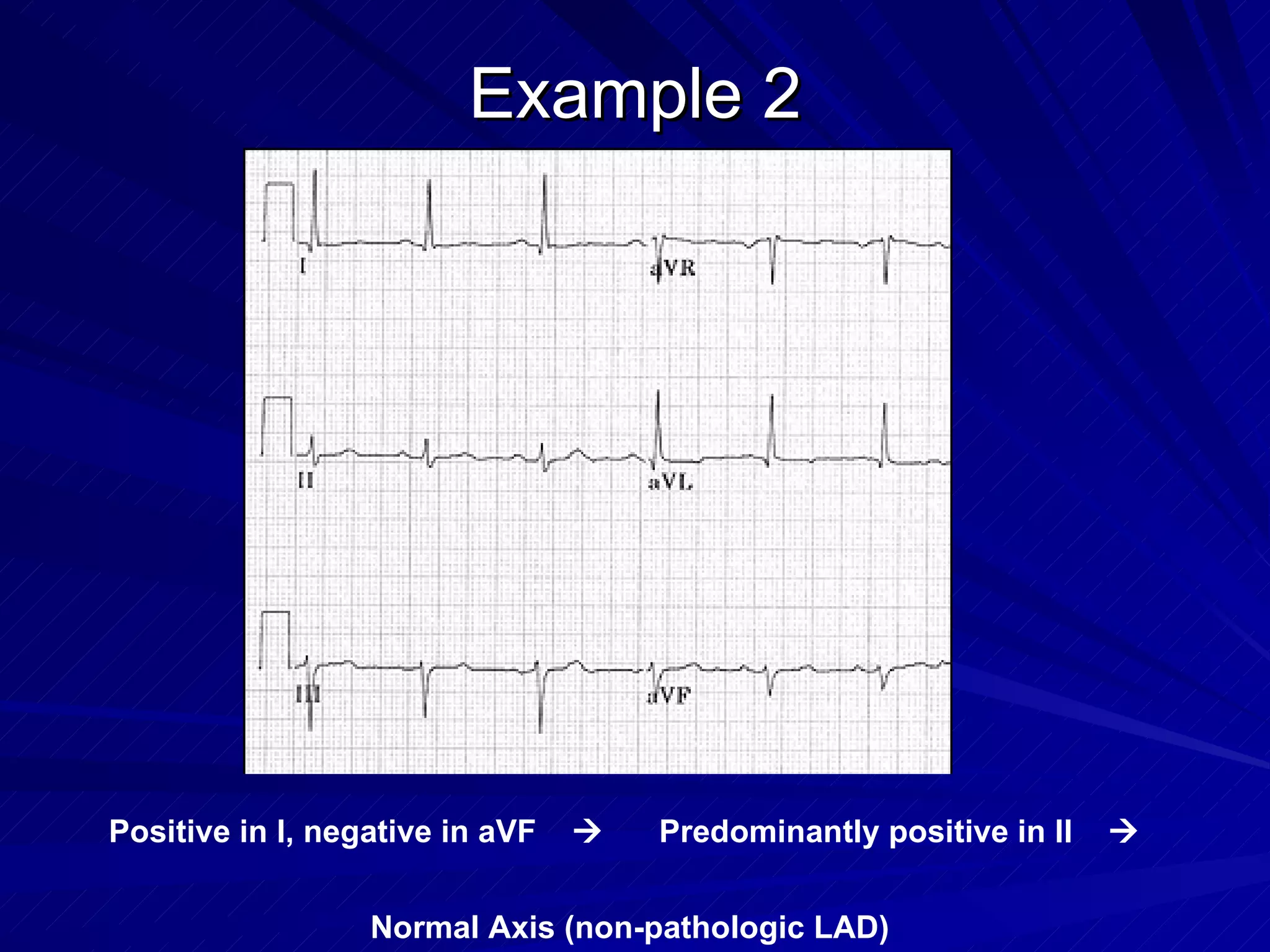
The Quadrant Approach 1. Examine the QRS complex in leads I and aVF to determine if they are predominantly positive or predominantly negative.  The combination should place the axis into one of the 4 quadrants below.
 
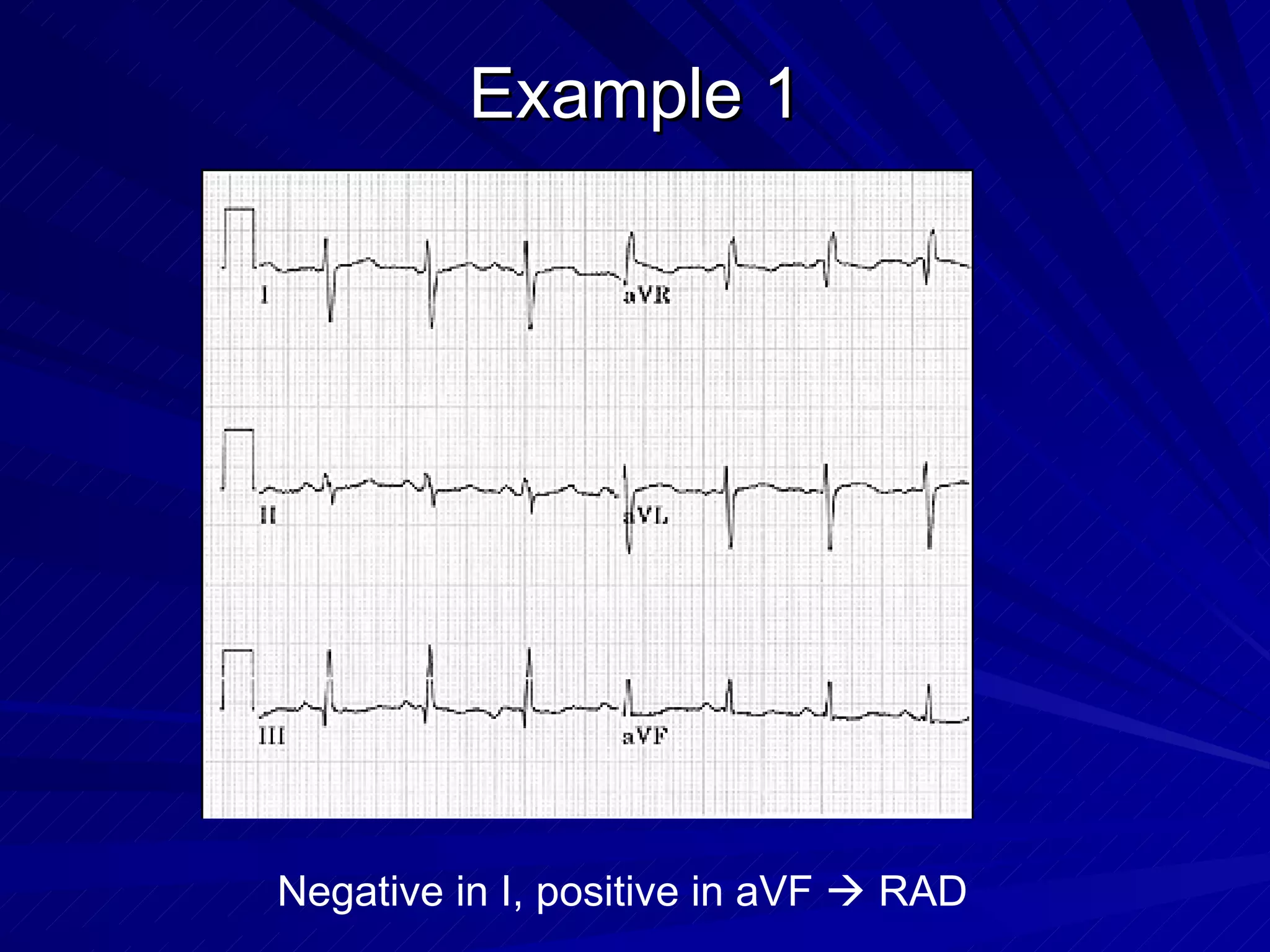
Example 1 Negative in I, positive in aVF    RAD
Example 2 Positive in I, negative in aVF     Predominantly positive in II     Normal Axis (non-pathologic LAD)
 
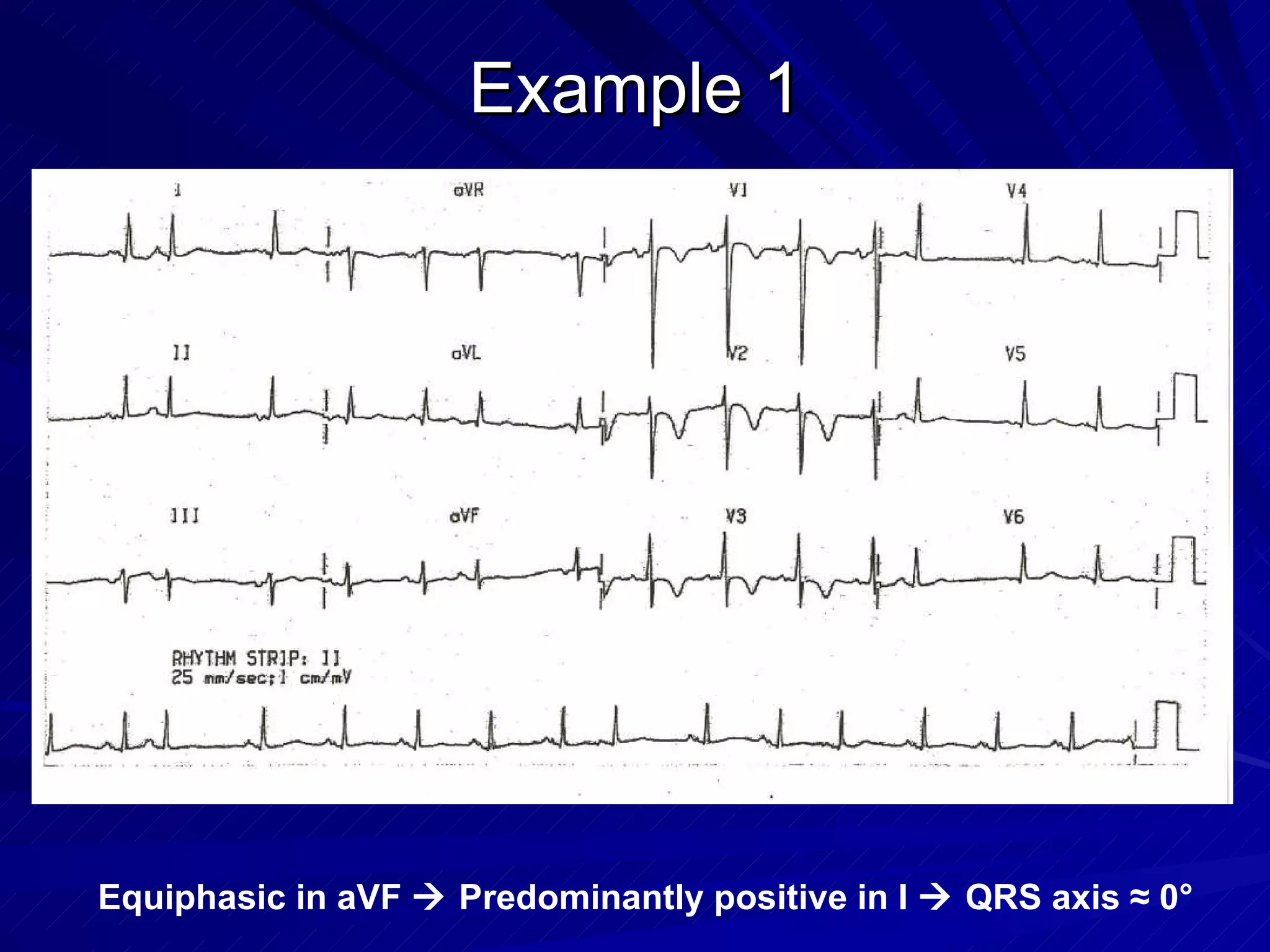
Example 1 Equiphasic in aVF    Predominantly positive in I    QRS axis  ≈ 0°
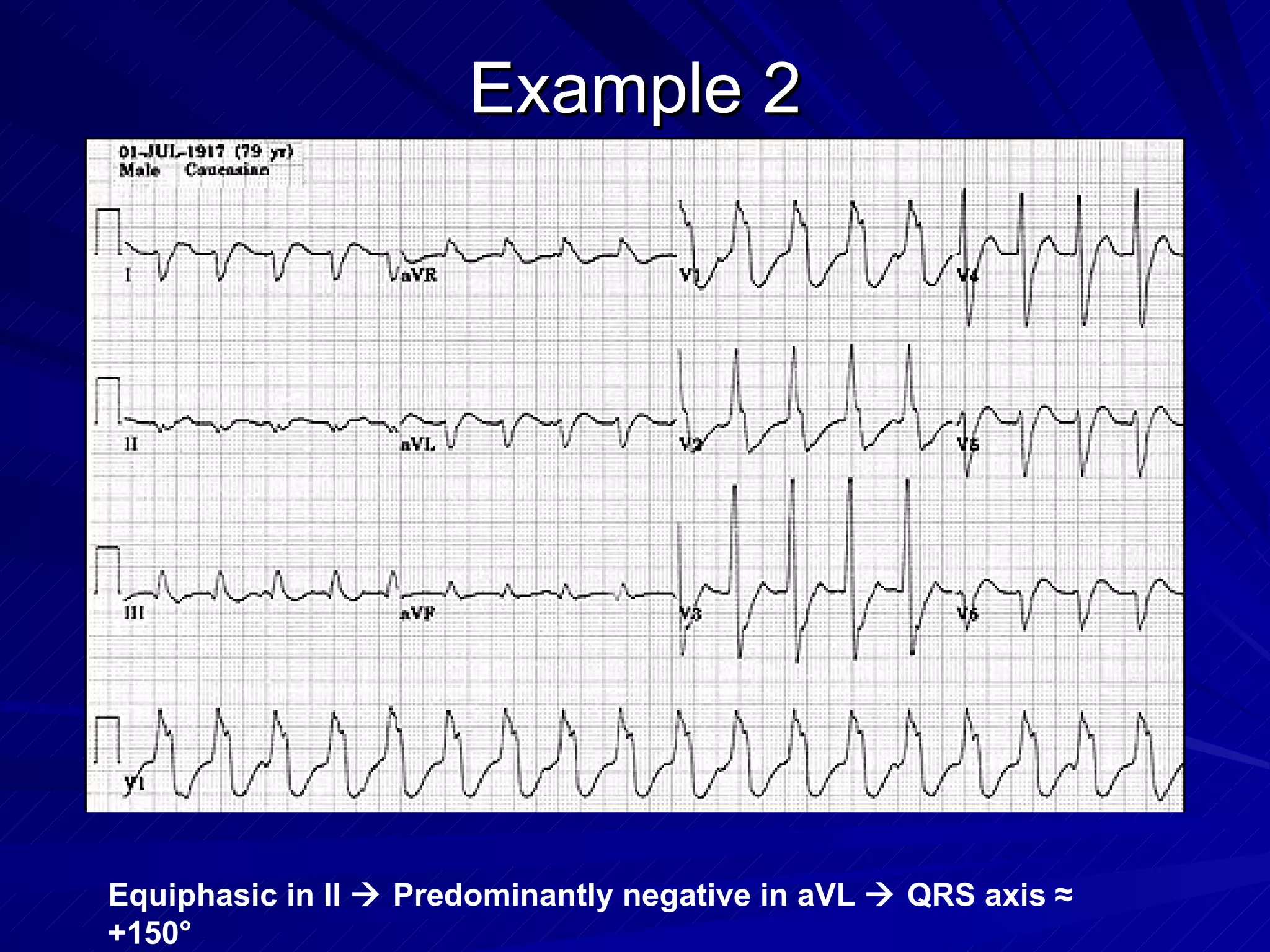
Example 2 Equiphasic in II    Predominantly negative in aVL    QRS axis ≈ +150°
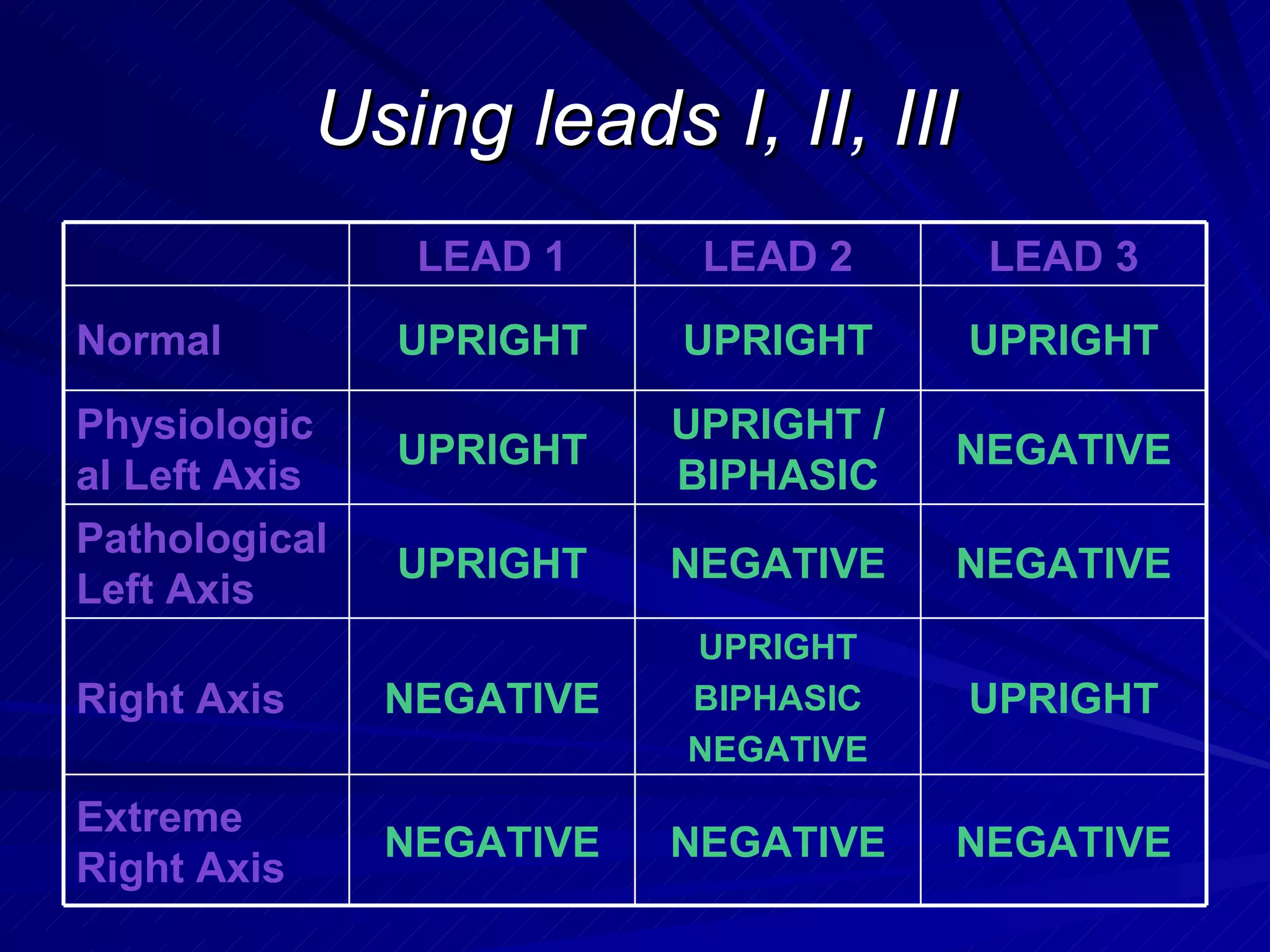
Using leads I, II, III NEGATIVE NEGATIVE UPRIGHT Pathological Left Axis UPRIGHT UPRIGHT BIPHASIC NEGATIVE NEGATIVE Right Axis NEGATIVE NEGATIVE NEGATIVE Extreme Right Axis NEGATIVE UPRIGHT / BIPHASIC UPRIGHT Physiological Left Axis UPRIGHT UPRIGHT UPRIGHT Normal LEAD 3 LEAD 2 LEAD 1
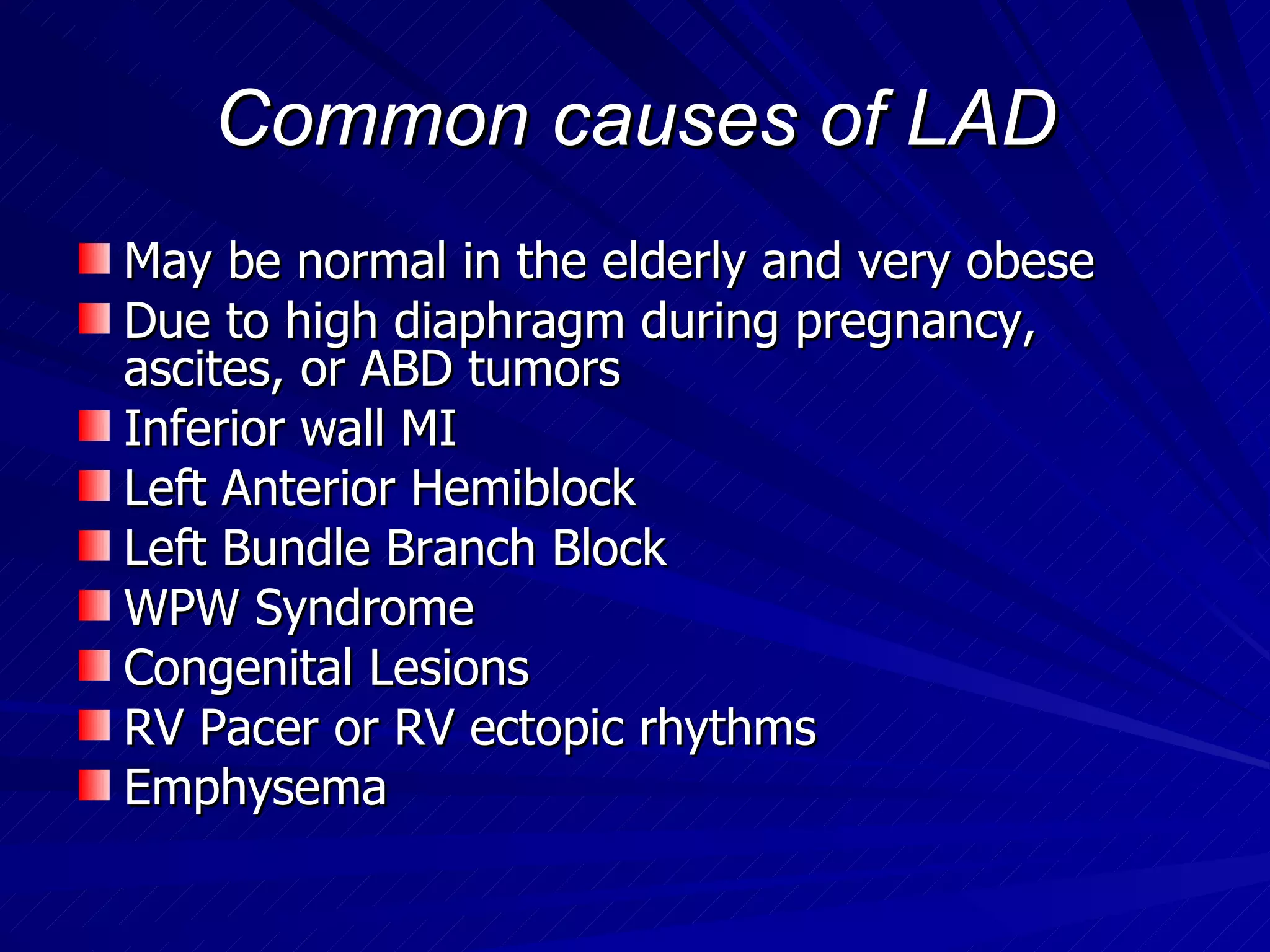
Common causes of LAD May be normal in the elderly and very obese Due to high diaphragm during pregnancy, ascites, or ABD tumors Inferior wall MI Left Anterior Hemiblock Left Bundle Branch Block WPW Syndrome Congenital Lesions RV Pacer or RV ectopic rhythms Emphysema
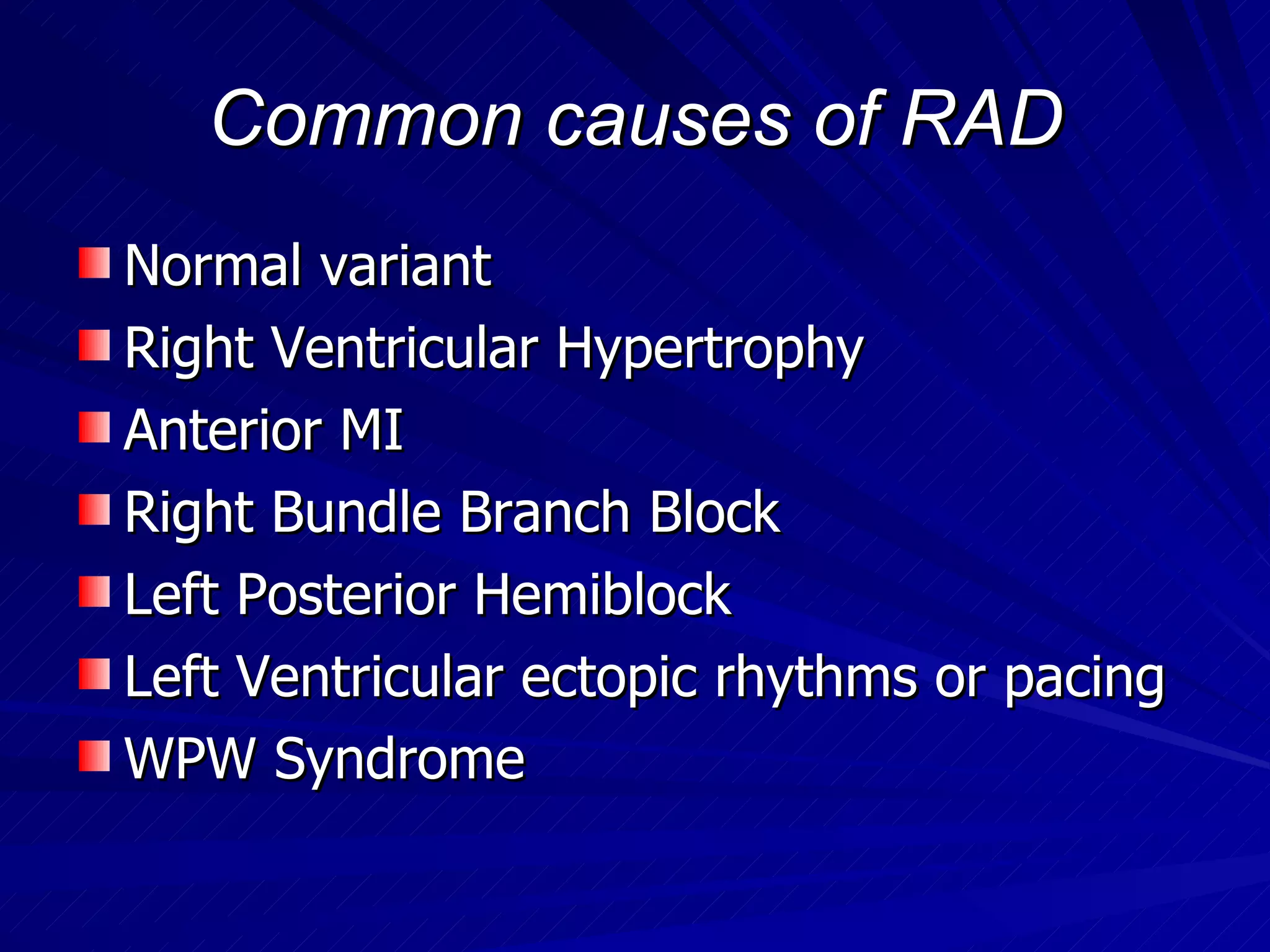
Common causes of RAD Normal variant Right Ventricular Hypertrophy Anterior MI Right Bundle Branch Block Left Posterior Hemiblock Left Ventricular ectopic rhythms or pacing WPW Syndrome
The Normal ECG Dr.K.Subramanyam 30-3-2009
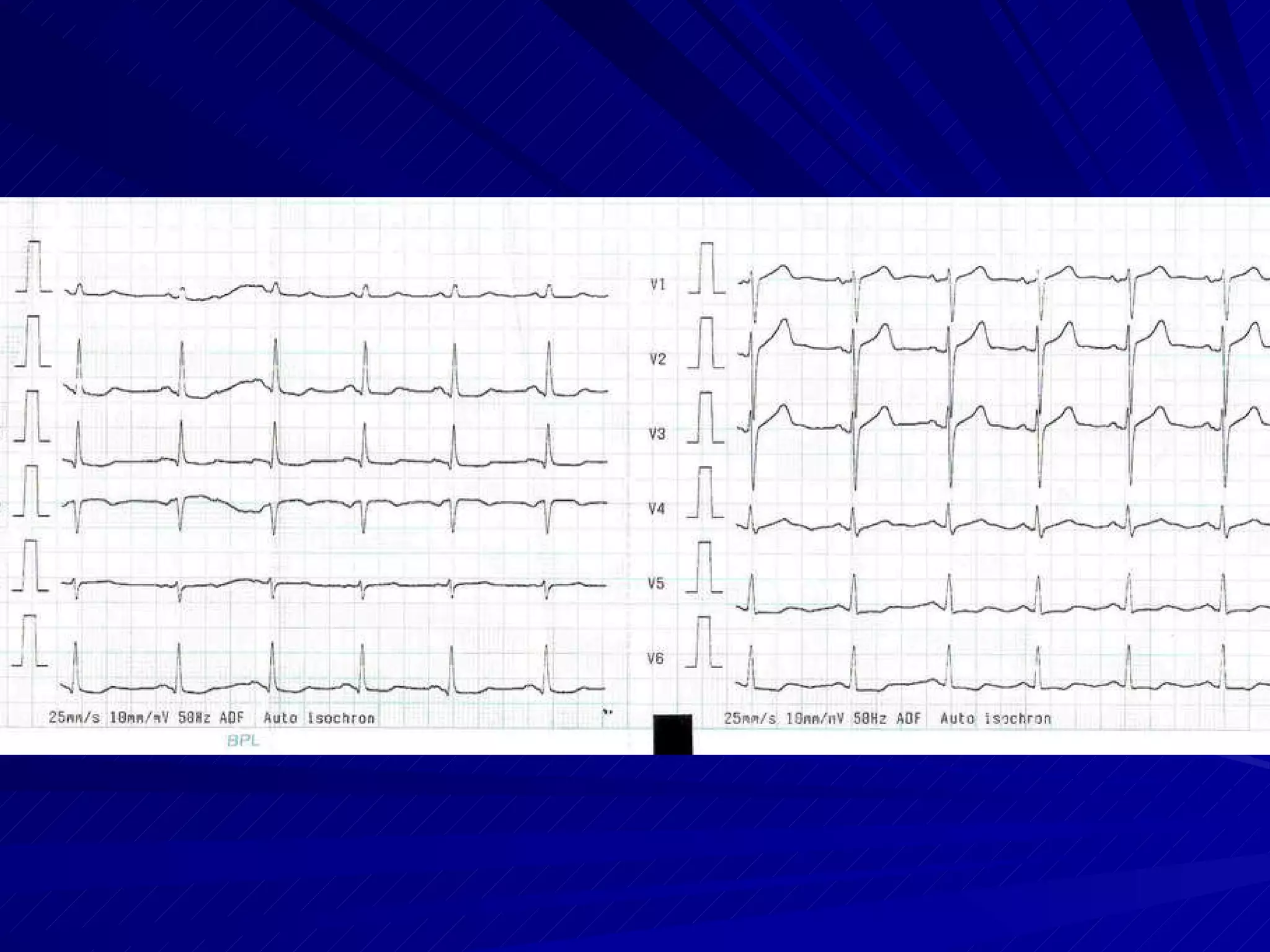
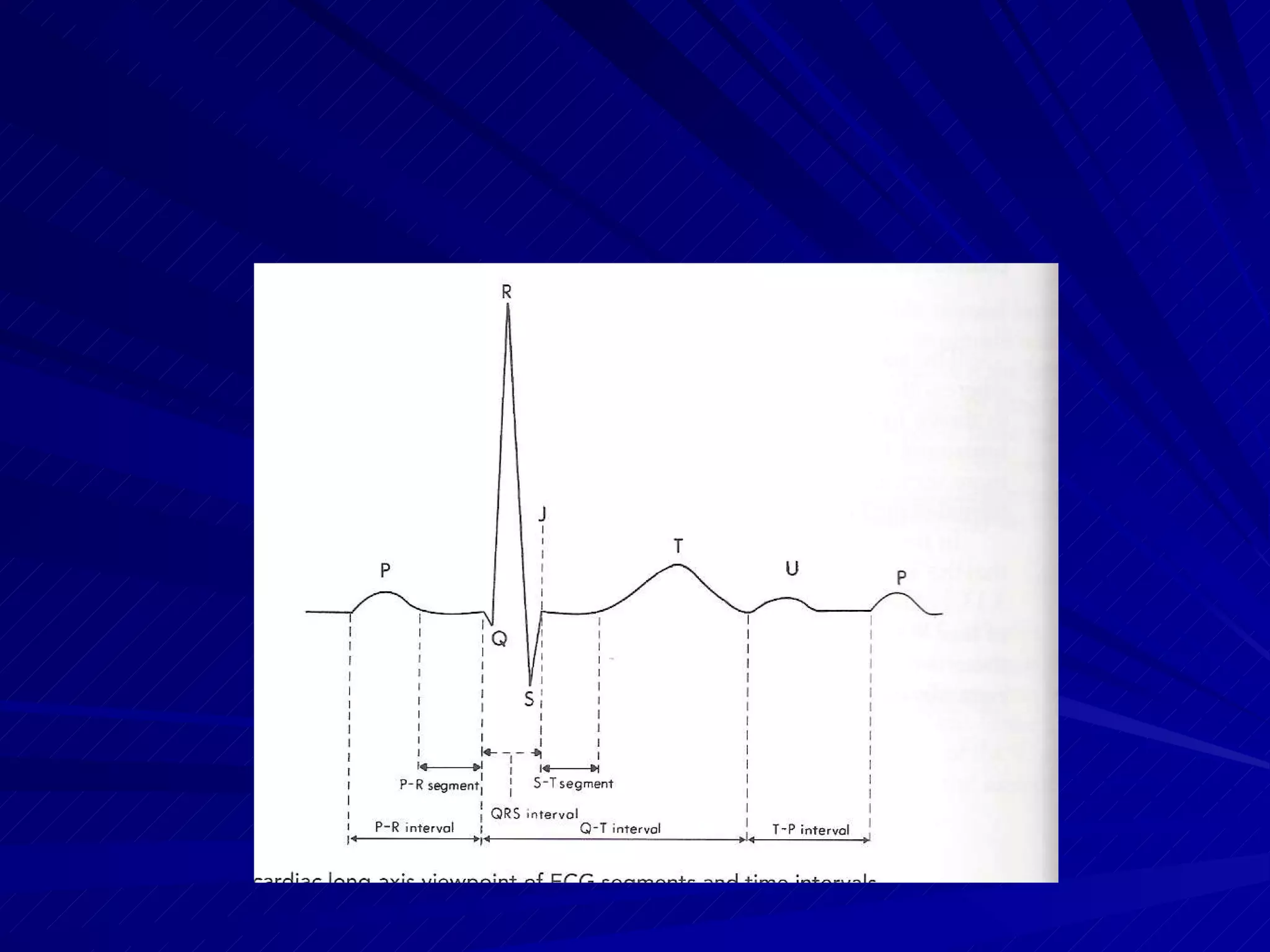
Normal Sinus Rhythm Originates in the sinus node Rate between 60 and 100 beats per min P wave axis of +45 to +65 degrees, ie. Tallest p waves in Lead II Monomorphic P waves Normal PR interval of 120 to 200 msec Normal relationship between P and QRS Some sinus arrhythmia is normal
 
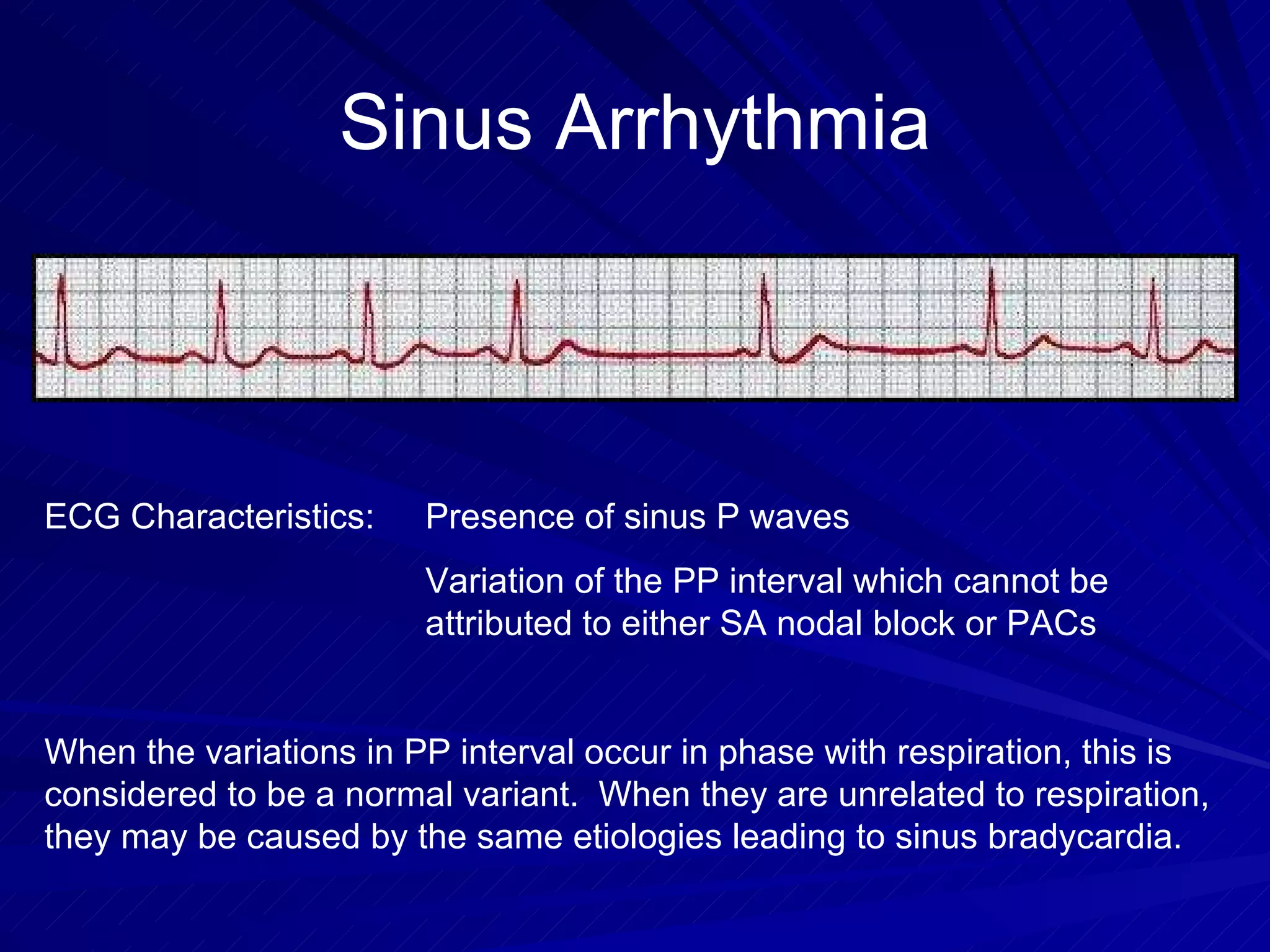
Sinus Arrhythmia ECG Characteristics: Presence of sinus P waves Variation of the PP interval which cannot be  attributed to either SA nodal block or PACs When the variations in PP interval occur in phase with respiration, this is considered to be a normal variant.  When they are unrelated to respiration, they may be caused by the same etiologies leading to sinus bradycardia.
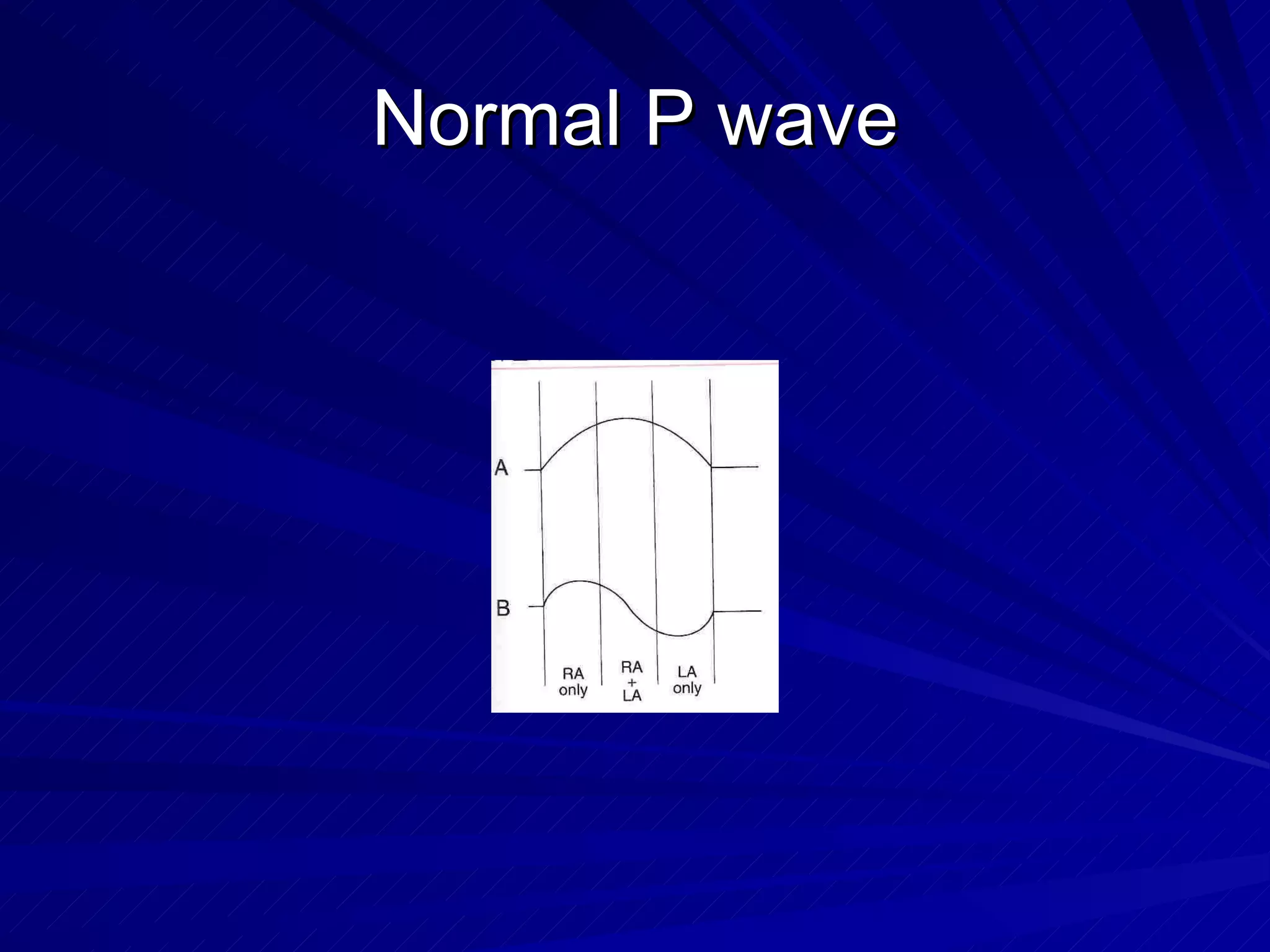
Normal P wave Atrial depolarisation Duration 80 to 100 msec Maximum amplitude 2.5 mm Axis +45 to +65 Biphasic in lead V1 Terminal deflection should not exceed 1 mm in depth and 0.03 sec in duration
Normal P wave
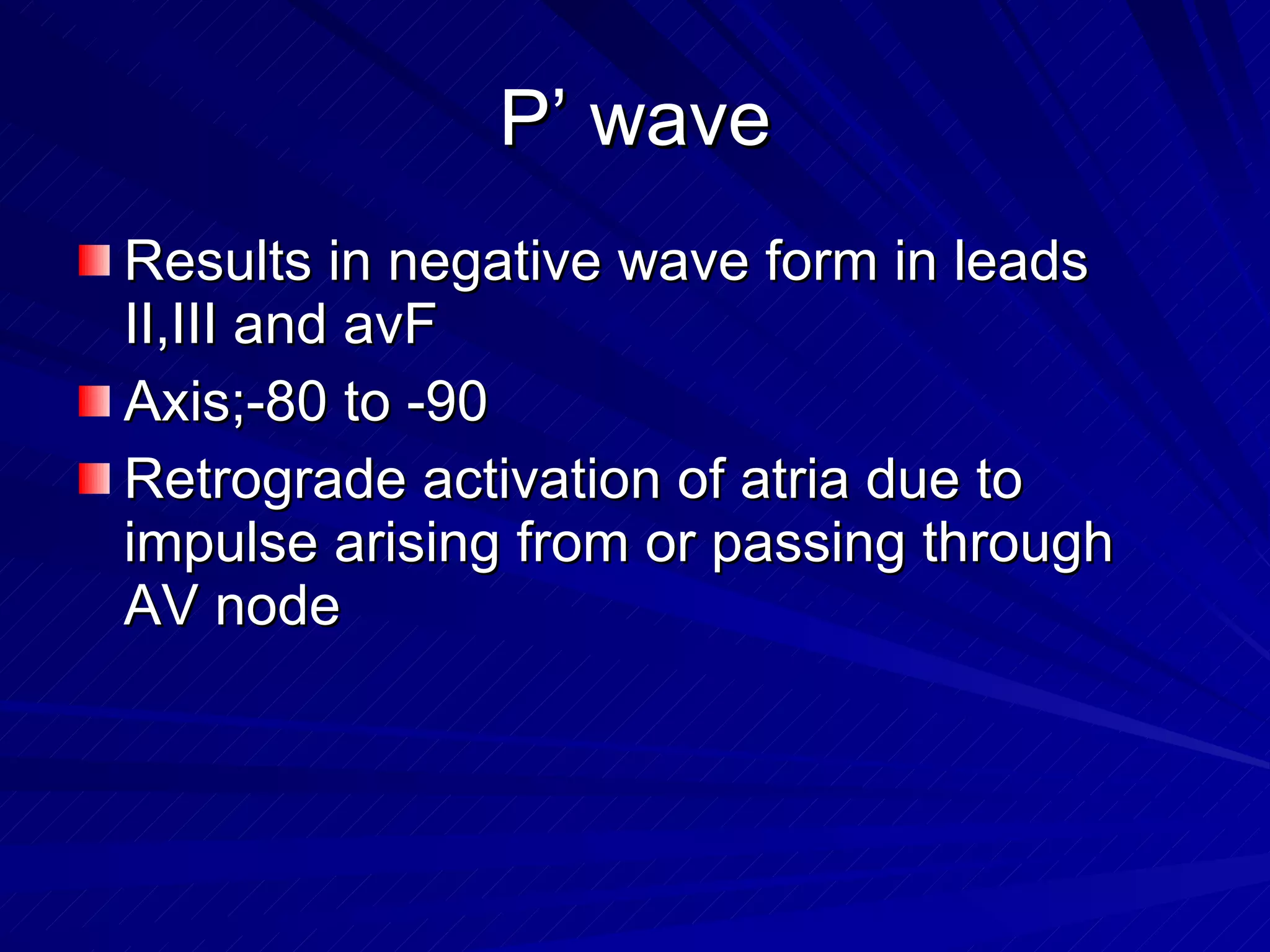
P’ wave Results in negative wave form in leads II,III and avF Axis;-80 to -90 Retrograde activation of atria due to impulse arising from or passing through AV node
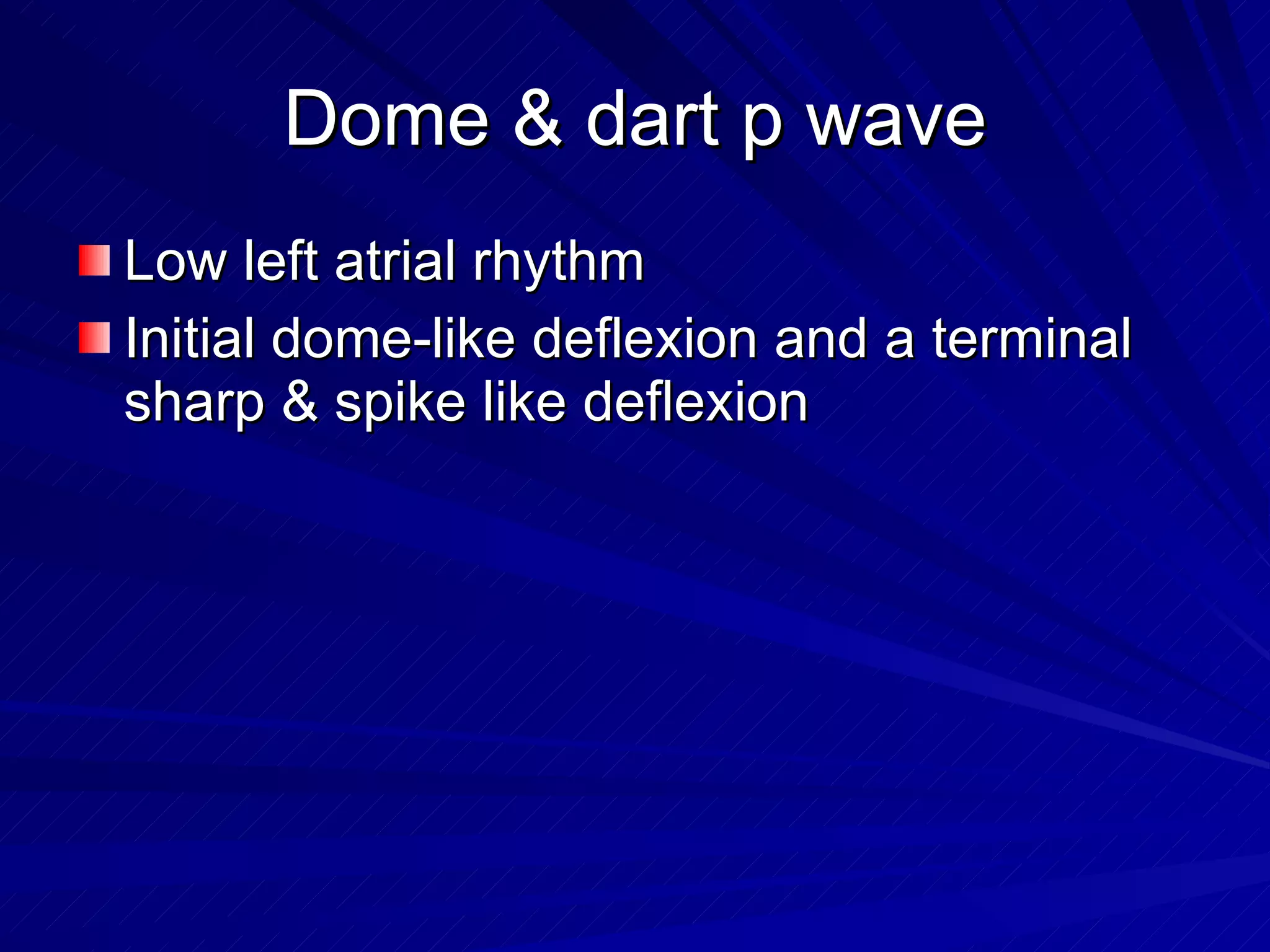
Dome & dart p wave Low left atrial rhythm Initial dome-like deflexion and a terminal sharp & spike like deflexion
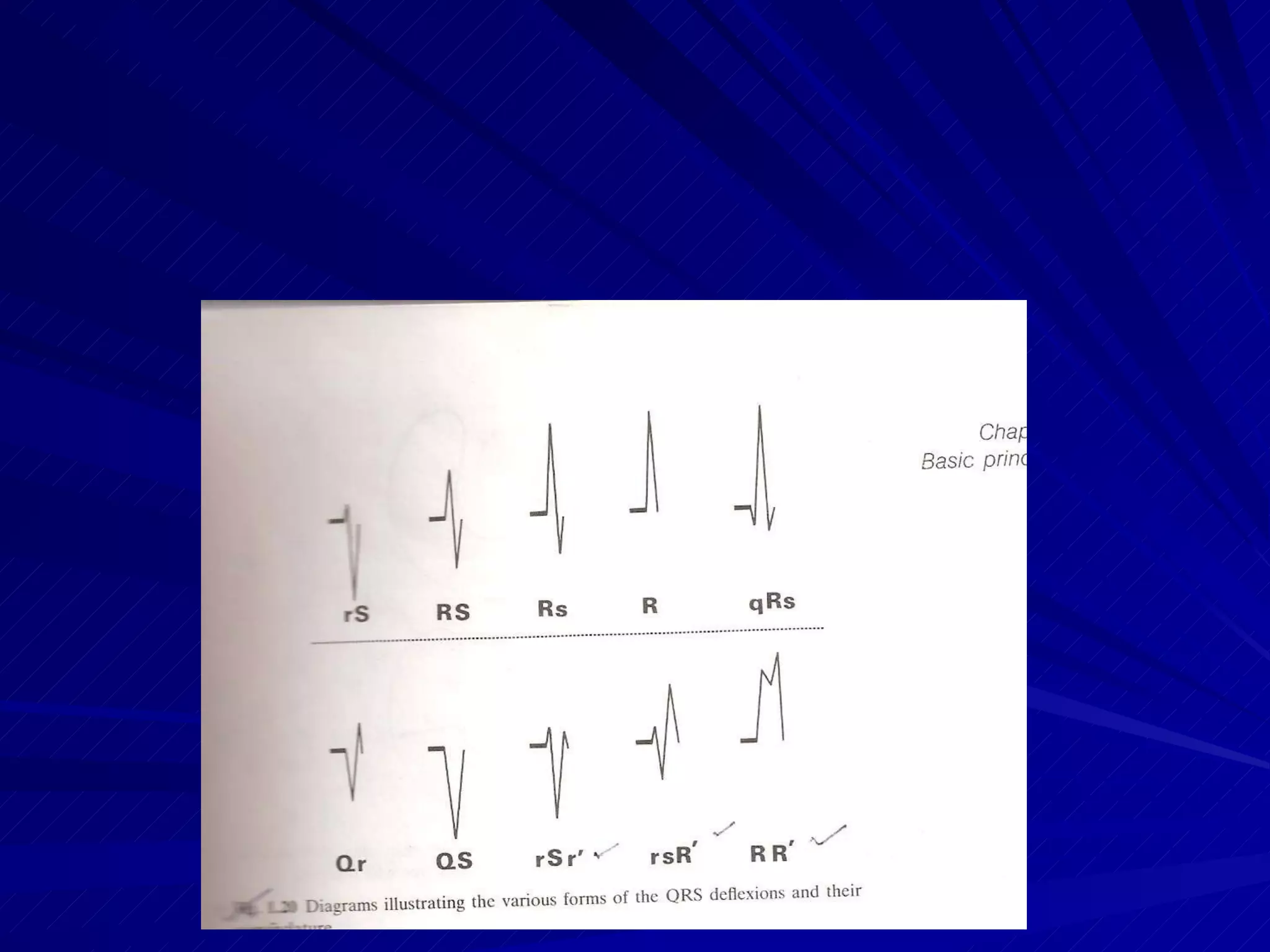
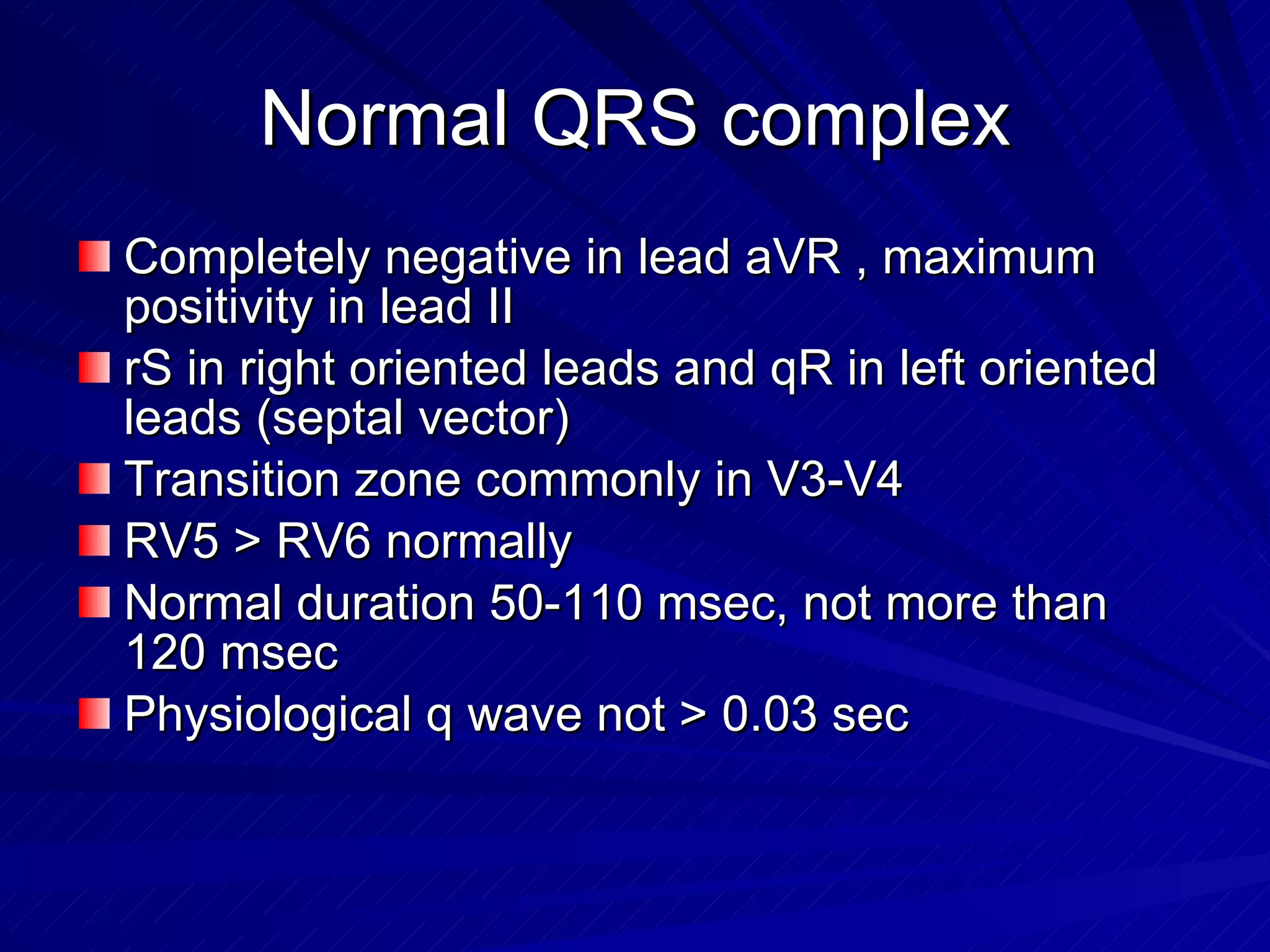
Normal QRS complex Completely negative in lead aVR , maximum positivity in lead II rS in right oriented leads and qR in left oriented leads (septal vector) Transition zone commonly in V3-V4 RV5 > RV6 normally Normal duration 50-110 msec, not more than 120 msec Physiological q wave not > 0.03 sec
 
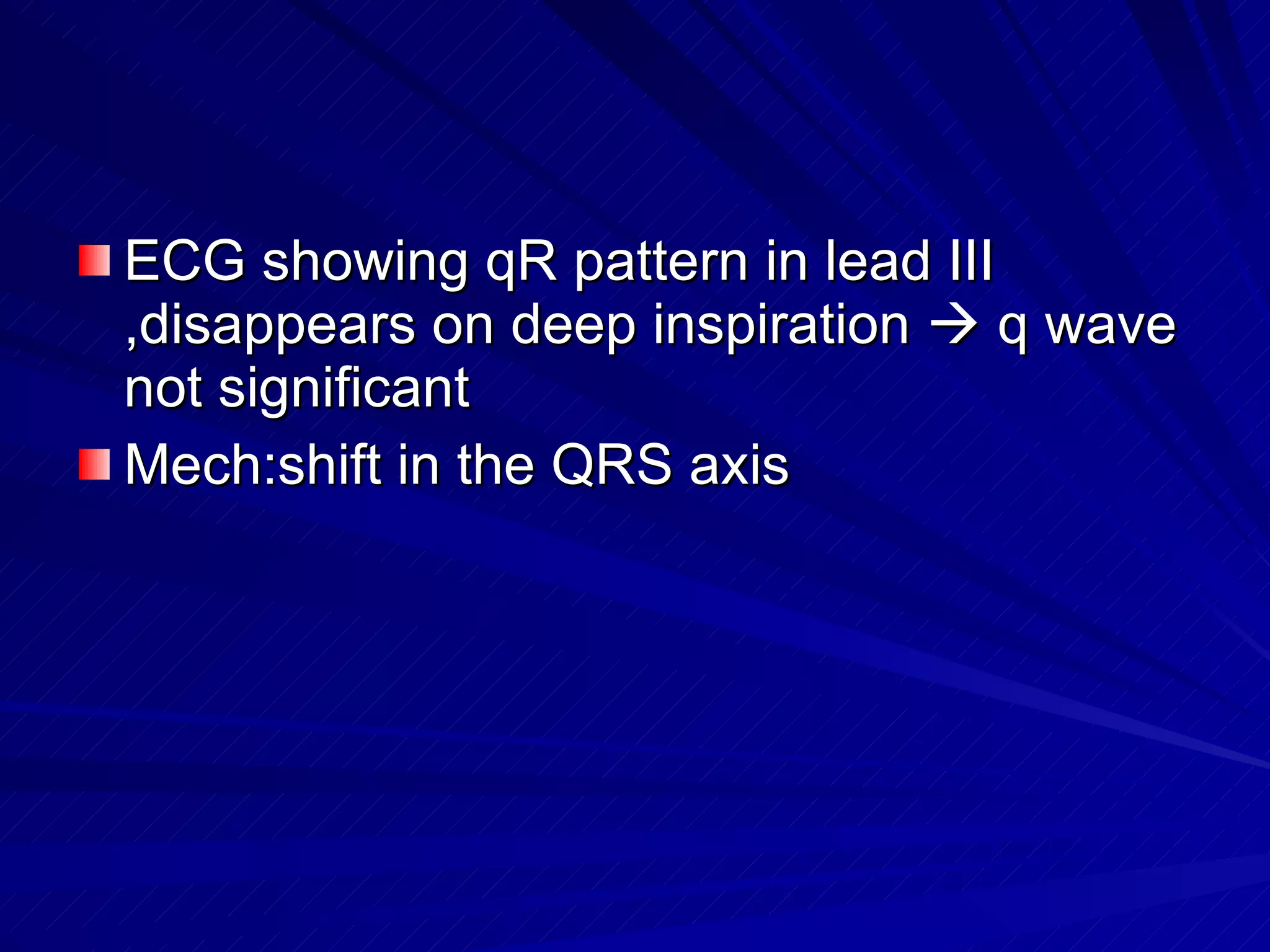
ECG showing qR pattern in lead III ,disappears on deep inspiration    q wave not significant Mech:shift in the QRS axis
QRS-T angle The normal t wave axis is similar to the QRS axis Normally the QRS-T angle does not exceed 60 deg
Amplitude of QRS Depends on the following factors 1.electrical force generated by the ventricular myocardium 2.distance of the sensing electrode from the ventricles
3.Body build;a thin individual has larger complexes when compared to obese individuals 4.direction of the frontal QRS axis
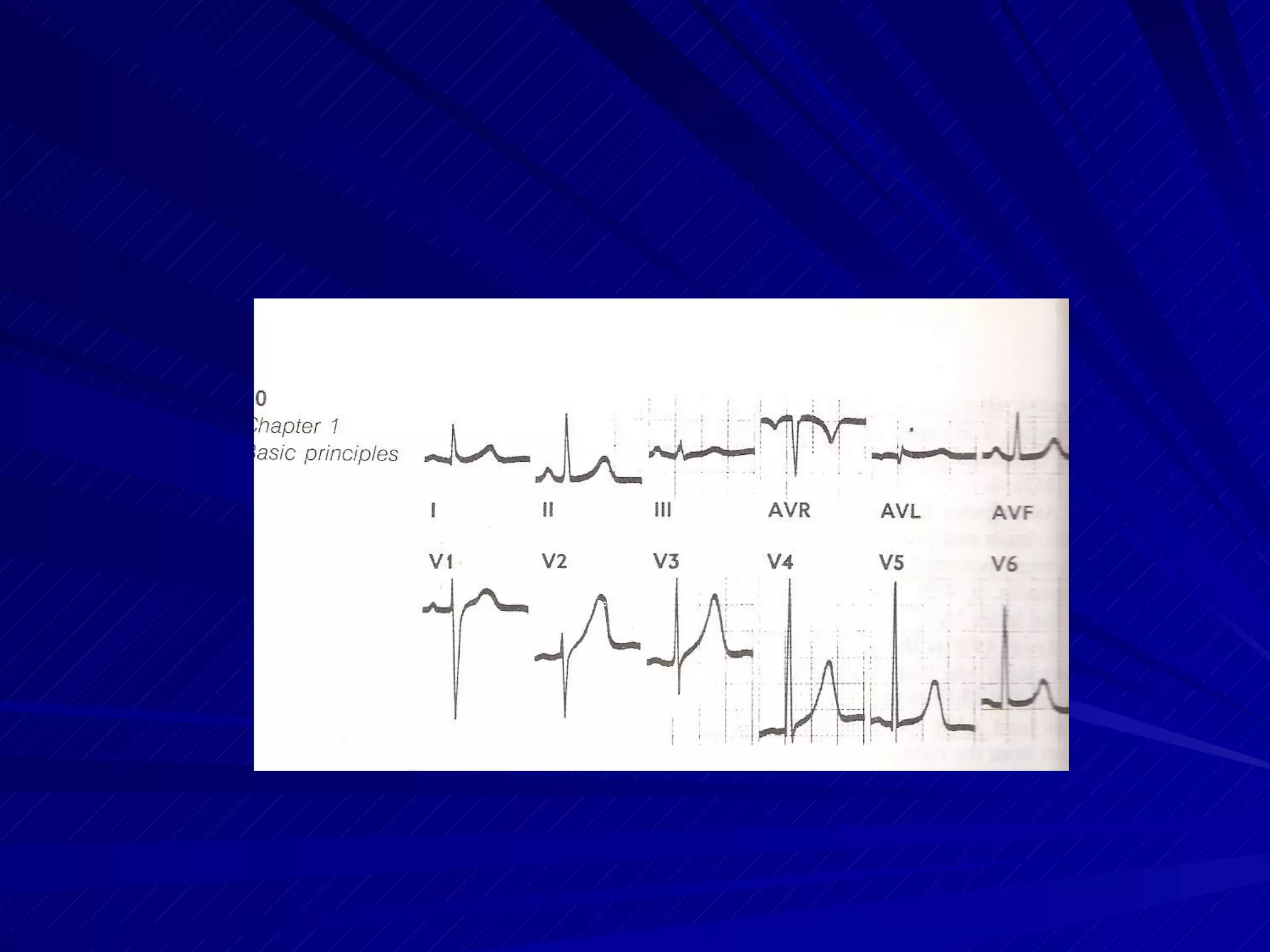
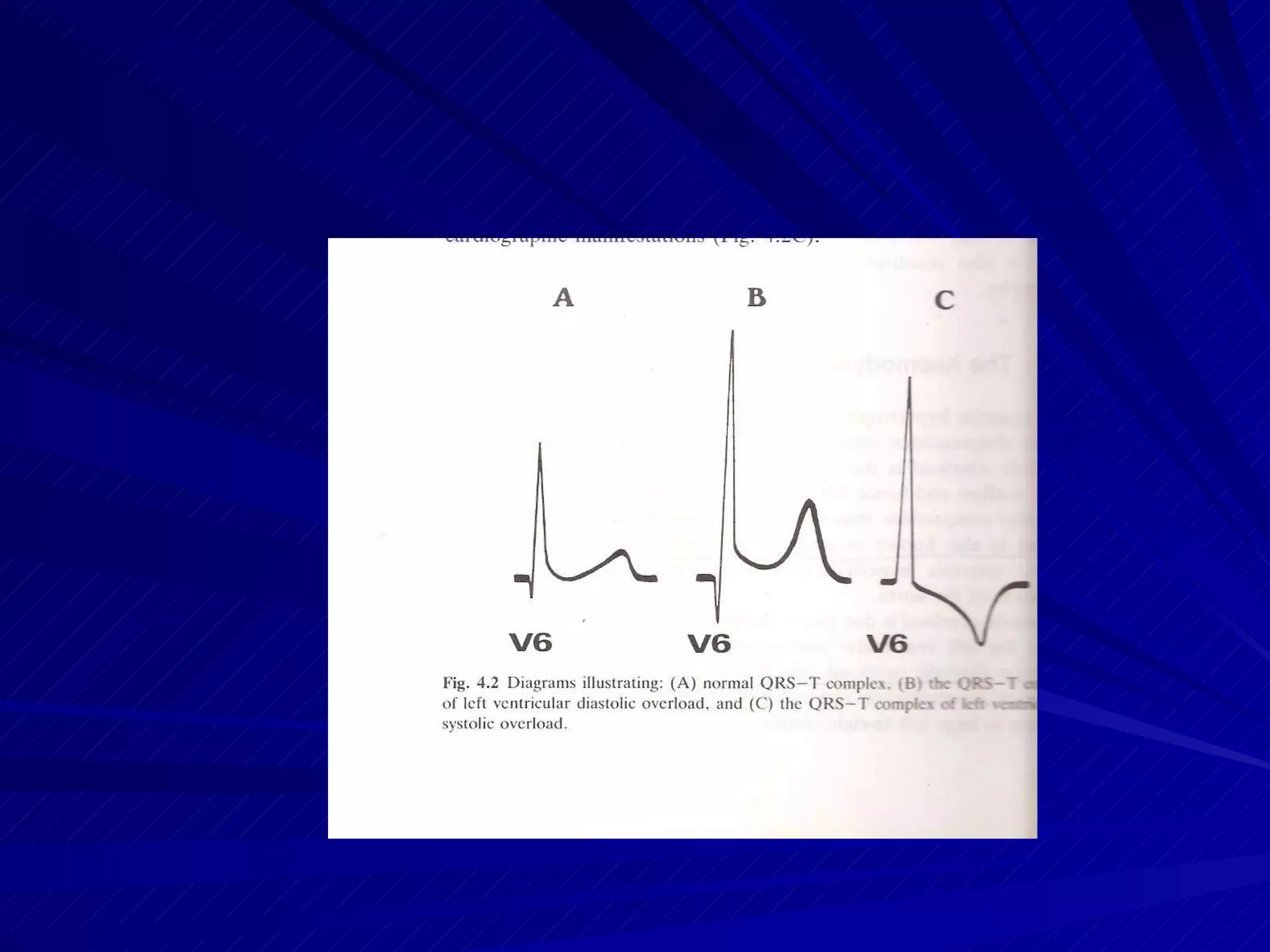
Normal T wave Same direction as the preceding QRS complex Blunt apex with asymmetric limbs Height < 5mm in limb leads and <10 mm in precordial leads Smooth contours May be tall in athletes
 
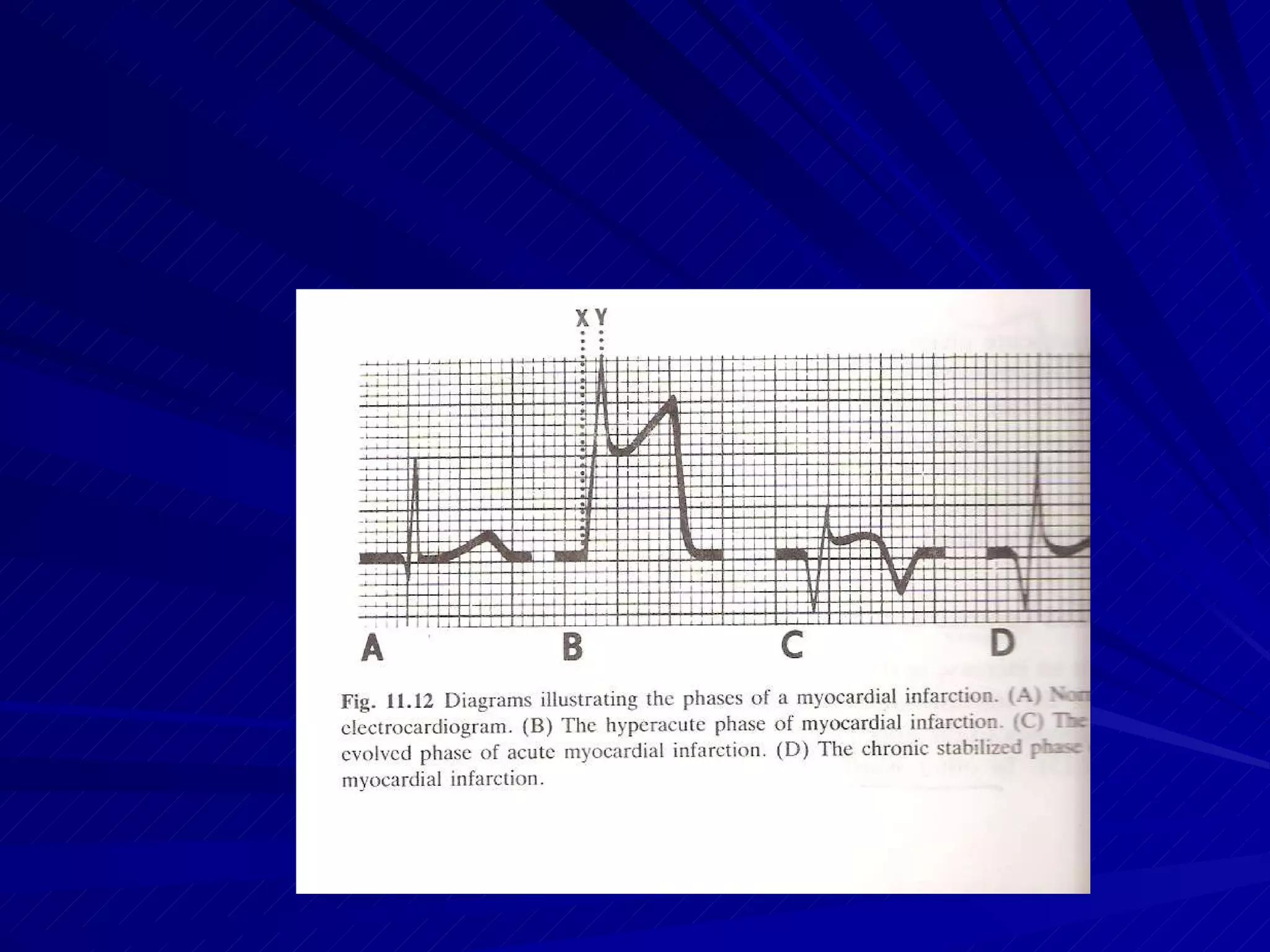
ST segment Merges smoothly with the proximal limb of the T wave No true horizontality
 
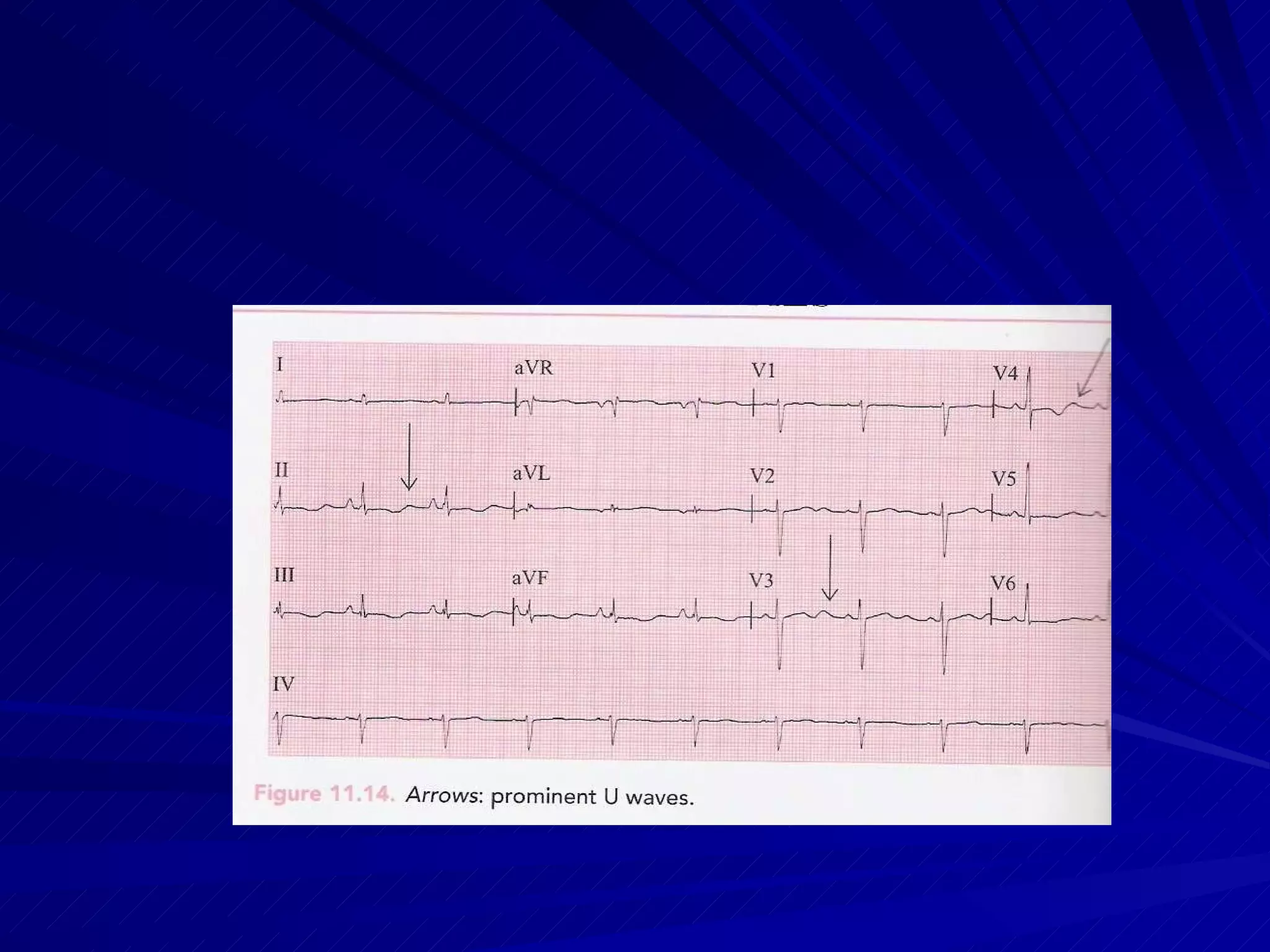
Normal u wave Best seen in midprecordial leads Height < 10% of preceding T wave Isoelectric in lead aVL (useful to measure QTc) Rarely exceeds 1 mm in amplitude May be tall in athletes (2mm)
 
QT interval Normally corrected for heart rate Bazett’s formula Normal 350 to 430 msec With a normal heart rate (60 to 100), the QT interval should not exceed half of the R-R interval roughly
 
Measurement of QT interval The beginning of the QRS complex is best determined in a lead with an initial q wave     leads I,II, avL ,V5 or V6 QT interval shortens with tachycardia and lengthens with bradycardia
Prolonged QTc During sleep Hypocalcemia Ac myocarditis AMI Drugs like quinidine,procainamide,tricyclic antidepressants Hypothermia HOCM
Advanced AV block or high degree AV block Jervell-Lange –Neilson syndrome Romano-ward syndrome
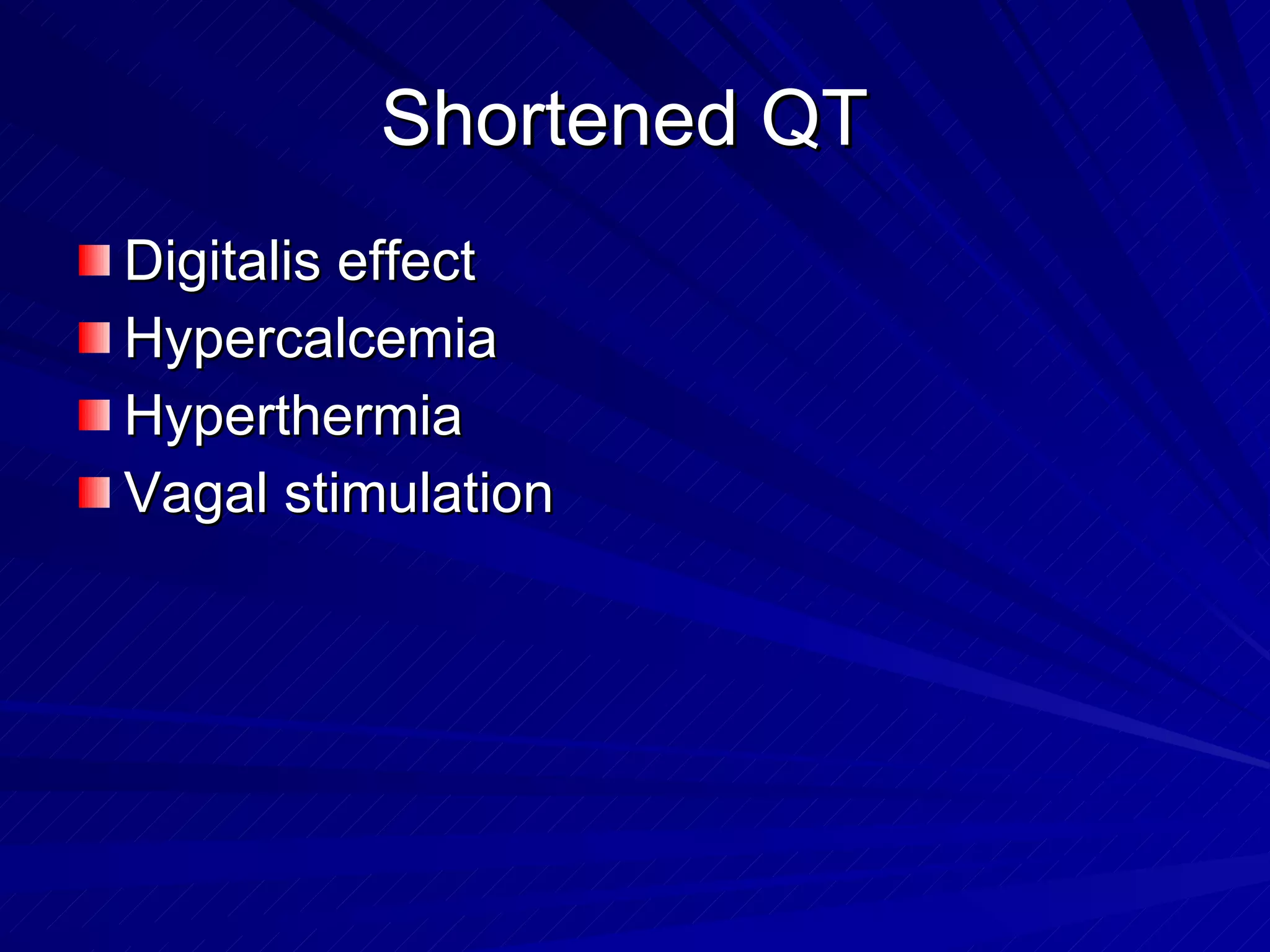
Shortened QT  Digitalis effect Hypercalcemia Hyperthermia Vagal stimulation
Normal standardization 1 mV=10 mm Will result in perfect right angles at each corner
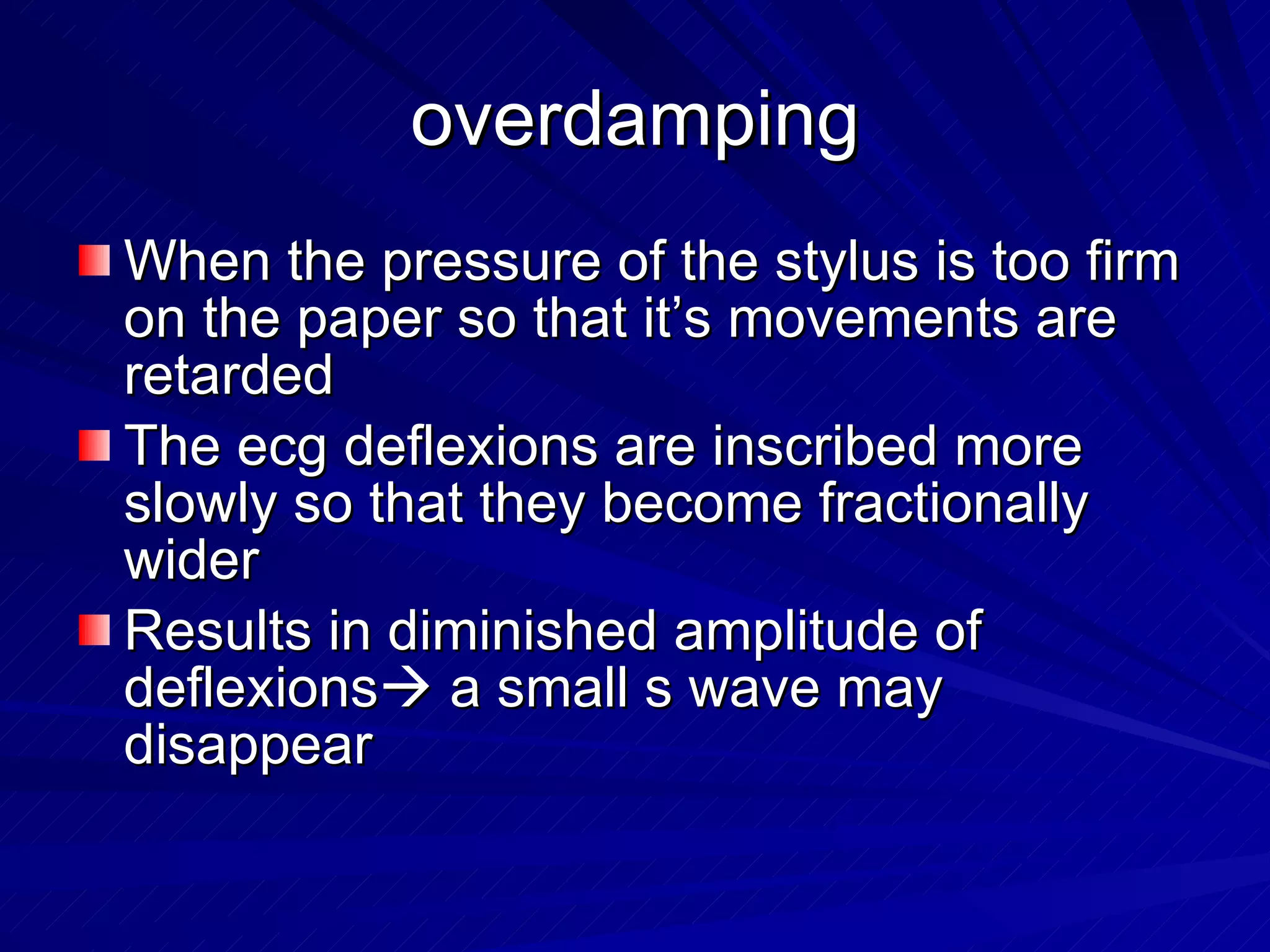
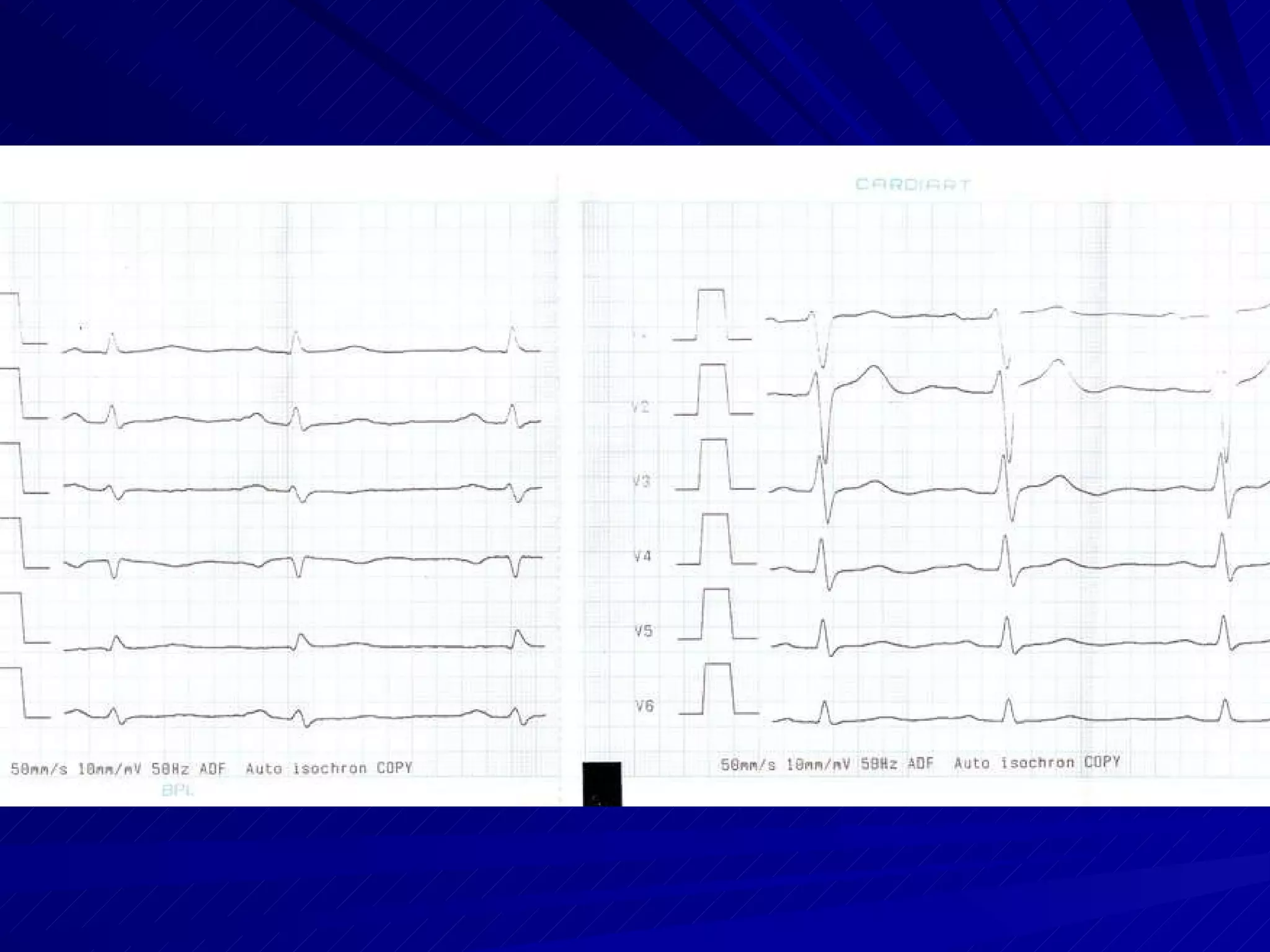
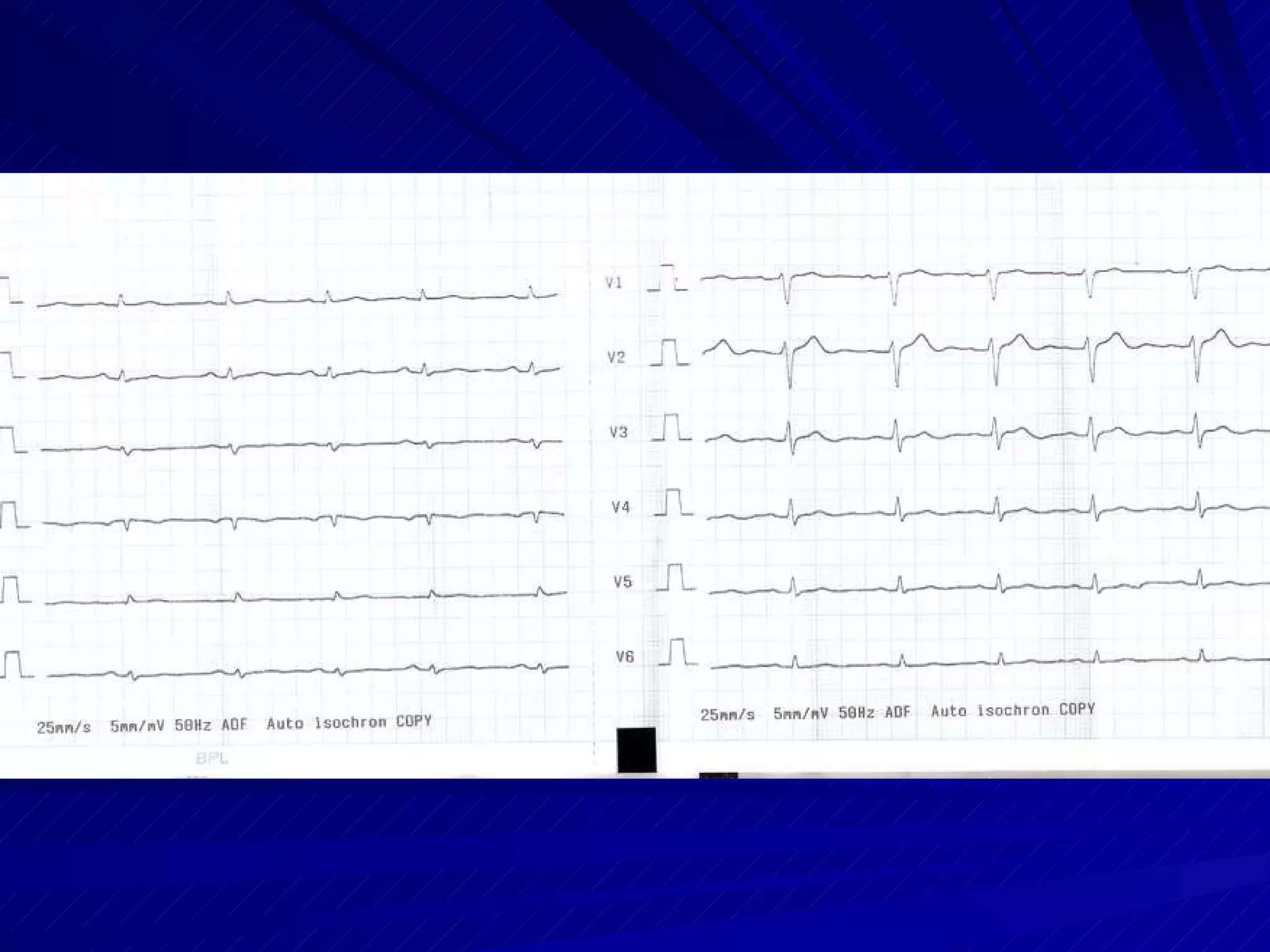
overdamping When the pressure of the stylus is too firm on the paper so that it’s movements are retarded The ecg deflexions are inscribed more slowly so that they become fractionally wider Results in diminished amplitude of deflexions   a small s wave may disappear
Underdamping or overshoot When the writing stylus is not pressed firmly enough against the paper Results in overshoot of the upswing and downswing of the writing stylus,resulting in sharp spikes at the corners Effects:deflexions are inscribed more rapidly    resulting in fractionally narrower complexes
The ecg deflexions may be increased in amplitude . An s wave becomes exaggerated
Normal Variants in the ECG
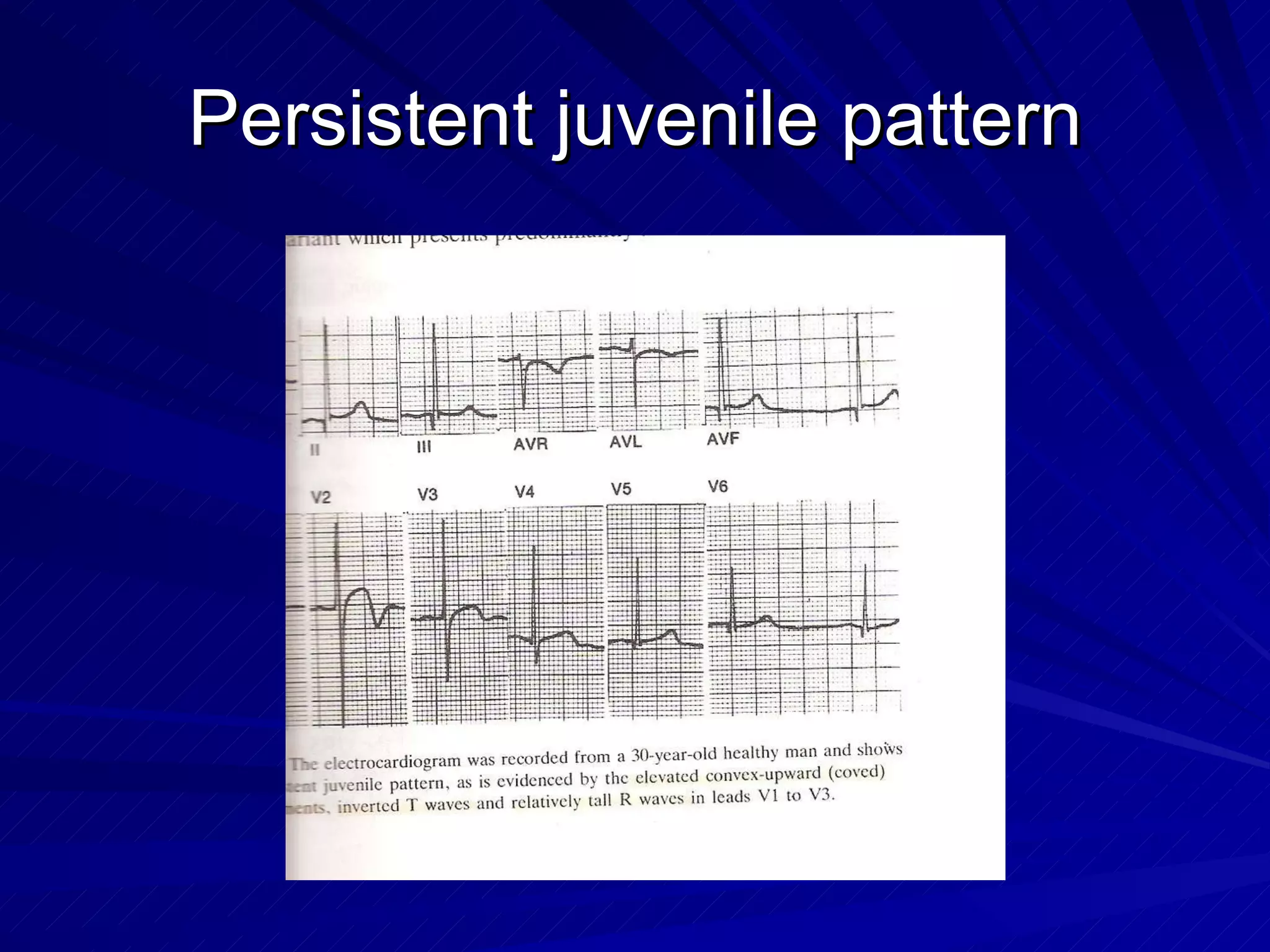
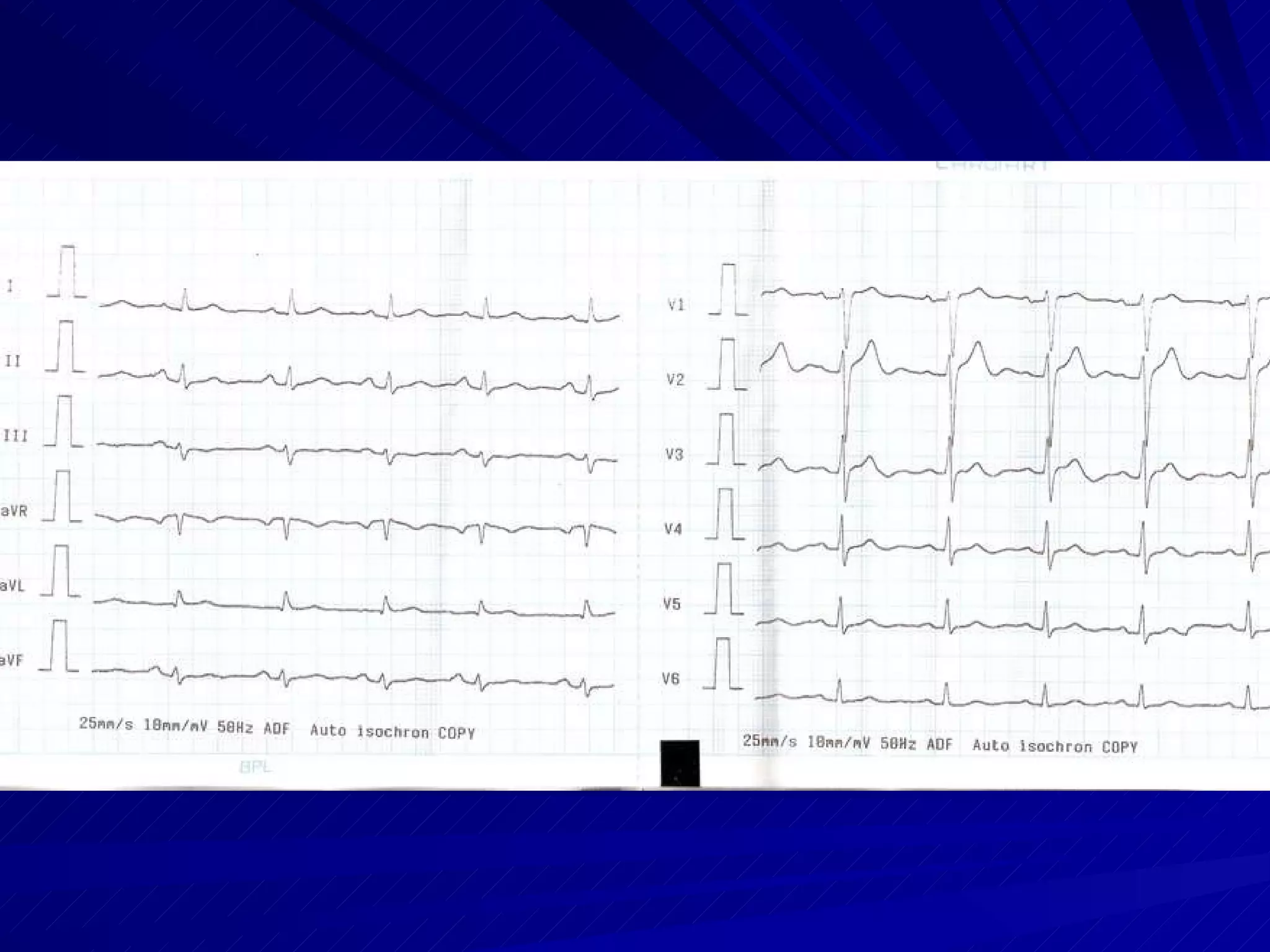
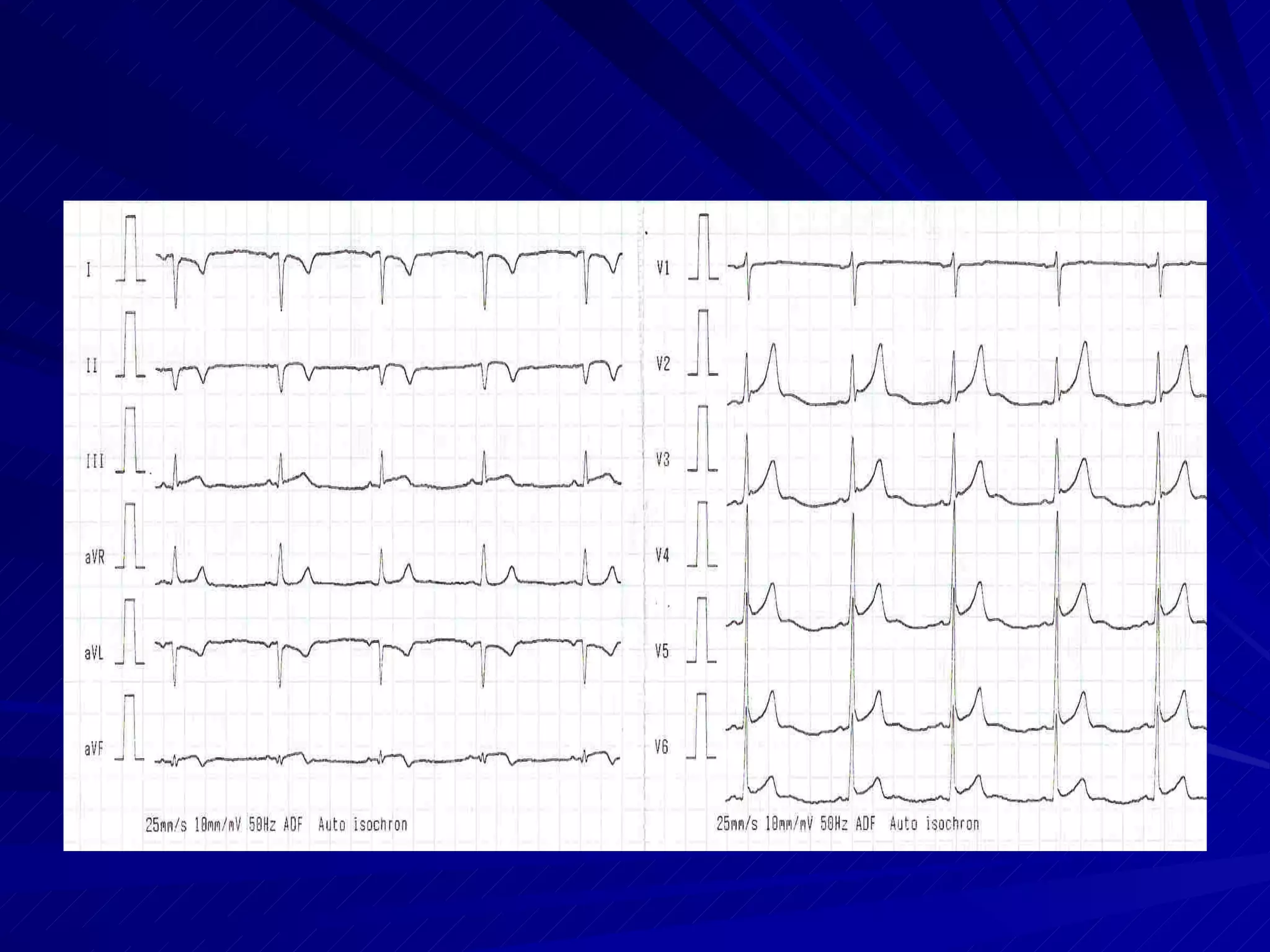
Sinus arrhythmia Persistent juvenile pattern Early repolarisation syndrome Non specific T wave changes
Persistent juvenile pattern
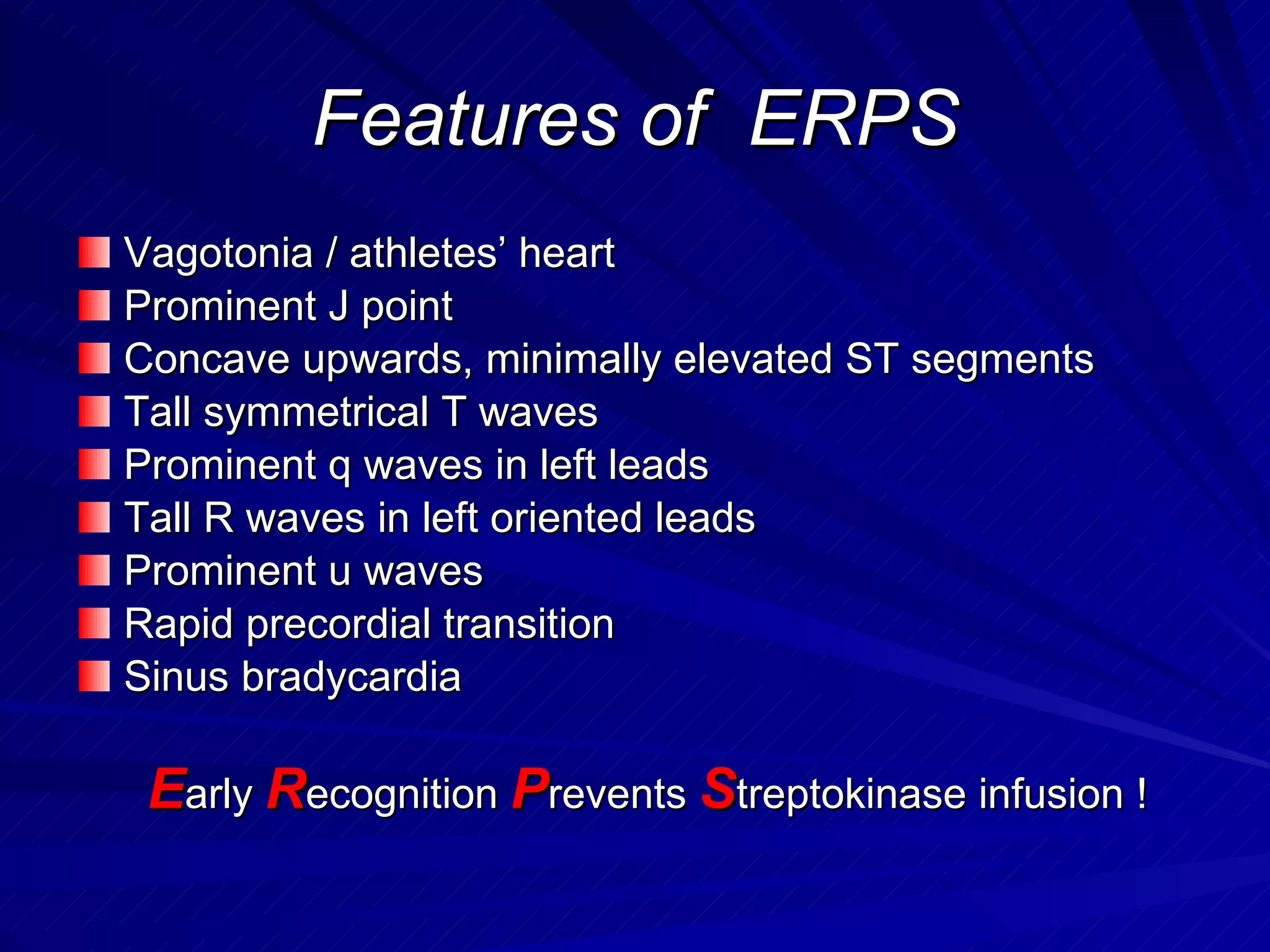
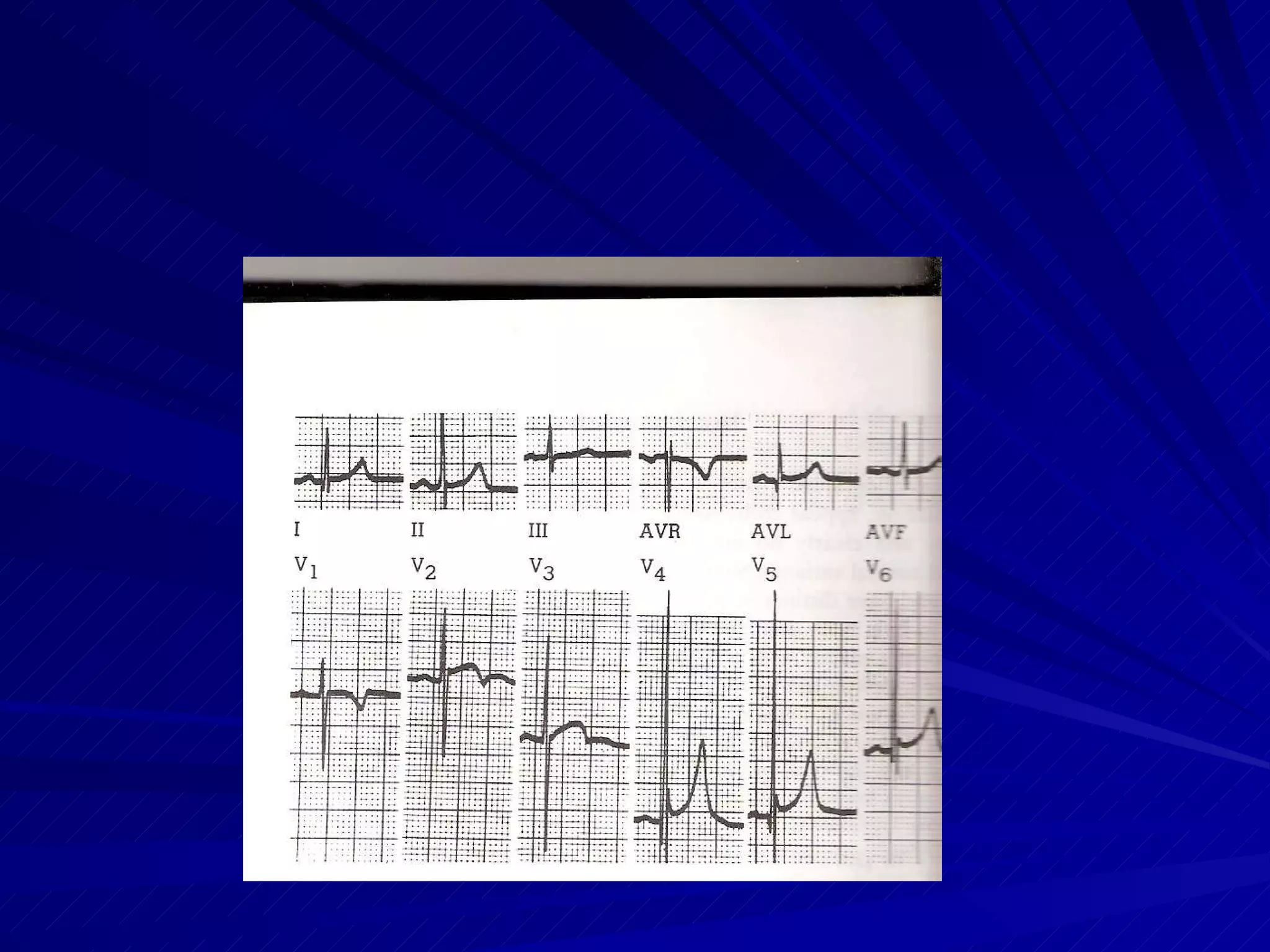
Features of  ERPS Vagotonia / athletes’ heart Prominent J point Concave upwards, minimally elevated ST segments Tall symmetrical T waves Prominent q waves in left leads Tall R waves in left oriented leads Prominent u waves Rapid precordial transition Sinus bradycardia E arly  R ecognition  P revents  S treptokinase infusion !
 
Reporting an ECG
1. Patient Details “ Whose ECG is it ?!”
2. Standardisation and lead placement “Is it properly taken ?”


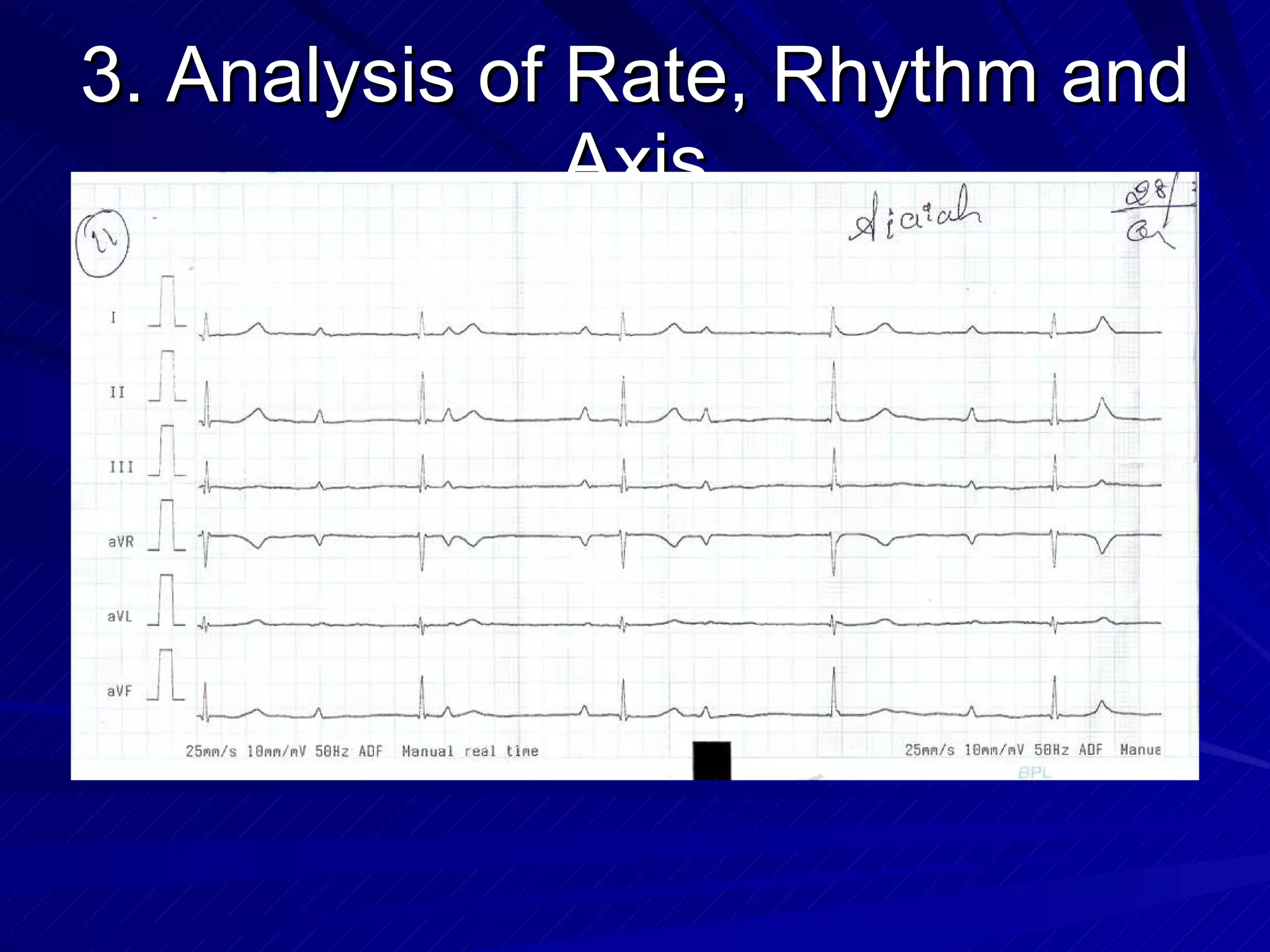
3. Analysis of Rate, Rhythm and Axis
 
 
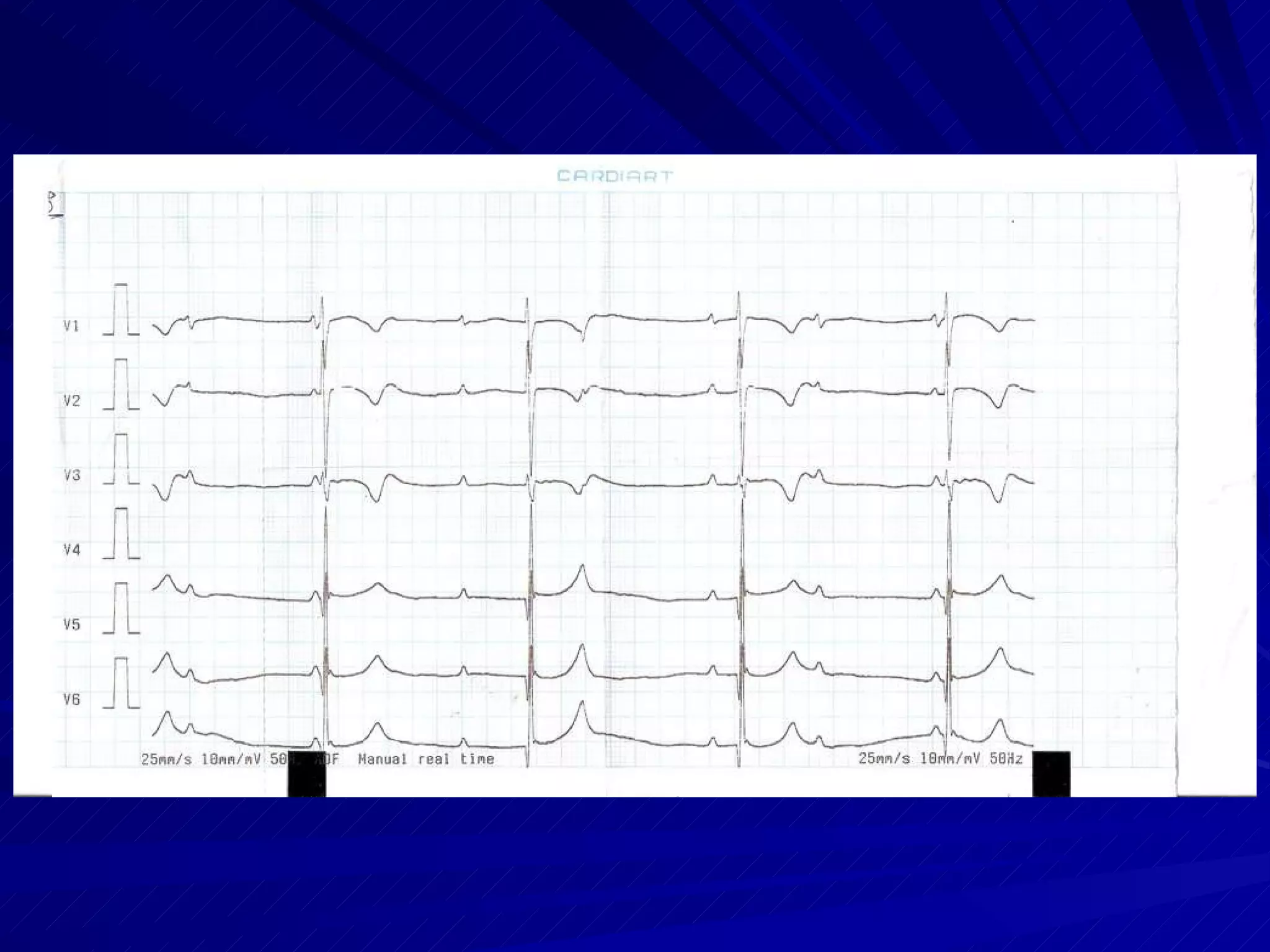
4. Segment and wave form analysis
 
 
5. Chamber enlargements
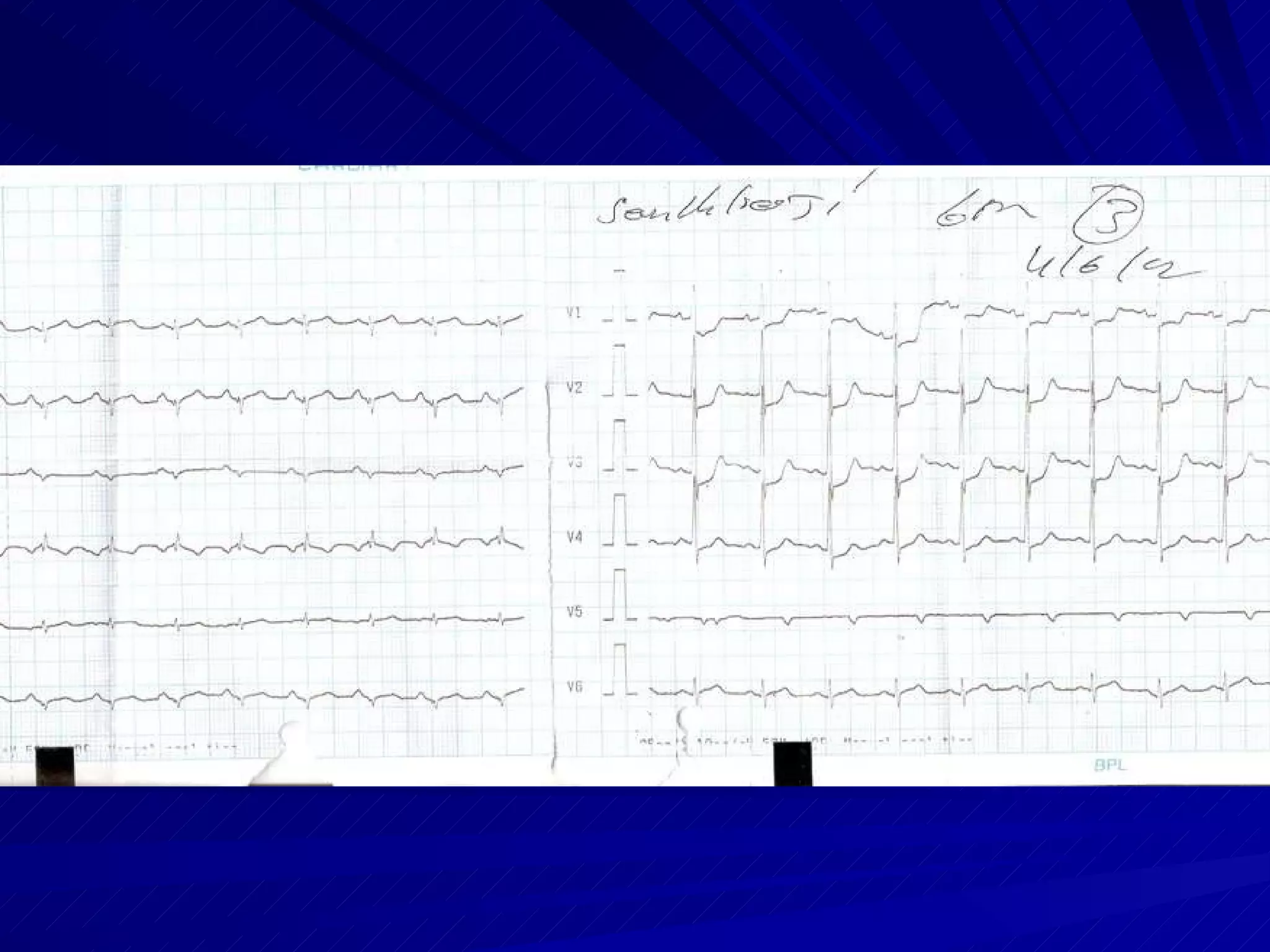
Final Impression “ Does the ECG correlate with the clinical scenario ?”
Thank you !

Basics of ECG.ppt dr.k.subramanyam

  • 1.
    Basics of ElectrocardiographyDr.K.Subramanyam 23-3-2009
  • 2.
    Outline Review ofthe conduction system ECG leads and recording ECG waveforms and intervals Normal ECG and its variants Interpretation and reporting of an ECG
  • 3.
  • 4.
    What is anECG? An ECG is the recording (gram) of the electrical activity(electro) generated by the cells of the heart(cardio) that reaches the body surface.
  • 5.
  • 6.
    Useful in diagnosisof… Cardiac Arrhythmias Myocardial ischemia and infarction Pericarditis Chamber hypertrophy Electrolyte disturbances Drug effects and toxicity
  • 7.
  • 8.
    Basics ECG graphs:1 mm squares 5 mm squares Paper Speed: 25 mm/sec standard Voltage Calibration: 10 mm/mV standard
  • 9.
    ECG Paper: Dimensions5 mm 1 mm 0.1 mV 0.04 sec 0.2 sec Speed = rate Voltage ~Mass
  • 10.
    ECG Leads Leadsare electrodes which measure the difference in electrical potential between either: 1. Two different points on the body (bipolar leads) 2. One point on the body and a virtual reference point with zero electrical potential, located in the center of the heart (unipolar leads)
  • 11.
    + - RARA LL + + - - LA LL LA LEAD II LEAD I LEAD III Remember, the RL is always the ground By changing the arrangement of which arms or legs are positive or negative, three unipolar leads (I, II & III ) can be derived giving three &quot;pictures&quot; of the heart's electrical activity from 3 angles. The Concept of a “Lead” Leads I, II, and III I II III
  • 12.
    ECG Leads Thestandard ECG has 12 leads: 3 Standard Limb Leads 3 Augmented Limb Leads 6 Precordial Leads The axis of a particular lead represents the viewpoint from which it looks at the heart.
  • 13.
    ECG LEADS GoldBerger :aV frontal leads Wilson & co-workwers :chest leads
  • 14.
  • 15.
  • 16.
  • 17.
    Summary of LeadsV 1 -V 6 aVR, aVL, aVF (augmented limb leads) Unipolar - I, II, III (standard limb leads) Bipolar Precordial Leads Limb Leads
  • 18.
    Limb Leads (Einthovenleads) Einthoven triangle Einthoven Rule I+II+III==0 I+(-II)+III=0 I+III=II
  • 19.
  • 20.
  • 21.
  • 22.
  • 23.
  • 24.
  • 25.
  • 26.
    Localising the arterialterritory Inferior II, III, aVF Lateral I, AVL, V5-V6 Anterior / Septal V1-V4
  • 27.
    Standard sites unavailablePatient pathology Amputation or burns or bandages  should be placed as closely as possible to the standard sites
  • 28.
    Specific cardiac abnormalitiesSitus inversus dextrocardia  right & left arm electrodes should be reversed pre-cordial leads should be recorded from V1R(V2) to V6 RVH & RV infarction:V3R & V4R
  • 29.
    Continuous monitoring Bedside: Holter monitoring: TMT: Mason Likar system
  • 30.
    Other practical pointsElectrodes should be selected for maximum adhesiveness and minimum discomfort,electrical noise,and skin-electrode impedance Effective contact between electrode and skin is essential. ECG :calibration
  • 31.
    ECG :paper speedElectrical artifacts:external or internal external can be minimized by straightening the lead wires internal can be due to muscle tremors,shivering ,hiccoughs . Supine position
  • 32.
  • 33.
    Steps involved HeartRate Rhythm Axis Wave morphology Intervals and segments analysis Chamber enlargement Specific changes
  • 34.
  • 35.
    Determining the HeartRate Rule of 300 10 Second Rule
  • 36.
    Rule of 300Take the number of “big boxes” between neighboring QRS complexes, and divide this into 300. The result will be approximately equal to the rate Although fast, this method only works for regular rhythms.
  • 37.
    The Rule of300 It may be easiest to memorize the following table: 50 6 60 5 75 4 100 3 150 2 300 1 Rate # of big boxes
  • 38.
  • 39.
    10 Second RuleAs most ECGs record 10 seconds of rhythm per page, one can simply count the number of beats present on the ECG and multiply by 6 to get the number of beats per 60 seconds. This method works well for irregular rhythms.
  • 40.
  • 41.
    Genesis of QRSInitially there is a small vector from left to right through the IVS ,followed by a larger vector from right to left through the free wall of the LV
  • 42.
  • 43.
  • 44.
    Effect of leftoriented lead Small septal vector ,directed away from the positive pole resulting in a small q wave Larger vector of the free wall ,directed towards the positive pole resulting in a tall R wave
  • 45.
  • 46.
    Effect of rightoriented lead Small septal vector which is directed towards the positive pole,hence a small r wave Large vector of free LV wall which is directed away from the lead and hence a large s wave
  • 47.
    Transition zone Transitionfrom rS to qR pattern which is usually seen in V3 /V4
  • 48.
    Rotation of theheart Around AP axis;here the axis runs through the IVS from the ant to post surface of the heart Horizontal position;main body of the LV is oriented upwards and to the left:towards leads I and avL(left axis) Vertical position;main body of the LV is oriented to leads II and avF(right and inferior)
  • 49.
  • 50.
  • 51.
    Around oblique axis;theaxis runs through the IVS from apex to base Anatomical rotation  clock-wise and counter clock wise rotation
  • 52.
    Counter clock-wise  more anterior position of LV Results in transition zone shifting to left
  • 53.
  • 54.
    Clock wise rotation;hereth RV assumes a more anterior position so that the IVS lay parallel to the chest wall There is a shift of the transition zone to the right
  • 55.
  • 56.
  • 57.
    The QRS AxisThe QRS axis represents the net overall direction of the heart’s electrical activity. Abnormalities of axis can hint at: Ventricular enlargement Conduction blocks (i.e. hemiblocks)
  • 58.
  • 59.
    The QRS AxisBy near-consensus, the normal QRS axis is defined as ranging from -30 ° to +90 ° . -30 ° to -90 ° is referred to as a left axis deviation (LAD) +90 ° to +180 ° is referred to as a right axis deviation (RAD)
  • 60.
  • 61.
    Determining the AxisThe Quadrant Approach The Equiphasic Approach
  • 62.
    Determining the AxisPredominantly Positive Predominantly Negative Equiphasic
  • 63.
    The Quadrant Approach1. Examine the QRS complex in leads I and aVF to determine if they are predominantly positive or predominantly negative. The combination should place the axis into one of the 4 quadrants below.
  • 64.
  • 65.
    Example 1 Negativein I, positive in aVF  RAD
  • 66.
    Example 2 Positivein I, negative in aVF  Predominantly positive in II  Normal Axis (non-pathologic LAD)
  • 67.
  • 68.
    Example 1 Equiphasicin aVF  Predominantly positive in I  QRS axis ≈ 0°
  • 69.
    Example 2 Equiphasicin II  Predominantly negative in aVL  QRS axis ≈ +150°
  • 70.
    Using leads I,II, III NEGATIVE NEGATIVE UPRIGHT Pathological Left Axis UPRIGHT UPRIGHT BIPHASIC NEGATIVE NEGATIVE Right Axis NEGATIVE NEGATIVE NEGATIVE Extreme Right Axis NEGATIVE UPRIGHT / BIPHASIC UPRIGHT Physiological Left Axis UPRIGHT UPRIGHT UPRIGHT Normal LEAD 3 LEAD 2 LEAD 1
  • 71.
    Common causes ofLAD May be normal in the elderly and very obese Due to high diaphragm during pregnancy, ascites, or ABD tumors Inferior wall MI Left Anterior Hemiblock Left Bundle Branch Block WPW Syndrome Congenital Lesions RV Pacer or RV ectopic rhythms Emphysema
  • 72.
    Common causes ofRAD Normal variant Right Ventricular Hypertrophy Anterior MI Right Bundle Branch Block Left Posterior Hemiblock Left Ventricular ectopic rhythms or pacing WPW Syndrome
  • 73.
    The Normal ECGDr.K.Subramanyam 30-3-2009
  • 74.
    Normal Sinus RhythmOriginates in the sinus node Rate between 60 and 100 beats per min P wave axis of +45 to +65 degrees, ie. Tallest p waves in Lead II Monomorphic P waves Normal PR interval of 120 to 200 msec Normal relationship between P and QRS Some sinus arrhythmia is normal
  • 75.
  • 76.
    Sinus Arrhythmia ECGCharacteristics: Presence of sinus P waves Variation of the PP interval which cannot be attributed to either SA nodal block or PACs When the variations in PP interval occur in phase with respiration, this is considered to be a normal variant. When they are unrelated to respiration, they may be caused by the same etiologies leading to sinus bradycardia.
  • 77.
    Normal P waveAtrial depolarisation Duration 80 to 100 msec Maximum amplitude 2.5 mm Axis +45 to +65 Biphasic in lead V1 Terminal deflection should not exceed 1 mm in depth and 0.03 sec in duration
  • 78.
  • 79.
    P’ wave Resultsin negative wave form in leads II,III and avF Axis;-80 to -90 Retrograde activation of atria due to impulse arising from or passing through AV node
  • 80.
    Dome & dartp wave Low left atrial rhythm Initial dome-like deflexion and a terminal sharp & spike like deflexion
  • 81.
    Normal QRS complexCompletely negative in lead aVR , maximum positivity in lead II rS in right oriented leads and qR in left oriented leads (septal vector) Transition zone commonly in V3-V4 RV5 > RV6 normally Normal duration 50-110 msec, not more than 120 msec Physiological q wave not > 0.03 sec
  • 82.
  • 83.
    ECG showing qRpattern in lead III ,disappears on deep inspiration  q wave not significant Mech:shift in the QRS axis
  • 84.
    QRS-T angle Thenormal t wave axis is similar to the QRS axis Normally the QRS-T angle does not exceed 60 deg
  • 85.
    Amplitude of QRSDepends on the following factors 1.electrical force generated by the ventricular myocardium 2.distance of the sensing electrode from the ventricles
  • 86.
    3.Body build;a thinindividual has larger complexes when compared to obese individuals 4.direction of the frontal QRS axis
  • 87.
    Normal T waveSame direction as the preceding QRS complex Blunt apex with asymmetric limbs Height < 5mm in limb leads and <10 mm in precordial leads Smooth contours May be tall in athletes
  • 88.
  • 89.
    ST segment Mergessmoothly with the proximal limb of the T wave No true horizontality
  • 90.
  • 91.
    Normal u waveBest seen in midprecordial leads Height < 10% of preceding T wave Isoelectric in lead aVL (useful to measure QTc) Rarely exceeds 1 mm in amplitude May be tall in athletes (2mm)
  • 92.
  • 93.
    QT interval Normallycorrected for heart rate Bazett’s formula Normal 350 to 430 msec With a normal heart rate (60 to 100), the QT interval should not exceed half of the R-R interval roughly
  • 94.
  • 95.
    Measurement of QTinterval The beginning of the QRS complex is best determined in a lead with an initial q wave  leads I,II, avL ,V5 or V6 QT interval shortens with tachycardia and lengthens with bradycardia
  • 96.
    Prolonged QTc Duringsleep Hypocalcemia Ac myocarditis AMI Drugs like quinidine,procainamide,tricyclic antidepressants Hypothermia HOCM
  • 97.
    Advanced AV blockor high degree AV block Jervell-Lange –Neilson syndrome Romano-ward syndrome
  • 98.
    Shortened QT Digitalis effect Hypercalcemia Hyperthermia Vagal stimulation
  • 99.
    Normal standardization 1mV=10 mm Will result in perfect right angles at each corner
  • 100.
    overdamping When thepressure of the stylus is too firm on the paper so that it’s movements are retarded The ecg deflexions are inscribed more slowly so that they become fractionally wider Results in diminished amplitude of deflexions  a small s wave may disappear
  • 101.
    Underdamping or overshootWhen the writing stylus is not pressed firmly enough against the paper Results in overshoot of the upswing and downswing of the writing stylus,resulting in sharp spikes at the corners Effects:deflexions are inscribed more rapidly  resulting in fractionally narrower complexes
  • 102.
    The ecg deflexionsmay be increased in amplitude . An s wave becomes exaggerated
  • 103.
  • 104.
    Sinus arrhythmia Persistentjuvenile pattern Early repolarisation syndrome Non specific T wave changes
  • 105.
  • 106.
    Features of ERPS Vagotonia / athletes’ heart Prominent J point Concave upwards, minimally elevated ST segments Tall symmetrical T waves Prominent q waves in left leads Tall R waves in left oriented leads Prominent u waves Rapid precordial transition Sinus bradycardia E arly R ecognition P revents S treptokinase infusion !
  • 107.
  • 108.
  • 109.
    1. Patient Details“ Whose ECG is it ?!”
  • 110.
    2. Standardisation andlead placement “Is it properly taken ?”
  • 111.
  • 112.
  • 113.
  • 114.
  • 115.
    3. Analysis ofRate, Rhythm and Axis
  • 116.
  • 117.
  • 118.
    4. Segment andwave form analysis
  • 119.
  • 120.
  • 121.
  • 122.
    Final Impression “Does the ECG correlate with the clinical scenario ?”
  • 123.

Editor's Notes