E. Coli
Course Title : Pharmaceutical Microbiology
Course Code : BPH 2013
Presented to
Md. Mosiqur Rahman
Senior Lecturer, Southeast University
Contains…
‣ Escherichia coli
‣ Gram Negative Bacteria
‣ What Good Are E. coli? & Bad
E. coli?
‣ Physiology and Structure
‣ Characters
‣ Common virulence factors
‣ Types of Pathogenic E. coli
‣ Pathogenic Strains
‣ Morphology
‣ Culture characteristics of E. coli
‣ Diseases caused by E. coli
‣ Diagnosis
‣ Treatment, Prevention, and Control
‣ E.Coli Genome
‣ E.coli growth culture
‣ IMVIC Reactions for E. coli
‣ E. Coli Urinary Tract Infections
(UTIs)
‣ E.coli Meningitis
‣ E. coli Bacteremia
‣ Gastrointestinal Infections
‣ Laboratory Diagnosis
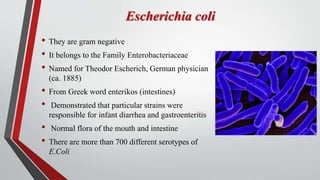
Escherichia coli
• They are gram negative
• It belongs to the Family Enterobacteriaceae
• Named for Theodor Escherich, German physician
(ca. 1885)
• From Greek word enterikos (intestines)
• Demonstrated that particular strains were
responsible for infant diarrhea and gastroenteritis
• Normal flora of the mouth and intestine
• There are more than 700 different serotypes of
E.Coli
Gram Negative Bacteria
Gram-negative bacteria are a group of bacteria that do
not retain the crystal violet stain used in the Gram
staining method of bacterial differentiation, making
positive identification possible.
• Gram positive appears purple.
• Gram-negative bacteria have a cytoplasmic membrane, a thin
peptidoglycan layer, and an outer membrane containing
lipopolysaccharide.
• The difference between Gram negative and Gram positive
bacteria is the cell wall structure, which accounts for the
different staining characteristics
What Good Are E. coli?
• Aids in digestion
• Produces our main source of vitamins B12 and K
• Lives symbiotically with us
Bad E. coli
• While most E. coli are good for you, there are a few strains of E. coli that are
harmful.
• ~ 5 billion bacteria are there in your intestine alone, most notorious strains of
E coli
• produces toxin and causes diarrhea, urinary tract infections and other
intestinal
• complications.
Physiology and Structure
• Gram-negative, facultative anaerobic rods
• Fermenter; oxidase negative
• Outer membrane makes the organisms susceptible to drying
• Lipopolysaccharide consists of outer somatic O polysaccharide, core
polysaccharide (common antigen), and lipid A (endotoxin)
Characters
• Most significant species in the family and important potential pathogen in
human and common isolate from colon flora.
• Most common cause of opportunistic infections.
• When grow on blood agar and are hemolytic, a feature uncommon in other
enterobacteriaceae members.
• Have three common antigens O, H, and K antigen.
Common virulence factors
• Endotoxin (Lipid A of LPS).
• Capsule.
• Pili.
• Enterotoxins.
• Antigenic phase variation.
• Acquisition of growth factors.
• Resistance to serum killing.
• Antimicrobial resistance by resistance plasmids
Types of Pathogenic E. coli
Two distinct types of pathogenic E. coli are recognized (genetically diverse):
• One group commonly called extra-intestinal, pathogenic E. coli (ExPEC)
includes those E.coli associated with newborn meningitis (NBM or sepsis and
UTIs). 6
• The second group termed intestinal pathogenic E. coli (IPEC) includes E. coli
responsible for a range of distinct classes of diarrheal disease.
Pathogenic Strains
• Enterohaemorrhagic E. coli (EHEC)
• Enterotoxigenic E. coli (ETEC)
• Enteroinvasive E. coli (EIEC)
• Enteropathogenic E. coli (EPEC)
Morphology
• Usually motile, produce peritrichous flagella
• Some produce polysaccharide capsules
• Grow well on nonselective media, forming
smooth, colourless colonies 2-3 mm in diameter
in 18h on nutrient agar
• Temperature (15-45℃)
Culture characteristics of E. coli
• N.agar – circular, convex, small
colonies
• MacConkey medium– rose pink
• Eosin Methylene blue – Metallic
sheen colonies
Diseases caused by E. coli
Diseases caused by Escherichia coli in the presence of virulence factors include
the following:
• Most common causes of UTI about 90%, particularly in women.
• Diarrhea.
• Urinary tract infection.
• Neonatal meningitis.
• Gram-negative sepsis, occurring commonly in debilitated hospitalized
patients.
Diagnosis
• Organisms grow rapidly on most culture media
• Enteric pathogens with the exception of EHEC are detected only in reference or
research laboratories
Treatment, Prevention, and Control
• Enteric pathogens are treated symptomatically unless disseminated disease occurs
• Antibiotic therapy is guided by in vitro susceptibility tests
• Appropriate infection-control practices are used to reduce the risk of nosocomial
infections
• Maintenance of high hygienic standards to reduce the risk of exposure to
gastroenteritis strains
• Proper cooking of beef products to reduce risk of EHEC infections
E.Coli Genome
• The E. coli genome has only 4.6 million bp and
about 4300 genes.
• Humans have thousand times larger
approximately 3 billion bp and 20,000 to 25,000
genes.
• E.coli genome was completely sequenced in
1997 thus making it advantageous for analysis.
E.coli growth culture
• They can grow in even simple nutrient media containing only salts, a source
of nitrogen and source of carbon and energy. Division time (40 minutes)
normal 20 minutes.
• From the bacterial colony the mutants can be selected and analyzed easily.
• Biosynthetic reaction in simple media aids in study of biochemical path ways.
• E.coli in McConkey media gives pink color since it digests lactose.
IMVIC Reactions for E. coli
• Indole (+).
• Methyl red (+).
• Voges-Proskauer (-).
• Citrate (-).
E. Coli Urinary Tract Infections (UTIs)
E. coli infect the bladder (cystitis).
E. coli infect the kidney itself (pyelonephritis).
The acquisition of a pili virulence factor allows E. coli to travel up the urethra and
infect the bladder (cystitis) and sometimes move further up to infect the kidney itself
(pyelonephritis).
E. coli is the most common cause of urinary tract infections, which usually occur in
women and hospitalized patients with catheters in the urethra.
Symptoms
• Symptoms include the following:
• Burning on urination (dysuria).
• Having to pee frequently (frequency).
• Feeling of fullness over the bladder.
E.coli Meningitis
E. Coli is the second most common cause of neonatal meningitis (group B
streptococcus is first).
The majority of cases caused by a capsular antigen called K1.
The colonization of the newborn's intestines with these strains, that are
present in the mother's vagina, lead to bacteremia, which leads to
meningitis.
E. coli Bacteremia
Escherichia coli is also the most common cause of gram-negative sepsis.
This usually occurs in debilitated hospitalized patients. Septic shock due to the
lipid A component of the LPS is usually the cause of death.
Gastrointestinal Infections
• Enterotoxigenic (ETEC): “traveler’s diarrhea”; watery diarrhea without
blood; self-limiting; usually not identified.
• Enteropathogenic (EPEC): primarily in infants and children; outbreaks in
hospital nurseries and day care centers; stool has mucous but not blood;
identified by serotyping.
• Enteroinvasive (EIEC): produce dysentery with bowel penetration,invasion
and destruction of intestinal mucosa; watery diarrhea with blood.
Continue…
• Enterohemorrhagic (serotype 0157:H7): associated with:
Hemorrhagic diarrhea sometime called cucumber E coli.
Hemolytic-uremic syndrome (HUS), which includes low platelet count,
hemolytic anemia, and kidney failure;
Fatal, especially in young children, associated with undercooked hamburger,
unpasteurized milk and some vegetables at fast-food restaurants.
• Enteroaggregative (EaggEC): cause diarrhea by adhering to the mucosal
surface of the intestine; watery diarrhea; symptoms may persist for over two
weeks.
Laboratory Diagnosis
• Specimens: according to disease e.g. urine, CSF, pus.
• Culture: MacConkey’s agar plate.
• Identification: by sugar fermentation tests and IMVIC formula.
E. coli

E. coli

  • 1.
    E. Coli Course Title: Pharmaceutical Microbiology Course Code : BPH 2013 Presented to Md. Mosiqur Rahman Senior Lecturer, Southeast University
  • 2.
    Contains… ‣ Escherichia coli ‣Gram Negative Bacteria ‣ What Good Are E. coli? & Bad E. coli? ‣ Physiology and Structure ‣ Characters ‣ Common virulence factors ‣ Types of Pathogenic E. coli ‣ Pathogenic Strains ‣ Morphology ‣ Culture characteristics of E. coli ‣ Diseases caused by E. coli ‣ Diagnosis ‣ Treatment, Prevention, and Control ‣ E.Coli Genome ‣ E.coli growth culture ‣ IMVIC Reactions for E. coli ‣ E. Coli Urinary Tract Infections (UTIs) ‣ E.coli Meningitis ‣ E. coli Bacteremia ‣ Gastrointestinal Infections ‣ Laboratory Diagnosis
  • 3.
    Escherichia coli • Theyare gram negative • It belongs to the Family Enterobacteriaceae • Named for Theodor Escherich, German physician (ca. 1885) • From Greek word enterikos (intestines) • Demonstrated that particular strains were responsible for infant diarrhea and gastroenteritis • Normal flora of the mouth and intestine • There are more than 700 different serotypes of E.Coli
  • 4.
    Gram Negative Bacteria Gram-negativebacteria are a group of bacteria that do not retain the crystal violet stain used in the Gram staining method of bacterial differentiation, making positive identification possible. • Gram positive appears purple. • Gram-negative bacteria have a cytoplasmic membrane, a thin peptidoglycan layer, and an outer membrane containing lipopolysaccharide. • The difference between Gram negative and Gram positive bacteria is the cell wall structure, which accounts for the different staining characteristics
  • 5.
    What Good AreE. coli? • Aids in digestion • Produces our main source of vitamins B12 and K • Lives symbiotically with us Bad E. coli • While most E. coli are good for you, there are a few strains of E. coli that are harmful. • ~ 5 billion bacteria are there in your intestine alone, most notorious strains of E coli • produces toxin and causes diarrhea, urinary tract infections and other intestinal • complications.
  • 6.
    Physiology and Structure •Gram-negative, facultative anaerobic rods • Fermenter; oxidase negative • Outer membrane makes the organisms susceptible to drying • Lipopolysaccharide consists of outer somatic O polysaccharide, core polysaccharide (common antigen), and lipid A (endotoxin)
  • 7.
    Characters • Most significantspecies in the family and important potential pathogen in human and common isolate from colon flora. • Most common cause of opportunistic infections. • When grow on blood agar and are hemolytic, a feature uncommon in other enterobacteriaceae members. • Have three common antigens O, H, and K antigen.
  • 8.
    Common virulence factors •Endotoxin (Lipid A of LPS). • Capsule. • Pili. • Enterotoxins. • Antigenic phase variation. • Acquisition of growth factors. • Resistance to serum killing. • Antimicrobial resistance by resistance plasmids
  • 9.
    Types of PathogenicE. coli Two distinct types of pathogenic E. coli are recognized (genetically diverse): • One group commonly called extra-intestinal, pathogenic E. coli (ExPEC) includes those E.coli associated with newborn meningitis (NBM or sepsis and UTIs). 6 • The second group termed intestinal pathogenic E. coli (IPEC) includes E. coli responsible for a range of distinct classes of diarrheal disease.
  • 10.
    Pathogenic Strains • EnterohaemorrhagicE. coli (EHEC) • Enterotoxigenic E. coli (ETEC) • Enteroinvasive E. coli (EIEC) • Enteropathogenic E. coli (EPEC)
  • 11.
    Morphology • Usually motile,produce peritrichous flagella • Some produce polysaccharide capsules • Grow well on nonselective media, forming smooth, colourless colonies 2-3 mm in diameter in 18h on nutrient agar • Temperature (15-45℃)
  • 12.
    Culture characteristics ofE. coli • N.agar – circular, convex, small colonies • MacConkey medium– rose pink • Eosin Methylene blue – Metallic sheen colonies
  • 13.
    Diseases caused byE. coli Diseases caused by Escherichia coli in the presence of virulence factors include the following: • Most common causes of UTI about 90%, particularly in women. • Diarrhea. • Urinary tract infection. • Neonatal meningitis. • Gram-negative sepsis, occurring commonly in debilitated hospitalized patients.
  • 14.
    Diagnosis • Organisms growrapidly on most culture media • Enteric pathogens with the exception of EHEC are detected only in reference or research laboratories Treatment, Prevention, and Control • Enteric pathogens are treated symptomatically unless disseminated disease occurs • Antibiotic therapy is guided by in vitro susceptibility tests • Appropriate infection-control practices are used to reduce the risk of nosocomial infections • Maintenance of high hygienic standards to reduce the risk of exposure to gastroenteritis strains • Proper cooking of beef products to reduce risk of EHEC infections
  • 15.
    E.Coli Genome • TheE. coli genome has only 4.6 million bp and about 4300 genes. • Humans have thousand times larger approximately 3 billion bp and 20,000 to 25,000 genes. • E.coli genome was completely sequenced in 1997 thus making it advantageous for analysis.
  • 16.
    E.coli growth culture •They can grow in even simple nutrient media containing only salts, a source of nitrogen and source of carbon and energy. Division time (40 minutes) normal 20 minutes. • From the bacterial colony the mutants can be selected and analyzed easily. • Biosynthetic reaction in simple media aids in study of biochemical path ways. • E.coli in McConkey media gives pink color since it digests lactose.
  • 17.
    IMVIC Reactions forE. coli • Indole (+). • Methyl red (+). • Voges-Proskauer (-). • Citrate (-).
  • 18.
    E. Coli UrinaryTract Infections (UTIs) E. coli infect the bladder (cystitis). E. coli infect the kidney itself (pyelonephritis). The acquisition of a pili virulence factor allows E. coli to travel up the urethra and infect the bladder (cystitis) and sometimes move further up to infect the kidney itself (pyelonephritis). E. coli is the most common cause of urinary tract infections, which usually occur in women and hospitalized patients with catheters in the urethra. Symptoms • Symptoms include the following: • Burning on urination (dysuria). • Having to pee frequently (frequency). • Feeling of fullness over the bladder.
  • 19.
    E.coli Meningitis E. Coliis the second most common cause of neonatal meningitis (group B streptococcus is first). The majority of cases caused by a capsular antigen called K1. The colonization of the newborn's intestines with these strains, that are present in the mother's vagina, lead to bacteremia, which leads to meningitis.
  • 20.
    E. coli Bacteremia Escherichiacoli is also the most common cause of gram-negative sepsis. This usually occurs in debilitated hospitalized patients. Septic shock due to the lipid A component of the LPS is usually the cause of death.
  • 21.
    Gastrointestinal Infections • Enterotoxigenic(ETEC): “traveler’s diarrhea”; watery diarrhea without blood; self-limiting; usually not identified. • Enteropathogenic (EPEC): primarily in infants and children; outbreaks in hospital nurseries and day care centers; stool has mucous but not blood; identified by serotyping. • Enteroinvasive (EIEC): produce dysentery with bowel penetration,invasion and destruction of intestinal mucosa; watery diarrhea with blood.
  • 22.
    Continue… • Enterohemorrhagic (serotype0157:H7): associated with: Hemorrhagic diarrhea sometime called cucumber E coli. Hemolytic-uremic syndrome (HUS), which includes low platelet count, hemolytic anemia, and kidney failure; Fatal, especially in young children, associated with undercooked hamburger, unpasteurized milk and some vegetables at fast-food restaurants. • Enteroaggregative (EaggEC): cause diarrhea by adhering to the mucosal surface of the intestine; watery diarrhea; symptoms may persist for over two weeks.
  • 23.
    Laboratory Diagnosis • Specimens:according to disease e.g. urine, CSF, pus. • Culture: MacConkey’s agar plate. • Identification: by sugar fermentation tests and IMVIC formula.