Department of microbiology & immunology

Faculty of pharmacy

Ain-Shams university


Plasmodium falciparum


Aya Ahmed Saber yosif

86
Introduction:


* Malaria is caused by one of four species of Plasmodium (falciparum, vivax, malariae
and ovale).

*Of these P. falciparum is the most lethal being estimated to cause 200 million clinical
 cases, and 1-3 million deaths (including many children) every year world-wide


*Plasmodium falciparum:


*is a protozoan parasite, one of the species of Plasmodium that cause malaria in
humans.

*It is transmitted by the female Anopheles mosquito.

*also called malignant

* is the most dangerous form of malaria with the highest rates of complications and
mortality.

*As of 2006 there were an estimated 247 million human malarial infections (98% in
Africa, 85% being 5 years or younger).[4

* It is much more prevalent in sub-Saharan Africa than in other regions of the world; in
most African countries, more than 75% of cases were due to P. falciparum, whereas in
most other countries with malaria transmission, other less virulent Plasmodial species
predominate. Almost all global malarial deaths are caused by P. falciparum.
History

*The organism itself was first seen by Laveran on November 6, 1880 at a military
hospital in Constantine, Algeria, when he discovered a microgametocyte exflagellating.

*In 1885, similar organisms were discovered within the blood of birds in Russia. There
was brief speculation that birds might be involved in the transmission of malaria.

*in 1894 Patrick Manson hypothesized that mosquitoes could transmit malaria. This
hypothesis was independently confirmed by the Italian physician Giovanni Battista
Grassi working in Italy and the British physician Ronald Ross working in India, both in
1898.

*Ross demonstrated the existence of Plasmodium in the wall of the midgut and salivary
glands of a Culex mosquito using bird species as the vertebrate host.

* For this discovery he won the Nobel Prize in 1902.

*Grassi showed that human malaria could only be transmitted by Anopheles
mosquitoes.
Pathogenesis

*Plasmodium falciparum causes severe malaria via a distinctive property not shared by
any other human malaria, that of sequestration.

* Within the 48-hour asexual blood stage cycle, the mature forms change the surface
properties of infected red blood cells causing them to stick to blood vessels (a process
called cytoadherence).

*This leads to obstruction of the microcirculation and results in dysfunction of multiple
organs, typically the brain in cerebral malaria.


                  Clinical picture ( Symptoms )

*Malarial attacks present over 4 to 6 hours with shaking chills, high fever, and sweating,
and are often associated with fatigue, headache, dizziness, nausea, vomiting, abdominal
cramps, dry cough, muscle or joint pain, and back ache.

*The attacks may occur every other day or every third day

*Cerebral malaria and death can occur, sometimes within 24 hours, if the infection is
caused by plasmodium falciparum .


                          Diagnosis of Malaria


 Methods of diagnosis are

1-complete medical history of symptoms and travel

2-physical examination

3-blood tests, including: thick and thin blood films, to identify the plasmodium species
responsible for infection and for detection of schizonts,gametocytes& ring stage
Plasmodium life cycle

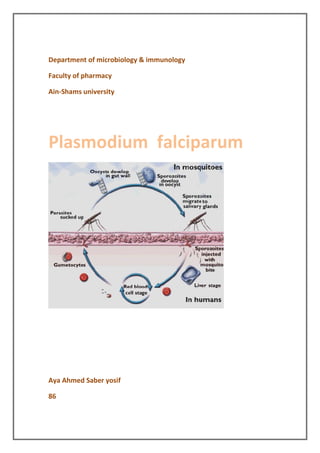
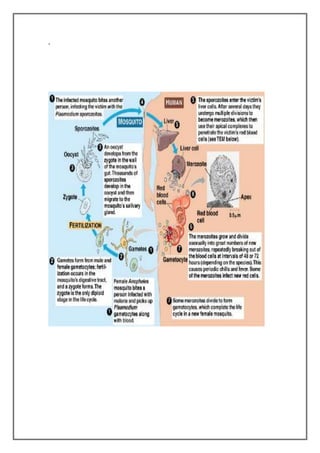
The life cycle of all Plasmodium species is complex.

1- Infection in humans begins with the bite of an infected female Anopheline mosquito.

2-Sporozoites released from the salivary glands of the mosquito enter the bloodstream
during feeding, quickly invading liver cells (hepatocytes).

3-Sporozoites are cleared from the circulation within 30 minutes.

4- During the next 14 days in the case of P. falciparum, the liver-stage parasites
differentiate and undergo asexual multiplication resulting in tens of thousands of
merozoites which burst from the hepatocyte.

5-Individual merozoites invade red blood cells (erythrocytes) and undergo an additional
round of multiplication producing 12-16 merozoites within a schizont. The length of this
erythrocytic stage is 48 hours for P. falciparum (((The clinical manifestations of
malaria, fever and chills, are associated with the synchronous rupture of the infected
erythrocyte))).

6- The released merozoites go on to invade additional erythrocytes.

7- Not all of the merozoites divide into schizonts, some differentiate into sexual forms,
male and female gametocytes.

7-These gametocytes are taken up by a female anophylean mosquito during a blood
meal.

8- Within the mosquito midgut, the male gametocyte undergoes a rapid nuclear division,
producing 8 flagellated microgametes which fertilize the female macrogamete.

9- The resulting ookinete traverses the mosquito gut wall and encysts on the exterior of
the gut wall as aoocyst.

10-Soon the oocyst ruptures, releasing hundreds of sporozoites into the mosquito body
cavity where they eventually migrate to the mosquito salivary gland
Morphology
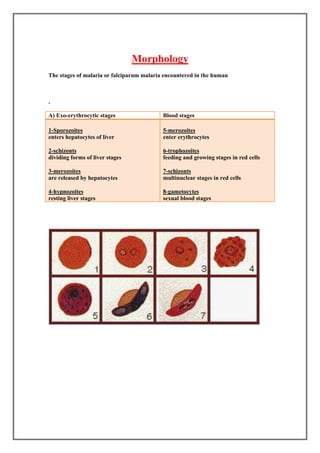
The stages of malaria or falciparum malaria encountered in the human


A) Exo-erythrocytic stages                 Blood stages

1-Sporozoites                              5-merozoites
enters hepatocytes of liver                enter erythrocytes

2-schizonts                                6-trophozoites
dividing forms of liver stages             feeding and growing stages in red cells

3-merozoites                               7-schizonts
are released by hepatocytes                multinuclear stages in red cells

4-hypnozoites                              8-gametocytes
resting liver stages                       sexual blood stages
Prevention

 Prevention is based on

1-evaluating the risk of exposure to infection

2-preventing mosquito bites by using DEET mosquito repellant, bed nets, and clothing
that covers most of the body

3-chemoprophylaxis (preventive medications )


                                   Treatment

*Drugs include: chloroquine, mefloquine,pyrimethamine-sulfadoxine ,and combination
between Atovaqine&Proguani in case of resistance against chloraquine


                Drugs in the Egyption markets
1-Cidoquine ( Cid)
2-Chloraquine ( Pharco)
3-Alexoquine(Pharco)
4-Jedcoquine(Jedco)
5-Malarquine(Nasr)
6-Daraprim(Wellcome)
7-Malariquin(EvaPharma)
References


http://www.healthscout.com/ency/68/347/main.html#TreatmentofMalaria


http://www.google.com.eg/search?q=plasmodium&hl=ar&rlz=1C1RNPN_enEG431&pr
md=imvnsb&tbm=isch&tbo=u&source=univ&sa=X&ei=vJjeTpCyA8eSOurM_asJ&ve
d=0CEEQsAQ&biw=1280&bih=699


http://en.wikipedia.org/wiki/Plasmodium_falciparum#Pathogenesis


http://www.jstor.org/pss/27802107


http://www.jimmunol.org/content/149/1/194.short


Master On Therapeutic Drugs( drug Index )


Sief pharmacy

Plasmodium falciparum

  • 1.
    Department of microbiology& immunology Faculty of pharmacy Ain-Shams university Plasmodium falciparum Aya Ahmed Saber yosif 86
  • 2.
    Introduction: * Malaria iscaused by one of four species of Plasmodium (falciparum, vivax, malariae and ovale). *Of these P. falciparum is the most lethal being estimated to cause 200 million clinical cases, and 1-3 million deaths (including many children) every year world-wide *Plasmodium falciparum: *is a protozoan parasite, one of the species of Plasmodium that cause malaria in humans. *It is transmitted by the female Anopheles mosquito. *also called malignant * is the most dangerous form of malaria with the highest rates of complications and mortality. *As of 2006 there were an estimated 247 million human malarial infections (98% in Africa, 85% being 5 years or younger).[4 * It is much more prevalent in sub-Saharan Africa than in other regions of the world; in most African countries, more than 75% of cases were due to P. falciparum, whereas in most other countries with malaria transmission, other less virulent Plasmodial species predominate. Almost all global malarial deaths are caused by P. falciparum.
  • 3.
    History *The organism itselfwas first seen by Laveran on November 6, 1880 at a military hospital in Constantine, Algeria, when he discovered a microgametocyte exflagellating. *In 1885, similar organisms were discovered within the blood of birds in Russia. There was brief speculation that birds might be involved in the transmission of malaria. *in 1894 Patrick Manson hypothesized that mosquitoes could transmit malaria. This hypothesis was independently confirmed by the Italian physician Giovanni Battista Grassi working in Italy and the British physician Ronald Ross working in India, both in 1898. *Ross demonstrated the existence of Plasmodium in the wall of the midgut and salivary glands of a Culex mosquito using bird species as the vertebrate host. * For this discovery he won the Nobel Prize in 1902. *Grassi showed that human malaria could only be transmitted by Anopheles mosquitoes.
  • 4.
    Pathogenesis *Plasmodium falciparum causessevere malaria via a distinctive property not shared by any other human malaria, that of sequestration. * Within the 48-hour asexual blood stage cycle, the mature forms change the surface properties of infected red blood cells causing them to stick to blood vessels (a process called cytoadherence). *This leads to obstruction of the microcirculation and results in dysfunction of multiple organs, typically the brain in cerebral malaria. Clinical picture ( Symptoms ) *Malarial attacks present over 4 to 6 hours with shaking chills, high fever, and sweating, and are often associated with fatigue, headache, dizziness, nausea, vomiting, abdominal cramps, dry cough, muscle or joint pain, and back ache. *The attacks may occur every other day or every third day *Cerebral malaria and death can occur, sometimes within 24 hours, if the infection is caused by plasmodium falciparum . Diagnosis of Malaria Methods of diagnosis are 1-complete medical history of symptoms and travel 2-physical examination 3-blood tests, including: thick and thin blood films, to identify the plasmodium species responsible for infection and for detection of schizonts,gametocytes& ring stage
  • 5.
    Plasmodium life cycle Thelife cycle of all Plasmodium species is complex. 1- Infection in humans begins with the bite of an infected female Anopheline mosquito. 2-Sporozoites released from the salivary glands of the mosquito enter the bloodstream during feeding, quickly invading liver cells (hepatocytes). 3-Sporozoites are cleared from the circulation within 30 minutes. 4- During the next 14 days in the case of P. falciparum, the liver-stage parasites differentiate and undergo asexual multiplication resulting in tens of thousands of merozoites which burst from the hepatocyte. 5-Individual merozoites invade red blood cells (erythrocytes) and undergo an additional round of multiplication producing 12-16 merozoites within a schizont. The length of this erythrocytic stage is 48 hours for P. falciparum (((The clinical manifestations of malaria, fever and chills, are associated with the synchronous rupture of the infected erythrocyte))). 6- The released merozoites go on to invade additional erythrocytes. 7- Not all of the merozoites divide into schizonts, some differentiate into sexual forms, male and female gametocytes. 7-These gametocytes are taken up by a female anophylean mosquito during a blood meal. 8- Within the mosquito midgut, the male gametocyte undergoes a rapid nuclear division, producing 8 flagellated microgametes which fertilize the female macrogamete. 9- The resulting ookinete traverses the mosquito gut wall and encysts on the exterior of the gut wall as aoocyst. 10-Soon the oocyst ruptures, releasing hundreds of sporozoites into the mosquito body cavity where they eventually migrate to the mosquito salivary gland
  • 7.
    Morphology The stages ofmalaria or falciparum malaria encountered in the human A) Exo-erythrocytic stages Blood stages 1-Sporozoites 5-merozoites enters hepatocytes of liver enter erythrocytes 2-schizonts 6-trophozoites dividing forms of liver stages feeding and growing stages in red cells 3-merozoites 7-schizonts are released by hepatocytes multinuclear stages in red cells 4-hypnozoites 8-gametocytes resting liver stages sexual blood stages
  • 8.
    Prevention Prevention isbased on 1-evaluating the risk of exposure to infection 2-preventing mosquito bites by using DEET mosquito repellant, bed nets, and clothing that covers most of the body 3-chemoprophylaxis (preventive medications ) Treatment *Drugs include: chloroquine, mefloquine,pyrimethamine-sulfadoxine ,and combination between Atovaqine&Proguani in case of resistance against chloraquine Drugs in the Egyption markets 1-Cidoquine ( Cid) 2-Chloraquine ( Pharco) 3-Alexoquine(Pharco) 4-Jedcoquine(Jedco) 5-Malarquine(Nasr) 6-Daraprim(Wellcome) 7-Malariquin(EvaPharma)
  • 9.