CARDIAC
DYSRHYTHMIAS
SUDESHNA BANERJEE
M.SC (N) 2ND YEAR
HFCON
ATRIOVENRICULAR JUNCTIONAL
DYSRHYTHMIAS
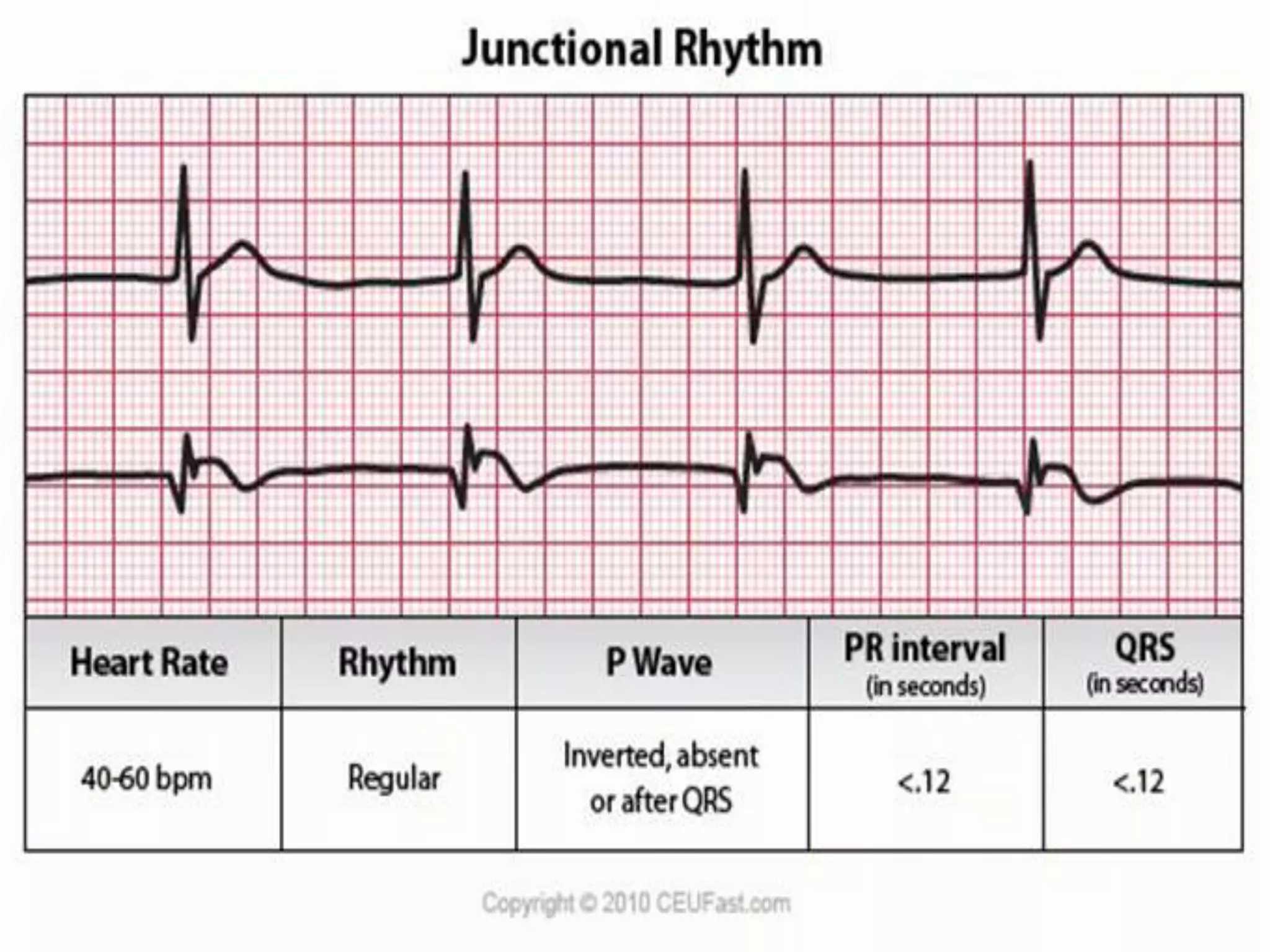
 Junctional rhythm describes an abnormal heart rhythm
resulting from impulses coming from a locus of tissue in the
area of the atrio-ventricular node; the "junction" between
atria and ventricles
 If the SA node fails to fire & an impulse is not initiated in
other ectopic sites in the atria, the AV junction is the next
pacemaker for the heart
Cont…
During junctional rhythms, cardiac output decreases because
there is no atrial kick to the ventricles
 2 major types of dysrhythmias arise in the AV junction:
• Disturbances in automaticity, with the AV junctional tissue
assuming the role of the pacemaker
• Disturbances in conduction, with the AV junction blocking
impulses journeying from the atria to the ventricles
In this case, the PR interval shortens to less than 0.12
second
Disturbances in automaticity
Premature Junctional Contractions:
Also called atrio-ventricular junctional premature
complexes or junctional extra systole
A PJC is the single, early firing of a junctional ectopic
focus
Clients are usually asymptomatic & no interventions
required
Paroxysmal Junctional Tachycardia
• A junctional rhythm with a rate that exceeds 60 beats/min
is called a junctional tachycardia
• Usually stops and starts abruptly
• Rate is between 140-220 beats/min
 Causes may be metabolic imbalances, increased
sympathetic stimulation, Digitalis toxicity, Acute coronary
syndrome
Disturbances in impulse conduction
 FIRST DEGREE ATRIO-VENTRICULAR BLOCK: a delay in passage
of the impulse from atria to ventricles creating a prolonged P-R
interval is greater than normal 0.20 seconds
 The rhythm is regular and each P wave is followed by a QRS
complex & the P-R interval usually remain constant
(this characteristic is an important differentiation between AV
blocks)
 Causes: Atrial septal defect, right atrial enlargement
 SECOND DEGREE ATRIOVENTRICULAR BLOCK:
Some impulses are conducted and others are blocked
Results in intermittently dropped QRS complex
Atrial depolarization continues producing normal appearing P
waves at regular intervals
Causes: CAD, rheumatic fever, viral infections, inferior wall MI
Can be divided into 2 additional types:
Mobitz type1 & mobitz type2
Type 1 (Mobitz I/Wenckebach)
An abnormally long refractory period at the AV node, this
delay causes the P-R interval to progressively lengthen until
the P wave fails to conduct to the ventricles & a QRS
complex is dropped
As the P-R interval lengthens, the R-R interval becomes
shorter
Carries a better prognosis compared to type II
Type 2 (Mobitz II/Hay)
Occurs when a P wave is not conducted, resulting in a
dropped QRS complex
Here P-R interval remains constant without prolongation
P waves are normal and are followed by normal QRS
complexes at regular intervals until suddenly a QRS
complex is dropped
Causes: ischaemia, MI, drug toxicity, congenital valvular
heart disease, hyperkalemia
Third degree atrio-ventricular block
Also known as complete heart block, is a condition in which
the impulse generated in the sinoatrial node (SA node) in
the atrium of the heart does not propagate to
the ventricles
Sometimes called a AV dissociation because upper & lower
chambers on the heart are working independently
Ventricular rate is typically 40-60 beats/mins
Cont…
Causes:
MI
Congenital anomalies
Myocarditis
Trauma
Cardiomyopathy
Lyme disease
Intraventricular impulse conduction
abnormalities
Bundle-branch block: Indicates that conduction is impaired
in one of the bundle branches (distal to bundle of his) &
thus the ventricles don’t depolarize simultaneously
Abnormal conduction causes a wide (greater than 0.20 sec)
or notched QRS complex
Causes: MI, CAD, cardiomyopathy, myocardial fibrosis,
pulmonary embolism
Cont…
Bundle branch block can be of 2 types.
Left bundle branch block:
The QRS complex in V1 is described as rS or QS
Carries a worse prognosis
Composed of anterior and posterior fascicles & one or
both fascicles may be involved
No specific intervention
Right bundle branch block:
• The QRS complex is described as rsR
• Exists along with block in one of the fascicles of the
left bundle, the one remaining fascicle represents
the only conduction pathway to the ventricles
• A pacemaker is required
VENTRICULAR ARRHYTHMIAS
Disturbances in automaticity:
Premature Ventricular Complexes (PVCs): Originate from an
irritable focus in the ventricular conduction system or muscle
tissue.
Cont…
Causes:
 Myocardial hypoxia
 Hypokalemia
 Hypocalcemia
 Acidosis
 Heart failure
 Intracardiac catheters
Ventricular fibrillation
Most serious cardiac rhythm disturbance. The lower
chambers quiver and the heart can't pump any blood,
causing cardiac arrest
The heart's lower chambers contract in a rapid,
unsynchronized way. (The ventricles "fibrillate" rather than
beat.) The heart pumps little or no blood
 Causes: Cardiomyopathy, Problems with the aorta, Drug
toxicity, Sepsis
Long Q-T syndrome
Produces episodic tachydysrhythmias including torsades de
pointes, which may eventually lead to ventricular fibrillation
Pre-excitation syndromes
 Accessory connections between the atrium and ventricle
are the result of anomalous embryonic development of
myocardial tissue bridging the fibrous tissues that separate
the two chambers.
 The tissue allows for electrical conduction between atria
and ventricles at sites other than the atrio-ventricular node
Wolf Parkinson White Syndrome (WPW):
WPW is caused by the presence of an abnormal accessory
electrical conduction pathway between the atria and
the ventricles
Electrical Signals through abnormal pathway stimulate the
ventricles to contract prematurely
A unique type of supraventricular tachycardia referred to as
an ”atrioventricular reciprocating tachycardia”
Disturbances in conduction
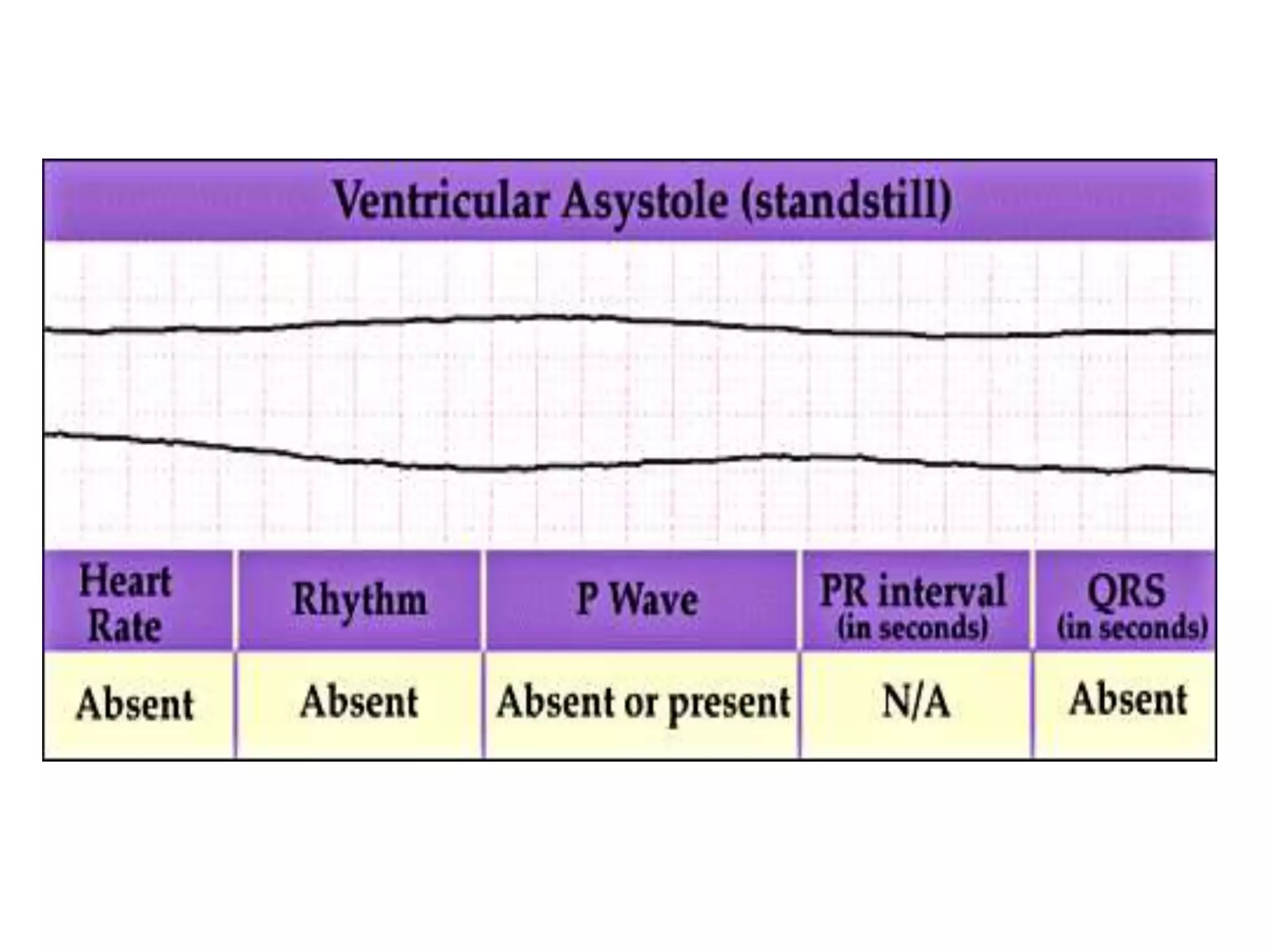
Ventricular asystole:
 Ventricular asystole or cardiac standstill represents the total
absence of ventricular electrical activity
 The client has no palpable pulse and a rhythm is absent if the
client is monitored
 Ventricular systole can occur as a primary event, or it may
follow VF or pulseless electrical activity
 Asystole can also occur in patients with complete heart block
in whom there is no escape without pacemaker
Cont…
Causes:
 Hypoxia
 Hyperkalemia & hypokalemia
 Pre-existing acidosis
 Drug overdose
 Hypothermia
Pulseless electrical activity
 A clinical condition characterized by unresponsiveness and lack
of palpable pulse in the presence of organized cardiac electrical
activity
 Pulseless electrical activity has previously been referred to as
electromechanical dissociation (EMD)
 The absence of peripheral pulses should not be equated with
PEA, as it may be due to severe peripheral vascular disease
Sudden cardiac death
 Defined as death resulting from abrupt loss of heart
function(cardiac arrest)
 The time & mode of death are unexpected, and death
occurs within minutes after the manifestations appear
 More than 163,000 deaths occur annually because of
sudden cardiac death
MANAGEMENT OF DYSRHYTHMIAS
PHARMACOTHERAPY:
Sodium Channel Blockers
• Procainamide
• Quinidine
• Disopyramide
 Effects on cardiac activity
Decrease automaticity
CONT…
 Uses:
• Acute : Ventricular tachycardia and fibrillation
(esp. during ischemia)
• Not used in atrial arrhythmias or AV junctional
arrhythmias
BETA-ADRENOCEPTOR-BLOCKING DRUGS
• Propranolol
• Acebutolol
• Esmolol
Cardiac effects:
• Increase APD and refractory period in AV node to
slow AV conduction velocity
Cont…
 Uses:
Treating sinus and catecholamine dependent tachy-
arrhythmias
Converting re-entrant arrhythmias in AV
Protecting the ventricles from high atrial rates (slow
AV conduction)
ANTI-ARRHYTHMIC AGENTS
• Amiodarone
• Sotalol
• Ibutilide
• Dofetilide
Cardiac effects:
• Increase refractory period and  APD (K+)
• Decrease conduction (Na+)
• Decrease speed of AV conduction
 Uses: Very wide spectrum: effective for most arrhythmias
CALCIUM CHANNEL-BLOCKING DRUGS
• Verapamil
• Diltiazem
Cardiac effects:
• Slow conduction through AV (Ca++)
• Increase refractory period in AV node
 Uses:
• Control ventricles during supraventricular tachycardia
• Convert supraventricular tachycardia (re-entry around AV)
DEFIBRILLATION
• Defibrillation is a treatment for life-threatening cardiac
dysrhythmias, specifically ventricular fibrillation (VF)
and non-perfusing ventricular tachycardia (VT)
• Electrical intervention can:
 Abruptly stop the heart’s erratic electrical discharge
 Restore the flow of electrical current where there is none
CONT…
Defibrillation is a process in which an electrical device
called a defibrillator sends an electric shock to the heart to
stop an arrhythmia resulting in the return of a productive
heart rhythm.
This current causes the entire myocardium to
depolarize completely at the moment of shock.
Indication
• Defibrillation is indicated only in certain types of cardiac
dysrhythmias, specifically ventricular fibrillation (VF) and pulseless
ventricular tachycardia
Contraindication
• If the heart has completely stopped, as in asystole or pulseless
electrical activity (PEA), defibrillation is not indicated
• Defibrillation is also not indicated if the patient is conscious or has a
pulse. Improperly given electrical shocks can cause dangerous
dysrhythmias, such as ventricular fibrillation
PROCEDURE
Defibrillators deliver a brief electric shock to the heart, which enables the heart's
natural pacemaker to regain control and establish a productive heart rhythm
The defibrillator is an electronic device that includes defibrillator paddles and
electrocardiogram monitoring
During external defibrillation, the paddles are placed on the patient's chest with a
conducting gel ensuring good contact with the skin
When the heart can be visualized directly, during thoracic surgery, sterile internal
paddles are applied directly to the heart
Defibrillation continues until the patient's condition stabilizes or the
procedure is ordered to be discontinued.
Care before defibrillation:
If the client is not responsive, call for immediate assistance
Call for the defibrillator and crash cart
Assess the client’s airway, breathing and circulation
Open airway: look, listen and feel
If the client is not breathing, give 2 slow breaths
Assess the client’s circulation, if no pulse present, start CPR
Perform CPR until defibrillator in place
Check ECG to verify the presence of VF or pulseless VT
Remove any nitroglycerin patch
Care after defibrillation:
After defibrillation, the patient's cardiac status, breathing, and
vital signs are monitored with a cardiac monitor
Additional tests to measure cardiac damage will be performed,
which can include a 12 lead electrocardiogram, a chest x-ray,
and cardiac catheterization
Treatment options will be determined from the outcome of
these procedures. The patient's skin is cleansed to remove gel
and, if necessary, electrical burns are treated
ABLATION CONDUCTION
Variety of procedures can be used when medications
are not successful in bringing about conversion of the
abnormal rhythm
Interventions include:
1. Chemical and mechanical ablation
2. Radiofrequency ablation of the abnormal
pathway
CHEMICAL ABLATION
Alcohol or phenol is inserted into the involved areas of the
myocardium through an angioplasty catheter leading to
myocardial necrosis
Alcohol septal ablation is a technique designed to reduce
the obstruction to blood being ejected from the heart. The
technique creates a small controlled heart attack, killing the
area of heart muscle responsible for the obstruction, and
eventually causing it to become less thick.
MECHANICAL ABLATION
The abnormal pathway is surgically removed or treated
with a cryoprobe to interrupt its effect on heart rhythms
SVT, atrial fibrillation, atrial flutter, WPW syndrome are
treated with this method
The procedure can be performed with open-heart or
closed-heart methods
Its purpose is to remove skin spots, aged skin, wrinkles,
thus rejuvenating it
CRYOPROBE
RADIOFREQUENCY ABLATION
RFA is used primarily for SVT associated with WPW or AV
nodal entry, also used to treat VT
Pacing catheter directs low-power, high frequency current
to a localized accessory pathway & necroses a small portion
of myocardium
The temperature of the contact tissue rises, water is driven
out, and coagulation necrosis results
Cont…
The amount of tissue injury depends on the amount
of energy delivered (5 to 50 W), the length of time
it is delivered(10-90 secs)
Major advantage of RFA is high rate of success,
especially with SVT, and low morbidity
SURGICAL MANAGEMENT
Automatic implantable cardioverter-defibrillator: The
automatic implantable cardioverter-defibrillator (AICD) is a
device designed to monitor the heartbeat.
 This device can deliver an electrical impulse or shock to the
heart when it senses a life threatening change in the
heart’s rhythm. Like a pacemaker, the AICD is small enough
to be implanted under the skin in the upper chest.
The AICD system consists of:
A pulse generator that can send an electrical impulse or
shock to the heart
Electrodes that sense the rhythm of the heart and deliver a
shock to the heart muscle
Batteries designed to last 4 to 5 years and deliver about
100 shocks
A small computer chip that tells the AICD when to deliver a
shock
Uses
The indications for an AICD are:
People whose heart suddenly stops
People who have had documented excessive rapid
heartbeats (ventricular tachycardia)
Or patients who are at risk for the above rhythm problems
due to: A poor or inadequate blood flow to the heart, A
severe heart attack (MI), An enlarged heart
(cardiomyopathy) or related conditions like congestive
heart failure
Pacemakers
• A pacemaker (or artificial pacemaker) is a medical device which uses
electrical impulses, delivered by electrodes contracting the heart
muscles, to regulate the beating of the heart
Types
Implantable pulse generators with endocardial or myocardial
electrodes for long-term or permanent use( permenant pacemakers)
External, miniaturized, transistorized, patient portable, battery-
powered, pulse generators with exteriorized electrodes for
temporary transvenous endocardial or transthoracic myocardial
pacing. (temporary pacemakers)
THE MACHINE:
Modern pacemakers have two parts. One part, called the pulse
generator, contains the battery and the electronics that control your
heartbeat. The other part is one or more leads to send electrical signals
to your heart. Leads are small wires that run from the pulse generator to
your heart. Pacemakers generally treat two types of arrhythmias:
tachycardia, a heartbeat that’s too fast, bradycardia, a heartbeat that’s
too slow.
INDICATIONS
• Sinus node dysfunction
• Acquired atrio-ventricular block in adults
• Chronic bifascicular block
• After acute myocardial infarction
• Hypersensitive carotid sinus syndrome and neuro-
cardiogenic syncope
• After cardiac transplantation
• Pacing to prevent tachycardia
• Patients with congenital heart disease
COMPLICATIONS
An allergic reaction to anesthesia
Bleeding
Bruising
Damaged nerves or blood vessels
An infection at the site of the incision
A collapsed lung, which is rare
A punctured heart, which is also rare
Client with permanent Pacemaker
should be taught:
Measure the pulse rate as instructed by the physician in
wrist or on neck
Notify physician if pulse rate is slower
Avoid being near areas with high voltage, magnetic force
fields, or radiation
Avoid being near large running motors(gas or electric) and
standing near high-tension wires, power plants, radio
transmitters, large industrial areas etc
Dysrhythmias

Dysrhythmias

  • 1.
  • 2.
    ATRIOVENRICULAR JUNCTIONAL DYSRHYTHMIAS  Junctionalrhythm describes an abnormal heart rhythm resulting from impulses coming from a locus of tissue in the area of the atrio-ventricular node; the "junction" between atria and ventricles  If the SA node fails to fire & an impulse is not initiated in other ectopic sites in the atria, the AV junction is the next pacemaker for the heart
  • 4.
    Cont… During junctional rhythms,cardiac output decreases because there is no atrial kick to the ventricles  2 major types of dysrhythmias arise in the AV junction: • Disturbances in automaticity, with the AV junctional tissue assuming the role of the pacemaker • Disturbances in conduction, with the AV junction blocking impulses journeying from the atria to the ventricles In this case, the PR interval shortens to less than 0.12 second
  • 5.
    Disturbances in automaticity PrematureJunctional Contractions: Also called atrio-ventricular junctional premature complexes or junctional extra systole A PJC is the single, early firing of a junctional ectopic focus Clients are usually asymptomatic & no interventions required
  • 7.
    Paroxysmal Junctional Tachycardia •A junctional rhythm with a rate that exceeds 60 beats/min is called a junctional tachycardia • Usually stops and starts abruptly • Rate is between 140-220 beats/min  Causes may be metabolic imbalances, increased sympathetic stimulation, Digitalis toxicity, Acute coronary syndrome
  • 8.
    Disturbances in impulseconduction  FIRST DEGREE ATRIO-VENTRICULAR BLOCK: a delay in passage of the impulse from atria to ventricles creating a prolonged P-R interval is greater than normal 0.20 seconds  The rhythm is regular and each P wave is followed by a QRS complex & the P-R interval usually remain constant (this characteristic is an important differentiation between AV blocks)  Causes: Atrial septal defect, right atrial enlargement
  • 10.
     SECOND DEGREEATRIOVENTRICULAR BLOCK: Some impulses are conducted and others are blocked Results in intermittently dropped QRS complex Atrial depolarization continues producing normal appearing P waves at regular intervals Causes: CAD, rheumatic fever, viral infections, inferior wall MI Can be divided into 2 additional types: Mobitz type1 & mobitz type2
  • 11.
    Type 1 (MobitzI/Wenckebach) An abnormally long refractory period at the AV node, this delay causes the P-R interval to progressively lengthen until the P wave fails to conduct to the ventricles & a QRS complex is dropped As the P-R interval lengthens, the R-R interval becomes shorter Carries a better prognosis compared to type II
  • 13.
    Type 2 (MobitzII/Hay) Occurs when a P wave is not conducted, resulting in a dropped QRS complex Here P-R interval remains constant without prolongation P waves are normal and are followed by normal QRS complexes at regular intervals until suddenly a QRS complex is dropped Causes: ischaemia, MI, drug toxicity, congenital valvular heart disease, hyperkalemia
  • 14.
    Third degree atrio-ventricularblock Also known as complete heart block, is a condition in which the impulse generated in the sinoatrial node (SA node) in the atrium of the heart does not propagate to the ventricles Sometimes called a AV dissociation because upper & lower chambers on the heart are working independently Ventricular rate is typically 40-60 beats/mins
  • 17.
  • 18.
    Intraventricular impulse conduction abnormalities Bundle-branchblock: Indicates that conduction is impaired in one of the bundle branches (distal to bundle of his) & thus the ventricles don’t depolarize simultaneously Abnormal conduction causes a wide (greater than 0.20 sec) or notched QRS complex Causes: MI, CAD, cardiomyopathy, myocardial fibrosis, pulmonary embolism
  • 19.
    Cont… Bundle branch blockcan be of 2 types. Left bundle branch block: The QRS complex in V1 is described as rS or QS Carries a worse prognosis Composed of anterior and posterior fascicles & one or both fascicles may be involved No specific intervention
  • 21.
    Right bundle branchblock: • The QRS complex is described as rsR • Exists along with block in one of the fascicles of the left bundle, the one remaining fascicle represents the only conduction pathway to the ventricles • A pacemaker is required
  • 23.
    VENTRICULAR ARRHYTHMIAS Disturbances inautomaticity: Premature Ventricular Complexes (PVCs): Originate from an irritable focus in the ventricular conduction system or muscle tissue.
  • 25.
    Cont… Causes:  Myocardial hypoxia Hypokalemia  Hypocalcemia  Acidosis  Heart failure  Intracardiac catheters
  • 26.
    Ventricular fibrillation Most seriouscardiac rhythm disturbance. The lower chambers quiver and the heart can't pump any blood, causing cardiac arrest The heart's lower chambers contract in a rapid, unsynchronized way. (The ventricles "fibrillate" rather than beat.) The heart pumps little or no blood  Causes: Cardiomyopathy, Problems with the aorta, Drug toxicity, Sepsis
  • 28.
    Long Q-T syndrome Producesepisodic tachydysrhythmias including torsades de pointes, which may eventually lead to ventricular fibrillation
  • 29.
    Pre-excitation syndromes  Accessoryconnections between the atrium and ventricle are the result of anomalous embryonic development of myocardial tissue bridging the fibrous tissues that separate the two chambers.  The tissue allows for electrical conduction between atria and ventricles at sites other than the atrio-ventricular node
  • 30.
    Wolf Parkinson WhiteSyndrome (WPW): WPW is caused by the presence of an abnormal accessory electrical conduction pathway between the atria and the ventricles Electrical Signals through abnormal pathway stimulate the ventricles to contract prematurely A unique type of supraventricular tachycardia referred to as an ”atrioventricular reciprocating tachycardia”
  • 31.
    Disturbances in conduction Ventricularasystole:  Ventricular asystole or cardiac standstill represents the total absence of ventricular electrical activity  The client has no palpable pulse and a rhythm is absent if the client is monitored  Ventricular systole can occur as a primary event, or it may follow VF or pulseless electrical activity  Asystole can also occur in patients with complete heart block in whom there is no escape without pacemaker
  • 33.
    Cont… Causes:  Hypoxia  Hyperkalemia& hypokalemia  Pre-existing acidosis  Drug overdose  Hypothermia
  • 34.
    Pulseless electrical activity A clinical condition characterized by unresponsiveness and lack of palpable pulse in the presence of organized cardiac electrical activity  Pulseless electrical activity has previously been referred to as electromechanical dissociation (EMD)  The absence of peripheral pulses should not be equated with PEA, as it may be due to severe peripheral vascular disease
  • 36.
    Sudden cardiac death Defined as death resulting from abrupt loss of heart function(cardiac arrest)  The time & mode of death are unexpected, and death occurs within minutes after the manifestations appear  More than 163,000 deaths occur annually because of sudden cardiac death
  • 37.
    MANAGEMENT OF DYSRHYTHMIAS PHARMACOTHERAPY: SodiumChannel Blockers • Procainamide • Quinidine • Disopyramide  Effects on cardiac activity Decrease automaticity
  • 38.
    CONT…  Uses: • Acute: Ventricular tachycardia and fibrillation (esp. during ischemia) • Not used in atrial arrhythmias or AV junctional arrhythmias
  • 39.
    BETA-ADRENOCEPTOR-BLOCKING DRUGS • Propranolol •Acebutolol • Esmolol Cardiac effects: • Increase APD and refractory period in AV node to slow AV conduction velocity
  • 40.
    Cont…  Uses: Treating sinusand catecholamine dependent tachy- arrhythmias Converting re-entrant arrhythmias in AV Protecting the ventricles from high atrial rates (slow AV conduction)
  • 41.
    ANTI-ARRHYTHMIC AGENTS • Amiodarone •Sotalol • Ibutilide • Dofetilide Cardiac effects: • Increase refractory period and  APD (K+) • Decrease conduction (Na+) • Decrease speed of AV conduction  Uses: Very wide spectrum: effective for most arrhythmias
  • 42.
    CALCIUM CHANNEL-BLOCKING DRUGS •Verapamil • Diltiazem Cardiac effects: • Slow conduction through AV (Ca++) • Increase refractory period in AV node  Uses: • Control ventricles during supraventricular tachycardia • Convert supraventricular tachycardia (re-entry around AV)
  • 43.
    DEFIBRILLATION • Defibrillation isa treatment for life-threatening cardiac dysrhythmias, specifically ventricular fibrillation (VF) and non-perfusing ventricular tachycardia (VT) • Electrical intervention can:  Abruptly stop the heart’s erratic electrical discharge  Restore the flow of electrical current where there is none
  • 44.
    CONT… Defibrillation is aprocess in which an electrical device called a defibrillator sends an electric shock to the heart to stop an arrhythmia resulting in the return of a productive heart rhythm. This current causes the entire myocardium to depolarize completely at the moment of shock.
  • 45.
    Indication • Defibrillation isindicated only in certain types of cardiac dysrhythmias, specifically ventricular fibrillation (VF) and pulseless ventricular tachycardia Contraindication • If the heart has completely stopped, as in asystole or pulseless electrical activity (PEA), defibrillation is not indicated • Defibrillation is also not indicated if the patient is conscious or has a pulse. Improperly given electrical shocks can cause dangerous dysrhythmias, such as ventricular fibrillation
  • 46.
    PROCEDURE Defibrillators deliver abrief electric shock to the heart, which enables the heart's natural pacemaker to regain control and establish a productive heart rhythm The defibrillator is an electronic device that includes defibrillator paddles and electrocardiogram monitoring During external defibrillation, the paddles are placed on the patient's chest with a conducting gel ensuring good contact with the skin When the heart can be visualized directly, during thoracic surgery, sterile internal paddles are applied directly to the heart Defibrillation continues until the patient's condition stabilizes or the procedure is ordered to be discontinued.
  • 48.
    Care before defibrillation: Ifthe client is not responsive, call for immediate assistance Call for the defibrillator and crash cart Assess the client’s airway, breathing and circulation Open airway: look, listen and feel If the client is not breathing, give 2 slow breaths Assess the client’s circulation, if no pulse present, start CPR Perform CPR until defibrillator in place Check ECG to verify the presence of VF or pulseless VT Remove any nitroglycerin patch
  • 49.
    Care after defibrillation: Afterdefibrillation, the patient's cardiac status, breathing, and vital signs are monitored with a cardiac monitor Additional tests to measure cardiac damage will be performed, which can include a 12 lead electrocardiogram, a chest x-ray, and cardiac catheterization Treatment options will be determined from the outcome of these procedures. The patient's skin is cleansed to remove gel and, if necessary, electrical burns are treated
  • 50.
    ABLATION CONDUCTION Variety ofprocedures can be used when medications are not successful in bringing about conversion of the abnormal rhythm Interventions include: 1. Chemical and mechanical ablation 2. Radiofrequency ablation of the abnormal pathway
  • 51.
    CHEMICAL ABLATION Alcohol orphenol is inserted into the involved areas of the myocardium through an angioplasty catheter leading to myocardial necrosis Alcohol septal ablation is a technique designed to reduce the obstruction to blood being ejected from the heart. The technique creates a small controlled heart attack, killing the area of heart muscle responsible for the obstruction, and eventually causing it to become less thick.
  • 52.
    MECHANICAL ABLATION The abnormalpathway is surgically removed or treated with a cryoprobe to interrupt its effect on heart rhythms SVT, atrial fibrillation, atrial flutter, WPW syndrome are treated with this method The procedure can be performed with open-heart or closed-heart methods Its purpose is to remove skin spots, aged skin, wrinkles, thus rejuvenating it
  • 53.
  • 54.
    RADIOFREQUENCY ABLATION RFA isused primarily for SVT associated with WPW or AV nodal entry, also used to treat VT Pacing catheter directs low-power, high frequency current to a localized accessory pathway & necroses a small portion of myocardium The temperature of the contact tissue rises, water is driven out, and coagulation necrosis results
  • 55.
    Cont… The amount oftissue injury depends on the amount of energy delivered (5 to 50 W), the length of time it is delivered(10-90 secs) Major advantage of RFA is high rate of success, especially with SVT, and low morbidity
  • 57.
    SURGICAL MANAGEMENT Automatic implantablecardioverter-defibrillator: The automatic implantable cardioverter-defibrillator (AICD) is a device designed to monitor the heartbeat.  This device can deliver an electrical impulse or shock to the heart when it senses a life threatening change in the heart’s rhythm. Like a pacemaker, the AICD is small enough to be implanted under the skin in the upper chest.
  • 59.
    The AICD systemconsists of: A pulse generator that can send an electrical impulse or shock to the heart Electrodes that sense the rhythm of the heart and deliver a shock to the heart muscle Batteries designed to last 4 to 5 years and deliver about 100 shocks A small computer chip that tells the AICD when to deliver a shock
  • 60.
    Uses The indications foran AICD are: People whose heart suddenly stops People who have had documented excessive rapid heartbeats (ventricular tachycardia) Or patients who are at risk for the above rhythm problems due to: A poor or inadequate blood flow to the heart, A severe heart attack (MI), An enlarged heart (cardiomyopathy) or related conditions like congestive heart failure
  • 61.
    Pacemakers • A pacemaker(or artificial pacemaker) is a medical device which uses electrical impulses, delivered by electrodes contracting the heart muscles, to regulate the beating of the heart Types Implantable pulse generators with endocardial or myocardial electrodes for long-term or permanent use( permenant pacemakers) External, miniaturized, transistorized, patient portable, battery- powered, pulse generators with exteriorized electrodes for temporary transvenous endocardial or transthoracic myocardial pacing. (temporary pacemakers)
  • 64.
    THE MACHINE: Modern pacemakershave two parts. One part, called the pulse generator, contains the battery and the electronics that control your heartbeat. The other part is one or more leads to send electrical signals to your heart. Leads are small wires that run from the pulse generator to your heart. Pacemakers generally treat two types of arrhythmias: tachycardia, a heartbeat that’s too fast, bradycardia, a heartbeat that’s too slow.
  • 65.
    INDICATIONS • Sinus nodedysfunction • Acquired atrio-ventricular block in adults • Chronic bifascicular block • After acute myocardial infarction • Hypersensitive carotid sinus syndrome and neuro- cardiogenic syncope • After cardiac transplantation • Pacing to prevent tachycardia • Patients with congenital heart disease
  • 66.
    COMPLICATIONS An allergic reactionto anesthesia Bleeding Bruising Damaged nerves or blood vessels An infection at the site of the incision A collapsed lung, which is rare A punctured heart, which is also rare
  • 67.
    Client with permanentPacemaker should be taught: Measure the pulse rate as instructed by the physician in wrist or on neck Notify physician if pulse rate is slower Avoid being near areas with high voltage, magnetic force fields, or radiation Avoid being near large running motors(gas or electric) and standing near high-tension wires, power plants, radio transmitters, large industrial areas etc